223 | P a g e
FACE DETECTION AND RECOGNITION USING
MORPHOLOGICAL SHARED-WEIGHT NEURAL
NETWORK
Miss.Triveni K. Patil
1, Prof. Balasaheb T. Salokhe
21
Master of Electronics, Department of Electronics Tatyasaheb Kore Institute of Engineering &
Technology, Warananagar, M.S., (India)
2
Asso. Prof. Department of Electronics, Tatyasaheb Kore Institute of Engineering& Technology,
Warananaga, M.S., (India)
ABSTRACT
An algorithm based on the morphological shared-weight neural network is introduced here. Being nonlinear
and translation-invariant, the MSNN can be used to create better generalization during face recognition. As
electronic recording system generates securities in many sectors with the help of biological parameters present
in human body like face, Finger, Hand etc. In this project MATLAB based algorithm is implemented for human
face recognition system using two biological parameters first method includes detection and recognition using
whole face while other method includes eye level based detection and Recognition.
Keywords—
Face Recognition, Hidden Layer, Neural Networks, Morphological Operations,
Structuring Element.
I. INTRODUCTION
Face detection and localization is usually the first step in many biometric applications like, face recognition,
video surveillance, human computer interface etc. Face detection‟s research has rapidly expanded by engineers
and also neuroscientists, since it has found that it have many applications in computer vision communication
and automatic access control system. Biometric-based technologies include identification based on
physiological characteristics (such as face, fingerprints, finger geometry, hand geometry, hand veins, palm,iris,
retina, ear and voice) and behavioral traits (such as gait, signature and eye stroke dynamics). Face recognition
appears to offer several advantages over other biometric methods, a few of which are outlined here: Almost all
these technologies require some voluntary action by the user, i.e., the user needs to place his hand on a hand-rest
for fingerprinting or hand geometry detection and has to stand in a fixed position in front of a camera for iris or
retina identification. However, face recognition can be done passively without any explicit action or
participation on the part of the user since face images can be acquired from
a distance by a camera.
This isparticularly beneficial for security and surveillance purposes. The system we are describing here uses a
shared-weight morphological neural network (MSNN) in its face detection phase [2]. MSNNs have been used in many
224 | P a g e
robust enough to handle some variation in target size and/or orientation. The main characteristics of neural
networks are that they have the ability to learn complex nonlinear input-output relationships, use sequential
training procedures, and adapt themselves to the data.
II. NEURAL NETWORK
Neural network [6] techniques are powerful tools that prove their efficiency in real-world applications, where
problems are badly defined or difficult to formalize. Some applications, especially those involving images,
require a huge number of operations and an enormous reduction of the dataflow from input to output data. For
sorting objects by vision or image analysis, for example, inputs are images at video rate; outputs are correcting
values, names of objects, or locations of specific objects. The main characteristics of neural networks are that
they have the ability to learn complex nonlinear input-output relationships, use sequential training procedures,
and adapt themselves to the data. The most commonly used family of neural networks for pattern classification
tasks is the feed-forward network, which includes multilayer perceptron networks. Another popular network is
the Self-Organizing Map (SOM), or Kohonen-Network, which is mainly used for data clustering and feature
mapping. The learning process involves updating network architecture and connection weights so that a network
can efficiently perform a specific classification/clustering task. A neural network is a massively parallel
distributed processor that has a natural prosperity for storing experimental knowledge. It resembles the brain in
two respects: [7]
i. Knowledge is acquired by the network through a learning process;
ii. Inter-connected connection strengths known as synaptic weights are used to store the knowledge; each neuron
has an internal state called its threshold or activation function (or transfer function) used for classifying vectors.
Neural classification generally comprises of four steps
:
i. Pre-processing, e.g., atmospheric correction, noise suppression, band rationing, Principal Component
Analysis, etc;
ii. Training - selection of the particular features which best describe the pattern;
iii. Decision - choice of suitable method for comparing the image patterns with the target patterns;
iv. Assessing the accuracy of the classification.
III.
SYSTEMV
DEVELOPMENT
MSNN stands for morphological shared weight neural network. This type of architecture was proposed by Won
[1]. It consists of two networks which are joined to each other. The first phase of the network is used for feature
extraction from the image and next network is used for classification. During training, input images given to the
MSNN. The feature extraction is achieved with morphological hit miss transform. Then these features are
applied to the neural network. The weights of neural network are saved. During testing, the testing image again
goes through MSNN. The output of MSNN is depending on training. During training, input images given to the
225 | P a g e
applied to the neural network. The weights of neural network are saved. During testing, the testing image again
goes through MSNN. The output of MSNN is depending on training.
Figure 1: Face Detection and Recognition System Overview
.
2.1 Neural Network Modeling
Training a network [10] is not an easy task. Each choice of any parameter will affect the other. An appropriate
choice of learning parameters should guarantee that a good quality solution is found within a reasonable period
of computing time. Generally, it is important to pay attention to a following few aspects:
a. Weight Initialization [11]
Initialization strongly affects the classifying solution. There are now many new methods of doing it using
statistics. It is necessary to reset the weights if an unsuccessful training occurs. A good convergence is also
determined by the values of weights that are initialized: that is, whether they are randomly initialized or
zero-initialized. The choice of random or zero weights for the hidden and output layers affects the network‟s
performance.
b. Weight Adaptation
Cumulative weight adjustment [11] refers to the implementation of weight adjustments at the conclusion of a
complete learning cycle. During incremental training, the weights continue to be modified as each error is
computed. If the network is capable and the learning rate is set correctly, the error will eventually be driven to
zero. In batch mode, the weights and biases of the network are updated only after the entire training set has been
applied to the network
.
c. Learning Constant
Its optimum value depends on the problem to be solved and is normally chosen experimentally (with values
ranging from 0.05 to 0.35). Only small learning rate guarantees a true smooth gradient descent. Too large a
value leads to fast convergence but poor stability. Too small a value results in slow convergence. An adaptive
226 | P a g e
d. The Hidden Layer
The best number of hidden units depends on the numbers of input and output units; the number of training examples; the complexity of the function or classification to be learned; the architecture; the type of hidden unit activation function; the training algorithm
IV. IMPLEMENTATION RESULTS
a. Training Parameters and Weight Initialization-
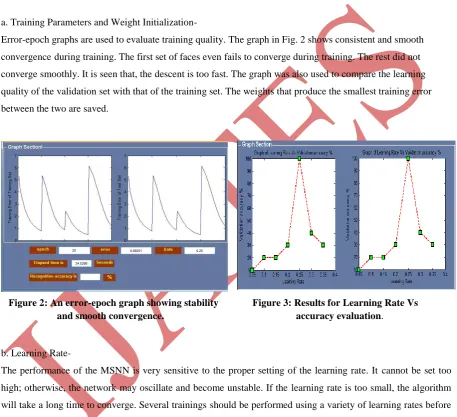
Error-epoch graphs are used to evaluate training quality. The graph in Fig. 2 shows consistent and smooth
convergenceduring training. The first set of faces even fails to converge during training. The rest did not
converge smoothly. It is seen that, the descent is too fast. The graph was also used to compare the learning
quality of the validation set with that of the training set. The weights that produce the smallest training error
between the two are saved.
Figure 2: An error-epoch graph showing stability Figure 3: Results for Learning Rate Vs
and smooth convergence. accuracy evaluation.
b. Learning Rate-
The performance of the MSNN is very sensitive to the proper setting of the learning rate. It cannot be set too
high; otherwise, the network may oscillate and become unstable. If the learning rate is too small, the algorithm
will take a long time to converge. Several trainings should be performed using a variety of learning rates before
determining the optimum η. Here experiments are conducted with learning rates ranging from 0.05 to 0.4, each
time increasing by 0.05. Recognition accuracy increases with the learning constant until it reaches full
recognition at η = 0.25, after which the performance starts to deteriorate. The recognition rate finally drops to
227 | P a g e
c. Number of Hidden Neurons-
To determine the number of hidden neurons is always a discussion topic in neural networks. In this experiment,
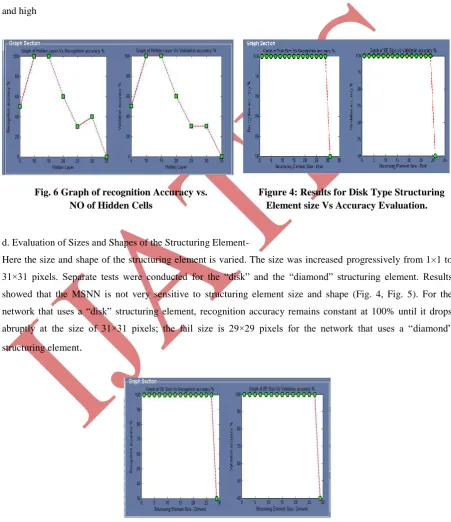
MSNN is trained with different numbers of hidden units (5 to 40) and recorded their recognition rates. For a
network with 10 to 20 hidden neurons, the recognition accuracy is 100%. Any number of hidden units beyond
20 will experience a gradual decrease in performance, eventually hitting zero recognition at 40 neurons. As the
graph in Fig. 6.24 indicates, efficiency increases as the number of neurons increases from 5 to 10; it remains
constant between 10 to 15 neurons, and drops drastically after that. Although it is true that increasing the
number of hidden neurons can extract more implicit information, an excessive number may cause over fitting
and high
Fig. 6 Graph of recognition Accuracy vs. Figure 4: Results for Disk Type Structuring NO of Hidden Cells Element size Vs Accuracy Evaluation.
d. Evaluation of Sizes and Shapes of the Structuring Element-
Here the size and shape of the structuring element is varied. The size was increased progressively from 1×1 to
31×31 pixels. Separate tests were conducted for the “disk” and the “diamond” structuring element. Results
showed that the MSNN is not very sensitive to structuring element size and shape (Fig. 4, Fig. 5). For the
network that uses a “disk” structuring element, recognition accuracy remains constant at 100% until it drops abruptly at the size of 31×31 pixels; the fail size is 29×29 pixels for the network that uses a “diamond”
structuring element
.
228 | P a g e
V. CONCLUSION
From the evaluation and analysis data it is concluded that with increased size of the structuring element
validation and recognition accuracy reduces so use small size of structuring element. From the Training time
and Test time analysis data it is concluded that with increase in size of the structuring element processing time
for training MSNN increases. Structuring element type is decided by conducting analysis for two types Disk
type and Diamond type from the analysis it is concluded that the results for disk type of structuring element
gives better validation and recognition accuracy over defined range. From the learning rate analysis result it is
concluded that validation and recognition accuracy is reach to 100 % for 0.25. Further analysis for deciding
hidden layer for MSNN is also conducted from the analysis data it is concluded that validation and recognition
accuracy reaches to 100 % between the ranges of 10 to 15 so finally above parameters are chosen for carrying
out recognition test.
REFERENCES
[1] Y. Won et. al., Morphological Shared-Weight Networks with Applications to Automatic Target
Recognition, Electronics and Telecommunications Research Institute, Daejon, South Korea, 1995.
[2] Y. Won and P. Gader Morphological Shared-Weight Neural Network for Pattern Classification and
Automatic Target Detection, University of Missouri-Columbia, 1995.
[3] D. Haun, K. Hummel, and M. Skubic, Morphological Neural Network Vision Processing for Mobile
Robots, University of Missouri-Columbia, 1997.
[4] U. Uludag and A. Jain, Biometrics, International Conference on Pattern Recognition, Department of
Computer Science and Engineering, Michigan State University, 1999.
[5] D. Samal, V.V. Starovoitov and D.V. Briliuk „‟ Image Enhancement for Face Recognition‟‟International
Conference on Iconics, 2003, St.Petersburg, Russia.
[6] G. Scott and M. Skubic, Face Recognition Using Morphological Shared-Weight Neural Networks,
University of Missouri-Columbia, 1995.
[7] Mohamed A. Khabou and Laura F. Solari “A Morphological Neural Network-Based System for Face
Detection and Recognition” IEEE 2006.
[8] L. Aryananda, Online and Unsupervised Face Recognition for Humanoid Robot: Toward Relationship
with People, A. I. Lab, MIT, 2001.
[9] Y. Lee, S. Oh, and M. Kim, The Effect of Initial Weights on Premature Saturation in Backpropagation
Learning, International Joint Conference on Neural Nets, Seattle, 1991.
[10] Y. Won, P. Gader, and P. Coffield, “Morphological Shared-Weight Neural Networks with Applications to
Automatic Target Recognition,” IEEE Transactions Neural Networks,Vol. 8, pp. 1195–1203, 1997.
[11] Y. Lee, S. Oh, and M. Kim, The Effect of Initial Weights on Premature Saturation in Backpropagation