INTERNATIONAL RESEARCH JOURNAL OF PHARMACY
www.irjponline.com
ISSN 2230 – 8407
Research Article
A COMPARATIVE STUDY OF DENIM FABRICS DEVELOPED USING RING AND
ROTOR BAMBOO/COTTON YARNS
G. Nagarajan
1*, T. Ramachandran
21
Research Scholar, Karpagam Academy of Higher Education, Coimbatore, Tamilnadu. India
2Principal (Rtd.) Karpagam Institute of Technology, Coimbatore , Tamilnadu, India
*Corresponding Author Email: [email protected]
Article Received on: 04/04/18 Approved for publication: 22/04/18
DOI: 10.7897/2230-8407.09457 ABSTRACT
In this paper, the functional properties of bamboo, cotton and bamboo/cotton blended denim fabrics have been studied. In this study, twenty denim fabric samples have been developed using ring and rotor spun yarns with different blend proportions of bamboo/cotton like 70:30, 50:50 & 30:70. The fabric samples were evaluated for their comfort and mechanical properties like air permeability, water vapour permeability rate (WVTR), Over all Moisture Management Capability (OMMC), crease recovery, tensile and tear strength. It is observed that with increase in the bamboo content in the blend improves the comfort and mechanical properties in both the ring and rotor yarn fabrics. Ring yarn fabrics exhibited better moisture management properties, water vapour transmission rate , tensile and tear strength than the rotor yarn fabrics. In contrary, rotor yarns have better air permeability, crease recovery, fabric assistance than the ring yarn fabrics. 70:30 bamboo/cotton blends have better comfort and mechanical properties than other blends
Keywords: Twill, Moisture, MVTR, Denim, OMMC, Crease recovery
INTRODUCTION
Denim fabrics are characterised by their high durability, longer washing cycles and ability to adapt to changing cultural and fashion trends in the market. It is considered a popular garment in the international market.1 Nevertheless, the increased awareness
among the customers on aesthetic and functional performance of the denim is the need of the present day market conditions.2
Further, the physiological comfort determined by important fabric properties like air permeability, moisture management properties, UV protection are influenced by various constructional parameters of the fabric, type of fibre used. These factors have a significant influence on the porosity of the woven fabric structure. Total porosity of a woven fabric is dependent upon two types, viz. micro porosity and macro porosity.3 Micro
porosity is caused by void spaces among the fibres in the yarns and macro porosity is due to the void spaces amongst the yarns. In the bamboo fibre, there is more number of micro spaces in the fibre structure, which makes the fibre meet the functional requirements of the consumers4.
Textile fabrics made of natural fibres and blends are more prone to microbial attack. The microbial growth will inflict a wide range of undesirable effects not only on the fabrics but also to the wearer. In the present changing environment, with increased awareness among the consumers about the health and hygiene, more emphasis is given to the fibres and fabrics which possess functional properties.5 Denim is a popular garment liked by all
the age groups and worn for an extended period of time. Bamboo is a relatively new regenerated fibre. It possesses inherent properties suitable for the manufacture of apparel and medical textiles. Regenerated bamboo fibre is obtained from the bamboo plant which is classified as grass. It grows quickly within three to
five years to reach the harvest conditions.6 Bamboo fibre has
distinctive characteristics like high moisture absorption capacity, softness, brightness, ultra violet (UV) protection and more importantly anti-microbial properties. This property is widely accepted in medical textiles and tried in the wound care dressings. Bamboo fibres have high moisture absorbing capacity of around 13% which ensures comfort for various end uses in textiles like sportswear and other dress materials. In such situations, growth of microbes is unavoidable. Due to the inherent anti-microbial characteristic of bamboo fibres, it is blended with other natural and manmade fibres for the manufacture of knitted and woven materials. Bamboo fabrics are characterised by their good moisture absorbing capacity, sweat absorption and release and excellent air and water vapour permeability. They are also soft and easy to dye7. Hence, the positive attributes of the bamboo
fibres have been utilised and in this research work, yarns and denim fabrics were made using bamboo- cotton blends and their comfort properties were studied and analysed keeping in mind, the growing demand among the consumers of denim fabrics with functional and aesthetic properties.
MATERIALS AND METHODS
properties like air permeability, Moisture vapour transmission
rate (MVTR) using cup method, crease recovery, overall moisture management properties (0MMC) and mechanical properties like tensile and tear strength using standard test procedures.
TEST METHODS
The property and the test methods are shown in Table 1
Table 1Property and Test method
S. No. Property Test method
1 Air permeability ASTM D 737-04(2016)
2 Water vapour transmission rate (MVTR) ASTM E 96
3 Crease recovery ASTM D - 1295
4 Over all moisture management capability (OMMC) AATCC 195 - 2009
5 Tear strength ASTM D 1424 – 09 -2013
RESULTS AND DISCUSSION
Air permeability
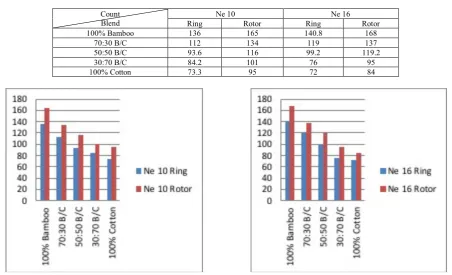
The air permeability of the fabrics made out of ring and rotor yarns is shown in Table 2
Table 2 Air permeability of fabrics
Count Blend
Ne 10 Ne 16
Ring Rotor Ring Rotor
100% Bamboo 136 165 140.8 168
70:30 B/C 112 134 119 137
50:50 B/C 93.6 116 99.2 119.2
30:70 B/C 84.2 101 76 95
100% Cotton 73.3 95 72 84
Figure 1 Air permeability of Ne 10 Ring & Rotor fabrics Figure 2 Air permeability of Ne 16 Ring & Rotor fabrics
From Table 2 & Figures 1 and 2, it is observed that the air permeability of rotor yarn fabrics have higher air permeability than the corresponding ring yarn fabrics by 12% to 20%. in both the yarn counts. The higher air permeability of the rotor yarn fabrics is attributed to the presence of wrapper fibres on its surface and also due to the floats in the twill fabric construction. Rotor yarns are characterised by its higher bulkiness and dense
Table 3Tensile strength of the Fabrics
Count Blend
Ne 10 Ring (Warp + Weft)
Ne 10 Rotor (Warp + Weft)
Ne 16 Ring (Warp + Weft)
Ne 16 Rotor (Warp + Weft)
100% Bamboo 35.39 33.12 37.15 35.66
70:30 B/C 29.56 27.76 32.37 30.42
50:50 B/C 27.32 24.58 30.26 27.83
30:70 B/C 23.46 20.64 25.70 22.61
100% Cotton 21.85 18.57 23.17 20.15
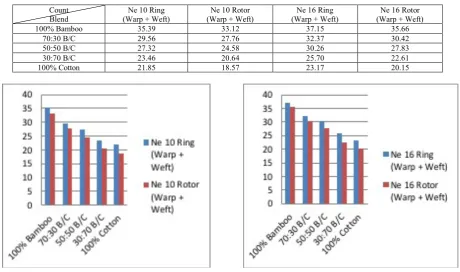
Figure 3 Tensile strength of Ne 10 Ring and Rotor Figure 4 Tensile strength of Ne 16 Ring and Rotor
Table 3 and Figures 3 & 4 show the tensile strength of the ring and rotor yarn fabrics. It is observed that the tensile strength of the rotor yarn fabrics is distinctly inferior by 5% to 15% to the ring yarn fabrics. This is mainly attributed to the lower single yarn breaking strength of the rotor yarns. With decrease in the bamboo component in the blend, the tensile strength of the fabrics is correspondingly reduced.
Fabric Assistance
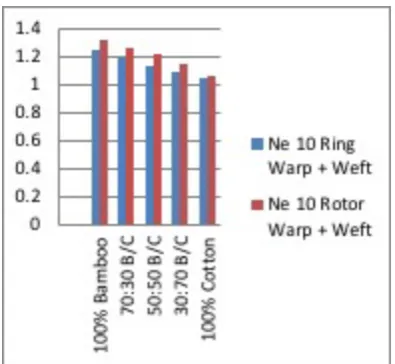
Fabric assistance is the relationship between the ratio of strip strength per yarn and single yarn strength (S/Y) used to quantify the fabric assistance property of woven fabrics. It is dependent upon the frictional forces acting between warp and weft yarns on the fabric structure, which influence the fabric strength. Fabric assistance arises due to the interlacement of warp and weft yarns and, during tensile strength testing, the fabrics act like one body than as individual threads in the free state . Fabric assistance of Ring and Rotor yarn fabrics is shown in the Table 4
Table 4 Ratio of fabric strip strength per yarn and single yarn strength
Count
Blend
Ne 10 Ring Ne 10 Rotor Ne 16 Ring Ne 16 Rotor
Warp + Weft Warp + Weft Warp + Weft Warp + Weft
100% Bamboo 1.25 1.31 1.27 1.35
70:30 B/C 1.19 1.26 1.19 1.28
50:50 B/C 1.13 1.22 1.11 1.16
30:70 B/C 1.09 1.15 1.07 1.12
Figure 5 Fabric Assistance of Ne 10 Ring & Rotor Figure 6 Fabric Assistance Ne 16 Ring & Rotor
From the results, the strength fall in rotor spinning comes down from yarn to fabric stage. However, the strength ratio improves from yarn to fabric stage. This is mainly ascribed to the better fabric assistance of the rotor yarn fabrics in relation to ring spun yarns. Fabric assistance of the rotor yarns is higher by 4% to 6% than the ring yarn fabrics in both warp and weft directions. It might be due to the non-load bearing wrapper fibres which get trapped in the fabric structure and contribute for the higher fabric assistance. This trend is observed in all the blends in both counts.
Tear Strength
The behaviour of the woven fabrics under impact load is different from that under tensile load. In tensile load, all the yarns in the direction of tension share the load, whereas in the case of tearing, only few yarns share the load. Tear strength of the fabrics in both directions is shown in Table 5
Table 5 Tear strength of the fabrics
Property
Blend
Tear Strength Ne 10
Tear Strength Ne 16
Ring Rotor Ring Rotor
Warp way
Weft way
Warp way
Weft way
Warp way
Weft way
Warp way
Weft way
100% Bamboo 5132 4315 3456 2729 5337 4633 4077 3125
70:30 B/C 4723 3915 3161 2412 5056 4212 3522 2628
50:50 B/C 4070 3281 3008 2295 4518 3588 2920 2094
30:70 B/C 3455 2645 2472 1821 3315 2518 2215 1521
Table 5 and Figures 7 & 8 show that the warp-way tear strength is always higher than the weft-way tear strength due to the lower number of picks/unit length maintained in the fabric construction. The difference being 15 % to 28 % in ring-spun fabrics and 21% to 30% in rotor spun fabrics The tear strength of 100% bamboo yarn fabrics in both the ring and rotor yarns shows higher tearing due to the inherent strength of the bamboo fibres. However, in the subsequent blends with the cotton fibres, the tear strength gradually gets decreased. It is attributed to the lower strength of the cotton fibres which cannot withstand the impact load. Among the various blend proportions, 70:30 bamboo-cotton blend shows better tear strength than its counterparts. The tear strength of the
fabrics made out of rotor- spun yarns is 20 – 27% lower than that of the fabrics made from ring-spun yarns due to the lower yarn tenacity of the rotor yarns. The weft-way tear strength is found to be distinctly lower than the warp-way tear strength. It is attributed to the difference in the number of ends and picks per inch maintained in the fabric.
Crease recovery
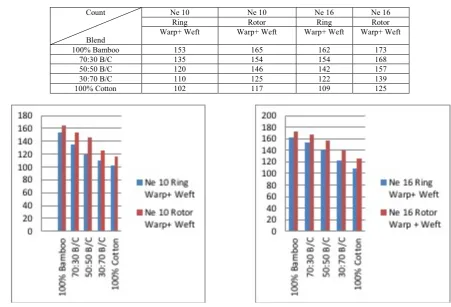
The crease recovery of the fabrics was carried out on the vertical strip method according to ASTM standard. Crease recovery of the fabrics is shown in Table 6
Table 6 Crease recovery of fabrics
Count
Blend
Ne 10 Ne 10 Ne 16 Ne 16
Ring Rotor Ring Rotor
Warp+ Weft Warp+ Weft Warp+ Weft Warp+ Weft
100% Bamboo 153 165 162 173
70:30 B/C 135 154 154 168
50:50 B/C 120 146 142 157
30:70 B/C 110 125 122 139
100% Cotton 102 117 109 125
Figure 9 Crease recovery of Ne 10 Ring & Rotor fabrics Figure 10 Crease recovery of Ne 16 Ring & Rotor fabrics
From Table 6 and Figures 9 & 10, it is observed that the crease recovery of rotor spun yarn fabrics is higher than that of the ring yarn fabrics by 7% to 15% . The higher crease recovery of rotor yarn fabrics is attributed to the higher diameter and higher bulkiness which make the fabric more resilient. Crease recovery of 100% bamboo fabrics is higher than 100% cotton and its blends. It is attributed to the smooth surface structure and lower resistance to bending and recovery of the bamboo fibers. With increase in cotton component in the blend, crease recovery decreases which is as expected due to the higher resistance offered by the cotton fibres.
Water Vapour Transmission Rate (WVTR)
The water vapour transmission of the fabric samples has been measured using the cup method according to the ASTM E 96 standard. This method is based on the evaporation time 24 h. of water contained in a cup and the water vapour permeability is determined by the weight loss. The water vapour permeability of the fabrics is shown in Table 7.
Table 7 Water vapour permeability of ring and rotor fabrics
Count
Blend Ring Ne 10 Rotor Ring Ne 16 Rotor
100% Bamboo 1558 1713 1878 2059
70:30 B/C 1496 1662 1799 1944
50:50 B/C 1389 1579 1642 1845
30:70 B/C 1368 1492 1502 1752
Figure 11 WVTR of Ne 10 Ring & Rotor fabrics Figure 12 WVTR of Ne 16 Ring & Rotor fabrics
Water Vapour Transmission Rate (WVTR) of bamboo, bamboo/cotton blended fabrics of ring and rotor yarns is shown in Table 7 and Figures 11 & 12. It is observed that fabrics made out of rotor yarns have higher water vapour transmission rate than the ring yarn fabrics by 8% to 14%. It is also seen from the fabrics that the WVP of fabrics with Ne 16 is higher than Ne 10 fabrics. It is attributed to the lower yarn diameter fabric thickness than Ne 10 fabrics. Bamboo fabrics have higher WVP than the cotton fabrics due to the presence of micro spaces and less pore size which allow the water vapour to permeate more easily into the fabric structure. However, in the blends, WVP is reduced due to the presence of cotton fibres and higher yarn diameter and fabric thickness. The WVP of rotor fabrics is less due to its higher bulkiness and yarn diameter and hence the flow rate is directly
proportional to the fabric thickness due to the higher fabric cover of the rotor fabrics.
Overall Moisture Management Capability (OMMC)
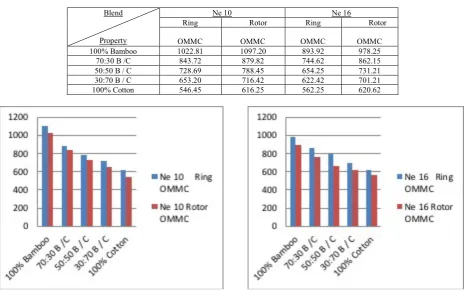
Moisture management tester (MMT) (SDL Atlas, is used for testing the liquid moisture transfer properties of the fabrics. This instrument is capable of determining the liquid transfer in multiple directions through fabrics like spreading of liquid outward to inner surface of the fabric, wetting time of top and bottom surface, absorption rate etc., and gives the result as OMMC index of the fabrics. The higher the OMMC the better the moisture transfer of the fabrics. Moisture management properties of the fabrics is shown in Table 8.
Table 8 Overall Moisture Management Capabilities (OMMC)
Blend
Property
Ne 10 Ne 16
Ring Rotor Ring Rotor
OMMC OMMC OMMC OMMC
100% Bamboo 1022.81 1097.20 893.92 978.25
70:30 B /C 843.72 879.82 744.62 862.15
50:50 B / C 728.69 788.45 654.25 731.21
30:70 B / C 653.20 716.42 622.42 701.21
From Table 8 and Figures 13 & 14, it is observed that the liquid transfer properties (OMMC) of rotor yarn fabrics Ne 16 is better than the ring yarn fabrics by 6% to 11% . It is due to the yarn diameter of the ring yarn, close packing of fibers in the yarn and also close spacing in the fabrics which takes longer time for the liquid to traverse through them. Hence wetting time (Top/ Bottom), Spreading time (Top/Bottom), Absorption rate (Top/ Bottom) are more for coarser yarns than the finer yarns. Hence, yarns of lower linear density and lower fabric thickness would result in fast liquid spreading behaviour than its coarser yarn counterparts. OMMC of bamboo fabrics is higher than the cotton fabrics due to the porous structure of the bamboo fibres and higher moisture absorbing capacity. However, OMMC of blended fabrics decreases with the decrease in bamboo fibre content due the presence of cotton fibres. On the other hand, lower OMMC of rotor yarn fabrics is attributed to its inherent yarn structure, fabric thickness and bulkiness, which takes time for wetting and spreading through the fabrics.
CONCLUSION
In this study, twenty denim fabric samples developed from bamboo/cotton blends using ring and rotor yarns are critically analysed for their comfort and mechanical properties. The tensile and tear strength of the ring yarn denim fabrics made out of bamboo fabrics and 70:30 bamboo/cotton blends are better by 5% to 15% and 15% to 25% than the rotor yarn denim fabrics. However, rotor yarn denim fabrics have more fabric assistance than the ring yarn fabrics. The air permeability of the bamboo and 70:30 bamboo/cotton blended rotor yarn denim fabrics are better by 12% to 20% due to more micro spaces present in the bamboo fibres. Rotor yarn denim fabrics have more air permeability than the ring yarn fabrics due to the higher bulk, higher diameter and open structure of rotor yarns. Crease recovery of rotor yarn denim fabrics is better by 7% to 15% than the ring yarn denim fabrics. It is due to the resilient nature and more fabric thickness of the rotor denim fabrics. Bamboo and bamboo / cotton blend of 70:30 made out of ring yarn denim fabrics have better water vapour transmission rate than the other blends, which is due to the high hygroscopic nature of the bamboo fibres. The water vapour transmission rate of the rotor yarn denim is inferior due to the fabric thickness. Moisture management properties of bamboo and 70:30 bamboo cotton blends of ring yarn denim fabrics have higher OMMC by 6 % to 11% than the rotor yarn denim fabrics. It is due to the fabric thickness and higher bulkiness, which takes more time for the moisture to spread, absorb and traverse through.
REFERENCES
1. Indra Doraiswamy, Dr. K.P. Chellamani,etal; A study on the properties of fabrics made from rotor- spun and ring -spun yarns ; Indian Journal of Fibre and Textile Research1991; 16; 137 – 139.
2. P.K. Hari & G. Sankara Narayanan. Comparison of Physical and Mechanical Properties of Ring and Rotor Yarn Fabrics; Indian Journal of Fibre and Textile Research 1984; 9; 85 – 90.
3. Yamini Jhanji, Deepti Gupta & V. K. Kothari. Moisture management and wicking properties of polyester- cotton plated knits; Indian Journal of Fibre and Textile Research.1991;42; 183 – 188.
4. Subrata Das & V.K. Kothari. Moisture vapour transmission of cotton fabrics . Indian Journal of Fibre and Textile Research. 2007;37; 151 – 156.
5. Slater. K. Progress in Textile Science and Technology Testing and Quality management; 1999; 360 – 385.
6. Sudipta S. Mahish, A.K. Patra & Rashmi Thakur. Functional properties of bamboo/polyester blended knitted apparel fabrics . Indian Journal of Fibre and Textile Research 2012; 37; 231 – 237.
7. Wiah Wardiningsih & Olga Troynikoy Influence of cover factor on liquid moisture transport performance of bamboo knitted fabrics. Journal of Textile Institute 2012;103; 89 – 98..
8. G.K.Tyagi, S. Bhattacharya & G. Kheredekar Comfort behaviour of woven bamboo-cotton ring and MJS yarn fabrics . Indian Journal of Fibre and Textile Research 2011;36; 47 – 52.
9. Abhijit Majumdar, Samrat Mukhopadyay & Ravindra Yadav. Properties of ring-spun yarns made from cotton and regenerated bamboo fibres. Indian Journal of Fibre and Textile Research. 2011; 36; 15 – 23.
10.Mansour. H., Mohammed & Peter R. Lord Comparison of Physical Properties of Fabrics woven from Open-end and Ring spun yarns. Textile Research Journal 1972;3; 154 – 164. 11.Pandurangan Senthil kumar. Moisture transfer in textile
materials. Melliand, International 2016;4; 41 – 43.
12.Mohammed Umar, Tanveer Hussain & Yasir Nawab. Effect of woven fabric structure on the air permeability and moisture management properties.Journal of Textile Institute, 2016;170;5;596 – 605.
13.Mangesh Teli, Javed Sheikb & L. Gomathi. Combined anti-bacterial and flame retardant finishing of denim using chitosan formulation. Melliand International 2013;4; 229 – 231.
14.Vinay Midha, S. Suresh Kumar & M. Nivas Kumar .Investigation on air permeability and moisture management properties of different denim fabrics after repeated laundering. Journal of Textile Institute . 2017;106; 71 – 77.
Cite this article as:
G. Nagarajan and T. Ramachandran. A comparative study of denim fabrics developed using ring and rotor bamboo/cotton
yarns. Int. Res. J. Pharm. 2018;9(4):35-41
http://dx.doi.org/10.7897/2230-8407.09457
Source of support: Nil, Conflict of interest: None Declared