345 | P a g e
PERFORMANCE AND EMISSION
CHARACTERISTICS OF CONSTANT SPEED
COMPRESSION IGNITION ENGINE OPERATING ON
RICE BRAN, SESAME AND DIESEL OIL BLEND -
REVIEW
Pradip Bhadresha
1, Harshraj Dangar
2 1P G student of Marwadi Education Foundation, Rajkot (India)
2
Asst Prof Department of Mechanical Engineering, Marwadi Education Foundation,
Rajkot (India)
ABSTRACT
In this review paper, we would like to review the use of rice bran and sesame oil as biodiesel. The main
problem behind not using rice bran and sesame as a fuel is because of high viscosity there occurs problems with
atomization and self-ignition does not takes place. But still with the help of transesterification we can reduce the
viscosity of rice bran and sesame oil.The vegetable oil used in blending is rice bran and sesame oil is blended
with diesel fuel in diesel engine & showing its effects on performance parameter and emission characteristics of
single cylinder 4 stroke diesel CI engine. The rice bran and sesame oil blended in varying proportion with
diesel fuel in the CI engine and performance parameter & emission characteristics are evaluated and compared
with diesel operation.
Keywords: Rice Bran Oil, Sesame Oil, Transesterification, Single Cylinder Four Stroke CI Engine,
Performance Parameter, Exhaust Emission.
I. INTRODUCTION
346 | P a g e
formulated, have been found suitable for utilization in diesel engine. Vegetable oils are triglycerides with a no. of branched chains of different lengths. Vegetable oil creates some problem when it is used in engine; these problems are high viscosity, low volatility & polyunsaturated character of neat vegetable oil. Some common problems arising in engine when it run by vegetable oil are coking and trumpet formation on the injectors, carbon deposits, oil ring sticking & thickening & gelling of lubricating oil as a result of contamination by the vegetables oils. Different techniques are used to reduce the viscosity & make them suitable for engine application. Second largest producer of sesame oil is India in the World. 3rdlarghest producer of sesame seeds is India but 2nd largest producer of oil just because of faulty harvesting practices associated with the seed production. Sesame being a sub continental shrub can grow anywhere in waste lands, low laying planes and region with scarcity of water.Rice is the seed of the monocot plants Oryza sativa (Asian rice) or Oryza glaberrima (Africanrice). Rice is the most important cereal cultivated in the world which fed more than half of the people of the world. Rice bran is the by-product of rice milling process. Due to the presence of active lipase and high free fatty acid, about 60-70% of rice bran oil production is non-edible. Rice can be grown practically anywhere, even on a steep hill. It contains about 16-32% oil by Weight.
Sesame (Sesamum indicum L) is an oil seed herbaceous crop of the Pedaliaceae family primarily found in tropical and subtropical areas. It is an annual plant growing 50 to 100 cm tall with opposite leaves 4-14 cm long. The flowers are yellow, tubular with four-lobed mouth. The flower may vary in colour with some being white, blue or purple. The tree is originated in Africa, Turkey, India, China, Sudan, Burma, Tunisia, Egypt, Thailand, Mexico, Guatemala, Afghanistan, Pakistan, Bangladesh and etc. The oil content is about 57-63%.
II. PROPERTIES OF RICE BRAN AND SESAME OIL
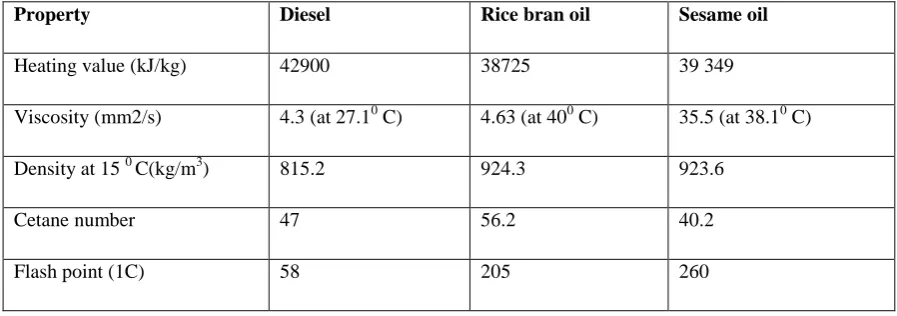
The properties of Sesame and diesel oil are shown in Table 1. Various parameters such as Heating value, Viscosity, Density, Cetane number, Flash point, sulphur and carbon residue of rice bran and sesame oil is compared the diesel which shows higher viscosity of Rice bran and sesame oil and that can be reduced by transesterification process or through blending.
Table 1: Property of diesel rice bran and sesame oil
Property Diesel Rice bran oil Sesame oil
Heating value (kJ/kg) 42900 38725 39 349
Viscosity (mm2/s) 4.3 (at 27.10 C) 4.63 (at 400 C) 35.5 (at 38.10 C)
Density at 15 0 C(kg/m3) 815.2 924.3 923.6
Cetane number 47 56.2 40.2
347 | P a g e
Sulphur (%) <0.01 0.01 0.01
Carbon residue (% by weight) <0.35 0.23 0.25
III. LITERATURE REVIEW
Bhaskor j. bora, Ujjwal k.saha et al. (Nov 2015) [1] In this paper, the research is done on using a
biodiesel-blend with diesel on compression-ignition engine with veering compression ratio 17, 17.5 and 18. Using eddy current dynamometer measure engine performance and emission.
Using Biodiesel -blend with diesel because it’s good property of high octane number, high latent heat of vaporisation, calorific value, nearest to gasoline fuel so it easy use in CI engine. Some problem are created to use blend fuel with diesel is fuel-consumption is increase because biodiesel has lower energy content. In this paper measure engine performance with using blend B5 & B10 And also measure emission at different vehicle speed and varying blend percentage.
Ramesh Krishnan, Harish Sivasubramanian, Aditya Krishna Ganeshram et al. (Sep 2016)[2] In this
paper, the research on using bio-diesel blend on four-stroke single cylinder compression-ignition engine with rice-bran, neem and cotton seed biodiesel. Now day more shortage of gasoline/petrol fuel, so now experiment to use alternative fuel in Morden vehicle with blend, And achieve more power & performance to use various biodiesel. Brake thermal efficiency increase of ND, RBME, NME and CSME AT 100% load are31.08%, 30.02%, 27.08%, 26.80 by using biodiesel. Unburnt HC and CO levels were the lowest for the RBME.Also exhaust gas temperature was higher with biodiesel blended with diesel. Using blend fuel with diesel NOx
emission were higher for the RBME.
J. Jayaprabakar, A.Karthikeyan et al. (Sep 2015) [3] in this paper, the research on using bio-diesel blend on
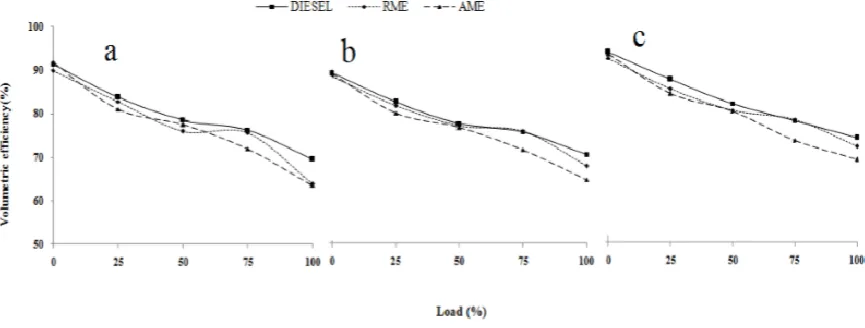
four-stroke single cylinder compression-ignition engine. Rice bran oil and algae oil biodiesel blends (B20) can be a used as fuel in Compression ignition engine with slightly advanced injection timing. Biodiesel blends consume more fuel and the volumetric efficiency values for them are slightly lesser than Diesel. The advancement in the injection timing brought better performance of the engine as well as less emission than normal and retarded two injection timings.
348 | P a g e
Fig. 1. (a) BTE vs. load at 20° BTDC; (b) BTE vs. load at 23° BTDC; (c) BTE vs. load at 26°
BTDC
Fig. 2. (a) BSFC vs. load at 20° BTDC; (b) BSFC vs. load at 23° BTDC; (c) BSFC vs. load at 26°
BTDC
349 | P a g e
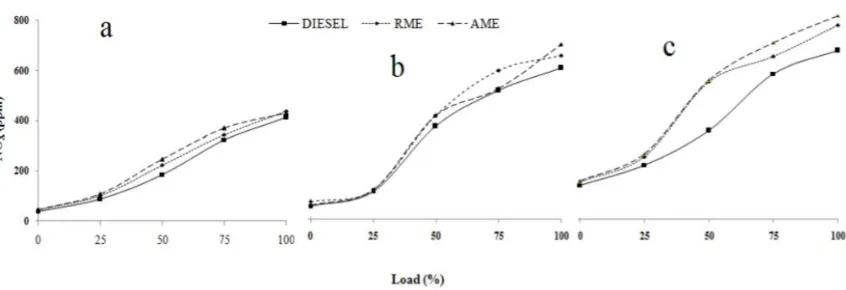
Fig. 4. (a) NOx vs. load at 20° BTDC; (b) NOx vs. load at 23° BTDC; (c) NOx vs. load at 26°
BTDC
Nikhil A Bhave, Vivek M Ugare, Amol M Andhare et al. (Nov 2013)[4] In this paper, the research on using
bio-diesel blend on four-stroke single cylinder compression-ignition engine. Sesame Biodiesel used with diesel.
The Brake Thermal Efficiency for B40 was found to be 29.81% with diesel having 29.12%. The brake thermal efficiency was increased by about 2.64% for SOME. The Brake Specific fuel consumption was found to be 593.62 Kg/kWhr for B40 compared to diesel with 611.31 Kg/kWh. The Brake Specific fuel consumption was found to be decreased by 2.89% for B40. The Brake Specific Energy Consumption was found to be less for B40 24.601 MJ/kWhr compared to mineral diesel with 25.81 MJ/kWhr. Thus Brake Specific Energy Consumption was found to decrease by 4.68% compared to diesel.
Shailaja.Ma, A. Aruna Kumaria, A V Sita Rama Rajuc et al. (2013) [5] In this paper, the research on using
bio-diesel blend in biodiesel is prepared from sesame oil and short term tests were conducted with different blends of biodiesel and diesel on a single cylinder four stroke diesel engine and performance and emissions are evaluated and compared with diesel operation. 10% sesame oil biodiesel + 90% Diesel 20% sesame oil biodiesel + 80% Diesel 25% sesame oil biodiesel + 75% Diesel 30% sesame oil biodiesel + 70% Diesel 40% sesame oil biodiesel + 60% Diesel As already discussed that the biodiesel has higher bulk modulus results in early start of injection and higher cetane number reduces the ignition delay, this finally results in early start of combustion with biodiesel blends as compared base diesel. Sesame oil bio diesel is proved potentially suitable as fuel for a diesel engine. Brake thermal efficiency and mechanical efficiency increase with increase in load, B25 and B60 give maximum brake thermal efficiency and mechanical efficiency respectively. Lowest bsfc for B 25.
Sehmus Altun, Husamettin bulut, Cengiz Oner et al. (2008)[6]In the experiments, a vehicle has four-stroke,
350 | P a g e
low NOx emissions in the exhaust gases. Although some researchers found that NOx emissions were found to be insensitive to ignition delay others stated that ignition delay could be a reason of increased NOx emission. In this study, the effects of sesame oil–diesel fuel mixture as an alternative fuel on engine performance and exhaust gas emissions are investigated experimentally.N.R. Banapurmath, P.G. Tewari, R.S. Hosmath et al. (2009) [7] in this study, Experiments were conducted
on a four-stroke single-cylinder direct-injection CI engine. The engine tests were conducted on a four-stroke-single cylinder direct-injection water-cooled CI engine whose specifications are given. The engine was always operated at a rated speed of 1500 rev/min.
The effect of brake power on the brake thermal efficiency for diesel, Honge oil methyl esters (HOME), Jatropha oil methyl esters (JOME) and sesame oil methyl esters (SOME). There is a steady increase in efficiency as the load increases in the diesel, HOME, JOME and SOME operations. The brake thermal efficiency is always lowest with the JOME as compared to other fuels. This is due to poor mixture formation as a result of the low volatility, higher viscosity and density of the Jatropha oil. Among the biodiesels tested, the maximum brake thermal efficiency was recorded with SOME and is 30.4% at 80% power output compared to 31.25% for diesel. However, the brake thermal efficiency values for HOME, SOME and JOME were 29.51%, 30.4% and 29%, respectively, at 80% load.
Bhaskor j. bora, Ujjwal k.saha et al. (2015)[8]In this paper, the research the test set-up is a single cylinder,
four stroke, and direct injection, water-cooled, naturally aspirated, 3.5 kW diesel engine (Kirloskar made, India). The diesel engine is tested initially with diesel for baseline data. During the experiments, the engine is tested with 20%, 40%, 60%, 80% and 100% load. The brake mean effective pressure (BMEP) corresponding to percentage loading conditions The CO2 emission increases with the increase of load for both diesel and dual fuel
mode as observed. This is due to the fact that the amount of fuel consumes increases with for high loading conditions. However, CO2 emission is higher for all the three cases of dual fuel mode in comparison to diesel
mode. This is because biogas contains large amount of CO2 (i.e. around 40% by volume).RBME-biogas
produced a maximum efficiency of 19.97% in comparison to 18.4% and 17.4% for PME-biogas and POME-biogas, respectively at 100% load. The emission study divulged that under dual fuel mode, there is an increase of CO emission by 25.74% and 32.58% for PME-biogas and POME-biogas, respectively in comparison to RBME-biogas. Comparison to RBME-biogas. On the other hand, there is a decrease in NOX emission by 5.8%
and 14%, respectively for PME-biogas and POME.
Lin Lin, Dong Ying, Sumpun Chaitep, Saritporn Vittayapadung et al. (2008)[9]In this paper, the research
the test Three types of fuel, namely, 100% diesel, 100% BD and blend of 30% BD were tested for their use as a fuel of diesel in a single-cylinder diesel engine. Three types of fuel were used for conducting the short-term engine emission tests at varying loads (10%, 25%, 50%, 75%, 90% and 100%).The exhaust of emissions of CO and hydrocarbon (HC) from RBO biodiesel (RBD) was much lower than that of regular diesel fuel. However, emissions tests showed a slight increase in NOX, primarily due to its high oxy-gen content. , it was found that
351 | P a g e
because of high oxygen content in RBD. As a result, burning efficiency and combustion reaction were much improved.Nilesh Kumar Sharma, A.C.Tiwari et al. (2014) [10] in this paper evaluated in his performance test, using
blending of 50% sesame oil & 50% Diesel fuel. As seen from the figures, engine torque & power are low at low engine speed but when engine speed is increased, the engine torque and power increases. Power reaches its peak value then it decreases. Engine Torque & power are slightly lower when compared with ordinary diesel fuel. This is because of lower heating value of blend fuel and not mixing of air and fuel properly which cause bad combustion. Specific fuel consumption is high at low speed. By increasing the speed of engine fuel consumption decreases then it reaches maximum value.CO is the toxic product of combustion due to the improper burning of hydrocarbon (HC). CO emission is less when engine speed is high & blend produces significantly lower CO emissions than that of diesel fuel.
Fig.1&2 shows the variation of engine torque and SFC with engine speed for sesame oil and its
blends with diesel.
Fig.3&4 Shows the variation of engine power & CO emission with engine speed for sesame oil
352 | P a g e
Milan D. Trivedi1 Pragna R. Patel, Tushar M. Patel, Gaurav P. Rathod et al. (2014) [11] in this paperevaluated in effect of additives on properties, performance and emission of biodiesel fuelled compression ignition engine. This paper shows how important is to use biodiesel to reserve the fuel source and reduce the CO2 emission. He observed that use of biodiesel led to loss in engine power due to low temperature properties and lower heating value of biodiesel compared to diesel. The low temperature properties of biofuels are less favourable than diesel fuels .However, blending with additives improves the flash point, reduces the pour point and viscosity of biodiesel fuel. Performance parameters studied by the author were Power, Torque, Brake specific fuel consumption, Brake thermal efficiency and Emission of particularly Co and HC.
Dr.G Venkata Subbaiah et al. (2015) [12] in this paper present investigation Kirloskar single cylinder, four
stroke, water cooled diesel engine is used for comparing the performance and emission characteristics of diesel, and biodiesel blends. The photograph of the experimental set-up. The brake thermal efficiency increased as the load on the engine increased. The brake thermal efficiency of the B20 Blended fuel is highest than the all other fuels. The brake thermal efficiency decreased as the proportion of rice bran oil increased. This can be explained by the fact that as the viscosity of the blend increased, the atomization of fuel is not as good as pure diesel.it is evident that the brake specific fuel consumption of the B20 blend is much less when compared to diesel and other blends. As the proportion of rice bran oil increased in the blends, specific fuel consumption increased.B20 fuel, Brake thermal efficiency was found to have maximum value and specific fuel consumption was found to be lowest.B40 and B50 fuels showed better hydro carbon and carbon dioxide emissions than diesel fuel. NOx emissions reduced for all the blends at different loads compared to diesel emissions.
IV. CONCLUSION
From the above review it is concluded that the blend of rice bran oil and Sesame oil and diesel improve the emission characteristics. The rice bran oil and sesame oil has ability to be used as a blending. The main aim of this work is to find out the blended fuel for diesel engine & to make economical blend which gives improved performance and emission characteristics.differant blending percentage to improve the performance and emission.
REFERENCES
[1] Bhaskor j. bora, Ujjwal k.saha Experimental evaluation of a rice bran biodiesel – biogas run dual fuel diesel engine at varying compressor ratio renewable energy 87, 2016,782-790.
[2] Gopinath Dhamodaran, Ramesh Krishnan, Harish Sivasubramanian, Aditya Krishna Ganeshram fuel 187,2016,296-305.
[3] J. Jayaprabakar,A.Karthikeyan Materials Today: Proceedings 3 (2016) 2468–2474.
353 | P a g e
[5] Shailaja.Ma, A. Aruna Kumaria, A V Sita Rama Rajuc International Journal of Current Engineering andTechnology.
[6] Sehmus Altun, Husamettin bulut, Cengiz Oner renewable energy 33,2008,1791-1795.
[7] N.R. Banapurmath, P.G. Tewari, R.S. Hosmath Renewable Energy 33,2008,1982-1988.
[8] Bhaskor J. Bora, Ujjwal K.Saha Renewable Energy 81 ,2015,490-498.
[9] Lin Lin, Dong Ying, Sumpun Chaitep, Saritporn Vittayapadung Applied Energy 86 (2009) 681–688.
[10] Nilesh Kumar Sharma, A.C.Tiwari International Journal Of Engineering Sciences & Research Technology 3,2014.
[11] Milan D. Trivedi1 Pragna R. Patel, Tushar M. Patel, Gaurav P. Rathod International Journal for Scientific Research & Development| Vol. 2, Issue 10, 2014.