AUTOMATIC IMAGE EQUALIZATION AND
CONTRAST ENHANCEMENT USING GAUSSIAN
MIXTURE MODELING
M. Raghavendra Sir, S.Sana Bushra , S.Chaitanya Kumar
ABSTRACT
In this paper, we propose an adaptive image equaliza- tion algorithm that automatically enhances the contrast in an
input image. The algorithm uses the Gaussian mixture model to model the image gray-level distribution, and the
intersection points of the Gaussian components in the model are used to partition the dy- namic range of the image
into input gray-level intervals. The con- trast equalized image is generated by transforming the pixels’ gray levels in
each input interval to the appropriate output gray-level interval according to the dominant Gaussian component and
the cumulative distribution function of the input interval. To take ac- count of the hypothesis that homogeneous
regions in the image rep- resent homogeneous silences (or set of Gaussian components) in the image histogram, the
Gaussian components with small variances are weighted with smaller values than the Gaussian components with
larger variances, and the gray-level distribution is also used to weight the components in the mapping of the input
interval to the output interval. Experimental results show that the proposed algo- rithm produces better or
comparable enhanced images than sev- eral state-of-the-art algorithms. Unlike the other algorithms, the proposed
algorithm is free of parameter setting for a given dynamic range of the enhanced image and can be applied to a
wide range of image types
Record Terms: Contrast Improvement, Gaussian Blend Mod-Eling, Worldwide Histogram Leveling
(GHE), Histogram Parcel, Ordinary Dispersion.
I INTRODUCTION
Procedures in the initial two gatherings regularly utilize multiscale butt-centric ysis to break down the picture into various recurrence groups and upgrade its coveted worldwide and neighborhood frequencies [2]–[4]. These methods are computationally mind boggling yet empower worldwide and neighborhood differentiate upgrade at the same time by changing the signs in the suitable groups or scales.
II APPLICATIONS
2.1 For Image Enhancement in Colour and Gray Scale Images
Picture improvement strategies are utilized to underline and hone picture elements, for example,
to acquire an outwardly more lovely, more point by point, or less boisterous yield image.
Image upgrade is the way toward applying these methods to encourage the advancement of an
answer for a Digital imaging issue.
2.2 Underwater Image Enhancement
Kashif Iqbal et al. (2007) proposed a an approach based on slide stretching algorithm to enhance the underwater images in which the clarity of the images is degraded by light absorption and scattering and as a result one color dominates the image. This involves contrast stretching of RGB algorithm which is applied to equalize the colour contrast in images. Further, Saturation and intensity stretching of HSI is used to increase true colour and solve the problem of lighting in images. Interactive software is developed for under water image enhancement and quality of images which is statistically illustrated through histograms. The methodology for underwater image enhancement 2. See-through image enhancement through sensor fusion Bo fu et al. (2012) proposed a novel image enhancement method to improve the frame visual quality captured by camera behind the see through screen. An algorithm is developed which out-performs the traditional image enhancement method in recovering colored image with less noise and more detail information.
Colored satellites image enhancement using wavelet and threshold enhancement using wavelet and threshold decomposition Muna et al. (2011) made a study to enhance the satellite image using an intelligent aspect of filtering and describe multi-threshold technique with an additional step in order to obtain the perceived image. A new enhancement filter is introduced for digital satellite images
3.Image Enhancement of low light scenes with infrared flash images Sosuke Matsu et al. (2010) developed a technique for enhancing an image using near infrared flash images.
III.EXIXTING METHOD
Besides, they re-quire suitable parameter settings that may some way or another re-sult in picture debasements. For instance, the middle encompass Retinex [2] calculation was created to accomplish softness and shading steadiness for machine vision applications. The consistency alludes to the flexibility of saw shading and gentility to spatial and ghostly light varieties. The advantages of the Retinex calculation incorporate element run pressure and shading inde-pendence from the spatial conveyance of the scene enlightenment. In any case, this calculation can bring about "corona" relics, particu-larly in limits between substantial uniform districts. Additionally, "turning gray out" can happen, in which the scene tends to change to center dark.Among the three gatherings, the third gathering got the most consideration due to their direct and instinctive implementa-tion qualities. Direct difference extending (LCS) and worldwide his-togram balance (GHE) are two generally used techniques for worldwide picture improvement [1]. The previous directly modifies the dynamic scope of a picture, and the last uses a contribution to-yield mapping acquired from the combined dissemination func-tion (CDF), which is the vital of the picture histogram. Since the complexity pick up is relative to the tallness of the histogram, dark levels with huge pixel populaces are extended to a bigger scope of dim levels, though other dim level reaches with less pixels are compacted to littler extents. Despite the fact that GHE can ef-ficiently use show forces, it tends to over improve the picture differentiate if there are high tops in the histogram, frequently bringing about an unforgiving and loud appearance of the yield picture. LCS and GHE are basic changes, yet they don't al-ways create great outcomes, especially for pictures with vast spatial variety interestingly. Furthermore, GHE has the undesired impact of overemphasizing any commotion in a picture.
To overcome the previously mentioned issues, neighborhood histogram-evening out (LHE)- based improvement strategies have been proposed, e.g., [5] and [6]. For instance, the LHE technique [6] utilizes a little window that slides through each picture pixel consecutively, and just pixels inside the present position of the window are histogram adjusted; the dim level mapping for improvement is done just for the middle pixel of the window. In this manner, it uses neighborhood data. In any case, LHE now and then causes over improvement in some bit of the picture and en-hances any clamor in the info picture, alongside the picture fea-tures. Moreover, LHE-based techniques deliver undesirable checkerboard impacts.
MMBEBHE is the augmentation of BBHE, which gives maximal splendor safeguarding.The previously mentioned systems may make issues while upgrading an arrangement of pictures, when the histogram has spikes, or when a characteristic looking improved picture is required. In this paper, we propose a versatile picture evening out calculation that is successful as far as enhancing the visual nature of various sorts of info pictures. Pictures with low complexity are automat-ically enhanced as far as an expansion in the dynamic range. Pictures with adequately high difference are additionally enhanced however not to such an extent. The calculation additionally improves the shading nature of the information pictures as far as shading consistency, higher difference amongst closer view and foundation objects, bigger element extend, and more noteworthy points of interest in picture substance. The proposed algo-rithm is free from parameter setting. Rather, the pixel estimations of an info picture are demonstrated utilizing the Gaussian blend display (GMM). The crossing point purposes of the Gaussian segments are utilized as a part of dividing the dynamic scope of the info picture into information dark level interims. The dark levels of the pixels in each information interim are changed by the overwhelming Gaussian part and the CDF of the interim to acquire the differentiation adjusted picture.
This method is applicable for dynamic scenes. A joint local mean algorithm is used to remove noise and motion blur. A multispectral imaging system is implemented which captures a color image and NIR flash images without causing any interference. The effectiveness of the technique is confirmed through experiments using real images. The flow of denoising and deblurring methods is explained with the help of NIR flash images.
IV. PROPOSED METHOD
Give us a chance to consider an info picture of size pixels, where . Give us a chance to accept that has a dynamic scope of , where . The principle goal of the proposed algorithm is to produce an improved picture , which has a superior visual quality regarding
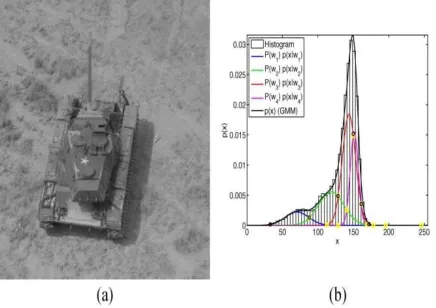
The dim level dispersion , where , of the info picture can be demonstrated as a thickness work made out of a straight blend of capacities.
Fig. 1. (a) Gray-level image and (b) its histogram and GMM fit.
V.SIMULATION RESULT:
Bar Graph Histogram for Equalized Image
Mapping From Starting to Origin Position Mapping Colour Image:
VI CONCLUSION
In this paper, we have proposed a programmed picture upgrade ment calculation that utilizes Gaussian blend displaying of an info picture to perform nonlinear information mapping for creating outwardly satisfying improvement on various sorts of pictures. Execution examinations with cutting edge procedures demonstrate that the proposed calculation can accomplish picture adjustment that is adequate even under differing light conditions. The proposed calculation can be connected to both dim level and shading pictures with no parameter tuning. It can be likewise used to render HDR pictures. It doesn't divert the general substance of an info picture with differentiation that is sufficiently high. It encourage im-demonstrates the shading substance, shine, and differentiation of a picture consequently. Utilizing the trial of criticalness on the Berkeley informational index, it has been demonstrated that the proposed technique accomplishes splendor protection, DE safeguarding, and differentiate enhance ment under the 99% certainty level.
REFERENCES
[1] R. C. Gonzalez and R. E. Woods, Digital Image Processing. Upper Saddle River, NJ: Prentice-Hall, 2006. [2] D. Jobson, Z. Rahman, and G. Woodell, "A multiscale retinex for conquering any hindrance between shading pictures and the human perception of scenes," IEEE Trans. Picture Process., vol. 6, no. 7, pp. 965–976, Jul. 1997. [3] J. Mukherjee and S. Mitra, "Upgrade of shading pictures by scaling the DCT coefficients," IEEE Trans. Picture
Process., vol. 17, no. 10, pp. 1783–1794, Oct. 2008.
[4] S. Agaian, B. Silver, and K. Panetta, "Change coefficient histogram-based picture upgrade calculations utilizing contrast entropy," IEEE Trans. Picture Process., vol. 16, no. 3, pp. 741–758, Mar. 2007.
[5] R. Dale-Jones and T. Tjahjadi, "A review and change of the neighborhood histogram evening out calculation," Pattern Recognit., vol. 26, no. 9, pp. 1373–1381, Sep. 1993.
[6] T. K. Kim, J. K. Paik, and B. S. Kang, "Differentiate upgrade framework utilizing spatially versatile histogram leveling with fleeting sifting," IEEE Trans. Consum. Electron., vol. 44, no. 1, pp. 82–87, Feb. 1998.
[7] C.- C. Sun, S.- J. Ruan, M.- C. Shie, and T.- W. Pai, "Dynamic complexity improvement in light of histogram detail," IEEE Trans. Consum.Electron., vol. 51, no. 4, pp. 1300–1305, Nov. 2005
[8] Y.- T. Kim, "Differentiate upgrade utilizing shine saving bi-his-togram adjustment," IEEE Trans. Consum. Electron., vol. 43, no. 1, pp. 1–8, Feb. 1997.
[9] Y. Wang, Q. Chen, and B. Zhang, "Picture improvement in view of equivalent territory dualistic sub-picture histogram evening out technique," IEEE Trans. Consum. Electron., vol. 45, no. 1, pp. 68–75, Feb. 1999.
[10] S.- D. Chen and A. Ramli, "Least mean shine mistake bi-his-togram balance conversely upgrade," IEEE Trans. Consum. Electron., vol. 49, no. 4, pp. 1310–1319, Nov. 2003.
[12] M. Abdullah-Al-Wadud, M. Kabir, M. Dewan, and O. Chae, "A dy-namic histogram evening out for picture differentiate upgrade," IEEE Trans. Consum. Electron., vol. 53, no. 2, pp. 593–600, May 2007.
[8] Y.- T. Kim, "Differentiate upgrade utilizing shine saving bi-his-togram adjustment," IEEE Trans. Consum. Electron., vol. 43, no. 1, pp. 1–8, Feb. 1997.
[9] Y. Wang, Q. Chen, and B. Zhang, "Picture improvement in view of equivalent territory dualistic sub-picture histogram evening out technique," IEEE Trans.