http://www.sciencepublishinggroup.com/j/wros doi: 10.11648/j.wros.20190806.11
ISSN: 2328-7969 (Print); ISSN: 2328-7993 (Online)
The Ancient Shells Were Studied by X-ray Diffraction and
Electron Probe
Chen Junhao, Chen Guiqing
Institute of Technology, Jinan University, Guangzhou, China
Email address:
To cite this article:
Chen Junhao, Chen Guiqing. The Ancient Shells Were Studied by X-ray Diffraction and Electron Probe. Journal of Water Resources and Ocean Science. Vol. 8, No. 6, 2019, pp. 86-93. doi: 10.11648/j.wros.20190806.11
Received: September 27, 2019; Accepted: October 17, 2019; Published: November 5, 2019
Abstract:
What changes have they made since the shells were buried in the ground for thousands of years? The geological crystallography book records that the physical properties of the aragonite structure are unstable and will eventually be converted into calcite. This is probably also a theory copied from abroad, and no one in the country has ever studied it. The crystal structure of the test substance can only be measured by an X-ray diffractometer, and geologists seem to not be familiar with crystallography. Now I plan to use X-ray diffraction to verify the correctness of this theory? It turns out that after a long geological time, not only did the aragonite not become calcite, but the grain grew up again - "single crystal" and even calcite decreased, proving that this theory is wrong. Carbon 14 (C14) is used to determine the geological age of some artifacts. Now using the electronic probe to detect the "double Chen weathering hole CC" of the ancient shell, it may be used as another method to determine the geological time.Keywords:
Marine Biology, X-ray Diffraction, Aragonite Structure, Calcite Structure, WDX-Electron Probe, CC-double Chen, Weathered Hole1. Foreword
What changes will happen to shells after they have been buried in the ground for thousands of years? The geological crystallography textbook [4, 5] records that the physical properties of the meteorite structure are unstable and will eventually turn into calcite. This has become a common sense and can be found on any Internet. If the crystal structure really changes, it will be a long process, the vergeite lattice constant will gradually become distorted, and finally become the calcite structure!
Aragonite gemstones are composed of aragonite (also known as aragonite in crystallography), calcite, iron oxide, and opal. They are secondary minerals and aragonite is one of the main components. In the world, only China's Tibet, Taiwan's Penghu Islands and Italy's Sicily produce aragonite gemstones. According to the above theory, aragonite does not seem to exist in the world, because the aragonite structure contained in these minerals has been transformed into calcite structure after hundreds of millions of years, but in fact they still exist! We have detected that the lattice constant of the aragonite structure gradually transforms into the deformed
lattice of the calcite structure at high temperature, but under deep sea high pressure, the Abra profundorum shell and the
nautilus pampilium L shell are still aragonite crystals. The aragonite structure is stable under high pressure, which also questions the correctness of this theory. We now use x-ray diffraction to detect the crystal structure of ancient shells, to see if the aragonite or calcite distortion lattice constant can be detected? In order to verify the correctness of the above theory!
The use of electronic probes to detect ancient shells has revealed many weathering holes that vary with the geological age. We call it the “double Chen weathering hole CC”, which may be used as another method to determine the geological time.
2. Materials and Methods
2.1. X-ray Diffraction
with domed shells and mussels with beautiful shells. In 2016, tan yehui, a researcher at the south China sea institute of oceanology, Chinese Academy of Sciences, provided four kinds of ancient shells, including tridacna, tridacna, pipi and clams. The crystal structure was determined by X - ray diffractometer. Aragonite structure conforms to 04-1475 [6]; Calcite structure is consistent with 24-27 [6].
2.2. Electron Microprobe Discuss
Materials as before; The electron probe method was used in the study by south China sea institute of oceanology, Chinese Academy of Sciences.
3. Results and Discussion
3.1. Experimental Results of X-ray Diffraction
In Table 1, the lower bar line such as 0.3400 corresponds to the card 041-1475 [6], which is the aragonite line; the lower dotted line such as 0.3038 corresponds to the card 24-27 [6], which is the calcite line; the lower point, the bar, the point line line 0.3336 is the silica line. The line will drift somewhat due to detection conditions, zero calibration, etc. The same is true of the following.
3.1.1. Schistodesmus sp. Prismatic Layer
102 West Point Village, field number ADY201, 1983/9/9. Age: hundreds of years to thousands of years.
All spectral lines conform to card 041-1475, all are aragonite structures and there are no impurities.
3.1.2. Schistodesmus Lampreyanus (Baird & Adams) Prismatic Layer
102, Kenting Village, Shanxi, 1986/12/16. Age: hundreds of years to thousands of years.
All spectral lines conform to card 041-1475, all are aragonite structures and there are no impurities.
3.1.3. Unio Douglasiae (Gray)
Field number ADY201, 12/16, 1986/12/16. Years: hundreds to thousands of years.
(i). Unio Douglasiae (Gray) Pearl Layer
Most of the spectral lines conform to the card 041-1475, It's almost all aragonite structure
The only occurrence of calcite weak line d104=0.3038nm,
I/I0=1.64%, containing calcite 0.15% [12]. It's too weak, it's
probably stuck, because the stratum corneum does not have it.
(ii). Unio Douglasiae (Gray) Periostracum
All spectral lines conform to card 041-1475, all are aragonite structures and there are no impurities.
3.1.4. Lamprotula sp.
Field number ADY193, 1986/12/16. Age: hundreds of years to thousands of years.
(i). Lamprotula sp. Pearl Layer
All spectral lines conform to card 041-1475, all are
aragonite structures and there are no impurities.
(ii). Lamprotula sp. Prismatic Layer
Most of the spectral lines conform to the card 041-1475, it's almost all aragonite structure.
The only occurrence of calcite weak line d104=0.3034nm,
I/I0=2.6%, containing calcite 0.23%. It's too weak, it's
probably stuck.
(iii). Lamprotula sp. Periostracum
Most of the spectral lines conform to the card 041-1475, it's almost all aragonite structure.
The only occurrence of calcite weak line d104=0.3024nm,
I/I0=1.7%, containing calcite 0.17%. It's too weak, it's
probably stuck,
(iv). Modern Lamprotula sp. Pearl Nuclei
All spectral lines conform to card 041-1475, all are aragonite structures and there are no impurities.
There is no difference in spectroscopy between modern shells and ancient shells
3.1.5. Trapezium Liratum (Reeve) Periostracum
Guangdong Shunde Longbei Lunjiao Brigade Yuan Zhou production team 1 well Quaternary loose sedimentary rock center. Collectors: Wu Wenzhong, Zhao Huan Ting. Acquisition time: early 1970s. Year: 500-1000 years ago. Measurement date / time 2015-11-27 8:48:35.
Most of the spectral lines conform to the card 041-1475, it's almost all aragonite structure.
There are two strong silica lines d=0.3370nm, I/I0=70.2%;
d=0.1824nm, I/I0=55.96%, which is the silica that the ancient
shells have adhered to in the soil for many years. Because modern shells never see these lines.
3.1.6. Potamacorbula Laevis (Hinas) Periostracum
Guangdong Shunde Longbei Lunjiao Brigade Yuan Zhou production team 1 well Quaternary loose sedimentary rock center. Collectors: Wu Wenzhong, Zhao Huan Ting. Acquisition time: early 1970s. Year: 500-1000 years ago. Measurement date/time: 2015-11-27/9:01:27.
All spectral lines conform to card 041-1475, all are aragonite structures and there are no impurities.
3.1.7. Corbicula Fluminea (Müller)
Guangdong Shunde Longbei Lunjiao Brigade Yuan Zhou production team 1 well Quaternary loose sedimentary rock center. Collectors: Wu Wenzhong, Zhao Huan Ting. Acquisition time: early 1970s. Year: 500-1000 years ago. Measurement date / time 2015-11-27 9:14:37
(i). Corbicula Fluminea (Müller) Prismatic Layer
All spectral lines conform to card 041-1475, all are aragonite structures and there are no impurities.
(ii). Corbicula Fluminea (Müller) Periostracum
Most of the spectral lines conform to the card 041-1475, it's almost all aragonite structure.
nm is the second strongest spectral line of silica SiO2
d100=0.4255 nm. This is the silica that the ancient shells were
buried in the soil for many years and therefore adhered. Modern shells have never seen these spectral lines.
Two weak calcite spectral lines appeared: d104=0.3033 nm,
I/I0=8.71% and d113=0.2282 nm, I/I0=7.26%, containing
calcite 0.77%. It's too weak, Two weak calcite spectral lines appeared: d104=0.3033 nm, I/I0=8.71% and d113=0.2282 nm,
I/I0=7.26%, containing calcite 0.77%. It's too weak, and may
be adhered to.
There is also an impurity spectral line d = 0.3205 nm, I / I0 =
18.38%, I don't know what the substance is, Is also adhesive impurity.
The ancient Corbicula fluminea shell is the same as the modern Corbicula fluminea shell spectral line.
(iii). Modern Corbicula Fluminea (Müller) Prismatic Layer
Most of the spectral lines conform to the card 041-1475, it's almost all aragonite structure.
The only one weak impurity line d = 0.3632 nm, I / I0 =
3.21%.
3.1.8. Corbicula Maxima Prime
Unearthed from the water project of Longyan Village, Shunde, Guangdong. Collector: Zhao Huan Ting and so on. Collection time: February 1961. Year: 500-1000 years ago. Measurement date / time 2015-11-27 9:48:41
(i). Corbicula Maxima Prime Pearl Layer
All spectral lines conform to card 041-1475, all are aragonite structures and there are no impurities.
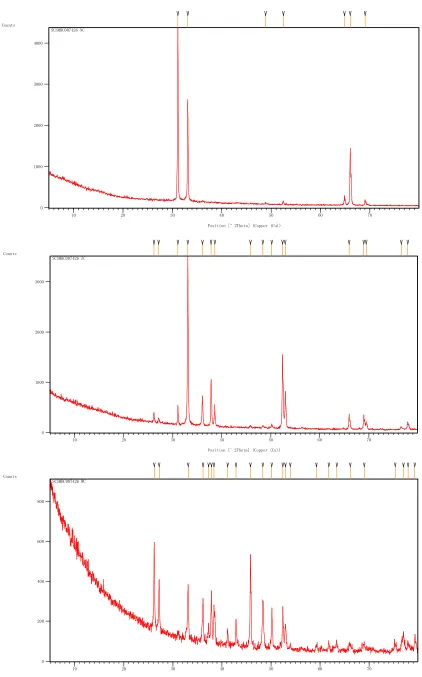
From the left side of Figure 1, The strongest spectral line d= 0.2875nm absolute strength is equal to I = 4290.7 (this is the diffraction result of the instrument, omitted in the table. Generally, the strongest intensity of the spectral line of the shell is about 700), It is very strong, very narrow, and has less spectral lines. The conclusion of geological crystallography: the crystal structure of aragonite is unstable, and it will eventually become calcite. Now, on the contrary, it will develop to a higher "aragonite single crystal", indicating the structure of aragonite, it is stable.
From the X-ray diffraction theory of the crystal Scherrer's formula [7]: the spectra line becomes stronger, narrower and has few spectral lines. is due the growth and thickening of the grains in the diffraction direction (preferred orientation growth), we call it "Single crystalization trend".
The growth process of shell pearl layer is the growth process of aragonite crystal. Due to the lattice distortion caused by the vacancy or impurity filling into the crystal lattice, the crystal face family spacing d changes and the spectral line becomes wider. New internal stress is always generated, and the stress is constantly released under the
action of stress. When the shellfish die, the crystal stops growing and no new internal stress is created. The internal stress in the shell is gradually released, the vacancy is gradually filled or the impurities are gradually removed to the grain boundary to eliminate the internal stress. At this time, the internal stress is also concentrated on the grain boundary, so it is easy to be weathered away. Aragonite grain grows continuously, so; Make spectral lines stronger, narrower and less!
Because the Corbicula maxima shell is larger, it is less affected by the surrounding soil,, more can reflect the growth process.
(ii). Corbicula Maxima Prime Prismatic Layer
All spectral lines conform to card 041-1475, all are aragonite structures and there are no impurities.
The strongest line d =0.2709nm absolute strength is equal to I = 3406.3, It is very strong, very narrow, and has less spectral lines. However, because the prismatic layer is between the pearl layer and the periostracum, the internal stress is released slowly, so the spectral line is slightly more, but from its X-ray diffraction pattern, many weak lines have become almost flattening, the development is similar to the pearl layer spectra line.
(iii). Corbicula Maxima Prime Periostracum
All spectral lines conform to card 041-1475, all are aragonite structures and there are no impurities.
From the right side of Figure 1, the absolute intensity of the strongest line d=0.1980nm is the I=481.16, due to the large organic matter in the stratum corneum, affecting the single crysta processl, making absolute The intensity is greatly reduced and the spectral lines are slightly more
The characteristics of the amorphous diffraction pattern are as shown in the figure, and the entire scanning angle range (2θ from 1° -- 2° starts to the several tens of degrees) because the intensity of the near direct beam is large. And the intensity rapidly with the increase of the angle to decrease, to a high angle intensity towards the instrument's background value, there may be one to several peak values. From the point of view of Scherrer's formula [7], this phenomenon can be considered as the grain size is extremely small, and these crystallites are too small to be affected by external forces, and the crystal lattice is differently distorted, resulting in the diffraction peak of the crystal being greatly widened. The result of overlapping and obscuring.
Figure 1. X-ray diffraction pattern of Corbicula maxima: Left picture pearl layer, Middle picture prismatic layer, Right picture periostracum.
Position [°2Theta] (Copper (Cu))
10 20 30 40 50 60 70
Counts
0 1000 2000 3000 4000
SCSMBC007426 NC
Position [°2Theta] (Copper (Cu))
10 20 30 40 50 60 70
Counts
0 1000 2000 3000
SCSMBC007426 ZC
Position [°2Theta] (Copper (Cu))
10 20 30 40 50 60 70
Counts
0 200 400 600 800
Table 1. Shell X-ray diffraction data.
Schistodesmussp. prismatic layer Schistodesmus lampreyanus prismatic layer Unio douglasiae pearl layer Unio douglasiae periostracum
d (nm) I/I0 (%) d (nm) I/I0 (%) d (nm) I/I0 (%) d (nm) I/I0 (%)
0.3980 2.32 0.3398 73.2 0.3399 66.6 0.3397 100
0.3400 91.4 0.3274 43.6 0.3275 35 0.3274 51.6
0.3275 48.4 0.2702 100 0.3038 1.64 0.2700 63.2
0.2702 100 0.2484 42.9 0.2873 23.5 0.2483 38.3
0.2484 52.9 0.2373 46.9 0.2702 100 0.2371 37.6
0.2373 55.4 0.2332 27.9 0.2484 40.4 0.2335 27.2
0.2335 28.5 0.2105 13.3 0.2373 41.2 0.2105 20.5
0.2105 22.2 0.1976 39.5 0.2332 19.6 0.1976 61
0.1977 52.9 0.1879 22.6 0.1976 34.7 0.1879 34
0.1879 31.1 0.1814 19.5 0.1879 21.8 0.1813 20.6
Lamprotula sp. pearl layer Lamprotula sp. prismatic layer Lamprotula sp. periostracum Modern Lamprotula sp. Pearl nuclei
d (nm) I/I0 (%) d (nm) I/I0 (%) d (nm) I/I0 (%) d (nm) I/I0 (%)
0.3993 1.39 0.3401 100 0.4218 19 0.3395 53.9
0.3399 58.9 0.3277 51 0.3397 100 0.3273 31.9
0.3274 31.3 0.3034 2.6 0.3274 51 0.2872 16.8
0.2873 12.9 0.2703 61 0.3024 1.9 0.2700 100
0.2702 100 0.2484 38.3 0.2700 26 0.2483 32.9
0.2484 37.3 0.2373 39.8 0.2482 31.4 0.2371 31.6
0.2373 40.3 0.2387 31.8 0.2372 23 0.2329 18
0.2332 21.7 0.2106 22.3 0.2338 35 0.1976 31.9
0.1976 29.4 0.1977 64.8 0.2104 29.1 0.1878 20.6 0.1879 17.2 0.1880 34.4 0.1976 76.3 0.1813 14.1
Trapezium liratum periostracum
Potamacorbula laevis
periostracum Corbicula fluminea prismatic layer Corbicula fluminea periostracum
d (nm) I/I0 (%) d (nm) I/I0 (%) d (nm) I/I0 (%) d (nm) I/I0 (%)
0.3418 100.00 0.3411 22.68 0.3404 31.86 0.4249 17.42 0.3370 70.20 0.3282 15.70 0.3282 15.23 0.3388 32.23 0.3299 38.08 0.2885 23.50 0.2876 11.04 0.3336 100.0 0.2711 45.46 0.2725 76.00 0.2706 100.0 0.3268 18.22 0.2497 42.98 0.2705 100.00 0.2491 31.42 0.3205 13.38 0.2389 52.35 0.2488 49.58 0.2377 51.42 0.3033 8.71 0.2344 25.26 0.2375 54.28 0.2332 22.73 0.2697 67.10 0.2121 13.89 0.2332 25.17 0.1998 11.92 0.2485 30.65 0.1989 78.70 0.1989 4.15 0.1882 11.69 0.2372 39.83 0.1890 59.93 0.1882 14.25 0.1820 13.38 0.2282 7.26 0.1824 56.00 0.1819 12.82 0.1761 14.13 0.1979 18.54
Modern Corbicula fluminea
prismatic layer Corbicula maxima Pearl layer Corbicula maxima prismatic layer Corbicula maxima periostracum
d (nm) I/I0 (%) d (nm) I/I0 (%) d (nm) I/I0 (%) d (nm) I/I0 (%)
0.3632 3.21 0.2875 100.0 0.3407 5.31 0.3399 90.81 0.3409 100.0 0.2706 58.06 0.3287 2.61 0.3279 54.75 0.3285 50.6 0.1862 1.48 0.2879 10.97 0.2703 54.46
0.2709 94 0.1744 2.09 0.2709 100.00 0.2484 46.31
0.2490 42.4 0.1438 5.77 0.2492 16.96 0.2413 20.54 0.2415 13.8 0.1415 32.81 0.2378 27.43 0.2377 56.42 0.2377 53.6 0.1361 3.21 0.2334 13.13 0.2345 36.76
0.2338 28.1 0.1979 1.33 0.2193 16.07
0.2109 18.2 0.1881 1.45 0.2110 28.15
0.1980 52.4 0.1817 2.48 0.1980 100.0
0.1882 30.6 0.1747 42.95 0.1883 50.92
Table 2. Lattice constant of shell aragonite structure [8-13].
Lattice constant of ancient shell aragonite structure (nm, nm3) Schistodesmus sp. shell
prismatic layer a=0.497, b=0.797, c=0.574, v=0.227
Trapezium liratum shell
periostracum a=0.500, b=0.805, c=0.576, v=0.232 Schistodesmus lampreyanus
shell prismatic layer a=0.497, b=0.797, c=0.574, v=0.227
Potamacorbula laevis shell
periostracum a=0.500, b=0.799, c=0.575, v=0.230 Unio douglasiae shellpearl
layer a=0.497, b=0.797, c=0.574, v=0.227
Corbicula fluminea shell
periostracum periostracum Lamprotula sp. shellpearl
layer a=0.497, b=0.797, c=0.574, v=0.227
Corbicula maxima shellpearl
layer a=0.498, b=0.801, c=0.575, v=0.229 Lamprotula sp. shell
prismatic layer a=0.497, b=0.798, c=0.575, v=0.228
Corbicula maxima shell prismatic
layer a=0.498, b=0.801, c=0.576, v=0.230 Lamprotula sp. shell
periostracum a=0.497, b=0.797, c=0.574, v=0.227
Corbicula maxima shell
periostracum a=0.496, b=0.799, c=0.575, v=0.228 Lattice constant of modern shell aragonite structure (nm, nm3)
Pinctada martensi pearl a=0.496, b=0.796, c=0.574, v=0.227 Pinctada margaritifera Shelll
pearl layer a=0.497, b=0.797, c=0.574, v=0.228 Pinctada martensi shell
pearl layer a=0.495, b=0.794, c=0.573, v=0.225
Pinctada margaritifera shell
prismatic layer a=0.496, b=0.795, c=0.574, v=0.226 Pinctada martensi shell
prismatic layer a=0.496, b=0.796, c=0.574, v=0.227
Pinctada chemnitzi shell pearl
layer a=0.496, b=0.796, c=0.574, v=0.227 Pinctada maximax shell
pearl layer a=0.496, b=0.796, c=0.574, v=0.227
Pinctada chemnitzi shell
prismatic layer a=0.495, b=0.794, c=0.573, v=0.226 Pinctada maximax shell
prismatic layer a=0.496, b=0.795, c=0.573, v=0.226 Haliotis diversicolor shell a=0.496, b=0.796, c=0.574, v=0.227 Pteria (Magnavicula)
Penguin shell pearl layer a=0.495, b=0.795, c=0.574, v=0.226 Mytilus edulis shell a=0.499, b=0.801, c=0.577, v=0.231 Pteria (Magnavicula)
penguinshell prismatic layer a=0.495, b=0.794, c=0.573, v=0.225 Corbicula fluminca shell a=0.498, b=0.800, c=0.576, v=0.230
Table 3. Calcite content of ancient and modern shells [8-13].
Calcite content of ancient shells: Well below 1%, it's almost nonexistent Schistodesmus sp. Shell prismatic
layer 0% Lamprotula sp. Shell prismatic layer 0.23% Corbicula fluminea shell periostracum 0.77% Schistodesmus lampreyanus shell
prismatic layer 0% Lamprotula sp. Shell periostracum 0.17% Corbicula maxima shell pearl layer 0%
Unio douglasiae shell pearl layer 0.15% Trapezium liratum shell
periostracum 0%
Corbicula maxima shell mprismatic
layer 0%
Unio douglasiae shell periostracum 0% Potamacor bula laevis shell
periostracum 0% Corbicula maxima shell periostracum 0%
Lamprotula sp. shell pearl layer 0% Corbicula fluminea shell prismatic
layer 0%
Calcite content of modern shells
Pinctada martensi shell periostracum 100% Pinctada chemnitzi shelll
periostracum 100% Nerita albicilla shell 8.52%
Pinctada maxima shell periostracum 100% Ostrea rivularis shell Most of the
majority 100% Mytilus edulis shell 15.19% Pteria (Magnavicula) Penguin shell
periostracum 100%
Haliotis diversicolor Shell prismatic
laye 8.31% Chama dunker shell 20.03% Pinctada margaritifera shell
periostracum 100%
Pinna atropurpurea shell
periostracum 14% Abra profundorum shell 14%
Pinctada nigra Shell periostracum 100% Haliotis diversicolor shell 29.92% Modern Corbicula fluminca shell prismatic laye 0 All prismatic layers of pearl shells contain less than 1% of calcite spectral lines.
3.2. Electron Microprobe Results
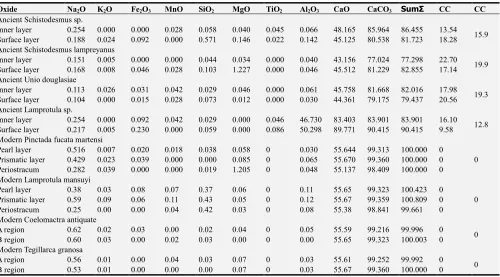
Elements with atomic Numbers below 11 (Na) cannot be measured, so; CaCO3 can only be calculated from CaO
molecular formula.
3
2 3
CaCO CaO CaO
CaO CO CaCO
56.0794 100.0892
M (100.089 56.0794) M 1.78478 M
+ →
= ÷ × = ×
For ancient Schistodesmus sp. Shell: Inner layer:
3 CaCO
M =1.78478×48.165=85.9639;
Surface layer: 3 CaCO
M =1.78478×45.125=80.5377.
The same is true of the following.
In the table summation Ʃ is equal to the summation calcium
carbonate and the rest of the oxide. Modern shells of summation measurement results of electron probe Ʃ equal to about 100%, not necessarily is 100, this is due to the error due to certain factors, normalized to 100%, but the ancient sea shells Ʃ and 100% have a certain gap, this is the result of ancient shell one thousand weathering, we define: CC = 100 -
Ʃ for "double chen weathering hole", all the parts of the CC in the shell is not the same, expressed by average. According to our test scores of modern shells, general results: Ʃ = 98.5, so imagine CC value within 5 negligible, as 0, namely "Double Chen weathering hole" is 0. Because the scope of the electron probe test is very small, the important data need to be measured and averaged.
Will ancient Schistodesmus sp. Shell; Ancient
Schistodesmus lampreyanus shell; Ancient Unio douglasiae
martensi shell; Modern Lamprotula mansuyi shell; Modern
Coelomactra antiquate shell; Modern Tegillarca granosa
shell; Electron Microprobe, results as follows:
Table 4. Oxide of shell.
Oxide Na2O K2O Fe2O3 MnO SiO2 MgO TiO2 Al2O3 CaO CaCO3 SumƩ CC CC
---Ancient Schistodesmus sp.
Inner layer 0.254 0.000 0.000 0.028 0.058 0.040 0.045 0.066 48.165 85.964 86.455 13.54 15.9 Surface layer 0.188 0.024 0.092 0.000 0.571 0.146 0.022 0.142 45.125 80.538 81.723 18.28 Ancient Schistodesmus lampreyanus
Inner layer 0.151 0.005 0.000 0.000 0.044 0.034 0.000 0.040 43.156 77.024 77.298 22.70 19.9 Surface layer 0.168 0.008 0.046 0.028 0.103 1.227 0.000 0.046 45.512 81.229 82.855 17.14 Ancient Unio douglasiae
Inner layer 0.113 0.026 0.031 0.042 0.029 0.046 0.000 0.061 45.758 81.668 82.016 17.98 19.3 Surface layer 0.104 0.000 0.015 0.028 0.073 0.012 0.000 0.030 44.361 79.175 79.437 20.56 Ancient Lamprotula sp.
Inner layer 0.254 0.000 0.092 0.042 0.029 0.000 0.046 46.730 83.403 83.901 83.901 16.10 12.8 Surface layer 0.217 0.005 0.230 0.000 0.059 0.000 0.086 50.298 89.771 90.415 90.415 9.58
Modern Pinctada fucata martensi
Pearl layer 0.516 0.007 0.020 0.018 0.038 0.058 0 0.030 55.644 99.313 100.000 0
0 Prismatic layer 0.429 0.023 0.039 0.000 0.000 0.085 0 0.065 55.670 99.360 100.000 0
Periostracum 0.282 0.039 0.000 0.000 0.019 1.205 0 0.048 55.137 98.409 100.000 0 Modern Lamprotula mansuyi
Pearl layer 0.38 0.03 0.08 0.07 0.37 0.06 0 0.11 55.65 99.323 100.423 0
0 Prismatic layer 0.59 0.09 0.06 0.11 0.43 0.05 0 0.12 55.67 99.359 100.809 0
Periostracum 0.25 0.00 0.00 0.04 0.42 0.03 0 0.08 55.38 98.841 99.661 0 Modern Coelomactra antiquate
A region 0.62 0.02 0.03 0.00 0.02 0.04 0 0.05 55.59 99.216 99.996 0
0 B region 0.60 0.03 0.00 0.02 0.03 0.00 0 0.00 55.65 99.323 100.003 0
Modern Tegillarca granosa
A region 0.56 0.01 0.00 0.04 0.03 0.07 0 0.03 55.61 99.252 99.992 0
0 B region 0.53 0.01 0.00 0.00 0.00 0.07 0 0.03 55.67 99.360 100.000 0
Table 5. Comparison of the “double Chen weathered hole CC” result between Ancient and modern shells.
Ancient shell species Oxide
summation Ʃ
— Double Chen
weathered hole CC
--- Moder shell species Oxide
summation Ʃ
— Double Chen weathered
hole CC
---Schistodesmus sp. 84.09 15.9 Pinctada martensi shell 100.00 0 Schistodesmus lampreyanus 80.08 19.9 Lamprotula mansuy shell 100.30 0 Unio douglasiae 80.73 19.3 Mactra antiquate shell 100.00 0 Lamprotula sp. 87.16 12.8 Arca (Anadara) granosa shell 100.00 0
4. Conclusions
1. We studied the X-ray diffraction results of 16 samples of 8 ancient shells and modern shells as shown in Table 1. Most of them are aragonite structures of calcium carbonate, and the crystal grains are relatively large, a small amount of calcite structure. Only the stratum corneum of the striatum and the stratum corneum of the river scorpion are with silica and a little impurity. The crystal structure, lattice constant and unit cell volume of ancient shells,it are not different from those of modern shells [8-13] Crystallography books and textbooks the conclusion record that the physical properties of the aragonite structure are unstable, after many years be converted into a calcite structure is incorrect. Moreover, China’s Tibet, the Penghu Islands in Taiwan Province, and the Sicily in Italy produce aragonite gemstones (mainly aragonite structures) that have survived for hundreds of millions of years.
2. From the Corbicula maxima Prime shell pearl layer and prism layer buried in the ground for thousands of years,
the aragonite structure has developed to a higher degree of crystallization - "single crystal", making the spectral line stronger, narrower and less ! It is even more impurity-free than modern shells, which means that the aragonite structuce grains are grow and more stable. Further reversing the conclusion that geological crystallography is unstable about the crystal structure of aragonite and will eventually become calcite. Because there are very few calcite lines, maybe even calcite turns into a aragonite!
Shell sample thicker, better test results!
3. many modern shells has calcite structure as shown in the table 2, but the ancient shells basically have no calcite structure, It shows that after a long period of time, the calcite of the shell became aragonite.
4. The "shellfish science program" considers that the shellfish shell prism layer is a calcite structure [9-13] is wrong. It is confirmed from the above shells and ancient shells that the prism layer of the shell is all aragonite structure.
many voids - "Double Chen weathering hole CC" is shown in Table 5! We hope that it will become another way to apply ancient shells and even ancient artifacts to detect the age!
References
[1] Zhang Xi, Qi Zhongyan. The Outline of Shellfish [M]. Beijing: Science Press 1961.
[2] Sonjinjiayi. The canon of pearls. Beilong Pavilion, 1965.
[3] Xiaolinxinerlang, Dubuzheguang. Pearl Research [M], Xiong Daren Translation, Beijing Agricultural Press, 1966.
[4] Jiang liangjun, 1960. Mineralogy ii [M]. Beijing: metallurgical industry press.
[5] Rock ore research office, department of geology, nanjing university, 1978. Crystallography and mineralogy [M]. Beijing: geological press.
[6] Handbook of mineral X-ray powder crystal identification [M], guiyang institute of geochemistry, Chinese Academy of Sciences, 1978. Mineral X-ray powder crystal identification manual. Science press.
[7] Professor kwang-ming liu sunny's blog, http://blog.sina.com.cn/drgmliu.
[8] Chen Guiqing, Chen Junhao, Zhang Xiujun. The crystal structure of the Pinctada maxima shell, the. Pinctada margaritifera shell, the Pinctada nigra shell and the Pinctada martensi shell [J]. Marine Drug 1985, 4 (1): 20-22.
[9] Chen Junhao, Chen Guiqing. Pteria (Magnavicula) penguin shell, Pinctada chemnitzi shell, Pinna atropurpurea shell and Perna viridis shell crystal structure [J]. Marine Drug 1986, 5 (1): 20-23.
[10] Chen guiqing, Chen junhao, Chen piao. Study on the natural pearl and shell of Pinctada martensi. Marine Drug 1986, 5 (3): 4-7. In 1987, he was awarded "excellent paper award" by Marine drug.
[11] Chen guiqing, Chen junhao, 1988. Crystal structure type of shell [J]. Chinese Marine drug, 1-2: 21-29.
[12] Chen Guiqing, Chen Junhao. New conclusions about the crystal structure of pearls and shells. Applied Oceanographic Journal, Vol. 36, No. 4, Nov. 2017/11, P. 528-531.
[13] Chen junhao and Chen guiqing. Crystal structure and application of pearls and shellfish [M]. Jinan university press, December 2018.
[14] Cao boxun. AMS carbon C14 dating method and analysis. Baidu library - education - higher education - science. In 2014.
![Table 2. Lattice constant of shell aragonite structure [8-13].](https://thumb-us.123doks.com/thumbv2/123dok_us/1009656.1600869/5.595.41.555.90.662/table-lattice-constant-shell-aragonite-structure.webp)
![Table 3. Calcite content of ancient and modern shells [8-13].](https://thumb-us.123doks.com/thumbv2/123dok_us/1009656.1600869/6.595.54.553.323.551/table-calcite-content-ancient-modern-shells.webp)