for infant patients with crying disorders:
A prospective cohort study
Joyce Miller,
BS, DC*,†Dave Newell,
BS, MSc, PhD** Anglo-European College of Chiropractic (Bournemouth University), 3-15 Parkwood Road, Bournemouth, Dorset BH5 2DF, UK. † First author: Dr. Joyce Miller, Associate professor, Tel: 44-1202-436 232; Fax: 44-1202-436-312; E-mail: [email protected];
Alt. E-mail: [email protected]
Disclaimers: There was no funding. All patient data were treated with total confidentiality. The statistician was blinded to the group and treatment. The study was approved by our ethics committee.
© JCCA 2012
Introduction : On connaît peu de traitements convaincants pour les nourrissons qui pleurent excessivement. Le manque de renseignements au sujet des sous-groupes de patients est une explication possible. Dans le cadre de la présente étude, un protocole de catégorisation cliniquement plausible est appliqué aux nourrissons faisant partie d’un sous-groupe, et tous changements aux symptômes entre les différents sous-groupes sont comparés tout au long du traitement.
Méthodologie : La méthodologie employée se fonde sur l’observation de cohortes. Tous les nourrissons faisant preuve de pleurs excessifs du nourrisson entre juillet 2007 et mars 2008 ont été assignés à l’un de trois sous-groupes : (A) coliques du nourrisson, (B) syndrome de l’irritabilité du nourrisson d’origine musculosquelettique et (C) alimentation inefficace et sommeil perturbé. Les groupes assignés sont déterminés selon les antécédents et les constats physiques. Les mères ont rempli des questionnaires sur lesquels elles notaient leurs propres caractéristiques, et celles de leur enfant, avant une série de traitements manuels, et à la fin de celle-ci. Des associations indépendantes entre les sous-groupes de nourrissons et des modifications dans les résultats continus (pleurs, stress, sommeil et consolabilité) ont été évaluées. Les facteurs de confusion éventuels ont été identifiés et contrôlés au moyen d’une analyse de la covariance à plusieurs variables.
Résultats : Au total, 158 nourrissons ont participé à l’étude. Il n’y a eu aucune différence significative dans le Introduction: Few convincing treatment options have
been identified for the excessively crying infant. One explanation may be a lack of identification of patient subgroups. This study used a clinically plausible categorization protocol to subgroup infants and
compared changes in symptoms between these subgroups during treatment.
Methods: An observational cohort design was employed. All infants presenting with excessive infant crying between July 2007 and March 2008 were categorized into three subgroups, (A) infant colic, (B) irritable infant syndrome of musculoskeletal origin (IISMO) and (C) inefficient feeding crying infants with disordered sleep (IFCIDS) based on history and physical findings. Mothers completed questionnaires which rated their own and their child’s characteristics prior to and at the end, of a course of manual therapy. Independent associations between infant subgroups and changes in continuous outcomes (crying, stress, sleep, and consolability) were assessed. Multivariable analysis of covariance was used to identify and control for potential confounders.
Results: A total of 158 infants were enrolled. There was no significant difference in demographic profile between groups or any significant difference in infant crying or level of maternal stress at the start. Only the putative subgroups were significantly associated with differences in outcomes. In general, colic babies improved the most in consolability and crying.
Introduction
Infant crying is a normal and natural activity and may occur for any number of reasons, including hunger, ill-ness, tiredness or a need for comfort. However, some babies will not settle, even when their needs have been met and every method of soothing tried.
The excessively crying infant is difficult to understand and manage both for parents and clinicians. It is a preva-lent and expensive condition,1 with as many as one in five
parents reporting problems regarding infant irritability or crying during the infants’ first three monthsand is the most widely reported parental concern in the first year of life.1–5 Excessive crying was traditionally thought to be
harmless with no long-term consequences, however, asso-ciations with maternal depression3,4 and child abuse6 may
question this assumption.
Despite concentrated research efforts, no single in-tervention has been identified as superior in efficacy for infants with excessive crying. One plausible explanation common to other non-specific clinical presentations may be that these infants do not form a homogenous group, but rather are composed of subgroups that respond differently to treatment or differ in their natural course or aetiology. Clinical observation supports the idea that all excessive infant crying is not colic and that despite aetiologies be-ing varied, they remain clinically recognisable.7–11
How-ever, unanimity concerning any possible classification is lacking. The ultimate goal of classification systems is
to improve clinical outcomes, since each case would be treated relative to the signs and symptoms identifying each group, and more efficient targeting of clinical effort might be achieved
Previous investigations have hinted at the possible presence of different subgroups of excessively crying in-fants, which have been based on clinical observation.7–12
However, a firmer basis for sub grouping is needed. This study aimed to determine any possible justifica-tion of the use of three a priori clinically determined cat-egories of excessively crying infants, based on differences in parent reported outcomes after a course of chiropractic treatment.
Methods
A cohort of infants presenting with excessive crying to a UK chiropractic teaching clinic were followed through a course of treatment. All babies between the ages of one day and 18 weeks who presented between July 2007 and March 2008 with the chief complaint of excessive cry-ing were eligible for inclusion. Infants were included if they could be categorised using clinical signs and symp-toms into one of the three classification groups; infant colic, irritable Infant syndrome of musculoskeletal origin (IISMO) or inefficient feeding crying infant with disor-dered sleep (IFCIDS). (Table 1) Infants were excluded if they had symptoms of any other disorder that might be implicated in infant crying such as cow’s milk protein be viewed as a homogenous group. Treatment outcomes
may be improved by targeting appropriate subgroups prior to treatment.
(JCCA 2012; 56(1):40–48)
k e y w o r d s : Subgroups, infant colic, excessive crying of infancy
profil démographique entre les groupes, ni de différence significative dans le niveau de pleurs des nourrissons ou de stress maternel au début de l’étude. Seuls les sous-groupes putatifs étaient significativement associés à une différence dans le résultat. Dans l’ensemble, les plus grandes améliorations ont eu lieu dans les niveaux de consolabilité et de pleurs des bébés souffrant de coliques.
Conclusion : Les bébés qui pleurent excessivement ne doivent pas être considérés comme un groupe homogène. Le ciblage d’un sous-groupe approprié préalablement à un traitement peut donner lieu à de meilleurs résultats. (JCCA 2012; 56(1):40–48)
intolerance or gastro-oesophageal reflux disease or sus-pected pathology.12
The data were collected using questionnaires and pa-tient files. Questionnaires were given to the parents before the start of their child’s treatment. Parents were asked to rate their child’s behaviour in terms of irritability, the de-gree of maternal stress caused, consolability of the child and quality of the child’s sleep. All of these metrics were measured using a 10 point scale, with 1 being the most positive (e.g. very easy to console) and 10 being the most negative response (e.g. difficult or cannot be consoled).
They were asked to tick the box of the numerical value that best represented their child’s behaviour.
At the end of the course of treatment, parents were asked to answer the same questions using the same meth-ods. In addition, they were also asked to rate the degree of improvement (if any) that their child had shown. A scale ranging from 1 (none at all) to 10 (completely better) was used. They were also asked whether the child’s condition worsened and whether the child had experienced any neg-ative side effects from care. (yes/no)
Additional data gathered included age, gender, ges-Characteristics Infant Colic Irritable Infant Syndrome of Musculoskeletal origin
Inefficient Feeding Crying Infant with Disordered Sleep
Common age range 2 weeks–3 months; Onset most commonly within first 2 weeks
3 weeks to 3 months but may occur outside of these ranges, infant needs ability to hold antalgic posture
1–6 months (seen less frequently 7–12 months)
Crying patterns Loud, disturbing, relentless unsoothable crying often late afternoon/ evening
Crying may be high-pitched at any time of day. Often triggered by positioning child out of position of comfort
Many episodes and long bouts of crying, peaking during the day; high intensity, priercing cries common
Physical presentation/ behaviour
Tense abdomen, flexed posture, kicking, flailing legs and boxing arms. Unconsolable whether picked up or not.
Antalgic posture held for sake of comfort; asymetric movemetns/unilateral spinal hypertonicity; tactile defensive; musculoskeletal sensitivity.
“Pained faces” (facial grimaces) accompany crying; body unrest, arching postures, general irritability and difficult to soothe; difficult to distinguish from colic crying/movements, but not limited to end of day and longer hours
Other signs/ symptoms
Appears in pain, changes from happy to crying in an instant, wants frequent cuddling but may not respond
Restless sleep; may not wish to rest supine (some will only sleep in car seat); affective disorder common.
Male predominance (60:40); feeding problems common, sleep disorders common (difficulty falling asleep and staying asleep)
After Miller, 2007
tational age, birth weight, birth type, medication usage, whether the child was breast fed, average age breast feed-ing stopped (if applicable), referral by health professional, chiropractic treatment of other family members, allergies or asthma in immediate family, main body part treated, and number of visits for this episode of care
Proportions and measures of central tendency were calculated and one sample Kolomogorov-Smirnov tests were used to ascertain normality of continuous data. Dif-ferences in baseline variables were compared between groups using appropriate parametric and non-parametric analysis of variance for continuous variables, and Pear-sons chi-squared tests for categorical variables. All anal-yses were carried out using SPSS 17.0. The study was approved by the Anglo European College of Chiroprac-tic ethics (AECC) panel and data from all patients were anonymous.
Results
During the period, July 2007 to March 2008, 173 babies presented with the complaint of excessive crying. Of the158 infants who could be categorised, 90 (57%) were male and 68 (43%) were female. Fifteen (8.7%) could not be placed into categories; nine (5.0%) had suspected cows’ milk protein intolerance and six (3.5%) were
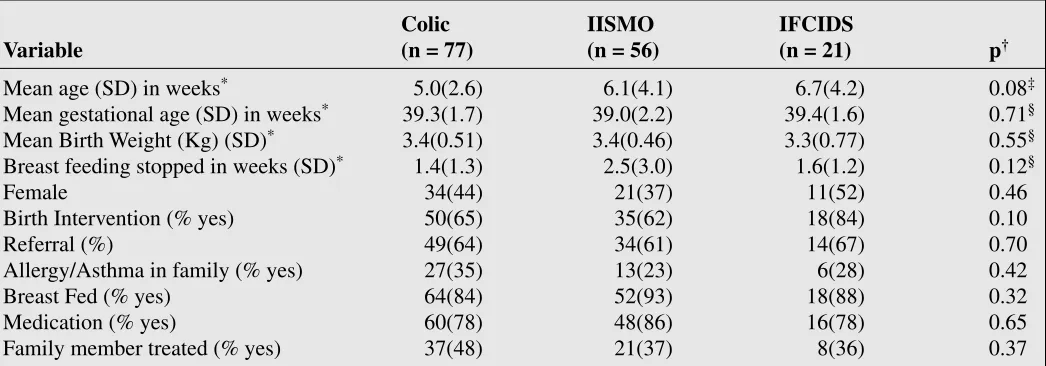
re-ferred to the GP for possible further investigation to rule out pathology. The remaining 158 were placed into cry-ing categories accordcry-ing to the criteria in Table 1. The colic category accounted for 77 (49%), IISMO 56 (35%) and IFCIDS 25 (16%) of the total study population re-spectively. None of the remaining demographic variables measured were statistically different between the 3 groups (Table 2). However, mean age was generally younger in the colic babies.
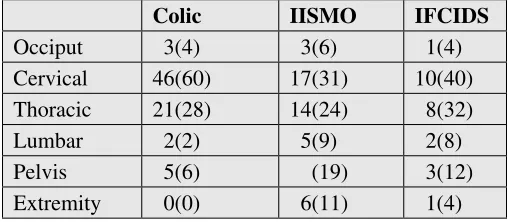
Primary areas of spinal dysfunction as indicated by the treating clinician were also investigated for each group. Although cervical and thoracic problems were identified most commonly across groups, IFCIDS and IISMO ba-bies had a greater range of other musculoskeletal prob-lems than colic babies (Table 3). The area treated was not significantly associated with any of the outcomes at a uni-variate or multivariable level.
Table 4 shows the number of treatments received in each group at discharge from care. A between group analysis showed significant differences (p < 0.001) with colic showing significantly fewer treatment sessions than IISMO or IFCIDS categories.
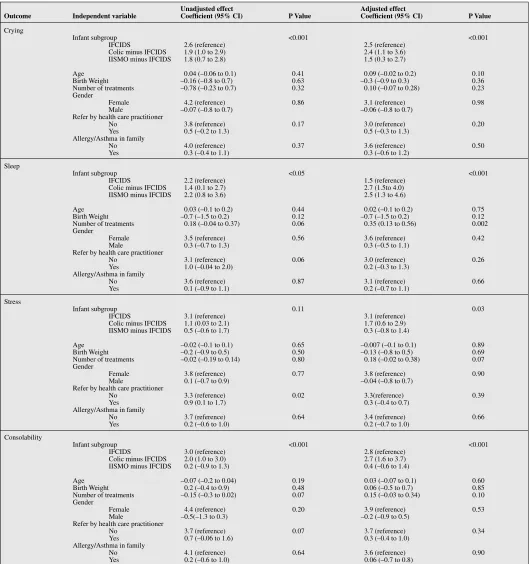
Table 5 summarises the parents’ perception of infant improvement after chiropractic treatment. The changes of parental ratings were significant at a level of p < 0.001
Colic IISMO IFCIDS
Variable (n = 77) (n = 56) (n = 21) p†
Mean age (SD) in weeks* 5.0(2.6) 6.1(4.1) 6.7(4.2) 0.08‡
Mean gestational age (SD) in weeks* 39.3(1.7) 39.0(2.2) 39.4(1.6) 0.71§
Mean Birth Weight (Kg) (SD)* 3.4(0.51) 3.4(0.46) 3.3(0.77) 0.55§
Breast feeding stopped in weeks (SD)* 1.4(1.3) 2.5(3.0) 1.6(1.2) 0.12§
Female 34(44) 21(37) 11(52) 0.46
Birth Intervention (% yes) 50(65) 35(62) 18(84) 0.10
Referral (%) 49(64) 34(61) 14(67) 0.70
Allergy/Asthma in family (% yes) 27(35) 13(23) 6(28) 0.42
Breast Fed (% yes) 64(84) 52(93) 18(88) 0.32
Medication (% yes) 60(78) 48(86) 16(78) 0.65
Family member treated (% yes) 37(48) 21(37) 8(36) 0.37
* Means with standard deviations in parentheses where specified. Counts with percentages in parentheses otherwise. † Pearsons Chi2 unless otherwise specified.
‡ Kruskal Wallis. § One-way ANOVA.
within all groups during treatment although colic and IISMO babies improved the most. Differences between groups for parent’s ratings are also shown in Table 5. At the multivariable level of analysis, the only variable that was significantly associated with change scores was the proposed subgroup, with the exception of the number of treatments on changes in sleep and stress. In this case, the number of treatments was weakly associated with in-creased sleep and dein-creased stress scores. For changes in both sleep and crying scales, the IFCIDS group displayed significantly poorer change scores than both colic and IISMO subgroups. For stress and consolability change scores, colic babies improved significantly more than the other two categories.
Discussion
This prospective observational study showed that cry-ing babies, when divided a priori into clinical categories, show significant differences between groups in parent re-ported outcomes at the end of treatment. Generally infants classified as “colic” had fewer treatments to discharge
and parents of infants with colic reported greater over-all improvement compared to the other two categories. Those infants categorised as IFCIDS at presentation im-proved less so in comparison to colic babies and IISMO babies, who improved the most, relative to the treatment outcomes. Baseline characteristics of the three groups did not significantly differ in gender, gestational age, birth-weight or birth type although colic babies were slightly younger and had the most unconsolable crying and this may indicate that parents are less tolerant of “waiting out” crying that cannot be soothed.
All three categories of irritable babies in this study shared a propensity for a higher than average rate of birth interventions, ranging from 65% in colic infants to 84% in IFCIDS in comparison to the average rate of interven-tions in the local area hospitals (which birth approximate-ly 5000 babies yearapproximate-ly) of 34.8%13 This is consistent with
various studies that found an association between type of birth and the excessively crying baby.9,14–17 Although this
could possibly reflect a biomechanical mechanism of in-fant distress, this study cannot confirm this idea.
In all three groups spinal areas of dysfunction were found primarily in the cervical, thoracic and pelvic areas. There were considerably more colic infants for which the cervical region was the primary area of dysfunction. Pre-vious studies have found that the most common dysfunc-tion pattern found in irritable babies involves the upper cervical complex and the most common abnormal mo-tion segment in infants with musculoskeletal problems is C1-2.2,7,17
There were significant differences between groups in the number of treatments received, with the colic group receiving the fewest average number of treatments and the IFCIDS group receiving the most. At a multivari-able level, more treatment was significantly associated with improved sleep, but not significantly associated with changes in other outcomes. A number of manual thera-py trials have reported an average of four treatments for children with colic.18–20 However, in other trials, fewer or
more treatments have been reported and it is clear that little consensus about the optimum number of treatments appears in the literature.21–23 It is possible that trials have
not always recruited exclusively colic patients and conse-quently, a heterogeneous population of crying babies may have been included in previous trials and could plausibly account for disparity in treatment numbers.
Table 3 Comparison across the groups of practitioner-determined areas of primary dysfunction*
Colic IISMO IFCIDS
Occiput 3(4) 3(6) 1(4)
Cervical 46(60) 17(31) 10(40)
Thoracic 21(28) 14(24) 8(32)
Lumbar 2(2) 5(9) 2(8)
Pelvis 5(6) (19) 3(12)
Extremity 0(0) 6(11) 1(4)
* Column frequencies with percentages in parentheses.
Table 4 Number of treatments at release from care Infant
colic IISMO IFCIDS
Mean number
(SD) 4.5(1.2) 6.6(2.3) 7.2(2.3)
Difference (95% CI)
Table 5 Results of linear regression models assessing the effects of infant group and other independent variables on change scores
Unadjusted effect Adjusted effect
Outcome Independent variable Coefficient (95% CI) P Value Coefficient (95% CI) P Value
Crying
Infant subgroup <0.001 <0.001
IFCIDS 2.6 (reference) 2.5 (reference)
Colic minus IFCIDS 1.9 (1.0 to 2.9) 2.4 (1.1 to 3.6)
IISMO minus IFCIDS 1.8 (0.7 to 2.8) 1.5 (0.3 to 2.7)
Age 0.04 (–0.06 to 0.1) 0.41 0.09 (–0.02 to 0.2) 0.10
Birth Weight –0.16 (–0.8 to 0.7) 0.63 –0.3 (–0.9 to 0.3) 0.36
Number of treatments –0.78 (–0.23 to 0.7) 0.32 0.10 (–0.07 to 0.28) 0.23
Gender
Female 4.2 (reference) 0.86 3.1 (reference) 0.98
Male –0.07 (–0.8 to 0.7) –0.06 (–0.8 to 0.7)
Refer by health care practitioner
No 3.8 (reference) 0.17 3.0 (reference) 0.20
Yes 0.5 (–0.2 to 1.3) 0.5 (–0.3 to 1.3)
Allergy/Asthma in family
No 4.0 (reference) 0.37 3.6 (reference) 0.50
Yes 0.3 (–0.4 to 1.1) 0.3 (–0.6 to 1.2)
Sleep
Infant subgroup <0.05 <0.001
IFCIDS 2.2 (reference) 1.5 (reference)
Colic minus IFCIDS 1.4 (0.1 to 2.7) 2.7 (1.5to 4.0)
IISMO minus IFCIDS 2.2 (0.8 to 3.6) 2.5 (1.3 to 4.6)
Age 0.03 (–0.1 to 0.2) 0.44 0.02 (–0.1 to 0.2) 0.75
Birth Weight –0.7 (–1.5 to 0.2) 0.12 –0.7 (–1.5 to 0.2) 0.12
Number of treatments 0.18 (–0.04 to 0.37) 0.06 0.35 (0.13 to 0.56) 0.002
Gender
Female 3.5 (reference) 0.56 3.6 (reference) 0.42
Male 0.3 (–0.7 to 1.3) 0.3 (–0.5 to 1.1)
Refer by health care practitioner
No 3.1 (reference) 0.06 3.0 (reference) 0.26
Yes 1.0 (–0.04 to 2.0) 0.2 (–0.3 to 1.3)
Allergy/Asthma in family
No 3.6 (reference) 0.87 3.1 (reference) 0.66
Yes 0.1 (–0.9 to 1.1) 0.2 (–0.7 to 1.1)
Stress
Infant subgroup 0.11 0.03
IFCIDS 3.1 (reference) 3.1 (reference)
Colic minus IFCIDS 1.1 (0.03 to 2.1) 1.7 (0.6 to 2.9)
IISMO minus IFCIDS 0.5 (–0.6 to 1.7) 0.3 (–0.8 to 1.4)
Age –0.02 (–0.1 to 0.1) 0.65 –0.007 (–0.1 to 0.1) 0.89
Birth Weight –0.2 (–0.9 to 0.5) 0.50 –0.13 (–0.8 to 0.5) 0.69
Number of treatments –0.02 (–0.19 to 0.14) 0.80 0.18 (–0.02 to 0.38) 0.07
Gender
Female 3.8 (reference) 0.77 3.8 (reference) 0.90
Male 0.1 (–0.7 to 0.9) –0.04 (–0.8 to 0.7)
Refer by health care practitioner
No 3.3 (reference) 0.02 3.3(reference) 0.39
Yes 0.9 (0.1 to 1.7) 0.3 (–0.4 to 0.7)
Allergy/Asthma in family
No 3.7 (reference) 0.64 3.4 (reference) 0.66
Yes 0.2 (–0.6 to 1.0) 0.2 (–0.7 to 1.0)
Consolability
Infant subgroup <0.001 <0.001
IFCIDS 3.0 (reference) 2.8 (reference)
Colic minus IFCIDS 2.0 (1.0 to 3.0) 2.7 (1.6 to 3.7)
IISMO minus IFCIDS 0.2 (–0.9 to 1.3) 0.4 (–0.6 to 1.4)
Age –0.07 (–0.2 to 0.04) 0.19 0.03 (–0.07 to 0.1) 0.60
Birth Weight 0.2 (–0.4 to 0.9) 0.48 0.06 (–0.5 to 0.7) 0.85
Number of treatments –0.15 (–0.3 to 0.02) 0.07 0.15 (–0.03 to 0.34) 0.10
Gender
Female 4.4 (reference) 0.20 3.9 (reference) 0.53
Male –0.5(–1.3 to 0.3) –0.2 (–0.9 to 0.5)
Refer by health care practitioner
No 3.7 (reference) 0.07 3.7 (reference) 0.34
Yes 0.7 (–0.06 to 1.6) 0.3 (–0.4 to 1.0)
Allergy/Asthma in family
No 4.1 (reference) 0.64 3.6 (reference) 0.90
Although some authors suggest scant evidence for ef-ficacy in the treatment of colic using chiropractic as an intervention,24 others such as Hughes and Bolton suggest
that “there is good evidence that taking a colicky infant to a chiropractor will result in fewer reported hours of colic by the parents.”25 This may indicate a dearth of high
qual-ity trials or, alternatively, evidence of a genuine treatment effect. Either way, it is an important finding that parents genuinely perceive that children cry less after a thera-peutic encounter. In support of the Hughes and Bolton proposition, this study also shows that parents reported that all three groups showed reductions in crying prior to discharge with the greatest improvement in crying and consolability in those infants categorised as “colic.”
Given the self-reported nature of outcomes by parents, it is quite likely that changes in parents’ stress may have affected crying and that changes in crying may have af-fected parents’ stress. It is possible that with infant recov-ery came lowered stress levels in the parents.
On the other hand, it must be considered that parental stress may have reduced naturally with time rather than as a result of crying reduction. Whatever the mechanism, it is apparent that the same level of parental stress reduction did not occur in the IFCIDS category who’s crying did not reduce as markedly as the other two groups. This study was not designed to understand the interaction between parental stress and infant crying, but it is still important to note that mothers reported experiencing reduced stress when crying was reduced. This finding is consistent with that of other studies.2,26,27
The primary objective of this study was to describe unique characteristics of crying infants that differ between clinically plausible subgroups. There is clinical logic to the divisions; colic babies cry a great deal and are incon-solable, but sleep reasonably well. IISMO infants cry a great deal, but are consolable when they are able to reach a comfortable position with antalgic posture and therefore cry less, but do not sleep well because they are unable to maintain this position when placed supine in a cot (re-quired due to the back-to-sleep programme). IFCIDS cry the most and sleep the least. It has been hypothesized that crying can occur at the expense of sleep and that seems to be the case in the IFCIDS group. Additionally in this group there may be another component to these children’s discomfort as they do not feed well; this is not a problem in either of the other two groups. Therefore, hunger may
be part of the problem, although there were no notable differences in growth charts (results not shown). Further studies should be carried out to see if this is the case.
Improved sleeping patterns in paediatric patients after manual therapy treatment is frequently reported in the lit-erature.18,23,28,29 In a RCT of 43 infants, the mean hours
of sleep per day were significantly improved at day 14 in both groups that received manual therapy.23 Parents
also reported improved sleep in our study to a significant degree.
True to their reputation, colic infants were the least consolable1–5,8,9,18 at baseline and the IISMO group were
the easiest to console. This observation may have clini-cal plausibility in that IISMO infants become comfortable with help achieving their posture of comfort. Colic infants do not respond to postural change. After chiropractic care the colic group became more consolable than the IISMO group. To reach this level, the colic group reported the highest average improvement score in consolability.
Both the IISMO and colic groups reported the high-est average level of overall improvement compared to the IFCIDS category. It is interesting to note that in those infants considered to have a preponderance of mus-culoskeletal problems (IISMO and Colic).8,10,7,18–23 that
improvement during chiropractic treatment was most marked. Such an association was not found in the IFCIDS group and it is possible that manual therapy may not be the treatment of choice for this group of crying infants, although further investigation is needed to corroborate this idea.
Clear limitations exist in this study. First, the prospect-ive cohort design precludes any association of changes seen with treatment as all the effects observed may be a consequence of effect upon the mothers reporting rather than direct effects on the baby, natural history or age, al-though the treatment times of 2–3 weeks was generally shorter than the accepted natural history of the disorder (12–24 weeks).1–6,15,30 However, parent reporting of
cry-fuss problems are clinically relevant and have been used in other studies in the literature.30,31 Second, it should also
be noted that this study was subject to sampling bias as it was limited to one teaching clinic, the patient population of which may be different from that of a small field prac-tice or to other larger geographical areas.
cat-egories of crying infants. Although categorisation was achieved without prior strong evidential support, consid-erable observational data suggest that there may be real differences between types of crying babies, particularly three groups described herein, IISMO and IFCIDS. Fur-ther studies should be carried out to ascertain the veracity of these observations but at the very least, in this study, a priori categorisation of crying infants was associated with significant differences in measured outcomes.
In conclusion, the excessively crying infant may not be a homogenous group and it is possible that the categoriza-tion used here may capture relevant characteristics that serve to differentiate meaningful subgroups. It remains a possibility that treatment outcome can be improved by clinically dividing patients into appropriate subgroups prior to manual therapy.
Acknowledgement
We wish to acknowledge Sean Phelps who worked tire-lessly to collate this data.
References
1 Morris S, St.James-Roberts I, Sleep J, Gillham P.
Economic evaluation of strategies for managing crying and sleeping problems. Arch Dis Child. 2001; 84:15–19. 2 Davies, NJ, Jamison, JR. Chiropractic management of
irritable baby syndrome. Chiro J Aust. 2007; 37(1):25–29. 3 Barr RG, St James-Roberts I, Keefe MR, eds,. New
Evidence on Unexplained Early Infant Crying: Its Origins, Nature and Management 2001.
4 Akman I, Kuscu K, Ozdemir N, Yurdakul Z, Solakoglu M, Orhan L, Karabekiroglu A, Ozek E. Mothers’ postpartum psychological adjustment and infantile colic. Arch Dis Child. 2006;91 (5):417–419.
5 Crowcroft NS, Strachan DP. The social origins of infantile colic: questionnaire study covering 76,747 infants. BMJ.1997; 314:1325–1328.
6 Reijneveld SA, van der Wal MF, Brugman E, Hira Sing RA, Verloove-Vanhorick SP. Infant crying and abuse. Lancet. 2004; 364:1340–1342.
7 Biedermann, H. Manual therapy in children: proposals for an etiologic model. J Manip Physiol Ther. 2005; 28(3): e1–e15.
8 Miller J, Caprini-Croci S. Cry baby, why baby? Beyond colic: is it time to widen our view? J Clin Chiro Peds. 2005; 6(3):419–423.
9 Kvitvaer BG, Miller J, Newell D. Improving our
understanding of the irritable infant: an observational study in a chiropractic teaching clinic. J Clin Nurs. epub.2011. 10 Hamanishi C, Tanaka S. Turned head-adducted hip–truncal
curvature syndrome. Arch Dis Child. 1994; 70:515–9.
11 Philippi H, Faldum A, Schleupen A, Pabst B, Jung T, Bergmann H, Bieber I, Kaemmerer C, Dijs P, Reitter B. Infantile postural asymmetry and osteopathic treatment: a randomized therapeutic trial. Dev Med Child Neurol. 2006; 48:5–9.
12 Miller J. Cry babies: a framework for chiropractic care. Clin Chiropr. 2007; 10:139–146.
13 www.Birthchoice.co.uk
14 Hogdall CK, Vestermark V, Birch M, Plenov G, Toftager-Larsen K. The significance of pregnancy, delivery and postpartum factors for the development of infantile colic. J Perinat Med. 1991; 19:251–257.
15 Saavedra MAL, Dias da Costa JS, Garcias G, Horta BL, Tomasi E, Mendonca R. Infantile colic incidence and associated factors: a cohort study. J Pediatr. 2003; 79(2):115–122.
16 Vestager SV, Husted-Andersen S, Myburgh C, Grunnet-Nilsson N. A possible correlation between the duration of birth and infantile colic – a short preliminary report. Clin Chiropr. 2007; 10(4):195–197.
17 Biedermann H. Kinematic imbalances due to suboccipital strain in newborns. J Manual Med. 1992; 6:151–156. 18 Hayden C, Mullinger B. A preliminary assessment of the
impact of cranial osteopathy for the relief of infant colic. Complementary Therapies in Clinical Practice. 2006; 12(2):83–90.
19 Klougart N, Nilsson N, Jacobsen J. Infantile colic treated by chiropractors: a prospective study of 316 cases. J Manipulative Physiol Ther. 1989; 12(4):281–288.
20 Koonin SD, Karpelowsky AS, Yelverton CJ, Rubens BN. A comparative study to determine the efficacy of chiropractic spinal manipulative therapy and allopathic medication in the treatment of infantile colic. In: 7th Biennial Congress
of the World Federation of Chiropractic. Orlando (FL), 2003:1–3.
21 Wiberg JMM, Nordsteen J, Nilsson N. The short-term effect of spinal manipulation in the treatment of infantile colic: a randomized controlled clinical trial with a blinded observer. J Manipulative Physiol Ther. 1999; 22(8):517– 522.
22 Olafsdottir E, Forshei S, Fluge G, Markestad, T.
Randomised controlled trial of infantile colic treated with chiropractic spinal manipulation. Arch Dis Child. 2001; 84:138–141.
23 Browning M, Miller J. Comparison of the short-term effects of chiropractic spinal manipulation and occipito-sacral decompression in the treatment of infant colic: A single-blinded, randomised, comparison trial. Clinical Chiropractic. 2008; 11, 122–129.
24 Bronfort G, Haas M, Evans R, Leiniger B, Triano J. Effectiveness of manual therapies: the UK evidence report. Chiropractic and Osteopathy. 2010; 18(3):e1–112.
26 Long T, Johnson M. Living and coping with excessive infantile crying. J Adv Nurs. 2001; 34(2):155–162. 27 Keefe MR, Kajrlsen KA, Lobo ML, Kotzer AM, Dudley
WN. Reducing parenting stress in families with irritable infants. Nurs Res. 2006; 55(3):198–205.
28 Rome PL. Case report: The effect of a chiropractic spinal adjustment on toddler sleep pattern and behaviour. Chiro J Austr. 1996; 26(1):11–14.
29 Miller J, Klemsdal M. Can chiropractic care improve infants’ sleep? J Clin Chiro Ped. 2008; 9(1):543–546.
30 Lehtonen LA, Rautava PT. Infantile colic: natural history and treatment. Curr Probl Pediatr. 1996; 26:79–85. 31 Wake M, Morton-Allen E, Poulakis Z, Hiscock H, Gallagher S, Oberklaid F. Prevalence, stability, and outcomes of cry-fuss and sleep problems in the first 2 years of life: prospective community-based study. Pediatrics. 2006; 117:836–842.