Impulsivity and Behaviour Problems in Dogs: A Reinforcement Sensitivity Theory 1
Perspective 2
Patrizia Piottia,1*, Liam Paul Satchella,2, Tom Steven Lockharta 3
4
Affiliations 5
a Department of Psychology, University of Portsmouth, King Henry Building, King Henry 1st 6
Street Portsmouth, PO1 2DY, U.K. 7
8
*Corresponding author: [email protected] 9
10
Present/permanent address 11
1 Department of Ethology, ELTE Eötvös Loránd University, Pázmány Péter sétány 1/c, 1117, 12
Budapest, Hungary 13
2 School of Law and Criminology, University of West London, St Mary's Rd, London, W5 5RF, 14
U.K. 15
18
1. Introduction 19
Trait impulsivity is stirring growing interest among comparative researchers. One species 20
where the trait is being extensively investigated is the domestic dog (Canis familiaris) (e.g. Miller 21
et al., 2010, 2012; Fadel et al., 2016; Riemer et al., 2014; Wright et al., 2011, 2012). Research 22
shows theoretical and evidential convergence between human and dog impulsivity. For example, 23
consistent neuro-behavioural individual differences in cognitive control are found in dogs (Cook 24
et al., 2016) as well as humans (e.g. Kane and Engle, 2002). Likewise, both in dogs and humans, 25
self-control relies on biological mechanisms related to blood glucose levels (Miller, et al., 2010). 26
There are also indications of human-dog convergence regarding genotype-phenotype 27
associations for trait impulsivity (humans: Munafó et al., 2008; dogs: Hejjas et al., 2009; Wan et 28
al., 2013). Impulsivity in dogs is also related to behaviours similar to human psychological 29
disorders. For example, genetic and behavioural homologies between dogs and humans have 30
been observed in relation to the Attention Deficit and Hyperactive Disorder (ADHD) (e.g. Hejjas 31
et al., 2009; Vas et al., 2007), as measured in dogs through a rating scale for the assessment of 32
ADHD in children, reworded for describing dog behaviour (Vas et al., 2007) and a behaviour 33
battery (Kubinyi et al., 2012). Another typical case is the relationship between high impulsivity and 34
aggressive behaviour, which has also been observed both in humans (Apter, et al., 1990) and 35
dogs (Amat et al., 2013; Wright et al., 2012). 36
The current study brings together a biologically based human measure of impulsivity and a well 37
validated dog measure of impulsivity, to investigate the extent to which the measures show 38
convergence. 39
Trait impulsivity may be measured in domestic dogs with questionnaire scales, such as 40
the Dog Impulsivity Assessment Scale (DIAS; Wright et al., 2011). The DIAS provides an overall 41
questionnaire score (OQS), which directly reflects the dog owner’s opinion on how impulsive their 42
behavioural measures (Brady et al., 2018). However, the scale also provides three independent 44
sub-factors, which can reflect distinct nuanced features of dog impulsivity. Factor 1, ‘Behaviour 45
Regulation’ factor provides a more focused measure of impulsivity: high scores relates to having 46
little control over a response to stimuli, little thinking before acting and being impatient, on the 47
other side relates to showing extreme physiological signs when being excited. Factor 2, 48
‘Aggression and Response to Novelty’ relates to lower tolerance thresholds to potentially aversive 49
stimuli: individuals with high scores are less keen on new situations and more likely to respond 50
aggressively to stimuli. Factor 3, ‘Responsiveness’ relates to general responsiveness and 51
environmental awareness: high scores reflect high trainability, long interest in stimuli and quick 52
reactions (Wright et al., 2011). The scale was found to relate to variation in the behaviour 53
observed in two systematically manipulated experimental designs, i.e. a delayed reward choice 54
test (Wright et al., 2012) and, for the OQS and Factor 1, a spatial discounting test (Brady et al., 55
2018); correlations were found also between the DIAS scores and variation in physiological 56
factors - i.e. serotonin metabolites (5-HIAA) levels (Wright et al., 2012). This suggests that the 57
DIAS is a reliable measure of trait impulsivity in domestic dogs. Further investigations have 58
indicated that DIAS scores and cognitive measures in behaviour tests remain stable over time, 59
suggesting that personality trait of impulsivity is consistent over time (Riemer et al., 2014; Fadel 60
et al., 2016). 61
In a broader sense trait impulsivity, as measured by the DIAS, may also be regarded as 62
part of a wider network of theories investigating dispositional approach and avoidance behaviour. 63
In this paper, we investigated how one such theory, the Reinforcement Sensitivity Theory (RST) 64
of personality, might be of interest to research areas on dogs’ individual differences. 65
RST is a neuropsychological account of the neural and cognitive processes underlying the 66
major dimensions of personality (Corr, 2008). The theory describes three neurologically defined 67
systems which influence the organism’s behaviours; the Behavioural Approach System (BAS, 68
and resolution of conflict between compelling goals) and the Fight-Flight-Freeze System (FFFS, 70
activated by aversive stimuli). The BAS has its neural basis in the dopaminergic reward circuitry 71
(Pickering and Gray, 2001) and underlies any behaviour that involves approaching appetitive 72
stimuli, whether it is to eat food or attack a prey. Because of this, the BAS is related to personality 73
traits such as optimism, reward-orientation and impulsivity (Corr, 2004). The neural basis of the 74
FFFS is the periaqueductal grey and medial hypothalamus (McNaughton and Corr, 2004). On a 75
proximal level, the system is activated in response to aversive stimuli, encouraging active 76
avoidance behaviours, and is responsible for personality traits such as proneness to fear (Corr & 77
McNaughton, 2008). The BIS can be related to the septo-hippocampal system (Gray & 78
McNaughton, 2000; Miller, 1991). The BIS is concerned with the monitoring and resolution of 79
conflict between incompatible but equally compelling approach and avoidance goals. In humans, 80
a strong presence of trait BIS is experienced as repetitive thoughts, rumination and anxiety 81
(Andersen, Moore, Venables & Corr, 2008; Markarian, Pickett, Deveson & Kanona, 2013; Morgan 82
et al., 2009). While low trait BIS is manifested as risk proneness and has been linked to Attention 83
Deficit Hyperactivity Disorder (Gomez, Woodworth, Waugh & Corr, 2012). 84
RST is highly relevant to the non-human animal research as it was developed from 85
experimental non-human animal behaviour research (Gray, 1987; Wilson, Barrett & Gray, 1989). 86
In fact, several RST neurological studies have been performed on non-human animals, such as 87
rodents (Ito & Lee, 2016; Young & McNaughton, 2008) and even AI programs have been coded 88
using RST (Fua, Horswill, Ortony & Revelle, 2009). RST is especially useful when observing 89
behaviour in non-verbalising species, as tendencies of approaching or avoiding aspects of the 90
environment are readily codeable, in that behaviour measures may be unambiguous, such as 91
increasing and decreasing of distances from a specific stimulus (see Budaev, 1997; Mather & 92
Anderson, 1993). Finally, the strong focus on overt behaviour in experimental settings, such as 93
go/no-go tasks, (Moore, Mills, Marshman & Corr, 2012) aids objective scoring of behaviour by 94
There are also some examples where elements drawn from RST have been employed in 96
the development of frameworks directed, for example, to domestic animal research of affective 97
states (Mendl, Burman & Paul, 2010) or individual differences in sensitivity to punishment and 98
reward (Sheppards & Mills, 2002). To our knowledge, however, the RST of personality has not 99
been applied in its entirety to companion animals’ research (i.e. without integration within further 100
theories). It is therefore not yet clear to which degree RST may be relevant to companion animals 101
and whether there is any overlapping with existing theories. For this reason, it was of interest to 102
place domestic dogs’ trait impulsivity in an RST theoretical network. 103
Dogs were chosen as a species of interest because they are adapted to life with humans 104
and share human social environment (Hare & Tomasello, 2002; Miklósi et al., 2003), which makes 105
them an ideal and convenient model of comparison in the study of personality (Gosling et al., 106
2003). Additionally, the investigation of frameworks that are able to predict individual traits 107
potentially linked to increased risk of developing behaviour problems in dogs has implications for 108
animal welfare. For example, there are indications that aggressive behaviour in dogs may relate 109
to neurotransmitters linked to impulsivity (Amat et al., 2013; Wright et al., 2012), a low BIS or high 110
BAS-related trait. Aggressive responses may also be fear-related in dogs (van der Borg, Graat 111
and Beerda, 2017; Zapata, Serpell and Alvarez, 2017), i.e. relevant to the FFFS. For example, 112
tendency to engage in active avoidant behaviours like barking or growling could be seen as 113
defensive behaviours, reflected in the FFFS. Or it could be the case that high trait BIS leads to 114
better inhibition of destructive behaviour that may occur when the animal is distressed. 115
Consistently with the theoretical link between impulsivity and behaviour inhibition, it has been 116
observed that depletion of self-control is linked to risk proneness in dogs (Miller et al., 2012). 117
The current study brings together the DIAS (Wright et al., 2011) and a psychometric 118
measure of RST (adapted from a children-focused scale; Cooper et al., 2017). As stated above, 119
the principal reason for including both DIAS and RST measures is due to the mutual importance 120
Regulation’ trait (which is correlated with the spatial discounting test of impulsivity, Brady et al., 122
2018) and the RST BAS (which includes impulsivity) traits. Further, given that RST BIS is arguably 123
the inverse of impulsivity and we expected this factor to negatively relate to the DIAS impulsivity 124
measures. We had an exploratory approach regarding the relationship between the other factors 125
of the RST and DIAS measures. Further we investigated the relationships between behavioural 126
problems and the personality measures. Given that the DIAS was designed with behavioural 127
problems in mind, we predicted that the DIAS traits predict behavioural problems. It was expected 128
that FFFS would positively correlate with avoidance behaviours (e.g. biting, barking, cowering, 129
trying to escape). We had no other explicit hypotheses for the relationship between the RST 130
measures and the behavioural problems. 131
132
2. Material and Methods 133
134
2.1. Procedure & Questionnaires 135
The current study was approved by the University of Portsmouth's Science Faculty Ethics 136
Committee (2017 - 026). The described work been performed in accordance with the Code of 137
Ethics of the World Medical Association (Declaration of Helsinki) for experiments involving 138
humans. Responses were provided anonymously by the participants. This work did not involve 139
direct experimentation, observation or interaction with live animals and ethics was required for 140
the data collection with animal owners. 141
After providing informed consent, participants completed the RST personality trait 142
questionnaire. This measure was adapted from the ‘Reinforcement Sensitivity Theory Personality 143
Questionnaire - Child (RSTPQ-C, 21 items; Cooper et al., 2017): for the current study, the 144
RSTPQ-C was reworded into a format that allowed owners to report on their dogs’ behaviour, 145
creating a Reinforcement Sensitivity Theory Personality Questionnaire-Dog (RSTPQ-D). Care 146
imitate the RSTPQ-C, the RSTPQ-D was also answered on a four-point scale with the options; 148
Not at all (scoring 1), Slightly (2), Moderately (3) and Highly (4). The mean response to each of 149
the RSTPQ-D subscales was used for analysis. The RSTPQ-D has 3 subscales of 7 items each, 150
reflecting trait BIS, FFFS and BAS. 151
After completion of the RSTPQ-D, participants completed the 18 item DIAS. DIAS 152
response is measured on a 5 point scale from Strongly Agree (5) to Strongly Disagree (1), with a 153
sixth Don’t know/not applicable option. Consistent with the scoring for the DIAS (Wright et al., 154
2011), each sub-factor was calculated as a ratio of the potential total score of items that had a 155
response (due to the Don’t know option, participants could opt to not respond to some items). The 156
DIAS (Wright et al. 2011) has 3 factors, Factor 1 ‘Behavioural Regulation’ (10 items, a high score 157
implies higher trait impulsivity), Factor 2 ‘Aggression and Response to Novelty’ (5 items, a high 158
score suggests a more aggressive/aversive aversion to novelty) and Factor 3 ‘Responsiveness’ 159
(5 items, a high score implies fast and engaged responses to new things). 160
Finally, participants were asked to answer to a checklist of 12 further questions related to 161
behaviour problems and indicate how well they described their dog’s behaviour. Questions were 162
presented in a 5-point scale, from Very much like my dog (5), to Not at all like my dog (1). 163
Questions referred to aggressive behaviours (barking, growling, biting, showing teeth, snapping), 164
cowering/fearful behaviour (shaking, panting, moving away), destructive behaviour (digging, 165
chewing) and house soiling. A copy of the questionnaire is provided as Supplemental Information 166
1. 167 168
2.2. Participants 169
The inclusion criteria for dog owners to participate in the study were to be at least 18 years 170
old and to have owned their dog for at least 6 months at the time they participated. Responses 171
1, neutered : intact = 6 : 1) were used for analysis. Dogs’ demographic information is included in 173
the Supplemental Information 2. 174
175
3. Results 176
3.1. Behaviour Checklist Factors. 177
Data were analysed using IBM SPSS Statistics version 22 and R (R Core Team, 2015). 178
We examined the grouping of the behaviours listed in the checklist as it was expected that some 179
behaviours may co-occur in some dogs. We first used an exploratory orthogonal (varimax) 180
principal component analysis (henceforth ‘EFA’) with the loadings of the 12 behaviours. This 181
suggested a four factor structure (Eigenvalue= 1.69, explaining 72% of variance) and grouped 182
the behaviours in the checklist in the expected manner. A confirmatory factor analysis (henceforth 183
‘CFA’) further evidenced this (χ2 (df= 48) = 153.90, p < 0.001, CFI= 0.97, RMSEA= 0.06). The four 184
factors generated related to Active Avoidance (i.e. increasing distance from a perceived threat), 185
Passive Avoidance (i.e. withholding interaction with a perceived threat), Destructive and 186
Inappropriate Elimination Behaviours. Active Avoidance Behaviours consisted of frequency of 187
Snapping (EFA loading= 0.89; CFA loading= 0.86), Biting (0.91; 0.92), Growling (0.82; 0.83) and 188
Barking (0.74; 0.78). Passive Avoidance Behaviours constituted of frequency of Avoiding others 189
(0.83; 0.95), Shaking (0.83; 0.96) and Panting (0.78; 0.87). Destructive Behaviours included 190
frequent Damaging of objects (0.81; 0.71), Digging (0.72; 0.59) and Other Destructive behaviours 191
(0.84; 0.76). Inappropriate Elimination related to reported Defecation (0.90; 0.52) and Urination 192
(0.90; 0.74) at inappropriate locations. For further analyses, we retain aggregate response of the 193
items for each factor, with a higher score indicating stronger endorsement of that behaviour. It is 194
important to note that Inappropriate Elimination Behaviours were rarely endorsed (see Table 1) 195
as were Destructive Behaviours (to a lesser extent). There was more variation in the Active and 196
Passive Avoidance Behaviours but, on average, owners were more likely to disagree that these 197
199
3.2. Personality Factors. 200
We computed average score totals for the DIAS and RSTPQ-D. The RSTPQ-D retained 201
an acceptable fit for its factor structure (21 items into three domains of FFFS, BIS and BAS) when 202
applied to the owner’s ratings of dogs (CFA: χ2 (df= 186) = 1001.94, p < 0.001, CFI= 0.88, 203
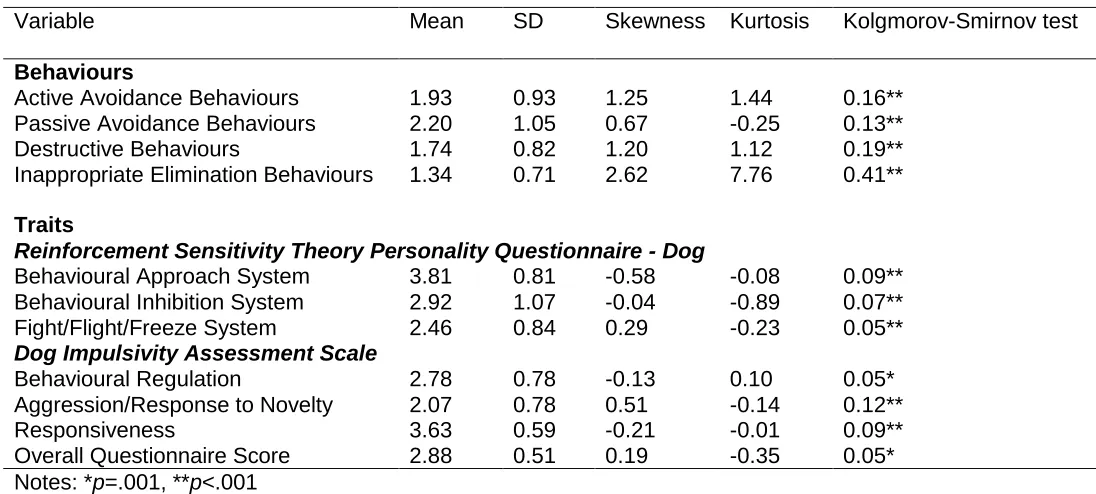
RMSEA= 0.08). The descriptive statistics for these personality factors can be found in Table 1. 204
Given that both these data and those of the behaviours are considered non-normal by 205
Kolmogorov-Smirnov testing (table 1), we investigate relationships between our variables using 206
Spearman’s rho correlations. In order to correct for multiple comparisons, the significance level 207
has been corrected for the number of comparisons, therefore a significance level of alpha = 0.002 208
was accepted (alpha = 0.05 / 24). 209
The RSTPQ-D’s BAS measure positively correlated with the DIAS’ Responsiveness 210
(rs(730)= 0.46, 95% CI [0.40, 0.53], p< 0.001), this suggests that the RST’s BAS has a similar 211
function to the DIAS’ Responsiveness trait. There were small negative correlations with the DIAS’ 212
Aggression/Response to Novelty (rs(730)= -0.19, 95% CI [-0.26, -0.12], p< 0.001) and 213
Behavioural Regulation (rs(730)= -0.12, 95% CI [-0.19, -0.05], p= 0.002). 214
There was a notable negative correlation between the RSTPQ-D’s BIS and the DIAS’ 215
Behavioural Regulation factor (rs(730)= -0.30, 95% CI [-0.37, -0.22], p< 0.001), reflecting that 216
reported impulsivity is in opposition to reported inhibition. There were much weaker correlations 217
with the DIAS’ Aggression/Response to Novelty (rs(730)= 0.15, 95% CI [0.08, 0.23], p< 0.001) 218
and Responsiveness (rs(730)= -0.08, 95% CI [-0.15, -0.01], p= 0.024) factors. 219
The RSTPQ-D’s FFFS factor was largely distinct to the DIAS factors. It did not notably 220
correlate with Behavioural Regulation (rs(730)= -0.02, 95% CI [-0.10, 0.06], p= 0.531), 221
Aggression/Response to Novelty (rs(730)= 0.04, 95% CI [-0.03, 0.12], p= 0.243) or 222
Responsiveness (rs(730)= -0.12, 95% CI [-0.20, -0.04], p= 0.002). Overall, RST’s FFFS and the 223
and Aggression/Response to Novelty relate to avoidance-style behaviours and this result would 225
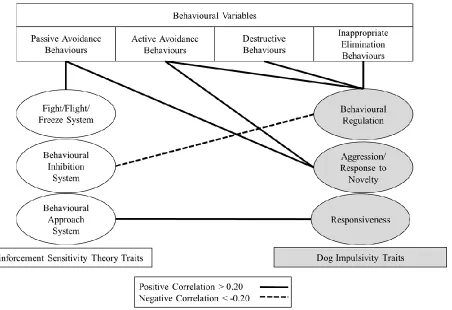
suggest that they relate to different aspects of behavioural avoidance. Fig 1. provides a visual 226
overview of the relationships between the trait factors. 227
228
3.3. Personality and Behaviours. 229
One aim of this study was to identify personality traits that related to common problem 230
behaviours in dogs. The correlations between personality and behaviours are reported in Table 231
2. Overall the DIAS better reflects problem behaviours than the RSTPQ-D. There are notable 232
correlations between DIAS’ Behavioural Regulation (impulsivity measure) and the more overt 233
Active Avoidance and Destructive Behaviours. DIAS’ Aggression/Response to Novelty positively 234
correlated with both the Active and Passive Avoidance Behaviours, implying that a trait aversion 235
to novel stimuli was more likely to lead to behavioural avoidance. DIAS’ Responsiveness showed 236
no noteworthy correlations with the behaviours. 237
The RSTPQ-D had smaller correlations with the Behaviours than the DIAS. However, the 238
FFFS trait did positively correlate with Passive Avoidant traits and (weakly) negatively with Active 239
Avoidance traits and the difference in the size of these two correlations is notably large (Fisher’s 240
Z’ test= 7.76, p<0.001). This suggests that the FFFS trait may reflect an axis of Active to Passive 241
Avoidant Behaviour and offer more discriminability in the style of avoidance behaviour than the 242
DIAS traits. BIS and BAS largely did not correlate with the behaviours. 243
244
4. Discussion 245
The current study investigated the overlap between measures of domestic dog 246
impulsivity (DIAS) and a broader cross-species theory of individual differences in 247
approach/avoid behaviour, Reinforcement Sensitivity Theory (Gray and McNaughton, 2000). 248
Our results show that, in dogs, RST trait inhibition (BIS) is the inverse to impulsivity, as 249
the positive relationship between BAS and Responsiveness, as predicted. The DIAS 251
Responsiveness factor contains behaviours related to high trainability, interest in the 252
environment and quick reactions (Wright et al., 2011). Such behaviours intuitively relate to trait 253
BAS, which promotes reward seeking and goal-oriented behaviours (Corr, 2004). These 254
findings suggest that the RST theoretical framework can be used to complement the DIAS tool. 255
None of the DIAS facets related with the RST trait FFFS. FFFS did demonstrate a small 256
positive correlation with the Passive Avoidance behaviour problems and a negative relationship 257
with the Active Avoidance. From this, we see that FFFS is largely distinct from the DIAS model 258
but it may potentially have predictive value for fear-related behavioural problems in dogs, such 259
as aggression (in line with previous findings on dog aggression: Amat et al., 2013; Wright et al., 260
2012). According to RST, FFFS is related to the Fight-Flight-Freeze response, which reflects 261
defensive avoidance strategies based on the perceived intensity of a threat. Threat perception 262
may be measured in terms of defensive distance, i.e. distance from a threat that causes various 263
defensive behaviours (Blanchard and Blanchard, 1988). The smallest defensive distances result 264
in explosive attack (fight response), while intermediate defensive distances lead to flight and 265
freeze (Blanchard and Blanchard, 1988; McNaughton and Corr, 2004). Interestingly, an 266
alternative measure of individual differences in dogs, the PANAS scale (Positive and Negative 267
Activation Scale, Sheppard and Mills, 2002), is partially driven from an RST scale based on an 268
earlier version of the framework (Carver and White, 1994) and measures dogs’ sensitivity to 269
reward and to punishment, which reflects the directional component of the most recent version 270
of RST (Gray and McNaughton, 2000). Given the current results, investigating how the PANAS 271
relates with the updated FFFS domain would provide further evidence of the applicability of RST 272
to the investigation of dog behaviour. 273
The relationship between DIAS-Behaviour Regulation and Active Avoidance / 274
Destructiveness (both characterised by high activity levels) also suggests that such behaviours 275
line with the human literature, where low BIS is associated with risk proneness and ADHD 277
(Gomez, Woodworth, Waugh & Corr, 2012) and the canine literature, where high impulsivity, as 278
measured with the DIAS, is associated with aggressive behaviour (Wright et al., 2012). While it 279
is not possible to draw conclusions on similar patterns in dogs, given the established similarities 280
between human and dog ADHD (Hejjas et al., 2009; Kubinyi et al., 2012; Vas et al., 2007), it 281
may be also of interest to understand whether RST relates with the existing measures of canine 282
ADHD. 283
Overall, the current results highlight how RST might be potentially of interest for the 284
investigation of dogs’ individual differences, especially in the investigation of approach and 285
avoidance behaviour. We suggest that the questions relating to the FFFS factor of the RSTPQ-286
D could integrate the existing DIAS scale. We also suggest that future research should look 287
further into how RST framework may be used to interpret results obtained from the DIAS. In 288
order to further explore this possibility, future research on the relationship between RST and 289
trait dog behaviour should be investigated through behavioural experiments, providing direct 290
observation of behaviour under systematic manipulation. Various existing experimental 291
paradigms have indicated individual differences in dogs based on approach and avoidance 292
behaviours (e.g. cognitive bias test, Starling et al., 2014; response to threat, Vas et al., 2008). 293
There is also evidence that difference in persistence affects dogs’ strategies when trying to 294
retrieve a food reward in the presence of a cognitive conflict, such as in the so-called unsolvable 295
task (Marshall-Pescini et al., 2017). Finally, several experimental tasks have been developed to 296
measure inhibitory control in dogs (which is supposedly related to impulsive behaviour as 297
measured by the DIAS, Wright et al., 2011), suggesting a subdivision in persistency, 298
compulsivity and decision speed (Brucks et al., 2017). This subdivision suggests it may be of 299
interest to investigate how the result of these behaviour tests relate with the RST domains. 300
Given the existing strong neurobiology basis of RST, it is also worthy to consider that 301
literature - for example, in humans, behaviour tests based on go/no go and stop signal tasks are 303
paired with EEG measurements (Brier et al., 2010; Moore et al., 2012; Shadli, Glue, McIntosh & 304
McNaughton, 2015). Finally, RST work could also be extended to other non-human species 305
where individual differences research focuses on approach-avoid behaviours (e.g. birds: Meier 306
et al., 2017; sheep: Beausoleil et al., 2005; sharks: Byrnes and Brown, 2016; Finger et al., 2016; 307
minks: Malmkvist et al., 2003) 308
The current study revolves on data coded by dog-owners rather than direct observations 309
of dogs’ behaviour, which may be considered a limitation of the presented work. Although care 310
was taken to avoid questions on “internalised” processes, it should be understood that the 311
responses reflect the owner’s interpretation of their dog’s behaviour. However, previous 312
research indicates that dog owners are relatively reliable in describing their dogs’ behaviour 313
(Gosling et al., 2003). Additionally, the DIAS scale has been validated against experimental 314
measures and for consistency over time (Wright et al., 2011; Riemer et al., 2014; Fadel et al., 315
2016). Moreover, the aim of the current study was to measure correlations between the two 316
scales, RSTPQ-D and DIAS, rather than informing on the validity of an RST measure in itself. 317
Validation should be in fact a consideration for future studies. 318
Another consideration regards the relatively small correlations observed between the 319
RST and the DIAS factors. This may suggest that part of the observed variance might be 320
attributable to external factors (Ferguson, 2009) not considered in this study, such as breed 321
differences or training experience. These and other potential confounders should be evaluated 322
in the future. 323
Finally, it is noteworthy that the current findings support the idea that investigating the 324
potential applications to RST to non-human animals may provide benefits also to animal 325
welfare. Versions of RST scales (e.g. Carver and White, 1994; Gray 1994; McNaughton & Corr, 326
2008) have been beneficial to the development of frameworks, based on approach and 327
al., 2010), providing evidence that RST may be relevant to companion animals in general and 329
dogs specifically. For example, research based on measuring dogs’ tendency to approach 330
rewarding stimuli and avoid unpleasant ones, has led to the demonstration of a negative 331
cognitive bias in dogs affected by separation related issues (Burman et al., 2009). Additionally, 332
a scale (PANAS), which partially draws from an earlier version of RST, proved to be useful in 333
measuring sensitivity to reward and punishment in dogs, which is particularly relevant to predict 334
the success of dog training or veterinary behaviour medicine interventions (Sheppard and Mills, 335
2002). Indeed, RST provides a theoretical framework grounded on neurobiological evidence to 336
understand traits related to behaviour issues, such as impulsive behaviour or anxiety. The 337
partial overlapping between the RSTPQ-D and the DIAS and the relationship of the FFFS facet 338
with reported behaviour issues potentially related to fear and anxiety (avoidance behaviours) 339
further advocates for the investigation of RST as a tool to understand companion animals’ 340
behaviour. Given the necessary validation, RST might, in the future, aid the selection of 341
treatments in clinical cases through a better distinction between FFFS-fear behaviours and BIS-342
anxiety behaviours, in line with the definitions provided by Gray and McNaughton (2000), 343
especially in those cases characterised by immobility as behavioural response, which might 344
reflect freezing behaviour (activation of FFFS) or conflict (activation of BIS). Again, RST has 345
proved to be beneficial in human psychology for the identification of markers for the risk to 346
develop psychological disorders (e.g. anxiety, Shadli et al., 2015); similar research directions 347
could be explored in veterinary behaviour medicine, especially in the presence of other known 348
environmental risk factors, such as dogs adopted from pet shops or shelters (Cannas et al., 349
2017). Nevertheless, benefits may be extended also to other species, even beyond domestic 350
animals. For example, inhibitory control in a stop-signal task has been linked to increased fit and 351
survival in pheasants (Whiteside et al., 2016). 352
353
In conclusion, the findings of this work suggest an overlap between RST and the 355
constructs of trait impulsivity in dogs (as measured by the DIAS). However, this is a starting 356
point, the aim of which is to suggest RST as a useful framework for the cross-specific 357
investigation of individual differences. Future experimental and large scale personality studies 358
will allow for the comprehensive framework of RST to contribute to the literature on dogs’ and 359
other non-human animals’ welfare and behaviour. 360
361
Acknowledgments 362
This work was supported by the University of Portsmouth (U.K.). 363
We would like to thank all the participants of our online questionnaire. 364
365
Compliance with Ethical Standards 366
Conflict of Interest: Patrizia Piotti declares that she has no conflict of interest. Liam Satchell 367
declares that he has no conflict of interest. Tom Lockhart declares that he has no conflict of 368
interest. 369
370
References 371
372
1. Amat, M., Le Brech, S., Camps, T., Torrente, C., Mariotti, V. M., Ruiz, J. L., & Manteca, X. 373
(2013). Differences in serotonin serum concentration between aggressive English cocker 374
spaniels and aggressive dogs of other breeds. Journal of Veterinary Behavior: Clinical 375
Applications and Research, 8(1), 19-25. 376
2. Andersen, S. B., Moore, R. A., Venables, L., & Corr, P. J. (2009) Electrophysiological 377
correlates of anxious rumination. International Journal of Psychophysiology, 71(2), 156– 378
3. Apter A., van Praag H. M., Plutchik R., Sevy S., Korn M., Brown S-L. (1990) 380
Interrelationships among anxiety, aggression, impulsivity, and mood: A serotonergically 381
linked cluster? Psychiatry Research, 32(2), 191–199. 382
4. Beausoleil, N. J., Stafford, K. J., & Mellor, D. J. (2005) Sheep show more aversion to a dog 383
than to a human in an arena test. Applied animal behaviour science, 91(3), 219-232. 384
5. Blanchard, D. C., & Blanchard, R. J. (1988) Ethoexperimental approaches to the biology of 385
emotion. Annual review of psychology, 39(1), 43-68. 386
6. Brady, K., Hewison, L., Wright, H., Zulch, H., Cracknell, N., & Mills, D. (2018) A spatial 387
discounting test to assess impulsivity in dogs. Applied Animal Behaviour Science. 388
7. Brier, M. R., Ferree, T. C., Maguire, M. J., Moore, P., Spence, J., Tillman, G. D., Hart Jr, J. 389
and Kraut, M. A. (2010) Frontal theta and alpha power and coherence changes are 390
modulated by semantic complexity in Go/NoGo tasks. International Journal of 391
Psychophysiology, 78(3), pp.215-224. 392
8. Budaev, S. V. (1997) Alternative styles in the European wrasse, Symphodus ocellatus: 393
boldness-related schooling tendency. Environmental Biology of Fishes, 49(1), 71-78. 394
9. Cannas, S., Talamonti, Z., Mazzola, S., Minero, M., Picciolini, A., & Palestrini, C. (2017). 395
Factors associated with dog behavior problems referred to a behavior clinic. Journal of 396
Veterinary Behavior. 397
10. Cook P. F., Spivak M, Berns G (2016) Neurobehavioral evidence for individual differences 398
in canine cognitive control: an awake fMRI study. Animal cognition, 19(5), 867-878. 399
11. Cooper, A. J., Stirling, S., Dawe, S., Pugnaghi, G., & Corr, P. J. (2017) The reinforcement 400
sensitivity theory of personality in children: A new questionnaire. Personality and Individual 401
Differences, 115, 65–69. 402
12. Corr, P. J. & McNaughton, N. (2008) Reinforcement Sensitivity Theory and personality. In 403
P. J. Corr (ed.), The Reinforcement Sensitivity Theory of Personality (pp. 155-187). 404
13. Fadel, F.R., Driscoll, P., Pilot, M., Wright, H., Zulch, H. and Mills, D. (2016) Differences in 406
trait impulsivity indicate diversification of dog breeds into working and show lines. Scientific 407
reports, 6, p.22162. 408
14. Ferguson, C.J. (2009) An effect size primer: a guide for clinicians and 409
researchers. Professional Psychology: Research and Practice, 40(5), p.532. 410
15. Fua, K., Horswill, I., Ortony, A., & Revelle, W. (2009) Reinforcement Sensitivity Theory and 411
Cognitive Architectures (AAAI Technical Repots FS-09-01). Arlington: AAAI Press 412
16. Gray, J. A., McNaughton, N. (2000) The neuropsychology of anxiety: an enquiry into the 413
functions of the septo-hippocampal system, 2nd ed., Oxford University Press. 414
17. Goldberg L. R. (1990) An alternative "description of personality": the big-five factor 415
structure. Journal of personality and social psychology, 59(6), 1216. 416
18. Gomez, R., Woodworth, R., Waugh, M., & Corr, P. J. (2012) Attention-Deficit/Hyperactivity 417
Disorder symptoms in an adult sample: Associations with Cloninger’s temperament and 418
character dimensions. Personality and Individual Differences, 52(3), 290–294. 419
19. Gosling S. D., Kwan V. S., John O. P. (2003) A dog's got personality: a cross-species 420
comparative approach to personality judgments in dogs and humans. Journal of 421
personality and social psychology, 85(6), 1161. 422
20. Hare, B., Brown, M., Williamson, C., & Tomasello, M. (2002) The domestication of social 423
cognition in dogs. Science, 298(5598), 1634-1636. 424
21. Hejjas K., Kubinyi E., Ronai Z., Szekely A., Vas J., Miklósi Á., Sasvari-Szekely M., 425
Kereszturi E (2009) Molecular and behavioral analysis of the intron 2 repeat polymorphism 426
in the canine dopamine D4 receptor gene. Genes, Brain and Behavior, 8(3), 330-336. 427
22. Ito, R., & Lee, A. C. H. (2016) The role of the hippocampus in approach-avoidance conflict 428
decision-making: Evidence from rodent and human studies. Behavioural Brain Research, 429
23. Leary T. (1957) Interpersonal Diagnosis of Personality: A Functional Theory and 431
Methodology for Personality Evaluation. Ronald: New York. 432
24. Markarian, S. A., Pickett, S. M., Deveson, D. F., & Kanona, B. B. (2013) A model of 433
BIS/BAS sensitivity, emotion regulation difficulties, and depression, anxiety, and stress 434
symptoms in relation to sleep quality. Psychiatry Research, 210(1), 281–286. 435
25. Mather, J. A., & Anderson, R. C. (1993) Personalities of octopuses (Octopus 436
rubescens). Journal of Comparative Psychology, 107(3), 336 437
26. Meier, C., Pant, S.R., van Horik, J.O., Laker, P.R., Langley, E.J., Whiteside, M.A., 438
Verbruggen, F. and Madden, J.R., (2017) A novel continuous inhibitory-control task: 439
variation in individual performance by young pheasants (Phasianus colchicus). Animal 440
cognition, 20(6), pp.1035-1047. 441
27. Miller, H. C., Pattison, K. F., DeWall, C. N., Rayburn-Reeves, R., & Zentall, T. R. (2010) 442
Self-control without a “self”? Common self-control processes in humans and dogs. 443
Psychological science, 21(4), 534-538. 444
28. Miller, H. C., DeWall, C. N., Pattison, K., Molet, M., & Zentall, T. R. (2012) Too dog tired to 445
avoid danger: Self-control depletion in canines increases behavioral approach toward an 446
aggressive threat. Psychonomic bulletin & review, 19(3), 535-540. 447
29. Malmkvist, J., Herskin, M. S., & Christensen, J. W. (2003) Behavioural responses of farm 448
mink towards familiar and novel food. Behavioural processes, 61(3), 123-130. 449
30. Moore, R. A., Mills, M., Marshman, P., & Corr, P. J. (2012) Behavioural Inhibition System 450
(BIS) sensitivity differentiates EEG theta responses during goal conflict in a continuous 451
monitoring task. International Journal of Psychophysiology, 85(2), 135-144. 452
31. Morgan, B. E., van Honk, J., Hermans, E. J., Scholten, M. R., Stein, D. J., & Kahn, R. S. 453
(2009) Gray's BIS/BAS dimensions in non-comorbid, non-medicated social anxiety 454
32. Munafò M. R., Yalcin B., Willis-Owen S. A., Flint J. (2008) Association of the dopamine D4 456
receptor (DRD4) gene and approach-related personality traits: meta-analysis and new 457
data. Biological psychiatry, 63(2), 197-206. 458
33. R Core Team (2015). R: A language and environment for statistical computing. R 459
Foundation for Statistical Computing, Vienna, Austria. URL https://www.R-project.org/. 460
34. Riemer S., Mills D. S., Wright H. (2014) Impulsive for life? The nature of long-term 461
impulsivity in domestic dogs. Animal cognition, 17(3), 815-819. 462
35. Shadli, S. M., Glue, P., McIntosh, J., & McNaughton, N. (2015) An improved human 463
anxiety process biomarker: Characterization of frequency band, personality and 464
pharmacology. Translational Psychiatry, 5, e699. 465
36. Sheppard, G., & Mills, D. S. (2002) The development of a psychometric scale for the 466
evaluation of the emotional predispositions of pet dogs. International journal of comparative 467
psychology, 15(2). 468
37. van der Borg, J. A., Graat, E. A., & Beerda, B. (2017). Behavioural testing based breeding 469
policy reduces the prevalence of fear and aggression related behaviour in 470
Rottweilers. Applied Animal Behaviour Science, 195, 80-86. 471
38. Vas, J., Topál, J., Péch, E., & Miklósi, A. (2007) Measuring attention deficit and activity in 472
dogs: a new application and validation of a human ADHD questionnaire. Applied Animal 473
Behaviour Science, 103(1), 105-117. 474
39. Wan M., Hejjas K., Ronai Z., Elek Z., Sasvari-Szekely M., Champagne F. A., Miklósi Á., 475
Kubinyi E. (2013) DRD4 and TH gene polymorphisms are associated with activity, 476
impulsivity and inattention in Siberian Husky dogs. Animal genetics, 44(6), 717-727. 477
40. Whiteside, M. A., Sage, R., & Madden, J. R. (2016) Multiple behavioural, morphological 478
and cognitive developmental changes arise from a single alteration to early life spatial 479
environment, resulting in fitness consequences for released pheasants. Royal Society 480
41. Wright, H. F., Mills, D. S., Pollux, P. M. (2011) Development and validation of a 482
psychometric tool for assessing impulsivity in the domestic dog (Canis familiaris). 483
International Journal of Comparative Psychology, 24(2). 484
42. Wright, H.F., Mills, D.S. and Pollux, P.M., 2012. Behavioural and physiological correlates of 485
impulsivity in the domestic dog (Canis familiaris). Physiology & behavior, 105(3), pp.676-486
682. 487
43. Young, C. K., & McNaughton, N. (2008) Coupling of Theta Oscillations between Anterior 488
and Posterior Midline Cortex and with the Hippocampus in Freely Behaving Rats. Cerebral 489
Cortex, 19(1), 24–40. 490
44. Zapata, I., Serpell, J. A., & Alvarez, C. E. (2016). Genetic mapping of canine fear and 491
493
Tables: 494
Table 1. The descriptive statistics of the critical behavioural and personality variables in this study
Variable Mean SD Skewness Kurtosis Kolgmorov-Smirnov test
Behaviours
Active Avoidance Behaviours 1.93 0.93 1.25 1.44 0.16** Passive Avoidance Behaviours 2.20 1.05 0.67 -0.25 0.13**
Destructive Behaviours 1.74 0.82 1.20 1.12 0.19**
Inappropriate Elimination Behaviours 1.34 0.71 2.62 7.76 0.41** Traits
Reinforcement Sensitivity Theory Personality Questionnaire - Dog
Behavioural Approach System 3.81 0.81 -0.58 -0.08 0.09** Behavioural Inhibition System 2.92 1.07 -0.04 -0.89 0.07** Fight/Flight/Freeze System 2.46 0.84 0.29 -0.23 0.05** Dog Impulsivity Assessment Scale
Behavioural Regulation 2.78 0.78 -0.13 0.10 0.05*
Aggression/Response to Novelty 2.07 0.78 0.51 -0.14 0.12**
Responsiveness 3.63 0.59 -0.21 -0.01 0.09**
Overall Questionnaire Score 2.88 0.51 0.19 -0.35 0.05* Notes: *p=.001, **p<.001
495
496
497
Table 2. Spearman’s correlations between the behaviour and personality trait variables (absolute p values in brackets) [95% CI in square brackets]
Traits Active Avoidance
Behaviours
Passive Avoidance Behaviours
Destructive Behaviours Inappropriate
Elimination Behaviours Reinforcement Sensitivity Theory Personality Questionnaire - Dog
Behavioural Approach System -0.08 (=0.032) [-0.15, -0.00] -0.11 (=0.002) [-0.18, -0.04] 0.01 (=0.965) [-0.08, 0.08] -0.04 (=0.281) [-0.12, 0.05] Behavioural Inhibition System -0.00 (=0.961) [-0.08, 0.08] 0.16 (<0.001) [0.08, 0.23] -0.15 (<0.001) [-0.24, -0.08] 0.06 (=0.113) [-0.02, 0.13] Fight/Flight/Freeze System -0.14 (<0.001) [-0.22, -0.06] 0.26 (<0.001) [0.19, 0.34] 0.03 (=0.360) [-0.04, 0.11] 0.11 (=0.002) [0.02, 0.19] Dog Impulsivity Assessment Scale
Behavioural Regulation 0.34 (<0.001) [0.27, 0.40] 0.17 (<0.001) [0.09, 0.24] 0.30 (<0.001) [0.23, 0.36] 0.22 (<0.001) [0.15, 0.29] Aggression/Response
to Novelty 0.53
(<0.001) [0.45, 0.57] 0.48 (<0.001) [0.38, 0.50] 0.10 (=0.005) [0.02, 0.17] 0.13 (<0.001) [0.04, 0.18]
Responsiveness -0.034 (=0.319) [-0.11 0.04] -0.11 (=0.003) [-0.18, 0.04] 0.03 (=0.415) [-0.04, 0.11] -0.03 (=0.431) [-0.10, 0.05] Overall Questionnaire Score 0.40 (<0.001) [0.34, 0.46] 0.18 (<0.001) [0.12. 0.26] 0.29 (<0.001) [0.23, 0.36] 0.20 (<0.001) [0.13, 0.26] Notes:
Figures: 500
501
Fig 1. Overview of the relationships between the behavioural and trait (from the Reinforcement Sensitivity Theory 502
Personality Questionnaires and Dog Impulsivity Assessment Scale) factor variables in the study. Spearman rho’s 503
correlations, with r above 0.20 are shown (p < 0.002 – corrected alpha level of 0.05 over 24 comparisons; r cut-off was selected 504
based on Ferguson, 2009). 505
Supplemental information 1 507
Reinforcement Sensitivity Theory of Personality Questionnaire - Dog 509 510 S tr on gl y di sag ree S omew ha t di sag ree N ei the r ag ree o r di sag re e S omew ha t ag ree S tr on gl y ag ree
1. My dog would be frozen to the spot if there was a dangerous animal in the house with him/her.
1 2 3 4 5 2. My dog would be frozen to the spot if he/she saw a large
shadow when swimming.
1 2 3 4 5 3. My dog would run away if he/she saw a dangerous animal. 1 2 3 4 5 4. My dog would freeze if he/she thought a something was going
to attack him/her.
1 2 3 4 5 5. My dog would freeze if he/she heard scary noises at night. 1 2 3 4 5 6. My dog would run away from an animal if it was making her/him
feel scared.
1 2 3 4 5 7. My dog would run upstairs if there was something scary
downstairs.
1 2 3 4 5 8. My dog is careful when doing something that might hurt
him/her.
1 2 3 4 5
9. My dog would be careful when playing. 1 2 3 4 5
10. My dog would stop what he/she was doing if he/she thought there was physical danger or he/she might hurt him/herself.
1 2 3 4 5 11. My dog would stop what he/she was doing if he/she thought it
was too risky to keep going.
1 2 3 4 5
12. My dog worries about getting hurt. 1 2 3 4 5
13. My dog would stop and think before going down a steep slope or sharp drop (where they would not be able to stop easily).
1 2 3 4 5 14. My dog appears to stop and think carefully before trying out for
something.
1 2 3 4 5 15. My dog spends a lot of time trying to get better at things he/she
likes doing (such as fetch/agility).
1 2 3 4 5 16. My dog works hard to do well at the things they like doing (like
playing ‘find it’ or ‘fetch’).
1 2 3 4 5 17. My dog likes to practice something he/she likes doing. 1 2 3 4 5 18. My dog puts in lots of effort to achieve a goal (or get what
he/she wants).
1 2 3 4 5 19. My dog wants to keep on improving (getting better) at his/her
favourite things.
512 513
RSTPQ-D questionnaire and comparison with the original child version (Cooper t al., 514
2017) 515
516
RSTPQ-D RSTPQ-Child
(Cooper et al., 2017) FFFS:
1. My dog would be frozen to the spot if there was a dangerous animal in the house with him/her.
I would be frozen to the spot if there was a snake or spider in the bathroom with me.
2. My dog would be frozen to the spot if he/she saw a large shadow when swimming.
I would be frozen to the spot if I saw a large shadow when swimming in the ocean.
3. My dog would run away if he/she saw a dangerous animal.
I would run away if I saw a spider or snake.
4. My dog would freeze if he/she thought a something was going to attack him/her.
I would freeze if I thought a bird was going to attack me.
5. I would say my dog would freeze if he/she heard scary noises at night.
I would freeze if I heard strange noises when in bed at night time.
6. My dog would run away from an animal if it was making her/him feel scared.
I would run away from an animal if it was making me
feel scared.
7. My dog would run upstairs if there was something scary downstairs.
I would run back upstairs if there were no lights on
downstairs. BIS:
8. My dog is careful when doing something that might hurt him/her.
I am careful when doing something that might hurt me.
9. My dog would be careful when playing.
I would be careful when playing a game or sport.
10. My dog would stop what he/she was doing if he/she thought there was
physical danger or he/she might hurt him/herself.
I would stop what I was doing if I thought there was
physical danger or I might hurt myself. 11. My dog would stop what he/she was
doing if he/she thought it was too risky to keep going.
I would stop what I was doing if I thought it was too
risky to keep going.
12. My dog worries about getting hurt. I worry about what would happen if I was hurt.
13. My dog would stop and think before going down a steep slope or sharp drop (where they would not be able to stop easily).
I would stop and think before going down a hill on a
skateboard, rollerblades, bike etc. 14. My dog appears to stop and think
carefully before trying out for something.
I would think carefully about trying out for something
make it in.
BAS:
15. My dog spends a lot of time trying to get better at things he/she likes doing (such as fetch/agility).
I am training to be better at sport/things I like doing.
16. My dog works hard to do well at the things they like doing (like playing ‘find it’ or ‘fetch’).
I work hard to do well at the things I like doing.
17. My dog likes to practice something he/she likes doing.
I like to practise something I like doing so I can get
better.
18. My dog puts in lots of effort to achieve a goal (or get what he/she wants).
I put in lots of effort to achieve a goal (or get where I
want). 19. My dog wants to keep on improving
(getting better) at his/her favourite
things.
I want to keep on improving (getting better) at my
favourite things.
20. My dog is interested in exploring places.
I am interested in exploring places. 21. My dog likes to do new and exciting
things.
I like to do new and exciting things. 517
518
Check-list of Behaviour Problems: 519
1. My dog barks, charges or lunges at people, dogs, other animals or certain objects 520
2. My dog growls or snarl (shows his/her teeth) at people, dogs, other animals or certain 521
objects 522
3. My dog tries to bite people, dogs, other animals or certain objects 523
4. My dog snaps or bites people, dogs, other animals or certain objects 524
5. My dog urinates where he/she shouldn’t (e.g. in the house) 525
6. My dog defecates where he/she shouldn’t (e.g. in the house) 526
7. My dog shakes in the presence of certain people, animals, objects or situations (e.g. 527
crowded places or loud noises) 528
8. My dog pants in the presence of certain people, animals, objects or situations (e.g. 529
crowded places or loud noises)
9. My dog tries to avoid people, other animals, objects or situations (e.g. crowded places 531
or loud noises) 532
10. My dog damages or destroys objects (e.g. chews shoes or carpets)
533
11. My dog digs holes in the garden, etc.
534
12. My dog shows other destructive behaviours
![Table 2. Spearman’s correlations between the behaviour and personality trait variables (absolute p values in brackets) [95% CI in square brackets] Traits Active Avoidance Passive Avoidance Destructive Behaviours Inappropriate](https://thumb-us.123doks.com/thumbv2/123dok_us/996269.1599352/22.792.70.676.94.483/correlations-behaviour-personality-avoidance-avoidance-destructive-behaviours-inappropriate.webp)