Do w n l o a d e d fr o m : h t t p ://i n si g h t . c u m b r i a . a c . u k /i d/ e p ri n t/ 2 8 6 2 /
U s a g e o f a n y i t e m s f r o m t h e U n i v e r s i t y o f C u m b r i a’ s i n s t i t u t i o n a l r e p o s i t o r y ‘I n s i g h t ’ m u s t c o n f o r m t o t h e f o l l o w i n g f a i r u s a g e g u i d e l i n e s .
Any it e m a n d it s a s s o ci a t e d m e t a d a t a h el d i n t h e U niv e r si ty of C u m b r i a ’s in s ti t u ti o n al r e p o si t o r y I n si g h t ( u nl e s s s t a t e d o t h e r wi s e o n t h e m e t a d a t a r e c o r d ) m a y b e c o pi e d , di s pl ay e d o r p e rf o r m e d , a n d s t o r e d i n li n e wi t h t h e JIS C f ai r d e a li n g g ui d eli n e s ( av ail a bl e h e r e) fo r e d u c a t i o n al a n d n o t-fo r-p r ofi t a c tiviti e s
p r o v i d e d t h a t
• t h e a u t h o r s , ti tl e a n d full bi blio g r a p h i c d e t ail s of t h e it e m a r e ci t e d cl e a rly w h e n a n y p a r t
of t h e w o r k is r ef e r r e d t o v e r b a lly o r i n t h e w ri t t e n fo r m
• a h y p e rli n k/ U RL t o t h e o ri gi n al I n si g h t r e c o r d of t h a t it e m is i n cl u d e d i n a n y ci t a ti o n s of t h e w o r k
• t h e c o n t e n t is n o t c h a n g e d i n a n y w a y
• all fil e s r e q ui r e d fo r u s a g e of t h e it e m a r e k e p t t o g e t h e r wi t h t h e m a i n it e m fil e.
Yo u m a y n o t
• s ell a n y p a r t of a n it e m
• r e f e r t o a n y p a r t of a n it e m wi t h o u t ci t a ti o n
• a m e n d a n y it e m o r c o n t e x t u ali s e it i n a w a y t h a t will i m p u g n t h e c r e a t o r ’s r e p u t a t i o n
• r e m ov e o r a l t e r t h e c o py ri g h t s t a t e m e n t o n a n it e m .
T h e full p oli cy c a n b e fo u n d h e r e.
For Peer Review Only
Using cross cultural conversation to contextualise understandings of play; a multinational study
Journal: Early Child Development and Care
Manuscript ID GECD-2016-0165
Manuscript Type: Special Issue Article
Keywords: Play,, ethnomethodology, cross cultural discourse, conceptualisation of children’s play
For Peer Review Only
Using cross cultural conversation to contextualise understandings of
play; a multinational study
The following study, framed within an ethnographic methodology, examines researcher
perspectives on play in the lives of children from diverse cultural contexts. Two questions guided
this study; 1) how do researchers conceptualise children’s play and 2) what shapes their
understanding of play. In order to answer these questions a critical discourse was established
between two researchers who had each completed ethnographic studies of play in the UK and
Jamaica. The initial research studies comprised of observations, semi-structured interviews, field
notes and collection of artefacts relating to play. Through discourse, new understandings were
unearthed by examining the different contexts of play. The aim of this study is to contextualise
our understanding of play and to expand our notions of play beyond researcher positionalities.
This discursive method allows concepts of play to be grounded, but not restricted by national
contexts through juxtaposition with multinational policies, programmes and practices.
Introduction
Children’s engagement and use of play have long been explored within the research
sphere. Multidisciplinary, interdisciplinary and transdisciplinary attempts at
interrogating this issue have been grounded in the goal of achieving greater breadth
and depth of knowledge of the factors shaping children’s play, while simultaneously
removing professional boundaries, which often serve as limitations and hindrances in
the research process (Choi & Pak, 2007). Parten (1933), a psychologist, focussed on
children’s social play at home and in the wider community, Veitch, et al, (2006),
researchers in health and nutrition, examined the spaces in which children’s play and
how parents perceived it, while Rubin (1977), a human development expert, focussed
on describing the behaviours children exhibit during play. Studies such as these,
among others, have added great richness to the field and have contributed significantly
to the body of literature guiding our understanding of play as not merely for pleasure,
but more so because of its benefits in supporting children’s cognitive, socio-emotional
and affective development.
The value of studies on children’s play play cannot be overemphasised. After all,
according to Gusso and Carvalho (2013), play is a “a basic human motivation and a
locus of individual development and of culture assimilation and construction leads to a
particular view on childhood and early education (2013, p.1)”. The powerful influences
For Peer Review Only
of play have gained steady global acceptance however , it has been overwhelmingly
evident that the majority of these studies have emerged from researchers from
dominant- hegemonic perspectives, (Europe, North-America and Australasia). As two
researchers, one (from Jamaica and the other from the UK) who have also conducted
ethnographic research on children’s play, we were very interested in how, we have been
shaped by our positionalities and how these influence our perspectives and our
interpretation of children’s play within our own research contexts.
In the following study, framed within ethnographic methodology, we draw on
data derived from our engagement in critical discourse to “unplug” how we have been
influenced by our individual positionalities and to assess how these have guided our
interpretation of children’s play. Our primary aim is to contextualise our understanding
of play and to expand our notions of play beyond researcher positionalities.
Researchers’ positionalities
The nature of our discourse is grounded in reflexivity. Our aim is simple. As suggested
by England (1998) we seek to rise above the notion of reflexivity as “a confession to
salacious indiscretions...but rather [to see this] as an opportunity [for] self-critical,
sympathetic introspection and the self conscious analytical scrutiny of the self as
researchers (p244)”. Through this, we see this as opening ourselves, our lives and our
experiences to unveil the factors we believe have shaped our positionalities and that
we believe have formed the lens through which we look at our research, our research
contexts and the co-constructors we work with.
Bearing in mind the aforementioned, as researchers, from different disciplines,
engaged in this reflexive process, it was important that we examine our positionalities
because we recognise that the positions from which we come are powerful (Skelton,
2001; England, 1998; Merriam et al 2001). Rightly so , in this regard, because as
Skelton (2001) explains, our experiences “... have a bearing upon who we are, how our
identities are formed and how we do our research; we are not neutral, scientific
observers, untouched by the emotional and political contexts of places where we do our
research.”
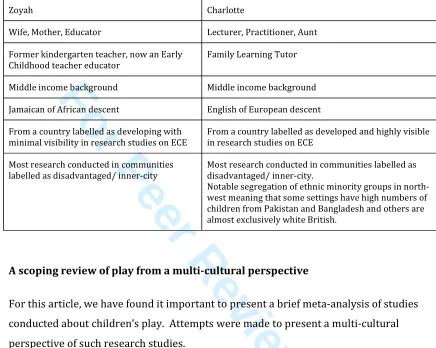
For mere expediency we have found it quite useful to outline our positionalities
in tabular format.
For Peer Review Only
Table 1. Researchers’ positionalities.Zoyah Charlotte
Wife, Mother, Educator Lecturer, Practitioner, Aunt
Former kindergarten teacher, now an Early Childhood teacher educator
Family Learning Tutor
Middle income background Middle income background
Jamaican of African descent English of European descent
From a country labelled as developing with minimal visibility in research studies on ECE
From a country labelled as developed and highly visible in research studies on ECE
Most research conducted in communities labelled as disadvantaged/ inner-city
Most research conducted in communities labelled as disadvantaged/ inner-city.
Notable segregation of ethnic minority groups in north-west meaning that some settings have high numbers of children from Pakistan and Bangladesh and others are almost exclusively white British.
A scoping review of play from a multi-cultural perspective
For this article, we have found it important to present a brief meta-analysis of studies
conducted about children’s play. Attempts were made to present a multi-cultural
perspective of such research studies.
Understanding children’s play from a cross-cultural perspective
Several studies have sought to outline cross-cultural perspectives of children’s play and
to understand how adults, more specifically parents, support children in this activity.
Research has been fairly balanced in outlining the impact of culture or lack thereof, on
shaping children’s play. For instance, Faver and Lee-Shin’s (2000) study of Korean
American mothers highlighted the role of acculturation in changing dominant parent
practices and beliefs in supporting children’s play while, Göncü, Mistry & Mosier’s
(2000) study (conducted in the United States, Turkey, Guatemala and India) described
how toddlers’ play vary across cultures. Their findings suggest that though all children
engage in social play, the frequency of this play differs.
For Peer Review Only
Perhaps one of the most ground-breaking studies which initially sought to
explore this issue from a cross cultural perspective was Whiting’s (1963) Six Cultures
Study, conducted in six countries; Kenya, India, Japan, Mexico, the United States and
the Philippines. Though the primary aim of this study was to describe how child
rearing practices across different cultures had an impact on “subsequent differences in
children’s personalities”, one of the findings that was unearthed was how parents
engagement in play activities with their children differed across cultural lines.
Subsequent studies have also affirmed these different parental approaches. Carvalhlo et
al’s (2003) exploration of children’s play in Brazil outline that for Brazilian children,
play differs along gender, geographical and socio-economic lines. Bornstein et al’s
(1999) study, in a similar vein, also explored this issue. In their research which
compared how mothers from the United States and Argentina engaged in various forms
of play with their toddler children. Similar to Carvalhlo et al (2003) the authors suggest
that differences emerge and along cultural and gender lines. They too highlight that
Argentine mothers’ had more frequent play experiences with their children than their
American counterpart. Interestingly enough, both sets of mothers played with their
sons differently from how they played with their daughters .
Another study which explored cultural differences in play was that of Edwards
(2000) who drew on Whiting’s (1963) Six Cultures study. According to Edwards, at the
more visible level, culture shapes play because it influences whether or not adults
support and encourage children’s play, whether or not they design the environment in
ways conducive to play and whether or not they supply the resources to facilitate
children’s engagement in various types of play. Hyun and Choi’s (2004) examination of
“gender doing and gender-bending” in children’s play also support this. In their
comparative study of American and South Korean children, the authors suggest that
children from South Korea, unlike their North American counterpart, are
“uncomfortable” with play that requires them to usurp perceived gender norms. These
findings highlight that children learn very quickly the dominant social and cultural
norms of their contexts and are mindful of them as they play.
Another study which also compares South Korean and North American children
highlights little difference exists in their play. Farver, Kim and Lee-Shin’s (2000) study,
specifically focussing on pretend play in Korean American and European American
children concludes that minimal difference can be seen in the play of the two groups of
For Peer Review Only
children from distinct cultural backgrounds. Several factors may account for this. For
instance, these findings support Faver and Lee-Shin’s (2000) study about the role of
acculturation in guiding parents practices about play. In extension, the authors outline
that other behaviours supported by parents facilitate the minimal differences in
children’s behaviour.
Parental beliefs about play; what shapes this?
Literature has documented much about parental beliefs about play and how this shapes
children’s play. Interest in this aspect in particularly important because social mores,
values and practices are primarily transmitted within homes and communities and it is
within these environments that children learn how to respond to, and, fit in with the
prevailing cultures. The aforementioned studies of Hyun and Choi’s (2004) and
Bornstein et al (1999) serve as examples of how parents can influence how their
children play, the types of play their engage in and their children’s willingness or not to
push dominant cultural and social norms in their play. Gaskins, Haight and Lancy
(2007), refer to these as the three cultural variations on parents’ acceptance of play and
the value of it to children. These are ‘Culturally curtailed play’, ‘Culturally accepted play’
and ‘Culturally cultivated play’.
1. ‘Culturally curtailed play’ refers to the practice of discouraging children from
playing. Within the Caribbean, especially in poorer communities, parents curtail
children’s play because they see little value in the activity.
2. ‘Culturally cultivated play’, as the name suggests refers to cultures that support
and encourage children’s play. In such cultures, parents engage in play with
their children because they are cognisant of the significant benefits of it. This
typically occurs in wealthier and more educated families in the Caribbean. This
is also typical in more developed countries such as North America and some
European countries.
3. ‘Culturally accepted play’ refers to cultures where play is tolerated but not
supported. In such cultures, parents do not recognise the value of play but
accept children play for fun or to pass time. Parents in this context refrain from
engaging in play with their children.
For Peer Review Only
Carvalhlo et al (2003), Göncü, Mistry & Mosier (2000) and Gosso & Carvalhlo’s
studies all serve as examples of three cultural variations on parents’ acceptance of play.
For instance Göncü, Mistry & Mosier’s (2000) study concluded that American and
Turkish parents think of themselves as play partners with their children and
encouraged frequent moments where they played with their children. Parmar,
Harkness, & Super’s (2004) study also confirms this as it relates to European American
parents. In their study of Asian and European American parents beliefs about play and
how this shapes children’s behaviours at home and school, their findings suggest that
Asian parents saw very little value of play in supporting their children’s development
and as such did not encourage children’s engagement in this activity. This has also been
a similar practice within most Caribbean communities.
Findings from Roopnarine & Jin (2012), Leo-Rhynie (1997),
Grantham-McGregor et al (1983), Barrow (2008) and Author outline that within the English
speaking Caribbean, there is great reluctance to accept play as a valuable activity which
supports children’s development; intellectually, cognitively, socially and physically.
This is particularly the case for families from lower income communities.
Similar to Asian families, as highlighted by Parmar, Harkness, & Super’s (2004)
study, Caribbean parents predominantly encourage their children to develop robust
academic skills because they see moments of play as time which could otherwise have
been used for meaningful, intellectually stimulating activities. As Barrow (2008)
explains, in these communities, play is considered to be wasteful, unproductive and a
“distraction and a potential problem... making children and their homes dirty and
untidy”.
As is the case in many other cultures, data suggests there is a strong correlation
between parent socio-economic and educational backgrounds and their perspectives
about play. According to Roopnarine and Davidson (2015), Tamis-Lemonda et al
(2012), Veitch, et al (2006), parents from homes with less capital, are less likely to
engage in play with their children. Undoubtedly factors such as high levels of stress,
other home and parenting responsibilities and job obligations among other factors
account for this.
Methodology
Data collection and Analysis
For Peer Review Only
To gather the data for this ethnomethodological study, we engaged in four cross cultural
conversations (one face to face and three via Skype) about our individual research on
play. Each critical discussion was guided by one of our research questions;
1) How do we conceptualise children’s play?
2) What shapes our understanding of play?
Each of our conversation sessions lasted for approximately 30 minutes. During these
sessions we discussed several issues germane to our understanding of how we perceive
play, factors shaping play within our research contexts and how these influenced us. In
order to achieve this, we drew on; our previous research, our research methodology,
how we accessed our data, the contexts of our research, and how our positionalities
(both life experiences and the contexts in which we were situated) influenced our
conceptualisation and understanding of play.
Through use of Grounded Theory, we were able to elicit dominant themes emerging
from our conversations. Grounded Theory, is an inductive qualitative research method
which allow themes to evolve from the data rather than from literature. This approach
was specifically useful as it allowed us to take advantage of the “theoretical sensitivity”
which gave us the opportunity to have frequent encounters with our data through
“stepping back” every now and again once new lines of inquiry were revealed (Glaser,
1978; Strauss & Corbin, 1998; Hoare, 2012).
Findings
Our conversations revealed several underlying factors which influenced our
understandings of play. Three dominant themes emerged from our conversations;
1. Changing lives, changing perspectives
2. Dominant positions
3. The gap; play interrupted by policy, practice and cultural norms?
Changing lives, changing perspectives
Throughout our conversations, a dominant construct we frequently referred to was how
we approached our research. It was quite evident that our perspectives of our research
about children’s play evolved as we experienced significant change in our lives. These
For Peer Review Only
changes in our positionalities were significant because they transformed the lens
through which we examined our research settings, how we understood our
co-constructors behaviours and actions, and how we made meaning of their play.
Changing lives came through a range of new experiences. Whether through increased
experience as researchers, opportunities to conduct research in other countries,
contexts and cultures dissimilar to ours, or even changes in our personal lives, all these
shifts modified how we looked at and approached our research.
For instance, in one of our conversations we spoke of the changes in our
approach to our research when we reflected on our lives as parents and aunts. These
changes were great and had a significant impact on how we viewed our
co-constructors. In one such case, Zoyah shared;
“... when I became a parent my interpretation of children’s play changed. Through new
eyes I was able to truly understand or perhaps justify why children reacted to situations in the
way they do. I was also able to look at my co-constructors and see similarities in my children’s
behaviours... before I became a mother I never once thought of these things...”
Dominant positions
" Zoyah has to look at (literature on play) from a best fits approach. For me it’s familiar.”
Though we understood prior to commencing our conversations that we came from
different positions and had diverse experiences in our individual research studies, as
we became more engaged in our discourse, we recognised that, while dissimilar, we also
had much in common. In one sense we recognised that we had a commonality as two
female researchers exploring an issue which has been historically dominated by male
researchers, however we also recognised we were dissimilar in that we came from
dominant and non-dominant research cultures and this impacted how we approached
and understood the value of our research.
As female researchers, we recognised that our positionalities as mother and aunt
undergirded our feminist approach to our research. As Zoyah explained, in one of our
conversations, there was the recognition that her role of mother influenced how she
understood the behaviours and actions of her co-constructors.
Through reflexive practice, as we sought to situate our research, and interrogate
our identities our understanding of our play recognised the significance of our gender
and the impact it had on how she approached her research. For instances in Zoyah’s
For Peer Review Only
case, as “an female outsider, invading the protected spaces” of her co-constructors
commonsense had to be used. It is well known that Jamaica’s inner-city communities
can be some of the most dangerous spaces for women. In this case,
“... as a woman, I had to take into consideration my safety. I had to look at the physical
risk I was putting myself in... in some instances, I entered spaces that I knew I had to leave before
the sun went down....commonsense had to be used... not because of the risks from my
co-constructors but because of the communities in which they lived. There were a couple occasions
when I had to ask my husband to be my chauffer and if needed my body guard ... In some way,
this served as a lesson for the struggles of my co-constructors of the risks they faced as they
played. In some sense my experienced helped me as a researcher. Frequently conducting
research in some of Jamaica’s most volatile inner-city communities served as a reminder of what
my co-constructors’ lives are like on a daily basis.”
Another issue that emerged throughout our discussions, was our frequent
reference to the different contexts and cultures from which we emerged and how these
broadly influenced our research, the issues we explored and the lens through which we
viewed our co-constructors. We understood that we were representatives of dominant
(Charlotte) and non-dominant (Zoyah) research voices. Dominant in the that sense
that much of the research about children’s play comes from a European perspective and
non-dominant in the sense that very little research about play has emerged from a
Jamaica perspective.
This occurrence had implications for how we approached our research. For one
of us (Charlotte, from the UK) the research is relatable. In our conversation about extant
research on play Charlotte shared; “literature about play is very familiar to me...I can
relate to it more...it makes sense”. In direct contradiction to this (Zoyah, from Jamaica)
shared;
“I come from a context where there really is a dearth of literature germane to the
Jamaican context ... most times literature is very unreflective and in some instances irrelevant to
my context. When I read about children’s play and issues about play being at risk... I can’t relate
to it... Jamaican children still play. In authentic settings at home and in their communities, they
play with sticks, they play in the streets... my experience is very different from what research
alludes to.
The gap; play interrupted by policy, practice and cultural norms?
For Peer Review Only
“Adults feel the need to dictate what children’s play should looks like.” (Charlotte,
Personal Communication)
An interesting finding that we unearthed though our discussions was the gap that
existed between policy and practice/rhetoric and reality in our individual contexts. We
addressed how play, especially at school, the home and in the wider community had
become influenced by “political correctness” and notions of good play, appropriate play,
constructive play and safe play.
Notions of what adults believe children’s play should look like have begun to
affect the authenticity of this natural childhood activity. We discussed how play is
viewed from a Jamaican perspective and focussed on how prevailing cultural notions
of play as being unconstructive, “romping” contradicted the dominant British perceptive
of play as a valuable activity all children were encouraged to participate in. As Charlotte
explained, “We [The Government] have done a good job of selling to parents (in
England) the value of play,. They understand its importance, however, it is frequently
the case where adults; teachers and parents, feel the need to dictate what children’s
play should look like.”
From a Jamaican point of view, adult interruptions of play frequently hinge on
gender appropriateness. Within the Jamaican context, there still remains rigid
adherence to “boy play” and “girl play”. Boys are often reprimanded and forbidden
from engaging in play experiences that replicates or closely resembles stereotypical girl
behaviours. In such situations, boys may be punished, scolded, or even have toys taken
away.
Girls too face similar condemnation. Historically, it was often the case where
rough and tumble play was considered only for boys. In fact, it was frequently the case
where boys were the ones who were allowed to play, while girls had to remain indoors
and help with housekeeping chores. Truth be told, in many families, it still exists where
girls are forbidden from engaging in play which could result in their clothes getting
dirty, their skin being bruised or sadly, playing in the sun where their skin would be
tanned.
In Jamaica, in direct contradiction to what predominantly obtains in the UK, is
the fact that play is not necessarily seen as a valuable childhood pastime, for this reason,
For Peer Review Only
children’s play is interrupted by cultural and historical perceptions of rightness and
appropriateness and acceptability.
Discussion and implications
The primary aim of this study was to examine researcher perspectives on play in the
lives of children from diverse cultural contexts. Through use of cross-cultural discourse,
we were able to acquire some understanding of each other’s approach, interpretation
and conceptualisation of play. This discursive method draws attention to the need for
concepts of play to be grounded, but not restricted by national contexts through
juxtaposition with multinational policies, programmes and practices.
Our conversations elicited three dominant themes;
1. Changing lives, changing perspectives
2. Dominant positions
3. The gap; play interrupted by policy, practice and cultural norms?
Our findings confirm dominant research findings which highlight the influence of
researcher positionalities on their interpretation, contextualisation and of their
research(Skelton, 2001; England, 1998; Merriam et al 2001). Our rich discourse about
extant literature on play elicited substantive feedback on privileged researcher
hegemony and how non-dominant communities, such as Jamaica, and dare we say many
of the other developing countries, struggle with a “best fits approach”. Tantamount to a
Cinderella approach, in many instances researchers, from such non-dominant contexts
have to siphon through the research from more prolific and dominant voices on
children’s play to find literature that fits or closely resembles what refers to their
context.
Our findings also highlight the risk factors of children’s play. Similar to the findings
of Farver, Kim and Lee-Shin’s (2000), Parmar, Harkness, & Super’s (2004) Roopnarine
& Jin (2012), Leo-Rhynie (1997), Hyun & Dong (2004), Grantham-McGregor et al
(1983), Barrow (2008) and Author studies on play (conducted among European,
European –American and Caribbean families)we were able to highlight differences in
socio-cultural practices and how these disrupt the naturalness of children’s play.
For Peer Review Only
Undoubtedly, as both our societies become “less safe” for children, there is growing
need for adults to dictate when and how children ought to play. From Charlotte’s
British perceptive, fear of accidents, increased use of technology and other social
dangers has significantly limited the time children play outside. Interestingly, this also
obtains in however in Zoyah’s context, Jamaica, the insidious impact on crime has
weaselled its way into many of Jamaica’s communities and has interrupted the spaces
and time when and where children play.
Conclusion
This article highlights the findings of a grassroots conversation between two
researchers who have conducted research about children’s play. Our overarching aim
was to highlight the gap between policy and practice/rhetoric and reality and to find
ways to encourage children’s authentic play whilst being true to our values as
educators and researchers. As two researchers, who have conducted research about
children’s play, we sought to contextualise our understanding of play and to expand our
notions of play beyond researcher positionalities and to embrace cross cultural.
Our findings unearth the need for researchers to interrogate their own identities
and to examine the “baggage” the take with them into their research settings. Though
the findings of this study are not generalisable they provide fodder for other
researchers to consider how they make meaning of their studies and to consider how
concepts of play can be grounded, but not restricted by national contexts.
References
Barrow, C. (2008). Early Childhood in the Caribbean.Working Papers in Early Childhood
Development, No. 47.Bernard van Leer Foundation. PO Box 82334, 2508 EH, The
Hague, The Netherlands.
Bornstein, M., Haynes, O., Pascual, L., Painter, K., &Galperín, C. (1999). Play in Two
Societies: Pervasiveness of Process, Specificity of Structure. Child
Development,70(2), 317-331.
For Peer Review Only
Carvalho AMA, Magalhães CMC, Pontes FAR, Bichara, ID, eds. Brincadeira e cultura:
Viajando pelo Brazil que brinca [Play and Culture: a Travel through Brazil at Play].
São Paulo, SP: Casa do Psicólogo; 2003.
Choi, B. C., & Pak, A. W. (2007). Multidisciplinarity, interdisciplinarity, and
transdisciplinarity in health research, services, education and policy: 2. Promotors,
barriers, and strategies of enhancement. Clinical & Investigative Medicine, 30(6),
224-232.
England, K. V. L. (1994). Getting personal: Reflexivity, positionality, and feminist
research. The Professional Geographer, 46(1), 80-89.
Edwards, C. P. (2000). "Children's Play in Cross-Cultural Perspective: A New Look at the
Six Cultures Study." Cross-Cultural Research 34:318–338.
Farver, J. A. M., & Lee-Shin, Y. (2000).Acculturation and Korean-American children’s
social and play behavior. Social Development, 9(3), 316-336.
Farver, J. A. M., Kim, Y. K., & Lee-Shin, Y. (2000).Within cultural differences examining
individual differences in Korean American and European American preschoolers’
social pretend play. Journal of Cross-Cultural Psychology, 31(5), 583-602.
Gaskins, S., Haight, W. and Lancy, D.F. (2007). The cultural construction of play. In A.
Göncü and S. Gaskins (eds) Play and Development: Evolutionary, Sociocultural and
Functional Perspectives. Mahwah, NJ: Lawrence Erlbaum.
Glaser, B. G. (1978). Theoretical sensitivity: Advances in the methodology of grounded
theory. Sociology Press.
Grantham-McGregor, Sally, Jacqueline Landman, and Patricia Desai. 1983. “Child
Rearing in Poor Urban Jamaica.” Child: Care, Health, and Development 9:57–71.
Göncü, A., Mistry, J., & Mosier, C. (2000).Cultural variations in the play of
toddlers. International Journal of Behavioral Development, 24(3), 321-329.
Gosso, Y., & Carvalho, A. M. A. (2013). Play and Cultural Context. Play, 21.
For Peer Review Only
Haight, Wendy L., Wang Xiao-lei, Fung Heidi Han-tih, Williams Kimberley, and Mintz
Judith. "Universal, Developmental, and Variable Aspects of Young Children's Play:
A Cross-Cultural Comparison of Pretending at Home." Child Development 70.6
(1999): 1477-488.
Hoare, K. J., Mills, J., & Francis, K. (2012).Dancing with data: an example of acquiring
theoretical sensitivity in a grounded theory study. International Journal of Nursing
Practice, 18(3), 240-245. doi:10.1111/j.1440-172x.2012.02038.x
Hyun, E., & Dong, H. C. (2004). Examination of young children's gender-doing and
gender-bending in their play dynamics: A cross-cultural exploration. International
Journal of Early Childhood, 36(1), 49-65.
Leo-Rhynie, E. 1997.“Class, Race, and Gender Issues in Child Rearing in the Caribbean.”
In Caribbean Families: Diversity among Ethnic Groups, edited by Jaipaul L.
Roopnarine and Janet Brown, 25–55.
Merriam, S. B., Johnson-Bailey, J., Lee, M. Y., Kee, Y., Ntseane, G., & Muhamad, M. (2001).
Power and positionality: Negotiating insider/outsider status within and across
cultures. International Journal of Lifelong Education,20 (5), 405-416.
Parmar, P., Harkness, S., & Super, C. M. (2004). Asian and Euro-American parents’
ethnotheories of play and learning: Effects on preschool children’s home routines
and school behaviour. International Journal of Behavioral Development, 28(2),
97-104.
Parten, M. B. (1933). Social play among preschool children.The Journal of Abnormal and
Social Psychology, 28(2), 136.
Roopnarine, J. L., & Davidson, K. L. (2015).Parent-Child Play across Cultures. The
Handbook of the Study of Play, 2, 85.
Roopnarine, J. L., &Jin, B. (2012).Indo Caribbean immigrant beliefs about play and its
impact on early academic performance. American Journal of Play, 4(4), 441.
For Peer Review Only
Roopnarine, J L. (2011). “Cultural Variations in Beliefs about Play, Parent-Child Play,
and Children’s Play: Meaning for Childhood Development.” In The Oxford
Handbook of the Development of Play, edited by Anthony D. Pellegrini, 19–37.
Rubin, K. H. (1977). Play behaviors of young children. Young children, 32(6), 16-24.
Skelton, T., (2001).Cross- cutural research: issues of power, positionality and “Race”.In: M.
Limb, & C. Dwyer (eds.) Qualitative Methodologies for Geographers. London,
Arnold, 87-100. [Accessed 23 August 2008].
Strauss, A., & Corbin, J. (1998). Basics of qualitative research: Grounded theory
procedures and techniques (2nd ed.). Thousand Oaks, CA: Sage
Tamis-Lemonda, C. S., Baumwell, L., &Cristofaro, T. (2012).Parent–child conversations
during play.First Language, 32, 413–438.
Veitch, J., Bagley, S., Ball, K., & Salmon, J. (2006). Where do children usually play? A
qualitative study of parents’ perceptions of influences on children's active
free-play. Health & place, 12(4), 383-393.
Whiting, B. B. (1963). Six cultures: Studies of child rearing.