Article
1
Evaluating Garlic (
Allium sativum
L.) Growth Parameters with Different
2
Mulching under Irrigation in Fiche Condition, Ethiopia
3
Weldemariam Seifu Gessesew1, Tsion Yemane Gebreslassie2
4
1Department of Horticulture, College of Agriculture and Natural Sciences, Salale University; PO box 245, Fiche, Ethiopia;
5
E-mail: [email protected]
6
2Department of Horticulture, College of Veterinary Medicine and Agriculture, Addis Ababa University; Ethiopia; E-mail:
7
8
* Correspondence: [email protected]; Tel: +251947886886
9
10
Abstract: A field experiment to assess the effect of mulch on growth (days to maturity, plant height, leaf length and leaf
11
number) of Garlic (Allium Sativum L.) was conducted in 2015 - 2016 at Addis Ababa University Selale campus, on
12
demonstration field to identify optimum plant growth using different mulches for Garlic tested independently. The
13
experiment was designed using randomized complete block. The analyzed result using ANOVA shows significance
14
difference among the treatments. Plots treated with black polyethylene mulch and grass mulch enhanced maturity by about
15
114 and 116 days, respectively, while garlic in control showed slightly delayed maturity of 125 days. Maximum plant height
16
(66.5 cm) was recorded in the plants mulched by black polyethylene mulch followed by grass mulch which records 62.3 cm
17
and 52.3 cm, respectively. A highly significant variation (p<0.05) in the leaf length was observed at the different mulch
18
treatments. Significantly maximum leaf number (15.3) was recorded in plants mulched with black polyethylene followed by
19
grass mulch with 14.0 leaf number. Thus, black polyethylene and grass mulch performs better than control treatment in
20
growth parameter evaluation of garlic plants under fiche condition.
21
Keywords: Black polyethylene, Mulches, Allium sativum, Growth, Grass
22
1. INTRODUCTION
23
Garlic (Allium sativum L.) belongs to the family Alliaceae and genus Allium, and is a shallow rooted vegetable crop [1]. The
24
genus Allium, which belongs to the family Alliaceae, is diverse and comprises about 750 species, but only seven of them are
25
widely cultivated in different parts of the world. Of these, the species important in Ethiopia are onion (Allium cepa L.),
26
shallot (A.cepa var. ascalonicum L.), garlic (A.sativum L.) and leek (A.ampeloprasum L.). The first three are diploid with the
27
basic chromosome number of 2n=16 whereas leek is tetraploid with 2n=32 [2,3].
28
Garlic is an ancient crop originated in Central Asia [4]. The alliums are distributed widely throughout the temperate, warm
29
temperate and boreal zones of the northern hemisphere [5]. It is one of the oldest cultivated vegetables and the second most
30
widely produced Allium next to onion [6]. The species has been already grown and consumed in ancient Egypt and Rome
31
[7]. According to [8], evidence of garlic cultivation can be found as far back as 3200 BC in Egypt and it continues to be an
32
important part of Mediterranean, European and Asian diets as a food item, as well as a medicinal plant used to treat a variety
33
of ailments.
34
China is by far the largest producer of garlic, with around 20 million tons grown annually accounting for over 81% of world
35
output. India (4.6%) and South Korea (1.4%) follow, with Egypt (1.2%) on fourth place. Ethiopia is the seventh producer in
36
the World by producing 222,548 tons annually [9].
37
Garlic is grown for its edible bulbs, which are composed of a number of cloves. The bulbs can be eaten fresh, cooked in
38
various ways, processed into a dehydrated product, or saved for the seed for later propagation [10].The crop has been grown
39
for culinary, medicinal, and religious purposes for several millennia [5,10]. Garlic takes one of the top places among
40
vegetables contributing to the maintenance of good health of humans. It is a natural antiseptic and had used in the First
41
World War [11]. Not surprisingly, in view of its strength of flavor, it is used primarily as a condiment rather than a bulk
42
foodstuff [12]. The crop is a good source of income for many farmers in many parts of the country and earns foreign
43
currency by exported to Europe, Middle East and North America [13-15] and proved to be income generating activity for
44
farmers, especially for those who have limited cultivated land or small holder farmers [16].
45
In terms of production, garlic is ranked second after the onion and it is grown for its pungent flavored bulbs and used
46
world-wide to season foods [17,18]. Garlic produces unique flavors savored by almost all of the global culture [19].
47
Garlic's volatile oil has many sulphur containing compounds that are responsible for the strong odor, its distinctive flavor
48
and pungency as well as for its healthful benefits [20]. In Africa, Ethiopia was third in the area (10,690 ha) after Egypt and
49
Algeria, second in production but fourth in productivity with 9.63 t ha-1 which was far below Egypt (24.36 t ha-1), Kenya
50
(23.87 t ha-1) and Niger (10.64 t ha-1) in 2011 [21]. In Ethiopia garlic produced mainly as a spice crop for seasoning of foods
51
and for its medicinal values. It is widely cultivated around home gardens, but nowadays, its production is practiced in some
52
large farms.
53
A lion share of 95% of the vegetables and fruits produced in Ethiopia comes from the small holder sector. In Ethiopia, garlic
54
crop is one of the most important vegetables produced by small hold farmers mainly as a source of cash income and for
55
flavoring the local stew ‘wet. The crop is believed to be more intensively consumed than any other vegetable crop. In Africa,
56
Ethiopia was third in area (10,690 ha) after Egypt and Algeria, second in production but fourthin productivitywith 9.63 t
57
ha-1which was far below Egypt (24.36 t ha-1), Kenya (23.87 t ha-1) and Niger (10.64 t ha-1) in 2011 [21]. A range of
58
factors may contribute to the low productivity of garlic. In many areas characterized by low and erratic rainfall and crop
59
water stress, lack of available nutrients is frequently the limiting factor next to the soil water. Besides, lack of soil water
60
diminishes nutrient availability by reducing microbial activity, which is responsible for the liberation of N, P and S from soil
61
organic matter [22].
62
Garlic production in Ethiopia was increased from 6,042 ha in 2001/02 to 21,258 ha of land in 2012/13 with a total
63
production increment from 79,421 to 222,548 tons of bulbs. The crop is produced mainly in the mid and high lands of the
64
country [14,15] but its productivity was decreased from 13.20 to 10.47 t ha-1 [15, 23]. In many parts of the country, garlic
65
crop yields are low due to a number of constraints, among which lack of balanced nutrient supply, poor soil fertility, weed
66
infestation, diseases, and moisture stress are the major ones [6].
67
Mulching is a cropping practice that entails placing organic or inorganic or synthetic materials on soil close to plants to
68
provide a more favorable environment for growth and development. Organic or inorganic mulches can be used for weed
69
control. Mulch controls weeds by smothering seedlings, prevent day light which helps foster germination from reaching
70
weed seeds and prevents airborne seeds from taking hold on the soil surface [24,25].
71
Mulches serve as protective covering, reduce moisture loss from the soil by preventing evaporation from the sunshine and
72
desiccating winds, regulate soil temperature cooler in summer and warmer in winter. The temperature regulating effect
73
encourages the root growth. It was observed that different mulching materials highly influenced the plant height and bulb
74
diameter [26] as well as yield of garlic [27]. Results of different kinds of mulching indicated increased plant growth, yields,
75
and improved bulb size of the garlic. Many of these effects were attributed to the capacity of the mulch to conserve soil
76
Mulching has been reported to conserve moisture [28,33] by protecting the plant from excess transpiration and direct
78
evaporation from soil thus reducing the irrigation requirements [34]. Mulching helps in significant increase in N, P and K
79
uptake over unmulched [35]. Therefore, a better understanding of the uses of mulching in garlic production is very
80
importantin order to develop management strategies, which optimize moisture and increasing returns to the producers by
81
increasing Garlic yield and quality. Thus, it is in view of this background the research was undertaken with the objective of
82
the following:
83
To evaluate the effect of different mulches on garlic growth parameters in fiche condition.
84
2. MATERIAL AND METHOD
85
2.1. Description of the Study Area
86
The study was conducted at Fiche, Addis Ababa University, Selale campus demonstration farm. The experimental site lies
87
on an altitude of about 2750 m.a.s.l and is located at latitude of 9◦ 48 0 N and longitude of 38◦42 0 E which is found
88
112 km far from Addis Ababa city. Fich district is characterized by a highland agro-ecological zone which has a cold
89
condition with annual average temperature of 16.5◦c and average rainfall of 1150 mm year-1. The soil type of the study area
90
is clay with pH of 6.4 [36].
91
2.2. Experimental Material
92
Local garlic cultivar was used for planting as a test crop for the experiment which is widely cultivated in the study area.
93
Black polyethylene mulch and grass mulch were used as experimented materials. DAP and Urea fertilizers were used as per
94
the recommended rate of the crop uniformly in all treatments.
95
2.3. Treatments and Experimental Design
96
The experiment was conducted by using randomized complete block design (RCBD), which consists of three treatments
97
(black polyethylene mulch, grass mulch, no mulch/control) with three replications. The plot size was 2 m length and 1.5m
98
width consisting 5 rows with 20 plants per row which comprised a total of 100 plants per plot; the clove was planted at a
99
space of 30 cm x 10 cm between rows and plants respectively. The spacing between plots and blocks was 0.5 m and 1m
100
respectively.
101
2.4. Experimental Procedure
102
The experimental field was digging out. Large clods were broken down in order to make the land fine tilth, and then 9 plots
103
with size of 1.6 m x 2 m were measured and laid out. Irrigation and drainage channels were designed for conveyance and
104
drainage of excess water. The plots was leveled; furrows and ridges were made at a spacing of 40 cm. Local garlic cultivar
105
was used for planting. At planting time, cloves were separated from the bulb and sorted (i.e. diseased, damaged and very
106
small size clove were separated). Cloves with the same size were used for planting. After land prepared, fertilizers were
107
applied according to the national recommendation at the rate of 92 kg ha-1 P2O5 and 92 kg ha-1N from Di-ammonium
108
phosphate (DAP) and urea fertilizers, respectively. The DAP will be applied all at planting and the urea was splinted and
109
applied one third during planting, and the rest two third were side dressing in two applications. One half was applied after
110
three weeks and the rest one half five weeks after plant emergence. The experimental plots were kept free from any disease,
111
weed, insect and other pests as much as possible and regularly watered. Harvesting was done when70% of the leaves fell
112
over by digging up or pulling the individual plants by hand and sun dried for days.
113
2.5. Data Collection
114
The growth parameter data was collected during the field experiment by sampling plants randomly from the two central
115
ten randomly taken plants from each plot of no mulch, grass mulch and black polyethylene mulch. All data pertaining to
117
growth, yield components. Accordingly, the following data was collected.
118
Days to maturity: Days to maturity was the actual number of days from the day of transplanting to the time when 70% of
119
plants’ foliage fall down and when plants show neck fall in the field experiment [37].
120
Plant height (cm): plant height was measured in centimeter from the soil surface to the tip of matured leaf in the plant at
121
maturity by a ruler.
122
Leaf number per plant: is the mean number of leaves produced by sampled plants and was calculated by dividing the total
123
number of leaves counted from the sampled plants to the number of sampled plants to get mean leaf number per plant.
124
Leaf length (cm): The length of three leaves per plant (from upper, medium and lower) was measured at maturity by using
125
a ruler and the average leaf length was taken.
126
3. RESULTS AND DISCUSSION
127
3.1. Phenology and Growth Parameters
128
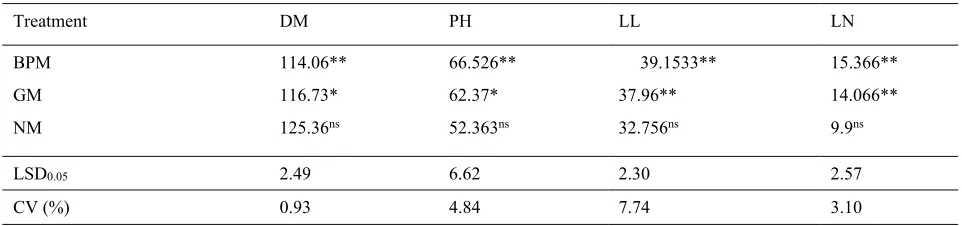
Plant height, days to maturity, Leaf length and leaf number were significantly (P<0.05) influenced by the effect of different
129
Mulches (Table 1).
130
Table 1: The effect of different Mulch on plant height (cm), leaf length (cm), leaf number (No) and days to maturity (days) of local garlic
Treatment DM PH LL LN
BPM 114.06** 66.526** 39.1533** 15.366**
GM 116.73* 62.37* 37.96** 14.066**
NM 125.36ns 52.363ns 32.756ns 9.9ns
LSD0.05 2.49 6.62 2.30 2.57
CV (%) 0.93 4.84 7.74 3.10
* = Statistically significant at P<0.05, ** = statistically highly significant at P<0.01, DF= degree of freedom, NS =
non-significance, PH= Plant Height, LL= Leaf Length, LN= Leaf number, DM= Days to maturity, BPM= black polyethylene mulch, GM= grass mulch, NM= no mulch.
131
3.1.1. Days to maturity
132
Days to maturity was highly significantly (p<0.05) influenced by black polyethylene mulch (Table 1). Black polyethylene
133
mulch and grasses mulch enhanced maturity by about 114.6 and116.73 days, respectively, while the control treatment
134
showed slightly delayed maturity by 125.36 days. This might be attributed due to increasing soil organic matter (grass
135
mulch) and water efficiency by minimizing excess evaporation, regulation of temperature in causing early bulb maturity
136
while not using mulch allowed plant to have access for adverse conditions like scarcity on water and temperature. Similarly
137
[38-40] also reported significant effect of mulching on day to maturity.
138
3.1.2. Plant height (cm)
139
Plant height was highly significantly (p<0.05) affected by black polyethylene mulch (Table 1). Various mulches
140
significantly affected the plant height in garlic production. Maximum height (66.52cm) was recorded in black polyethylene
141
mulch followed by grass mulch (62.37cm) and without mulch (52.36cm) respectively. With respect to plant height, another
142
reported the effect black polyethylene mulch on plant height for garlic. Similarly, [41] observed also an increased plant
144
height for shallot. These Might be attributed to the possible competition for soil moisture, appropriate temperature and
145
nutrients without competitor through suppressing nature of mulches.
146
3.1.3. Leaf number
147
The result of the field experiment showed that there is significance difference among treatments with reference to leaf
148
number per plant. Black polyethylene and grass mulch increases leaf number by 5.466 and 4.166 respectively as compared
149
to the control treatment (Table 1).The highest leaf number (15.36) was recorded on black polyethylene mulch treatment,
150
followed by grass mulch (14.06) which was statistically at par while the lowest leaf number (9.9) was recorded on treatment
151
with no mulch. This might be due to addition of nutrient from straw mulch and reduction of competition and water stress by
152
black polyethylene plastic. Research finding conducted at Agarfa on garlic reported that, the highest number of leaves
153
plant-1 was obtained with straw mulch which was statistically at same level with black polyethylene mulch [42]. This result
154
is in line with the results of [43,44] who reported significant effect of mulching on leaf number of onions. Similarly, result of
155
[38-40] showed that, significant effect of mulching on leaf number plant-1 of garlic.
156
3.1.4. Leaf Length (cm)
157
Highly significant variation (p<0.01) in the leaf length was observed at the different mulches. Black polyethylene mulch
158
produced the longest (39.15cm) leaf length 37.96cm by black polyethylene mulches and the shortest 32.75 was recorded in
159
the absence of mulch.This might be due to less competition for light with large canopy leaf of weed which suppressed by the
160
application of mulches. According to [45] reported that, Black polyethylene mulch significantly increased leaf length. This
161
result is comparable with the findings of [46] who found significant increase in leaf sizes of tomato by using mulches.
162
4. CONCLUSION AND RECOMMENDATION
163
Garlic is one of the main alliums vegetables known worldwide with respect to its production, and economic, medicinal and
164
food seasoning values next to common onion with a characteristic pungent smell, and It is rich in sugar, protein, fat,
165
calcium, potassium, phosphorous, sulfur, iodine fiber and silicon in addition to vitamins and many other substances that
166
contributes significant nutritional value to the human diet and it has miracle pharmaceutical effects which used to cure an
167
enormous disease.
168
In Ethiopia Production of cash crops like garlic is the most widely cultivated species and proved to be income generating
169
activity for farmers, especially for those who have limited cultivated land or small holder farmers. However, its productivity
170
is low due to diverse crop management problems including the nature of propagation, Limited precipitation and erratic
171
rainfall as well as low soil fertility in the arid and semi-arid regions, limit crop production, poor laterally spread and scarce
172
root system, lack of improved agronomic practices, lack of improved and adaptable varieties, low soil fertility, diseases,
173
insect pests and lack of improved post-harvest technologies. On the other hand, all alliums including garlic have lower
174
nutrient extraction capacity than most crop plants because of its shallow depth root. As a result mulching has been reported
175
to conserve moisture by protecting the plant from excess transpiration and direct evaporation from soil thus reducing the
176
irrigation.
177
Therefore, a field experiment was conducted at Addis Ababa University, Selale campus demonstration farm in 2014/15
178
under irrigation to assess the effect of different mulches on growth parameters of garlic. The treatments were composed of
179
two types of mulches the so called black polyethylene mulch and grass mulch, with comparing to bare land and were
180
Results of the field experiment revealed that the effects of different mulches showed a significant effect on, plant height, leaf
182
length, leaf number and days to maturity. Maximum height (66.52cm) was recorded in black polyethylene mulch, followed
183
by the grass mulch (62.37cm). More leaf number (39.15) and late maturity day (114.6 days) were also recorded in
184
treatments treated with black polyethylene mulch followed by grass mulch measured leaf number of 37.96 and 116.73
185
days to maturity, respectively.
186
It could be conclude that, under Fiche condition, good quality and quantity of garlic is possible to produce by using different
187
types of mulch. According to this research finding black polyethylene mulch is very favorable for garlic production and
188
result obtained from grass mulch is also comparative. There is a need to study the effect of further types of mulches across
189
sites. There is also a need to undertake soil analysis after harvest in order to check effect of the different mulches on the
190
improvement of soil. It is important even to undertake similar studies at different seasons with different varieties in
191
consideration of their cost benefit analysis.
192
REFERENCES
193
[7] Rekowska E and Skupien K (2007). Influence of Flat Covers and Sowing Density on Yield and Chemical Composition
194
of Garlic Cultivated for Bundle-Harvest: Vegetable Crops Research Bulletin, 66, 17-24,
195
http://dx.doi.org/10.2478/v10032-007-0003-y; accessed date February 13, 2016.
196
[13] DARC (Debrezeit Agricultural Research Center)(2006).Garlic Production Management.Debrezeit Agricultural
197
Research Center, Leaflet (Amharic Version), Debrezeit, Ethiopia.
198
[21] FAOSTAT (2013). Food and Agriculture Organization of the United Nations; http: //faostat.fao.org/ site/567/ Accessed
199
on January 20, 2016.
200
[8] Goldy R (2000).Producing Garlic in Michigan, Michigan State University Extension. Gene, B., 2009: Garlic
201
Huntington College of Health Sciences, Literature Education Series on Dietary Supplements.
202
[10] Hannan RM and Sorensen EJ (2001). Crop Profile for Garlic in Washington; Washington State University, Pullman.
203
[5] Brewster JL (1994).Onions and other vegetable Alliums. CAB International, Walling ford, UK. 236p.
204
[15] Central Agricultural Census Commission (CACC) (2002). Report on the preliminary result of area, production and
205
yield of temporary crops (Meher season private peasant holdings). Part II. Ethiopian Agricultural sample
206
Enumeration, 2001/2002: Federal Democratic Republic of Ethiopia, Central Statistical Authority; Addis Ababa.
207
[14] Getachew T and Asfaw Z (2000).Achievements in Shallot and Garlic Research. Report No. 36. Ethiopian Agricultural
208
Research Organization, Addis Ababa Ethiopia.
209
[12] Purseglove SW (1992). Tropical Crops, Monocotyledons. Vol. 2, Longman Group Ltd., London, 20-140.
210
[2] Jones TL, Jones US and Ezell DO(1977).Effect of nitrogen and plastic mulch on properties of Troup loamy sand on yield
211
of “water tomato”.J. Am. Soc. Hort. Sci., 101: 265-273.
212
[42] Wolde T (2014).Effect of Mulching and Nitrogen on Weeds, Yield Components and Yield of Garlic (Allium Sativum
213
L.)At Agarfa, South-Eastern Highlands of Ethiopia. MSc thesis submitted to Haramayauniversity, Ethiopia.
214
[39] Karaye AK and Yakubu AI (2006). Influence of intra-row spacing and mulching on weed growth and bulb yield of
215
garlic (Allium sativum L.) in Sokota, Nigeria, African Journal of Biotechnology. 5(3): 260-264.
216
[26] Iroc A, Sisson LC and SolidumPP (1991).Effects of different mulching materials on garlic (Allium sativum L.); Bulletin
217
Penelitian.Horticultura, 7: 104-108
218
[28] Adetunji IA (1990).Effect of mulches and irrigation on growth and yield of lettuce in semi-arid region.Biotronics, 19:
219
93-98.
220
[45] Gebrehaweria T (2007).Effects Of Mulching, Nitrogen And Phosphorus On Yield And Yield Components Of Garlic
221
[41] Kebede W (2003). Shallot (Allium cepa var. ascalonicum) Responses to Plant Nutrients and Soil Moisture in a
223
sub-humid Tropical Climate, Doctoral, Thesis Swedish university of Agricultural Sciences, Alnarp, 2003.
224
[33] Gajri PR, Arora VKand ChaudharyMR (1994). Maize growth responses to deep tillage, straw mulching and farmyard
225
manure in coarse textured soils of North West India. Soil Use Manage.10: 15-20.
226
[32] Duranti A, and Cuocolo L(1989).Chemical weed control and mulching in onion (Allium cepa L.). And garlic (Allium
227
sativum L.) Advances in Horticultural Science, 5: 7-1.
228
[43] John T (2000).The physical properties of mulches contributing to weed suppression.ARS Publication, USDA
229
Agricultural research. USA. pp. 1-2.
230
[44] Umar MS, MuonekeCO, MagajiM.D (2000). Effect of intra-row spacing and mulching materials on growth and yield
231
of onion (Allium cepa L.), Nig. J. Agri. and envi., 1(2): 29-39.
232
[46] Asiegbu JE (1991). Response of tomato and eggplant to mulching and nitrogen fertilization under tropical conditions,
233
Scientia Hortic., 46: 33-41.
234
[40] Hossain AKMM, Islam MJ, Khanam F, Majumber UK, Rahman MM and saifur Rahman M (2007). Effect of mulching
235
and Fertilization on Growth and Yield of Garlic at Dinajpur in Bangladesh. Asian J. of Sciences, 6(1): 98-101.
236
[22] Food and Agriculture Organization (FAO), 2003: Optimizing soil moisture for plant production. FAO soils Bull. 79:
237