Article
Factorization of Odd Integers with a Divisor of the
Form 2
a
u
±
1
Xingbo WANG1,2,∗
1 Department of Mechatronic Engineering,Foshan University,18 Jiangwanyi Road, Foshan City, PRC;
2 State Key Laboratory of Information Security, Institute of Information Engineering, Chinese Academy of
Sciences, Beijing 100093, PRC; [email protected]
Abstract: The paper proves that an odd composite integer N can be factorized in at most O(0.125u(log2N)2) searching steps ifN has a divisor of the form 2au+1 or 2au−1 witha > 1 being a positive integer and u > 1 being an odd integer. Theorems and corollaries are proved with detail mathematical reasoning. Algorithms to factorize the kind of odd composite integers are designed and tested by factoring certain Fermat numbers. The results in the paper are helpful to factorize the related kind of odd integers as well as some big Fermat numbers.
Keywords:Integer factorization; Fermat number; Cryptography;Algorithm
Factoring an odd composite number has been a research topic in number theory as well as cryptography. Although there are several algorithms to factorize a composite number, as overviewed in [1] and [2], new and efficient methods are still in need. Paper [3], a very recent publication, proved that an odd composite integerNcould be factorized inO((log2N)4)bit operations if N= pqwith
q=2αu±1 and 1< p≤2α+1 or 2α+1< p≤2α+1−1, whereαis a positive integer andu≥1 is
an odd integer andαis a positive integer. This result might be marvelous for factoring the kind ofN. However, the paper [3] did not mention the case whenpis of a more general form. Hereby, this paper investigates the case 2α+β+1≤ p≤2α+β+1−1 withβbeing a positive integer.
The contents of this paper include five main parts: section 2 presents certain preliminaries, section 3 shows the main results including theorems, corollaries and algorithms designed for each case, section 4 presents numerical experiments on factoring certain related Fermat numbers, section 5 points out the advantage of the algorithms and the barrier to apply the algorithms as well as the possible future attempts.
1. Preliminaries
1.1. Definitions & Notations
In this whole article, symbolbxcdenotes the floor function, an integer function of the real number xsuch thatx−1< bxc ≤ xor equivalentlybxc ≤ x < bxc+1. Symbol A⇒ Bmeans result Bis derived from conditionAorAcan deriveBout. Symbol GCD is to express thegreatest common divisor between two integers.
1.2. Lemmas
Lemma 1(See in [4])Properties of the floor functions with real numbersx,yand integern (P1)bxc+byc ≤ bx+yc ≤ bxc+byc+1
(P2)bxc − byc −1≤ bx−yc ≤ bxc − byc<bxc − byc+1 (P13)x≤y⇒ bxc ≤ byc
(P14)bx±nc=bxc ±n
(P32)nbxc ≤ bnxc ≤n(bxc+1)−1. Takingn=2 yields 2bxc ≤ b2xc ≤2bxc+1 Lemma 2(See in [5])Odd integerN>1 satisfies 2blog2Nc+16N62blog2Nc+1−1. 2. Main Results
2.1. Math Foundations
Theorem 1LetN = pqbe an odd integer withpandqbeing odd integers bigger than 1; suppose q=2αu±1 and 2α+β+16p62α+β+1−1 withα,βbeing positive integers andu>1 being an odd
integer; then
2α+β+16blog2Nc
Proof. The conditionsu≥3 andq=2αu+1 yield
N= (2αu+1)p=2αup+p=2α(u+ 1
2α)p
⇒22α+β(u+ 1
2α)<N<2
2α+β+1(u+ 1
2α)
⇒22α+β×3<N<22α+β+1(u+ 1
2α)
⇒2α+β+1<log2N<2α+β+1+log2(u+ 1 2α)
⇒2α+β+16blog2Nc
Similarly, the conditionsu≥3 andq=2αu−1 yield
N= (2αu−1)p=2αup−p=2α(u− 1
2α)p
⇒22α+β(u− 1
2α)<N<2
2α+β+1(u− 1 2α)
⇒22α+β×2<N<22α+β+1(u− 1 2α)
⇒2α+β+1<log2N<2α+β+1+log2(u− 1 2α)
⇒2α+β+16blog2Nc
Remark 1During the reasoning process, the properties list in Lemma 1 are frequently applied, and so they are with the following reasoning.
Proposition 1LetN=pqbe an odd integer withpandqbeing odd integers; supposeq=2αu±1 and
2α+β+16 p62α+β+1−1 withα,βbeing positive integers andu>1 being an odd integer; then
α6
log2N 2
−1
Proof. We consider two cases:q≥ pandq<p. For the caseq>p, it follows
q≥p⇒q≥√N≥p>2α+β ⇒
α+β<log2 √
N⇒α+β≤
log2N 2
Sinceβ≥1, it yields
α≤
log2N 2
−β≤
log2N
2
Now the caseq<p. First considerq=2αu+1; then
q< p⇒q6√N⇒2α6
√ N−1
u < √
N 3
⇒α< 1
2log2N−log23< 1
2log2N−1 ⇒α6
log 2N 2
−1
Likewise, whenq=2αu−1 it follows
q<p⇒q6√N⇒2α6
√ N+1
u 6
√ N+1
3
⇒α6log2( √
N+1)−log23= 1
2log2N+log2(1+ 1 √
N)−log23 Since 0<log2(1+√1
N)<1 and 1.5<log23<2, it knows
1
2log2N−2< 1
2log2N+log2(1+ 1 √
N)−log23= 1
2log2N−0.5 ⇒α6
log2N
2
−1
Remark 2The caseq=2αu+1 actually yieldsα6jlog2N 2
k
−2 becauseα< 12log2N−log23⇒α6 jlog
2N 2
k −2.
Theorem 2LetN = pqbe an odd integer withpandqbeing odd integers bigger than 1; suppose q=2αu+1 and 2α+β+1≤ p≤2α+β+1−1 withα,βbeing positive integers andu>1 being an odd integer; then ju 4 k ≤
N−1 22α+β+2
≤ju
2 k
+1
Proof. See the following reasoning process.
N= (2αu+1)p=2αup+p
⇒2αu(2α+β+1) + (2α+β+1)<N<2αu(2α+β+1−1) + (2α+β+1−1)
⇒22α+βu+2αu+2α+β <N−1<22α+β+1u−2αu+2α+β+1−2
⇒22α+βu+2α+β<N−1<22α+β+1u+2α+β+1−2<22α+β+1u+2α+β+1 ⇒22α+β(u+ 1
2α)<N−1<22α+β+1(u+ 1 2α)
⇒1
4(u+21α)< N
−1
22α+β+2 < 12(u+21α)
⇒u 4
≤ju4+ 1 2α+2
k
≤j22Nα+−β1+2
k
≤ju2+ 1 2α+1
k ≤u
2
+1
⇒u 4
≤j N−1 22α+β+2
k ≤u
2
+1
Theorem 3LetN = pqbe an odd integer withpandqbeing odd integers bigger than 1; suppose q=2αu−1 and 2α+β+1≤ p≤2α+β+1−1 withα,βbeing positive integers andu>1 being an odd
integer; then
ju 4 k
−1≤
N−1 22α+β+2
≤ju
Proof. See the following reasoning process.
N= (2αu−1)p=2αup−p
⇒2αu(2α+β+1)−(2α+β+1−1)<N<2αu(2α+β+1−1)−(2α+β+1)
⇒22α+βu+2αu−2α+β+1<N−1<22α+β+1u−2αu−2α+β−2
⇒22α+βu−2α+β+1<N−1<22α+β+1u−2α+β−2<22α+β+1u−2α+β
⇒22α+β(u− 1
2α−1)<N−1<22α+β+1(u−2α1+1)
⇒ 1
4(u−2α−11)< N−1
22α+β+2 < 21(u−2α1+1)
⇒u 4
−1≤ju 4−2α1+1
k
≤j N−1 22α+β+2
k ≤ju
2−2α1+2
k ≤u
2
⇒u 4
−1≤j N−1 22α+β+2
k ≤u
2
2.2. Algorithms For General Cases
Corollary 1LetN=pqbe an odd integer withpandqbeing odd integers; supposeq=2αu+1 and
2α+β+1≤ p≤2α+β+1−1 withα>1,β≥1 being integers andu>1 being an old integer; thenN
can be factorized at mostO(u8(log2N)2)searching steps. Proof. First, it follows whenα>1 andβ≥1
N=2αup+p⇒u= N−p
2αp = N 2αp−
1 2α
⇒ N
22α+β+1 −21α <u< N 22α+β−
1 2α
⇒ N−1 22α+β+1 +
1 22α+β+1 −
1 2α <u<
N−1 22α+β +
1 22α+β−
1 2α
⇒j N−1 22α+β+1
k
−1≤u≤jN−1 22α+β
k
Let
nu = j
N−1 22α+β
k
−(j22Nα+−β1+1
k −1)
2 +1
Thennuis the number of the odd integers thatupossibly takes. Since
N−1 22α+β+1
≤
N−1 22α+β
−
N−1 22α+β+1
≤
N−1 22α+β+1
+1 it holds 1 2 N−1 22α+β+1
+1
2 +1≤nu ≤ 1 2
N−1 22α+β+1
+1+1
and thus
N−1 22α+β+2
+1−1
2 <nu <
N−1 22α+β+2
+2+1
That is
N−1 22α+β+2
+1≤nu ≤
N−1 22α+β+2
+2
By Theorem 2,
ju 4 k
≤
N−1 22α+β+2
≤ju
2 k
+1
ju 4 k
+1≤nu ≤ ju
2 k
+3
This finsihes proving that there are at mostu 4
+2 searching steps to find au0that fitsq=2αu0+1 aroundj22Nα+−β1+2
k .
Now consider the ranges ofαandβin algorithm design. By Theorem 1 and Proposition 1,
2α+β+1≤ blog2Nc and
α≤ log
2N 2
−1
It seems thatblog2Ncmight be taken to be the maximal value of 2α+β+1 . However this does not work because by Lemma 2
2blog2Nc+1≤N≤2blog2Nc+1−1
which leads to
j N−1 2blog2Nc
k
=1, 2≤j N−1 2blog2Nc−1
k
≤3, 4≤j N−1 2blog2Nc−2
k ≤7
and
2χ≤
N−
1 2blog2Nc−χ
≤2χ+1−1
Accordingly, it is suitable to takeblog2Nc −2 to be the maximal value of 2α+β+1 and then the condition that odd integeru>1 can be ensured. Consequently, an algorithm is designed as Algorithm 1.
Algorithm 1(Search Procedure 1)
1: Comment:Factorization by Calculating GCD 2: Input Parameters:N;
3: Begin
4: Calculateb=blog2Nc −2,a=jlog2N 2
k −2; 5: fori=bdownto 3do
6: foru=ltorstep 2do 7: forj=2 toado 8: Calculatel=jN−1
2i k
−1,r=jN−1 2i−1
k ;
9: ifl mod 2=0then
10: l=l−1;
11: end if
12: ifr mod 2=0then 13: r=r+1;
14: end if
15: Calculateg=gcd(N, 2ju+1); 16: ifg>1then
17: returng;
18: end if
19: end for
20: end for 21: end for 22: End
Obviously, the number of total searching steps is at most O(u4 · blog2Nc
2 · blog2Nc) =
O(u8blog2Nc2).
Remark 3Whenuis relatively larger, we can choose a smallerbin the procedure by 2χ≤j N−1
2blog2Nc−χ k
≤
2χ+1−1. For example, if we can first predict thatu>2χ, we can chooseb=blog
Corollary 2LetN=pqbe an odd integer withpandqbeing odd integers; supposeq=2αu−1 and
2α+β+1≤ p≤2α+β+1−1 withα>1,β≥1 being integers andu>1 being an old integer; thenN
can be factorized at mostO(u8(log2N)2)searching steps. Proof. First, it yields whenα>1 andβ≥1
N=2αup−p⇒u= N+p
2αp = 2Nαp+21α
⇒ 22α+Nβ+1 +21α <u< N 22α+β+
1 2α
⇒ N−1
22α+β+1 +22α+1β+1 +21α <u< N
−1 22α+β +
1 22α+β+
1 2α
⇒j22Nα+−β1+1
k
≤u≤j2N2α−+1β
k +1
Let
nu = j
N−1 22α+β
k
+1−j N−1 22α+β+1
k
2 +1
Then referring to the proof of Corollary 1, it knows
N− 1 22α+β+2
+1≤nu ≤ N−
1 22α+β+2
+2
By Theorem 3
ju 4 k
−1≤
N−1 22α+β+2
≤ju
2 k
Next is referring to the proof of Corollary 1. Accordingly, an algorithm is designed as Algorithm 2.
Algorithm 2(Search Procedure 2)
1: Comment:Factorization by Calculating GCD 2: Input Parameters:N;
3: Begin
4: Calculateb=blog2Nc −2,a=jlog2N 2
k −1; 5: fori=bdownto 3do
6: foru=ltorstep 2do 7: forj=2 toado
8: Calculatel=
j N−1
2i k
,r=jN−1 2i−1
k +1;
9: ifl mod 2=0then
10: l=l−1;
11: end if
12: ifr mod 2=0then 13: r=r+1;
14: end if
15: Calculateg=gcd(N, 2ju−1); 16: ifg>1then
17: returng;
18: end if
19: end for
20: end for 21: end for 22: End
Referring to the analysis of Corollary 1, it knows Corollary 2 holds.
Theorem 4LetN= pqbe an odd integer withpandqbeing odd integers; supposeq=2αu±1 and
2α+β+1≤p≤2α+β+1−1 withα>1,β≥1 being integers andu>1 being an odd integer; thenN
can be factorized in at mostO(0.25u(log2N)2)
Proof. By Theorem 2, Theorem 3, Algorithm 1 and Algorithm 2 are incorporated into the following Algorithm 3 that can factorize Nprovided that the divisorqis of the form 2αu+1 or 2αu−1 with
Algorithm 3(Search Procedure 3)
1: Comment:Factorization by Calculating GCD 2: Input Parameters:N;
3: Begin
4: Calculateb=blog2Nc −2,a=jlog2N 2
k −1; 5: fori=bdownto 3do
6: foru=ltorstep 2do 7: forj=2 toado
8: Calculatel=jN2−i1k−1,r=jN2i−−11
k +1;
9: ifl mod 2=0then
10: l=l−1;
11: end if
12: ifr mod 2=0then 13: r=r+1;
14: end if
15: Calculateg=gcd(N, 2ju+1); 16: ifg>1then
17: returng;
18: end if
19: Calculateg=gcd(N, 2ju−1); 20: ifg>1then
21: returng;
22: end if
23: end for
24: end for 25: end for 26: End
2.3. Algorithms For Factoring Fermat Numbers
It is known that, every prime divisor of the Fermat numberFm is of the form 2n·u+1 with
n−m≥2 . Assume a Fermat number has two divisorsp=2m+2+ik+1 andq=2m+2+jl+1 withi,j being nonnegative integers,k>1 andl >1 being odd integers (Note: Paper [3] proved that the case k=1 orl=1 was easy to factorize.); it follows
N=pq= (2m+2+ik+1)(2m+2+jl+1) =22m+4+i+jkl+2m+3(2ik+2jl) +1 ⇒ N−1
22m+4 =2i+jkl+2
ik+2jl
2m+1 >9
⇒2m+2< √
N−1 3
⇒n=m+2≤jlog2(N−1)
2 −log23 k
=jlog2(N−1) 2
k −2
This is a theoretical upper bound forn. However, from practical point of view, referring to Prof. Wilfrid Keller’s research [6], we takem+20 to be the maximal limit ofnand design the Algorithm 4. Remark 4The parameterχin the procedure is related with the range ofuand is used to limit the upper bound ofb, as mentioned in Remark 3. Referring to [6], it knows that, for a Fermat number, the range ofucan be predicted with an upper boundLn. This can reduce a lot of search time.
3. Numerical Experiments
Algorithm 4(Factoring Fermate Numbers) 1: Comment:Factorization by Calculating GCD 2: Input Parameters:N,χ;
3: Begin
4: Calculaten=blog2log2(N−1)c, b=blog2(N−1)c −χ,a=n+20;
5: fori=bdownto 3do 6: foru=ltorstep 2do 7: forj=2 toado 8: Calculatel=jN−1
2i k
−1,r=jN−1 2i−1
k ;
9: ifl mod 2=0then
10: l=l−1;
11: end if
12: ifr mod 2=0then 13: r=r+1;
14: end if
15: Calculateg=gcd(N, 2ju+1); 16: ifg>1then
17: returng;
18: end if
19: end for
20: end for 21: end for 22: End
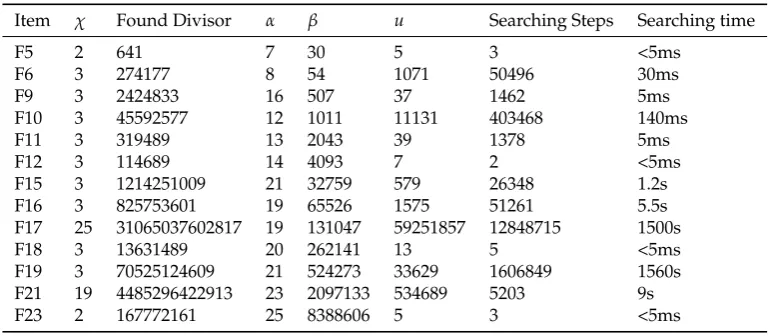
Table 1.Factorization of Some Fermat Numbers
Item χ Found Divisor α β u Searching Steps Searching time
F5 2 641 7 30 5 3 <5ms
F6 3 274177 8 54 1071 50496 30ms
F9 3 2424833 16 507 37 1462 5ms
F10 3 45592577 12 1011 11131 403468 140ms
F11 3 319489 13 2043 39 1378 5ms
F12 3 114689 14 4093 7 2 <5ms
F15 3 1214251009 21 32759 579 26348 1.2s
F16 3 825753601 19 65526 1575 51261 5.5s
F17 25 31065037602817 19 131047 59251857 12848715 1500s
F18 3 13631489 20 262141 13 5 <5ms
F19 3 70525124609 21 524273 33629 1606849 1560s
F21 19 4485296422913 23 2097133 534689 5203 9s
F23 2 167772161 25 8388606 5 3 <5ms
4. Conclusion, Discussion & Future Work
4.1. Conclusion
Factoring big integers is both a challenge to and an exploitation of human intelligence. We know that there are many odd integers that have divisors of the form 2αu±1 and factorization of such
numbers is still a hard problem in the world. By investigating the intrinsic structures of such odd number, this paper shows that factorization of them is highlyu-related: a smalluleads to a rapid factorization. The results in this paper theoretically can factorize Fermat Numbers that have a bign. For example, referring to [6], whennis bigger than 100001,u<20000. Then it is easy to find a divisor ofFm.
4.2. Discussion
most 264−1=18446744073709551615. Now there are software tools that declaim themselves to have the capability in big number computing, e.g., GMP library (The GNU Multiple Precision Arithmetic Library)[7], NTL (A Library for doing Number Theory)[8], MIRACL(Multi-precision Integer and Rational Arithmetic Cryptographic Library)[9] and so on. They surely do well work for a popular big integer but none of them can work for a ’big’ Fermat number. I make such conclusion based on my own C/C++ programming experiences. Take GMP, which is said to be ’arithmetic without limitations’, as an example; let’s show what our barrier is. Seen from the user’s manual, the GMP library provides a functionmpz_mul_2exp(mpz_t&rop, mpz_t op, unsigned long i)to perform the following operation
rop=op×2i
With this function and under the condition 1≤ i≤2w−1, wherewis the word-length of the computer system, we can obtain a Fermat Number by defining a function SetFermatNumber as follows (Note: the number before each sentence is for later explanations)
void SetFermatNumber(mpz_t &rop, unsigned long k) {
(1) mpz_t t; unsigned long s;
(2) mpz_init(t); mpz_set_ui(t,1); //initialize t and set t=1
(3) s=1«k; //s=2k
(4) mpz_mul_2exp(rop, t, s); //rop=1×2s=22k (5) mpz_add_ui(rop, rop, 1); //rop=rop+1⇒22k+1
(6) mpz_clear(t) //release t
}
This function works well when 1≤k≤2w−1. Otherwise it does not work because the sentence (3) is only available for unsigned long integers and the third parametersin sentence (4) must be an unsigned long integer. We wish we could have gotten a function like this
mpz_mul_2expz(mpz_t&rop, mpz_t op, mpz_t z) with which a real big Fermat number could be calculated.
Consequently, we have no way to obtain a computable Fermat numberFmwithm>2w−1. Hope new tools can solve this problem.
4.3. Future Work
Corollaries 1 and 2 do provide an approach to factorize odd integers with a divisor of the form 2αu±1. However, seeing the reasoning process of this paper, we have to have more researches on
the speeding-up process for a bigu, for example, the F7 hasq=116503103764643·29+1 with a big u=116503103764643. This remains the future work. Actually, in our experiments, we have found that, changing the parametersχwill lead to different searching steps. For example, when factoring F5, it took more than 340 steps whenχ=3 while it merely took 3 steps whenχ=2. Another example is factoring F21 that has a divisor 4485296422913. When takingχ=19 according to Remark 2 it took 5203 steps (9 seconds) to finish the work while it took 3675387 steps (over 30 minutes) whenχ=5. These phenomena indicate that a speed-up attempt is available.One of our future tasks is trying to solve the problem. And I also hope more young join and succeed.
Acknowledgments: The research is supported by the Open Project Program of the State Key Lab of CAD&CG(Grant No. A2002), Foshan University and by Foshan Bureau of Science and Technology under project that constructs Guangdong Engineering Center of Information Security for Intelligent Manufacturing System.
Terminologies
Maple is the mathematical software in which one can program using Maple scripts to test algorithms.
Appendix A Maple Program and Running Results
Here is the Maple program and its running results.
FactFermat := proc (N, x) # Maple program from Algorith 4 local a, b, i, j, u, l, s, r, g, d, rm, c, Z;
c := 1; # a counter to count searching steps Z := N-1+0.1e-1;
b := floor(log[2](Z))-x; s := floor(log[2](log[2](Z))); a := s+15;
for i from b by -1 to 3 do l:= f loor((N−1)/2i)−1; r:= f loor((N−1)/2(i−1)); if ‘mod‘(l, 2) = 0 then l := l-1 end if; if ‘mod‘(r, 2) = 0 then r := r+1 end if;
for j from s+2 to a do for u from l by 2 to r do c := c+1;
d:=2j×u+1; g := gcd(N, d); if 1 < g then do
lprint(i, j, u, d, g, c); return g;
end do end if end do end do end do end proc
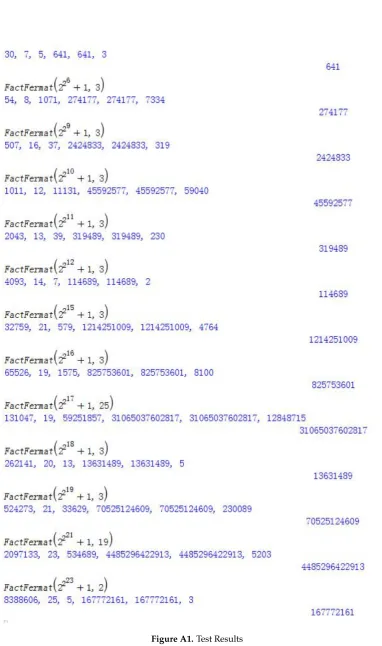
# The following screenshot (see Figure A1) shows the testing results to factorize Fermat numbers. The meanings of the output data are as follows:
The first one is the calcualtedα The second one is the calcualtedβ The third one is the calcualtedu The fourth one is the calcualted 2αu+1
The fifth one is the calcualted divisor
The last one is the number of searching steps.
3. Xingbo WANG, Fast Approach to Factorize Odd Integers with Special Divisors.Journal of Mathematics and Statistics,2020,16(1), 40-51.https://thescipub.com/abstract/10.3844/ofsp.12920
4. X. WANG, Brief Summary of Frequently-Used Properties of the Floor Function: Updated 2018 .IOSR Journal
of Mathematics,2019,15(1), 30-33.
5. X. WANG,T3Tree and Its Traits in Understanding Integers.Advances in Pure Mathematics,2018,8(5), 494-507.
6. Wilfrid Keller, Prime factors k·2n +1 of Fermat numbers Fm and complete factoring status,
http://www.prothsearch.com/fermat.html, 2020.
7. GMP library, The GNU Multiple Precision Arithmetic Library.https:// gmplib.org/, 2020.
8. Victor Shoup, NTL: A Library for doing Number Theory.https://www. shoup.net/ntl/, 2020.
9. MIRACL , MIRACL Cryptographic SDK .https://github.com/miracl/ MIRACL, 2020
Sample Availability:Source codes of C/C++ programs with GMP big number library are available from the author. Readers of insterests may ask for them.
References
1. Sonal Sarnaik, Dinesh Gadekarand Umesh Gaikwad, An overview to Integer factorization and RSA in
Cryptography.International Journal for Advance Research in Engineering and Thechnology,2014,2(9), 21-26.