OPINION
Hybridization in Parasites: Consequences for
Adaptive Evolution, Pathogenesis, and Public
Health in a Changing World
Kayla C. King1☯, Rike B. Stelkens2☯, Joanne P. Webster3☯, Deborah F. Smith4, Michael
A. Brockhurst4*
1Department of Zoology, University of Oxford, Oxford, United Kingdom,2Max Planck Institute for Evolutionary Biology, Plön, Germany,3Department of Pathology and Pathogen Biology, Centre for Emerging, Endemic and Exotic Diseases (CEEED), Royal Veterinary College, University of London, London, United Kingdom,4Department of Biology, University of York, York, United Kingdom
☯These authors contributed equally to this work. *[email protected]
Hybridization of parasites is an emerging public health concern at the interface of infectious disease biology and evolution. Increasing economic development, human migration, global trade, and climate change are all shifting the geographic distribution of existing human, livestock, companion animal, and wildlife parasites [1–9]. As a result, human populations encounter new infections more frequently, and coinfection by multiple parasites from different lineages or species within individual hosts occurs. Coinfection may have a large impact on the hosts and parasites involved, often as a result of synergistic or antagonistic interactions between parasites [10]. Indeed, mixed-species coinfections have been found to influence parasite estab-lishment, growth, maturation, reproductive success, and/or drug efficacy [11–13]. However, coinfections can allow for heterospecific (between-species or between-lineage) mate pairings, resulting in parthenogenesis (asexual reproduction in which eggs occur without fertilization), introgression (the introduction of single genes or chromosomal regions from one species into that of another through repeated backcrossing), and whole-genome admixture through hybrid-ization [14].
Recent molecular developments have revealed instances of fertile hybridization and intro-gression in plants [15], animals [16,17], and humans [18]. However, modern genetics and genomics have also uncovered the first confirmed cases of introgression within eukaryotic par-asites [14,19]. Examples for such successful reticulate evolution in parasites include, but are not exclusive to, causative agents of important diseases initiated by fungi (Cryptococcus[20]), hel-minthic worms (Schistosoma,Fasciola,Ascaris, andTrichinella[21,22–24]), and protozoa (Plasmodium,Leishmania,Toxoplasma, andTrypanosoma[25,26–31]), as well as their vectors. These cases involve introgression between members of the neglected tropical diseases (NTDs) and/or neglected zoonotic diseases (NZDs)—highly debilitating diseases infecting more than a sixth of the world’s human population (and their livestock), with devastating consequences for individuals and communities. Such diseases are predominantly diseases of the world’s poorest communities, afflicting those people who are most at risk of contracting mixed parasitic infec-tions (and hence also at risk for potential novel introgressed parasite infecinfec-tions) and at the same time least likely to get proper medical care once infected [32].
Evidence gathered to date, mainly from studies on nonparasitic animals and plants, suggests that hybridization can have a major evolutionary impact [33]. While hybridization can result OPEN ACCESS
Citation:King KC, Stelkens RB, Webster JP, Smith DF, Brockhurst MA (2015) Hybridization in Parasites: Consequences for Adaptive Evolution, Pathogenesis, and Public Health in a Changing World. PLoS Pathog 11(9): e1005098. doi:10.1371/journal.ppat.1005098
Editor:Glenn F Rall, The Fox Chase Cancer Center, UNITED STATES
Published:September 3, 2015
Copyright:© 2015 King et al. This is an open access article distributed under the terms of theCreative Commons Attribution License, which permits unrestricted use, distribution, and reproduction in any medium, provided the original author and source are credited.
Funding:This work was supported by a Royal Society Newton Fellowship (KCK), a Marie Curie Fellowship (RBS), and a European Research Council Starting Grant (MAB). The funders had no role in study design, data collection and analysis, decision to publish, or preparation of the manuscript.
in lower average fitness due to F1 sterility and inviability, caused by negative epistatic interac-tions [34–36] and the disruption of beneficial gene complexes [37,38], hybridization is at the same time a rich source of new genetic variation [39]. This can provide the raw material for natural selection to shape the evolution of ecologically relevant traits [33,40,41]. Thus, while a hybrid offspring, under certain conditions, may be less fit than its purebred offspring counter-parts from either parental line, hybridization broadens the“working surface”for selection by producing a whole range of potentially adaptive phenotypes, ranging from one parent to the other and beyond. In nonparasitic taxa, hybridization has already been shown to promote geo-graphic range expansions of populations (for example, in spiders [42]) as well as adaptation to new environments (Darwin finches [43]). There is also increasing evidence that hybridization can lead to the functional diversification of a group, as shown inHelianthussunflowers [44], and even to speciation (reviewed in [40,45,46]). One key example of this is the case of“ trans-gressive hybrids,”i.e., hybrids expressing extreme phenotypes that do not reside in either of the parental populations. These are“hopeful monsters”with respect to their evolutionary potential because they can diverge from their parents ecologically and may quickly become reproduc-tively isolated from them [47–49]. In addition to broadening the selection surface, hybridiza-tion can also speed up the process of adaptahybridiza-tion. After hybridizahybridiza-tion events, new alleles or allelic combinations that happen to be beneficial in the new environment are available immedi-ately. This is in contrast to nonhybrid populations in which adaptation relies on alleles brought in via immigration or de novo mutation, both processes that require relatively longer periods of time [50,51]. As a consequence, populations with a hybrid origin may survive rapid environ-mental change better than their nonhybrid parents, as recently shown in yeast [52].
We predict that parasites are one of the major groups of organisms in which hybridization can have major impacts on the evolution and diversification of a group [14,19] and can lead to speciation [53], affecting key pathogenic traits and transmission. Hybridization in parasites may thus pose a serious challenge for the prevention, effective control, and therapy of disease [19]. While it has been suggested that hybridization and introgression between parasites can potentially drive the emergence and rapid evolution of novel zoonotic diseases [14], most stud-ies to date are descriptive and do not consider the evolutionary consequences. Here, we review some of the most recent advances in the detection of hybridization in eukaryotic parasites (and their vectors) and discuss the significance of parasite hybridization for adaptive evolution and public health supported by relevant case studies inSchistosomaspp. (Box 1),Leishmaniaand
Trypanosoma(Box 2), and the malaria vectorAnopheles(Box 3). Given the role of infectious agents in our changing world, particularly in terms of emerging parasitic disease in response to anthropogenic change [32], it is time for a new and integrative perspective. Here, we argue for the integration of parasitology, disease biology, and evolutionary biology to understand the consequences of parasite hybridization to aid in the management and prevention of disease.
Consequences of Hybridization in Parasites
known about the hybridization of eukaryotic parasites, their frequency in the wild, or how hybridization may affect their spread and pathogenicity. Modern molecular techniques, how-ever, can expose the signature of hybridization in the genome more rapidly and accurately, thereby increasing the number of recent reports of parasite hybridization.
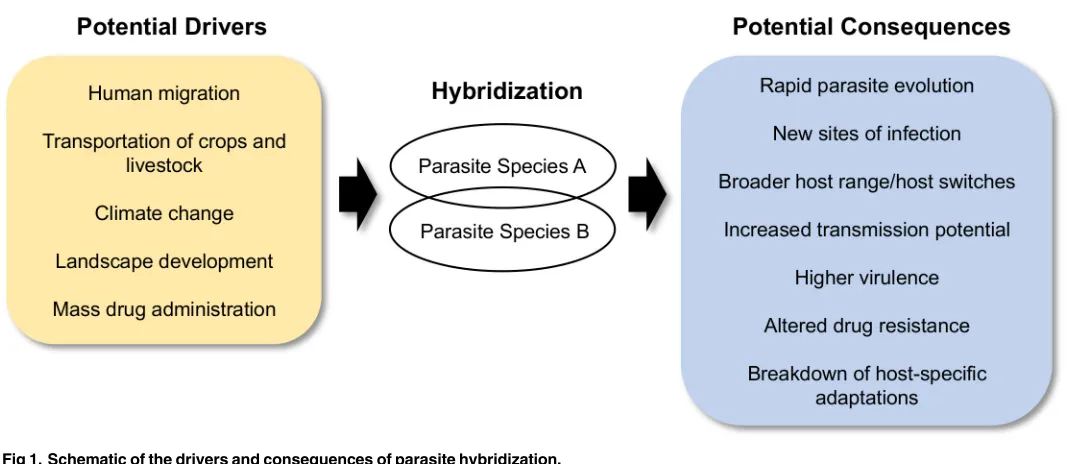
We outline what we believe will be the most important and/or potentially dangerous effects of hybridization in eukaryotic parasites: (1) the generation of novel and extreme infection phenotypes, (2) an increase in host range, being just one component of (3) an increase in trans-mission potential, (4) an increase in parasite evolutionary potential with consequences for host–parasite coevolution, (5) the breakdown of host-specific adaptations, and also (6) an altered response to drug therapy (Fig 1).
Box 1. Case Example
—
Introgression in Helminths: Schistosomiasis
Schistosomaspp. are the causative agents of schistosomiasis, a prevalent, chronic, and debilitating helminthic disease of humans and animals that occurs across much of the developing world. As early as 1948, there have been phenotypic reports of eggs indicative of potentialSchistosoma haematobium–S.mattheeihybrids in Rhodesia/Zimbabwe [75],
S.bovis–S.curassonihybrids in West African ruminants,S.haematobium–S.mattheei
hybrids in Southern African ruminants, andS.haematobium–S.bovishybrids in humans from West Africa [76–78]. More recently, ITS1+2 andcox1barcoding studies of viable schistosome miracidial larvae hatched from the stool and urine of Senegalese school chil-dren confirmed bidirectional hybridization between humanS.haematociumand live-stockS.bovis[67], as well as forS.haematobiumandS.curassoni[79]. Studies from infected snails in Kenya have observed hybrid cercariae betweenS.mansonifrom humans and its sister species,S.rodhaini, from rodents [80]. These authors, using micro-satellite markers (ribosomal DNA [rDNA] and mitochondrial DNA [mtDNA]), demon-strated that these hybrids produce viable offspring through first or successive generation backcrosses withS.mansoni. Unlike theS.haematobiumandS.bovisorS.currassoni
hybrids described above, the direction of introgression appeared highly asymmetric, causing unidirectional gene flow from the rodentS.rodhainito the humanS.mansoni
1. As a result of new allelic combinations produced by hybridization, hybrid parasites may show enhanced phenotypic characteristics compared to the parents. Hybrids may be better at host exploitation, such that they may be more efficient at obtaining nutrition from the host, leading to higher fecundity or faster maturation time. Also, certain new hybrid parasite genotypes have been shown to be better at avoiding recognition and resistance from the host’s adaptive immune system, potentially leading to higher infectivity and unusual pathol-ogies [29,62]. We thus predict that hybrid parasites are able to exploit novel resources and sites of infection within the host, which parental genotypes cannot utilize.
2. Hybrid parasites may be able to infect a greater range of host species [14,19,63]. While parental parasites are often restricted to one host species, hybrid parasites may be able to exploit both. InterspecificSchistosomaspp. hybrids, for instance, are able to infect both parental intermediate snail hosts (Box 1) [21]. In addition, just as some hybrids of nonpara-sitic taxa adapt to new ecological conditions and colonize novel environments that neither of the parents can survive [44,49], we would predict that hybrid parasites may be able to infect entirely new host species. As an indication that this indeed occurs in the wild, two plant pathogenic fungi (Phytophthoraspp. infecting alder trees [64] andZymoseptoria pseu-dotriticiinfecting a range of grasses [53]) and one amphibian fungal pathogen (a new line-age ofBatrachochytrium dendrobatidiscausing dramatic outbreaks of chytridiomycosis
Box 2. Case Example
—
Introgression in Protozoans: Leishmaniosis
and Trypanosomiasis
[65]), which all emerged via hybridization, have been found to live on host species neither of their parents are found on.
3. With increasing land use and current rates of anthropogenic change across both the envi-ronment and agricultural/livestock practices, we predict that recombinant parasite geno-types will be generated at an increasing rate. Encounters between previously isolated parasite species become more frequent when geographic and ecological barriers that
Box 3. Case Example
—
Introgression in the Parasite Vector
Anopheles
: Malaria
Anopheleshas become a model organism at the interface of speciation genomics and epi-demiology [94], showcasing the potential perils of hybridization for public health but also the possible benefits of using controlled and induced hybridization as a means for disease control.Anophelesmosquitoes are vectors for malaria, which is caused by para-sitic protozoans belonging to the genusPlasmodium. Malaria affects 200 million people a year worldwide, with an estimated 0.5–1 million deaths per year, mostly among young children in sub-Saharan Africa, where 90% of the world’s malaria deaths occur [95].
There are approximately 60 different species ofAnophelesfound worldwide [96], and genomic sequences of 16Anophelesspecies (including vector and nonvector species) have recently become available [94,97]. These sequences have revealed fast and flexible evolutionary rates with respect to traits affecting their transmission potential, shown extensive introgression betweenAnophelesspecies, and suggested that enhanced vectorial capacity and adaptation to humans as primary hosts can result from interspecific genetic exchange. A multilocus single nucleotide polymorphism (SNP) genotyping panel is also at hand to detect F1 hybrids and backcrosses between the main vectors of malaria,
Anopheles gambiaesensu stricto (S form) andA.coluzzii(M form) [98].
Control ofAnophelesthrough insecticides, such as dichlorodiphenyltrichloroethane (DDT) and pyrethroids, has contributed to the prevention of malaria, but resistance to insecticides has recently emerged inAnophelespopulations [99,100]. Recent studies have demonstrated rapid adaptive introgression of the insecticide resistance mutation Vgsc-L1014FfromA.gambiaetoA.coluzzii, in response to strong anthropogenic selection from increased insecticide use [101,102]. Others have found gene flow occurring at rates “far from inconsequential”between other species ofAnopheles(e.g., betweenA.gambiae and A.arabiensisin Uganda [99,103] andA.sinensisandA.kleiniin Korea [104]). Experimental interpopulation crosses ofA.gambiae, monitored for traits determining their malaria transmission potential, scored higher for fecundity, body size, adult longev-ity, and average blood meal size, compared to both parental strains [105]. It is thus con-ceivable that the fitness-enhancing potential of hybridization may also apply to closely related interspecific hybrid crosses.
Hybridization betweenAnophelesspecies may have beneficial effects for disease con-trol. Asymmetric introgression has recently been shown to transfer adaptive immunity and increased refractoriness to thePlasmodiumpathogen fromA.coluzziitoA.gambiae
previously existed between parasite species are lost. Taking together the potential impact of hybrid superiority and host range expansions (described in 2) and an increase in anthro-pogenically mediated parasite dispersal, the transmission of disease may become consider-ably facilitated [66,67]. This may lead to epidemics, threaten global food security, and endanger natural animal and plant populations. For instance, the increasing creation and alteration of water bodies for agriculture can lead to areas of overlap and co-occurrence of the different intermediate snail host species ofSchistosomaparasites [66,68]. This generates ample opportunity for coinfections of the definitive host by differentSchistosomaspecies, which may then hybridize. In addition, humans and livestock are drawn to the same water resources, where they can both release parasites and become infected, thus creating a“ hot-bed”for disease transmission between human and livestock.
4. Evolutionary theory predicts that elevated virulence and genetic diversity, both potential outcomes of parasite hybridization, can increase the evolutionary potential of parasites and alter the host–parasite coevolutionary process [69]. For instance, forPhytophthora, hybrid-ization has led to a range of new species with particularly aggressive pathogenicity [64], and hybrid lineages of the amphibian zoosporic fungusBatrachochytrium, which cause dramatic outbreaks of chytridiomycosis, have been found to be hypervirulent to many hosts [65]. In the context of coevolutionary races, higher virulence of hybrid parasites may impose stron-ger selection for host resistance.
5. Hybridization in parasites could, however, also be maladaptive for the parasites because of fitness-reducing genetic incompatibilities (negative epistasis) and the breakdown of host-specific adaptations, potentially leading to reduced infectivity/virulence. While such out-breeding depression is well known from free-living organisms, studies on the fitness of hybrid parasites are scarce. Outbreeding depression has been reported in a snail–trematode host–parasite system (Potamopyrgus antipodarum–Microphallussp.), in which hybrid para-sites suffer from reduced infectivity in both parental host populations [70,71]. In such cases, we predict that hybrid parasites may be less likely to evade host immunity or they may fail Fig 1. Schematic of the drivers and consequences of parasite hybridization.
to effectively colonize the correct organ or body site. Through recombination and segrega-tion, hybrids may also lose beneficial alleles that the parents had acquired previously, such as those conferring drug resistance (see below). Hybrid parasite inferiority can also lead to unusual pathogensis, which may hamper diagnosis, particularly when two very different dis-ease phenotype parasites are introgressed (Box 1). As such, hybridization between divergent parasite populations may both promote and alter pathogenesis, which has important impli-cations on disease prevalence, pathology, and treatment.
6. Hybridization may have a wide range of effects on drug efficacy in parasites. On the one hand, zoonotic hybrids may exhibit enhanced susceptibility to drugs if resistance alleles cir-culating in the human host parasite population are swamped by introgression of drug-sus-ceptible alleles from the animal host parasite population. Furthermore, if hybridization between human and animal parasites increases the host range from human host specificity to that of a large animal host range reservoir, this could act against the establishment and spread of drug resistance [32]. Alternatively, hybridization could potentiate adaptive evolu-tion within certain parasites in response to drug treatment (Box 1). One example for this is
Cryptococcusserotype hybrids that are resistant to an antifungal drug usually used to treat infections with the individual parental serotypes [20]. More evidence for the adaptive intro-gression of drug resistance genes from nonsusceptible strains or species comes from Hae-monchusnematodes that gained resistance against the broad-spectrum drug ivermectin through hybridization [72,73] and the introgression of anticoagulant rodent poison resis-tance by hybridization between Old World mice [74].
Conclusions
Understanding and monitoring hybridization in animal and human parasites will be essential for optimizing and evaluating control strategies across potential hybrid zones. Relatively simple diagnostic procedures currently exist for detecting hybrids in some parasite groups (e.g., using a multilocus approach with mitochondrial cytochrome c oxidase subunit 1 (COX-1)/internal transcribed spacer (ITS) barcoding; [67]). However, the advancement of state-of-the-art geno-mic technologies will be helpful for more fine-scale detection of hybridization in parasites, to determine their evolutionary rates, and to identify patterns of cross transmission between host species (i.e., sources of transmission of zoonotic parasites to humans). Since hybrid parasites appear to be a particular problem in NTDs, there is a need to develop cheap, robust diagnostics appropriate to use in the field.
References
1. Semenza JC, Menne B (2009) Climate change and infectious diseases in Europe. Lancet Infectious Diseases 9: 365–375. doi:10.1016/S1473-3099(09)70104-5PMID:19467476
2. Nichols GL, Andersson Y, Lindgren E, Devaux I, Semenza JC (2014) European Monitoring Systems and Data for Assessing Environmental and Climate Impacts on Human Infectious Diseases. Interna-tional Journal of Environmental Research and Public Health 11: 3894–3936. doi:10.3390/
ijerph110403894PMID:24722542
3. Martens P, Kovats RS, Nijhof S, de Vries P, Livermore MTJ, et al. (1999) Climate change and future populations at risk of malaria. Global Environmental Change-Human and Policy Dimensions 9: S89– S107.
4. Lafferty KD (2009) The ecology of climate change and infectious diseases. Ecology 90: 888–900. PMID:19449681
5. Brooks DR, Hoberg EP (2007) How will global climate change affect parasite-host assemblages? Trends in Parasitology 23: 571–574. PMID:17962073
6. Patz JA, Graczyk TK, Geller N, Vittor AY (2000) Effects of environmental change on emerging para-sitic diseases. International Journal for Parasitology 30: 1395–1405. PMID:11113264
7. Hales S, de Wet N, Maindonald J, Woodward A (2002) Potential effect of population and climate changes on global distribution of dengue fever: an empirical model. Lancet 360: 830–834. PMID:
12243917
8. Astrom C, Rocklov J, Hales S, Beguin A, Louis V, et al. (2012) Potential Distribution of Dengue Fever Under Scenarios of Climate Change and Economic Development. Ecohealth 9: 448–454. doi:10. 1007/s10393-012-0808-0PMID:23408100
9. Moore S, Shrestha S, Tomlinson KW, Vuong H (2012) Predicting the effect of climate change on Afri-can trypanosomiasis: integrating epidemiology with parasite and vector biology. Journal of the Royal Society Interface 9: 817–830.
10. Nowak MA, May RM (1994) Superinfection and the evolution of parasite virulence. Proceedings of the Royal Society of London B: Biological Sciences 255: 81–89.
11. Norton AJ, Webster JP, Kane R, Rollinson D (2008) Inter-specific parasite competition: mixed infec-tions ofSchistosoma mansoniandS.rodhainiin the definitive host. Parasitology 135: 1–12.
12. Webster JP, Gower CM, Norton AJ (2008) Application of evolutionary concepts to predicting and eval-uating the impact of mass-chemotherapy schistosomiasis control programmes. Evolutionary Applica-tions 1: 66–83. doi:10.1111/j.1752-4571.2007.00012.xPMID:25567492
13. Koukounari A, Donnelly CA, Sacko M, Keita A, Landoure A, et al. (2010) The impact of single versus mixed schistosome species infections on liver, spleen and bladder morbidity within Malian children pre- and post-praziquantel treatment. BMC Infectious Diseases 10: 227. doi: 10.1186/1471-2334-10-227PMID:20670408
14. Detwiler JT, Criscione CD (2010) An infectious topic in reticulate evolution: introgression and hybrid-ization in animal parasites. Genes 210: 102–123.
15. Baack EJ, Rieseberg LH (2007) A genomic view of introgression and hybrid speciation. Current Opin-ion in Genetics & Development 17: 513–518.
16. Arnold M (2004) Natural hybridization and the evolution of domesticated, pest and disease organisms. Molecular Ecology 13: 997–1007. PMID:15078439
17. Mavarez J, Salazar CA, Bermingham E, Salcedo C, Jiggins CD, et al. (2006) Speciation by hybridiza-tion inHeliconiusbutterflies. Nature 441: 868–871. PMID:16778888
18. Hawks J, Cochran G (2006) Dynamics of adaptive introgression from archaic to modern humans. Paleoanthropology 2006: 101–115.
19. Arnold ML (2004) Natural hybridization and the evolution of domesticated, pest and disease organ-isms. Molecular Ecology 13: 997–1007. PMID:15078439
20. Li W, Averette AF, Desnos-Ollivier M, Ni M, Dromer F, et al. (2012) Genetic diversity and genomic plasticity ofCyptococcus neoformansAD hybrid strains. G3: Genes, Genomes, Genetics 2: 83–97
21. Webster BL, Diaw OT, Seye MM, Webster JP, Rollinson D (2013) Introgressive hybridization of Schis-tosoma haematobiumgroup species in Senegal: species barrier break down between ruminant and human schistosomes. PloS Neglected Tropical Diseases 7: e2110. doi:10.1371/journal.pntd. 0002110PMID:23593513
23. Le TH, De NV, Agatsuma T, Thi Nguyen TG, Nguyen QD, et al. (2008) Human fascioliasis and the presence of hybrid/introgressed forms ofFasciola hepaticaandFasciola giganticain Vietnam. Interna-tional Journal for Parasitology 38: 725–730. PMID:18031748
24. Dunams-Morel DB, Reichard MV, Torretti L, Zarlenga DS, Rosenthal BM (2012) Discernible but lim-ited introgression has occurred whereTrichinella nativaand the T6 genotype occur in sympatry. Infec-tion, Genetics and Evolution 12: 530–538. doi:10.1016/j.meegid.2012.01.004PMID:22266240
25. Rogers MB, Downing T, Smith BA, Imamura H, Sanders M, et al. (2014) Genomic confirmation of hybridisation and recent inbreeding in a vector-isolatedLeishmaniapopulation PLoS Genetics 10: e1004092. doi:10.1371/journal.pgen.1004092PMID:24453988
26. Sturm NR, Vargas NS, Westenberger SJ, Zingales B, Campbell DA (2003) Evidence for multiple hybrid groups inTrypanosoma cruzi. International Journal for Parasitology 33: 269–279. PMID:
12670512
27. Machado CA, Ayala FJ (2001) Nucleotide sequences provide evidence of genetic exchange among distantly related lineages ofTrypanosoma cruzi. Proceedings of the National Academy of Sciences of the United States of America 98: 7396–7401. PMID:11416213
28. Gaunt MW, Yeo M, Frame IA, Stothard JR, Carrasco HJ, et al. (2003) Mechanism of genetic exchange in American trypanosomes. Nature 421: 936–939. PMID:12606999
29. Grigg ME, Bonnefoy S, Hehl AB, Suzuki Y, Boothroyd JC (2001) Success and virulence in toxoplasma as the result of sexual recombination between two distinct ancestries. Science 294: 161–165. PMID:
11588262
30. Akopyants NS, Kimblin N, Secundino N, Patrick R, Peters N, et al. (2009) Demonstration of genetic exchange during cyclical development ofLeishmaniain the sand fly vector. Science 324: 265–268. doi:10.1126/science.1169464PMID:19359589
31. Ramiro RS, Khan SM, Franke-Faynard B, Janse CJ, Obbard DJ, et al. (2015) Hybridization and pre-zygotic reproductive barriers in Plasmodium. Proceedings of the Royal Society Biological Sciences Series B 282.
32. Webster JP, Molyneux D, Hotez PJ, Fenwick A (2014) The contribution of mass drug administration to global health—past, present and future. Philosophical Transactions of the Royal Society of London B Biological Sciences 369: 20130434. doi:10.1098/rstb.2013.0434PMID:24821920
33. Arnold ML (2006) Evolution through genetic exchange; Press OU, editor. Oxford.
34. Dobzhansky T (1937) Genetic nature of species differences. American Naturalist 71: 404–420.
35. Müller HJ (1942) Isolating mechanisms, evolution and temperature. Biological Symposium 6: 71– 125.
36. Coyne JA, Orr HA (2004) Speciation. Sunderland, MA: Sinauer Associates.
37. Edmands S (2002) Does parental divergence predict reproductive compatibility? Trends in Ecology & Evolution 17: 520–527.
38. Lynch M (1991) The genetic interpretation of inbreeding depression and outbreeding depression. Evo-lution 45: 622–629.
39. Barton NH (2001) The role of hybridization in evolution. Molecular Ecology 10: 551–568. PMID:
11298968
40. Abbott R, Albach D, Ansell S, Arntzen JW, Baird SJE, et al. (2013) Hybridization and speciation. Jour-nal of Evolutionary Biology 26: 229–246. doi:10.1111/j.1420-9101.2012.02599.xPMID:23323997
41. Seehausen O (2004) Hybridization and adaptive radiation. Trends in Ecology & Evolution 19: 198– 207.
42. Krehenwinkel H, Tautz D (2013) Northern range expansion of European populations of the wasp spi-derArgiope bruennichiis associated with global warming correlated genetic admixture and popula-tion-specific temperature adaptations. Molecular Ecology 22: 2232–2248. doi:10.1111/mec.12223
PMID:23496675
43. Grant BR, Grant PR (2008) Fission and fusion of Darwin's finches populations. Philosophical Transac-tions of the Royal Society B-Biological Sciences 363: 2821–2829.
44. Rieseberg LH, Raymond O, Rosenthal DM, Lai Z, Livingstone K, et al. (2003) Major ecological transi-tions in wild sunflowers facilitated by hybridization. Science 301: 1211–1216. PMID:12907807
45. Mallet J (2007) Hybrid speciation. Nature 446: 279–283. PMID:17361174
46. Schumer M, Rosenthal GG, Andolfatto P (2014) How common is homoploid hybrid speciation? Evolu-tion 68: 1553–1560. doi:10.1111/evo.12399PMID:24620775
48. Rieseberg LH, Archer MA, Wayne RK (1999) Transgressive segregation, adaptation and speciation. Heredity 83: 363–372. PMID:10583537
49. Stelkens RB, Brockhurst MA, Hurst GDD, Miller EL, Greig D (2014) The effect of hybrid transgression on environmental tolerance in experimental yeast crosses. Journal of Evolutionary Biology 27: 2507– 2519. doi:10.1111/jeb.12494PMID:25262771
50. Barrett RDH, Schluter D (2008) Adaptation from standing genetic variation. Trends in Ecology & Evo-lution 23: 38–44.
51. Hedrick PW (2013) Adaptive introgression in animals: examples and comparison to new mutation and standing variation as sources of adaptive variation. Molecular Ecology 22: 4606–4618. doi:10.1111/ mec.12415PMID:23906376
52. Stelkens RB, Brockhurst MA, Hurst GDD, Greig D (2014) Hybridization facilitates evolutionary rescue. Evolutionary Applications 7: 1209–1217. doi:10.1111/eva.12214PMID:25558281
53. Stukenbrock EH, Christiansen FB, Hansen TT, Dutheil JY, Schierup MH (2012) Fusion of two diver-gent fungal individuals led to the recent emergence of a unique widespread pathogen species. Pro-ceedings of the National Academy of Sciences of the United States of America 109: 10954–10959. doi:10.1073/pnas.1201403109PMID:22711811
54. Davies J (1996) Origins and evolution of antibiotic resistance. Microbiologia 12: 9–16. PMID:
9019139
55. Gyles C, Boerlin P (2014) Horizontally Transferred Genetic Elements and Their Role in Pathogenesis of Bacterial Disease. Veterinary Pathology Online 51: 328–340.
56. Ochman H, Moran NA (2001) Genes lost and genes found: the molecular evolution of bacterial patho-genesis and symbiosis. Science 292: 1096–1098. PMID:11352062
57. Ochman H, Lawrence JG, Groisman EA (2000) Lateral gene transfer and the nature of bacterial inno-vation. Nature 405: 299–304. PMID:10830951
58. Strauch E, Lurz R, Beutin L (2001) Characterization of a Shiga Toxin-Encoding Temperate Bacterio-phage ofShigella sonnei. Infection and Immunity 69: 7588–7595. PMID:11705937
59. Gibbs MJ, Armstrong JS, Gibbs AJ (2001) Recombination in the hemagglutinin gene of the 1918 "Spanish flu". Science 293: 1842–1845. PMID:11546876
60. Laird AR, Ibarra V, Ruiz-Palacios G, Guerrero ML, Glass RI, et al. (2003) Unexpected detection of ani-mal VP7 genes among common rotavirus strains isolated from children in Mexico. Journal of Clinical Microbiology 41: 4400–4403. PMID:12958276
61. Worobey M, Rambaut A, Holmes EC (1999) Widespread intra-serotype recombination in natural pop-ulations of dengue virus. Proceedings of the National Academy of Sciences of the United States of America 96: 7352–7357. PMID:10377418
62. Schelkle B, Faria PJ, Johnson MB, van Oosterhout C, Cable J (2012) Mixed infections and hybridisa-tion in monogenean parasites. Plos ONE 7: e39506. doi:10.1371/journal.pone.0039506PMID:
22808040
63. Volf P, Benkova I, Myskova J, Sadlova J, Campino L, et al. (2007) Increased transmission potential of
Leishmania major/Leishmania infantumhybrids. International Journal for Parasitology 37: 589–593. PMID:17376453
64. Brasier CM, Cooke DEL, Duncan JM (1999) Origin of a newPhytophthorapathogen through interspe-cific hybridization (vol 96, pg 5878, 1999). Proceedings of the National Academy of Sciences of the United States of America 96: 13589–13589.
65. Farrer RA, Weinert LA, Bielby J, Garner TWJ, Balloux F, et al. (2011) Multiple emergences of geneti-cally diverse amphibian-infecting chytrids include a globalized hypervirulent recombinant lineage. Proceedings of the National Academy of Sciences 108: 18732–18736.
66. Tchuente LAT, Southgate VR, Njiokou F, Njine T, Kouemeni LE, et al. (1997) The evolution of schisto-somiasis at Loum, Cameroon: replacement ofSchistosoma intercalatumbyS.haematobiumthrough introgressive hybridization. Transactions of the Royal Society of Tropical Medicine and Hygiene 91: 664–665. PMID:9509173
67. Huyse T, Webster BL, Geldof S, Stothard JR, Diaw OT, et al. (2009) Birdirectional introgressive hybridization between a cattle and human schistosome species. PLoS Pathogens 5: e1000571. doi:
10.1371/journal.ppat.1000571PMID:19730700
68. Webster BL, Tchuente LAT, Southgate VR (2007) A single-strand conformation polymorphism (SSCP) approach for investigating genetic interactions ofSchistosoma haematobiumand Schisto-soma guineensisin Loum, Cameroon. Parasitology Research 100: 739–745. PMID:17058111
70. Dybdahl MF, Jokela J, Delph LF, Koskella B, Lively CM (2008) Hybrid fitness in a locally adapted par-asite. American Naturalist 172: 772–782. doi:10.1086/592866PMID:18950274
71. Lively CM, Dybdahl MF (2000) Parasite adaptation to locally common host genotypes. Nature 405: 679–681. PMID:10864323
72. Redman E, Sargison N, Whitelaw F, Jackson F, Morrison A, et al. (2012) Introgression of Ivermectin resistance genes into a susceptibleHaemonchus contortusstrain by multiple backcrossing. PloS Pathogens 8: e1002534. doi:10.1371/journal.ppat.1002534PMID:22359506
73. Chaudhry U, Redman E, Abbas M, Muthusamy R, Ashraf K, et al. (2015) Genetic evidence for hybridi-sation betweenHaemonchus contortusandHaemonchus placeiin natural field populations and its implications for interspecies transmission of anthelmintic resistance. International Journal for Parasi-tology 45: 149–159. doi:10.1016/j.ijpara.2014.09.002PMID:25449043
74. Song Y, Endepols S, Klemann N, Richter D, Matuschka F-R, et al. (2011) Introgression of anticoagu-lant rodent poison resistance by hybridization between old world mice. Current Biology 21: 1296– 1301. doi:10.1016/j.cub.2011.06.043PMID:21782438
75. Alves W (1948) Transactions of the Royal Society of Tropical Medicine and Hygiene, 41: 430–439.
76. Bremond P, Campagne G, Sellin B, Labbo R, Garba A, et al. (1996) Les schistosomes anthropophiles et zoophiles au Niger et leur impact sur la santé publique: détermination du risque réel de contamina-tion et de pathogénicité pour les populacontamina-tions humaines. Rapport CERMES 6/96 document: 22 pages.
77. Rollinson D, Southgate VR, Vercruysse J, Moore PJ (1990) Observations on natural and experimental interactions betweenSchistosoma bovisandSchistosoma curassonifrom West-Africa. Acta Tropica 47: 101–114. PMID:1969699
78. Taylor MG (1970) Hybridisation experiments on five species of african schistosomes. Journal of Hel-minthology 17: 253–314.
79. Webster BL, Diaw OT, Seye MM, Webster JP, Rollinson D (2013) Introgressive hybridization of Schis-tosoma haematobiumgroup species in Senegal: species barrier break down between ruminant and human schistosomes. PLoS Neglected Tropical Diseases 7: e2110. doi:10.1371/journal.pntd. 0002110PMID:23593513
80. Steinauer ML, Hanelt B, Mwangi IN, Maina GM, Agola LE, et al. (2008) Introgressive hybridization of human and rodent schistosome parasites in western Kenya. Molecular Ecology 17: 5062–5064. doi:
10.1111/j.1365-294X.2008.03957.xPMID:18992007
81. Huyse T, Van den Broeck F, Hellemans B, Volckaert FAM, Polman K (2013) Hybridisation between the two major African schistosome species of humans. International Journal of Parasitology 43: 687– 689. doi:10.1016/j.ijpara.2013.04.001PMID:23643461
82. Berry A, Moné H, Iriart X, Mouahid G, Abbo O, et al. (2014)Schistosomiasis haematobium, Corsica, France [letter]. Emerging Infectious Diseases 20: 1595–1597. doi:10.3201/eid2009.140928PMID:
25153697
83. ECDC (2014) Rapid risk assessment: Local transmission ofSchistosoma haematobiumin Corsica, France–16 May 2014. Stockholm.
84. Boissier J, Moné H, Mitta G, Bargues MD, Molyneux DH, et al. (2015) Schistosomiasis reaches Europe. Lancet Infectious Diseases 15: 757–758. doi:10.1016/S1473-3099(15)00084-5PMID:
26122434
85. Messenger LA, Garcia L, Vanhove M, Huaranca C, Bustamante M, et al. (2015) Ecological host fitting ofTrypanosoma cruzi TcI in Bolivia: mosaic population structure, hybridization and a role for humans in Andean parasite dispersal. Molecular Ecology 24: 2406–2422. doi:10.1111/mec.13186PMID:
25847086
86. Messenger LA, Llewellyn MS, Bhattacharyya T, Franzén O, Lewis MD, et al. (2012) Multiple mito-chondrial introgression events and heteroplasmy inTrypanosoma cruzirevealed by Maxicircle MLST and Next Generation Sequencing. PLoS Neglected Tropical Diseases 6: e1584. doi:10.1371/journal. pntd.0001584PMID:22506081
87. Miles MA, Llewellyn MS, Lewis MD, al. e (2009) The molecular epidemiology and phylogeography of Trypanosoma cruzi and parallel research on Leishmania: looking back and to the future. Parasitology 136: 1509–1528. doi:10.1017/S0031182009990977PMID:19691868
88. Goodhead I, Capewell P, Bailey JW, Beament T, Chance M, et al. (2013) Whole-genome sequencing ofTrypanosoma bruceireveals introgression between subspecies that is associated with virulence. mBio 4: e00197–13. doi:10.1128/mBio.00197-13PMID:23963174
89. WHO (2014) Global Burden of Disease Estimates for 2000–2012.
91. Inbar E, Akopyants NS, Charmoy M, Romano A, Lawyer P, et al. (2013) The Mating Competence of Geographically Diverse Leishmania major Strains in Their Natural and Unnatural Sand Fly Vectors. PLoS Genetics 9: e1003672. doi:10.1371/journal.pgen.1003672PMID:23935521
92. Rogers MB, Downing T, Smith BA, Imamura H, Sanders M, et al. (2014) Genomic confirmation of hybridisation and recent Inbreeding in a vector-isolatedLeishmaniapopulation. PLoS Genetics 10: e1004092. doi:10.1371/journal.pgen.1004092PMID:24453988
93. Volf P, Benkova I, Myskova J, Sadlova J, Campino L, et al. (2007) Increased transmission potential of
Leishmania major/Leishmania infantumhybrids. Intenational Journal for Parasitology 37: 589–593.
94. Fontaine MC, Pease JB, Steele A, Waterhouse RM, Neafsey DE, et al. (2015) Extensive introgression in a malaria vector species complex revealed by phylogenomics. Science 347: 1258524. doi:10. 1126/science.1258524PMID:25431491
95. World Health Organization. Malaria 2015 [updated 2015; cited 2015 23 June].http://www.who.int/ malaria/en/.
96. Manguin S, Carnivale P, Mouchet J (2008) Biodiversity of Malaria in the World; John Libbey Eurotext, editor. Paris, France
97. Neafsey DE, Waterhouse RM, Abai MR, Aganezov SS, Alekseyev MA, et al. (2015) Highly evolvable malaria vectors: The genomes of 16Anophelesmosquitoes. Science 347: 1258522. doi:10.1126/ science.1258522PMID:25554792
98. Lee Y, Marsden CD, Nieman C, Lanzaro GC (2014) A new multiplex SNP genotyping assay for detecting hybridization and introgression between the M and S molecular forms ofAnopheles gam-biae. Molecular Ecology Resources 14: 297–305. doi:10.1111/1755-0998.12181PMID:24119184
99. Mawejje HD, Wilding CS, Rippon EJ, Hughes A, Weetman D, et al. (2013) Insecticide resistance mon-itoring of field-collectedAnopheles gambiae s.l. populations from Jinja, eastern Uganda, identifies high levels of pyrethroid resistance. Medical and Veterinary Entomology 27: 276–283. doi:10.1111/j. 1365-2915.2012.01055.xPMID:23046446
100. Wondji CS, Coleman M, Kleinschmidt I, Mzilahowa T, Irving H, et al. (2012) Impact of pyrethroid resis-tance on operational malaria control in Malawi. Proceedings of the National Academy of Sciences 109: 19063–19070.
101. Clarkson CS, Weetman D, Essandoh J, Yawson AE, Maslen G, et al. (2014) Adaptive introgression betweenAnophelessibling species eliminates a major genomic island but not reproductive isolation. Nat Commun 5: 4248. doi:10.1038/ncomms5248PMID:24963649
102. Norris LC, Main BJ, Lee Y, Collier TC, Fofana A, et al. (2015) Adaptive introgression in an African malaria mosquito coincident with the increased usage of insecticide-treated bed nets. Proceedings of the National Academy of Sciences 112: 815–820.
103. Weetman D, Steen K, Rippon E, Mawejje H, Donnelly M, et al. (2014) Contemporary gene flow between wildAn.gambiae s.s. andAn.arabiensis. Parasites & Vectors 7: 345.
104. Choochote W, Min G-S, Intapan P, Tantrawatpan C, Saeung A, et al. (2014) Evidence to support natu-ral hybridization betweenAnopheles sinensisandAnopheles kleini(Diptera: Culicidae): possibly a significant mechanism for gene introgression in sympatric populations. Parasites & Vectors 7: 36.
105. Menge D, Guda T, Zhong D, Pai A, Zhou G, et al. (2005) Fitness consequences ofAnopheles gam-biaepopulation hybridization. Malaria Journal 4: 44. PMID:16174295
106. Mancini E, Spinaci MI, Gordicho V, Caputo B, Pombi M, et al. (2015) Adaptive Potential of Hybridiza-tion among Malaria Vectors: Introgression at the Immune LocusTEP1betweenAnopheles coluzzii
andA.gambiaein‘Far-West’Africa. PLoS ONE 10: e0127804. doi:10.1371/journal.pone.0127804
PMID:26047479
107. Pates HV, Curtis CF, Takken W (2014) Hybridization studies to modify the host preference of Anophe-les gambiae. Medical and Veterinary Entomology 28: 68–74. doi:10.1111/mve.12070PMID: