Developing ethical awareness among MBA students
Roger Cook
|
[email protected]
University of West London
The teaching and learning of business ethics is challenging for postgraduate
management students, who often lean towards a pragmatic worldview which
does not relate easily to idealistic concepts. However the Masters of Business
Administration (MBA) classroom can provide an invaluable location for enquiry,
for social learning activity, and for critical reflection.
Contemporary business ethics texts largely rely on classical ethical theories to
frame and explore moral aspects of business, despite the strangeness of these
theories to management - a discipline grounded in social sciences. We find at The
University of West London (UWL) that MBA students are often able to engage
more readily with an ethical conversation which is grounded in psychological
perspectives on moral reasoning, rather than on philosophical concepts. This
paper summarizes the results of students’ feedback upon completion of a core
Business Ethics module, which was delivered from a range of differing conceptual
start points. The findings indicate that an adapted model derived from Kohlberg’s
concept of stages of moral development provides an accessible conceptual map
for personal learning and ethical discourse, which allows students to test and
appraise different ways to frame questions concerning ethics at work.
Keywords
|
Business ethics; MBA students; Kohlberg’s stages of moral
development
Introduction
It is increasingly recognized that if companies act responsibly (McEwan et al., 2003) and develop competence in evaluating, discussing and communicating values, they will over time create customer loyalty, engage stakeholders, and enhance competitive advantage. Business schools (Mangan, 2006) are now learning from past errors of omission in previously delivering management education reinforcing the ‘myth of amoral business’ (de George, 1999). The soul searching that followed the spate of corporate malfeasance which emerged around the millennium has led to substantive changes in curriculum design for business and management courses, and a recognition of the value of training managers to recognize and deal with ethical issues in the workplace (Trevino and Nelson, 2007). Design is not delivery however, and it is a demanding task in practice to engage students to develop skills in moral discourse and critical reflection in the relatively short periods of time typically
afforded to developing ethical awareness as part of a wider syllabus for a business or management course.
Ethical discussion is a skill only effectively acquired by doing - that is engaging in conversation and critical reflection about business conduct. It cannot be properly developed without first acquiring a degree of conceptual understanding and communicative skills in expressing and debating moral points of view about business or organisational situations, activities and decisions. Ethics as here defined conducts a discourse about morality, where morality concerns itself with decisions between the good and bad. As such it is inevitably value laden, and the challenge for the student is to understand and critically apply frameworks and concepts which can explain and justify any value judgements made, and to conduct a meaningful discourse within which such judgements can be evaluated and discussed.
For UK-based MBA degrees, students are by definition post-experience on initial enrolment, and therefore able to draw on previous real life examples of organizational and business conduct. With an appropriate approach to teaching and learning they can also benefit from the knowledge and experience of their peers as a social process guided by tutoring staff to facilitate to learning experience. Each MBA student arrives with prior exposure to challenges and dilemmas. Such issues bring significant benefits to a cohort if students are able to share their own work-based ethical challenges, and this results in enhancement to the collective learning experience. The seminar room becomes a learning laboratory where, in relatively safe conditions, problems and puzzles can be discussed - but in a limited timescale this has to be tutor guided, and the challenge is to achieve this effectively. Richmond and Cummings (2004) see the teacher’s role as a moral guide, rather than an authority figure transmitting rules of behaviour, which is the role that would be adopted using a traditionalist approach.
The teaching and learning strategy adopted is based on a ‘social constructivist’ (Renshaw and Brown, 1995) view of learning. In this approach, learning is seen as a social activity, which is interactive, co-constructive, and self-regulated by group members who evaluate shared ideas and values The emphasis is not on the teacher but rather on what is happening to participants as learners, and on participants’ interaction with their peer group and with circumstances, events, people and experiences. Through this interaction, participants gain
others’ moral perspectives. Constructivism is based on the belief that there are many ways to structure worldviews and there are diverse meanings and interpretations of an event or a concept. For business ethics this is an appropriate (though not exclusive) view of knowledge because participants’ previous management and learning experience will influence the way future events and experiences have meaning to them. In a social constructivist curriculum the course tutor takes the role of one who creates and provides learning experiences and opportunities that facilitate the natural development of participants’ mental abilities through various paths of discovery. Learning is seen as much as a collaborative and social activity as one of personal critical reflection.
The workplace is a key location where learning is applied and where expertise is developed, but learning can also be developed with the help of skilled tutors and teachers. Learning and teaching are concerned with the development of participants’ professional knowledge and competence, and the approach we have taken relies on Enquiry Based Learning (EBL) (Kahn and O’Rourke, 2004). Tosey and McDonnell (2006) further develop the notion of the ‘process of enquiry’, stating that EBL is at best a process in which the learner has a significant influence on or choice about the aim, scope, or topic of their learning, and is guided or supported in the process of learning.
It is the tutor’s role therefore to provide enabling frameworks which create a safe laboratory for learning and reflection where challenges, successes, and failures can be re-examined from differing perspectives. This is a valuable launch point for a personal and communal learning journey, as each participant is encouraged to reflect openly on actual dilemmas they have faced, and prepare for situations they may face in future.
The central question of business
ethics.
There is a fundamental problem in teaching the subject of business ethics as it stands today. We are for the most part delivering ethics courses as part of academic programmes; indeed the study of ethics from a philosophical perspective is arguably the founding
rigorous study and critical thinking, they must by now have developed concepts from which we can all learn (Goodpastor, 2002). Business ethics in particular however, is a relatively young academic discipline in the UK. It has developed through drawing from and adapting perspectives and analytical frameworks taken from moral philosophy. Indeed to a moral philosopher business ethics is arguably simply another form of situational ethics where rigorous logic and appropriate perspectives can be applied to a specific entrepreneurial context. Some of these ideas go way back in time, and to this day Aristotle’s approach to virtue ethics has its champions in the field of Business Ethics (Solomon, 1993).
Our MBA students need to learn quickly and efficiently, while dealing with time pressures, but find that the rarified language and vocabulary of philosophical discourse takes time and effort to acquire and use effectively. Traditional classical approaches to ethics largely continue to dominate the field of business ethics, as can be readily seen in terms of the approaches taken by recent texts aimed at undergraduate and postgraduate students. This issue lies at the heart of the dilemma of teaching ethics to business practitioners.
Moreover, the moral philosopher is not necessarily interested in any form of empirical approach to the study of ethics – indeed what is is by no means an indicator of what should be – i.e. a normative approach. Moral philosophy therefore can be broadly characterized as taking an idealistic perspective, as it is more interested in examining how underlying principles can be brought to bear in the analysis of business situations and decisions. The trouble is that anyone who has tried to teach business ethics starting from abstract concepts of deontological or teleological principles will be well aware how quickly the eyes of students may become glazed and the attention distracted.
Tensions arise when pragmatic managers grapple with idealistic moral theories, but this is a problem that is to some degree moderated by different approaches to the subject. While normative ethics (top-down) takes an idealistic approach, descriptive ethics seeks to better understand what is now, and why individuals and situations differ. Descriptive (bottom-up) ethics derives from the social sciences, and has an entirely different epistemology and research
paradigm to moral philosophy. The question arises as to whether it is possible to combine both approaches with such wide differences in their understanding of knowledge.
Ethical discussion works best if linked to actual conduct, that is by developing a praxis, and ethically informed practice is self-evidently the goal of ethics training and skills development. The academy is in a different position to professional bodies in that it has little or no leverage to enforce any form of adherence to an ethics code upon its graduates, but this is not necessarily a disadvantage as it can explore alternative perspectives unconstrained by operational requirements. Rather than being restricted to mechanistic compliance, issues and stances may be compared, and radical alternatives considered.
Ethics is historically a normative discipline since it is idealistic and inherently more concerned with what should be as opposed to what is. Its effectiveness derives from sound reasoning processes and application of relevant normative theories. The relatively recent development of descriptive ethics is a different branch of the discipline however, as it seeks to explain and understand differences between individuals and work situations as they actually exist. In the unique context of the workplace as a difficult or even hostile environment for ethical discussion, descriptive ethics does have a value for the MBA student. The MBA graduate is likely to return to the workplace in a management role and therefore needs to understand how people think and behave, and also how managers often are able to shape significantly the behaviour of those they supervise, motivate, control and reward and whose careers they may promote, regulate, or terminate. Because descriptive ethics is evidence based, MBA students more readily engage with it initially.
The contemporary challenge in classroom delivery is to contextualize the relativism and subjectivity which suffuses our collective consciousness, and then to proceed to engage in an exchange of ideas and viewpoints in order to enlarge the participants’ personal understanding. To facilitate this, the author aimed to develop a practical and accessible framework for ethical analysis and discussion starting from a process of reasoning
Developing a theoretical
framework
In developing and delivering business ethics modules, this writer found himself on a personal learning journey to discover how to best make ethics meaningful, accessible, and amenable to managers. The goal was to locate and disseminate ways of thinking critically, which are of value to practitioners, but which are also models and concepts sufficiently robust to structure analysis and evaluation. This has effectively become a form of action research (Reason and Beadbury, 2006). The writer discovered he was not the first to find that students participate more readily with ethical conversations by initially avoiding the avenues into critical discussion afforded through moral philosophy (Beerel, (2006). Rather, by starting from more familiar territory, MBA students engage with evidence based approaches to study. It was found that Lawrence Kohlberg’s (1982, 1984) empirical studies of moral reasoning intuitively made sense to managers when introduced to the concept. In summary Kohlberg formed the view that moral development was as distinctly identifiable as psychological or physical development, and followed a specific identifiable sequence of levels of ethical awareness, moving from ego-centered
reasoning (Level 1) through stages of reasoning based on social awareness (Level 2) and arriving at a final level of principle-centred reasoning in some mature adults (Level 3). These levels’ cognitive moral development (CMD) are summarized to create the perspectives outlined at Figure 1 below. Each level delineates a perspective from which moral reasoning occurs.
Figure 1 Levels of CMD - Adapted from L. Kohlberg (1984)
Pre-conventional Level: Ego–centred reasoning
Stage 1: Right and wrong defined by expectation of punishment and reward Stage 2: Instrumental self interest-seeks reciprocity in exchange
Conventional Level – Group-/Society-centred reasoning
Stage 3: Individuals accord with expectations of peers and social groups Stage 4: Consideration broadened to wider society’s laws and expectations
Post- Conventional level: Principles-centred reasoning
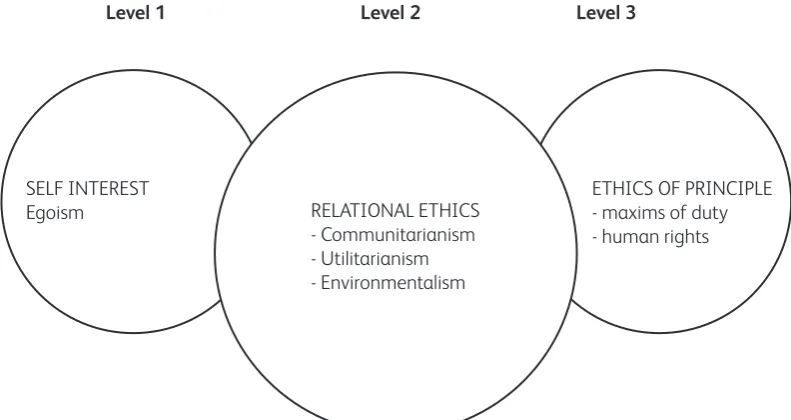
Kohlberg’s levels of moral reasoning point to useful mindsets from which to approach business ethics questions, even if to do so takes them well away from their original context. Kohlberg’s model is based on observed human behaviour, and his findings have in part been replicated in other situations (Snarey, 1985), even if his ideas were not originally conceived in a business or organisational context. However subsequent research has indicated that the actual behaviour of managers correlates to CMD (Blasi, 1980), and that most managers remain at Level 2 (Weber, 1990). This relevance to a work context has been confirmed empirically (Trevino and Youngblood, 1992). Kohlberg has also been adapted as a framework for the conduct of research into the issue of levels of development also applied to the whole organisation (Victor and Cullen, 1988) as well as to the individual manager. This research subsequent to Kohlberg’s original work is a valuable development, as it takes the basic principles of CMD and reworks the idea while keeping its essential nature as a useful framework for describing how ethical decisions are made at work in an enterprise or organisation. This is represented in Figure 2.
An adapted Kohlbergian framework proves a useful summary model for considering issues in business ethics, in that the recognition of legitimate self-interest is a key motivator in business behaviour. Also, for Kohlberg Level 2 and 3 perspectives do not replace more immature Level 1 thinking, but build upon it from fresh viewpoints
Figure 2 An adapted Kohlbergian model to frame moral reasoning :
Level 1 Level 2 Level 3
SELF INTEREST
RELATIONAL ETHICS
Given that CMD has been discovered to provide a useful framework to engage with business ethics questions, it is now relevant to survey how his work is treated in Business Ethics texts seeking to perform a similar function to the module delivered at UWL.
The state of knowledge: some
literature reviewed
Business ethics is itself an emerging discipline even if it remains at present dominated by an approach derived from classic moral philosophy. The esoteric nature of this discourse is problematic for students, but at least many of the business ethics texts published over the last ten years specifically reject any monistic approach to the study of ethics in business in favour of pluralistic models incorporating a diversity of concepts and frameworks (McEwan, 2001; Fisher and Lovell, 2010).
This brief overview of relevant texts concentrates primarily on authors who are seeking to make ethics accessible to practitioners - most often to support the delivery of courses to students enrolled on validated programmes of study. This is work by academics engaged in the field as a specialism, but aimed at a wider audience. As a body of literature it reflects contemporary approaches taken either to shape course development, or to communicate to practicing managers wishing to acquire a working subject knowledge. While the majority of this corpus is American, recently increasingly credible efforts have been made at developing a specifically European approach, which is helpful for students enrolled at a British university. Contemporary European texts of the type here surveyed typically rely primarily on a summary presentation of influential normative theories to provide the tools for ethical analysis, but then also acknowledge the contribution of descriptive ethics. For example Crane and Matten (2010), at present the best selling European text, places a chapter on descriptive ethics immediately after a summary of traditional and contemporary normative theories. A reasonably thorough summary of CMD is included as one of a range of individual factors shaping a person’s conduct, but it sits uneasily within descriptive ethics as having only an explanatory value to ethical analysis (which is essentially done after events have occurred). Crane and Matten do however address CMD in sufficient detail including a range of critiques of Kohlberg’s work.
A similar approach though less critical is followed by Fisher and Lovell (2009), who also provide their own summary framework of normative concepts as an analytical framework, as has McEwan (2001). These approaches, if differently ordered, are comparable to Crane and Matten who by contrast do not provide a specific summary framework to shape a pluralistic analysis. Other UK-based texts recently published (Mellahi, Morrell and Wood 2010) Campbell and Kitson (2008) however ignore CMD entirely in favour of summaries focused entirely on traditional normative theory – these authors are specifically seeking to develop concise work accessible to practicing managers so an abbreviation of material is unavoidable – but they are by default stating that normative theory exclusively must be the guiding chief principle for ethical enquiry. Their omission of psychological or sociological perspectives speaks volumes.
A major component of the person-situation interactionist model that has guided her work has its base in Kohlberg’s research.
Ferrell, Fraedrich and Ferrell’s (2008) ethics text takes a forward step in the use of CMD in recognizing that the personal values of the manager are more effectively considered ahead of the shared or stated values of the organization. They also recognize that CMD is a valid construct for considering managers’ moral maturity. The same authors have also taken this approach in a wider focus in Thorne, McAlister, Ferrell and Ferrell (2008). A widely disseminated text in the same vein from Lawrence, Weber and Post (2005) adopts a similar approach. These texts are each inevitably reductionist in their representations, but provide sufficient material to grasp the key dimensions of relevant perspectives.
Kohlberg’s (1981, 1984) own research has received a great deal of attention from social science researchers who have subsequently sought to apply his model of CMD to various professions uncritically, but this school of study does not seek to take the conceptual leap to adapt or reframe Kohlberg’s model (Weber, 1990).
It needs to be recognized that Kohlberg’s work has been the subject of criticism, particularly for its interdisciplinary nature which displeases the purists among both philosophers and psychologists as it does not fall entirely within the norms of either discipline (Modgil and Modgil 1985). Also, the invariate sequence of linear development across levels is disputed in various ways, for example:
• Gender differences are not addressed (Gilligan, 1982)
• Model is individualistic, doesn’t recognize community (Snarey, 1985)
• Kohlberg’s model doesn’t extend to moral regression, which is a critical issue in entrepreneurial ethics, as an individual’s moral behaviour may degenerate over time (Crane and Matten, 2003)
• At level 3 the model interjects personal values, assuming deontological ethics to be of higher worth than relational ethics (Derry, 1987)
• The model lacks context dependency, which is also a significant influence on ethical behaviour (Jones 1991).
None of these observations take away from the basic appeal of Kohlberg’s approach as grounded in observed human behaviour, even if the validity of some of these criticisms is accepted. His model has a value as an organising framework for the consideration of moral reasoning from different perspectives, even in a somewhat deconstructed form.
A research approach
and some findings
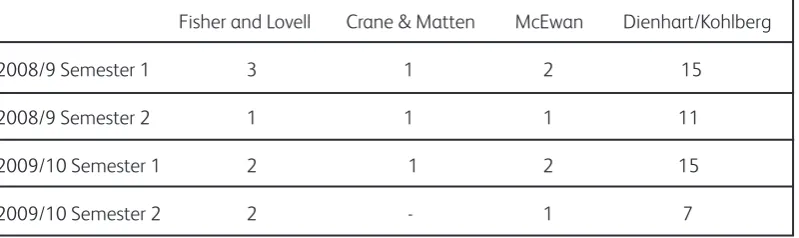
MBA students were, over the course of the delivery of a business ethics module, asked to appraise business conduct, situations and activities from a number of starting points, applying widely accepted concepts and frameworks as summarized in the literature and progressively introduced by the tutor. Models from three UK texts (Crane and Matten, (2010); Fisher and Lovell, (2009); and McEwan, (2001)) were considered as alternative useful ways to organize the classification and application of ethical theory. Module assessment for students was based on their own individual choice of enquiry, though students were required to present and defend their work to their peers. They were also asked to reflect on their learning experience, specifically as to the value and use of a range of ethical concepts for the purpose of engaging in ethical analysis and discussion.
Table 1 Preference for organising framework
Fisher and Lovell Crane & Matten McEwan Dienhart/Kohlberg
2008/9 Semester 1 3 1 2 15
2008/9 Semester 2 1 1 1 11
2009/10 Semester 1 2 1 2 15
2009/10 Semester 2 2 - 1 7 At the conclusion of the module, they were also invited to record their views as to the comparative value of the three different conceptual frameworks. Each student was asked to indicate their preference of model for its comprehensiveness, rigour and practicality in applying an ethical analysis, and to provide supporting comments as to the reasons for their choice. Any additional observations were recorded by mean of module assessment and feedback, circulated questionnaires, participant interviews, and plenary discussions. Results were captured and compared over 2 academic years (2008/9, and 2009/10), as obtained from six MBA cohorts in total. Questionnaires were completed and returned by 35 students in 2008/9, (21 in Semester One, 14 in Semester Two) and 32 students in 2010 (22 in Semester One and 10 in Semester Two). These results are summarized below.
The findings provide clear evidence that an approach which is interdisciplinary in nature, combining insights from both developmental psychology and moral philosophy, is
consistently the most effective in engaging MBA students. Typical comments recorded were:
‘Crane and Matten summarize most normative theories well, but do not then really provide a specific methodology for their application ‘
‘The McEwan ‘moral compass’ is overloaded in attempting to incorporate too wide a range of theories’
‘The Fisher and Lovell ‘map’ of ethical theories is questionable in its placing of Virtue theory, although the theory itself is well explained’
‘The CMD model makes sense, as it reflects my own experience’.
Kohlberg’s work is then a useful start point for adaptation to build a pluralistic approach to the use of ethical theory. Dienhart has demonstrated that the levels of CMD provide the basis of broad classifications of ethical theories, and can be applied as an adaptive model reflecting the different ethical
orientations of different individuals. Students engaging with the subject are able to progress by the end of the module to create their own mental maps, including or discarding specific moral theories as they shape and enrich their own worldview.
Figure 3 represents one particular student’s typology of key ethical theories with which she wishes to engage - environmental ethics is here classified as relational because the student accepts Lovelock’s notion of Gaia. Others have used the framework differently, for instance several of those of religious belief have adopted the principle of stewardship and therefore include faith as a relational ethic. The adapted CMD model has also proved accessible as a useful framework for personal learning and development in its various applications to business contexts. Discussions with students demonstrated that the model can be freely tailored as a personal construct to be used for self-directed study, as it provides a reliable and adaptive mental map for their own learning journey.
Level 1 Level 2 Level 3
SELF INTEREST
Egoism RELATIONAL ETHICS
- Communitarianism - Utilitarianism - Environmentalism
Examples of comments recorded by students relating to the extended use of this model were:
“I am interested in exploring rights theory and its relationship to distributive justice “
“I would like to understand Machiavelli better – not sure if it is ethical though!”
“None of these models adequately covers different approaches to environmental ethics”
These comments indicate that there are ultimately limitations to the use of any conceptual model, no matter how well framed.
Value and limitations
The challenge of making ethical conversations relevant to the workplace can be met with the use of appropriate practical frameworks, in the context of enquiry based learning and in a safe social space for that learning to occur.
Analysis and debate is a precursor to reflective learning, which is of course not at all the same thing as ethical behavior in the workplace. In the seminar, pressures such as moral distancing (Bauman, 1993) that is a suppression of any sense of personal involvement are not incurred, and ‘moral muteness’ (an inability to articulate moral discourse due to the pressure of the workplace) are avoided (Bird and Waters, 1989). However the absence of such pressures is precisely the value of an educational context, where there is opportunity for skills in ethical discourse to be developed. Also, the classroom is not the workplace, but for MBA students there is a reasonable proximity between the two, and in this context a work-related approach to learning is relevant and useful. Here the variables of power relationships and the influence of organisational culture and ethos are diminished. MBA students of course do not always accurately represent the whole population of management practitioners – there is an inherent bias among them towards those open to new ideas and willing to make the effort to learn. But they do represent those who are willing to change, to think and act differently, and as such are a valuable barometer for all practicing managers.
We live now in a business context where increasingly stakeholders will challenge moral aspects of business, and expect management to be to explain, defend, and sometimes improve their praxis. Thus effective and accessible ways to develop ethical awareness among managers is becoming a key skill at work.
In developing the framework offered in this paper no attempt has been made to distinguish gender difference, as the paper focuses rather on the mental map of the individual regardless of age, gender, ethnicity or religious belief. Previous research on the influence of gender difference on ethics at work has in any case proved inconclusive (O’Fallon and Butterfield, 2005). The influence and value of long-standing and influential religions and philosophies is not denied or excluded by applying such a framework. Indeed as a tutor personally embracing a Christian worldview, this writer has found that it is possible to engage with students of diverse religious beliefs and philosophical backgrounds in a discourse examining and articulating the ethical implications of personal belief systems through the application of this framework.
Conclusions
The language of ethics is collaboratively developed and defined, and ethical conversations in the workplace are initiated and shaped by managers and leaders. Skills are needed for this task, which can be effectively developed in a context which is work related but a separate space, where competences and skills can be developed for use at work. These findings indicate that an interdisciplinary approach can be created which crosses the boundaries between developmental psychology and moral reasoning to which practitioners can readily relate. This has implications for the direction of further research in applied business ethics.
While the framework developed in this paper is intended to facilitate personal learning and growth, its ultimate value may lie in acting as a lens to contextualize and apply contrasting normative theories to business and work situations. It is therefore more a pluralistic than a postmodern approach to ethics, and seeks to avoid reducing ethics to mere relativism and subjectivity. However the framework is intended to facilitate an articulation of values as an essential starting point for the development of an effective ethical discourse.
Developing ethical awareness among MBA students remains challenging, but it can be also engaging and exciting when structured as a social learning experience and can further stimulate subsequent personal reflection. The use of normative theory as an ethical resource is helpful to frame moral thinking and discourse, but because it is unfamiliar territory it is best introduced through the vehicle of more readily assimilated material. If moral discourse is approached from a perspective of cognitive moral development, the territory becomes rather more familiar. Kohlberg’s research is controversial, but it is remains a valuable starting point for enquiry into moral reasoning from different various psychological perspectives which have their counterpart in a range of specific moral theories.
References
Bauman, Z. (1993) Postmodern ethics. Oxford: Blackwell.
Beerel, A. (2006) Business ethics: the unconscious at work. In Proceedings of the 10th annual conference of the European Business Ethics Network - UK Association ( EBEN- UK). London: Royal Holloway College.
Beauchamp, T.L., Bowie, N.E. and Arnold, D.E. Eds. (2009) Ethical theory and business, 8th ed. London: Pearson.
Bird, F. & Waters, J. (1989) The moral muteness of managers. California Management Review, Fall, p. 73-88
Blasi, A. (1980) Bridging moral cognition and moral action, Psychological Bulletin,
88, p. 1-45.
Bowie, N.E. ed. (2002) The Blackwell guide to business ethics. Oxford: Blackwell.
Campbell, R. & Kitson, A. (2008) The ethical organization, (2nd ed.) Basingstoke: Palgrave.
Crane, A and Matten, D. (2010) Business ethics,
3rd ed. Oxford: Oxford University Press.
De George, R. (1999) Business ethics. Upper Saddle River (NJ): Prentice Hall.
Dienhart, J.W. (2000) Business, institutions and ethics. Oxford: Oxford University Press .
Ferrell, O.C., Fraedrich, J. and Ferrell, L. (2008)
Business ethics, 7th ed. Boston (MA): Houghton Mifflin.
Fisher, C.M. and Lovell, A. (2009) Business ethics and values, 3rd ed. Harlow: FT Prentice Hall.
Flyn, V. (2010). Teaching ethics on hybrid business information technology courses. In 17th. EDINEB Conference Proceedings: Crossing Borders in Education and Work-Based Learning.
Maastricht: FEBA ERD Press
Frederick, R. ed. (2002) A companion to business ethics. Oxford: Blackwell.
Gilligan, C. (1982) In a different voice.
Goodpastor, K.E. (2002) Teaching and learning ethics by case method. In The Blackwell guide to business ethics, N.E.Bowie, ed. Oxford: Blackwell.
Kahn, P. & O’Rourke, K. (2004) Understanding enquiry based learning. Manchester: University of Manchester.
Kohlberg, L. (1981) Essays on moral development. Volume 1: The philosophy of moral development. New York: Harper & Row.
Kohlberg, L. (1984) Essays on moral development. Volume 2: The nature and validity of moral stages. San Francisco: Harper & Row.
Lawrence, A.T., Weber, J. and Post, J. (2005)
Business and society. London: McGraw Hill.
Mangan, K. (2006) Most MBA students believe companies should help improve society. The Chronicle of Higher Education, November, 2006.
McCuddy, M. (2010) Applying the development centre paradigm in a business ethics course.
In EDINEB Conference proceedings: crossing borders in education and work-based learning.
Maastricht: FEBA ERD Press.
McEwan, T. (2001) Managing beliefs and values in organisations. Harlow: FT Pearson.
McIntosh, M., Thomas, R., Leipzeiger, D. and Coleman,G. (2003) Living corporate citizenship. Harlow: FT Prentice Hall.
Mellahi, K. Morrell, K. and Wood, G. (2010) The ethical business. Basingstoke: Palgrave.
O’Fallon, M.J and Butterfield, K.D. (2005) A review of the empirical ethical decision making literature 1996-2003. Journal of Business Ethics , 59 (4), p. 375-413.
Reason, P. and Bradbury, H. (2006) Handbook of action research. London: Sage.
Renshaw and Brown (1995) The role of teachers in a community of learners. London: Routledge.
Richmond, A.S., and Cummings, R. (2004) In support of the cognitive developmental approach to moral education. Journal of Moral Education, 33, p. 197-205.
Solomon, R.C. (1993) Ethics and excellence: cooperation and integrity in business.
Oxford: Oxford University Press.
Snarey, R. (1985) Cross cultural universality of social–moral development: a critical review of Kohlbergian research. Psychological Bulletin,
97, p. 202-232.
Thorne McAlister, D., Ferrell, O. & Ferrell, L. (2008) Business and society, 3rd ed. Boston (MA): Houghton Mifflin.
Tosey, P. and McDonnell, J. (2006) Mapping enquiry based learning. Guildford: University of Surrey.
Trevino, L .K. (1986) Ethical decision making in organizations: a person-situation interactionist model. The Academy of Management Review,
11, (3).
Trevino, L. K. and Nelson, K.A. (2007)
Managing business ethics - straight talk about how to do it right, 4th ed. Chichester: Wiley.
Trevino, L. K. and Weaver, G.R. (2003)
Managing ethics in business organizations – social scientific perspectives. Stanford California: Stanford University Press.
Trevino, L.K., and Youngblood, S.A. (1990) Bad apples in bad barrels: a causal
analysis of ethical decision making behaviour.
Journal of Applied Psychology, 75, p. 378-385.
Victor, B and Cullen, J (1988) The
organizational bases of ethical work climates.
Administrative Science Quarterly, 33, p. 101-125.
Weber, J. (1990) Managers’ moral reasoning: assessing their responses to three moral dilemmas. Human Relations, 43, p. 687-702.