Public Perceptions and Commitment to Social Distancing during COVID-19
1
Pandemic: A National Survey in Saudi Arabia
2 3
Abdu Aldarhami1*, Abdulrhman S. Bazaid2, Omar W Althomali2 & Naif K Binsaleh2
4 5
1Clinical Laboratory Sciences Department, Turabah University College, Taif University, 6
Turabah, Saudi Arabia. 2 College of Applied Medical Sciences, University of Ha’il, Ha’il, 7
Saudi Arabia.
8 9 10
*Corresponding author:
11
Abdu Aldarhami
12
E-mail: [email protected]
13
Tel +966(0)128224366
14
Clinical Laboratory Sciences Department, Turabah University College, Taif University,
15
Turabah, Saudi Arabia.
16 17 18
2
Abstract
19
Objectives: Social distancing measures are currently implemented to control COVID-19
20
pandemic in many countries, including Saudi Arabia. The aim of this study was therefore to
21
evaluate the awareness and adherence of the Saudi population to these measures.
22
Methods: A web-based questionnaire was designed with 16 questions (8 questions related to
23
demographics, 3 in relation to awareness about social distancing and 5 related to overall
24
practice of social distancing).
25
Results: 5105 participants completed the survey [58.4% female, 66.3% young individuals
26
(aged 18-37 years), 55.8% bachelor degree holders, and 51.0% from the western region]. The
27
Saudi Ministry of Health (MOH) was the main source of information about COVID-19 for
28
most participants (78.2%). High awareness (81.3%) regarding social distancing was
29
observed, associated mainly with female participants, those from the middle region and those
30
with high education and income. Overall implementation of social distancing was satisfactory
31
(score 3.13/5), with 37.8% never leaving home during the home-stay period. Better
32
adherence to social distancing was observed for female participants, higher degree holders
33
and those aged over 38 years.
34
Conclusions: Organised plans by the Saudi MOH have been effective in raising awareness
35
and improving practice of social distancing among public. However, the observed lower
36
practice of social distancing by individuals with lower education and income indicates the
37
need for targeted interventions to achieve better outcome.
38
39
Keywords: COVID-19, SARS-CoV2, Public Awareness, Public Practice, Social Distancing
40
and Saudi Arabia
3
Introduction
43
In late December 2019, a novel strain of coronavirus emerged, which was first reported
44
as a national outbreak in Wuhan, china [1,2]. Subsequently, this disease was designated as
45
coronavirus disease 2019 (COVID-19), which is caused by severe acute respiratory syndrome
46
coronavirus 2 (SARS-CoV-2) [3]. The wide spread of the disease since then led the WHO to
47
announce COVID-19 as a pandemic on March 11th, 2020 [4]. To date (May 11th, 2020), 48
SARS-CoV-2 has led to over 4 million cases and 285000 deaths globally [5]. In addition to
49
the lack of effective vaccines or treatments, SARS-CoV-2 has high infectivity even before
50
the onset of symptoms, which can take up to 14 days to manifest [2,6], during which
51
transmission is possible [1,2,7]. Consequently, this pandemic has been announced as a high
52
concern for health with the very challenging task to contain its worldwide spread [1,8].
53
Currently, health authorities are left only with preventive measures to tackle the spread of the
54
pandemic [1,9].
55
A few measures, such as social distance, isolation, home-isolation and
self-56
quarantine, have been introduced as feasible precautionary steps that can be implemented to
57
limit, delay or flatten the reproduction rate (R0) of the SARS-CoV-2 [7,10]. These terms
58
have showed up more frequently in the media and various scientific publications [11,12,13].
59
The exact definition of such terms overlap as they generally share similar meanings, which
60
can emphasise physical separation or distance between healthy people and individuals with
61
confirmed or suspected infection [2,7,9]. Social distancing measures were used in the past to
62
combat the spread of other viral and bacterial contagions, including the Plague and severe
63
acute respiratory syndrome (SARS) [14]. Implementing these measures and precautions in
64
the current SARS-CoV-2 pandemic has proven its effectiveness in controlling or containing
65
this infection in China and other far eastern countries [7].
66
Even before the first confirmed case of COVID-19 in the Kingdom of Saudi Arabia
67
(KSA), the national authority closed shopping centres and suspended flights, face-to-face
68
education and physical attendance at most governmental agencies as preventive steps [6].
69
Further precaution was followed by suspending prayers at mosques and implementing a
70
lockdown in cities with numbers of cases [6,15]. This aimed to limit population mobility and
71
minimise social gatherings in order to control transmission. Nevertheless, up to date (May
72
11th, 2020) statistics reported over 41000 cases and 255 deaths in KSA and the numbers 73
continue to rise [16]. Therefore, in order to confirm whether preventive steps have been
4
successfully implemented in KSA, evaluation of overall understanding and adherence of the
75
general public to physical separation should be conducted. Likewise, it is crucial to ensure
76
that the public access information about preventive measures from well-trusted agencies.
77
Hence, the aim of the current study was to evaluate awareness and practice of the Saudi
78
population in relation to social distancing (home-staying).
5
Methods
81
Study design and setting
82
A cross-sectional, observational study was conducted to evaluate overall awareness and
83
adherence of the Saudi population to social distancing to control the spread of COVID-19. A
84
survey tool was written in Arabic, the mother tongue of the target population, and was built
85
using an online survey forms. To ensure a wide distribution, dissemination to the target
86
participants was carried out using various social media (Twitter, WhatsApp and Snapchat)
87
between March 25th and April 17th, 2020. The questionnaire included introductory 88
information to inform participants about the purpose of the study and consent information to
89
ensure voluntary participation in the study while ensuring confidentiality of personal data.
90
Participants under 18 years were excluded from this study.
91
The questionnaire was created according to novel coronavirus (2019-nCoV) infection
92
guidelines [17]. To ensure the accuracy of collected information, multiple choice and
close-93
ended questions were used in this study. Validation of the questionnaire were conducted by
94
five multidisciplinary experts to suit the target participants. The resulting pre-final survey
95
was piloted with 20 individuals from the general population from different age groups and
96
genders to address any ambiguity in the questions and assess the extent to which these
97
questions are related to the objectives of this study. The questionnaire was then edited based
98
on the collected feedback, which was used to prepare a final version for the study.
99
Measurement
100
The final questionnaire contained 16 questions, allocated to three sections. The first
101
covered the demographics of the participants (age, gender, monthly income, education level,
102
marital status, occupation and geographical region of residence). The second covered their
103
main sources of information about COVID-19 (the MOH, the WHO, friends and relatives or
104
social media), their understanding of who should stay at home during the pandemic (the
105
elderly, children, symptomatic people or the whole population), as well as their beliefs about
106
the possibility of asymptomatic transmission. The final section comprised of five questions
107
(Supplement 1) about practice of participants in relation to social distancing. This included
108
questions about the reasons for going out (work, buying necessities, purchasing a meal or
109
entertainment), time spent out (days per week and hours per days), and practices when
110
leaving the home (whether they leave alone or with others).
6
Scoring system and statistical analysis
112
Responses provided by participants to each question were given designated scores; one
113
point [1] for the most appropriate answer and no points [0] for the least appropriate or
114
uncertain (I do not know) responses (Supplement 1). Collected responses to the questions
115
intended to measure adherence to the home-stay strategy were scored as a quarter [0.25], half
116
[0.5] or one [1] point for responses of two hours spent outside, less than one hour outside or
117
never leaving the home, respectively. All statistical analyses were performed using SPSS
118
software version 25.0 (IBM Corp, Armonk, NY). The numbers of participants, their
119
percentages, the mean, standard deviation (SD) and the median in relation to variables
120
describing knowledge and practices were assessed using descriptive analysis. Overall scores
121
related to practices were analysed based on demographic characteristics using a one-way
122
analysis of variance (ANOVA) and independent sample t-test for normally distributed data,
123
while Kruskal-Wallis and Mann-Whitney tests were used for non-parametric analysis [18].
124
Questions testing knowledge were analysed using Chi-square or Fisher’s Exact Test to find
125
out if there are significant differences between responses in relation to demographic
126
characteristics.
127
Multivariable linear regression was used to identify factors associated with overall
128
scores describing practices, which were determined using the stepwise method. To quantify
129
the relationship between variables, odds ratios (ORs), unstandardized regression coefficients
130
and 95% confidence intervals (CIs) were calculated. Statistical significance was defined by a
131
p-value below 0.05. The maximum score assigned to individuals with perfect adherence to
132
the home-stay strategy was 5. Cronbach’s alpha coefficient of the questionnaire (five
133
question for practice) was 0.81, indicating very good internal consistency between questions.
7
Results
135
Demographic characteristics of participants
136
A total of 5105 participants completed the survey, out of whom 58.4% were female,
137
and most were young individuals (29.4% and 36.9% from age groups 18-27 and 28-37 years,
138
respectively) and married (60.9%). In addition, contributors to this survey were mainly
139
bachelor degree holders (55.8%), employees (45.2%), with low income (40.9%), living in the
140
western of Saudi Arabia (51%) and residents of cities (93.8%) (Supplement 2).
141
Awareness of Saudi population about COVID-19
142
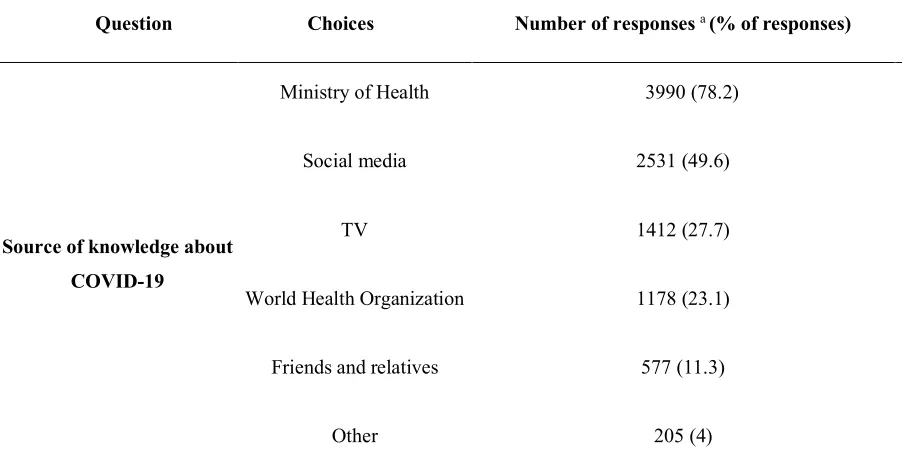
Participants were asked about their sources of information about COVID-19 to
143
determine the most widely used sources by the Saudi population. about 78% and 49% of
144
participants selected the Saudi MOH and social medial as their main sources of knowledge,
145
respectively. Seeking information about COVID-19 from friends, colleagues or relatives was
146
the least favorable source used by Saudi people (Table 1).
147
Participants expressed their views about social distancing; the majority of responses
148
(94.7%) were of the view that “everyone” should observe social distancing as a preventive
149
measure, and most expressed beliefs that asymptomatic transmission was possible (85.2%).
150
This translates to 81.3% awareness based on both items taken together. Knowledge regarding
151
social distancing differed between genders, age groups and education levels (p < 0.05) (Table
152
2). Multiple logistic regression analysis (Table 3) showed that females (OR 1.779, p < 0.001)
153
and participants from the middle region (OR 1.549, p = 0.007) were considerably more likely
154
to choose the appropriate response to the question about social distancing. In contrast,
155
participants from the age group 38-47 years (OR 0.705, p = 0.014) and those with secondary
156
education or below (OR 0.561, p < 0.001) were less likely to choose the appropriate response
157
to the question. Likewise, in relation to the question about asymptomatic transmission, there
158
were clear differences related to demographic characteristics, including gender, education
159
level, income, employment and geographical region (p < 0.05) (Table 2). Participants with
160
higher educational levels (Master or PhD; OR 2.28, p < 0.001) and those with high income
161
(>20000 SR; OR 1.787, p = 0.017) were more aware of the likelihood of asymptomatic
162
transmission of COVID-19 patients (Table 3). In contrast, lack of awareness about
163
asymptomatic transmission was found to be associated with participants from the southern
164
part of the Kingdom (OR 0.671, p = 0.01), secondary and below educational level (OR 0.452,
8
p < 0.001), diploma holders (OR 0.712, p = 0.011) and those with low income (<3000 SR)
166
(OR 0.74, p < 0.001) (Table 3).
167
Practice of social distancing by the Saudi population
168
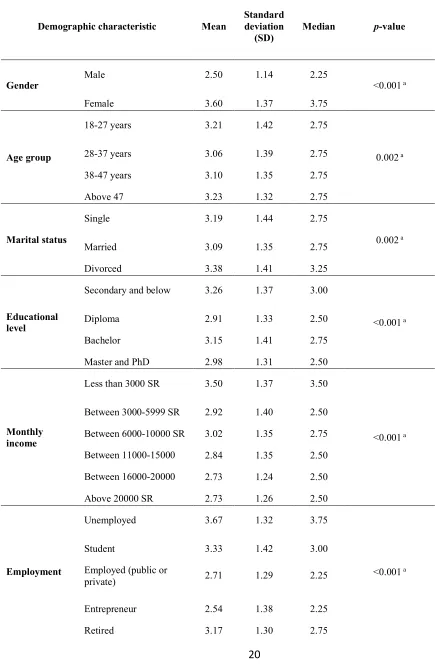
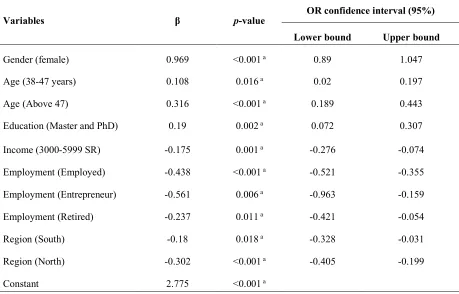
The practice of participants was scored based on Supplement 1; a summary of the
169
scores in relation to demographics is shown in Table 4 and the results of regression analysis
170
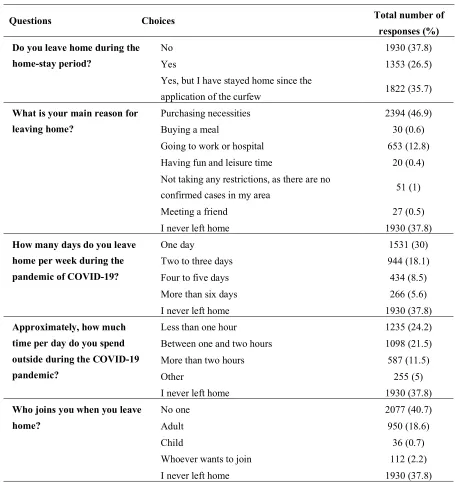
are shown in Table 5. The average score of the respondents was approximately 3.13 (SD
171
1.38, range 0-5), representing 62.6% implementation. However, just over a third (37.8%) of
172
participants confirmed they never left home since the start the social distancing application
173
(Table 6). The score significantly differed in relation to gender, age, marital status,
174
educational level, monthly income, employment and geographical region (Table 4). Multiple
175
linear regression analysis showed that females (β 0.969, p < 0.001), Master and PhD holders
176
(β 0.190, p = 0.002), people from age group 38-47 years (β 0.108, p = 0.016) and individuals
177
older than 47 years (β 0.316, p < 0.001) were associated with a higher score (Table 5). In
178
contrast, participants with low income (3000-5999 SR, β -0.175, p = 0.001), employees (β
-179
0.438, p < 0.001), entrepreneurs (β -0.561, p = 0.006), retired participants (β -0.237, p =
180
0.011) and residents in the south (β -0.180, p = 0.018) or north (β -0.302, p < 0.001) of the
181
Kingdom were associated with a lower score (Table 5). Almost half (46.9%) the participants
182
went out to buy necessities, whereas going to work or hospital was the reason for leaving
183
home for almost 13% of the respondents. In addition, nearly a third (30%) and about a
184
quarter (24%) of the participants stated that they spent one day per week and less than an
185
hour per day outside, respectively. Approximately one in five respondents acknowledged
186
leaving their home 2-3 days a week for a total time of 1-2 hours per day (Table 6). In the
187
context of practicing social distancing, about 41% of participants went out alone while 19%
188
were accompanied by an adult.
9
Discussion
192
Awareness of the public is crucial in controlling the spread of COVID-19 nationally
193
and internationally because the level of awareness in society affects implementation of
194
precautionary measures [7]. Therefore, this study was conducted to analyse the knowledge
195
and practice of the population in KSA in relation to staying at home as a preventive measure
196
to contain the COVID-19 pandemic. To the best of our knowledge, this is first study
197
performed to evaluate adherence of individuals to the home-stay measure in KSA and to
198
provide suggestions of multiple reasons behind any deficiency in its application.
199
A survey was distributed and 5105 responses were returned by participants from
200
different demographics to ensured that the collected data are representative, to an acceptable
201
level, of the Saudi population. The responses indicated high awareness among the Saudi
202
population with the majority of participants (94.7%) expressing views that everyone should
203
practice social distancing. The respondents (85.2%) were also aware of asymptomatic
204
transmission of infection. A population with this level of awareness is speculated to
205
successfully practice social distancing. Previous studies conducted on the Chinese and
206
Japanese populations [13,19] showed similar findings regarding public knowledge towards
207
COVID-19.
208
In the context of raising awareness, the local public health has established multiple
209
campaigns and launched health applications and call centers, offering the public with
210
information about COVID-19 as well as providing answers to related queries [6]. This
211
approach has provided Saudi individuals with information related to the benefits of staying at
212
home and encouraged its implementation [6]. The respondents indicated that the Saudi MOH
213
was their main source of information (78%), followed by social media, such as Twitter
214
(49%), which suggests a limited opportunity for misinforming the Saudi population about
215
COVID-19.
216
High awareness of the Saudi population demonstrated in the early stages of the
217
pandemic indicates the existence of established plans by the government to educate the nation
218
about coronaviruses. This might be the result of the response to the Middle East Respiratory
219
Syndrome (MERS) epidemic in 2012; both Saudi people and the MOH learned from this
220
previous experience in order to contain similar infections [15,20]. Consequently, the Saudi
221
authorities acted very early (even before the pandemic reached KSA) by establishing
10
campaigns to enhance public awareness and engage the public in active learning and
223
searching for information about COVID-19 and related precautionary measures. In contrast, a
224
recent study conducted in the initial stage of this pandemic demonstrated moderate
225
knowledge (66%) of participants living in three Arabic-speaking countries, including Saudi
226
Arabia [21]. This could be because more than a quarter of the participants were older than 50
227
years. During COVID-19 pandemic, information to raise awareness of individuals was
228
mainly delivered using online, which may not be accessible or easy to use by the elderly. In
229
contrast, since the majority of recruited people in this study were found to be young, it can be
230
speculated that the observed high knowledge of participants is linked with their ability to
231
access online information about COVID-19 more easily. Therefore, since elderly people are
232
more susceptible to COVID-19 than younger individuals [22], national public health need to
233
ensure that information about this pandemic are received by all age groups. The local health
234
authority has started recently the approach of texting individuals with information about
235
COVID-19 in multiple languages. This step would increase the knowledge of people from
236
various age groups and languages as well as residents of rural area where the internet
237
connection is not well established. In line with findings by [13,21], the level of education was
238
positively associated with increased awareness. This is self-evident as educated individuals
239
are able to seek, access and understand information far more easily than those who are less
240
well educated.
241
Regional discrepancies were demonstrated in relation to awareness of the Saudi society
242
about social distancing, with participants from the middle of the Kingdom showing higher
243
levels of knowledge compared to other regions. Although the total number of recorded
244
COVID-19 cases is almost equal between cities from the western region, e.g. Makkah (3381)
245
and Medina (2438), and the middle region (Riyadh, 2679), the daily reported cases have
246
dropped dramatically to about 150 cases in Riyadh compared to 200 cases in Makkah and
247
Medina [16]. Therefore, higher awareness of individuals in the middle region of Saudi Arabia
248
may have contributed to the decrease in the numbers of daily cases in Riyadh. Similarly, the
249
majority of respondents were fully aware of asymptomatic SARS-CoV-2 carriers, which was
250
positively correlated with their level of education and income. Being aware of asymptomatic
251
transmission should be sufficient to ensure successful engagement and effective
252
implementation of preventive measures to contain COVID-19.
11
With respect to the practice of staying at home, overall implementation of social
254
distancing by participants was found to be moderate (3.13/5). However, a high level of
255
implementation (5/5) was conducted by 37% of participants who never left home since the
256
application of the home-stay. In addition, participants who left home quoted reasons, such as
257
buying necessities (47%), going to work (13%) or going out for leisure (around 2%).
258
Furthermore, the majority of those who left home (46% of respondents) returned within two
259
hours, and their frequency of leaving was less than three days a week, showing a satisfactory
260
level of implementation of social distancing. Moreover, the majority of responders either
261
went out alone (41%) or with an adult (19%), indicating a positive adherence by limiting
262
contact between individuals to reduce viral dissemination among the population [23]. These
263
results are supported by a mobility report for the Saudi communities during COVID-19
264
pandemic, which was provided by Google, in which about 45% reduction was observed in
265
the number of people visiting food warehouses and pharmacies in the Kingdom [24]. These
266
outcomes should increase the overall home-stay practice from moderate to high level;
267
however, there still remains possibility for more improvement, encouragement and support to
268
reach higher levels of adherence, especially for those who left home seeking entertainment.
269
As good adherence to social distancing by Chinese individuals was a key element in efforts
270
by authorities to contain COVID-19 pandemic [7], containment of COVID-19 may be
271
managed in Saudi Arabia quite early. Nevertheless, behavior changes of the Saudi population
272
to the implementation of precautionary measures (e.g. washing hands) outside of the home
273
need to be investigated.
274
Statistical analysis of responses revealed that females, people aged 38 years or over
275
and Master and PhD holders showed higher commitment to social distancing compared to
276
their counterparts. This is in agreement with a previous study on awareness of Saudi people
277
about MERS, which demonstrated that females were more likely to apply safety precautions
278
than males [20]. A possible explanation might be that culturally males tend to go out more
279
frequently than females. In relation to the better adherence by people of middle age and older,
280
people of this age group may be influenced by published findings from Chinese
281
epidemiological studies, which showed that older patients are more prone to developing
282
invasive forms of COVID-19 with high fatality rate [22]. Likewise, respondents with higher
283
degrees were more likely to practice social distancing, suggesting that education is positively
284
associated with improved practice towards preventive action [13]. In addition, the study
285
showed reduced practice of staying home among employees and entrepreneurs possibility
12
because the nature of their work requires leaving the home regularly compared to other type
287
of jobs. Notably, residents of the northern and southern parts of KSA presented lower
288
practice of social distancing, which could be attributed to delayed appearance of COVID-19
289
cases in those regions. Areas with limited cases of COVID-19 tend to be associated with
290
reduced knowledge and practice [13]. The immediate application of the lockdown strategy
291
has shown its effectiveness in flattening the curve of COVID-19 spread in cities (regions) in
292
the Kingdom, as the northern and southern parts were protected from a sharp propagation of
293
cases [6,15]. Full curfew (24 hours a day) was applied to cities with high numbers of daily
294
cases in the west, east and middle regions, whereas less affected cities in northern and
295
southern regions were locked down partially (12-15 hours a day) [15]. This might explain the
296
variation in overall adherence between regions. However, it was found that the application of
297
the lockdown strategy managed to limit frequency of leaving home for about 35% of
298
participants. Establishment of the national lockdown strategy may have been treated by
299
individuals as an alarming sign, indicating the serious and urgent need for action, and this
300
may have encouraged them to practice better adherence.
301
In line with [13], responses by low-income individuals with showed lower social
302
distancing practice, and this finding might be related to the need to work to secure their
303
income. Fortunately, a minority of respondents admitted lack of commitment to social
304
distancing, mainly because of the absence of cases in their areas. Poor practice can result
305
from lower knowledge of individuals about asymptomatic carriers who can spread the
306
infection. These groups whom lacking the good practice to social distancing, especially those
307
with low income need to be investigated more closely, so that appropriate solutions to
308
enhance their adherence can be implemented.
309
13
Conclusion
311
The current study indicated a relatively high level of knowledge and adherence to the
312
home-stay strategy by the Saudi population due to continuous efforts by the local public
313
health to raise awarenessusing various media channels. Demographic characteristics affected
314
knowledge and adherence to social distancing, which should be used by policymakers to
315
identify target individuals and suitable actions to achieve better knowledge and adherence.
316
Current awareness and adherence of the Saudi population to social distancing seem to be in
317
the right direction to facilitate the containment of COVID-19 pandemic, although further
318
targeted efforts to people with reduced knowledge and practice of social distancing need to
319
be considered by public health authorities.
320 321 322 323
Conflict of interest
324
The authors declare that there is no conflict of interest.
325 326
Acknowledgment
327
This study was funded by Scientific Research Deanship at University of Ha’il, Saudi Arabia
328
through project reference number: COVID-1901.
329 330
Ethical approval
331
This study was approved by Ethics Committee at the University of Hail (Ethics approval
332
reference number H-2020-080).
14
References
335 336
[1] Nemati M, Ebrahimi B, Nemati F. Assessment of Iranian Nurses’ Knowledge and
337
Anxiety Toward COVID-19 During the Current Outbreak in Iran. Arch Clin Infect Dis. 2020;
338
15(COVID-19):e102848.
339 340
[2] Singhal T. A Review of Coronavirus Disease-2019 (COVID-19). Indian J. Pediatr. 2020;
341
87:281-286.
342 343
[3] World Health Organization. Naming the coronavirus disease (COVID-19) and the virus
344
that causes it.
https://www.who.int/emergencies/diseases/novel-coronavirus-2019/technical-345
guidance/naming-the-coronavirus-disease-(covid-2019)-and-the-virus-that-causes-it. 2020
346
[Accessed 19 April 2020].
347 348
[4] Cucinotta D, Vanelli M. WHO Declares COVID-19 a Pandemic. Acta Biomed. 2020;
349
91:157-60.
350 351
[5] World Health Organization. WHO COVID-19 Dashboard. https://covid19.who.int/. 2020
352
[Accessed 22 April 2020].
353 354
[6] Algaissi A, Alharbi N, Hassanain M, Hashem A. Preparedness and Response to
COVID-355
19 in Saudi Arabia: Building on MERS experience. J Infect Public Health. 2020
356 357
[7] Aslam F. COVID-19 and Importance of Social Distancing. Preprints. 2020.
358 359
[8] Modi P, Nair G, Uppe A, Modi J, Tuppekar B, Langade D. COVID-19 Awareness
360
Among Healthcare Students and Professionals in Mumbai Metropolitan Region: A
361
Questionnaire-Blased Survey. Cureus 2020; 12: e7514.
362 363
[9] Sen-Crowe B, McKenney M, Elkbuli A. Social distancing during the COVID-19
364
pandemic: Staying home save lives. Am J Emerg Med. 2020
365 366
[10] Center for Disease Control and Prevention. Coronavirus Disease 2019 (COVID-19).
367
https://www.cdc.gov/coronavirus/2019-ncov/prevent-getting-sick/social-distancing.html.
368
2020 [Accessed 22 April 2020].
369 370
[11] Abel T and McQueen D. The COVID-19 pandemic calls for spatial distancing and social
371
closeness: not for social distancing!. Int J Public Health 2020; 65:231.
372 373
[12] Tellis G, Sood A, Sood N. How Long Should Social Distancing Last? Predicting Time
374
to Moderation, Control, and Containment of COVID-19. SSRN Electronic Journal. 2020.
375 376
[13] Zhong B-L, Luo W, Li H-M, Zhang Q-Q, Liu X-G, Li W-T, et al. Knowledge, attitudes,
377
and practices towards COVID-19 among Chinese residents during the rapid rise period of the
378
COVID-19 outbreak: a quick online cross-sectional survey. Int J Biol Sci 2020;
16:1745-379
1752
380 381
[14] Center for Disease Control and Prevention. History of Quarantine.
382
https://www.cdc.gov/quarantine/historyquarantine.html. 2012 [Accessed 20 April 2020].
15
[15] Yezli, S. and Khan, A. COVID-19 social distancing in the Kingdom of Saudi Arabia:
385
Bold measures in the face of political, economic, social and religious challenges. Travel Med
386
Infect Dis 2020; 101692.
387 388
[16] Ministry of Health. COVID 19 Dashboard: Saudi Arabia. https://covid19.moh.gov.sa/.
389
2020 [Accessed 5 May 2020].
390 391
[17] The Saudi Center for Disease Prevention and Control. novel coronavirus (2019-nCoV)
392
infection guidelines.
393
https://www.moh.gov.sa/en/CCC/healthp/regulations/Documents/Novel%20Corona%20Viru
394
s%20Infection%20Guidelines.pdf. 2020 [Accessed 22 April 2020].
395 396
[18] Field AP. Discovering statistics using IBM SPSS statistics. SAGE, London. 2018.
397 398
[19] Machida M, Nakamura I, Saito R, Nakaya T, Hanibuchi T, Takamiya T, et al. Adoption
399
of personal protective measures by ordinary citizens during the COVID-19 outbreak in Japan.
400
Int J Infect Dis 2020; 94:139-144.
401 402
[20] Aldowyan N, Abdallah AS, El-Gharabawy R. Knowledge, Attitude and Practice (KAP)
403
Study about Middle East Respiratory Syndrome Coronavirus (MERS-CoV) among
404
Population in Saudi Arabia. Int Arch Med 2017; 10.
405 406
[21] Naser AY, Dahmash EZ, Alwafi H, Alsairafi ZK, Al Rajeh AM, Alhartani YJ, et al.
407
Knowledge and practices towards COVID-19 during its outbreak: a multinational
cross-408
sectional study. medRxiv. 2020
409 410
[22] Wu Z and McGoogan JM. Characteristics of and Important Lessons From the
411
Coronavirus Disease 2019 (COVID-19) Outbreak in China: Summary of a Report of 72 314
412
Cases From the Chinese Center for Disease Control and Prevention. JAMA 2020;
323:1239-413
1242.
414 415
[23] Zhang J, Litvinova M, Liang Y, Wang Y, Wang W, Zhao S, et al. Changes in contact
416
patterns shape the dynamics of the COVID-19 outbreak in China. Sci 2020; eabb8001.
417 418
[24] Google. COVID-19 Community Mobility Report Saudi Arabia.
419
https://www.gstatic.com/covid19/mobility/2020-04-26_SA_Mobility_Report_en.pdf. 2020
420
[Accessed 5 May 2020].
16
Table 1| Responses of participants to the question about the sources they used to obtain
432
information and updates about the COVID-19 pandemic.
433
Question Choices Number of responses a (% of responses)
Source of knowledge about COVID-19
Ministry of Health 3990 (78.2)
Social media 2531 (49.6)
TV 1412 (27.7)
World Health Organization 1178 (23.1)
Friends and relatives 577 (11.3)
Other 205 (4)
a Participants were permitted to select more than one response to this question 434
17
Table 2| Responses of the participants to two questions about knowledge regarding social
437
distancing and awareness about asymptomatic transmission of COVID-19.
438 439
“Everyone” was the response
to Question 1b response to Question 2 “YES” was the b
Demographic characteristics Total number of
responses (%) p-value
Total number of responses
(%) p-value
Gender Male 1976 (93) <0.001 a 1841 (86.6) 0.018*
Female 2859 (95.9) 2511 (84.3)
Age group
18-27 years 1441 (96.1)
0.006 a
1262 (84.1)
0.322
28-37 years 1787 (94.9) 1607 (85.3)
38-47 years 985 (93) 906 (85.6)
Above 47 622 (94) 577 (87.2)
Marital status
Single 1698 (95.4)
0.054
1503 (84.5)
0.126
Married 2925 (94.1) 2670 (85.9)
Divorced 212 (96.8) 179 (81.7)
Educational level
Secondary and below 1125 (92.3)
<0.001 a
922 (75.6)
<0.001*
Diploma 496 (94.5) 441 (84)
Bachelor 2732 (95.8) 2503 (87.8)
Master and PhD 482 (94.5) 486 (95.3)
Monthly income
Less than 3000 SR 1980 (94.9)
0.318
1698 (81.4)
<0.001*
Between 3000-5999 SR 672 (95.6) 586 (83.4)
Between 6000-10000 SR 690 (94) 633 (86.2)
Between 11000-15000 SR 783 (93.8) 740 (88.6)
Between 16000-20000 SR 368 (93.9) 360 (91.8)
Above 20000 SR 342 (96.3) 335 (94.4)
Employment Unemployed 1441 (95.1) 0.240 1228 (81.1) <0.001*
18
Employed 2185 (94.6) 2046 (88.6)
Entrepreneur 34 (89.5) 32 (84.2)
Retired 287 (93.5) 275 (89.6)
Others 222 (92.5) 195 (81.3)
Geographical regions
West 2448 (94)
0.096
2207 (84.8)
0.033*
Middle 1232 (96.2) 1102 (86)
East 254 (94.8) 238 (88.8)
North 620 (94.7) 566 (86.4)
South 281 (94.3) 239 (80.2)
Do you live in City 4533 (94.7) 0.832 4087 (85.4) 0.320
Village 302 (95) 265 (83.3)
Everyone means all individuals in the Saudi population. a statistical significance. b Question 440
1: Who should stay at home during COVID-19 pandemic? Question 2: Do you believe in
441
asymptomatic transmission of COVID-19?
19
Table 3| Multiple logistic regression analysis on demographic characteristics associated with
444
responses to two questions about knowledge regarding social distancing and awareness about
445
asymptomatic transmission of COVID-19.
446
Model 1 OR p-value OR 95% confidence interval
Lower bound Upper bound
Question 1: Who should stay at home during COVID-19?
Gender (female) 1.779 <0.001 a 1.389 2.28
Age (38-47 years) 0.705 0.014 a 0.533 0.931
Education (Secondary and below) 0.561 <0.001 a 0.432 0.728
Region (Middle) 1.549 0.007 a 1.127 2.128
Constant 15.501 <0.001 a
Question 2: Do you believe in asymptomatic transmission of COVID-19?
Education (Secondary and below) 0.452 <0.001 a 0.38 0.537
Education (Diploma) 0.712 0.011 a 0.548 0.924
Education (Master and PhD) 2.28 <0.001 a 1.477 3.52
Income (Less than 3000 SR) 0.74 <0.001 a 0.629 0.87
Income (Above 20000 SR) 1.787 0.017 a 1.111 2.873
Region (South) 0.671 0.01 a 0.496 0.908
Constant 8.264 <0.001 a
OR, odds ratio, a statistical significance 447
20
Table 4| Total scores of participants in relation to practicing staying home strategy during the
449
COVID-19 pandemic.
450
Demographic characteristic Mean
Standard deviation
(SD) Median p-value
Gender Male 2.50 1.14 2.25 <0.001 a
Female 3.60 1.37 3.75
Age group
18-27 years 3.21 1.42 2.75
0.002 a
28-37 years 3.06 1.39 2.75
38-47 years 3.10 1.35 2.75
Above 47 3.23 1.32 2.75
Marital status
Single 3.19 1.44 2.75
0.002 a
Married 3.09 1.35 2.75
Divorced 3.38 1.41 3.25
Educational level
Secondary and below 3.26 1.37 3.00
<0.001 a
Diploma 2.91 1.33 2.50
Bachelor 3.15 1.41 2.75
Master and PhD 2.98 1.31 2.50
Monthly income
Less than 3000 SR 3.50 1.37 3.50
<0.001 a
Between 3000-5999 SR 2.92 1.40 2.50
Between 6000-10000 SR 3.02 1.35 2.75
Between 11000-15000 SR
2.84 1.35 2.50
Between 16000-20000
SR 2.73 1.24 2.50
Above 20000 SR 2.73 1.26 2.50
Employment
Unemployed 3.67 1.32 3.75
<0.001 a
Student 3.33 1.42 3.00
Employed (public or
private) 2.71 1.29 2.25
Entrepreneur 2.54 1.38 2.25
21
Others 3.32 1.38 3.00
Geographical regions
West 3.19 1.38 2.75
<0.001 a
Middle 3.26 1.41 3.00
East 3.05 1.39 2.75
North 2.91 1.35 2.50
South 2.72 1.34 2.25
Do you live in
City 3.14 1.39 2.75
0.381
Village 3.06 1.44 2.75
22
Table 5| Multiple logistic regression analysis of the association of demographic
452
characteristics with participants’ scores in relation to practicing the staying home strategy.
453
β, slope of the regression line, a statistical significance 454
455
Variables β p-value OR confidence interval (95%)
Lower bound Upper bound
Gender (female) 0.969 <0.001 a 0.89 1.047
Age (38-47 years) 0.108 0.016 a 0.02 0.197
Age (Above 47) 0.316 <0.001 a 0.189 0.443
Education (Master and PhD) 0.19 0.002 a 0.072 0.307
Income (3000-5999 SR) -0.175 0.001 a -0.276 -0.074
Employment (Employed) -0.438 <0.001 a -0.521 -0.355
Employment (Entrepreneur) -0.561 0.006 a -0.963 -0.159
Employment (Retired) -0.237 0.011 a -0.421 -0.054
Region (South) -0.18 0.018 a -0.328 -0.031
Region (North) -0.302 <0.001 a -0.405 -0.199
23
Table 6| Responses of participants to questions assessing their practice during COVID-19
456
pandemic (n = 5105).
457
Questions Choices Total number of
responses (%) Do you leave home during the
home-stay period?
No 1930 (37.8)
Yes 1353 (26.5)
Yes, but I have stayed home since the
application of the curfew 1822 (35.7)
What is your main reason for leaving home?
Purchasing necessities 2394 (46.9)
Buying a meal 30 (0.6)
Going to work or hospital 653 (12.8)
Having fun and leisure time 20 (0.4)
Not taking any restrictions, as there are no
confirmed cases in my area 51 (1)
Meeting a friend 27 (0.5)
I never left home 1930 (37.8)
How many days do you leave home per week during the pandemic of COVID-19?
One day 1531 (30)
Two to three days 944 (18.1)
Four to five days 434 (8.5)
More than six days 266 (5.6)
I never left home 1930 (37.8)
Approximately, how much time per day do you spend outside during the COVID-19 pandemic?
Less than one hour 1235 (24.2)
Between one and two hours 1098 (21.5)
More than two hours 587 (11.5)
Other 255 (5)
I never left home 1930 (37.8)
Who joins you when you leave home?
No one 2077 (40.7)
Adult 950 (18.6)
Child 36 (0.7)
Whoever wants to join 112 (2.2)
I never left home 1930 (37.8)