Chiropractic College towards the chiropractic
management of non-musculoskeletal conditions
Jodi Parkinson,
BScJennifer Lau,
BSc (Hons)Sandeep Kalirah,
BHSc (Hons)Brian J. Gleberzon,
DC, BA, MHSc** Professor and Chair, Department of Applied Chiropractic, Canadian Memorial Chiropractic College, 6100 Leslie St. Toronto, ON M2H 3J1, E-mail: [email protected]
© JCCA 2011
Objectif : L’objectif de cette étude était de déterminer les comportements du corps professoral en clinique au cours de l’année scolaire 2009–2010 au Canadian Memorial Chiropractic College (CMCC) envers le traitement de divers troubles non-musculosquelettiques. Méthodes : Un sondage confidentiel a été distribué au corps professoral en clinique par courriel. Il consistait en plusieurs questions interrogeant la population enquêtée comme, par exemple les années dans la pratique clinique, et une liste de 29 conditions non-musculosquelettiques. Les cliniciens étaient invités à donner leur opinion sur chaque condition à partir d’une échelle d’évaluation allant de fortement en accord à fortement en désaccord.
Résultats : Vingt des 22 cliniciens ont répondu. Les états pathologiques recueillant le plus grand nombre de cotes positives sont: l’asthme, la constipation, les douleurs pelviennes chroniques, la dysménorrhée, les coliques infantiles et le vertige. Les choix concernant le vertige et l’asthme, tout en démontrant un comportement globalement positif envers les bienfaits des soins
chiropratiques, étaient stratifiés chez les cliniciens en fonction du nombre d’années en pratique clinique. Conclusion : Cette étude suggère que les cliniciens de ce collège sont modérément ouverts à l’égard du traitement chiropratique de certains troubles non-musculosquelettiques.
(JCCA 2011; 55(2):107–119)
m o t s c l é s : non-musculosquelettique, chiropratique, traitement, CMCC
Objective: The objective of this study was to determine the attitudes of clinical faculty during the 2009–2010 academic year at the Canadian Memorial Chiropractic Collegetowards the treatment of various
non-musculoskeletal disorders.
Methods: A confidential survey was distributed to the clinical faculty via email. It consisted of several questions polling the demographic of the respondent such as years in clinical practice, and a list of 29 non-musculoskeletal conditions. Clinicians were asked to indicate their opinions on each condition on rating scale ranging from strongly agree to strongly disagree.
Results: Twenty of 22 clinicians responded. The conditions garnering the greatest positive ratings include: asthma, constipation, chronic pelvic pain, dysmenorrhea, infantile colic, and vertigo. The options regarding vertigo and asthma, while demonstrating an overall positive attitude towards the benefits of chiropractic care, were stratified amongst clinicians with varying years in clinical practice.
Conclusion: This study suggests clinicians at this college are moderately open towards the chiropractic treatment of some non-musculoskeletal disorders. (JCCA 2011; 55(2):107–119)
Introduction
“I was deaf 17 years ago and expected to remain so, for I had doctored a great deal without any benefit … Last January, Dr. Palmer told me that my deaf-ness came from an injury in my spine. This was new to me; but it is a fact that my back was injured at the time I went deaf. Dr. Palmer treated my spine; in two treatments I could hear quite well. That was eight months ago. My hearing remains good.”(1p9)
The epochal event in the history of chiropractic oc-curred on September 18, 1895 when D.D. Palmer ad-justed Harvey Lillard’s spine with the intent of restoring his lost hearing and, what may be lesser known, is that Palmer’s second patient presented with heart problems, a chief complaint that was also addressed using spinal ad-justing directed to the patient’s mid back.1–3 Two features
of this well-known story are especially relevant. One is that it was Palmer’s intent to restore these patients func-tions via spinal adjusting of vertebrae that were “racked out of place,”4,5 since it is the intention of the practitioner
which is often of paramount importance to many chiro-practors6 and, secondly, the first two chiropractic patients
did not present with the types of chief complaints that are typically associated with chiropractic care today. Rather than present with back pain, Palmer’s first two patients sought out his help to cure their non-musculoskeletal (non-MSK) conditions. Palmer rationalized this thera-peutic intention using the terms “tone” and “dis-ease” re-spectively, whereby “tone” referred to the intensity of an organ’s function as a reflection of the purported vibratory frequency of its associated nerves and “dis-ease” referred to the loss of innate intelligence, meaning the loss of the body’s ability to adapt to internal or external stressors.7
Palmer posited that nerves supplying the organs were ad-versely affected when the nerves were impinged by sub-luxated spinal joints,8 negatively influencing the body’s
innate recuperative ability to heal.7 D.D.’s son B.J. Palmer
continued with this ideological approach, eventually de-veloping the Meric technique system that linked specific spinal segments (vertemeres) to their corresponding end organs or structures.9 Eventually the Meric Technique
system evolved into the Full Spine Specific Technique, a technique system taught principally at the two Cleveland Colleges of Chiropractic today.9
Over the next century, there has been something of a divergence in the profession with, on the one hand, groups of chiropractors advocating the profession exclu-sively championing a “spinal health care model”10 to, on
the other hand, groups of chiropractors who maintain the profession ought to pay homage to its vitalistic roots and continue with a more holistic, tonal-based worldview.11–13
And of course there are chiropractors who bridge the gap between these two dichotomous poles, both in terms of practice activities and ideology.
Although the concept of chiropractic treatment for non-MSK conditions is controversial, students at the Canadian Memorial Chiropractic College (CMCC) are exposed to a variety of opinions on the subject. During their fourth and final year of studies students undergo their internship under the direct supervision of a licensed clinician at one of six clinics across the Greater Toronto Area. Clinicians, who are experienced Doctors of Chiropractic, have opin-ions based upon the accrual of their own education, clin-ical experience and personal ideology and it is possible they communicate these opinions to their interns during their rotation with them, not unlike how clinicians imprint their own personal preference on elements within the core curriculum taught to students during their undergraduate training.14 In addition, since interns are providing
chiro-practic care under the direct supervision of the clinician, and technically are providing services under that clin-ician’s certificate of registration/license, it is the clinician who will be the final arbiter as to whether or not care is provided for this or that diagnosed condition at all.
Bearing all this in mind, the purpose of this study was to determine the attitudes of the supervising clinicians at CMCC towards the chiropractic management of various non-musculoskeletal conditions.
Methods
The study was approved by the Research and Ethics Board at CMCC.
Survey
An online survey using SurveyMonkey™ was conducted
chiropractic treatment for specified non-musculoskeletal complaints. Each question required a response before the participant could proceed to the next question. (Appendix A)
SurveyMonkey™ is a web-based software program
that enables users to create their own web-based surveys and/or questionnaires. An enhanced paid account was made available through the existing license purchased by CMCC. Clinician emails were obtained through re-questing a directory from the human resources depart-ment at CMCC. The emails were uploaded into the survey tool (SurveyMonkey™). Emails consisting of a
descrip-tion of the study, as well as informed consent, were sent to the clinicians along with the survey URL. Clinicians were asked to read the description and informed consent form and given an option to proceed with the study, (implying agreement,) or to decline from participation.
Clinicians were not asked to input any personal iden-tifiers on the survey. Survey responses were collected using the “Email Invitation Collector” (EIC) option pro-vided by SurveyMonkey™. EIC allowed the survey tool
system to automatically generate unique links tied to a specific email address. Only the recipient knew his/her link. Survey authors and data collectors were not able to see the assigned link inside the collector. As a person re-sponds, only the email was tracked as a status – as having responded/completed the survey. No personal identifiers were linked to any particular survey. Data collection was handled by the authors of the survey who held the license to the “pro” account.
Confidentiality
Clinicians were not required to identify themselves in any way on the survey. Electronic identifiers only included email addresses which were removed from the raw data before analysis by the principal investigators.
Selecting conditions
The outcome measure was the ranking of effectiveness of chiropractic care for the following list of non-MSK con-ditions: ADHD/learning disabilities, arrhythmias/ECG abnormalities, asthma, autism, bowel/bladder dysfunc-tion, cerebral palsy, chronic obstructive pulmonary dis-order, chronic pelvic pain, constipation, Crohn’s Disease, depression, dysfunction of nursing, dysmenorrhea/PMS, eczema/psoriasis, hearing loss/tinnitus, hypertension,
infantile colic, infertility/amenorrhea, multiple sclero-sis, nocturnal enuresclero-sis, otitis media, Parkinson’s disease, pneumonia, seizures, ulcers, upper respiratory infection, urinary tract infection, vertigo, and visual disturbances.15
This list was compiled from the 2001 literature review by Cheryl Hawk et al,15 which in turn was based on their
analysis of the most prevalent non-MSK complaints seen in chiropractic practice.
Data Analysis
This survey was intended to be a descriptive study based on overall trends, means, and proportions with groups stratified by years in practice. Using Microsoft Excel, re-sponses were sorted by years in practice (<10, 10–20 and >20) and analyzed by the number of positive (strongly agree and agree), neutral and negative (strongly disagree and disagree) responses. By graphically examining the data, any observable trends were noted and that data was then analyzed again, calculating the percentage response of each tier. The percentage response allowed for com-parison by proportions.
Results
Response Rate
All 22 clinicians were surveyed and 20 responded, yield-ing a response rate of 90.9%. All returned surveys were sufficiently completed to be used in the data analysis.
Clinicians were asked to indicate their year of gradua-tion, how many years they have been in practice, as well as to which ideologies they subscribe. Table 1 is a sum-mary of the population demographics. It was observed that all clinicians surveyed had been educated at CMCC either for their doctor of chiropractic degree or for their post-graduate studies. Of the possible 22 respondents, it is observed that there is a disproportionate ratio of men (15) to women (7). Five clinicians had been in practice less than 10 years, nine had been in practice less than 20 years, and six had been in practice more than 30 years (Table 1). With respect to technique systems, most clinicians re-ported to use Diversified technique.16
20 respondents, two reported they were subluxation based (Table 1).
Table 2 depicts the percentage of CMCC clinicians that strongly agree, agree, are neutral to, disagree, or strongly disagree to chiropractic treatment being beneficial to the conditions listed above. More than 50% of the clinicians agreed or strongly agreed that chiropractic could be ef-fective for the treatment of asthma, chronic pelvic pain, constipation, dysmennorhea, infantile colic and vertigo (Table 2). Similarly, strong negative responses (disagree or strongly disagree) were noted for ADHD/learning dis-abilities, arrhythmias/ECG abnormalities, autism, Crohn’s disease, eczema/psoriasis, infertility/amenorrhea, Parkson’s disease, pneumonia, seizures, upper respiratory in-fection, urinary tract infection and vision problems (Table 2). It is also observed that no one condition had a neutral response higher than 45% (Table 2).
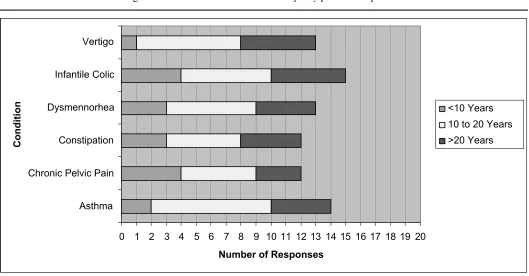
After analysis of the raw data, Figure 1 represents the conditions listed above that showed high favorable re-sponses toward the benefit of chiropractic treatment. For
the sake of simplicity, a positive response was considered whenever the chosen answer was either strongly agree or agree. The number of clinicians that indicated a positive response are depicted, divided into categories by number of years in practice (<10, 10–20 or >20).
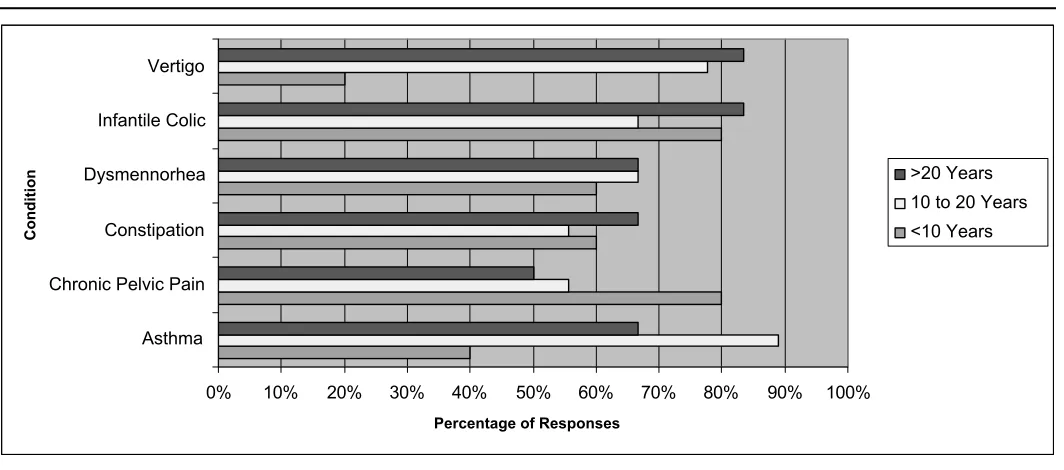
Because the population surveyed was limited in size, the results were analyzed by percentage proportions only for the purposes of comparison; high percentages are not an indication of statistically significant responses (Table 3 and Figure 2).
Using the data from Table 3, Figure 2 graphically displays significant differences in opinion between the “years in practice” groups for conditions such as asthma, chronic pelvic pain and vertigo. Positive responses for treatment of asthma totaled 12 out of 15 clinicians who have been in practice longer than ten years, whereas only 2 out of 5 clinicians in the under 10 year bracket gave a positive response. This demonstrates a proportional dif-ference of 40%. In the case of chronic pelvic pain, 4 out of 5 clinicians in the <10 year bracket had a positive re-sponse, compared to 5 out of 9 in the 10-20 bracket and 3 out of 6 in the >20 year bracket. Positive responses for vertigo showed the opposite; only 1 out of 5 in the <10 year bracket but 7 out of 9 (10–20) and 5 out of 6 (>20) in the other two brackets; a proportional difference of 58% and 63% respectively (Table 3 and Figure 2).
Similarly, conditions listed from Table 2 with a largely negative response (disagree and strongly disagree) were analyzed; however no clear trends or differences were seen in regards to years in practice.
Discussion
As demonstrated by this study, opinion on chiropractic treatment for certain non-musculoskeletal conditions dif-fers greatly between individual CMCC clinicians with some congruence due to years in practice and condition. A fourth year intern may formulate their own opinion on chiropractic treatment of a non-musculoskeletal condi-tion, or, depending on the clinicians they are assigned to during their clinical rotations, may be influenced by their clinician’s opinions and experiences. Some chiropractors, especially more recent graduates, shy away from treating non-musculoskeletal disorders and instead approach pa-tient care from a musculoskeletal perspective only.
Initially the study attempted to correlate clinician ideology with the clinician’s attitude toward the
appro-Characteristic
Number of Respondents
(n = 20)
Graduation Year (before 1995) 10
Graduation Year (after 1995) 10
Years in Practice (1–10 years) 5
Years in Practice (11–20 years) 9
Years in Practice (>21) 6
Philosophies subscribed to/practiced
Subluxation-based 2
Pain-based 17
Functional-based 19
Structural-based 11
Tonal-based 0
Other
Patient-centered 1
Biomechanical 1
Outcome based 1
priateness of treating of non-musculoskeletal conditions. However, as the sample size was very limited, the data collected was not sufficiently robust to draw any conclu-sions with respect to ideology. Perhaps not surprisingly, conditions that garnered greater than 50% or higher
posi-tive response with respect to appropriateness of chiro-practic management are the conditions that generally have the most supportive retrievable research available for them. For the conditions where 50% or higher nega-tive responses were ascertained, the opposite is generally
Non-musculoskeletal Condition
Strongly Agree (%)
Agree (%)
Neutral (%)
Disagree (%)
Strongly Disagree (%)
ADHD/Learning Disabilities 5 0 40 25 30
Arrhythmias/ ECG abnormalities 5 0 40 25 30
Asthma 10 60 10 5 15
Autism 5 0 40 25 30
Bowel/Bladder Dysfunction 0 30 35 15 20
Cerebral Palsy 0 30 35 10 25
Chronic Obstructive Pulmonary Disorder 0 25 30 20 25
Chronic Pelvic Pain 20 40 30 0 10
Constipation 5 55 25 5 10
Crohn’s Disease 0 10 35 20 35
Depression 15 15 25 15 30
Dysfunction of nursing 0 20 35 15 30
Dysmenorrhea/PMS 20 45 20 0 15
Eczema/Psoriasis 0 15 25 25 35
Hearing Loss/Tinnitus 0 15 45 20 20
Hypertension 0 40 35 10 15
Infantile Colic 10 65 15 0 10
Infertility/Amenorrhea 0 5 35 35 25
Multiple Sclerosis 0 25 40 10 25
Nocturnal enuresis 5 30 20 25 20
Otitis Media 5 25 45 0 25
Parkinson’s Disease 5 20 25 25 25
Pneumonia 0 10 20 45 25
Seizures 0 0 35 30 35
Ulcers 5 5 45 20 25
Upper Respiratory Infection 0 10 40 25 25
Urinary Tract Infection 0 10 20 40 30
Vertigo 15 50 20 5 10
Vision Problems 0 5 35 30 30
demonstrated through a paucity of peer-reviewed evi-dence in the literature.
Further analysis of five conditions (asthma, chronic pel-vic pain, vertigo, infantile colic, constipation) was done to observe any trends with respect to years in practice to see if opinions were related to clinical experience. Three conditions demonstrated clear differences between dec-ades in practice: asthma, chronic pelvic pain, and vertigo. From these results, a percentage proportion was calculat-ed. It was noted that asthma and vertigo showed the most significant difference within the stratification of years in practice. Specifically, a high proportion of CMCC clin-icians with greater than 10 years experience indicated a
favorable response toward the chiropractic treatment of both asthma and vertigo. Conversely, very few clinicians with less than 10 years experience concurred with their more experienced colleagues. Considering that the litera-ture regarding the efficacy of chiropractic treatment for asthma is equivocal, it is possible that clinicians with less clinical experience rely more heavily on evidence-based literature thus accounting for their low favorable response rate. That said, since the research on vertigo is generally more favorable towards the effectiveness of manual ther-apies (see further discussion below), it was expected there would be a higher congruence amongst all three tiers of experience. Although more experienced clinicians (>20 Years in
Practice Response Asthma
Chronic
Pelvic Pain Constipation Dysmennorhea
Infantile
Colic Vertigo
<10 Positive 40% 80% 60% 60% 80% 20%
10 to 20 Positive 89% 56% 56% 67% 67% 78%
>20 Positive 67% 50% 67% 67% 83% 83%
Table 3 Proportion of clinicians by years in practice reporting positive responses to selected conditions.
0 1 2 3 4 5 6 7 8 9 10 11 12 13 14 15 16 17 18 19 20 Asthma
Chronic Pelvic Pain Constipation Dysmennorhea Infantile Colic Vertigo
Condition
Number of Responses
<10 Years 10 to 20 Years >20 Years
years) did report their belief that chiropractic care was ef-fect for vertigo (83% in favor), it is noteworthy that rela-tively few chiropractors with less than 10 years experience mirrored this sentiment (20%). Overall, asthma, chronic pelvic pain, constipation, dysmennorhea, infantile colic and vertigo showed the strongest positive clinician re-sponse for chiropractic treatment. Though research exists for each one of these conditions, the quality of the litera-ture is varied and the strength is debatable.
Brontfort et al have recently published a systematic review of the literature on the effectiveness of manual therapies for a variety of musculoskeletal and non-mus-culoskeletal conditions.17 In it, the authors stated that,
overall, there is moderate quality evidence that spinal ma-nipulation is effective for cervicogenic dizziness (short term), is not effective (similar to sham manipulation) for the treatment of asthma, infantile colic and primary dys-menorrhea, and inconclusive evidence exists regarding the effectiveness of manipulation for otitis media, hyper-tension, premenstrual syndrome.17
Asthma is one of the most common chronic diseases amongst children causing increased mucous production and airway hypersensitivity resulting in decreased air-flow.18,19 Chiropractic treatment has been thought to be
beneficial in the treatment of this condition as it posited
that it may modify the autonomic system and elicit viscer-osomatic reactionsto it.18–20 Additionally, it has been
hy-pothesized that misalignments at the levels of the upper C-spine create spinal reflexes that can induce asthma and correcting the misalignments could potentially alleviate the symptoms.19,21,22 In addition, a more recent review by
Kaminskyj et al23 reported in their systematic review of
the literature that chiropractic care should be used as an adjunct, not a replacement to traditional medical therapy. It is interesting to note that there exists a large positive response (70%) amongst CMCC clinicians with respect to this condition, even though the literature is extremely polar and generally equivocal (Table 2). This incongru-ence may suggest that clinicians consider their treatment to be beneficial for the musculoskeletal symptoms associ-ated with asthma rather than the condition itself.
Chronic pelvic pain is described as non-cyclic pelvic pain persisting longer than three months and distinct from dysmenorrhea (a fairly common syndrome causing pain and disability in women).24 The etiology is considered to
be multi-factorial, attributed to anatomical, neurological, hormonal, musculoskeletal and psychosocial factors.24
There has been very little research conducted on the ef-fect of chiropractic care on chronic pelvic pain. One study by Hawk et al concluded that chronic pelvic pain
0% 10% 20% 30% 40% 50% 60% 70% 80% 90% 100% Asthma
Chronic Pelvic Pain Constipation Dysmennorhea Infantile Colic Vertigo
Condition
Percentage of Responses
>20 Years 10 to 20 Years <10 Years
is best treated using a multi-disciplinary approach includ-ing spinal manipulative therapy which showed positive short-term effects compared with sham adjustments.24
This conclusion is supported by the data from this study as 60% of CMCC clinicians responded positively toward the benefit of chiropractic treatment for chronic pelvic pain (Table 2).
Constipation is a common condition amongst the young and the elderly. Difficulty and infrequency in the elimination of feces is often accompanied with pain, fear, and discomfort.25 In a study conducted by Alcantara and
Mayer on three pediatric patients, they found successful resolution of the condition after a regiment of spinal ma-nipulative therapy by observing an increased frequency in bowel movements, with less straining and pain.25
Simi-larly, a case study done on a 64 year old Caucasian female demonstrated a positive resolution to chronic constipa-tion after ten treatments of spinal manipulative therapy.26
While there is no extensive, high quality research on this issue, CMCC clinicians responded favorably (60%) to-ward the use of chiropractic treatment for constipation. This may be explained by personal experience as refer-enced by the above case studies.
Dysmenorrhea, painful menstrual cramps of uterine origin, is differentiated from chronic pelvic pain by its cyclic nature and is grouped into two categories, primary and secondary.17 Primary dysmenorrhea is not associated
with pelvic disease while secondary dysmenorrhea is as-sociated with underlying pelvic pathology such as endo-metriosis.17,24 Hondras et al conducted a randomized,
blinded clinical trial concluding that there was no signifi-cant difference between spinal manipulative therapy and sham treatment on the symptoms of primary dysmenor-rheal.27,28 In a narrative review conducted by Spears, the
author concluded that dysmenorrhea is best treated by a multi-modal approach including nutrition, chiropractic, medication and other alternative healthcare practices.29
Sixty-five percent of the respondents in this study indi-cated a positive opinion; while this may not be reflected in research studies, clinicians may have approached this question with a multi-modal treatment plan in mind.
Infantile colic is an easily identified condition in in-fancy; however its etiology is relatively unknown.30
Ori-ginally defined by Wessel et al infantile colic must meet three criteria: crying for three hours a day, for at least three days a week, for at least three weeks.31 Many
in-fants suffering from colic were observed to have cranial and spinal dysfunction as a result from a traumatic birth process and it has also been theorized that colic may be associated with gastrointestinal dysfunction.32,33 Some
chiropractors opine that manipulative therapy could ef-fectively treat infantile colic because misalignments in the spine may be inhibiting sympathetic output. Since an “adjustment” theoretically causes sympathetic stimu-lation which, based on physiology, in turn relaxes the smooth muscle of the gastrointestinal tract, reduces peri-stalsis, and inhibits bowel function, infantile colic could be effectively treated through manual therapy32 A
ran-dom controlled study conducted in Denmark showed a 67% reduction in daily crying with spinal manipulation, another study conducted in South Africa showed com-plete resolution of symptoms in 93% of infants in the manipulation group.33 On the other hand, Olafsdottir et al conducted a blinded, randomized, and placebo con-trolled clinical trial on the effectiveness of chiropractic treatment on infantile colic and found it was no more ef-fective than placebo.34 Despite the extremes of opinion
demonstrated by the research, 75% of CMCC clinicians responded favorably toward the chiropractic treatment of infantile colic. This may attributed to personal clinical experience and/or their choice of what research they have read.
Vertigo is a fairly common condition described as a false sensation of movement of self or the environment.17
Underlying pathologies vary from trauma to infection in the inner ear, or pathological disorders such as ver-tebrobasilar insufficiency or central nervous system le-sions.17,27 In some patients, the cause of the dizziness may
not fall in the above categories, and it is suspected that the cause may originate from the cervical spine, termed cer-vicogenic dizziness.35 Cervicogenic dizziness is defined
as vertigo induced by changes in position of the neck or originating from the cervicalregion.36
A retrospective study conducted by Elster showed 100% positive response with either symptoms having im-proved or completely reversed within one to six months of care using a treatment plan of upper cervical adjust-ments.37 In contrast, a review study conducted by Reid
and Rivett cited a lack of randomized clinical trials and insufficient clinical research fails to prove the efficacy of manual therapy in treating vertigo.36 Similarly, Bracher
in-cluding spinal manipulative therapy, soft tissue therapy, analgesic electrotherapy and exercise demonstrated a consistent improvement for patients experiencing cer-vicogenic vertigo.37 However, they also concluded that
further studies are needed to assess the treatment valid-ity.37 Considering that most of the research regarding
this condition is positive for chiropractic treatment the results from this study (65%) concur with the literature (Table 2).
Limitations
This study had several limitations. The clinicians could have misinterpreted the questions regarding each condi-tion to mean whether or not chiropractic care was effect-ive in treating the condition itself or the musculoskeletal symptoms associated with them. For example, condi-tions such as asthma and chronic pelvic pain have been associated with higher incidences of thoracic and lower back pain respectively.19,24 Moreover, several clinicians
did suggest that those individuals exhibiting any of the above listed conditions may have co-morbidities or dys-function in their musculoskeletal systems, making chiro-practic treatment both chiro-practical and beneficial. Although clarifications were made about the question to those who asked, it cannot be assumed that all respondents were accurate in their interpretation of each question in the survey. Future studies ought to take greater care in differ-entiating whether a respondent believes that chiropractic care can effectively manage a condition listed, the mus-culoskeletal effects associated with it or a combination of the two.
Including the option of “neutral” as a possible response was also open to respondent interpretation. Since the sur-vey required an answer for each question, respondents may have chosen the answer “neutral” not because they genuinely had no positive or negative position on the mat-ter, but rather because they were required to select an an-swer in order to continue with the survey. Furthermore, a neutral response could be translated as a mixed opinion; in that personal clinical experience has shown some positive and some negative responses in treating the above listed conditions, again not a “true” neutral response. It can also be argued that, by responding “agree,” “neutral” or “dis-agree,” a respondent does not have a strong opinion at all. That said, surveys such as the one used in this study con-ventionally collapse “strongly agree” and “agree together
and “strongly disagree” and “disagree” together. In the future, this study may be replicated with the inclusion of an interview component that would clarify reasons for a neutral, “agree” or “disagree” response.
Finally, as this survey study was restricted to the 22 CMCC clinicians of the 2009–2010 academic school year, the sample size was very small, and not all clinicians participated. Had all clinicians responded, the response frequencies would have been different. Bearing in mind the above limitations of the study, the small sample size may have created a skew in the distribution of the results and the attitudes of CMCC clinicians towards the man-agement of non-MSK conditions may not be representa-tive of the attitudes of field practitioners in general.
Lastly, it might be interesting to conduct similar sur-veys of clinicians at other accredited chiropractic college and compare their attitudes towards the effectiveness of chiropractic care of non-MSK from those institutions to the ones discussed here.
Conclusion
Overall, there appears to be a positive response toward the chiropractic treatment of non-MSK conditions such as asthma, constipation, chronic pelvic pain, dysmenorrhea, infantile colic, and vertigo amongst CMCC clinicians. It was noted that, regardless of number of years in clinical practice, most opinions amongst CMCC clinicians were congruent with the exception of asthma and vertigo. However, a majority of the more experienced clinicians posited that chiropractic care would be of benefit to pa-tients affected by these two conditions. Both conditions are fairly prevalent in the population and many patients with these conditions seek chiropractic care, not neces-sarily for the condition itself, but for related/associated MSK symptoms.
The unexpected result regarding vertigo indicates that research may not play as significant a role as predicted since clinicians with less than 10 years of clinical ex-perience had a low positive response result compared to their more experienced colleagues despite the availabil-ity of literature indicating there is evidence of moderate strength supporting the use of chiropractic in treating this condition.
var-iety of theoretical knowledge and opinions pertaining to the non-musculoskeletal conditions discussed. A study should be conducted to gather similar data to determine
if there is any vertical integration/continuity between the theory taught in class in the undergraduate program, and the opinions formed by fourth year interns.
Appendix A
Attitudes towards Non-Musculoskeletal Survey
This study is designed to determine the attitudes of the clinicians, specifically towards the chiropractic management of a set of non-musculoskeletal conditions. From the results of this study, we will discuss the influence of the clinicians on year 4 chiropractic students and how well that integrates with the first three years of study at the Canadian Memorial Chiropractic College.
1. Please indicate your year of graduation from an accredited chiropractic college
2. Please indicate the number of years in practice
0–5
6–10 11–15 16–20 21–25 26–30 >30
4. Please indicate which philosophies you subscribe to and/or practice. Please check all that apply.
Subluxation-based Pain-based
Functional-based Structural-based Tonal-based
Strongly Agree Agree Neutral Disagree
Strongly Disagree ADHD/Learning Disabilities
Arrhythmias/ ECG abnormalities Asthma
Autism
Bowel/Bladder Dysfunction Cerebral Palsy
Chronic Obstructive Pulmonary Disorder Chronic Pelvic Pain
Constipation Crohn’s Disease Depression
Dysfunction of nursing Dysmenorrhoea/PMS Eczema/Psoriasis Hearing Loss/Tinnitus Hypertension
Infantile Colic
Infertility/Amenorrhea Multiple Sclerosis Nocturnal enuresis Otitis Media Parkinson’s Disease Pneumonia
Seizures Ulcers
Upper Respiratory Infection Urinary Tract Infection Vertigo
Vision
5. Please indicate whether you think chiropractic is beneficial in treating the following conditions:
References
1 Keating JC Jr, Cleveland CS, Menke M. Chiropractic History: A Primer. Association for the History of Chiropractic, Davenport, Io. 2004.
2 Montgomery PD, Nelson MJ. Evolution of chiropractic theories of practice and spinal adjustment, 1900–1950. Chiro Hist. 1985; 5:71–77.
3 Kaptchuk TJ, Eisenberg DM. Chiropractic. origins, controversies and contributions. Arch Intern Med. 1998; 158:2215–2224.
4 Keating JC Jr. Several pathways in the evolution of chiropractic manipulation. J Manipulative Physio Ther. 2003; 26(5):300–321.
5 Paget J. Cases that bonesetters cure. BMJ. 1867; 1:1–4. 6 Meeker WC, Haldeman S. Chiropractic: A profession at
the crossroads of mainstream and alternative medicine. Ann Intern Med. 2002; 136:216–227.
7 Masarsky CS, Todres-Masarsky M. Somatovisceral Aspects of Chiropractic: An Evidence-Based Approach, 2001. Churchhill Livingstone USA.
8 Owens E. Theoretical constructs of vertebral subluxation as applied to chiropractic practitioners and researchers. T Clin Chiropr. 2000; 7(1):74–79.
9 Cooperstein R, Gleberzon BJ. Full-Spine Specific (FSS) Technique (Meric Technique, Meric Recoil Technique). In: Technique Systems in Chiropractic. Churchill-Livingstone, 2004:155–159
10 Nelson C, Lawrence D, Triano J et al. Chiropractic as spine care: A model for the profession. Chiropractic & Osteopathy. 2005;13(9). www.chiroandosteo.com/ content/13/1/9
11 Hawk C. Should chiropractic be a wellness profession? Top Clin Chiropr. 2000; 7:23–26.
12 Hawk C. When worldviews collide: maintaining a vitalistic perspective in chiropractic in the postmodern era. J Chiropr Humanit. 2005; 12:2–7.
13 Coopestein R, Gleberzon BJ. Towards a taxonomy of subluxation-equivalents. Top Clin Chiropr. 2000; 8(1):49– 60.
14 Vermet S, McGinnis K, Boodham M, Gleberzon BJ. Degree of vertical integration between the undergraduate program and clinical internship with respect to
lumbopelvic diagnostic and therapeutic procedures at a chiropractic college. J Chiro Ed 2010; 24(1):46–56. 15 Hawk C, Long CR, and Boulanger KT. Prevalence of
nonmusculoskeletal complaints in chiropractic practice: Report from a practice-based research program. J Manipulative Physiol Ther. 2001; 24(3):157–169. 16 Cooperstein R, Gleberzon BJ. Diversified Technique. In:
Technique Systems in Chiropractic. Churchill-Livingstone, 2004:
17 Bronfort G, Haas M, Evans R, Leininger B, Triano J. Effectiveness of manual therapies: The UK evidence report. Chiropractic & Osteopathy. 2010; 18:3.
18 Balon JW, Mior SA. Chiropractic care in asthma and allergy. Ann Allergy Asthma Immunol. 2004; 93(Suppl 1):S55–60.
19 Bronfort G. Childhood and adolescent asthma: the scientific basis for chiropractic management. European J Chiropr. 2002; 49: 8–12.
20 Balon J et al. A comparison of active and simulated chiropractic manipulation as adjustive treatment for childhood asthma. N Engl J Med. 1999; 339:1013–1020. 21 Bronfort G et al. Chronic pediatric asthma and chiropractic
spinal manipulation: a prospective clinical series and randomized clinical pilot study. J Manipulative Physiol Ther. 2001; 24:3639–3677.
22 Gibbs A. Chiropractic co-management of medically treated asthma. Clinical Chiropractic. 2005; 8:140–144.
23 Kaminskyj A, Frazier M, Johnstone K, Gleberzon B. Chiropractic care for patients with asthma: A systematic review of the literature. J Can Chiropr Assoc. 2010; 54(1):24–32.
24 Hawk C, Long C, Azad A. Chiropractic care for women with chronic pelvic pain: a prospective single-group intervention study. J Manipulative Physiol Ther. 1997; 20(2):73–79.
25 Alcantara J, Mayer D. The successful resolution of chronic constipation in three pediatric patients following chiropractic spinal manipulative therapy. European J Integrative Med. 2008; 1: 25–26.
26 Redly M. The effects of chiropractic care on a patient with chronic constipation. JCCA. 2001; 45(3):185–191. 27 Ernst E. Chiropractic manipulation for non-spinal pain – a
systematic review. NZMJ. 2003; 116:1179.
28 Hondras MA, Long CR, Brennan PC. Spinal manipulative therapy versus a low force mimic maneuver for women with primary dysmenorrheal: a randomized, observer-blinded, clinical trial. Pain. 1999; 81:105–114.
29 Spears LG. A narrative review of medical, chiropractic, and alternative health practices in the treatment of primary dysmenorrhea. J Chiropr Med. 2005; 4(2):76–88.
30 Cohen-Silver J, Ratnapalan S. Management of infantile colic: a review. Clinical Pediatrics. 2009; 48(1):14–17. 31 Wessel MA, Cobb JC, Jackson EB, Harris GS, Detwiler
AC. Paroxysmal fussing infancy, sometimes called ‘colic’. Pediatrics. 1954; 14:421–434.
32 Hipperson AJ. Chiropractic management of infantile colic. Clinical Chiropractic. 2004; 7:180–186.
33 Wiberg JMM. Infantile colic: the scientific evidence for chiropractic management. European J Chiropr. 2002; 48:3–7.
34 Olafsdottir E, Forshei S, Fluge G, Markestad T.
Randomised controlled trial of infantile colic treated with chiropractic spinal manipulation. Arch Dis Child. 2001; 84:138–141.
subluxation: A retrospective analysis. J Vertebral Subluxation Res. 2006; (Nov 8); 1–9.
36 Reid SA, Rivett DA. Manual therapy treatment of cervicogenic dizziness: a systematic review. Manual Therapy. 2005; 10:4–13.
37 Bracher ES, Almeida C, Almeida R, Duprat A, Bracher C. A combined approach for the treatment of cervical vertigo. J Manip Physiol Thera. 2000; 23(2):96–100.