related illness and sunburn in athletes:
A retrospective case series
Andrew L. Miners,
BPHE, BSc (Hons), CSCS, CK, DC, FCCSS(C)** Assistant Professor, Canadian Memorial Chiropractic College, 6100 Leslie St., Toronto, Ontario M2H 3J1.
Address correspondence to: Dr. Andrew Miners, Canadian Memorial Chiropractic College, 6100 Leslie St., Toronto, Ontario M2H 3J1. Phone: 905-409-6528; Email: [email protected]
Disclaimer: No funding was received for this report. The author has no commercial associations that might pose a confl ict of interest in con-nection with the submitted article.
© JCCA 2010.
Objectif : Les coups de chaleur contribuent
signifi cativement à la morbidité et occasionnellement à la mortalité pour plusieurs athlètes. Les coups de soleil augmentent le risque de développer divers carcinomes de la peau. Ce rapport présente un survol de l’étiologie, de la symptomatologie, de l’identifi cation du risque, de la prévention et du traitement pour les coups de chaleur et les coups de soleil.
Caractéristiques cliniques : Ce rapport présente quatre cas qui illustrent le diagnostic et le traitement immédiat des coups de chaleur et des coups de soleil en lien avec l’activité physique.
Intervention et résultat : L’identifi cation des signes et des symptômes, combinée à un traitement prompt, a permis de soulager trois athlètes qui souffraient de coups de chaleur en lien avec l’activité physique et un athlète souffrant d’un coup de soleil.
Conclusion : La meilleure approche thérapeutique est la prévention. Les chiropraticiens peuvent être une ressource importante pour diffuser l’information au sujet des stratégies de prévention et de traitement. Pour les coups de chaleur bénins à modérés, le traitement consiste en une identifi cation rapide des signes et des symptômes, suivie d’un refroidissement et d’une réhydratation rapide. Pour les coups de chaleur plus graves, un refroidissement rapide et agressif est essentiel pour réduire l’incidence de mortalité. Le meilleur moyen prouvé de traiter les coups de soleil est le soulagement symptomatique à l’aide d’émollients et le contrôle de la douleur par les médicaments.
(JCCA 2010; 54(2):107–117) Objective: Heat illnesses contribute to signifi cant
morbidity and occasional mortality in athletic
populations. Sunburn increases the risk of various skin carcinomas. This report provides an overview of the etiology, symptomatology, risk identifi cation, prevention, and treatment for heat related illnesses and sunburn.
Clinical Features: Four cases are presented to illustrate the diagnosis and immediate treatment of exercise related heat illness and sunburn.
Intervention and Outcome: Identifi cation of signs and symptoms combined with prompt treatment, achieved resolution in three athletes presenting with exercise related heat illness and one athlete with sunburn.
Conclusion: The best treatment approach is
prevention. Chiropractors can be an important resource for information regarding prevention and treatment strategies. For mild to moderate heat illness, quick identifi cation of signs and symptoms, followed by rapid cooling and re-hydration comprises treatment. For heat stroke, rapid and aggressive cooling is essential to reduce mortality. Best evidence treatment of sunburn is symptomatic relief with emollients and pain control via medications.
Introduction
Heat related illnesses and sunburn are extremely common but dramatically under reported.1 Heat illness, including heat edema, heat cramps, heat syncope, heat exhaustion, and heatstroke, contribute to signifi cant morbidity as well as occasional mortality in athletic, elderly, paediatric and disabled populations.1,2 The incidence of heatstroke alone, in urban areas of the United States during times of high ambient temperature, is upwards of 20 cases per 100,000 people, and accounts for at least 240 deaths annu-ally.2 Among US high school athletes, “heat illness is the third leading cause of death.”1 Although often associated, sunburn is not considered a true heat illness since it is a direct result of excessive sunlight exposure, whereas heat illness is a result of an increase in body temperature.1–3 The data from 4,023 respondents of the 1996 Canadian National Survey on Sun Exposure & Protective Behav-iours (NSSE&PB) indicated that; 53% of Canadians of age 15 years or older experience one or more sunburns during a summer, 68% of those being between the ages of 15 and 24, and a higher proportion of males reported sunburn than females.3 Evidence suggests that sun expos-ure leading to sunburn, including a history of sunburn at young ages, increases the risk of melanoma, basal cell carcinoma, and possibly squamous cell carcinomas.4 In addition to the risks of cancer, sunburn is commonly as-sociated with heat exhaustion and heatstroke.5 These are alarming statistics, considering that heat illnesses and sunburns are almost completely preventable, especially in a sporting situation.1,2
This report will describe the on-fi eld diagnosis and im-mediate treatment of four teenaged female athletes with various presentations of heat related illness and/or sun-burn. The report will provide an overview of the etiol-ogy, symptomatoletiol-ogy, risk identifi cation, prevention, and the treatment for heat related illnesses and sunburn. The illustrative cases and discussion are of interest to chiro-practors due to the high occurrence rate in athletes and people who enjoy physically active lifestyles, the risk of serious illness or death, and the fact that such situations are almost completely preventable. Chiropractors, as
pri-mary contact health care providers, are ideally suited to provide evidence based information and patient education regarding the prevention and treatment of heat related ill-ness and sunburn.
Case Presentations
A female under-17, Canadian representative soccer team was competing in multiple games on a hot, sunny day with clear skies and minimal wind, in Central America during March break. The team fl ew in from Canada the evening previous, slept in a hotel, and woke-up early to arrive at the soccer fi elds on time. The ambient temper-ature was approximately 38°C (100.4°F), and no sun shelter was available. Midway through the 2nd half of the second game, several players reported various symptoms.
Case 1
A 14-year-old female, 5⬘6⬙ in height and 135 lbs., re-ports extreme thirst, feeling abnormally tired, and slightly dizzy. She states that she is too tired to continue playing without taking a break. Upon questioning, she states that she only had a little water in between this game and the previous game. She feels quite hot. Physical examination reveals normal vital statistics; blood pressure (BP), pulse rate (PR), respiration rate (RR), and tympanic membrane body temperature (BT).
Case 2
A 14-year-old female, 5⬘8⬙ in height and 145 lbs., with a self-reported history of “hypoglycemia,” removes herself from the game and describes symptoms of “light headed-ness” and “wooziness.” She also claims an abnormally high level of fatigue, and she appears very fl ushed with rosy cheeks, and sweaty. She reports that she has been drinking GatoradeTM fairly regularly during the day, and states that she has almost fi nished a 1-litre bottle. Physical examination reveals normal vital statistics (BP, PR, RR, and BT).
Case 3
A 14-year-old female, 5⬘6⬙ in height and 130 lbs.,
with-k e y w o r d s: heat illness, sunburn, diagnosis, chiropractor.
draws from the game and describes symptoms of head-ache, extreme fatigue, dizziness, weakness, and exhibits a very fl ushed, rosy cheeked, sweaty appearance. She also shows mild swelling in her fi ngers and feet. She reports a previous history of “mild heat problems” which have included episodes of “fatigue, headaches, and dizziness” occurring during and after strenuous exercise in the heat. She uses an inhaler as required for exercise induced asth-ma, and she had just recently experienced the onset of menses. She has been trying to drink lots of water during the day, but is unsure of how much she may have con-sumed. Physical examination reveals strong and regular peripheral pulses, normal respiration, a BP of 110/74, PR of 110 beats/min, and a BT of 38.9°C (102°F).
Case 4
Later that evening a 16-year-old female, 5⬘6⬙ in height and 117 lbs., presented with severely sunburned forehead and arms. The skin on both her forehead and arms is very red and painful to touch. Her forehead exhibits signifi cant swelling and is starting to blister. She reports the addi-tional symptoms of feeling hot and dizzy. She does not feel like eating. Previous medical history reveals that she takes oral acne medication and has a history of menstrual irregularity and dysmenorrhoea. Physical examination re-veals normal vital statistics (BP, PR, RR, and BT).
The fi rst three athletes were diagnosed with various se-verities of heat exhaustion and dehydration, from a mild to a more moderate presentation, respectively. They were re-moved from play for the remainder of the day, superfl uous clothing was removed, cool water was splashed over their heads and upper torsos, and cool, wet towels were placed on their foreheads and necks. The third athlete presented, also had ice packs applied to both armpits and her neck. Shade was provided as best as possible using clothing and umbrellas as available. They were given easily digestible food, and instructed to slowly consume cool water until dinner time. All three of the athletes recovered rapidly and within approximately 30 to 60 minutes, reported little to no residual symptoms, with the exception of mild thirst. Upon follow-up that evening all three of the athletes had completely recovered and were continuing to slowly re-hydrate with water and electrolyte sport drinks.
The fourth athlete presented, was diagnosed with mul-tiple, moderate to severe sunburns, and the associated symptoms of excessive sun exposure. The burst blisters
on her forehead were cleaned with a mild anti-bacterial wound cleanser, and a clean dressing was applied. She was given a cool compress to apply to both her arms and forehead, and a moisturizing lotion was repeatedly ap-plied to the burned areas on her arms. She was instructed to slowly re-hydrate with cool water, consume food when she felt better, and to maintain bed rest for the remainder of the evening and the next morning.
All four athletes were withheld from competition the next day and were continually monitored. After sunburns were covered with opaque clothing, and each athlete was instructed on, and monitored for, proper hydration and sun protection practices, all four athletes were cleared for return to play on the third day. None of the athletes ex-perienced a recurrence of symptoms for the remainder of the trip, despite competing in fi ve additional games under the same environmental conditions.
Discussion
Heat Related Illness
Humans are homeothermic organisms, meaning that humans regulate their own warm-blooded body tem-perature.6 Typically speaking, humans are successful in maintaining their body temperature within a normal range of 35.8°C to 37.3°C (96.4°F to 99.1°F).1,6 However, exer-cising in the heat places demands on the body’s ability to thermoregulate.1 Heat production during exercise is 15 to 20 times greater than at rest, and is suffi cient to raise a persons core body temperature 1°C every fi ve minutes, if there were no inherent regulatory mechanisms.1 The heat generated by the body and the heat absorbed from the ambient environment must be offset by multiple mech-anisms for heat dissipation.1 These cooling mechanisms which work simultaneously to varying degrees depending on the situation include conduction, convection, radia-tion, and evaporation.1,2,7 Conduction refers to heat loss through direct contact with a cooler object.2,7 Convection is the dissipation of heat when relatively cool air passes over exposed skin.2,7 Radiation is the release of heat from the body directly into the environment, and evaporation through sweating, is a process that incorporates the pro-cesses of both convection and radiation by the secretion of body water through to the skins surface.2,7
temperature and moisture.6 As the ambient temperature and humidity increases, the thermal transfer from the body to the environment becomes less effi cient.1,2,6 When the ambient temperature rises above 20°C (68°F), the pro-cesses of conduction, convection, and particularly radia-tion, become less and less effi cient.1 In such situations the bulk of heat dissipation, especially in an exercising individual, results from evaporation through the process of sweating.1,7 In hot, dry conditions, evaporation from sweating can account for as much as “98% of dissipated heat.”1 Thus, any factor that limits the body’s ability to utilize evaporative sweating processes, such as high hu-midity, dehydration, or restrictive non-breathable cloth-ing, will have a profound effect on physiological function, athletic performance, and the risk for heat illness in exer-cising individuals.1,7
Body temperature homeostasis is about balance.8 Heat dissipation must equal heat accumulation. When heat accumulation surpasses heat dissipation, homeostasis is lost and hyperthermia is the result.8 Marsh and Jenkins (2002) state that the “continuum of hyperthermia symp-tom progression results in the clinical subcategories of heat illness,” meaning that the various subcategories of heat illness (heat edema, heat cramps, heat syncope, heat exhaustion, and heatstroke) are the attendant clinical symptoms of various stages of hyperthermia.8 Although traditionally heat edema, heat cramps, heat syncope, heat exhaustion, and heatstroke are the fi ve common types of heat illness typically associated with strenuous activity in hot, humid weather, there is disagreement as to whether heat edema and heat cramps are distinct conditions.1,7–9 Additionally, heat syncope is often used interchangeably with heat exhaustion.1,7,8,10 In fact, recent observations contend the idea that heat edema, heat cramps, heat syn-cope, and heat exhaustion are “heat illnesses” at all.7,9 A narrative review by Noakes (2008) contends that “heat stroke is the only condition that can be truly described as a heat illness, since it is the only condition in which there is clear evidence for a pathological elevation of body core temperature.”9
Heat edema is the mildest form of exercise related heat illness, and most commonly affects unacclimatised indi-viduals in extreme heat.1,8 It is characterised by transient peripheral vasodilation complicated by orthostatic pooling of venous blood return, and it is generally considered to be a warning sign for heat exhaustion.1 Symptoms include;
hypotension that develops after prolonged exercise due to “exercise-induced changes in blood pressure regulation and a state of low peripheral vascular resistance.”9 Hence, Noakes (2008) suggests that athletes presenting with signs and symptoms consistent with a diagnosis of heat exhaus-tion would better be diagnosed with “exercise-associated postural hypotension.”9 An interesting and likely accur-ate argument, however for the purposes of this paper the classical diagnostic term of “heat exhaustion” is utilized. Heatstroke is defi ned by the American College of Sports Medicine as “a condition in which body temperature is elevated to a level that causes damage to the body’s tis-sues, giving rise to a characteristic clinical and pathologic-al syndrome affecting multiple organs.”10 It is a medical emergency involving total thermoregulatory failure that will not spontaneously reverse without external cooling measures.1,2,10 Heatstroke is subdivided into classical and exertional forms.8,10 Classical heatstroke is caused by environmental exposure and results in core body hyper-thermia in excess of 40°C (104°F), central nervous sys-tem dysfunction, and the inability to sweat, a sign called anhydrosis.1,2,8,10 It primarily occurs in the elderly and those with chronic illness, and may develop slowly over several days.2 Exertional induced heatstroke is associated
with hard exertion or exercise in a hot, humid environ-ment resulting in core hyperthermia above 40°C (104°F) and central nervous system dysfunction.1,8–10 In contrast to the classical form, patients with exertional heatstroke may continue to sweat temporarily.8,10 It primarily af-fects younger, active persons, and has a relatively rapid onset, developing in hours, not days.1,8,10 It is important to note that the diagnosis of heatstroke, either classical or exertional, rests on two critical factors; hyperthermia in excess of 40°C (104°F), and central nervous system dys-function.1,2,8–10 Additional signs and symptoms that may accompany a diagnosis of heatstroke are listed in Figure 2.
Sunburn
Sunburn is the acute reaction of the skin to damage by ultraviolet (UV) light exposure.5,12–14 It is estimated that 90% of UV light reaching the earth is UV light type “A” (UVA), which has been shown to penetrate into the der-mis and contributes to the visible signs of aging and skin degeneration.12 The remaining 10% of UV light is UV light type “B” (UVB), the light responsible for sunburn erythema.12 The pathogenesis of sunburn is most likely due to vasodilation and increased vascular permeability of blood vessels in the upper dermis leading to erythema, Figure 1 Signs and Symptoms of heat exhaustion.
Signs and Symptoms of heat exhaustion may
Include…
and a core temperature rise of …
37.3°C
(99.1°F)
40°C
(104°F)
•
•
Headache
Headache
•
•
Extreme weakness
Extreme weakness
•
•
Dizziness, vertigo
Dizziness, vertigo
•
•
Heat sensations
Heat sensations
•
•
Heat cramps
Heat cramps
•
•
Chills
Chills
•
•
Irritability
Irritability
•
•
Syncope
Syncope
•
•
Sudden onset
Sudden onset
•
•
Low blood pressure
Low blood pressure
•
•
Elevated pulse
Elevated pulse
•
edema, infl ammatory response, and irreversible DNA damage.12 It is DNA damage that leads to the increased risk of skin cancer.3,12 The signs and symptoms of sun-burn include; erythema, edema, blisters, ulcerations, and pain.5,12 Signs and symptoms typically become evident 3 to 5 hours after exposure, peaking in 12 to 24 hours, and generally start to dissipate by 72 hours post exposure.5,12 Although not common practice, sunburns can be graded in terms of severity.5 First-degree sunburn involves only erythema, second-degree burns have erythema and blis-tering, and third-degree burns have erythema, blisters, and ulcerations.5
Risk Factors for Exercise Related Heat Illnesses and Sunburn
The major risk factor for exercise related heat illness is high ambient heat combined with a high level of humid-ity.1,8,15 Determination of the wet bulb globe temperature (WBGT) is used to assess environmental conditions and the associated risk of heat illness.1 WBGT is a standard-ized index of environmental heat stress that can be ob-tained using commercially available devices.1 It takes
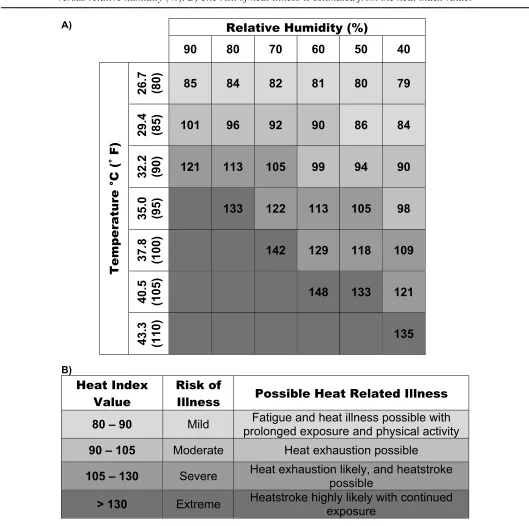
into account the contributions of ambient temperature, radiant heat, and humidity.1 WBGT above 27.8°C (82°F) is considered ‘very high risk.’1 WBGT between 22.8°C (73°F) and 27.8°C (82°F) is considered ‘high risk.’1 WBGT between 18.3°C (65°F) and 22.8°C (73°F) is con-sidered ‘moderate risk,’ and WBGT below 18.3°C (65°F) is considered ‘low risk.’1 The risk associated with high environmental heat and humidity can also be assessed by utilizing a heat illness risk assessment chart (see Figure 3) in combination with readings for temperature and humid-ity available from local news stations or internet weather sites. Another major risk factor for exercise related heat illness is hydration status.1,15–17 Athletes typically dehy-drate during exercise in the heat because of the unavail-ability of fl uids or a mismatch between thirst and water requirements.15 A 1% reduction in body weight due to water loss can induce stress on the cardiovascular system in addition to increases in heart rate and an inhibition in heat transfer to the skin and the environment, thus con-tributing to an increase in core body temperature.17 When exercising in the heat, water intake equalling sweat loss results in the slowest core temperature rise compared Figure 2 Diagnostic criteria and additional signs and symptoms associated with heatstroke.
The diagnosis of heatstroke rests on two critical
factors:
1. Hyperthermia > 40°C (104°F)
2. Central Nervous System Dysfunction
Additional signs and symptoms may include…
* Patients with exertional heat stroke may temporarily
continue to sweat !!
•
•
Anhydrosis*
Anhydrosis*
•
•
Cardiac Arrhythmias
Cardiac Arrhythmias
• Hyperventilation
• Shock
• Visual Disturbances
•
•
Irritability
Irritability
•
•
Seizures
Seizures
•
•
Confusion
Confusion
•
•
Anorexia
Anorexia
•
•
Dizziness
Dizziness
•
•
Fatigue / Weakness
Fatigue / Weakness
•
•
Headache
Headache
•
•
Nausea
Nausea
•
•
Ataxia
Ataxia
•
A)
B)
Heat Index
Value
Risk of
Illness
Possible Heat Related Illness
80 – 90
Mild
Fatigue and heat illness possible with
prolonged exposure and physical activity
90 – 105
Moderate
Heat exhaustion possible
105 – 130
Severe
Heat exhaustion likely, and heatstroke
possible
> 130
Extreme
Heatstroke highly likely with continued
exposure
Relative Humidity (%)
90 80 70 60 50 40
Tem
perature °C (
Ý
F)
26.7
(80)
85
84
82
81
80
79
29.4
(85)
101
96
92
90
86
84
32.2
(90)
121
113
105
99
94
90
35.0
(95)
133
122
113
105
98
37.8
(100)
142
129
118
109
40.5
(105)
148
133
121
43.3
(110)
135
Figure 3 Example of heat illness risk assessment charts. A) Heat index value is determined from temperature (°C) versus relative humidity (%). B) The risk of heat illness is estimated from the heat index value.
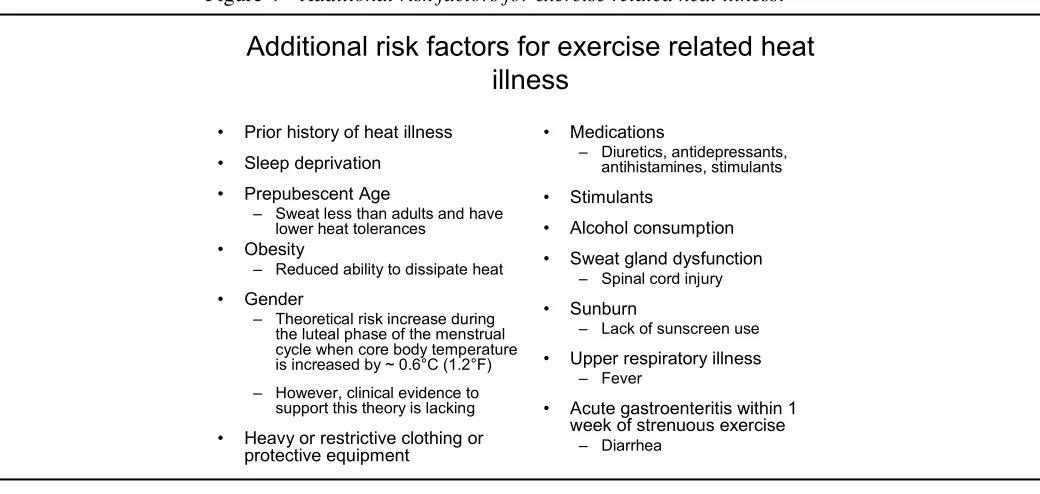
with ‘at will’ drinking and no water consumption.1,15,17 Lack of acclimatisation is the third major risk factor for exercise related heat illness.16 People who are adjusted to activity in heat show a signifi cantly increased ability to resist heat illness due to an increased sweating response, decreased heart rate, and a reduction in the level of per-ceived exertion during exercise in the heat.16 Compared to non-acclimated persons, acclimated persons demon-strate a comparatively lower core and skin temperature during exercise in the heat.16 The fourth major risk factor for heat illness in athletes is poor relative fi tness leve1.16 Studies have shown that persons with high cardiovascular fi tness, compared to untrained individuals, have an in-creased ability to dissipate heat, inin-creased heat tolerance, and an increased glycogen storage ability which increases a body’s ability to store water.16 In addition to the major risk factors for exercise related heat illness, there are a variety of other factors that have been theoretically linked to an increased risk of heat injury.1,8,10 The associated risk factors are listed in Figure 4.
Purdue et al., (2001) utilizing information collected from the 1996 National Survey on Sun Exposure & Pro-tective Behaviours (4,023 respondents) determined that the following factors are related to an increased risk of sunburn for persons in Canada; Ontario resident, younger
age, male sex, upper middle to high income status, birth-place in North America, lighter skin colour, lighter hair colour, no personal history of skin cancer, family history of skin cancer, high awareness of the UV index, having worked outdoors over the previous summer, and increased leisure-time sun exposure.3
Prevention
Heat illness prevention depends on removing and/or mini-mizing risk factors.1 Thus, education is the fi rst stage of prevention. Coaches, trainers, and the athletes themselves must be exposed to current and accurate information re-garding the risks of exercise induced heat illness.16 It is of utmost importance that the athletes understand the vari-ous risks and predisposing factors, and that they are edu-cated on how to minimize them.1,16 Proper hydration is an excellent example. Athletes are often poorly educated regarding hydration practices.1 In some athletic cultures, an ‘old school’ mentality persists where fl uid restriction during athletic training is practiced and deemed neces-sary to ‘toughen up’ the athletes.1 Additionally, it is not uncommon for athletes to receive much of their hydration information from well intentioned but under-informed coaches, team-mates, or parents.1,16 This may impart from the fact that there remains some variability within Figure 4 Additional risk factors for exercise related heat illness.1,8,10
Additional risk factors for exercise related heat
illness
• Prior history of heat illness
• Sleep deprivation
• Prepubescent Age
– Sweat less than adults and have lower heat tolerances
• Obesity
– Reduced ability to dissipate heat
• Gender
– Theoretical risk increase during the luteal phase of the menstrual cycle when core body temperature is increased by ~ 0.6°C (1.2°F) – However, clinical evidence to
support this theory is lacking
• Heavy or restrictive clothing or
protective equipment
• Medications
– Diuretics, antidepressants, antihistamines, stimulants
• Stimulants
• Alcohol consumption
• Sweat gland dysfunction
– Spinal cord injury
• Sunburn
– Lack of sunscreen use
• Upper respiratory illness
– Fever
• Acute gastroenteritis within 1
week of strenuous exercise
the literature regarding the best hydration and re-hydra-tion protocol.11,15–17 However, most sources recommend that athletes should consume 500 ml of fl uid (water or electrolyte sports drink) one to two hours prior to an ath-letic event, and then consume approximately 250 ml of fl uid every 20 minutes during exercise in activities lasting greater than one hour.1,15–17 Following exercise, an athlete should replace sweat water loss with 1.2 L of water con-taining 4% to 8% of carbohydrate (CHO) for every kilo-gram of body weight lost.1,15–17 However athletes should be careful not to consume greater than 1.5 L of fl uids each hour to avoid gastric discomfort.1,15–18
Another area where an athlete can practice prevention is by becoming acclimated or acclimatized to exercise in the heat. This is more of an art than a science, as proper adaptation depends on the intensity and duration of ex-ercise, on the environmental conditions, and the individ-ual athlete.16,18 However, adaptation generally requires 7 to 10 days of 60 to 100 minutes of moderately strenuous exercise carried out in hot conditions, with the objective of raising body temperature and stimulating a signifi cant sweating response.16
In addition to the above, exercise related heat illness can be prevented by athletes having heat exercise experience, and a self-awareness of how their body is responding to ac-tivity in the heat.1,15–17 Events can be timed to take place around the cooler times of the day, as opposed to occurring during or through high heat daytime hours.15–17 Athletes should wear light coloured, low weight, loose breathable clothing which does not interfere with the body’s cooling processes of conduction, convection, radiation, and evapora-tion.1,2,11,15–17 Athletes can maintain good lifestyle practices of eating a well balanced diet, maintaining regular hydra-tion, and keeping cardiovascular fi tness levels high.1,15–17 In addition to actively minimizing risk and predisposing factors, it is the responsibility of the athlete, team-mates, parents, coaches, trainers, and team doctors to monitor how someone is responding to exercising in the heat, and to ob-tain help and/or implement prevention/treatment strategies should any signs or symptoms of heat illness arise.
As with heat illness, the prevention of sunburn starts with education. Simple behavioural measures have been proven to minimize the risk of experiencing sunburn.13 Minimizing sun exposure, wearing protective cloth-ing, and using topical sunscreens, are simple measures to undertake, which will signifi cantly reduced a persons
risk of incurring sunburn.3,13 It is generally recommended that the minimum level of sunscreen protection utilized when exercising in the heat is sun protection factor (SPF) 15, however longer sun exposure times will necessitate higher levels of protection and repeated applications.3,13
Treatment
When signs and symptoms of exercise induced heat illness present in an athlete prompt recognition is essential. Once symptoms have been recognized and the athlete assessed, treatment can be initiated.2,10,19,20 For the milder presen-tations of heat illness treatment is fairly straightforward and typically involves removal of the athlete from the hot environment, resting the patient in the side lying recovery position, then a gradual cooling of the patient by utiliz-ing cool, wet towels or ice packs placed in the athletes underarms (axillae), groin, base of neck, or forehead.19 It is hypothesized that the application of cool compress-es to areas were large artericompress-es are relatively superfi cial in addition to the head and neck help to maximize the heat dissipation mechanism of conduction. However, to this author’s knowledge no study has been conducted to confi rm the benefi ts of one area of cool compress appli-cation over another. Once cooling has been initiated, the athlete can slowly begin to consume cool carbohydrate/ electrolyte fl uids, while recovery and vitals are further monitored.2,19 It is recommended that following a mild heat related illness, athletes should be protected from heat exposure for 24 to 48 hours.2
diag-nosed with heat exhaustion must be protected from heat exposure for a minimum of 48 hours after injury.2
Heatstroke is an emergency situation. Therefore prompt and accurate recognition is imperative. As mentioned previously, the diagnosis of heatstroke, either classical or exertional, rests on two critical factors, hyperthermia in excess of 40°C (104°F), and central nervous system dysfunction.1,2,8,10 The American College of Sports Medi-cine states that “mortality rate and organ damage due to heatstroke are proportional to the length of time between core temperature elevation and initiation of cooling ther-apy.”10 Consequently the initial stage of treatment for someone suspected of having heatstroke should be rapid and aggressive body cooling.10 Because rapid, aggressive cooling is the key to preventing mortality in patients diag-nosed with heatstroke, several different cooling methods have been investigated and studied.2,10,19,20 Methods in-clude; body immersion in iced water, evaporative cooling water spray and fans, immersing the hands and forearms in cold water, the use of ice or cold packs in the neck, groin, and axillae, invasive methods of iced gastric, blad-der, or peritoneal lavage, and chemically assisted cool-ing.2,10,19,20 Evidence for and against these methods comes in the form of controlled trials, several case series, and experimental cooling method protocols. However, con-clusive recommendations are generally lacking.2,10,19,20 A review of cooling methods for heatstroke by Hadad et al., in 2004, concluded that the majority of data, based on experimental models or healthy subjects, suggests that evaporative cooling is the best method to rapidly and safely lower core body temperature.20 However, in cases of actual heatstroke, cold water immersion was found to be the best for rapid cooling and a reduction in mortal-ity.20 Yet, Haddad et al., (2004) also state that for fi eld use, both methods were determined to be impractical, and that where immediate cooling is imperative, splashing copious amounts of cool water (1°C–16°C, 33.8°F–60.8°F) over the patient together with air fanning is strongly recom-mended.20 In 2005, a review by Smith concluded that the main predictor of outcome in exercise induced heatstroke is the duration and degree of hyperthermia, and that pa-tients should be cooled using iced water immersion, or a combination of other techniques where iced water is not possible.19 Smith (2005) further stated that there was no evidence to support chemically induced cooling, and that further controlled trials are necessary to strengthen the
overall recommendations.19 The consensus for practical emergency fi eld care cooling methods at athletic events, are a combination of cool water spraying, fanning, cool wet towel application, and ice pack application to the neck, groin, and axillae.2,10,19,20 Regardless of the cool-ing method utilized, vital signs must be monitored durcool-ing cooling, aggressive cooling should be stopped once core rectal temperature reaches 38°C (100.5°F), and the ath-lete should be transported for continued monitoring and/ or advanced medical care as soon as possible.2,10,19,20
Many sunburn treatment methods have been proposed and investigated.12 However, conclusive evidence for any single treatment is lacking.12,14 A review of the manage-ment of acute sunburn by Han and Maibach in 2004, concluded that regardless of the treatment modality, the damage to epidermal cells after sunburn is the same and cannot be reversed.12 They further concluded that cor-ticosteroids have minimal effect on the pain and tissue injury associated with sunburn, and that non-steroidal-anti-infl ammatory drugs (NSAIDs) may have an effect on pain and erythema, but the effect tends to diminish after 24–36 hours.12,14 Antihistamines have been proven to be ineffective.12 Emollients (aloe vera, etc.) may be helpful for controlling pain and decreasing sunburn associated symptoms, but studies do not support the idea that emol-lients decrease the recovery time from sunburn.12 Han and Maibach (2004), state that based on published evidence, the most logical treatment of sunburn is symptomatic re-lief with emollients, and pain control via medications if needed.12 Included in this regimen would be cool com-presses and oatmeal soaks in cool water for relief.12
Conclusions
mortality. Best evidence treatment of sunburn seems to be symptomatic relief with emollients and pain control via medications. Ultimately, both exercise related heat ill-ness and sunburn are preventable injuries. Consequently, it is the responsibility of those caring for athletes, the par-ents, coaches, trainers, and team doctors, to ensure that athletes are educated in preventative strategies and are properly monitored during training or competition in the heat. Chiropractors, as primary contact health care pro-viders, are ideally suited to provide this type of education and care to athletes, physically active patients, and to the general population.
Acknowledgments
The author would like to thank Dr. Robert Gringmuth for the opportunity to travel with the team referenced in this article, and Dr. Brian Gleberzon and Christine Miners for editing the manuscript prior to publication.
References
1 Coris EE, Ramirez AM, Van Durme DJ. Heat illness in athletes: the dangerous combination of heat, humidity and exercise. Sports Medicine. 2004; 34(1):9–16.
2 Glazer JL. Management of heatstroke and heat exhaustion. American Family Physician. 2005; 71(11):2133–2140. 3 Purdue MP, Marrett LD, Peters L, Rivers JK. Predictors
of sunburn among Canadian adults. Preventive Medicine. 2001; 33:305–312.
4 Hall HI, McDavid K, Jorgensen CM, Kraft JM. Factors associated with sunburn in white children aged 6 months to 11 years. Am J Preventive Medicine. 2001; 20(1):9–14. 5 Snowise M, Dexter WW. Cold, wind, and sun exposure:
managing and preventing skin damage. The Physician and Sportsmedicine. 2004; 32(12).
6 Cheung SS, McLellan TM, Tenaglia S. The
thermophysiology of uncompensable heat stress. Sports Medicine. 2000; 29(5):329–359.
7 Wendt D, van Loon LJC, van Marken Lichtenbelt WD. Thermoregulation during exercise in the heat: strategies for maintaining health and performance. Sports Medicine. 2007; 37(8):669–682.
8 Marsh SA, Jenkins DG. Physiological responses to the menstrual cycle: implications for the development of heat illness in female athletes. Sports . 2002; 32(10):601–614. 9 Noakes TD. A modern classifi cation of the exercise-related
heat illnesses. J Science and Medicine in Sport. 2008; 11:33–39.
10 Armstrong LE, Epstein Y, Greenleaf JE, Haymes EM, Hubbard RW, Roberts WO, Thompson PD. Heat and cold illnesses during distance running. Medicine & Science in Sports & Exercises. 1996; 28(10):139–148.
11 Naughton GA, Carlson JS. Reducing the risk of heat-related decrements to physical activity in young people. J Science and Medicine in Sport. 2008; 11:58–65. 12 Han A, Maibach HI. Management of acute sunburn. Am J
Clinical Dermatology. 2004; 5(1):39–47.
13 Dupuy A, Dunant A, Grob JJ. Randomized controlled trial testing the impact of high-protection sunscreens on sun-exposure behaviour. Arch Dermatology. 2005; 141:950–956.
14 Duteil L, Queille-Roussel C, Lorenz B, Thieroff-Ekerdt R, Ortonne JP. A randomized, controlled study of the safety and effi cacy of topical corticosteroid treatments of sunburn in healthy volunteers. Clinical and Experimental Dermatology. 2002; 27:314–318.
15 Sawka MN, Montain SJ. Fluid and electrolyte supplementation for exercise heat stress. Clinical Nutrition. 2000; 72(suppl): 564S–572S.
16 Maughan R, Shirreffs S. Exercise in the heat: challenges and opportunities. J Sports Sciences. 2004; 22:917–927. 17 Von Duvillard SP, Braun WA, Markofski M, Beneke R,
Leithäuser R. Fluids and hydration in prolonged endurance performance. Nutrition. 2004; 20(7/8):651–656.
18 Hargreaves M. Physiological limits to exercise
performance in the heat. J Science and Medicine in Sport. 2008; 11:66–71.
19 Smith JE. Cooling methods used in the treatment of exertional heat illness. Br J Sports Medicine. 2005; 39:503–507.