ARTICLE
Snore-Associated Sleep Fragmentation in Infancy:
Mental Development Effects and Contribution of
Secondhand Cigarette Smoke Exposure
Hawley E. Montgomery-Downs, PhDa, David Gozal, MDb
aDepartment of Psychology, West Virginia University, Morgantown, West Virginia;bDepartment of Pediatrics, Kosair Children’s Hospital Research Institute, University of
Louisville, Louisville, Kentucky
The authors have indicated they have no financial relationships relevant to this article to disclose.
ABSTRACT
OBJECTIVE.The link between sleep-disordered breathing and neurocognitive
func-tioning in preschool and school-aged children now has been established clearly. Within these age groups, isolated studies have examined the potential effect of snoring without gas exchange abnormalities on aspects of cognitive competence. The goal of the study was to test the potential association between snoring and decrements in developmental performance among infants.
METHODS.Thirty-five healthy community infants (8.2⫾0.4 months) were
admin-istered the Bayley Scales of Infant Development, including the Mental Develop-ment Index (MDI), after standard, overnight research polysomnography.
RESULTS.The apnea-hypopnea index for all infants was 0. Respiratory arousal index
was significantly correlated with MDI. Snoring-associated arousals accounted ex-clusively for this relationship; spontaneous arousals and those that were associated with central apnea and oxyhemoglobin desaturation episodes (ⱖ4%) were not significantly correlated with MDI. Living in a smoking household was not signif-icantly associated with the presence of objectively recorded snoring but was associated with an increase in arousal frequency in snoring infants.
CONCLUSIONS.Infants with lower scores on a standardized mental development
as-sessment had higher snoring-arousal indices. Because neither apnea nor hypopnea was present, these findings constitute additional evidence that snoring is not just an innocent noise during sleep in infants but may in fact represent the lower end of the disease spectrum associated with sleep-disordered breathing. Secondhand exposure to cigarette smoke may increase the deleterious effects of infant snoring.
www.pediatrics.org/cgi/doi/10.1542/ peds.2005-1785
doi:10.1542/peds.2005-1785
Key Words
infant, sleep, snoring, arousal, respiration, development, secondhand smoke
Abbreviations
SDB—sleep-disordered breathing OSA— obstructive sleep apnea AHI—apnea-hypopnea index TST—total sleep time SpO2—arterial oxygen saturation
BSID-II—Bayley Scales of Infant Development, Version II MDI—Mental Development Index RespArI—respiratory arousal index
T
HERE IS NOW substantial and compelling evidence indicating that sleep-disordered breathing (SDB) during early childhood is deleterious to cognition. Fur-thermore, SDB in early childhood leads to greater utili-zation of health care resources,1 more frequentdose-dependent cardiovascular morbidity2,3 and comorbid
chronic illnesses,4,5 as well as greater psychiatric and
behavioral comorbidities.6–10 Impairments associated
with SDB have been shown on cognition and school performance.6,9,11–16The cumulative evidence points to at
least partial reversibility of many of these effects in chil-dren17–20and in animal models,21,22highlighting the
im-portance of early detection of pediatric SDB. Indeed, failure to thrive associated with SDB, which has been reported in up to 52% of patient samples, has been shown to be reversible in infants who are younger than 18 months after treatment.23
Although report of snoring history is insufficient for diagnosis of SDB, it is known that snoring is reliably present in children with obstructive sleep apnea (OSA).24
The prevalence of SDB among school-aged children is estimated at 2% to 3%,25,26and symptoms that are
con-sistent with risk for SDB have been reported between 6% and 27%.4,12,15,26An emerging body of work recently
addressed the cognitive effects of mild SDB, or snoring exclusive of OSA, among school-aged children. Primary or habitual snoring may cause sufficient disruption of sleep architecture such that daytime functioning is af-fected in children.27Children who are aged 8 to 11 years
and have apnea-hypopnea indices (AHI) ofⱖ1 and⬍10 have impaired executive function.28 Compared with
nonsnoring control subjects, 5- to 8-year-olds who snore but have an obstructive AHI of⬍1 per hour of total sleep time (TST) have impaired verbal and global IQ and se-lective and sustained attention and memory, with direct relationships between severity of impairment and mild oxyhemoglobin desaturations, obstructive hypopneas with desaturation, and respiratory arousals.29 Habitual
snoring among children who are aged 5 to 7 and have an obstructive AHI of ⬍1 per hour of TST have impaired performance on attention measures, as well as greater social problems and anxious/depressive symptoms.16
Prevalence rates of snoring similar to those of pschool- and early pschool-aged children have been re-ported among infants. Indeed, habitual snoring was found in 5% of 2- to 4-month-olds30 and in 6- to
12-month-olds,26with higher rates in infants who are aged
1 to 8 months (16 –26%).31 More recently, we found
habitual snoring in 1% to 9% of infants and toddlers (2–24 months of age).32However, the influence of
snor-ing on the developsnor-ing infant is unknown. Accordsnor-ingly, the primary goal of the present study was to test the association between snoring and cognitive development among 8-month-old infants.
Furthermore, exposure to secondhand smoke is a known risk factor for snoring and SDB among
school-aged children,33 and significant differences have been
shown in the histopathologic and ultrastructural evalu-ation of adenoid tissue from children who were exposed to passive smoking, indicating that this exposure is a primary contributor to repeated upper respiratory tract infection.34 Passive smoking also was identified
previ-ously as a risk factor for snoring among infants.31,35Thus,
a secondary study goal was to determine whether pres-ence of smoking in the household had a contributing effect on snoring and arousal indices.
METHODS
The study was approved by the institutional review boards at the University of Louisville, Clark Memorial Hospital, Baptist Hospital East, Floyd Memorial Hospital, Norton Healthcare, Norton Suburban Hospital, and the University of Louisville Hospital. A preamble letter de-scribing consent accompanied the screening survey; par-ent(s) signed informed consent and Health Information Portability and Accountability Act authorization for par-ticipation in overnight polysomnography and develop-mental assessment.
Postage-paid reply cards were included in the post-partum discharge packets at 6 local hospitals. Screening surveys then were sent to the homes of respondents when their infants reached 6 months and were returned to the research office via postage-paid mail. Qualifying families were invited to participate further when the infant reached 8 months.
Survey Instrument
The instrument assessed parent and child demographics, and a health history section included whether each par-ent snores or smokes (yes/no responses). Child sleep behaviors were assessed, including, “How often does your child snore?” with response options including “never” (never in the past 6 months), “rarely” (once a week), “occasionally” (2 times a week), “frequently” (3– 4 times a week), and “almost always” (⬎4 times a week). These items were taken from a thoroughly vali-dated and previously described instrument.36
Polysomnography and Scoring
Stage scoring was performed using standard criteria for infants.37Time spent in active sleep, quiet sleep, and
indeterminate sleep was calculated and expressed as a percentage of the TST. Respiratory events that lasted at least 2 breath-lengths were scored: central apneas were scored on the basis of cessation of oronasal flow and chest wall and abdominal movement; obstructive apnea was scored in the absence of oronasal airflow with con-tinued chest wall and abdominal movement38,39;
de-creases in oronasal flow ⱖ50% with continued effort were scored as hypopneas. Minimal duration of 2 breath-lengths and an associated ⱖ4% SpO2 desatura-tion and/or arousal were required for obstructive apnea and hypopnea scoring. Snoring was scored in the pres-ence of a change in basal snore sensor levels that was verified by the polysomnographic technologist via both in-room checks and microphone transmission. Cardio-respiratory variables were scored as indices on the basis of the number of events per hour of TST. Average SpO2 and nocturnal nadir were calculated from valid SpO2 during TST with values during movement artifact being excluded.
Because criteria for arousals have not yet been estab-lished for infants and children, arousals were scored manually as defined by the American Sleep Disorders Association Task Force report; briefly, an abrupt change in electroencephalography that lasted 3 to 14 seconds with a concurrent change in electromyography in rapid eye movement sleep40 was scored as spontaneous or
respiratory related (occurring immediately subsequent to an apnea, hypopnea, desaturation, or snore). Arousals and respiratory events were scored as indices on the basis of occurrence per hour of TST. Scoring of respira-tory events and desaturations was initially automated, all events and signals then were individually scorer val-idated. Polysomnography records were scored by a single blinded analyst; Cronbach’s␣and significance for intra-class correlations for interscorer reliability on previous work in the laboratory were .975 (P ⬍ .001) for sleep stage percentages, .821 (P ⬍.05) for arousal subtypes, .957 (P⬍.01) for periodic leg movements subtypes, and .975 (P⬍.001) for apnea subtypes and hypopneas. For overall combined polysomnography measures,␣⫽.996 (P⬍.001).41
Developmental Assessment
The Bayley Scales of Infant Development II (BSID-II) were performed the morning after polysomnography by a blinded administrator; parents were asked not to dis-cuss the polysomnography with the administrator. The BSID was originally standardized in the United States under the auspices of the National Institutes of Health on children from 1 to 42 months of age42and renormed in
1993.43The BSID is made up of the Mental Development
Index (MDI) and the Motor Scale. When administered within the first year, the MDI is an assessment of
sen-sory-perceptual acuity, discriminations, and response abilities and tests acquisition of object constancy as well as memory, learning, and problem-solving abilities. Vo-calizations and the beginnings of verbal communication are measured as early evidence of the ability to form generalizations and classifications, which are a basis of abstract thinking.
Results are expressed as a standard score ranging from 50 to 150 and encompassing 3 SDs (15 points) on either side of the mean (100 points). When administered at the same age, there is a correlation between the MDI and the Stanford-Binet IQ test.42The BSID at 4, 8, 12, 18, and 24
months is correlated with Stanford-Binet Intelligence Scales at 30 and 36 months, with the perceptual items being more predictive at early months.44 The MDI at 2
years is correlated with the Stanford-Binet IQ at 3 and 5 years.45No study was performed on a night when a child
had an acute illness such as fever or nasal discharge.
Statistical Analyses
Descriptive statistics were calculated. Regression analy-ses were conducted for continuous variables. 2 was used to examine bimodal frequencies; Fisher exact prob-ability test was used for tests with expected frequency value(s)⬍5. One-way analysis of variance was used for means comparisons. Cohen’sdwas calculated to deter-mine effect sizes. Data were analyzed using SPSS 13.0 (SPSS Inc, Chicago, IL), and P ⬍ .05 was considered significant.
RESULTS
Forty-four infants were recruited into the study, with 9 lost as a result of intolerance of polysomnography in-strumentation. Thirty-five infants underwent full over-night polysomnography recordings and developmental assessment and were available for analysis (Table 1). Four pregnancies were complicated by gestational dia-betes, pregnancy-induced hypertension, preeclampsia, and preterm labor, respectively. Six infants had medical conditions diagnosed before participation: bronchitis at 2 months, respiratory syncytial virus bronchiolitis (at 5 weeks, 3 months, and 5 months, respectively),
gastro-TABLE 1 Demographics and Family Characteristics
N 35
Age (SD; range), mo 8.2 (⫾0.44; 7.2–9.5)
Female, % 47
White, %a 80
Birth weight (SD), lb 7.6 (1.1)
Gestational age (SD), wk at birth 38.8 (1.5)
Primipara, % 43
Maternal age (SD), y 29.3 (5.3)
Maternal education (SD), y 15.1 (3.1)
ⱖ1 parent snores, % 59
ⱖ1 parent smokes, % 33
esophageal reflux disease, and eczema; 1 infant received a diagnosis of glycogen storage disease type IX after participation. Ten infants had medication administered within 24 hours before polysomnography: acetamino-phen (n⫽3), ophthalmic antibiotic (n⫽2), deconges-tant and antihistamine (n⫽2), metoclopramide (n⫽1), ibuprofen (n⫽1), and topical hydrocortisone (n⫽1). Glycogen storage disease type IX can cause developmen-tal delay, but this infant’s MDI was average (96) and the data were retained.
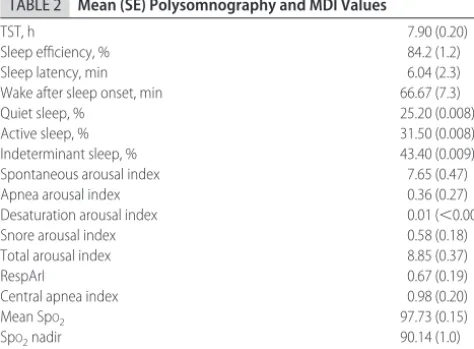
Infants spent 5.8 to 10.7 hours asleep with an average of 1.1 hour awake after initial sleep onset. The average total arousal index was 8.9 per hour of TST, and respi-ratory arousal index (RespArI) was 0.67 per hour of TST. No infant had any obstructive apneas or hypopneas; all but 9 infants had central apneas, with indices ranging from 0.12 to 4.02. Central apneas were not associated with significant desaturations (Table 2).
There was a significant, negative correlation between MDI and RespArI (r⫽ ⫺.43; F⫽7.3;P⫽.011; Fig 1). Because there were no obstructive apneas or hypopneas, RespArI was made up of arousals that resulted from central apneas, oxyhemoglobin desaturation (SpO2
ⱖ4%) episodes, and snoring. Among these, snoring-related arousals accounted exclusively for the correla-tion between MDI and RespArI (r⫽ ⫺.43; F⫽7.3;P⫽
.011). Spontaneous arousals and those that were asso-ciated with central apneas and desaturations were not significantly correlated with MDI. Variance among ma-ternal education years was low; MDI and mama-ternal ed-ucation were not significantly correlated. Motor Scale scores on the BSID were not significantly associated with polysomnography measures.
Fifty-nine percent of infants had at least 1 parent who reported snoring. 2 values were nonsignificant for a relationship between parental snoring and the presence of either infant snoring or respiratory-related arousals on polysomnography.
Thirty-three percent of infants were from a cigarette-smoking household (in which at least 1 parent smoked: both parents smoked in 17% of homes, only the father smoked in 9%, and only the mother smoked in 6%).2 for parental smoking and presence of infant snoring on polysomnography approached significance; snoring was observed in 41% of infants from a nonsmoking house-hold and in 73% of those from a smoking househouse-hold (2 ⫽3.0;P⫽.08).
Infants from a smoking household were significantly more likely to have respiratory-related arousals during polysomnography recordings. RespArI ⬎0 was present among 50% of infants from nonsmoking households and among 100% of infants from smoking households (Fisher’s P ⫽ .005). Maternal-only and paternal-only smoking were also both significantly related to RespArI ⬎0 (Fisher’sP ⫽.03, each). MDI did not differ signifi-cantly between infants from smoking and nonsmoking households (F⫽2.0;P⫽.16). There were no significant correlations or differences as a function of TST or sleep efficiency on RespArI or MDI.
DISCUSSION
The data presented herein indicate that even among infants and toddlers, the concept of habitual snoring’s being an innocent phenomenon without adverse conse-quences probably needs to be viewed as obsolete. In-deed, snoring may present a developmental hazard in young children, particularly when snore-associated arousals are present. Furthermore, we show that expo-sure to environmental smoke increases the risk for snor-ing-related sleep fragmentation.
In the present study, we did not find conclusive evi-dence suggesting that living in a cigarette-smoking household increased the risk for snoring per se. How-ever, Mitchell and Thompson31found that among nearly
2000 infants from 1 to 8 months of age, parental report of snoring was increased with concurrent reporting of maternal cigarette smoking, along with the presence of male gender, prone or supine sleeping, respiratory
in-TABLE 2 Mean (SE) Polysomnography and MDI Values
TST, h 7.90 (0.20)
Sleep efficiency, % 84.2 (1.2)
Sleep latency, min 6.04 (2.3)
Wake after sleep onset, min 66.67 (7.3)
Quiet sleep, % 25.20 (0.008)
Active sleep, % 31.50 (0.008)
Indeterminant sleep, % 43.40 (0.009)
Spontaneous arousal index 7.65 (0.47)
Apnea arousal index 0.36 (0.27)
Desaturation arousal index 0.01 (⬍0.00)
Snore arousal index 0.58 (0.18)
Total arousal index 8.85 (0.37)
RespArI 0.67 (0.19)
Central apnea index 0.98 (0.20)
Mean SpO2 97.73 (0.15)
SpO2nadir 90.14 (1.0)
MDI 98.03 (1.2)
FIGURE 1
fections, and the presence of snoring during the first month after birth. These findings suggest that multiple modifiers may contribute to the occurrence of snoring in the first year of life.
More important, we still do not know much about the natural history of snoring and snore-induced arousals in infancy. Zucconi et al46 found that among 18- to
24-month-olds who were evaluated for nightly snoring and referred for surgical treatment, the parents of ⬎50% reported that the habitual snoring had developed during the child’s first year of life, and 16% reported an onset in the first month of life. Furthermore, habitual snoring may persist over a 1-year period in 49% of primary school children. It is interesting that household cigarette smoking was identified as a risk factor for both initial onset of snoring and its continued presence over time.35
Thus, we speculate that exposure to secondhand ciga-rette smoke not only may account for more snore-re-lated arousals but may also contribute to the develop-ment of SDB among very young snorers.
Some of the study limitations merit discussion. First, the survey response rate is unknown because of the implementation of a prohibition on tracking the number of nonparticipants subsequent to Health Insurance Port-ability and AccountPort-ability Act legislation. Response cards were distributed to postpartum patients through local hospitals at the discretion of the nursing and clerical staff, so a response percentage cannot be calculated; among those who returned the response card and were sent a survey, the response rate was 57.1%. Thus, a self-selection bias clearly is possible, and our ability to generalize the results is limited. Second, the survey was not designed to gather extensive and comprehensive information about exposure to secondhand cigarette smoke. However, the previous studies reported above and current findings emphasize the need and the impor-tance of future research into the mechanisms that influ-ence snore-related arousals in infants and whether this effect is exposure dependent. Finally, 1 of the original goals of the study was to screen infants at the age of 8 months for objective evidence of SDB while minimizing intrusion into the natural sleep pattern and mother-infant interactions during the recording period. At the same time, home-based studies using currently available instrumentation for sleep recordings in infants are vul-nerable to data losses, and preliminary trials using this approach confirmed such concerns. Thus, we used a sleep laboratory– based approach that enabled a high rate of data integrity with minimal intrusion to the in-fant and the parent. Although the percentage of wake time subsequent to sleep onset was higher than would be expected in a naturalistic setting, it should be empha-sized that no relationships were found between RespArI or MDI and TST or sleep efficiency. Thus, we do not expect that administration of the BSID after
polysom-nography had on influence on MDI scores as a function of sleep loss.
This study and others clearly support the need for identification and evaluation of the youngest children with recognizable risk factors for SDB. This may pose a formidable challenge when we consider that the symp-toms of SDB, such as snoring, are less frequently the presenting complaint in such children when compared with associated comorbidities, such as recurrent upper respiratory tract infections and delays in growth and development.47 In addition, the recently published
American Academy of Pediatrics 2003 guidelines for di-agnosis and management of SDB in childhood specifi-cally exclude children who are younger than 1 year because these cases are considered too complex for the scope of the recommendations and require specialist consultation.48Finally, awareness of SDB symptoms on
the part of parents and physicians is very low.49,50Indeed,
using an exit-interview strategy after pediatrician con-sultation, Blunden and colleagues50reported that among
children with a significant history of snoring, only 8% of parents mentioned this symptom during the concurrent clinical evaluation, and only 15% had done so previ-ously. The robustness of our findings on the relationship between sleep fragmentation (as evidenced by snore-associated arousals) and the variance in mental devel-opment among healthy infants highlights the need to overcome these diagnostic screening challenges. Fur-thermore, we are unaware of any study that has exam-ined potential mechanisms underlying this correlation, and, as such, we do not know whether such decrements in developmental achievement will persist or completely reverse on implementation of measures that aim to treat snoring in these infants. The possibility exists that if such infants are left untreated, then they may go on subse-quently to develop SDB and its associated morbidities.
CONCLUSIONS
Snoring without evidence of apnea and/or hypopnea in 8-month-old infants is associated with decreased scores on the MDI of the BSID-II when such snoring induces sleep fragmentation, the latter being apparently facili-tated by cigarette-smoke exposure. We postulate that substantial reductions or elimination of exposure to sec-ondhand cigarette smoke may ameliorate the develop-mental outcomes of snore-related arousals among some children.
ACKNOWLEDGMENTS
This study was supported by National Institutes of Health grants F32 HL-074591 (Dr Montgomery-Downs) and RO1 HL-65270 (Dr Gozal), the Children’s Foundation Endowment for Sleep Research, and the Common-wealth of Kentucky Challenge for Excellence Trust Fund.
participate in the study. Subject recruitment was con-ducted with the assistance of the postpartum nursing staff at Baptist Hospital East, Clark Memorial Hospital, Floyd Memorial Hospital, Norton Healthcare, Norton Suburban Hospital, and the University of Louisville Hos-pital. Jennifer Bruner, RPSGT, and Nigel Smith, PSGT, performed polysomnographic data collection and were assisted by Cheryl Holbrook, RPSGT, MAT.
REFERENCES
1. Reuveni H, Simon T, Tal A, Elhayany A, Tarasiuk A. Health care services utilization in children with obstructive sleep ap-nea syndrome.Pediatrics.2002;110:68 –72
2. Amin RS, Kimball TR, Bean JA, et al. Left ventricular hyper-trophy and abnormal ventricular geometry in children and adolescents with obstructive sleep apnea.Am J Respir Crit Care Med.2002;165:1395–1399
3. Amin RS, Kimball TR, Kalra M, et al. Left ventricular function in children with sleep-disordered breathing.Am J Cardiol.2005; 95:801– 804
4. Archbold KH, Pituch KJ, Panahi P, Chervin RD. Symptoms of sleep disturbances among children at two general pediatrics clinics.J Pediatr.2002;140:97–102
5. Rona RJ, Li L, Gulliford MC, Chinn S. Disturbed sleep: effects of sociocultural factors and illness. Arch Dis Child. 1998;78: 20 –25
6. O’Brien LM, Holbrook CR, Mervis CB, et al. Sleep and neu-robehavioral characteristics of 5–7 year-old children with pa-rentally reported symptoms of ADHD. Pediatrics. 2003;111: 554 –563
7. Chervin RD, Dillon JE, Bassetti C, Ganoczy DA, Pituch KJ. Symptoms of sleep disorders, inattention, and hyperactivity in children.Sleep.1997;20:1187–1192
8. Aronen ET, Paavonen EJ, Fja¨llberg M, Soininen M, To¨rro¨nen J. Sleep and psychiatric symptoms in school-age children.J Am Acad Child Adolesc Psychiatry.2000;39:502–508
9. Lewin DS, Rosen RC, England SJ, Dahl RE. Preliminary evi-dence of behavioral and cognitive sequelae of obstructive sleep apnea in children.Sleep Med.2002;3:5–13
10. Gottlieb DJ, Vezina RM, Chase C, et al. Symptoms of sleep-disordered breathing in 5-year-old children are associated with sleepiness and problem behaviors. Pediatrics. 2003;112: 870 – 877
11. Stradling JR, Thomas G, Warley AR, Williams P, Freeland A. Effect of adenotonsillectomy on nocturnal hypoxaemia, sleep disturbance, and symptoms in snoring children.Lancet.1990; 335:249 –253
12. Gozal D. Sleep-disordered breathing and school performance in children.Pediatrics.1998;102:616 – 620
13. Gozal D, Pope DW. Snoring during early childhood and aca-demic performance at ages 13–14 years.Pediatrics.2001;107: 1394 –1399
14. Blunden S, Lushington K, Kennedy D. Cognitive and behav-ioural performance in children with sleep-related obstructive breathing disorders.Sleep Med Rev.2001;5:447– 461
15. Montgomery-Downs HE, Jones VF, Molfese VJ, Gozal D. Snor-ing in preschoolers: associations with sleepiness, ethnicity, and learning.Clin Pediatr (Phila).2003;42:719 –726
16. O’Brien LM, Mervis CB, Holbrook CR, et. al. Neurobehavioral correlates of sleep-disordered breathing in children.J Sleep Res.
2004;13:165–172
17. Goldstein NA, Post C, Rosenfeld RM, Campbell TF. Impact of tonsillectomy and adenoidectomy on child behavior.Arch Oto-laryngol Head Neck Surg.1998;124:494 – 498
18. Friedman BC, Hendeles-Amitai A, Kozminsky E, et al.
Adeno-tonsillectomy improves neurocognitive function in children with obstructive sleep apnea syndrome. Sleep. 2003;26: 999 –1005
19. Tarasiuk A, Simon T, Tal A, Reuveni H. Adenotonsillectomy in children with obstructive sleep apnea syndrome reduces health care utilization.Pediatrics.2004;113:351–356
20. Montgomery-Downs HE, Crabtree VM, Gozal D. Cognition, sleep and respiration in at-risk children treated for obstructive sleep apnoea.Eur Respir J.2005;25:336 –342
21. Row BW, Kheirandish L, Neville JJ, Gozal D. Impaired spatial learning and hyperactivity in developing rats exposed to inter-mittent hypoxia.Pediatr Res.2002;52:449 – 453
22. Kheirandish L, Gozal D, Pequignot JM, Pequignot J, Row BW. Intermittent hypoxia during development induces long-term alterations in working spatial memory, monoamines, and den-dritic branching in rat frontal cortex. Pediatr Res. 2005;58: 594 –599
23. Freezer NJ, Bucens IK, Robertson CF. Obstructive sleep apnoea presenting as failure to thrive in infancy.J Paediatr Child Health.
1995;31:172–175
24. Carroll JL, McColley SA, Marcus CL, Curtis S, Loughlin GM. Inability of clinical history to distinguish primary snoring from obstructive sleep apnea syndrome in children.Chest.1995;108: 610 – 618
25. Brouillette RT, Hanson D, David R, et al. Diagnostic approach to suspected obstructive sleep apnea in children. J Pediatr.
1984;105:10 –14
26. Gislason T, Benediktsdottir B. Snoring, apneic episodes, and nocturnal hypoxemia among children 6 months to 6 years old. An epidemiologic study of lower limit of prevalence. Chest.
1995;107:963–966
27. Guilleminault C, Winkle R, Korobkin R, Simmons B. Children and nocturnal snoring: evaluation of the effects of sleep related respiratory resistive load and daytime functioning.Eur J Pedi-atr.1982;139:165–171
28. Archbold KH, Giordani B, Ruzicka DL, Chervin RD. Cognitive executive dysfunction in children with mild sleep-disordered breathing.Biol Res Nurs.2004;5:168 –176
29. Kennedy JD, Blunden S, Hirte C, et al. Reduced neurocogni-tion in children who snore.Pediatr Pulmonol.2004;37:330 –337 30. Kelmanson IA. Snoring, noisy breathing in sleep and daytime behaviour in 2– 4-month-old infants.Eur J Pediatr.2000;159: 734 –739
31. Mitchell EA, Thompson JMD. Snoring in the first year of life.
Acta Paediatr.2003;92:425– 429
32. Montgomery-Downs HE, Gozal D. Prevalence of risk for sleep-disordered breathing (SDB) among infants and toddlers [ab-stract].Sleep.2003;0305G
33. Kaditis AG, Finder J, Alexopoulos EI, et al. Sleep-disordered breathing in 3,680 Greek children.Pediatr Pulmonol.2004;37: 499 –509
34. Gryczynska D, Kobos J, Zakrzewska A. Relationship between passive smoking, recurrent respiratory tract infections and oti-tis media in children. Int J Pediatr Otorhinolaryngol. 1999; 5(suppl 1):S275–S278
35. Urschitz MS, Guenther A, Eitner S, et al. Risk factors and natural history of habitual snoring.Chest.2004;126:790 – 800 36. Montgomery-Downs HE, O’Brien LM, Holbrook R, Gozal D.
Snoring and sleep-disordered breathing in young children: subjective and objective correlates.Sleep.2004;27:87–94 37. Anders T, Emde R, Parmelee A, eds.A Manual of Standardized
Terminology, Techniques and Criteria for the Scoring of States of Sleep
and Wakefulness in Newborn Infants. Los Angeles, CA: UCLA
38. Marcus CL, Omlin KJ, Basinski DJ, et al. Normal polysomno-graphic values for children and adolescents.Am Rev Respir Dis.
1992;156:1235–1239
39. American Thoracic Society. Standards and indications for car-diopulmonary sleep studies in children.Am J Respir Crit Care Med.1996;153:866 – 878
40. EEG arousals: scoring and rules and examples: a prelimi-nary report from the Sleep Disorders Atlas Task Force of the American Sleep Disorders Association. Sleep.1992;15: 173–184
41. Montgomery-Downs HE, O’Brien LM, Gulliver TE, Gozal D. Polysomnographic characteristics in normal preschool and early school-age children.Pediatrics.2006, in press
42. Bayley N.Bayley Scales of Infant Development.San Antonio, TX: Psychological Corporation; 1969
43. Bayley N.Bayley Scales of Infant Development. San Antonio, TX: Psychological Corporation; 1993
44. Siegel LS. Infant perceptual, cognitive, and motor behaviors as predictors of subsequent cognitive and language development.
Can J Psychol.1979;33:382–395
45. Ulvund SE, Smith L. The predictive validity of nonverbal com-munication skills in infants with perinatal hazards.Infant Behav Dev.1996;19:441– 449
46. Zucconi M, Ferini Strambi L, Pestalozza G, Tessitore E, Smirne S. Habitual snoring and obstructive sleep apnea syndrome in children: effects of early tonsil surgery.Int J Pediatr Otorhino-laryngol.1993;26:235–243
47. Leiberman A, Tal A, Brama I, Sofer S. Obstructive sleep apnea in young infants.Int J Pediatr Otorhinolaryngol.1988;16:39 – 44 48. Clinical practice guideline for diagnosis and management of childhood obstructive sleep apnea syndrome.Pediatrics.2002; 109:704 –712
49. Blunden S, Lushington K, Lorenzen B, Wong J, Balendran R, Kennedy D. Symptoms of sleep breathing disorders in children are underreported by parents at general practice visits.Sleep
Breath.2003;7:167–176
DOI: 10.1542/peds.2005-1785
2006;117;e496
Pediatrics
Hawley E. Montgomery-Downs and David Gozal
and Contribution of Secondhand Cigarette Smoke Exposure
Snore-Associated Sleep Fragmentation in Infancy: Mental Development Effects
Services
Updated Information &
http://pediatrics.aappublications.org/content/117/3/e496
including high resolution figures, can be found at:
References
http://pediatrics.aappublications.org/content/117/3/e496#BIBL
This article cites 44 articles, 9 of which you can access for free at:
Subspecialty Collections
http://www.aappublications.org/cgi/collection/smoking_sub
Smoking
http://www.aappublications.org/cgi/collection/pulmonology_sub
Pulmonology
sub
http://www.aappublications.org/cgi/collection/fetus:newborn_infant_
Fetus/Newborn Infant following collection(s):
This article, along with others on similar topics, appears in the
Permissions & Licensing
http://www.aappublications.org/site/misc/Permissions.xhtml
in its entirety can be found online at:
Information about reproducing this article in parts (figures, tables) or
Reprints
http://www.aappublications.org/site/misc/reprints.xhtml
DOI: 10.1542/peds.2005-1785
2006;117;e496
Pediatrics
Hawley E. Montgomery-Downs and David Gozal
and Contribution of Secondhand Cigarette Smoke Exposure
Snore-Associated Sleep Fragmentation in Infancy: Mental Development Effects
http://pediatrics.aappublications.org/content/117/3/e496
located on the World Wide Web at:
The online version of this article, along with updated information and services, is
by the American Academy of Pediatrics. All rights reserved. Print ISSN: 1073-0397.