ARTICLE
Attitudes of Neonatologists Toward Delivery Room
Management of Confirmed Trisomy 18: Potential
Factors Influencing a Changing Dynamic
Melanie P. McGraw, MD, Jeffrey M. Perlman, MB
Division of Newborn Medicine, Weill-Cornell School of Medicine, New York Presbyterian Hospital, New York, New York
The authors have indicated they have no financial relationships relevant to this article to disclose.
What’s Known on This Subject
Trisomy 18 is a common genetic disease with a very poor prognosis that traditionally has been classified as a futile condition, for which resuscitation is not indicated.
What This Study Adds
This study contributes the current responses of neonatologists to the ethical question of resuscitation and intensive care for an infant with confirmed trisomy 18. This article also addresses the change in providers’ ethical reasoning away from a best-interest standard.
ABSTRACT
OBJECTIVE.The objective of this study was to determine the attitude of neonatal pro-viders toward delivery room resuscitation of an infant with confirmed trisomy 18 with known congenital heart disease atⱖ36 weeks of gestation.
METHODS.A multiple-choice questionnaire listing this clinical scenario was completed by neonatologists and fellows staffing level III NICUs. Potential factors influencing the decision to initiate resuscitation included maternal preference, neonatal condi-tion at birth, obstetric care, and legal concerns.
RESULTS.Fifty-four (76%) of 71 surveys were completed. Of respondents, 44% indi-cated that they would be willing to initiate resuscitation. Maternal preference (70%) was the primary reason to initiate resuscitation, with the appearance of the neonate in the delivery room (46%) and legal concerns (25%) as additional factors.
CONCLUSIONS.Until recently, there was universal consensus that trisomy 18 was a lethal anomaly for which resuscitation in the delivery room was not indicated. These data indicate that more providers (44%) than anticipated would consider initiation of resuscitation for an infant with trisomy 18 even with congenital heart disease. We
speculate that support for the best-interest standard for neonates is diminishing in favor of ceding without question to parental autonomy. This shift may have profound implications for ethical decisions in the NICU.Pediatrics2008; 121:1106–1110
A
MONG THE MANYethical dilemmas encountered in neonatal medicine, one of the most troubling and conten-tious relates to whether to offer aggressive resuscitative measures for infants diagnosed as having conditions that carry extremely poor prognoses. Although many articles have explored neonatologists’ attitudes toward resuscitation decisions at the gestational edge of viability,1–7where intact survival rates are low, few have focusedspecifically on the decision-making process for infants with confirmed genetic anomalies such as trisomies 13 and 18. Historically, there was tacit consensus among those providing neonatal intensive care that these were lethal trisomies and therefore were classified as conditions for which resuscitation was not indicated.
It is appropriate and critically important that physicians strive to limit the futile use of neonatal intensive care, because by definition such care causes some degree of pain and suffering without offering any reasonable hope of benefit.8Concurrently, providers should strive to partner with parents in providing care and should try to accede to
parents’ wishes regarding their newborn as much as possible.9,10These 2 goals of avoiding futile care and honoring
parents’ wishes have the potential to come into direct conflict during the process of making difficult neonatal ethical decisions. This possible quagmire can be negotiated by appealing to the governing ethical standard for individuals who make decisions for neonates, that is, to act in the best interest of the infant.11 The best-interest standard
ultimately should supersede any ethical claim that parents might make under the heading of autonomy or that society might make under the heading of justice or a desire to reduce the burden to the community.9,10,12–18The
imperfections and difficulties in the application of this ethical standard have been well documented in the bioethics literature,16–19but this has remained the assumptive ethical stance of both parents and pediatricians caring for sick
infants, in large part because of its singularity in asking that both parties in this partnership adopt a strictly child-centered stance in all treatment decisions.
www.pediatrics.org/cgi/doi/10.1542/ peds.2007-1869
doi:10.1542/peds.2007-1869
Key Words
ethics, neonatal resuscitation, trisomy 18
Accepted for publication Oct 5, 2007 Address correspondence to Melanie P. McGraw, MD, Division of Newborn Medicine, Weill-Cornell School of Medicine, New York Presbyterian Hospital, 525 East 68th St, Suite N-506, New York, NY 10021. E-mail: jmp2007@ med.cornell.edu
Neonatal intensive care should be viewed as a trial of clinical therapy, with a short-term goal of avoiding mor-bidity and death and a long-term goal of attaining or preserving a functional state.20,21In each case in which it
is considered, the potential benefit (survival or attain-ment of a functional state) versus the cost of suffering should be evaluated.
For most neonatal patients, there is clear net benefit to intensive care therapy, and physicians are obligated to advocate for treatment even if it is against the wishes of the family.22 For infants with no reasonable hope of
benefit, physicians have the same obligation not to offer therapy, regardless of the wishes of the family, because the intervention would be futile.8,23,24In the latter
cir-cumstances, offering therapy despite the knowledge of futility would a violation of the ethical principle of non-maleficence (do no harm). Admittedly, futility is an ethical concept fraught with the potential for abuse as a self-fulfilling prophecy; therefore, its injunction must be used carefully. Therapies that offer no reasonable chance of bringing about the desired short- and long-term goals of care are correctly classified as futile. Under circum-stances in which there is physician-parent conflict re-garding the patient’s best interest in the aforementioned situations, a third party, such as an ethics committee, may be needed to help find a resolution.
There is a third category in the decision-making ma-trix regarding whether to treat, which is often referred to as the “gray zone” and is characterized by uncertainty regarding what is in the infant’s best interest. Parental wishes should be the deciding factor under such circum-stances, if the weight of medical thought cannot firmly establish a consensus regarding the patient’s best inter-est.14,25 The new international neonatal resuscitation
guidelines highlight the importance of incorporation of parental wishes by stating that parents would like to be given a greater voice in decision-making.26However, it is
also stated in those guidelines that this must be coun-terbalanced against futile conditions associated with al-most-certain death or an unacceptably high morbidity rate among rare survivors, such as cases of confirmed trisomy 13 or 18, for which resuscitation is not indicat-ed.26 Interestingly, the most-recent American Academy
of Pediatrics neonatal resuscitation guidelines omit tri-somy 18 from the list of examples of conditions for which resuscitation is not indicated.27The reasoning
be-hind this change from previous guidelines is not entirely
clear. To investigate whether there was indeed a subtle shift in attitude on this topic, we were interested in determining the current approach of delivery room pro-viders regarding resuscitation decisions for infants with confirmed trisomy 18. The objective of this study was to determine whether providers would be willing to con-sider resuscitation of an infant with confirmed trisomy 18 and congenital heart disease and, if so, to determine which factors were most likely to influence them toward a decision to resuscitate.
METHODS
A multiple-choice questionnaire was mailed to neonatal fellows and attending neonatologists in level III NICUs in the greater metropolitan area of New York City. The units12were chosen largely from the referral network of
the authors’ institution and did not represent an exhaus-tive list of units in the New York City area. Question-naires were mailed directly to the providers at their place of work. A self-addressed, stamped envelope to return the survey was included. There were 2 mailings, with identical recipient lists, separated by⬃1 month.
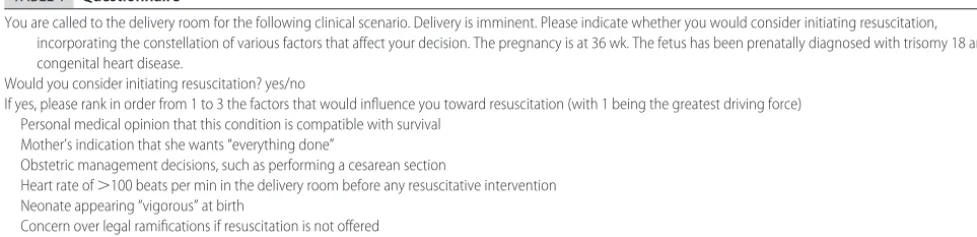
In the questionnaire, providers were presented with the scenario of being called to the delivery room for the deliv-ery of a 36-week fetus with confirmed trisomy 18 and congenital heart disease (Table 1). The first question re-garded whether the provider would consider resuscitation (yes or no). If the provider indicated that he or she would consider resuscitation, then the respondent was then asked to identify which factors would most influence his or her intervention toward initiation of resuscitation. Respon-dents could choose up to 3 reasons, ranked 1 (most signif-icant) to 3. Each reason to initiate resuscitation was counted as a positive response if the respondent scored it 1 or 2. The only identifying information in the survey was the gender of the provider and the number of years he or she had been practicing neonatal medicine (presented as a multiple-choice range of years).
The data were analyzed by using 2 or t tests where appropriate. The questionnaire was approved by the insti-tutional review board of Weill Cornell Medical College.
RESULTS
Seventy-one surveys were mailed, and 54 surveys (76%) were returned completed after 2 mailings. There were 29 male respondents and 25 female respondents. Twenty-four
TABLE 1 Questionnaire
You are called to the delivery room for the following clinical scenario. Delivery is imminent. Please indicate whether you would consider initiating resuscitation, incorporating the constellation of various factors that affect your decision. The pregnancy is at 36 wk. The fetus has been prenatally diagnosed with trisomy 18 and congenital heart disease.
Would you consider initiating resuscitation? yes/no
If yes, please rank in order from 1 to 3 the factors that would influence you toward resuscitation (with 1 being the greatest driving force) Personal medical opinion that this condition is compatible with survival
Mother’s indication that she wants “everything done”
Obstetric management decisions, such as performing a cesarean section
Heart rate of⬎100 beats per min in the delivery room before any resuscitative intervention Neonate appearing “vigorous” at birth
(44%) of 54 respondents indicated that they would con-sider initiation of resuscitation of an infant with trisomy 18 and known congenital heart disease.
There was no difference between male and female re-spondents and no influence in terms of years in practice. Maternal preference was the primary reason to consider initiation of resuscitation, noted by 22 (92%) of 24 of respondents. The condition of the neonate in the delivery room (appearing vigorous or having a heart rate ofⱖ100 beats per minute) was the second most cited reason (11 of 24 respondents; 46%), with legal concerns as the third factor (6 of 24 respondents; 25%). A small minority of respondents (3 of 24 respondents; 11%) chose previous obstetric management decisions or personal medical belief that this was a condition compatible with survival.
DISCUSSION
Trisomy 18 is the second most common triploidy after trisomy 21, affecting ⬃1 infant per 8000 live-born in-fants.28,29The median life expectancy for an infant with
nonmosaic trisomy 18 who is not treated with intensive care is quoted as 2 to 10 days.28,30–33 Survival statistics
indicate that first-year mortality rates are between 90% and 100%,28,32,33 and the vast majority of these infants
die in the first month. Those who do live beyond the first year experience shortened lives marked by severe neu-rologic and physical impairment.34,35
Even with the support of full intensive care, the data indicate that infants with trisomy 18 do not flourish. Two recent international publications detailed the “nat-ural history” of infants with trisomy 18 who receive intensive care, including intubation and surgery. A Jap-anese study (n⫽24) reported a 1-year survival rate of 25% and a median survival time of 152 days.36A Polish
study (n⫽20) found that, with full intensive care sup-port, 30% of the infants survived to discharge from the NICU. Although the authors acknowledged that the im-pact of widespread aggressive treatment on mortality rates is unclear, they raised the concern that, even with the most aggressive care, most infants in their study died before discharge from intensive care; the authors urged the avoidance of invasive procedures in light of the poor prognosis.37
The hypothetical case in this questionnaire was com-plicated by congenital heart disease, with a likely need for corrective heart surgery. In one of the few review articles on the subject, Paris et al8clearly presented an
ethical argument that surgery is not in the best interest of these infants. This position of nonintervention was reaffirmed in the most-recent recommendations from the Neonatal International Liaison Cardiopulmonary Committee on Resuscitation, in terms of delivery room resuscitation.26,27 The conclusion that intensive care is
inappropriate for these infants was also supported in the ruling in a British court case.38 In that case, a family
court judge ruled in favor of physicians who had been sued by a mother for their refusal to initiate mechanical ventilation for her newly born son with trisomy 18. The judge explained her ruling in terms that reflected the best-interest standard. She reasoned that, if the infant was placed on a ventilator, then he would necessarily be
deprived of activities that certainly were in his best in-terest, such as being able to be in his mother’s arms, and the judge decided that such deprivation would be ethi-cally and legally unacceptable. This case is particularly interesting because the judge was clearly motivated to determine which specific features of life were beneficial to the infant and to preserve those elements.
Until recently, the medical community that cared for infants with trisomy 18 seemed to agree that it did not serve these infants’ best interests to undergo invasive pro-cedures, such as heart surgery. A commentary on the issue has challenged this premise,39and the findings in this
re-port suggest that there is a changing approach, largely driven by physicians’ desires to honor parents’ preferences. The vast majority of respondents (⬃90%) who would con-sider resuscitation indicated that they would do so despite knowing that the life span of infants with trisomy 18 is invariably short. These observations raise the concern that some neonatologists are abandoning the best-interest stan-dard, which would require that providers agree only to treatment strategies that are consistent with furthering the good of the infant, and instead are adopting an “ethic of abdication” in their approach to difficult treatment/non-treatment decisions.40A significant proportion of providers
seem to be willing to put aside professional responsibility to direct the treatment decision and instead concede to any decision that parents may make. This may be a byproduct of the strong emphasis bioethics has placed on patient autonomy and the extension of this concept to “parental autonomy” in decision-making for children.39
In contrast to the relative silence on this topic in the medical literature, in recent years there has been an increase in Internet sites devoted to the most common fatal trisomies (trisomies 13 and 18) and aimed at par-ents who have received these devastating diagnoses. These sites offer both a wealth of helpful information and a ready-made support community in a time of true crisis and, in that regard, they provide an invaluable service. However, the authors of those sites are assump-tive in their opinion that all medical options should be offered to parents, from the moment of prenatal diag-nosis to the delivery room and beyond. Resuscitation, intensive care, and surgical corrections are presented as equally valid alternatives to comfort care.41 For parents
who have been informed of this diagnosis prenatally and are searching for all information they can gather, expec-tations that full resuscitation is a reasonable approach are developed. These expectations are then transmitted to both the obstetrician and the neonatologist and may explain in part the willingness of such a large proportion of respondents in this study to consider resuscitation.
con-firmed lethal trisomy gives the impression to parents that these are reasonable interventions to consider and downplays the invasive painful nature of these thera-pies. By choosing this nonguiding approach, physicians may place undue guilt on parents who would choose comfort care only, because implicit in the latter decision is the understanding that the parents could have chosen to do more. If we as physicians could be clear that noninvasive support and comfort care are the appropri-ate therapies for some infants, then some of the gut-wrenching struggle that parents face under such extraor-dinarily difficult circumstances could be alleviated.8We
would also be preserving our fiduciary ethical responsi-bility to both the infant and the family.
CONCLUSIONS
In this era of rapid access to sometimes-incomplete medical information, communication between the physicians and the parents must occur early and often. In the context of the ethical dilemma discussed above, we suggest that the neonatologist, in conjunction with the obstetrician and a genetics counselor, meet with the parents soon after the prenatal diagnosis is made. The medical team should ex-plain compassionately the futility of any intensive inter-ventions in meeting long-term goals of care, and the plan for palliative care should be delineated clearly. The uncer-tainty in terms of expected length of survival should be explained; many infants die within the first few days of life, but some live for months and may be able to be discharged from the hospital with the family, with very limited neu-rologic status. It is critical that the emphasis should remain on fostering the best interest of the infant at every branch of the treatment decision tree. In this way, the family and the medical team can act in concert to reach the shared goals of avoiding hopeless suffering and maximizing all good that can be attained during the infant’s short but precious life.
REFERENCES
1. Sanders MR, Donohue PK, Oberdorf MA, Rosencrantz TS, Allen MC. Perceptions of the limit of viability: neonatologists’ attitudes toward extremely preterm infants.J Perinatol.1995; 15(6):494 –502
2. Peerzada JM, Richardson DK, Burns JP. Delivery room deci-sion-making at the threshold of viability. J Pediatr. 2004; 145(4):492– 498
3. Oei J, Askie LM, Tobiansky R, Lui K. Attitudes of neonatal clinicians towards resuscitation of the extremely premature infant: an exploratory survey. J Paediatr Child Health. 2000; 36(4):357–362
4. McElrath TF, Norwitz ER, Nour N, Robinson JN. Contemporary trends in management of delivery at 23 weeks’ gestation.Am J Perinatol.2002;19(1):9 –15
5. Doron MW, Veness-Meehan KA, Margolis LH, Holoman EM, Stiles AD. Delivery room resuscitation decisions for extremely premature infants.Pediatrics.1998;102(3):574 –582
6. de Leeuw R, Cuttini M, Nadai M, et al. Treatment choices for extremely preterm infants: an international perspective.J Pe-diatr.2000;137(5):608 – 615
7. Streiner DL, Saigal S, Burrows E, Stoskopf B, Rosenbaum P. Attitudes of parents and health care professionals toward active treatment of extremely preterm infants.Pediatrics.2001;108(1): 152–157
8. Paris JJ, Weiss AH, Soifer S. Ethical issues in the use of life-prolonging interventions for an infant with trisomy 18.J Peri-natol.1992;12(4):366 –368
9. Lantos JD, Tyson JE, Allen A, et al. Withholding and with-drawing life sustaining treatment in neonatal intensive care: issues for the 1990s. Arch Dis Child Fetal Neonatal Ed. 1994; 71(3):F218 –F223
10. Fleischman AR, Nolan K, Dubler NN, et al. Caring for gravely ill children.Pediatrics.1994;94(4):433– 439
11. Caplan A, Cohen CB, eds. Imperiled newborns.Hastings Cent Rep.1987;17(6):5–32
12. President’s Commission for the Study of Ethical Problems in Medicine and Biomedical and Behavioral Research.Deciding to Forego Life-Sustaining Treatment.Washington, DC: US Govern-ment Printing Office; 1983:197–229
13. Fost N. Counseling families who have a child with a severe congenital anomaly.Pediatrics.1981;67(3):321–324
14. Kraybill EN. Ethical issues in the care of extremely low birth weight infants.Semin Perinatol.1998;22(3):207–215
15. Paris JJ. What standards apply to resuscitation at the borderline of gestational age?J Perinatol.2005;25(11):683– 684
16. Mercurio MR. Parental authority, patient’s best interest and refusal of resuscitation at borderline gestational age.J Perinatol.
2006;26(8):452– 457
17. Leuthner SR. Decisions regarding resuscitation of the ex-tremely premature infant and models of best interest.J Peri-natol.2001;21(3):193–198
18. Doyal L, Larcher VR. Drafting guidelines for the withholding or withdrawing of life-sustaining treatment in critically ill chil-dren and neonates.Arch Dis Child Fetal Neonatal Ed.2000;83(1): F60 –F63
19. Ladd RE, Mercurio MR. Deciding for neonates: whose inter-ests?Semin Perinatol.2003;27(6):488 – 494
20. McGraw MP, Perlman J, Chervenak FA, McCullough LB. Clin-ical concepts of futility and ethClin-ically justified limits on neonatal care: a case presentation of an infant with Apgar scores of 0 at 1, 5, and 10 minutes.Am J Perinatol.2006;23(3):159 –162 21. Lo B. Improving care near the end of life: why is it so hard?
JAMA.1995;274(20):1634 –1636
22. Fleischman AR, Chervenak FA, McCullough LB. The physi-cian’s moral obligations to the pregnant woman, the fetus, and the child.Semin Perinatol.1998;22(3):184 –188
23. Gustaitis R. Right to refuse life-sustaining treatment.Pediatrics.
1988;81(2):317–321
24. Paris JJ, Schreiber MD. Physicians’ refusal to provide life-prolonging medical interventions.Clin Perinatol. 1996;23(3): 563–569
25. Mercurio MR. Physicians’ refusal to resuscitate at borderline gestational age.J Perinatol.2005;25(11):685– 689
26. American Heart Association, Emergency Cardiovascular Care Committee, Subcommittees, and Task Forces. 2005 American Heart Association guidelines for cardiopulmonary resuscitation and emergency cardiovascular care. Circulation. 2005;112(24 suppl):IV1–IV203
27. American Heart Association, American Academy of Pediatrics. 2005 American Heart Association guidelines for cardiopulmo-nary resuscitation and emergency cardiovascular care of pedi-atric and neonatal patients: neonatal resuscitation guidelines.
Pediatrics. 2006;117(5). Available at: www.pediatrics.org/cgi/ content/full/117/5/e1029
28. Embleton ND, Wyllie JP, Wright MJ, Burn J, Hunter S. Natural history of trisomy 18.Arch Dis Child Fetal Neonatal Ed.1996; 75(1):F38 –F41
30. Goldstein H, Neilsen KG. Rates of survival of individuals with trisomy 13 and 18: data from a 10 year period in Denmark.Clin Genet.1988;34(6):366 –372
31. Carter PE, Pearn JH, Bell J, Martin N, Anderson NG. Survival in trisomy 18: life tables for use in genetic counseling and clinical paediatrics.Clin Genet.1985;27(1):59 – 61
32. Root S, Carey JC. Survival in trisomy 18. Am J Med Genet.
1994;49(2):170 –174
33. Rasmussen SA, Wong LC, Yang Q, May KM, Friedman JM. Population-based analysis of mortality in trisomy 13 and tri-somy 18.Pediatrics.2003;111(4):777–784
34. Jones KL.Smith’s Recognizable Patterns of Human Malformations. 4th ed. Philadelphia, PA: Saunders; 1988:17
35. Baty BJ, Jorde LB, Blackburn BL, Carey JC. Natural history of trisomy 18 and trisomy 13, part II: psychomotor development.
Am J Med Genet.1994;49(2):189 –194
36. Kosho T, Nakamura T, Kawame H, Baba A, Tamura M, Fuku-shima Y. Neonatal management of trisomy 18: clinical details of 24 patients receiving intensive treatment.Am J Med Genet A.
2006;140(9):937–944
37. Goc B, Walencka A, Wloch A, et al. Trisomy 18 in neonates: prenatal diagnoses, clinical features, therapeutic dilemmas and outcome.J Appl Genet.2006;47(2):165–170
38. Dyer C. Doctors need not ventilate baby to prolong his life.
BMJ.2004;329(7473):995
39. Kooley TK, Wilfond BS, Ross LR. Lethal language, lethal deci-sions.Hastings Cent Rep.2003;33(2):37– 41
40. Orlowski JP, Hein S, Christensen JA, Meinke R, Sincich T. Why doctors use or do not use ethics consultation. J Med Ethics.
2006;32(9):499 –503
41. Trisomy 18 Foundation. Making decisions. Available at: www. trisomy18.org/site/PageServer?pagename⫽parents㛭decisions
STUDY FINDS MANY PATIENTS DISSATISFIED WITH HOSPITALS
“Washington—Many hospital patients are dissatisfied with some aspects of their care and might not recommend their hospitals to friends and relatives, the federal government said Friday as it issued ratings for most of the nation’s hospitals, based on the first uniform national survey of patients. The survey was meant to provide a constructive way for patients to complain about arrogant doctors, crabby nurses and dirty or noisy hospital rooms. Medical experts said that some of the complaints bore directly on the quality of care. Many patients reported that they had not been treated with courtesy and respect by doctors and nurses; that they had not received adequate pain medication after surgery; and that they did not understand the instructions they received when discharged from the hospital. Nationwide, in the average hospital, 67 percent of patients said they would definitely recommend the institution where they had been treated to friends and relatives. Sixty-three percent gave their hospitals a score of 9 or 10 on a scale of 0 to 10. At the average hospital, more than 25 percent of patients said nurses had not always communicated well with them. The new data, part of a survey of patient experiences and perceptions of hospital care, is posted at a government Web site: www.hospitalcompare.hhs.gov. The results provide cause for concern, said Dr Carolyn M. Clancy, director of the Agency for Healthcare Research and Quality, a unit of the Public Health Service. ‘Poor communication is a major source of medical errors,’ Dr Clancy said. ‘If doctors are not listening carefully, patients may not bring up important information. Patients who do not understand discharge instructions are more likely to be readmitted to the hospital or end up in the emergency room.’ Nancy E. Foster, a vice president of the American Hospital Association, agreed that many hospitals needed to do a better job of controlling pain and communicating with patients. Pain control keeps patients comfortable and can speed healing and reduce com-plications after surgery. Many large teaching hospitals scored below the national average on questions about the cleanliness and quietness of the hospital environment. The data came from questionnaires completed by a random sample of patients treated at more than 2,500 hospitals from October 2006 to June 2007. Some hospitals chose not to cooperate, but they will soon have a financial incentive to do so. Herb B. Kuhn, a Medicare official, said that if hospitals did not report the data, the Medicare payments could be reduced, by about $100 for a typical case.”
Pear R.New York Times. March 29, 2008
DOI: 10.1542/peds.2007-1869
2008;121;1106
Pediatrics
Melanie P. McGraw and Jeffrey M. Perlman
Trisomy 18: Potential Factors Influencing a Changing Dynamic
Attitudes of Neonatologists Toward Delivery Room Management of Confirmed
Services
Updated Information &
http://pediatrics.aappublications.org/content/121/6/1106
including high resolution figures, can be found at:
References
http://pediatrics.aappublications.org/content/121/6/1106#BIBL
This article cites 36 articles, 11 of which you can access for free at:
Subspecialty Collections
http://www.aappublications.org/cgi/collection/neonatology_sub Neonatology
sub
http://www.aappublications.org/cgi/collection/fetus:newborn_infant_ Fetus/Newborn Infant
following collection(s):
This article, along with others on similar topics, appears in the
Permissions & Licensing
http://www.aappublications.org/site/misc/Permissions.xhtml
in its entirety can be found online at:
Information about reproducing this article in parts (figures, tables) or
Reprints
http://www.aappublications.org/site/misc/reprints.xhtml
DOI: 10.1542/peds.2007-1869
2008;121;1106
Pediatrics
Melanie P. McGraw and Jeffrey M. Perlman
Trisomy 18: Potential Factors Influencing a Changing Dynamic
Attitudes of Neonatologists Toward Delivery Room Management of Confirmed
http://pediatrics.aappublications.org/content/121/6/1106
located on the World Wide Web at:
The online version of this article, along with updated information and services, is
by the American Academy of Pediatrics. All rights reserved. Print ISSN: 1073-0397.