University of Pennsylvania
ScholarlyCommons
Publicly Accessible Penn Dissertations
1-1-2015
Distributed Differential Privacy and Applications
Arjun Ravi Narayan
University of Pennsylvania, [email protected]
Follow this and additional works at:http://repository.upenn.edu/edissertations Part of theComputer Sciences Commons
This paper is posted at ScholarlyCommons.http://repository.upenn.edu/edissertations/1910 Recommended Citation
Distributed Differential Privacy and Applications
Abstract
Recent growth in the size and scope of databases has resulted in more
research into making productive use of this data. Unfortunately, a
significant stumbling block which remains is protecting the privacy of
the individuals that populate these datasets. As people spend more
time connected to the Internet, and conduct more of their daily lives
online, privacy becomes a more important consideration, just as the
data becomes more useful for researchers, companies, and
individuals. As a result, plenty of important information remains
locked down and unavailable to honest researchers today, due to fears
that data leakages will harm individuals.
Recent research in differential privacy opens a promising pathway to
guarantee individual privacy while simultaneously making use of the
data to answer useful queries. Differential privacy is a theory that
provides provable information theoretic guarantees on what any answer
may reveal about any single individual in the database. This approach
has resulted in a flurry of recent research, presenting novel
algorithms that can compute a rich class of computations in this
setting.
In this dissertation, we focus on some real world challenges that
arise when trying to provide differential privacy guarantees in the
real world. We design and build runtimes that achieve the mathematical
differential privacy guarantee in the face of three real world
challenges: securing the runtimes against adversaries, enabling
readers to verify that the answers are accurate, and dealing with data
Degree Type Dissertation
Degree Name
Doctor of Philosophy (PhD)
Graduate Group
Computer and Information Science
First Advisor Andreas Haeberlen
Keywords
Differential Privacy, Distributed Systems, Security
DISTRIBUTED DIFFERENTIAL PRIVACY
AND APPLICATIONS
Arjun Narayan
A DISSERTATION in
Computer and Information Science
Presented to the Faculties of the University of Pennsylvania in Partial Fulfillment of the Requirements for the
Degree of Doctor of Philosophy
2015
Andreas Haeberlen, Assistant Professor of Computer and Information Science Supervisor of Dissertation
Lyle Ungar, Professor of Computer and Information Science Graduate Group Chairperson
Dissertation Committee:
Boon Thau Loo, Associate Professor of Computer and Information Science Zachary G. Ives, Professor of Computer and Information Science
Aaron Roth, Assistant Professor of Computer and Information Science
DISTRIBUTED DIFFERENTIAL PRIVACY AND APPLICATIONS
COPYRIGHT
2015
Arjun Narayan
Licensed under a Creative Commons Attribution 4.0 License.
To view a copy of this license, visit:
Acknowledgments
First and foremost, I’d like to thank Andreas Haeberlen. I could not have had a
better advisor. I’d also like to thank my excellent dissertation committee for their suggestions and generosity with their time: Boon Thau Loo, whose course I took in
my first year and collaborated with, and who also gave me valuable career advice, Aaron Roth, who taught me a tremendous amount about differential privacy, Zack
Ives, who taught an excellent databases course and provided valuable feedback from a different perspective, and Micah Sherr, for his early collaboration that helped me get
my feet wet doing research, as well as his comments that improved this document. The technical material in this thesis has been previously published. Fuzz was
pub-lished in USENIX Security 2011 (Haeberlen, Pierce, and Narayan,2011), DJoin in OSDI 2012 (Narayan and Haeberlen,2012), and VerDP in Eurosys 2015 (Narayan,
Papadimitriou, and Haeberlen,2015). All that work was a group effort, and for that I thank my collaborators Jason Reed, Antonis Papadimitriou, Ariel Feldman, and
Benjamin Pierce for their valuable contributions. In addition to everything else, Andreas was of course also a large part of all of those efforts.
At Penn I benefited greatly from the advice and guidance of wizened elders: Ja-son Reed got me bootstrapped and running, Sudipto Guha provided much-needed
guidance, and Michael Greenberg—despite his best efforts not to—helped. My first year cohort was always there: Mukund Raghothaman, Abhishek Udupa, Mingchen
Zhao. I shared many late-night debugging adventures with them. I hope that I offered some advice of use in turn to Justin Hsu, Ang Chen, and Antonis
Papadim-itriou. Even if I didn’t, they very graciously pretended otherwise. The conference circuit was always there too: Mike Chow, Michael Z. Lee, Bill Jannen, and
recur-ring roommate Malte Schwarzkopf helped me survive the stressful rites of passage of giving talks and presenting posters. Finally, Mike Felker helped ensure that the
countless bureaucracies were handled behind the scenes.
were always there for me. I would not have started a PhD without my father’s
guid-ance. Finally, Jennifer made the entire process worthwhile. Ernest, the world’s best dog, ensured a healthy dissertation writing schedule, and that I didn’t write more
ABSTRACT
DISTRIBUTED DIFFERENTIAL PRIVACY AND APPLICATIONS
Arjun Narayan
Andreas Haeberlen
Recent growth in the size and scope of databases has resulted in more research
into making productive use of this data. Unfortunately, a significant stumbling block which remains is protecting the privacy of the individuals that populate these
datasets. As people spend more time connected to the Internet, and conduct more of their daily lives online, privacy becomes a more important consideration, just as the
data becomes more useful for researchers, companies, and individuals. As a result, plenty of important information remains locked down and unavailable to honest
researchers today, due to fears that data leakages will harm individuals.
Recent research in differential privacy opens a promising pathway to guarantee
individual privacy while simultaneously making use of the data to answer useful queries. Differential privacy is a theory that provides provable information
theo-retic guarantees on what any answer may reveal about any single individual in the database. This approach has resulted in a flurry of recent research, presenting novel
algorithms that can compute a rich class of computations in this setting.
In this dissertation, we focus on some real world challenges that arise when trying
to provide differential privacy guarantees in the real world. We design and build runtimes that achieve the mathematical differential privacy guarantee in the face
of three real world challenges: securing the runtimes against adversaries, enabling readers to verify that the answers are accurate, and dealing with data distributed
Contents
Acknowledgements iv
Abstract v
List of Tables x
List of Figures 1
1 Introduction 1
1.1 Thesis . . . 3 1.2 Contributions . . . 4 1.3 Outline . . . 5
2 Background and related work 6
2.1 Privacy . . . 6 2.2 Differential Privacy . . . 8 2.3 Related Work . . . 12
3.1 Introduction . . . 16
3.2 Background . . . 20
3.3 Attacks on differential privacy . . . 21
3.4 Defending against timing attacks . . . 28
3.5 The Fuzz system . . . 32
3.6 Implementation strategies. . . 35
3.7 Proof-of-concept implementation . . . 37
3.8 Evaluation . . . 41
3.9 Related work on side and covert channel attacks . . . 49
3.10 Conclusion . . . 52
4 Differentially Private Join Queries over Distributed Databases 53 4.1 Introduction . . . 53
4.2 Related work on distributed private operations . . . 56
4.3 Background and overview. . . 57
4.4 Building blocks: BN-PSI-CA and DCR . . . 60
4.5 Distributed query processing . . . 66
4.6 DJoin design . . . 70
4.7 Evaluation . . . 77
4.8 Conclusion . . . 84
5 Verifiable Differential Privacy 86 5.1 Introduction . . . 86
5.2 Overview . . . 89
5.3 Background . . . 94
5.4 The VFuzz language . . . 96
5.5 The VerDP system . . . 100
5.6 Implementation . . . 108
5.8 Related work on verifiable computing . . . 121 5.9 Conclusion and Future Work. . . 122
6 Conclusion 123
List of Tables
3.1 Four approaches to the timing-channel problem. . . 25 3.2 Critical primitives in the Fuzz language . . . 32 3.3 Examples of non-adversarial Fuzz queries. . . 42 3.4 Effect of various attacks without and with predictable transactions.
Each adversarial query tries to vary its completion time based on whether some specific individual is in the database. We show the total macroquery processing times when the individual is present
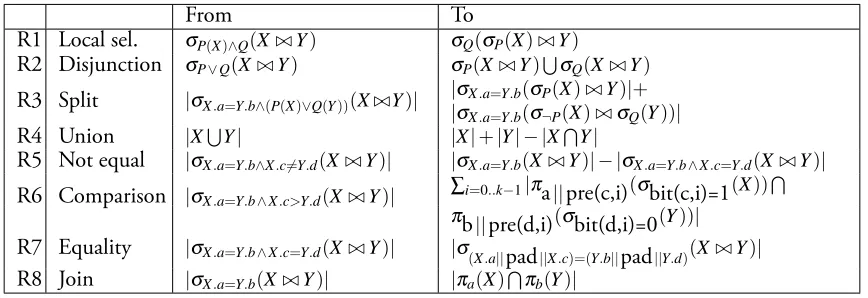
(hit) and absent (miss), as well as the differences. . . 47 4.1 DJoin’s rewrite rules. These rules are used to transform a query
(written in the language from Figure 4.2) into the intermediate
query language from Figure 4.4, which can be executed natively. . 65 4.2 Example queries and the corresponding query plans. The number
of BN-PSI-CA operations, which is a rough measure for the
com-plexity of the query, is shown on the right. . . 78 5.1 Queries we used for our experiments (based on Fuzz 3), lines of
List of Figures
3.1 Timing attack example . . . 24
3.2 State attack example . . . 24
3.3 Privacy budget attack example . . . 25
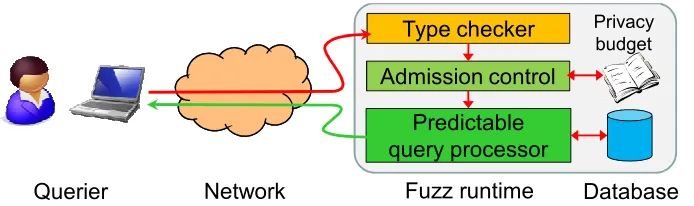
3.4 Scenario. Queries are first type-checked by Fuzz and then executed in predictable time. . . 33
3.5 Performance for non-adversarial queries.. . . 44
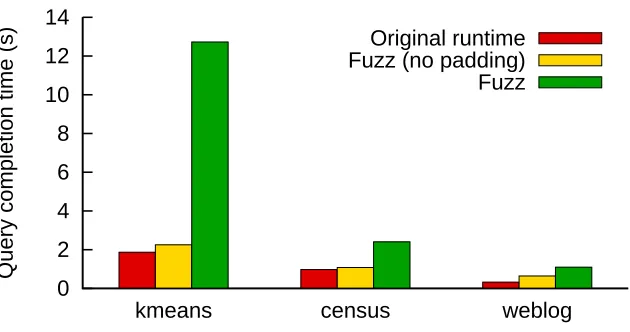
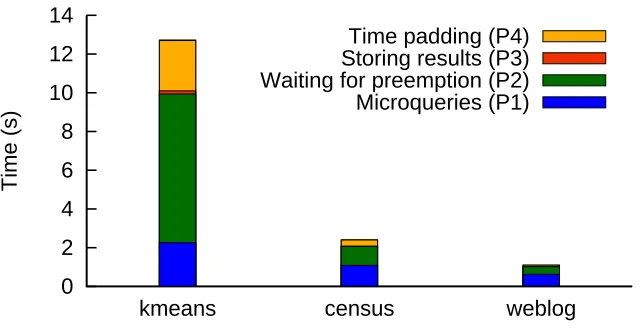
3.6 Time spent in different phases of query processing. . . 45
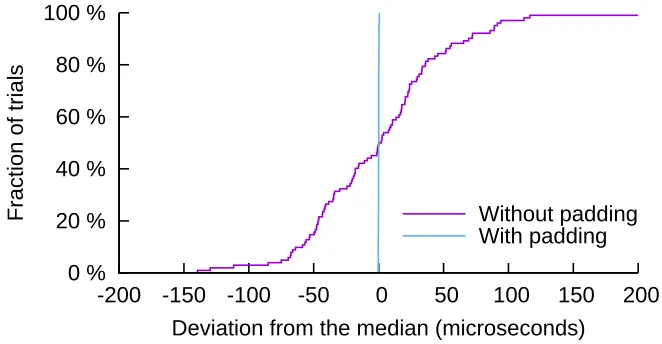
3.7 Variation of completion time for the weblog-delay query. . . 47
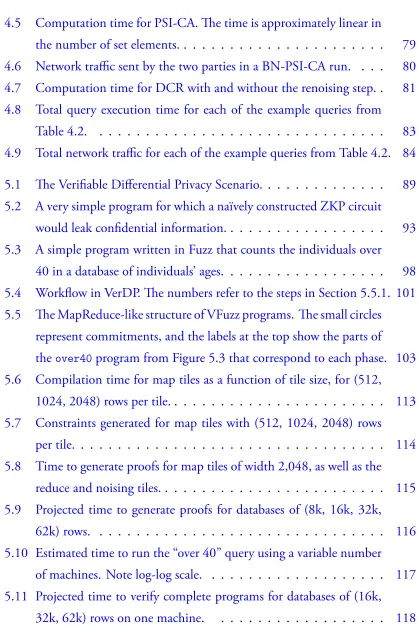
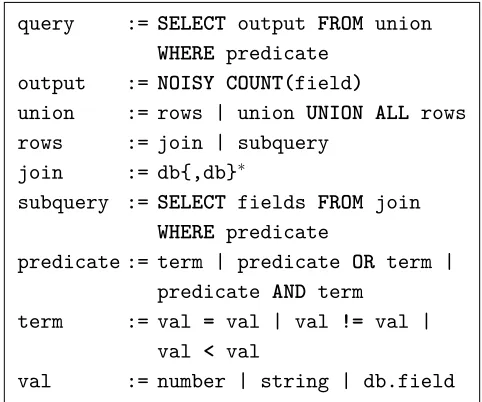
4.1 Motivating scenario. Charlie is a physician, and Carol and Chris are travel agents. Quentin would like to know the correlation between treatment for malaria and travel to high-risk areas. . . 57
4.2 DJoin’s query language. . . 66
4.3 Query example. The original plan (left) cannot be executed without compromising privacy. The rewritten plan (right) consists of three tiers: a local tier, a BN-PSI-CA tier, and a DCR tier. . . 67
4.5 Computation time for PSI-CA. The time is approximately linear in
the number of set elements.. . . 79 4.6 Network traffic sent by the two parties in a BN-PSI-CA run. . . . 80 4.7 Computation time for DCR with and without the renoising step.. 81 4.8 Total query execution time for each of the example queries from
Table 4.2. . . 83 4.9 Total network traffic for each of the example queries from Table 4.2. 84 5.1 The Verifiable Differential Privacy Scenario. . . 89 5.2 A very simple program for which a naïvely constructed ZKP circuit
would leak confidential information.. . . 93 5.3 A simple program written in Fuzz that counts the individuals over
40 in a database of individuals’ ages. . . 98 5.4 Workflow in VerDP. The numbers refer to the steps in Section 5.5.1. 101 5.5 The MapReduce-like structure of VFuzz programs. The small circles
represent commitments, and the labels at the top show the parts of
theover40program from Figure 5.3 that correspond to each phase. 103 5.6 Compilation time for map tiles as a function of tile size, for (512,
1024, 2048) rows per tile.. . . 113 5.7 Constraints generated for map tiles with (512, 1024, 2048) rows
per tile. . . 114 5.8 Time to generate proofs for map tiles of width 2,048, as well as the
reduce and noising tiles.. . . 115 5.9 Projected time to generate proofs for databases of (8k, 16k, 32k,
62k) rows. . . 116 5.10 Estimated time to run the “over 40” query using a variable number
of machines. Note log-log scale. . . 117 5.11 Projected time to verify complete programs for databases of (16k,
1
Introduction
Recent growth in the size and scope of databases has resulted in more research into
making productive use of this data. Unfortunately, a significant stumbling block which remains is protecting theprivacy of individuals that populate these datasets.
As people spend more time connected to the Internet, and conduct more of their daily lives online, privacy becomes a more important consideration, just as the very
same data becomes potentially more useful for researchers, companies, and individ-uals. Today, plenty of important information is locked down and unavailable to
honest researchers due to fears that data leakages will harm individuals. Despite the growth in useful datasets such as healthcare records and census records, these are
generally not available for academic or scientific use without great restrictions and access controls. In some cases, as with healthcare records (CDC and HHS, 2003)
or educational records (O’Donnell,2002), there are laws restricting how this infor-mation may be shared with any third party, regardless of their good intentions or
protections.
Increas-ingly, private companies are also stewards of large datasets. These companies wish to
use datasets such as Netflix’s movie ratings (Bell and Koren, 2007), Amazon’s retail purchase histories (Linden, Smith, and York,2003), and several companies that seek
to provide better targeted advertising (Mayer and Mitchell, 2012). Nevertheless, sharing this data with researchers or other companies is not easy: it is unclear what
private information may be inadvertently revealed by sharing a particular dataset. Even honest companies who spend lots of money and effort can get it wrong, by
making incorrect assumptions about the power of their adversaries (Narayanan and Shmatikov,2008). This uncertainty about the potential privacy losses creates an
en-vironment where data is seldom shared, even if there are large benefits from doing so.
Recent research in differential privacy (Dwork, McSherry, Nissim, and Smith, 2006b) gives us a promising way to quantify the privacy loss to individuals when
sharing private information. Differential privacy providesprovableinformation the-oretic guarantees on what any answer may reveal about any single individual in the
database. Unlike earlier work on data anonymization, which seeks to “scrub” a dataset clean of identifying information, differential privacy is a property ofqueries.
In this setting, the private dataset is not revealed to the third party. Instead, a third party can pose questions, incrementally consuming aprivacy budget. Once the
bud-get is depleted, no more questions are answered. This framework allows researchers to make a strong case when asking for individuals to allow their data to be shared:
they can precisely quantify what will be revealed about any individual, in the worst case situation. This powerful guarantee has resulted in a flurry of research (Dwork,
2008), presenting novel algorithms to compute a rich class of computations that provide differential privacy.
However, in practice, differential privacy is hard to guarantee. While the guar-antee can be achieved by several theoretical algorithms, executing those algorithms
se-cure execution. If arbitrary (and potentially adversarial) queriers supply programs, we
need to ensure that those queries are safe. Even if we can certify that their outputs are differentially private, the programs may exploit side channels, such as the time
taken to run to completion. A second concern is the fact that private data is often dispersed across multiple administrative domains, and some important queries
can-not be cleanly broken down into sub-queries that can be answered individually, and then post-processed into a final result. Third is the concern that differentially private
answers are noised, and thus contain an element of plausible deniabilityon the part
of the database owner. Thus, if there is the possibility of fraudulent answers, queriers
have no way of knowing whether the answer was computed correctly, and the noise added honestly from a random distribution. For differential privacy to be usable
in the real world, we need to build systems that sufficiently address these practical concerns.
1.1
Thesis
In this dissertation, we focus on real world scenarios that pose significant challenges
when providing differential privacy guarantees in practice. A differential privacy system needs to address the following three needs:
• Secure execution: A runtime needs to be secure against malicious adversaries
that attempt to breach the query system’s guarantees via malicious queries that attempt to infer additional information via side channels such as execution
time. Without this starting guarantee, any theoretical privacy guarantees on the output can be circumvented and rendered useless.
• Distributed execution: A runtime should be able to answer questions when the
underlying data is distributed among multiple parties who may not necessarily
• Verifiable answers: Answers should be provably correct, and these proofs should
be efficiently checkable. A proof of correctness that a given answer is differen-tially private should also not leak any additional private information.
1.2
Contributions
In this dissertation, we make the following contributions to address those concerns:
1. We present Fuzz, a differentially private database engine that provides secure
execution, protecting against side channel and covert channel attacks.
Our key insight is using a new primitive that we call predictable transactions -executing differentially private queries such that the execution takes a precise
predetermined amount of time, regardless of the value of the final result.
2. We present DJoin, a differentially private database engine that can answer
queries about private data that is spread across multiple different databases. DJoin can support many SQL-style queries, including joins on databases
main-tained by mutually untrusting entities.
Our key insight is that some useful JOINs can be expressed as set intersections, for which there are existing private algorithms. We modify one such algorithm
to make itdifferentiallyprivate, and rewrite our queries to use the underlying set intersection primitive for execution.
3. We present VerDP, a system for private data analysis that providesbothstrong integrity and strong differential privacy guarantees. This allows a querier to
verify that a given differentially private answer was generated honestly, and without any errors in its calculation.
The main challenge in verifying execution traces of a differentially private query
that we can transform Fuzz programs to a variant where the circuit generated
from the execution trace is also private, allowing us to safely release it, along with a zero-knowledge proof that it was executed honestly on the underlying
dataset.
1.3
Outline
1. We begin in chapter2with some background material on differential privacy, as well as discussing related work on building differentially private systems.
2. We describe in chapter 3 the design of a system, Fuzz, that guarantees secure
execution in the setting where the database and runtime is located at a single
party.
3. We then describe in chapter4the design of DJoin, which allows forJoinqueries in the multiparty setting.
4. We describe in chapter 5 the design of VerDP, a system that gives zero-knowledge proofs of correct execution in addition to differentially private answers, allowing readers to verify the correctness of private results.
2
Background and related work
2.1
Privacy
In many situations, participants in a computation care that their data will be kept private. This can be a nebulous and ill-defined requirement (Acquisti and Grossklags,
2007), and often depends on the specific use-case in question. In this dissertation I focus on one specific situation: where datasets are collected explicitly for the purpose
of using the data in aggregation. This is typical of statistical research, where a single anecdote is anyway not scientifically relevant. However, this definition of privacy
specifically ignores other settings, such as private outsourced computation (Atallah and Frikken, 2010) or transmitting private conversations (Garfinkel, 1995), where
the termprivacyis used in reference to hiding information from third parties entirely. In this setting, the first and most basic approach to ensuring database privacy
before releasing a dataset isanonymization. Anonymization is the process by which a dataset is stripped of explicitly identifying information , such as names and
in the face of adversaries that have auxiliary information about a potential victim.
This adversarial information can appear innocuous, making reasoning about it on a case-by-case basis infeasible. For instance, in a linkage attack, a publicly available
non-anonymized database is linked back on an individual-by-individual level to the anonymized database, allowing adversaries todeanonymizethe dataset. For example,
Narayanan and Shmatikov(2008) deanonymized the anonymized Netflix dataset by linking it to the public IMDB dataset, as many viewers had rated some movies on
both datasets. Consider an example user Alice, who likes watching movies. She watches some some set of movies A that she is comfortable being publicly linked
to her identity. She rates these movies on a public website such as IMDB. There is also a second set of movies that she watches, B that she is embarrassed about.
However, in her private Netflix account, she rates bothA and B. If Netflix releases a deanonymized set of ratings, a linkage attack can link the common subset A
be-tween both accounts, which, in effect, means that her ratings for the set Bare now also public.
Linkage attacks can be mitigated by only releasing aggregate statistics. A privacy criterion known as K-anonymity, first formalized by Sweeney (2002), is the
condi-tion that no single aggregate statistic is released unless at leastkindividuals are in the aggregation. This gives every user a crowd ofk−1 others to hide in. This, however,
has two flaws: it first results in a steep decrease in utility (Aggarwal,2005) for high dimensional datasets, and second, it is still not completely secure: K-anonymity is
not safe in the face of powerful adversaries. While a linkage attack would not work against a k−anonymized dataset, an adversary who knew the information of k−1
other individuals can still learn information about single users. A second attack is possible if the adversary controls the questions asked, and can ask multiple questions.
Consider a database of private salary information of computer science professors at the University of Pennsylvania. An adversary could ask for the average salary of all
department, this satisfies thek−anonymity rule even with a largek(which is
presum-ably, more private). In September 2015, a new professor joins. The adversary asks the same question, and can thus calculate the new professor’s exact salary. The flaw is
that the meta-query (constructed by the difference of the two queries) has exactly1 person in the set (breaking theklimit on any question). In general, reasoning about
all possible meta-queries that are composed of answered queries grows exponentially. Thus, K-anonymization does not give us the strong privacy guarantees we desire.
Finally, privacy is not just a concern when entire datasets are released. while the Netflix dataset deanonymization was done on an anonymized dataset released for
research purposes in improving their recommendation engine, just the recommen-dation engine itself can be used to break individual user’s privacy. For instance,
Ca-landrino, Kilzer, Narayanan, Felten, and Shmatikov(2011) use a moderate amount of auxiliary information to infer individual purchases based on the changes in what
the engine recommends over time.
2.2
Differential Privacy
Instead of attempting to scrub a dataset until it is “perfectly anonymized”, an im-possible target (Dwork and Naor,2008), we could try a second approach: releasing
just the result of a computation based on the private data, without releasing the dataset itself. This is considerably more private, and, if done carefully, can leak
al-most no individual information at all. Nevertheless, this approach is still fallible: powerful adversaries with lots of auxiliary information can still use the final result to
deduce information about individuals. A hypothetical adversary who knows every-thing about all users in the dataset except for Alice, can learn her information. This
is not as far fetched as it sounds, if the adversary can ask some questions, as in the previous example with professor salaries, he can quickly launch a differential attack.
Differential Privacy is a stronger requirement: it information theoretically limits
their auxiliary knowledge. Differential privacy is not a property of databases, but
a property of queries. The intuition behind differential privacy is that we bound how much the output can change if we change the data of a single individual in the
database. Formally, if we encode an individual’s data as asingle rowin the database, the property we desire is that for any two datasetsd1 andd2 which differ in a single
row, a function f over the range of outputsRisε-differentially private if for all subsets
SofR, it satisfies the following condition:
Pr[f(d1)∈S]≤eε·Pr[f(d2)∈S]
The above inequality means that any change in a single row results in at most a
multiplicative change ofeεin the probability of any output. Differential privacy does
notguaranteethat an adversary will not learn some private fact about you: instead,
it guarantees that the differentially private results will notraise the probabilityof any adversary learning any individual’s private data by more than the factoreε, which is ≈1+ε ifε ≪1.
Methods for achieving differential privacy can be attractively simple–e.g.,
per-turbing the true answer to a numeric query with carefully calibrated random noise. For example, the query “How many patients at this hospital are over the age of 40”
is intuitively “almost safe”: safe because it aggregates many individuals’ information together, but only “almost” because, if an adversary happened to know the ages of
every patient except John Doe, then answering this query exactly would give him certain knowledge of a fact about John. The differential privacy methodology rests
on the observation that, if we add a small amount of random noise to this query’s result, we still get a useful estimate of the true answer while obscuring the age of any
single individual. By contrast, the query, “How many patients named John Doe are over the age of 40?” is plainly problematic, since the answer is very sensitive to the
there will be essentially no signal left.
A common way to achieve differential privacy for queries with numeric outputs is the Laplace mechanism (Dwork et al., 2006b), which works as follows: Suppose
¯
q:I→R is a deterministic, real-valued function over the input data, and supposeq¯
has a finitesensitivity sto changes in its input, i.e., |q¯(d1)−q¯(d2)| ≤s for all similar
databasesd1,d2∈I. Thenq:=q¯+Lap(εs), i.e., the combination ofq¯and a noise term
drawn from a Laplace distribution with scale parameter s
ε, isε-differentially private.
This corresponds to the intuition that the more sensitive the query, and the stronger the desired guarantee, the more “noise” is needed to achieve that guarantee.
Adding noise degrades the utility of the output, as compared to releasing the unnoised deterministic answer itself, but if done carefully, we can limit the
degrada-tion to still useful levels. For example, in many statistical settings, there is already an implicit level of noise (due to sampling error) in the data, so researchers are usually
prepared to deal with noise in the aggregate results anyway. Thus, for a small cost to utility, we get strong privacy guarantees. Differential privacy systems are
parameter-ized by a tunableε parameter, which controlshow privatethe answer is. Setting this parameter is itself a complex task; Hsu, Gaboardi, Haeberlen, Khanna, Narayan,
Pierce, and Roth (2014) build threat models to determine how to precisely set ε, while still achieving reasonable utility from the result.
2.2.1 Compositionality and privacy budgets
An important consequence of the definition of differential privacy is that compos-ing a differentially private function with any other function that does not, itself,
depend on the database yields a function that is again differentially private—that is, no amount of post-processing, even with unknown auxiliary information, can lessen
the differential privacy guarantee. This allows us to reason about harmful effects of data release that might seem quite far removed from the function that is actually
Another important property of differential privacy is that its guarantee degrades
gracefully under repeated application: a pair of twoε-differentially private functions is always, at worst, 2ε-differentially private, when taken together. This allows us to
think of having a fixed “privacy budget” up front, which is slowly exhausted as queries are answered: if our privacy budget isε, we may feel free to independently answer k
queries, where theithquery isεi-differentially private and∑iεi≤ε, without fear that the aggregation of thesekqueries will violateε-differential privacy.
2.2.2 Function sensitivity
The central idea in proofs of differential privacy is to bound thesensitivityof queries to small changes in their inputs. Sensitivity is a kind of continuity property; a
func-tion of low sensitivity maps nearby inputs to nearby outputs.
Sensitivity is relevant to differential privacy because the amount of noise required
to make a deterministic query differentially private is proportional to its sensitivity. For example, the sensitivity of the two age queries discussed above is 1: adding or
removing one patient’s records from the hospital database can change the true value of each query by at most 1. This means that we should add the same amount of
noise to“How many patients at this hospital are over the age of40?” as to“How many
patients named John Doe are over the age of40?” This may appear counter-intuitive,
but it achieves the right goal: the privacy of single individuals is protected to exactly the same degree in both cases. What differs is the usefulnessof the results: knowing
the answer to the first query with, say, a typical error margin of ±100 could still be valuable if there are thousands of patients, whereas knowing the answer to the
second query (which can only be zero or one)±100is useless. We might try making the second query more useful by scaling its answer up numerically: “Is John Doe over
40? If yes, then 1000, else 0.” But this scaled query now has a sensitivity of 1000,
not1, and so 1000 times the noise must be added, blocking our attempt to violate
2.2.3 The Distributed Setting
This privacy guarantee on the output of the process, while involving considerable effort to guarantee, is still only one part of the story. In the single-party setting
it is sufficient (as long as the single party who sees the private data is trusted, and safe from side channel attacks). However, if the computation is distributed among
several administrative domains, we have to additionally consider how the distributed computation itself leaks between the domains: if Alice has trusted Bob with her
private data, she may not authorize Bob to share her data with Carol in order to jointly compute some statistical results for David. Thus, our goal is to build systems
that allow Bob to give provable privacy guarantees to Alice, while still performing distributed computations with Carol that have meaningful use. Thus, these privacy
guarantees arewith respect toCarolandDavid.
To avoid this case-by-case reasoning, a best-case criterion introduced in
McGre-gor, Mironov, Pitassi, Reingold, Talwar, and Vadhan(2010) would be that the entire
transcriptof messages in a distributed computation, as well as the final result, is
dif-ferentially private. This is the strongest possible guarantee, but results in degraded
utility: we could potentially achieve better by allowing for distributed databases to
communicate using cryptographically secure messages, or participate in secure mul-tiparty computation protocols. While this is not information theoretically private,
this is still a reasonable assumption in practice. Thus, our guarantees are weak-ened such that the transcript and output is only computationally differentially
pri-vate (Mironov, Pandey, Reingold, and Vadhan, 2009).
2.3
Related Work
2.3.1 The Single Database Setting:
The first system that is most relevant is PINQ (McSherry,2009). PINQ is a database engine in the client-server setting, which accepts queries from clients written in a
privacy aware version of the LINQ language. PINQ is the most general purpose language: it contains a rich set of operators on the underlying data, like joins and
group-bys, and supports arbitrary lambda functions in conjunction with these oper-ators. PINQ thus allows for a rich set of queries, but as we will discuss in Chapter3, does not provide for secure execution in the face of adversarial queriers who wish to exploitside channelsin order to break the differential privacy guarantees.
The second system that is most relevant is Airavat (Roy, Setty, Kilzer, Shmatikov, and Witchel, 2010). Airavat is a differentially private query engine that executes
queries with a MapReduce structure. Querier provided Mappers functions are re-stricted to observing a single database row, and have a system enforced maximum
sensitivity. Airavat implements some trusted reducers, which in combination with the querier-provided Mappers, can provide differentially private results.
2.3.2 The Horizontally Partitioned Distributed Setting:
In this setting, the data is sharded across multiple curators, but each curator holds a subset of the rows, with the exact same columns. Systems can only execute queries
that can be broken down into sub-queries executed over each shard, and then aggre-gated separately.
PDDP, byChen, Reznichenko, Francis, and Gehrke(2012), is a system for differ-entially private web-analytics in the horizontally partitioned setting. Analysts wish
to observe browsing behaviors of users in aggregate, but users want their individual private data protected from the analysts. PDDP’s solution is to use an intermediate
proxy, which sits between the (potentially multiple) analysts and the clients (which
live on the individual users’ computers). The analysts receive differentially private
the answers, and not collude with the analysts. In return, by following this protocol,
individuals are guaranteed that the analysts do not learn much about any single one of them.
SplitX, byChen, Akkus, and Francis(2013), is an evolution of the PDDP design, and focuses on the same setting of analysts and distributed horizontally-partitioned
clients. However, instead of a single proxy it relies upon three separate parties: two
mixes and an aggregator. By splitting the responsibilities for privacy between three
parties, it uses one-time pads to get much better performance than PDDP. However, in exchange, the system is reliant upon an additional assumption that no two of the
three parties collude.
“Peers for Privacy” or P4P, by Duan, Canny, and Zhan (2010), is a system
de-signed to execute machine learning workloads in a distributed private fashion. Users have private vectors, which are collected to form a matrix. Users use a secret sharing
scheme to break up their data into two separate secrets, which are sent to two sepa-rate servers. The servers aggregate this information. When they combine the data,
only the aggregated data is available to the servers. The servers can then execute any arbitrary function over the aggregated matrix. The motivation for P4P is to perform
private singular value decompositions (SVDs) of the user data matrix.
2.3.3 The General Distributed Setting:
A different, more general setting, concerns data that is not just horizontally
parti-tioned. Here, different users may have different columns of the dataset, in addition to different subsets of rows.
In this setting, one important primitive required is distributed noise generation. If many users wish to collaboratively aggregate their results privately, they need a
protocol by which they can aggregate their results and add noise to it. Since for privacy purposes noise only needs to be added once, if every user adds noise
(SMC) (Yao,1982) allows users to collaboratively execute a shared circuit, such that
only the final result is revealed, and every user’s individual input (and intermediate stage of the computation) is kept secret. Dwork, Kenthapadi, McSherry, Mironov,
and Naor (2006a) presents an efficient circuit that adds noise. This is crucial, as SMC is computationally very expensive to run, and requires small circuits to be
feasible. Critically, SMC can computeanyfunction, thus freeing users from the re-strictions of the horizontal partitioning setting. Once a final result is computed, the
distributed noise generation circuit is used to add Laplace noise to the final result, before it is released.
Finally, Shi, Chan, Rieffel, Chow, and Song (2011a), details the design of a sys-tem for “Private Stream Aggregation”, or (PSA). In this setting, users also wish to
collaboratively generate a differentially private aggregation of their inputs. How-ever, this setting assumes a stronger threat model than SplitX or PDDP: users do
not have a single (or multiple) servers that they trust, even partially. Unlike Dwork et al.(2006a), where users execute a secure multiparty computation synchronously
over a network, in PSA, users wish to execute results asynchronously, after an initial setup phase. In particular, users wish to execute a large number of aggregations.
This is motivated by the setting of “time series data”: for example, if users had smart meters but want their privacy protected, they would consent to differentially private
3
Securing Differentially Private Runtimes
3.1
Introduction
Early work on differentially private data analysis relied on manual proofs by privacy experts that the answers to particular queries were safe to release (McSherry and
Mironov,2009); today, systems like PINQ (McSherry,2009) and Airavat (Roy et al., 2010) can perform differentially private data analysis automatically, without needing
a human expert in the loop.
Airavat and PINQ go beyond just certifying queries by the data owner as
differ-entially private; they are explicitly designed to supportuntrusted queries over private databases. In this model, a third party is permitted to submit arbitrary queries over
the database, but the data owner imposes a privacy budget that limits the amount of information the third party can obtain about any individual whose data is in the
database. The system analyzes each new query to determine its potential privacy cost and allows it to run only if the remaining balance on the privacy budget is sufficiently
could give researchers access to its database of movie ratings via such a query interface
and still give strong privacy assurances to customers. An adversarial querier could not, for instance, obtain an accurate answer to the query “Has John Doe watched any
adult movies?” because the cost of such a query would exceed any reasonable privacy
budget.
However, Airavat and PINQ both contain vulnerabilities that can be exploited by an adversary to extract private information through covert channels.1 The reason is
that these systems rely on the assumption that the querier can observeonlythe result of the query, and nothing else. In practice, however, the querier is also able to observe
other effects of his query, such the time it takes to complete. Such observations can be exploited to mount a covert-channel attack. To continue with our earlier example,
the adversary might run a query that always returns zero as its result but that takes one hour to complete if John Doe has watched adult movies and less than a second
otherwise. Both Airavat and PINQ would consider the output of such a query to be safe because it does not depend on the contents of the private database at all.
However, the adversary can still learn with perfect certainty whether John Doe has watched adult movies—a blatant violation of differential privacy. PINQ’s prototype
implementation also permits global variables to be used as covert channels to leak private information during query execution.
Covert channels have plagued computer systems for many years (Lampson,1973; Wray,1991;Askarov, Zhang, and Myers,2010;Shroff and Smith,2008;Agat,2000;
Kang, Moskowitz, and Lee, 1996; Hu, 1991, etc.), and they are notoriously diffi-cult to avoid (Crosby, Wallach, and Riedi, 2009). However, they are particularly
devastating in a system that is designed to enforce differential privacy: if a channel allows the adversary to learn even a single bit of private information, the differential
privacy guarantees are already broken! Thus, differential privacy puts particularly high demands on a defense against covert channels; merely limiting the bandwidth
of the channels is not enough.
Fortunately, the untrusted-query scenario has two features that make a solution feasible. First, there is no need to allow the querier direct access to the machine
that hosts the database; he can be forced to submit queries and receive results over the network. This rules out difficult channels such as power consumption (Kocher,
Jaffe, and Jun,1999) and electromagnetic radiation (Gandolfi, Mourtel, and Olivier, 2001;Quisquater and Samyde,2001), essentially leaving the adversary with just two
channels: the privacy budget and the query completion time.
Our key insight is that, in this specific scenario, these two channels can be closed
completely through a combination of two techniques. The budget channel can be
closed by using program analysis to statically determine the privacy cost of each
query. Thus, the deduction from the privacy budget is independent of the database contents. The external timing channel can be closed by a) breaking each query into
“microqueries” that operate on a single database row at a time, and by b) enforcing that each microquery takes a fixed amount of time. (If necessary, the microquery is
aborted and a default valueis returned. In the context of differential privacy, this is safe—and does not open another channel—because the privacy cost of the default
values is already included in the privacy cost of the query.) Thus, we can obtain strong privacy assurances even if the adversary can pose arbitrary queries and can
observe all the (remotely measurable) channels that are possible in our model. We present the design of Fuzz, a system that implements this defense. Fuzz
uses a type system from Reed and Pierce (2010) to statically infer the privacy cost of arbitrary queries written in a special programming language, and it uses a novel
primitive calledpredictable transactions to ensure that a potentially adversarial com-putation completes within a specific time or returns a default value. We have built
and evaluated a proof-of-concept implementation of Fuzz based on the Caml Light runtime system (Leroy,1990;Leroy and Doligez,2004). Our results show that Fuzz
query completion time.
Implementing predictable transactions is challenging in practice: Fuzz must be able to abort an arbitrary and potentially adversarial computation by a specified
deadline, even if the adversary is actively trying to cause the deadline to be missed, and must ensure that—whether or not the computation is aborted—it leaves no
lin-gering traces that can measurably affect the program’s overall execution time (garbage in the heap, VM pages that must later be freed by the OS, etc).
Nevertheless, we show that, across a variety of adversarial queries that exploit different attack strategies, our implementation exhibits extremely small variation
in completion time—on the order of the time required to handle a single timer interrupt. This variation is so small that it is difficult to measure even on the machine
itself. Thus, it would be useless to a remote attacker, who would have to measure it across a wide-area network using the limited number of trials that the privacy budget
permits.
In summary, we make the following contributions in this chapter:
1. a detailed analysis of several classes of covert-channel attacks and a discussion of which are feasible in PINQ and Airavat (Section3.3);
2. an analysis of the space of potential solutions (3.4);
3. a concrete design for one specific solution, based on default values and
pre-dictable transactions (3.5+3.6);
4. a proof-of-concept implementation of our design (3.7); and 5. an experimental evaluation (3.8).
3.2
Background
3.2.1 Programming with privacy
Early work on differential privacy has mostly focused on specific algorithms rather
than general, compositional mechanisms: given a particular algorithm, we prove by hand that it is differentially private. Most of the time, this does not require much
ingenuity—just applying known techniques—but even so, this approach doesn’t scale well because it demands that each new algorithm be certified by a skilled,
trusted human. A better approach is to automate this certification process with a programming language in which every well-typed program is guaranteed to be
dif-ferentially private. Then (untrusted) non-experts can write as many different algo-rithms as they like, and the database administrator can rely on the language to ensure
that privacy is not being violated.
Systems are beginning to be available that implement such languages—notably
Privacy Integrated Queries (PINQ) (McSherry,2009) and Airavat (Roy et al.,2010). PINQ is an embedded extension of C# that tracks the privacy impact of variety of
relational algebra operations on database tables, as well as certain forms of query composition. Airavat integrates differential privacy into a distributed, Java-based
MapReduce framework.
3.2.2 Processing model
Although PINQ and Airavat differ in many particulars, they embody essentially the
same basic processing model, which we also follow in the Fuzz system described below. Aquery in each of these systems can be viewed as consisting of one or more
mapping operations that process individual records in the database, together with
some reducing code that combines the results of the mapping operations without
with the database, and—ifε remains nonzero—returns the query result. (Note that,
in this model, we account for the possibility of collusion between adversaries by associating the privacy budget with the database and not with individual queriers.
Thus, once the budget is exhausted, we must throw away the database and never answer any more queries.) We call the mapping operationsmicroqueriesand the rest
of the code themacroquery.
Airavat implements a simple version of this model: a query consists of a sequence
of chained microqueries (“mappers” in Airavat terminology) plus a selection from among a fixed set of macroqueries (“reducers”). The mappers are the only untrusted
code: the reducers are part of the trusted base. When a query is submitted, the adver-sary must also declare the expected numerical range of its outputs, which amounts
(since its input is a single record of the database) to stating its sensitivity. If the actual output ever falls outside of the declared range, it is clipped—in essence, the
declared sensitivity is enforced by the system. From the declared sensitivity, Aira-vat can calculate how much noise must be added to the reducer’s results to achieve
ε-differential privacy.
In PINQ, macroqueries are written in LINQ, a SQL-like declarative language,
which can be embedded in otherwise unconstrained C# programs. Microqueries can be general C# computations (optionally constrained by a checker method called
Purify; see Section3.3.5).
3.3
Attacks on differential privacy
Naturally, database administrators may be nervous about offering adversaries the opportunity to run arbitrary queries against their raw data. They will need strong
assurances that such adversarial queries not only play by the rules of differential privacy but also have no indirect means of improperly leaking private information
covert-channel attacks and have implemented either a partial defense (Airavat) or hooks for
adding one (PINQ), both systems remain vulnerable to a range of attacks, as we now demonstrate.
3.3.1 Threat model
It is well known that covert channels are essentially impossible to eliminate if we allow the adversary to run other processes on the same computer that runs the query.
Even if these other processes have no access to the database and cannot communicate directly with the query process, there are just too many ways for the query process to
perturb local conditions in ways that can be measured fairly accurately if the observer is this close—e.g., processor usage, disk activity, cache pollution, etc. However, if
we assume that the adversary is on the other end of a network connection, we have a much better chance of success. This is fortunate, since the demands of the situation
are very strong. It is not enough to limit leakage to a low bandwidth or a small number of bits: even one bitis too much if that bit is the answer to Does John Doe
watch adult movies?
We therefore assume that the database and associated query system are hosted
on a private, secure machine. The adversary does not have physical access to this machine or its immediate environment (so that there is no way to measure its power
usage, etc.) and can only communicate with it over a network. The adversary sub-mits arbitrary queries to the system over the network. The system executes each
query (if it determines that doing so is safe) and returns the answer over the net-work. The system also maintains a privacy budget for the database as a whole, and
it refuses to answer any more queries once the budget is exhausted.
This threat model is shared by all differentially private query systems (PINQ,
Airavat, and our Fuzz system), and its assumptions seem reasonable in practice. Es-sentially, it gives the adversary three pieces of information: (1) the actual answer to
on their end of the network connection, and (3) the system’s decision whether to
execute their query or refuse because doing so would exceed the available privacy budget. However, this threat model still provides plenty of room for attacks on
pri-vacy. We will see that, unless appropriate steps are taken, both the decision whether or not to execute a query and the execution time itself can be used as channels to leak
private information. In essence, both the query’s finishing time and the fact that it is accepted or refused areresultsthat the system is giving back to the adversary, and we
need to consider whether the combination ofallresults—not just the query’s numer-ical answer—is differentially private. Moreover, we will see, for PINQ, some ways
that a malicious query may cause the actualanswerto not be differentially private.
3.3.2 Timing attacks
Under the constraints of the above threat model, the easiest way for a query to send a
bit to the adversary is by simply pausing for a long time (by entering an infinite loop, computing factorial of a million, etc.) when a certain condition is detected in the
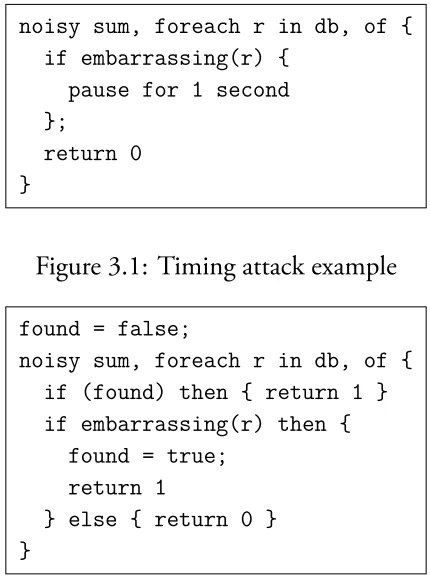
private data, as illustrated (in PINQ-like pseudocode) in Figure3.1. The macroquery adds together the results of running the microquery on each row of the database
(always 0) and finally adds some random noise to the total. Since almost all of the microquery instances finish very quickly, the distribution of query execution times
observed by the adversary will change significantly when an embarrassing record exists in the database—a violation of differential privacy.
A simple “microquery timeout” will not solve this problem, for at least two rea-sons. First, the adversary can also signal the condition by causing the query to take
an unusually small amount of time. The simple way to do this is to create an ex-ception condition that aborts the entire query. If this is blocked (e.g., by trapping
an exception in a microquery and replacing it with a default result just for that sin-gle microquery), the adversary can instead make all microqueries take a uniformly
noisy sum, foreach r in db, of { if embarrassing(r) {
pause for 1 second };
return 0 }
Figure 3.1: Timing attack example
found = false;
noisy sum, foreach r in db, of { if (found) then { return 1 } if embarrassing(r) then {
found = true; return 1
} else { return 0 } }
Figure 3.2: State attack example
in which case they terminate immediately. If the adversary happens to know exactly how many records are in the database, this leaks one bit. Second, the adversary can
defeat a simple “microquery timeout” by causing side-effects in the microquery that will slow down the macroquery or other microqueries—for example, by allocating
lots of memory to trigger garbage collection in the macroquery. We discuss this issue in more detail below.
3.3.3 State attacks
A different class of attacks involves using a channelbetween microqueries, such as a
global variable, to break differential privacy of the result, as illustrated in Figure3.2. This time, the result of each microquery is either 0 or 1, depending on whether
any previous microquery detected an embarrassing record. Since, in general, the
noisy sum, foreach r in db, of { if embarrassing(r) then {
run sub-query that uses a lot of privacy budget } else {
return 0 }
}
Figure 3.3: Privacy budget attack example
Constant execution time Variable execution time
Database size public Database size private
ε-differential privacy (ε,δ)-differential privacy
Static enforcement Exact timing analysis Time bound analysis
Time noise
Dynamic enforcement Timeouts Timeouts
Rounding up Time noise
Table 3.1: Four approaches to the timing-channel problem.
the contribution of this one record to the result, again violating differential privacy.
3.3.4 Privacy budget attack
A related form of attack uses the query processor’s decision whether to publicize the result of a query as a channel for leaking private data, relying on the fact that this
decision can be influenced by actions of the query that in turn depend on private data. This idea can be applied to systems that use adynamicanalysis to determine the
’privacy cost’ of a query, i.e., the amount that must be subtracted from the privacy budget before the result can be returned to the querier. As illustrated in Figure 3.3, the attack consists of looking for an embarrassing record and, when it is found, invoking some sub-query that will use up a bit of the remaining privacy budget.
3.3.5 Case study: PINQ
We have verified that the current PINQ implementation (version 0.1.1, released 08/18/09, available from (pinq)) is vulnerable to all of the above attacks. To
demon-strate the vulnerabilities, we have written three example programs, each based on the test harness that comes with PINQ.
The original test harness computes several differentially private statistics on a given text file, including the number of lines that contain a semicolon. When the
program starts, it first reads the text file and creates a database whose rows each con-tain one line of text. Then it selects all the rows that concon-tain a semicolon, using
microqueries with a boolean predicate p, and finally performs a noisy count on the resulting set of rows.
Our attacks are implemented by changing the predicate p so that it produces some observable side-effects when the input file contains a certain strings. For the
timing attack, we changed pso that, when invoked on a line that containss, p per-forms an expensive computation that takes several seconds and cannot be optimized
out. For the state attack, we added a static variable that is incremented by p when it discovers s, and we write the (un-noised) value of this variable to the console at
the end. For the budget attack, we added a different static variable that contains a reference to the database; whensis found, pcomputes a noisy count of the number
of rows in the database, which decreases the privacy budget.
The possibility of such attacks is acknowledged in the PINQ paper (McSherry,
2009), and the PINQ implementation does contain hooks for an expression rewriter (calledPurifyin (McSherry,2009)) that is invoked on all user-supplied expressions
and could potentially change or remove code that causes side-effects. However, such a rewriter is not provided; indeed, the PINQ downloads page contains an explicit
warning that the code is not hardened or secured and should not be used ‘in the wild.’
Avoid-ing the privacy budget attack will probably be easiest: every function that might
consume privacy budget could be wrapped with a check that raises an exception if it is called from inside a running microquery (i.e., with a PINQ operation already
on the call stack); this exception could then be turned into a default result for the microquery. State attacks are more difficult: since microqueries in PINQ are
ar-bitrary bits of C#, it seems the choices are either to execute them on a modified virtual machine that detects writes to global state (as Airavat does), or else to create a
small domain-specific language for writing microqueries that avoids global updates by design (as we do in Fuzz). Addressing timing attacks will require deeper changes
to PINQ: the issues and available solutions are precisely the ones we study in this chapter.
3.3.6 Case study: Airavat
Because Airavat calculates sensitivity and deducts the required amount from the pri-vacy budget before query execution begins, it is inherently safe from pripri-vacy
bud-get attacks. However, Airavat’s mechanism for preventing state attacks permits a related vulnerability. To prevent microqueries from communicating via static
vari-ables, Airavat runs microqueries on a modified JVM; if a microquery ever attempts to modify a static variable, an exception is thrown and the whole query is marked
“not differentially private.” Unfortunately, the adversary can now observe whether the system gives them the result at the end of query execution or says, “Sorry, that’s
not differentially private.” A better alternative would be to abort just the microquery, return, a default result, and allow the remainder of the query to run to completion.
In its published form, Airavat is also vulnerable to timing attacks. Its authors acknowledge this weakness (Roy et al., 2010) but counter that the bandwidth of
the channel it creates is very low. This, we agree, may make it tolerable in some contexts, e.g., with “mostly trusted” queriers that might be careless but will not
We understand that Airavat may soon be enhanced to add timeouts to microquery
executions [Shmatikov, personal communication, July 2010]; the implementation techniques described below should be useful in this effort.
3.4
Defending against timing attacks
State and privacy budget attacks can (and must) be addressed by designing the query
language so that they are impossible. Timing attacks require more work, and this will be our concern for the remainder of the chapter.
3.4.1 Four approaches to the problem
There are two basic strategies. One is to ensure that a given query takes very close to the same amount of time for all possible databases (of a given size—see below),
so that the adversary can learn nothing from observing the time it takes the query result to arrive. The other is to treat time as an additional output of the query, and to
limit the amount of information the adversary can gain using the same mechanisms (sensitivity analysis and appropriate perturbation) that are used for data outputs.2 In
either approach, we can either obtain the information about running time statically (by analyzing the program before running it) or enforce limits dynamically (e.g., by
using timeouts). This gives us the four possibilities shown in Table3.1.
The solutions in the right-hand column provide somewhat weaker privacy
guar-antees than those on the left. In order to properly “noise” a resource like time, we must have the ability to both increase and decrease its consumption. While we can
clearly increase execution time by adding a delay, we cannot easily decrease it. We can mitigate this problem by adding a default delayT; thus, we can add “time noise”
ν ≥ −T by delaying forT+ν at the end of each query. Nevertheless, since noise dis-tributions guaranteeing differential privacy have unbounded support (i.e.,P(ν)>0
for all ν), there is always a possibility that ν <−T, in which case we cannot
com-plete the computation. Thus,ε-differential privacy seems impossible in practice; all we can hope for is the slightly weaker property of(ε,δ)-differential privacy (Dwork
et al., 2006a), where δ is a bound on the maximum additive (not multiplicative) difference between the probability of any given query output with and without a
particular row in the input.
On the other hand, in the constant-time solutions (left column), the size of the
database becomes public knowledge, since, except for the most trivial queries, ex-ecution time depends on the size of the database. In practice, this is probably a
reasonable concession. In the case of the variable-time solutions (right column), the size of the database does not need to be published.
The static solutions (top row) are attractive in principle, but they depend on a static analysis of time sensitivity—something that has proved challenging except for
very simple, inexpressive programming languages. We therefore concentrate on the bottom row as being a more realistic target for a feasible implementation. In this row,
we choose one column to explore further: the “constant execution time” alternative, where we try to make each microquery take as close as possible to exactly the same
amount of time. (The “variable execution time” column is in principle feasible and also deserves exploration; we believe similar mechanisms will be required.)
3.4.2 Default values
The approach we explore in the rest of this chapter is to dynamically ensure that each microquery mtakes the exact same amount of time T. If the microquery takes less
time to execute, we delay it and only return its result afterT. If the microquery has executed for timeT without returning a result, we abort it. However, aborting the
enclosing macroquery is not an option because this would leak information to an adversarial querier. Instead, our approach is to have the microquery return adefault
To avoid privacy leaks through the default value,dmust not itself depend on the
contents of the database. In Fuzz, a static value for d is included with the query. Also, for reasons that will become clear in Section 3.4.4, d should fall within the range of the microquerym.
3.4.3 Do default values decrease utility?
When the microquery for a rowrtimes out while answering a non-adversarial query,
the utility of the query’s overall result almost inevitably degrades. After all, the result no longer incorporates the intended contribution of r or any other row whose
mi-croquery has timed out, but rather uses the default value for each such mimi-croquery. However, a non-adversarial querier can always avoid the inclusion of any default
values by choosing a sufficiently high timeout. If the timeouts are chosen properly,
timeouts should never occur while answering non-adversarial queries. Thus, the only
querier who experiences degraded utility is the adversary.
The question, then, becomes how to choose the timeout values. One possible
method is as follows. The querier is supplied with a reference implementation of the query processor that additionally outputs the maximum processing time Tmax
for each microquery. The querier can then (locally) test his queries on arbitrary databases of his own construction and thus infer a reasonable time bound. The
querier then adds a small safety margin and uses, say,1.1·Tmax as the timeout for his query. He then submits the query to the actual query processor, to be run on the
private database.
3.4.4 Do default values create privacy leaks?
At first glance, it may appear that default values are replacing one evil with another:
they seem to plug the timing channel at the expense of introducing a data channel. However, this is not the case: as long as the timeouts are applied at the microquery
preserved, for the following reason.
First, recall that Fuzz is designed to ensure that the completion time of a query depends only on the size of the database, but not its contents. Since we have assumed
that the size of the database is public, and since our threat model rules out all the other channels, the only remaining way in which private information could ‘leak’ is
through the (noised) data that the query returns.
Now, recall that the type system Fuzz implements is based on the type system
from (Reed and Pierce, 2010). As described in (Reed and Pierce, 2010), this type system ensures that all programs that type-check are differentially private. This is
achieved by inferring an upper bound on the program’s sensitivity to small changes in its inputs—specifically, a change to an individual database row.
Fuzz extends the type system from (Reed and Pierce, 2010) with microquery timeouts onmapandsplit, but, crucially, timeouts do not increase the sensitivity of
these two functions. The reason is that the sensitivity of mapandsplitdepends on the range of values that the microquery can return. Since the default value is taken
from the range of values that the microquery can already return in the absence of timeouts, the addition of timeouts does not increase this range, and thus does not
increase the sensitivity either.
Of course, running a query on a given database with and without timeouts (or
with shorter vs. longer timeouts) can yield very different results. Suppose we have a database band a function with microqueries that, without timeouts, produces an
output o when it is run on b. If we now add a very short microquery timeout, we can easily cause all the microqueries to abort and return their default value, and
the resulting output for the same database D can be dramatically different from o. However, this does not mean that differential privacy is violated. Recall from
Chap-ter 2 that the differential privacy guarantee makes a statement about running the
same query on two databases b and b′ that differ in exactly one row r. If we run a