QUALITY OF SERVICE AND
RELIABILITY WITH WEIGHTED FAIR
QUEUING AND CUSTOM QUEUING IN
OPTICAL COMMUNICATION
JITENDRA SAXENA
Department of Computer Science and Information Technology MANIT Bhopal MP-462052,India
[email protected] ADITYA GOEL
Department of Electronics Engineering MANIT Bhopal MP-462052, India
[email protected] Abstract:
Quality of service is a very important and vital issue for maintaining optical network with respect signal quality, jitter, and delay. Queuing theory is an important parameter to maintain triple play quality of service i.e video, voice and data. The network consists of different type of quality of service model client/ server model and a video client to client model. Video traffic is queued and prioritized in the firewall by using weighted fast queuing.
Keywords: Type of service; video traffic; weighted fast queuing; packet queuing; Hierarchical quality of service.
1. Introduction
The increasing rate of bandwidth with data rate of Terabits/sec has given modern world a vital task to manage it efficiently with low signal degradation, low latency and low network jitter [1, 2]. WDM technology is the most promising technology with wavelength conversion capability that enables to convert data from one wavelength to another wavelength. Reliability has been well recognized as an important design parameter in the design of modern high-speed networks. While past approaches offer either 100% protection in the presence of single link failure or no protection at all, connections in real networks may have multiple qualities of service requirements and reliability requirements. The current development in quality of service trend, however, is gradually driving the design of networks towards a unified solution that will jointly support voice and data services, as well as a variety of novel multimedia applications. Evidence of this trend over the last years is the introduction of concepts such as quality of service (QoS) [1, 2], and differentiated services [3, 4] that provide multiple levels of service performance in the same network [5, 6].The benefit of optical fiber deployment is low loss span with high band width capacity for the subscribers. In addition to the cost of network downtime, there is also the cost of service degradation like network slowness, latency and jitter are far common than network downtime. They also affect more users and last longer because they are more difficult to diagnose. Simultaneously increase in competitiveness among operators has led to an increased focus on quality of service (QoS). The assessment of reliability and quality of service is therefore the basis for the tradeoff between availability cost and performance.
2. Methodology
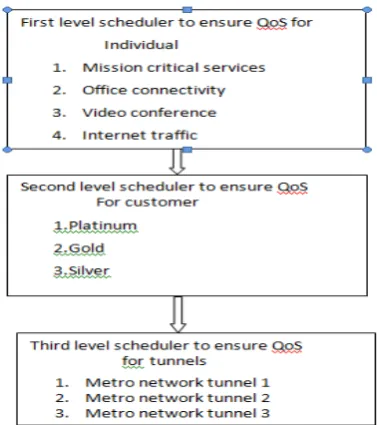
flexibility in managing his bandwidth. The first level scheduler would classify traffic into flows based on the service type (VOIP, Internet etc) coming from a particular customer (source address). The SLAs applied here would apply to the individual services for that customer. The second level scheduler can classify based on customers and apply CIR(Committed Information Rate) & EIR (Excess Information Rate) for that customer. The third level scheduler can apply a policy for a particular trunk (based on destination address). Thus all traffic going from location A to B would get a particular bandwidth guarantee within the shared Egress port. As the service and scheduler feeds traffic to the next level and that feed to the third level as shown in Fig 2.1,2.2, 2.3
Figure 2.1: Block Diagram Hierarchical Quality of Service
Figure 2.3 Design Layout for Hierarchical Quality of Service for WFQ Model.
3. Result and discussion
Routers support multiple queues for each type of service. Queue 4 receives type of service 4 traffic, queue 3 receives type of service 3 traffic. Queues are serviced using “Weighted Fair Queuing can be enabled on each interface in “advanced routers as shown in Fig.3.1. Queuing profiles and queuing processing mechanism are set in attribute “QoS information scenario in “ IP address information” compound attribute. Queuing profiles define the number of queues and the classification scheme. Queuing profile are defined in the QoS configuration. In this design the WFQ mechanism differentiates traffic between queues based on the type of service(TOS). Queues send traffic proportionally to their weight. In this design queues with high index have higher weight as a result of this classification traffic with higher type of service gets better delay as shown in Fig 3.2, 3.3, 3.4. Queue 3 and 4 get their share but let other queues starving of bandwidth. The only difference in weighted Fair Queuing and weighted Fair Queueing with low latency queue(LLQ) is in the WFQ profile detail setting where queue 1 is configured to be a low latency Queue(LLQ). The LLQ is a strict priority queue functioning within the regular weighted Fair Queuing scheduling environment. It receives absolute precedence over the other queues which mean that no other queue in the system can be serviced unless the LLQ is empty. If the LLQ is empty, other queues are serviced according to the regular “weighted Fair queuing mechanism. Traffic is queued in router A because of the bottleneck. Queue 1 which is configured to be LLQ get the highest priority with highest degree of reliability and thus the highest share of the bandwidth and lowest end to end delay.Queue 4 which has the highest weight among the other queues gets afull share of the bandwidth. Queues 2 and 3 get starved and have higher delays as shown in Fig 3.5.
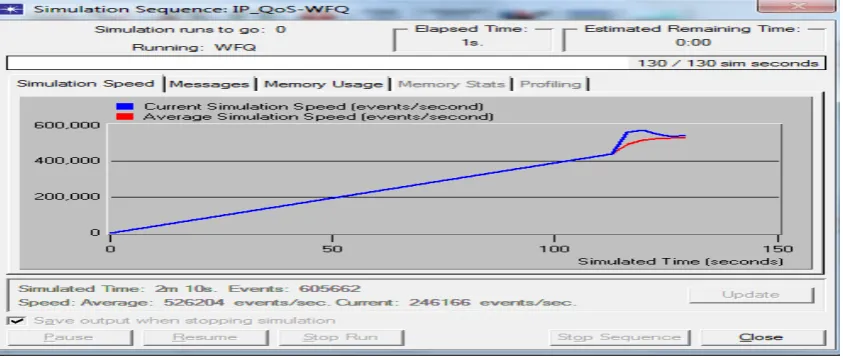
Fig.3.2 Result for WFQ, between memory uses & simulation Time
Fig.3.3 Result between simulation sequence and time for QoS custom queuing
Fig.3.5 Result of IP_QoS custom Queuing with Low latency Queue
In custom Queuing traffic is queued in “router A” because of the bottleneck. In this design custom Queuing mechanism differentiates traffic between queues based on the type of service(TOS). Traffic is sent from each queue in a round robin fashion. Queues send traffic proportionally to their byte count. In this design queues with high index have higher byte count. As a result of this classification traffic with higher type of service will get better delay. The only difference between custom Queuing (CQ) and custom Queuing with low latency queue (LLQ) is queue 1 is configured to be a low latency queue. The LLQ is a strict priority queue functioning within the regular customer queuing scheduling environment. It receives absolute precedence over the other queues which means that no other queue in the system can be served unless the LLQ is filled. The “Byte count” attribute is not used for the LLQ and its value gets ignored by the scheduler.
4. Conclusion
We investigate various weighted fair queuing with hierarchical Quality of service model and approach with OPNET simulation tool. The result shows in terms of fairness and delay performance. The losses of packets from higher priority video traffic can be eliminated using WFQ with LLQ.
References
[1] M.J. Fischer and D.M.B. Masi, “Modeling Overloaded Voice over Internet Protocol Systems,” Telecomm. Rev., 2006; [2] http://www.noblis.org/TelecommunicationsReview.htm.
[3] M.J. Fischer and D.M.B. Masi, “Simulating,Analyzing and Modeling of Voice and Data QoS Performance: Overview,” Presentation to the National Communications Systems Modeling and Simulation Working Group, Oct. 2006;
[4] http://www.noblis.org/BusinessAreas/ProgramManagement Acquisition/2591_final_ncs_ngps_Modeling_and Simulation_Group_MFischer_DMasi_10.03.2006. pdf.
[5] M.J. Fischer and D.M.B. Masi,“Voice Packet Arrival Models and Their Affect on Packet Performance”Proc. Applied Telecomm. Symp., 2005; http://www.noblis. org/BusinessAreas/ProgramManagementAcquisition/ATS05_final4 Spring_2005.pdf.
[6] D.M.B. Masi and M.J. Fischer, “Voice over Internet Protocol (VoIP) Performance Models – A Comprehensive Approach,” Proc. 2005 Int’l Conf. Telecomm. Systems – Modeling and Analysis (ICTSMA), 2005;
[7] http://www.noblis.org/BusinessAreas/ProgramManage mentAcquisition/ICTSM_2005VoIP_Performance_Models_2005--_final3.pdf.Class-based fair weighted queuing
[8] D. Gross and C. M. Harris, Fundamentals of Queueing Theory, 3rd ed., John Wiley, 1998. J.W. Cohen, The Single Server Queue, North- Holland Publishing Company, 1969