AMERICAN ACADEMY OF PEDIATRICS
John J. Fraser, Jr, MD, JD, and the Committee on Medical Liability
Technical Report: Alternative Dispute Resolution in Medical Malpractice
ABSTRACT. The purpose of this technical report is to provide pediatricians with an understanding of past cri-ses within the professional liability insurance industry, the difficulties of the tort system, and alternative strate-gies for resolving malpractice disputes that have been applied to medical malpractice actions. Through this re-port, pediatricians will gain a technical understanding of common alternative dispute resolution (ADR) strategies. The report explains the distinctions between various ADR methods in terms of process and outcome, risks and benefits, appropriateness to the nature of the dispute, and long-term ramifications. By knowing these concepts, pediatricians faced with malpractice claims will be bet-ter-equipped to participate in the decision-making with legal counsel on whether to settle, litigate, or explore ADR options.
ABBREVIATIONS. ADR, alternative dispute resolution; NPDB, National Practitioner Data Bank.
BACKGROUND
D
uring the 1970s and 1980s the Americanmed-ical profession experienced a series of profes-sional liability crises. The first sign was a significant rise in the number of malpractice claims filed against physicians. Already high litigation costs increased further with the growing number of med-ical malpractice claims being filed. Between 1930 and 1994 US tort costs grew almost 4 times faster than the rate of growth of the US economy. The most rapid escalation in US tort costs took place between 1950 and 1985, when they grew by an average of 12% annually, while nominal economic growth averaged 7.9% per year.1Burdensome litigation, unpredictable
court decisions, and steep indemnity awards drained the profitability from medical malpractice insurance policies.
This precipitated the next problem—a crisis of availability of medical malpractice insurance. Medi-cal liability insurance covers an array of indemnity policies, which protect health care facilities, hospi-tals, physicians, and other health care providers from a range of financial and legal risks. Because of the expanding scope of liability to which physicians are vulnerable, insurance carriers offer a variety of in-surance products either as separate contracts, riders, or layered protection. Examples of various kinds of medical professional liability policies are as follows: directors and officers insurance, errors and
omis-sions insurance, employment liability insurance, managed care liability insurance, billing errors insur-ance, and malpractice insurance. This technical re-port focuses specifically on the use of alternative dispute resolution (ADR) in resolving medical mal-practice claims; thus the term “malmal-practice insur-ance” is used to distinguish these policies from the range of products that may be contained in the broader term “professional liability.”
Physicians found it increasingly difficult to obtain malpractice insurance as commercial insurance car-riers either stopped offering medical malpractice coverage or abandoned professional liability market altogether. Insurers that continued to carry medical malpractice coverage had to raise insurance premi-ums, sometimes doubling or even tripling them to meet the rising costs of indemnifying physicians. At the height of this crisis premiums for medical mal-practice insurance coverage soared. It was reported that in 1 region of California physicians experienced a 360% increase in malpractice insurance premiums in 1 year.2
Physicians took matters in their own hands and created a network of professional liability insurance companies committed to providing long-term mal-practice insurance coverage at reasonable cost. Al-though the formation of physician-owned medical liability carriers helped stabilize the malpractice in-surance market, physicians still felt vulnerable to the lottery-like nature of malpractice allegations. It was clear then as well as now, that medical negligence litigation epitomizes the systemic problems in civil liability. Simply stated, very few acts of medical neg-ligence result in malpractice claims and very few malpractice lawsuits actually involve medical negli-gence.3 A patient’s motivation to sue a physician
for malpractice often rests in factors unrelated to the quality of medical care.
Realizing that the tort system was seriously flawed, several states experimented with various tort reform strategies. Despite these attempts, the linger-ing threat of malpractice continued to take its toll on health care delivery. Physicians learned to practice defensive medicine, which significantly increased health care cost.4But far more costly was the damage
done to the physician/patient relationship as con-cerns that the next patient could also be a potential malpractice suit added mistrust to medical encoun-ters.5
Various solutions were proposed to reform the tort system and thereby reduce the rippling effects of the malpractice crises on the cost and delivery of health care. These strategies are best understood when
con-The recommendations in this statement do not indicate an exclusive course of treatment or serve as a standard of medical care. Variations, taking into account individual circumstances, may be appropriate.
sidered as first-generation and second-generation re-forms (see Fig 1). Early interventions, first-genera-tion tort reforms, attempted to reduce the frequency and severity of malpractice claims. Later efforts, sec-ond-generation tort reforms, were aimed at stream-lining adjudication and compensation systems.6
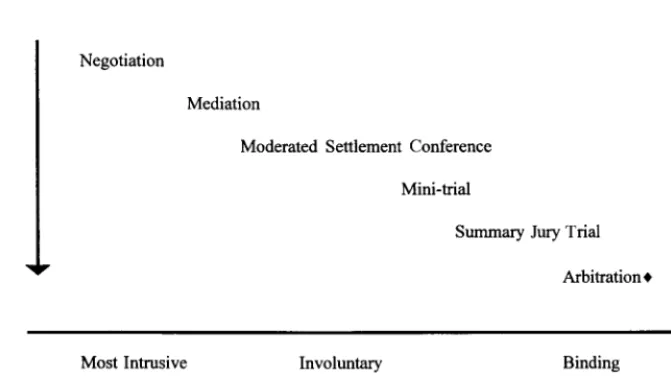
Those considered ADR devices are noted with an asterisk. ADR refers to a group of processes through which a dispute can be resolved short of litigation. Various ADR techniques are arranged along a con-tinuum in Fig 2 that depicts their relative progression from voluntary to mandated choices, from nonbind-ing to bindnonbind-ing outcomes, and from processes less likely to violate privacy and disrupt personal and professional life to those that are more public and intrusive.7
It is against this landscape of past crises, attempted reforms, and persistent inefficiencies in the US tort system that this technical report is written. The re-port focuses on four specific ADRs—negotiation, me-diation, arbitration, and the pretrial screening panel. It compares their relative advantages/disadvantages against litigation to remedy allegations of medical negligence. The report also defines other less
fre-quently used ADR methods and hybrid techniques as well in its glossary. This technical report is in-tended to make pediatricians aware of other means of resolving malpractice allegations and the potential risks and benefits associated with ADR processes.
NEGOTIATION
Negotiation, the most frequently used method of ADR, is defined as the process whereby 2 or more disputing parties confer together in good faith so as to settle a matter of mutual concern.8The approach
to negotiation may be positional or principled. In positional negotiation, divergent parties incremen-tally concede their position until a compromise is reached. In principled negotiation, the parties gener-ate options focused on their interests to arrive at an agreement based on objective criteria. Negotiation serves as the basis for mediation, an important ADR method used in medical malpractice cases.5
Negotiation has its advantages. The disputants re-main in control of the process. Negotiated resolu-tions tend to have greater durability than agreements reached by other methods.8The process of
negotia-tion can be educanegotia-tional for both parties and therefore may prevent subsequent discord in the relationship. However, sometimes negotiation alone is not enough to resolve medical malpractice actions. Most negoti-ated resolutions are reached when the disputing par-ties are large vertically structured corporations. In these instances, the negotiations are conducted by senior members of the opposing corporations some-times referred to as “wise people,” or high-level cor-porate agents with the authority to resolve the dis-pute. Because the negotiators were not involved in the original conflict, they have sufficient personal and emotional distance to compromise.7 Medical
malpractice litigation often involves individuals (a patient versus a physician); typically the disputants are not huge corporate entities. Traditionally physi-cians have been in relatively small corporations; therefore, it can be difficult to get the kind of dispas-sionate perspective that is conducive to successful resolution via negotiation alone.
MEDIATION
Mediation is an extension of direct negotiation between the parties, using a neutral third party to facilitate the negotiation process. As a facilitator, the mediator has no authority to impose a solution on the parties nor are the results of the process binding on the disputing parties. The mediator acts by iden-tifying issues, proposing solutions, and encouraging accommodation on both sides.5 Mediation can be
effective in medical malpractice cases in which the patient and physician want to preserve their relation-ship or in which poor communications has led to the dispute. The advantages of mediation over litigation are its decreased costs, more confidential proceed-ings, and the degree of control enjoyed by the dis-puting parties over the process and outcome. In re-solving allegations of medical negligence, patients tend to favor mediation because it provides a forum in which they can express their concerns and may lead to an acknowledgment of the problem—some-Fig 1. Tort reform measures. The asterisk (*) indicates those
times in the form of an apology.9Mediation has its
limitations. In many jurisdictions mediation is vol-untary and can only be pursued if both parties agree to it. Mediators do not have the same authority as judges and therefore cannot compel the release of information nor can their decisions be imposed. The mediator has only as much power as the disputing parties permit and as such can go no further than the disputants themselves are willing to go.9
ARBITRATION
In arbitration the parties agree to submit their dispute to a neutral third party, usually an arbitrator or an arbitration panel. The arbitrator conducts a hearing in which each side presents evidence. The arbitrator then makes a determination on liability and/or renders a decision of award. Often the par-ties agree in advance whether the arbitrator’s deci-sion will be binding.10 However, the decision of the
arbitrator is subject to limited appellate review for procedural error, arbitrator bias, or fraud. Arbitra-tion can be private, arising from the terms of a con-tract between the parties, or judicially mandated (court-annexed) by statute or rule.8
Potential advantages of arbitration over judicial trials for resolving malpractice claims are: speed (ar-bitration can be initiated as soon as the dispute aris-es), simpler and less expensive proceedings (in arbi-tration the rules of evidence are less stringent and the processes are often more streamlined than court pro-ceedings), and privacy (arbitration hearings are more private than judicial trials, which can become media events).9An advantage not to be overlooked is the
opportunity to use a uniquely skilled arbitrator. Un-like a judge, the arbitrator may possess technical skills or scientific knowledge directly related to the subject of the dispute; this could be a distinct advan-tage when the dispute is enmeshed in an extremely complex or esoteric content area such as medicine.8
However, by choosing an arbitration panel over a
court trial, the defendant physician sets aside certain rights. For example, in arbitration there is no right to a trial by jury and no judicial instruction on the law. Similarly, documents from arbitration proceedings are not as complete as court proceedings. This can become problematic, as arbitration panels need not explain the basis of their decisions.
Arbitration has been applied in medical malprac-tice for more than 20 years. In the state of Michigan it is required by statute and in California by contract between managed care organizations and enrollees.
Challenges to medical malpractice arbitration
awards in both states have been upheld by their highest courts.5Despite this, arbitration remains an
underutilized ADR method in medical malpractice cases across the country.11,12
PRETRIAL SCREENING PANEL
The pretrial screening panel is an ADR method that was uniquely developed for medical malpractice cases. About half of the states have statutes establish-ing pretrial screenestablish-ing panels that review malprac-tice claims and render a nonbinding advisory opin-ion on the merits of the claim before a suit being filed. Panel composition varies considerably from state to state. In some states only physicians sit on pretrial screening panels. Other states restrict panels to attorneys. Other states require that the members of a pretrial screening panel include physicians, attor-neys, judges, and/or laypersons. The panel reviews the merits of the malpractice case and offers an opin-ion on the physician’s liability. In some states the panel reviews the claim before legal action is taken. In other states the suit must be filed in court before it is sent to the panel. States also vary on whether the panel renders an opinion on damages. Furthermore, state law determines whether the findings of the pretrial screening panel can be admitted as evidence should the claim go to trial, and if so, how much weight the panel’s findings should be given. The Fig 2. Types of ADR: a continuum.
purpose of the pretrial screening process is twofold: to eliminate nonmeritorious claims and to encourage settlement of meritorious claims before litigation.13
The earliest malpractice pretrial screening panels date back to the 1960s. In New Mexico a 1962 statute introduced a voluntary pretrial review panel; in the mid 1970s, during the malpractice litigation crisis, the statute was revised to make pretrial screening mandatory. Consequently, from 1976 to 1996 New Mexico panels have heard more than 2100 medical malpractice cases; nearly three-quarters of those cases were resolved without trial.14
A major disadvantage of pretrial screening panels is the nonbinding nature of most ADR methods. In many states the plaintiff can still litigate after the pretrial screening panel decision is made. Thus, the pretrial screening panel may, in effect, further delay final resolution of the claim. Although there is some evidence that screening panels are effective in elim-inating low-merit cases others contend that panels are victims of their own existence, as they can be-come clogged with frivolous claims that otherwise would not be pursued.10
OTHER METHODS
Several other ADR methods are suited to resolving medical malpractice disputes, but are seldom used in this setting. These include early neutral evaluation, mediation-arbitration, mini-trial, neutral fact finder, ombudsman, private judging or rent-a-judge, and summary jury trial. (These ADR terms are defined in the glossary that follows this technical report). Many of these ADR techniques were developed for and are primarily used in the commercial or corporate envi-ronment. With the ongoing consolidation of health care entities into massive corporations, these meth-ods may become more commonly used in medical malpractice claims. Should the federal Employee Re-tirement Income Security Act of 1974 preemption from liability be lifted or amended to permit patients to sue their managed care organizations for malprac-tice, the use of ADR is likely to increase significantly.
BARRIERS TO ADR
A major impediment to physician use of ADR in medical malpractice is the mandatory reporting of all malpractice payments to the National Practitioner Data Bank (NPDB). It is important that physicians understand that any malpractice payment (eg, settle-ment or award) made on their behalf, even those derived from an ADR process, must be reported to the NPDB.15Entries in the NPDB are specific to the
physician on whose behalf the payment was made and are permanent. Every time a physician seeks or renews clinical privileges at a hospitals or new em-ployment his or her NPDB may be queried by au-thorized entities. Although physicians can furnish a note of explanation in their NPDB files, many prefer to take the odds of litigation, which tends to favor the physician defendant.10 Repeated efforts to open the
NPDB to the public have not succeeded thus far. This could change as patient rights initiatives continue to gain momentum and other databanks of disciplinary actions taken against health care practitioners that
are already open to the public (eg, Medicare/Medic-aid programs exclusions, Occupational Safety and Health Act/Clinical Laboratories Improvement Act sanctions, adverse actions taken by state medical licensing boards) continue to proliferate.
SUMMARY
Various ADR methods are available to resolve medical malpractice claims. Many promise to work more effectively and fairly than the current tort sys-tem. Litigation is adversarial, traumatic, and often detrimental to the patient-physician relationship. Lit-igation stress can take an enormous toll on the both the plaintiff and the defendant. The expense of liti-gation prevents equal access to the system; some-times patients who have suffered damages from medical negligence are not able to secure represen-tation because their claim is too small. Not only is the US tort system the most expensive in the world, its awards return less than 50 cents on the dollar to the people the system is designed to help. Furthermore, a relationship between patient injuries and malprac-tice may or may not exist. The literature has noted that malpractice claims are more likely to be trig-gered by maloccurence (bad outcome) than malprac-tice (bad medicine) and that many patients injured by negligent care never file malpractice suits. ADR techniques are often described as bilateral tort re-forms because they can make it cheaper for physi-cians to defend unfounded claims and easier for plaintiffs to prevail on meritorious claims. Given the persistent problems in medical malpractice litigation for both sides it is surprising that ADR methods remain underutilized, especially when reforms based on ADR potentially make the tort system more eq-uitable and affordable to both plaintiffs and defen-dants.
It is important for pediatricians to understand ADR processes, their relative advantages and disad-vantages, and suitability to certain kinds of disputes. Moreover, physicians must clearly understand the degree of privacy, the level of autonomy afforded the disputants, and the binding nature of each ADR method. Beyond knowing the strengths and weak-nesses of specific ADR strategies, physicians must also weigh the long-term consequences associated with ADR. For instance, physicians who predomi-nately rely on ADR when faced with a malpractice claims may end up with several entries in their NPDB files because ADR payments made on behalf of physicians are not exempt from mandatory NPDB reporting. Unless a more reasonable reporting trig-ger or payment threshold can be introduced to the NPDB, defendant physicians may prefer to take their chances in court rather than use ADR to resolve malpractice cases. Helping pediatricians understand the implications of ADR methods may empower them to work more effectively with defense counsel in selecting the best strategy for resolving malprac-tice allegations.
APPENDIX: GLOSSARY OF TERMS
litigation that are increasingly being used in com-mercial and labor disputes, divorce actions, motor vehicle claims, and medical malpractice tort claims. Arbitration: A form of ADR in which the parties agree to have 1 or more trained arbitrators hear the evidence of the case and make a determination on liability or damages. The disputing parties may spec-ify the rules of evidence and other procedural mat-ters. Arbitration can be binding (ie, subject to limited judicial review) or nonbinding (ie, the parties may proceed to trials if not satisfied with the outcome of the arbitration).
Caps on damages: Legislative limitations on the amount of money that can be awarded to the plaintiff for economic or noneconomic damages in a personal injury claims, such as medical malpractice. The limit is imposed regardless of the actual amount of eco-nomic and nonecoeco-nomic damages.
Damages: The sum of money a court or jury awards as compensation for a tort or breach of con-tract. The law recognizes several categories of dam-ages. General damages:typically intangible damages, such as pain and suffering, disfigurement, interfer-ence with ordinary enjoyment of life, or loss of con-sortium.Special damages:out-of-pocket damages that can be quantified, such as medical expenses, lost wages, or rehabilitation costs. Punitive/exemplary damages:damages awarded to the plaintiff in cases of intentional tort or gross negligence to punish the defendant or act as a deterrent to others.
Defensive medicine: Physician behavior intended to prevent patients from filing medical malpractice claims. Attempts to make more accurate diagnosis by ordering extra laboratory tests, medical procedures, and visits. The term can also be used to describe physician avoidance of high-risk patients or proce-dures primarily to reduce the risk of malpractice claims being filed against the physician. The perfor-mance of extra procedures for defensive purposes is sometimes called positive defensive medicine. The avoidance of high-risk patients or procedures can be referred to asnegative defensive medicine.
Early neutral evaluation: A panel of 1 to 3 neutral advisors hears a presentation of the disputants’ po-sitions. The panel reports its evaluation of the merits of each side’s case, then facilitates further settlement discussions. This term is synonymous with the term moderated settlement conferencewhen lawyers are the neutrals.
Enterprise liability: A system under which a health care institution or health insurance plan assumes full legal liability for the actions of physicians acting as their agents, and individual physicians cannot be named as defendants.
Malpractice: Professional negligence resulting from improper discharge of professional duties or failure to meet the standard of care of a professional, resulting in harm to another.
Medical-arbitration: This is a hybrid form of dis-pute resolution. It starts with mediation, which if unsuccessful, is followed by arbitration.
Mini-trial: Senior officials of corporate entities in the dispute meet with a neutral advisor and after
hearing each party’s presentation, proceed to de-velop a voluntary settlement.
Moderated settlement conference: Sometimes re-ferred to as “early neutral evaluation” or “advisory opinions,” this procedure is similar to nonbinding arbitration with certain exceptions: no rules of evi-dence, no cross-examination, and no formality in how the neutral entity communicates the outcome. This venue is often used in cases with heavy appli-cation-of-law content.
Neutral fact finder: A neutral entity with expertise in the disputed subject matter examines critical facts in the dispute and renders an advisory opinion on the matter.
No-fault compensation: A method for compensat-ing persons injured durcompensat-ing the course of medical treatment, regardless of whether the injury was caused by the negligence or fault of a health care provider.
Ombudsman: A neutral third party investigates facts involved in a complaint or grievance within an institution and makes a nonbinding advisory recom-mendation to senior managers regarding resolution of the problem.
Practice guidelines: Generally refers to clinical practice, which is defined by the Institute of Medi-cine as systematically developed statements to assist practitioner and patient decisions about appropriate health care for specific clinical circumstances.
Pretrial screening panel: An ADR procedure in which a screening panel hears the evidence of a malpractice claim including expert testimony, and determines liability before the plaintiff filing a mal-practice suit. In some instances the pretrial screening panel also determines damages in the claim. The pretrial screening panel may be composed of health care professionals, legal experts, and/or health care consumers. The use of the screening panel and its method of operation are determined legislatively, thus it may be mandatory or voluntary depending on the law. However, the decision of the pretrial screen-ing panels is not bindscreen-ing. Therefore, the parties may subsequently pursue the claim through the legal sys-tem.
Private judging: Also known as “rent-a-judge,” parties hire a retired judge to hear the case, following court-like procedures. The judge’s decision is as en-forceable as a regular court decision would be.
malprac-tice allegations. The more time that has passed, the more difficult it is to obtain pertinent evidence and available witnesses. Many states have shortened this period from when the minor-aged patient reaches the age of majority to within a specified number of years after the injury occurred or a specified number of years in which a reasonably intelligent person would have discovered the injury. (The Academy has model legislation to help state chapters reform statute of limitation for minors).
Summary jury trial: The parties’ lawyers present summaries of evidence and arguments to a jury in a 1-day hearing. After a nonbinding jury verdict is rendered, the parties may interview jurors about how they perceived the merits of each side’s posi-tion. A regular trial may follow if the parties do not subsequently settle based on the information re-ceived.
Tort: A civil wrong for which an action can be filed in court to recover damages for personal injury or property damage resulting from negligent acts of intentional misconduct.
Tort law: A body of law that provides citizens a private, judicially-enforced remedy for injuries caused by another person. Legal actions based in tort have 3 elements: 1) existence of a legal duty from the defendant to the plaintiff; 2) breach of that duty; and 3) injury to the plaintiff as a result of that breach.
Tort reform: A term used to describe collectively a number of legislative and judicial modifications to traditional tort law.
Committee on Medical Liability, 1999 –2000
Jan Ellen Berger, MD, MJ, Chairperson
Charles H. Deitschel, Jr, MD, Chairperson-Elect Jeffrey I. Berman, MD
Jerome M. Buckley, MD W. Hugh Craft, MD, MPH Geoffrey S. Evans, MD
John J. Fraser, Jr, MD, JD
Consultant
Holly J. Myers, JD
Staff
Julie Kersten Ake
REFERENCES
1. Sturgis RW.Tort Cost Trends: An International Perspective.New York, NY: Tillinghast-Towers Perrin; 1995
2. Physician Insurers Association of America Web site. Available at: http://www.thepiaa.org/history.htm
3. Localio AR, Lawthers AG, Brennan TA, et al. Relation between mal-practice claims and adverse events due to negligence.N Engl J Med. 1991;325:245–251
4. Rubin RJ, Mendelson DN. How much does defensive medicine cost?
J Am Health Policy. 1994;4:7–15
5. Fraser JJ. Medical malpractice arbitration: a primer for Texas physicians.
Tex Med. 1997;93:76 – 80
6. Kinney ED. Malpractice reform in the 1990s: Past disappointments, future success?J Health Politics Policy Law. 1995;20;99 –135
7. Trachte-Huber EW, Huber SK.Alternative Dispute Resolution: Strategies for Law and Business.Cincinnati, OH: Anderson Publishing Co; 1996 8. Brearton JJ, Hinck KE, Lott E, Nazario S. Alternative dispute resolution.
In:American Jurisprudence, IV. 2nd ed. Rochester, NY: Lawyers Cooper-ative Publishing; 1995:7–23
9. Grenig JE.Alternative Dispute Resolution With Forms.2nd ed. St Paul, MN: West Publishing Co; 1997
10. Metzloff TB. Alternative dispute resolution strategies in medical mal-practice.Alaska Law Rev. 1992;9:429 – 456
11. Ladimer I. Alternative dispute resolution in health care. In: Sanbar SS, Gibofsky A, Firestone, MH, Le Blang TR, eds.Legal Medicine.3rd ed. St Louis, MO: CV Mosby & Co; 1995
12. Metzloff TB. The unrealized potential of malpractice arbitration.Wake Forest Law Rev. 1996;31:203–231
13. Drechsler CT. Modern approaches to dealing with malpractice claims.
American Jurisprudence, LXI. 2nd ed. Rochester, NY: Lawyers Coopera-tive Publishing; 1981:546 –553
14. Kridelbaugh WW, Palmisano DJ. A 20-year experience with malpractice screening panels.Bull Am Coll Surg. 1997;82:21–23
15. US Dept of Health and Human Services, Public Health Service, Health Resources and Services Administration.National Practitioner Data Bank Guidebook. Rockville, MD: US Dept of Health and Human Services, Public Health Service, Health Resources and Services Administration; 1999
ERRATUM
In the AAP statement “Folic Acid for the Prevention of Neural Tube Defects” (1999;104:326), incorrect information was given in the second recommendation. In the second recommendation, the line that begins “During times in which a preg-nancy is not planned” should read as follows:
DOI: 10.1542/peds.107.3.602
2001;107;602
Pediatrics
John J. Fraser, Jr and the Committee on Medical Liability
Technical Report: Alternative Dispute Resolution in Medical Malpractice
Services
Updated Information &
http://pediatrics.aappublications.org/content/107/3/602
including high resolution figures, can be found at:
References
http://pediatrics.aappublications.org/content/107/3/602#BIBL
This article cites 6 articles, 0 of which you can access for free at:
Subspecialty Collections
http://www.aappublications.org/cgi/collection/risk_management_sub
Risk Management
http://www.aappublications.org/cgi/collection/medical_liability_sub
Medical Liability
_management_sub
http://www.aappublications.org/cgi/collection/administration:practice
Administration/Practice Management
following collection(s):
This article, along with others on similar topics, appears in the
Permissions & Licensing
http://www.aappublications.org/site/misc/Permissions.xhtml
in its entirety can be found online at:
Information about reproducing this article in parts (figures, tables) or
Reprints
http://www.aappublications.org/site/misc/reprints.xhtml
DOI: 10.1542/peds.107.3.602
2001;107;602
Pediatrics
John J. Fraser, Jr and the Committee on Medical Liability
Technical Report: Alternative Dispute Resolution in Medical Malpractice
http://pediatrics.aappublications.org/content/107/3/602
located on the World Wide Web at:
The online version of this article, along with updated information and services, is
by the American Academy of Pediatrics. All rights reserved. Print ISSN: 1073-0397.