Entropy Concept In Determining Reservoir
Continuity: A Case Study Of An Onshore Field In
The Niger Delta.
Kelechi Azubuike-Ijomah, Maxwell A. Ijomah
ABSTRACT: The entropy concept was introduced to determine the degree of randomness of the lithofacies in succession using the pre-depositional (E(pre)) and post-depositional (E(post)) entropy system of an onshore field in the Niger Delta. The whole sedimentation process followed the type B symmetrical Hattori plot. It is interpreted as bypassing of sediments, forming a thickening and thinning sequence of sediments which is attribut ed to fluctuations and changing of environment of deposition as the flow pattern changes from deltaic to shallow marine environment. The broad random degree and lateral continuity of sedimentation process showed that the cross-bedded coarse grained sandstone (SCC) and parallel laminated mudstone (MPL) facies have the lowest lateral continuity, while the planar/parallel laminated sandstone (SPL) has the highest lateral continuity.
Keywords: Entropy concept, Type B symmetrical, Hattori plot, and Lateral continuity.
————————————————————
INTRODUCTION
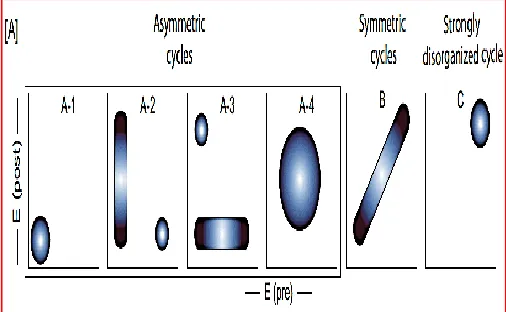
Johannes Walther Law of facies (1894), states that the vertical succession of facies is produced by the lateral migration of one environment over another. However, where there are breaks in the succession, seen as sharp or erosional contacts between facies, then the facies succession need not reflect laterally adjacent environments but could well be the products of widely separated environments. That is, in a conformable stratigraphic section, facies are laid laterally and subsequently affected by non-deposition or post-depositional tectonic activities. Hence, sedimentary environments that started out side-by-side will end up overlapping one another over time due to transgressions and regressions. However, Walther’s law can only apply to sections without unconformities and sub-dividing diachronous boundaries, for example, maximum flooding surfaces (mfs), transgressive surfaces (TS), etc, and sections without unconformities. The entropy concept is an extension of Markov chain process (as proposed by Hattori (1976) and only employed where lithologic sequence is found to be governed by a Markovian process. That is, where cyclicity is found to exist, the entropy concept is applied to evaluate the degree of randomness. Cyclicity in sedimentary system simply implies that one lithologic state determines the succeeding state. Hattori (1976), recognized two types of entropies with respect to each lithological state; one is post–depositional entropy and the second one is pre–depositional entropy. He used the interrelationships of Ei(post) and Ei(pre) to classify six types of sedimentary cycles based on studies of several lithological sequences belonging to different environments and grouped their entropy states as Asymmetric cycles, Symmetric cycles and Strongly disorganized cycle (fig. 1).
The Bouma’s model considered sedimentary cycle involving a set of lithological elements (e.g. A, B, C, D) and repeating in a different way through a succession. These sedimentary cycles were classified in three ideal groups regarding to the succession order; symmetric successions(A-B-C-B-A), asymmetric successions (A-B-C-A-B-C) and random cycle (A-C-A-B-C-A).
Figure 1: Sampled Entropy sets after Hattori (1976). The
distributions A-1, A-2, A-3 and A-4 are representatives of asymmetric cycles. B: symmetric cycle and C: strongly
disordered.
The entropy model uses the Esystem to get a broad depositional environment evaluation by plotting Esystem against the number of states as modeled after Hattori (1976).
AIM OF THE STUDY
To determine the lateral extent and continuity of reservoirs within the study area by applying entropy method at studying the lithofacies units, and determine the depositional environment setting.
GEOLOGY OF THE NIGER DELTA REGION
Niger Delta is one of the world’s largest tertiary delta systems. It is located in the Gulf of Guinea in West Africa, on the passive continental margin near the western coast of ___________________________
Kelechi Azubuike-Ijomah, Maxwell A. Ijomah
Department of Geology, University of Port Harcourt, Port Harcourt, Nigeria.
Email: [email protected]
Department of Maths/Statistics, University of Port Harcourt, Port Harcourt, Nigeria.
228
Nigeria, between latitudes 3oN and 6oN and longitudes 5oE and8oE (Reijers et. al, 1996)(Fig.2). It has its boundary in the west by the Benin flank and in the east by the Calabar flank, which is a subsurface expression of the obanmassif (Stonely, 1966). It has its limits in the south by the Gulf of Guinea and on the north by older (Cretaceous) tectonic elements, such as the Anambra Basin, Abakilili Uplift and Afikpo Syncline (Ejedawe, 1981). It is one of the subaerial basins in Africa, having subaerial area of about 75,000 km2, a total area of 300,000km2, a sediment fill of 500,000 km3 and sediment depth fill of between9-12 km (https://en.wikipedia.org/ wiki/Niger_Delta_Basin).
Fig. 2: Location map showing the Niger Delta (Ahiarakwem
et. al., 2012).
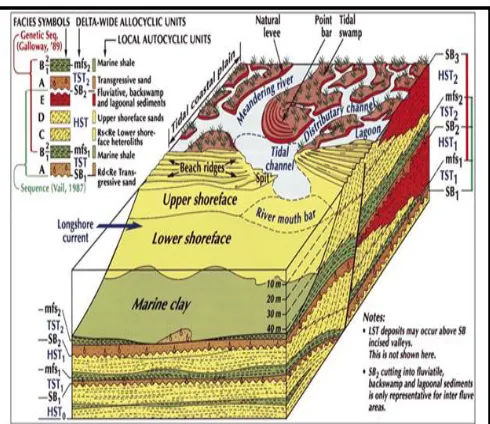
Reijers 1997, broadly categorized the Cenozoic Niger Delta into three distinct facies belts: continental delta top facies, paralic delta front facies and the marine prodeltafacies. This facies describes continental, transitional and marine depositional environment respectively (Fig.3) The Niger Delta depositional environment and lithofacies studies based on paleoenvironment, sedimentology and stratigraphy established a model that distinguished different facies variation as a product of energy, wave dominated, constructural, arcuate-lobate tropical delta (Reijers, 1996).
Fig.3: Depositional Environments settings of the Niger Delta (after Webers 1971, Reijers 2011).
The delta top environment is characterized by fluvial processes and this control deposition at the lower flood plain, while the tidal current influences coastward sweeping the river platform. The lithology of the subsurface describes the depositional environments, with sand-shale ratio, foraminiferal assemblages and mutual juxtaposition. The wave dominated delta observed today with prevailing southwest winds and long shore currents has persisted since the Miocene. The pre-Miocene delta could have had a more lobate, fluvial dominated character as it is less influenced by long shore currents (Doust et. al., 1989). Numerous offlap cycles is seen in the paralic sequence with thickness range of 15-100m (Weber and Daukoru, 1975). The sandy part of the paralic sequences comprises of barrier bars, point bars, distributary channels, tidal channels, river mouth bars, shallow marine bars and levees (Weber et. al., 1975). On a thickness scale of 15m to 60m (rarely 100m) is the offlapping regressive unit, exhibiting a well developed cyclicity, comprising at top: fluviatile backswamp and lagoonal sediment, barrier bar deposits, laminated fluviomarine sediments and marine shales while the base is transgressive marine sand. This basal transgessive sands are thin, shelly and glauconitic. As a result of reworking of the older cyclotherms, they are seen as deposited in waters deeper than 30m. The sands grade upwards through silty clays and barrier foot streaky sands into coarse barrier bar sands, which form the best reservoir units. Associate with the final fluviatile stage is the fluviatile, tidal or estuarine channel sand fills and they commonly disrupt the reservoir continuity. At the top of the cycle is the backswamp deposit consisting of silty clays, sands and coals.
METHOD OF STUDY
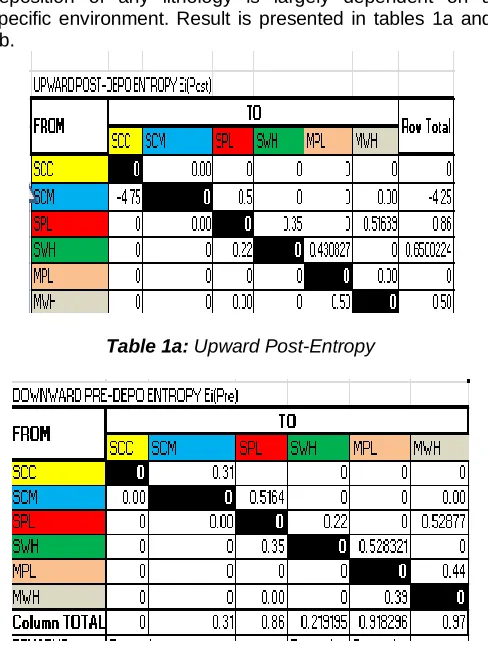
This work applied the entropy concept on an established area of Markovian presence|cyclicity, to determine the degree of randomness of the lithofacies in succession. Six lithofacies were studied: cross-bedded coarse grained sandstone (SCC), cross-bedded medium grained sandstones (SCM), planar/parallel laminated sandstone (SPL), wavy rippled sandy heterolith (SWH), parallel laminated mudstone (MPL), and wavy rippled muddy heterolith (MWH). We calculated for post depositional entropy and pre-depositional entropy, expressed as:
deposition of any lithology is largely dependent on a specific environment. Result is presented in tables 1a and 1b.
Table 1a: Upward Post-Entropy
Table 1b: Downward Pre-Entropy
A normalized entropy (En) was evaluated to eliminate increasing influence of lithologic facies states on Ei(post) and Ei(pre) (according to Hattori 1976). This is expressed as:
Where, En is the normalized entropy, E is either post– depositional or pre–depositional entropy, and Emax is the maximum entropy possible in a system where n state variable operates. The value of E (system) varies between‖ –log2 1/n‖ and ―-log2 1/n(n–1)‖. Result is presented in table 2
and Chart 1. Entropy for the whole sedimentation process as a measure of depositional system was interpreted (using Hattori 1976 method). This is expressed as:
E (system) = where rij = fij/n
Table 2: Normalised Entropy and Relationship
Chart 1: Entropy Relationship of En(pre) and En(post).
Table 3: E(system)
RESULTS AND INTERPRETATION
From table 2, it is seen that En(Pre) = En(Post) for the cross-bedded coarse grained sandstone (SCC) facies and Planar/Parallel Laminated Sandstone(SPL), indicating there is no dependency of Pre-deposition or post-deposition existing there. For the cross-bedded medium grained sandstone(SCM) and the Wavy Rippled Sandy Heterolith (SWH), the En(Pre) < En(Post), implying that they have stronger dependence on the preceding facie to occur than on succeeding bed. For the Planar Laminated Mudstone (MPL) and Wavy Rippled Muddy Heterolith (MWH) facies, En(Pre) > En(Post), indicating that they have minimal dependency of occurrence on the preceding facie, meaning they could individually occur after a different state. It is seen in presented normalized entropy result that the (E(pre)) and
(E(post)) for all the lithofacies ranges from 0 – above,
230
(SCC) and parallel laminated mudstone (MPL) facies has the lowest lateral continuity while the planar/parallel laminated sandstone (SPL) has the highest lateral continuity.
Chart 2: E(system) Depositional Environment Interpretation
CONCLUSION
The lateral continuity of lithofacies is related to the reservoir continuity within the study area. The broad random degree and lateral continuity of sedimentation process showed that the planar/parallel laminated sandstone (SPL) has the highest lateral continuity while the cross-bedded coarse grained sandstone (SCC) and parallel laminated mudstone (MPL) facies has the lowest lateral extent continuity. The sedimentation process as established from Hattori (1976) followed the type B symmetrical plot, interpreted as bypassing of sediments, forming a thickening and thinning sequence of sediments which is attributed to fluctuations and changing of environment of deposition as the flow pattern changes from deltaic to shallow marine environment. This work can be used to improve reservoir management, predict reservoir performance and better future well placements within the study area of the Niger Delta.
REFERENCES
[1]. Ahiarakwem, C.A and Opara, A.I.(2012). Application of Brine Concentrations as a Reconnaissance Geochemical Tool for Hydrocarbon Exploration: Case Study of Field ―X‖, OML63, Coastal Swamp 1 Depobelt, Niger Delta Basin, Nigeria. Volume 2 No.8, August 2012 ISSN 2224-3577 International Journal of Science and Technology 507-516.
[2]. Anderson, T. W. and Goodman, L. A .(1957). Statistical inference about Markov chain; Ann. Math. Statist. 28 89–110.
[3]. Beka, F.T., and Oti, M.N. (1995). The distal offshore Niger Delta: frontier prospects of a mature petroleum province, G., eds., Geolgy of Deltas: Rotterdam, A.A. Balkema, 237 -241.
[4]. Carr, T. (1982). Log-Linear Models Markov chains and cyclic sedimentation. Journal of Sedimentary Petrology: 52, 905–912.
[5]. Doust, H. and Omatsola, E. (1989). Niger Delta, in Divergent passive margin basins, J.D. Edwards and P.A Santogrossi, eds., AAPG Memoir 48, 201-238.
[6]. Doust, H. and Omatsola, E. (1990). Niger Delta, in, Edwards, J. D., and Santogrossi, P.A., eds., Divergent/passive Margin Basins, AAPG Memoir 48 Tulsa, 239-248.
[7]. Doveton, J. H. (1971). An application of Markov chain analysis to the Ayrshire Coal Measures succession. Scott. Jour. Geol., 7, 11 – 27.
[8]. Ejedawe. J.E. (1981). Patterns of incidence of Oil reserves in Niger Delta Basin: American Association of Petroleum Geologists, 65, 1574- 1585.
[9]. Ejedawe, J.E. (1989). The Eastern Niger Delta: Geological Evolution and Hydrocarbon Occurrences,‖ SPDC Internal Report Exploration Note 89.002.
[10]. Ejedawe, J.E., & Coker, S.,J.L., Lambert-Aikhionbare, D.O., Alofe, K.B., Adoh, F.O (1984). Evolution of oil-generative window and oil and gas occurrence in Tertiary Niger Delta Basin: American Association of Petroleum Geologists, 68, 1744-1751
[11]. Hattori, I. (1976). Entropy in Markov chains and discrimination of cyclic patterns in lithologic successions. Math. Geol., 8, 477-497.
[12]. Hunt, J.M. (1990). Generation and migration of petroleum from abnormally pressured fluid compartments: American association of Petroleum Geologist Bulletin, 74, 1-12.
[13]. Ikoro, D.O, Amajor, L.C, Inyang, D.O, Okereke, C.N, Ekeocha, N.O, Ibeneme, S.O, Israel, H.O, Nwagbara J.O and Essien, A.G. (2014). Facies Model Determination Using Markov Chain Analysis: A Case Study of Ajali Sandstone in Ohafia-Igbere, Southeastern Nigeria. Intl Research Journal of Geology and Mining (IRJGM) (2276-6618) Vol. 4(7) 188-198.
[14]. Malvic, T., Velic, J. & Peh, Z. (2005): Qualitative- Quantitative Analyses of the Influence of Depth and Lithological Composition on Lower Pontian Sandstone Porosity in the Central Part of Bjelovar Sag (Croatia). Geologia Croatica, 58, 1, 73- 85.
[16]. Miall, A.D.(1973). Markov chain analysis applied to an ancient alluvial plain succession. Sedimentology 20: 347-364.
[17]. Reijers, T.J.A. (1996).Selected Chapters on Geology. S.P.D.C. Corporate Reprographic Services: Warri, Nigeria, P. 197.
[18]. Reijers, T.J.A. (2011). Stratigraphy and Sedimentology of the Niger Delta. Geologos, 17(3): p. 133 – 162.
[19]. Reijers, T.J.A., & Petters, S.W., Nwajide, C.S. (1997). Niger Delta Basin, in Selley, R.C., ed., African Basins—Sedimendary Basin of the World (3): Amsterdam, Elsevier Science, 151-172.
[20]. Schwarzacher, W. (1969). Sedimentation models and quantitative stratigraphy. Elsevier Publ. Co. Amsterdam 382.
[21]. Schwarzacher, W. (1969). The use of Markov chains in the study of sedimentary cycles. Jour Math Geol 1: 17-39.
[22]. Stoneley, R., (1966). The Niger Delta region in the light of the theory of continental drift. Geology Magazine, 105: 385-397.
[23]. Tewari RC, Singh DP, Khan ZA (2009). Application of Markov chain and Entropy analysis to lithologic succession – an example from early Permian Barakar Formation, Bellampalli coalfield, Andhra Pradesh, India. J Earth Sys. Sci 18: 583–596.
[24]. Walther, J. (1893). Einleitung in die Geologie als historische Wissenschaft – Beobachtungen uber die Bildung der Gesteine und ihre organischen Einsclusse, Vol.1, Fischer, Jena.
[25]. Weber, K. J.(1971). Sedimentological aspects of oil fields in the Niger delta, Geologie en Mijnbouw, vol. 50, 559–576.