2353
Understanding The Concept Of Visualization
Phase Student In Geometry Learning
Baiduri, Agung Deddiliawan Ismail, Riny Sulfiyah
Abstract: This study aims to analyze the concept understanding of junior high school students in the visualization phase in geometry learning using van Hiele's models assisted by manipulative media of the rotary wheel. The research design used experimental teaching with descriptive type and there are 26 students of VII grade of Junior High School 4 as research subjects. Data were collected by observation, VHGT, tests and analyzed descriptively. The results showed that student's understanding of concepts in quadrilateral and triangle materials were good. At each stage of the van Hiele learning model, students can understand various indicators of understanding concepts. Furthermore, learning the geometry of van Hiele's model assisted by the manipulative media of the rotary wheel improves student thinking from the visualization phase to the analysis phase.
Index Terms: Concept Understanding, Visualization Phase, van Hiele Model, Manipulative media
—————————— ——————————
1 INTRODUCTION
Geometry is one part of mathematics related to the relationship between points, lines, angles, plane figure and spaces (Salim K &Tlawa, 2015) and one of the materials that obligatory taught in schools (NCTM, 2000). Geometry learning can help developing logical thinking skills, deductive reasoning, analytical reasoning and problem solving (Armah, Cofie, &Okpoti, 2018). Geometry abilities that students must possess are able to describe geometric shapes, analyze the characters and properties of geometric shapes, and make comparisons between geometric shapes (Al-ebous, 2016). Conceptual understanding is one of the prerequisites for learning mathematics (geometry) successfully and consider as important component to be proficient in mathematics (Kilpatrick, Swafford & Findell, 2001) and is very important in learning mathematics to understand other fields (Jelatu, Sariyasa & Ardana, 2018 ). Understanding the concept of geometry can help students think logically and deductively about mathematical objects and their relationships (Alqahtani& Powell, 2016). Understanding the concept is the main requirement for further learning activities, thus without sufficient understanding, it will be difficult to proceed further mathematic topics for student. Hershkowitz (1989) sets out the criteria for student’s concepts understanding, namely: 1) The ability to explain why certain objects or events are examples or non-examples. 2) The ability to define a concept based on examples or, at the very least, use the definition as a criteria for categorization, and 3) The ability to use concepts to solve problems, explain other concepts and explain the relationship between concepts and other concepts. While Yeni (2011) and Halim (2015) develop indicators of student's concepts understanding including:
1) The ability to restate a concept,
2) The ability to classify objects based on certain properties according to the concept, 3) The ability to give examples and not examples of concepts, 4) Presenting concepts in various forms of mathematical representation, 5) Developing the necessary and sufficient conditions of a concept, 6) Using,
utilizing and choosing certain procedures or operations, and 7) Applying concepts or algorithms solving mathematical concepts. Based on student’s understanding of geometry, van Hiele divides ways of understanding spatial visualization into five hierarchical levels, namely visualization, analysis, informal deduction, deduction and rigor (Usiskin, 1982; van de Walle, Karp & Bay-Williams, 2007; Alex &Mammen, 2015). Descriptions of these levels are as follows: Level 0: Recognition (or Visualization), students recognize images based on what they appear and make decisions based on intuition rather than reason. Level 1: Analysis (or Descriptive), students recognize images based on their characters, analyze and name image properties, however, they fail to relate between these properties. Level 2: Informal (or theoretical) deduction, students can distinguish necessary and sufficient conditions for a concept, forming meaningful definitions and provide informal arguments to justify their reasons. Level 3: Deduction, students can build theories in axiomatic systems. Knowing the meaning of the necessary and sufficient conditions of a theorem. Level 4: Rigor (stiffness), students understand the relationships between various geometry systems, compare, analyze, and make evidence in geometry systems. According to van Hiele, students must pass these five levels in a sequential order assisted by appropriate teaching methods without skipping any levels.
The difficulty of students in understanding mathematical concepts is due to many concepts which have different meanings in daily life and various mathematics terms in different contexts (Patkin, 2011). For example, a solid object in daily life means having particle coherence (different from liquid or gas). In mathematics, solid means three-dimensional geometric image like polyhedron or cone. The word "side" in daily life means any party, team, interest, or opinion that contradicts with another party. In mathematical language, "side" means one of the lines connecting the points of a polygon (Patkin, 2015). Some research states that many students at all levels experience errors about geometry concepts (Marchis, 2012; Safrina, 2014; Utami, Mardiyana, & Pramudya, 2017) as well as the difficulties of students in elementary and junior high schools and even adults in visualizing 2-3-dimensional dimensions and vice versa (Hershkowitz, 1990; Barkai & Patkin, 2012). For example, when they see a sphere in reality, it will look like a circle in the picture because it is difficult to describe 3-dimensions in images that have 2-dimensions. This is due to the teaching methods used in teaching geometry (Lim &Hwa, 2007), teachers ignoring spatial relationships (Karakuş & Peker, ————————————————
Baiduri, University of Muhammadiyah Malang, Indonesia, [email protected]
Agung Deddiliawan Ismail, University of Muhammadiyah Malang, Indonesia, [email protected]
2354 2015) and ineffective textbooks (Hershkowitz, 1987).
Mathematical teaching and learning should enable students to develop comprehensive understanding in learning mathematics and find out how students understand these concepts. Priority in teaching and learning is to enable student progress through various levels based on content and methods and not age. Therefore, teachers play an important role in teaching and learning geometry. Susanti (2011) stated that in learning mathematics there are still many students who do not understand what is conveyed by the teacher. The learning model that can provide understanding of geometry and develop understanding of geometry concepts is the van Hiele model (Yadil 2009; Alex & Mammen, 2015). According to van Hieles, a student develops through every level of thought as a result of instruction arranged in five learning phases, namely: 1) Information; 2) Guided Orientation; 3) Explanation; 4) Free orientation; 5) Integration (Clements & Battista, 1992; Yadil, 2009). The Information Phase, through discussion, the teacher identifies student’s prior knowledge of topic and oriented to a new topic. The guided orientation phase, students explore the object of instruction in carefully structured tasks such as folding, measuring, or making. The teacher ensures that students explore certain concepts. Explanatory Phase, students describe what they have learned about the topic in their own words. The teacher introduces relevant mathematical terms. The Free Orientation Phase, students apply the relationships they learn to solve problems and investigate more about open assignments. The Integration Phase, students summarize and integrate what they have learned, developing a network of new objects and relationships (Mason, 2002). In addition to learning models, which can improve students' understanding of mathematical concepts are manipulative objects (learning media) (Yeni, 2011). Learning media helps students visualize mathematical objects, especially abstract ones (Berney&Betrancourt, 2016), arousing passion for learning and deliberately making learning process is more interesting (Susilana&Riyana, 2009; Cope, 2015). Researches on understanding the concept of geometry in learning such as Jelatu, Sariyasa&Ardana (2018) with the REACT strategy and GeoGebra, Yeni (2011) using manipulative media, and Asrul (2011) using the guided discovery method. Geometry learning research using van Hiele model and assisted by geometry software media (Kanandjebo & Ngololo, 2017; Karakuş & Peker, 2015; Kurniawati, Junaedi, &Mariani, 2015; Abdullah &Zakaria, 2013; Kutluca, 2013; Siew et.al, 2013; ) with the object under study van Hiele's level of thinking. Based on previous research, there are no specific examination on geometry learning van Hiele model and manipulative media which is associated with concept understanding geometry. Thus, the research with this focus is widely open to conduct further exploration. This study aims to implement the van Hiele learning geometry model assisted by manipulative media of the rotary wheel and its effect on the understanding of concepts and thinking levels of students in junior high school. The manipulative learning media is in the form of a Turning Wheel that functions as a tool for learning and helps students to comprehend the concept of geometrical material in plane figure.
2 METHOD
2.1 Research Design
This study uses an experimental teaching design with
descriptive type because the aim is to describe the development of student's understanding of the visualization phase through the learning process provided by the teacher using the Van Hiele learning model using the rotary wheel media (Gravemeijer and Cobb, 2006). The basis of this research is learning presumption and produce a learning projection. The presumption were analyzed, redesigned, revised and implemented again. The approach used in this study is a qualitative and quantitative approach. A qualitative approach is used to describe the implementation of learning using the media by observing the level of student thinking using Van Hiele's theory to describe the understanding of student concepts in learning geometry. While the quantitative approach is used to observe the results of the analysis of test questions. The qualitative approach is carried out intensively, the researcher participates fully in the research, records every activity in the study, analyzes reflective of the documents found in the study and produce a detailed report (Arikunto, 2013).
2.2 Subject
The subjects in this study were students of class VII in Junior High School 4 Pamekasan in odd semester of 2018/2019 academic year who were at the level of visualization thinking. 26 students during visualization phase were subjected to the results obtained from the pre-test conducted on 32 students.
2.3 Instruments
Research instruments firstly used are the media validation sheet and lesson plan validation. Learning media validation sheets designed for visualization phase students include aspects of: 1) conformity with learning material, 2) usefulness, 3) ease of operation, 4) engineering of visual media (effectiveness and efficiency, maintenance and management, use and operation, determination of media type, easy to operate, and reuse), and 5) visual media communication (shape, color, texture, simplicity, emphasis, and cohesiveness) (Munadi, 2010). Indicators developed for the lesson plan validation sheet referred to Dahar (2011) which included aspects of: 1) formulation of learning objectives, 2) presentation of content, 3) Language, and 4) time. Second is the observation sheet. This sheet is used to observe student’s concept understanding of the visualization phase during learning activities that ignore the learning stage of Van Hiele's theory for the visualization phase (Clements & Battista, 1992; Yadil, 2009). The indicators of student's concept understanding were adapted from Yeni (2011) and Halim (2015). Third is the test sheet used to observe the level of student thinking (van Hiele phase), van Hilele Geometry Test (VHGT) adapted from Usisikin (1982) as many as 25 multiple choice questions where for each level of thinking there are 5 questions in stages. The first five questions to measure the lowest level of thinking (visualization) and the last five questions for the very high level of thinking (rigor). The four sheets of the students' concept understanding test after going through the learning process using the media of the rotary wheel and the van Hiele stage for the visualization phase. For the test, seven breakdown questions were used with rectangular and triangular material. All instruments are validated by experts who are competent in their fields.
2.4 Data Colection and Analisys
2355 validity of the lesson plan (RPP), the level of student thinking
(van Hiele phase), and the data of student's concept understanding. Media validity data was obtained from the material and media expert validator, and the lesson plan validity was obtained from the learning expert validator. Data for students' thinking levels were obtained from written test results adapted from Usisikin (1982) consisting of 25 multiple choice questions to select research subjects and 10 questions to see the effect of manipulative rotary wheels media on van Hiele thinking levels given after the learning process. Data collection of student’s concept understanding is done by observing the activities and the students' answers on student test sheets. In observation, what is observed is the process of students in understanding the plane figure material. Whereas in the test, it is focused on the way students answer the test questions. Data analysis to determine the level of thinking of students according to van Hiele's phase was done by counting the number of correct answers from each phase of thinking. If students answer at least three questions correctly at a particular phase (eg the visualization phase), then the level of thinking is in that phase (visualization). Research subjects answered 2 or 3 of the first 5 questions. Analysis of the effectiveness of the media seen from the analysis of Van Hiele's test questions which amounted to 10 questions in the form of multiple choice. If a minimum of 75% of test takers answer all the first five questions and at least the next two questions correctly then the media is considered effective. To determine the understanding of concepts, each indicator or aspect observed is given a score of 1 if students are unable to carry out activities, a score of 2 if students do activities but is unclear or inappropriate, and a score of 3 if students carry out activities clearly and precisely. Furthermore, communication skills are determined by the formula X = S / T × 100%, where X represents the value of students' concept understanding ability, S is the total score obtained by students and T is the maximum score. Understanding the concepts are categorized as very good if 81% <X ≤ 100%, good if 61% <X ≤ 81%, sufficient if 41% <X ≤ 61%, insufficient if 21% <X ≤ 41%, and poor if 0% <X ≤ 21% (Asrul, 2011). The results of the lesson plan validation by the validator is considered to be feasible applying in learning with an average of 89.67% with a very good category / very feasible to use. Aspects of the formulation of learning objectives with an average of 92.00% with very good categories, aspects of the content presented with an average of 100% with excellent criteria, and aspects of language with an average of 86.67% with very good categories, as well as time aspect with an average of 80.00% with the good category. For the test and observation sheets are valid, with the average validation results in both categories and can be used for data collection. The results of the validation of the rotary wheel media are valid as presented in Table 1.
TABLE 1.
Rotary Wheel Media Validation Results
No. Aspects Percentage (%)
Validator 1 Validator 2 Average 1. Indicator of Learning Material 87,5 % 91,7 % 89,6 % 2. Usefulness 75,0 % 83, 3 % 79,2 % 3. Ease of Operation 75,0 % 100 % 87,5 % 4. Visual Media Engineering 78,5 % 92,8 % 85,6 % 5. Visual Media Communication 75,0 % 90,6 % 82,8 %
Average 84,9 %
2.5PROCEDUR
The research procedure followed the Teaching Experimental
stages (Gravemeijer& Cobb, 2008), such as teaching preparation, experimental teaching, and analysis processing of teaching. Teaching preparation activities began by observing the learning process in class VII at Junior High School 4 Pamekasan with a total of 32 students. The results of observations showed that the process of learning mathematics still rarely uses concrete learning media. The teacher rely on textbooks, blackboards and power points. Therefore, there are many students who experience difficulty understanding the material described. In geometry material, for example, the teacher only uses a blackboard to draw. When students are asked to solve problems or asked to mention about the elements in geometric shapes, students are lost. Furthermore, tests are conducted to observe the level of student thinking by using Usisikin questions (1982). 26 of the 32 students who took the test were at the visualization level based on van Hiele's level of thinking. After obtaining the real subject, researcher makes manipulative learning media called the rotary wheel media. The wheel media is made with plywood measuring 30 cm x 30 cm, the inside is made of acrylic measuring 27 cm x 27 cm. The acrylic is divided into 8 parts then given a border. The media consists of three main parts, such the front side, back side and the inside as shown in Figure 1.
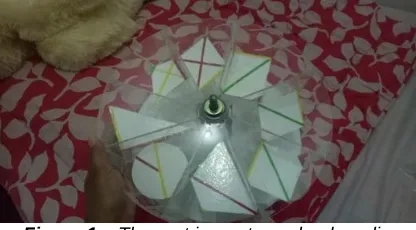
Figure 1a. The front view of the rotary wheel media
In Figure 1a can be seen the front view of the rotary wheel media, on the glass cup formed by an angle of 45 ° when rotated, the plane shape in the media will change. There are 8 planes in the wheel. The goal is that students can understand the planes and understand about its properties.
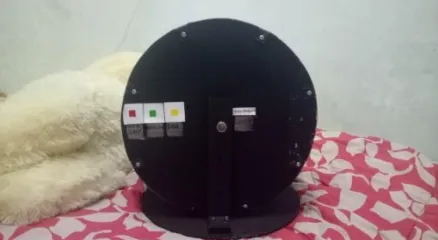
Figure 1b. The back side of a rotary wheel media
2356 Figure 1c. The part in a rotary wheel media
Figure 1c is a part in a rotary wheel media which is divided into 8 parts with 8 geometry shapes that vary according to the material to be taught. Yellow, red, and green colors are the colors that will be explained by the three holes lined up on the left as seen in the back view. After the media is finished, the researcher then prepares the lesson plans and research instruments and validates them to the experts. The experimental teaching phase carried out mathematics learning in class VII students of Junior High School 4 Pamekasan in the visualization phase, totaling 26 students using the rotary wheel media. The study was conducted three times where the last meeting was a test. Each meeting uses 2 x 40 minutes and is assisted by two observers to observe the understanding of concepts during the learning process. The learning syntax ignores the learning stages of Van Hiele's theory for the level of thinking in the visualization phase (Yadil, 2009) and links it with indicators of concept understanding in each step / stage of learning. After learning through the 5 stages above, students are then tested, this test is used to revise / evaluate for further learning activities. The last step is analysis processing of teaching by analyzing the data obtained during the learning process and writing the results of these activities in the form of student’s concept understanding as a result of geometry learning with the rotary wheel media.
Findings
Based on the results of the study, the research findings understanding of concepts of the visualization phase students’ in geometry learning using van Hiele's models assisted by manipulative media of the rotary wheel.student's in quadrilateral and triangle materials were good. At each stage of the van Hiele learning model, students can understand various indicators of understanding concepts (very good). Using van Hiele's model assisted by the manipulative media of the rotary wheel in learning the geometry improves student thinking from the visualization phase to the analysis phase.
4 FINDINGS
The researcher identified the effect of using the rotary wheel media on the conceptual understanding based on the learning process that was conducted twice and test results. The learning meeting was held on quadrilateral and triangle material for the second meeting. While the effect is on van Hiele's level of thinking by comparing the results of pre-test and post-test results. This is done in detail by explaining the assignments, student work, and student strategies as well as the researchers' interpretation of the process of understanding geometrical concepts. The learning process carried out is based on the van Hiele learning stage for students in the level of visualization thinking, which includes the information, guide orientation, explication, free orientation, and integration
stages, which are explained in detail below.
4.1 Information Stage
The student activity at this stage listens to the teacher's explanation of how to use the rotary wheel media and looks for information related to the material being discussed. The teacher informs or introduces students to a plane figure, so students begin to think about the shape of the plane figure and what is owned by a plane figure. Students look for information about rectangular and triangle shapes. In this stage students begin to know the types of rectangular and triangles from student books and the surrounding. At meeting I, students were not accustomed to seek information independently which was hugely different at meeting II, where students were already active in searching for information related to subject matter. From the results of dialogue between teachers and students in the class, when in the information stage students understand the concept through clarification of objects according to certain properties (sides) in accordance with the concept of square and rectangle, as well as by giving examples and not examples (ceramics in the form of rectangles and asbestos in the form of rectangles) and triangular differences and quadrilateral, and restate a concept by explaining triangles have three sides and quadrilateral has four sides.
4.2 Stage Orientation Guide
Students begin to apply the rotary wheel media and understand the shapes in the media. In this case the students find out what properties each rectangle and triangle shape have. This stage, students have understood the quadrilateral and triangle shapes by restating a concept. Students also have been able to classify objects according to certain traits with their concepts through the grouping of quadrilateral and triangle shapes using media. Students are able to explain a concept of quadrilateral and triangle shapes, which means students are able to restate a concept.
4.3 Explication Stage
In this step, students write down their observations on the rotary wheel media. At this stage, students are able to restate a quadrilateral and triangle concept which includes the name of the plane, shape, and determine the elements that exist in the shape. In addition, students are able to classify objects according to certain characteristics. Thus, students are able understand the sides, angles and diagonals in a plane figures in sequence and present concepts in various forms of mathematical representation from visual representations (images) to verbal representations. Also at this stage students are able to give examples and not examples of plane figure concept that is reinforced by the dialogue with students. Further in solving problems on the worksheet, students begin by drawing a plane figure followed by the name of the shape and its elements. This means students have used and selected certain procedures and algorithms for solving mathematical concepts.
4.4 Free Orientation Stage
2357 classify objects according to certain characteristics related to
the concepts by mentioning the types of rectangles and triangles, restating a concept, giving examples and not an example of a concept, and develop the necessary and sufficient conditions of a concept by distinguishing between rectangular and triangular shapes, and mentioning the elements or properties of plane figure. At this stage, students are also able to develop the necessary and sufficient conditions of a concept by explaining why a plane figure is called a square or isosceles triangle and others and is able to complete a concept precisely in accordance with certain steps.
4.5 Integration Stage
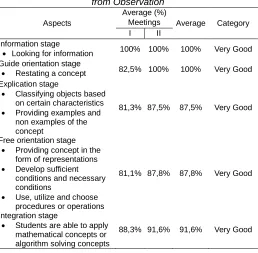
The last stage is the integration stage, at this stage, students are able to choose a concept and explain it directly and conclude their learning outcomes about the rectangular and triangular shape as shown in the students’ work sheet. A square has four angles, four sides, has two opposing sides (not quite right, because not all rectangles have this property). While the students' conclusions about triangles are three sides, three angles and no diagonals. This means students are able to develop the necessary and sufficient conditions of a concept and classify objects according to certain properties according to the concept. Furthermore, in drawing conclusions students use information obtained previously, which means that they have used and selected certain procedures. The results of understanding the concepts during the learning process were reinforced by the observations of two observers about the implementation of learning presented in Table 2 and the written test results in Table 3.
TABLE 2.
Implementation of Learning and Understanding the Concepts from Observation
Aspects
Average (%)
Average Category Meetings
I II Information stage
Looking for information 100% 100% 100% Very Good Guide orientation stage
Restating a concept 82,5% 100% 100% Very Good Explication stage
Classifying objects based on certain characteristics Providing examples and
non examples of the concept
81,3% 87,5% 87,5% Very Good
Free orientation stage Providing concept in the
form of representations Develop sufficient
conditions and necessary conditions
Use, utilize and choose procedures or operations
81,1% 87,8% 87,8% Very Good
Integration stage
Students are able to apply mathematical concepts or algorithm solving concepts
88,3% 91,6% 91,6% Very Good
The results of these observations inform that all the stages of van Hiele learning for visualization phase students are carried out very well by students who directly encourage the ability of students to understand concepts.
Table 3.
Concept Understanding Result from the Written Test
No Indicators Average
(%) Category 1. Being able to restate a concept 80.26 Very Good 2. Classifying Objects According to Specific
Characters with Its Concept 81.63 Very Good
3. Giving Examples and Not Examples of the
Concept 79.63 Good
4. Presenting concepts in various mathematical
representations 82.74 Very Good
5. Developing sufficient conditions and
necessary conditions in a concept 78.78 Good
6. Use, Utilize and Select Certain Procedures
or Operations 71.96 Good
7. Applying the Concept or Algorithm to Solve
Mathematical Concepts 71.78 Good
Total 78.11 Good
Test results show that students have a good level of concept understanding. At indicators 1, 2 and 4 students' understanding of concepts is very good. The other indicators are good, students' understanding of concepts is good because more than 70% of students are able to meet the seven indicators. The results of tests using 10 questions of the visualization and analysis phase (Usisikin, 1982) to the research subjects after the last learning were obtained that all subjects answered correctly at least 7 questions with the first 5 questions all correct.
5 DISCUSSION
2358 geometry with the van Hiele model and the rotary wheel media
eventually give students comprehensive understanding about the concept of quadrilateral and triangular shapes. These results are in line with previous studies (Yadil, 2009; Yeni, 2011; Safrina, 2014; Ketut, 2014; Al-ebous, 2016; Utami et.al, 2017). Based on the results of the VHGT pretest, it was found that the eighth grade students at Junior High School 4 Pamekasan were mostly at the level of visualization thinking with an average of 2.88. This result is in line with (Yazid, 2009; Molinasari, Sujadi, &Aryuna, 2017) which states that the level of thinking of middle school students is mostly in the visualization phase. However, after the learning process was carried out with the van Hiele learning stage with the help of manipulative media the rotating wheel average increased to 7.44 (students are in the analysis phase). This means that there is an increase in students' thinking phases from visualization to analysis. Thus, learning with the van Hiele model assisted by the manipulative media of the rotary wheel has a positive impact on the level of student thinking (Mariani, 2016; Halim, 2015; Karakuş & Peker, 2015; Siew et al., 2013;).
7 CONCLUSION
The implementation of learning using Van Hiele theory and the rotary wheel media is able to make student’s visualization phase know and understand about the plane figure and its properties. Understanding the concept of the aspect ―being able to restate a concept, classifying objects according to certain characteristics with the concept, and presenting concepts in various mathematical representations‖ is very good. while for musty ―give examples and not examples of concepts, develop necessary and sufficient conditions for a concept, use, utilize and choose certain procedures or operations, and apply concepts or algorithms to solve mathematical concepts‖ appears to be in good categories. Furthermore, the results of the study stated that there was a positive effect on the use of the wheel media on the level of thinking of junior high school students, because there was an increase in the thinking phase from the visualization phase to the analysis phase. In this phase students already know and understand the type of plane figure along with the properties possessed by each plane figure. Thus, the wheel media can be said to be effectively used in the learning of flat geometry. Therefore it can be used as an alternative by the teacher in an effort to increase the understanding of geometry concepts and van Hiele's level of thinking.
REFERENCES
[1] Abdullah, A. H., & Zakaria, E. (2013). The Effects of Van Hiele's Phase-Based Instruction Using The Geometers' Sketchpad (GSP) on Students' Levels of Geometric Thinking. Research Journal of Applied Sciences, Engineering and Technology, 5 (5), 1652-1660.
[2] Al-ebous, T. (2016). Effect of the Van Hiele Model in Geometric Concepts Acquisition : The Attitudes towards Geometry and Learning Transfer Effect of the First Three Grades Students in Jordan. International Education Studies, 9(4), 87–98.
[3] Alex, J. K., & Mammen, J. K. (2016), Lessons Learnt from Employing van Hiele Theory Based Instruction in Senior Secondary School Geometry Classrooms. Eurasia Journal of Mathematics, Science & Technology Education, 12(8), 2223-2236. doi: 10.12973/eurasia.2016.1228a
[4] Alqahtani, M.M. & Powell, A.B. (2016). Instrumental
Appropriation of a Collaborative, Dynamic-Geometry Environment and Geometrical Understanding. International Journal of Education in Mathematics, Science and Technology, 4(2), 72-83
[5] Arikunto, suharsimi. (2013). Prosedur Penelitian Suatu Pendekatan Praktik (Research Procedure of a Practical Approach). Jakarta: PT. Rineka Cipta
[6] Armah, R.B., Cofie, P.O., & Okpoti, C.A. (2018). Investigating the effect of van Hiele Phase-based instruction on pre-service teachers’ geometric thinking. International Journal of Research in Education and
Science (IJRES), 4(1), 314-330.
DOI:10.21890/ijres.383201
[7] Asrul, Karim. (2011). Penerapan Metode Penemuan terbimbing dalam Pembelajaran Matematika untuk meningkatkan Pemahaman Konsep dan Kemampuan Berfikir Siswa Sekolah Dasar (Application of the Guided Discovery Method in Mathematics Learning to Enhance Understanding of the Concepts and Thinking Abilities of Elementary School Students). Jurnal Pendidikan Universitas Negeri Surabaya, 2(1), 20 – 39.
[8] Barkai, R. & Patkin, D. (2012). Geometric thinking levels of in-service and pre-in-service mathematics teachers at various stages during their training. The Kibbutzim Education College Yearly, 34, 83-96.
[9] Berney, S., & Bétrancourt, M. (2016). Does animation enhance learning? A meta-analysis. Computers &
Education, 101, 150-167.
http://dx.doi.org/10.1016/j.compedu.2016.06.005
[10] Cope, L. (2015). Math Manipulatives: Making The Abstract Tangible. Delta Journal of Education, 5(1), 10 – 19. [11] Clements, D. H. and Battista, M. T. (1992). Geometry and
spatial reasoning. In D.A. Grouws (ed.), Handbook of Research on Mathematics Teaching and Learning. New York: Macmillan.
[12] Dahar, R.W. (2011). Teori-Teori Belajar & Pembelajaran (Theories of Study & Learning). Jakarta: Erlangga
[13] Gravemeijer, K & Cobb, P. (2006). Design Research From A Learning Design Perspective. EducationalDesign Research.
[14] Gravemeijer, K & Cobb, P. (2008). Experimenting to Support and Understand Learning Processes. Handbook of Design Research Methods in Education.
[15] Halim, Abdulllah. (2015). The Effects of Van Hiele's Phases of Learning Geometry on Students’ Degree of Acquisition of Van Hiele Levels. International Journal
Procedia - Social and Behavioral Sciences, 102, 251 – 266.
[16] Hershkowitz, R. (1987). The acquisition of concepts and misconceptions in basic geometryor when "a little learning is a dangerous thing. In J. D. Novak (Ed.), Proceedings of the second international seminar on misconceptions and educational strategies in science and mathematics (pp. 238-251). Itacha, NY: Cornell University [17] Hershkowitz, R. (1989). Visualization in geometry – two sides
of the coin. Focus on Learning Problems in Mathematics, 11(1), 61-76.
[18] Hershkowitz, R. (1990). Psychological aspects of learning geometry. In P. Nesher & J. Kilpatrick (Eds.), Mathematics and cognition (pp. 70-95), Cambridge, UK: Cambridge University Press.
2359 Geometry Concepts. International Journal of Instruction,
11(4), 325 – 336.
[20] Kanandjebo, L. N. & Ngololo, E. N. (2017). The Effects of Geometry Sketchpad’ on Grade 12 Learners’ Performance in Geometry, IEJME, 12(3), 735 – 747. [21] Karakuş, Fatih and Peker, Murat. (2015). The Effects of
Dynamic Geometry Software and Physical Manipulatives on Pre-Service Primary Teachers’ Van Hiele Levels and Spatial Abilities. Turkish Journal of Computer and Mathematics Education. 6(3), 338 – 365.
[22] Ketut, Sutama. (2014). Pengembangan Perangkat Pembelajaran Geometri Berdasarkan Teori Van Hiele Berbantuan Wingeom Dalam Upaya Meningkatkan Aktivitas Dan Hasil Belajar Siswa (The Development of Geometry Learning Tools Based on Van Hiele's Theory Assisted Wingeom in Efforts to Improve Student Activities and Learning Outcomes). e-Journal Program Pascasarjana Universitas Pendidikan Ganesha Program Studi Matematika, 6(2), 11 – 21.
[23] Kilpatrick, J., Swafford, J. & Findell, B., eds. (2001). Adding it up: Helping children learn mathematics, Washington DC: National Research Council
[24] Kurniawati, M., Junaedi, I., & Mariani, S. (2015). Analisis Karakteristik Berpikir Geometri dan Kemandirian Belajar dalam Pembelajaran Fase Van Hiele Berbantuan Geometers Sketchpad (Analysis of Geometry Thinking Characteristics and Learning Independence of the Van Hiele Phases Assisted by Sketchpad Geometers). Unnes Journal of Mathematics Education Research, 4 (2), [25] Kutluca, T. (2013). The effect of geometry instruction with
dynamic geometry software; GeoGebra on Van Hiele geometry understanding levels of students. Global Educational Journal of Science and Technology. 1(1), 1 – 10.
[26] Lim, C., & Hwa, T. Y. (2007). Promoting mathematical thinking in the Malaysian classroom: issues and challenges. Retrieved from http://www.criced.tsukuba. ac.jp/math/apec/apec2007/paper_pdf/Lim%20Chap%20S am.pdf
[27] Mariani, Andi. (2016). The Effect Of Van Hiele Learning Model Toward Geometric Reasoning Ability Based On Self-Efficacy Of Senior High School Students. Internation Journal of Mathematics Education, Vol 1 No 2
[28] Marchis, I. (2012). Preservice primary school teachers' elementary geometry knowledge. Acta Didactica Naporensia, 5(2), 33-40.
[29] Mason, M. (2002). The van Hiele Levels of Geometric Understanding. Professional Handbook for Teachers, Geometry: Explorations and Applications, MacDougal Litteil Inc.
[30] Molinasari, N., Sujadi, I., & Aryuna, D. R. (2017). Analisis Tingkat Berpikir Siswa Kelas VII Semester II SMP Negeri 14 Surakarta Dalam Memecahkan Masalah Geometri Berdasarkan Teori Van Hiele Pada Pokok Bahasan Bangun Datar Jajargenjang Dan Belah Ketupat (Analysis of Seventh Grade Student’s Thinking Levels of Semester II, Junior High School 14 Surakarta in Solving Geometry Problems Based on Van Hiele's Theory in Parallelogram and Rhombic Shapes), Jurnal Pendidikan Matematika dan Matematika (JPMM), Solusi, I(6), 8 – 16.
[31] Munadi, Yudhi. (2010). Media Pembelajaran: Sebuah Pendekatan Baru (Learning: A New Approach). Jakarta: Gaung Persada Press
[32] Mwakapenda, Willy. (2004). Understanding student understanding in mathematics. Pythagoras, 60, 28 – 35. [33] Patkin, D. (2011). The interplay of language and
mathematics. Pythagoras: Journal of the Association for Mathematics Education of South Africa, 32 (2), 1-7.
[34] Patkin, D. (2015). Various ways of inculcating new solid geometry concepts. International Journal of Education in Mathematics, Science and Technology, 3(2), 140-154
[35] Safrina, Khusnul. (2014). Peningkatan Kemampuan Pemecahan Masalah Geometri Melalui Pembelajaran Kooperatif Berbasis Teori Van Hiele (Enhancing the Ability to Solve Geometry Problems Through Cooperative Learning Based on Van Hiele Theory). Jurnal Didaktik Matematika, Vol.5 No.1, Hal 57-69 [36] Salim, K. &Tiawa D.H. (2015). Implementation of
Structured Inquiry Based Model Learning Toward Students’ Understanding of Geometry. International Journal of Research in Education and Science (IJRES), 1(1), 75-83.
Siew, N. M., Chang, C. L., & Abdullah, M. R. (2013). Facilitating students' geometric thinking through van Hiele's phase-based Learning using tangram. Journal of Social Science, 9(3), 101-111
[37] Susanti, Wiwi. (2011). Efektivitas model pembelajaran Van Hiele dengan alat peraga untuk meningkatkan hasil belajar siswa pada materi pokok bangun ruang sisi datar (The effectiveness of the Van Hiele learning model with teaching aids to improve student learning outcomes on the plane flat sides subject). Jurnal Pendidikan Matematika IAIN, Vol.1 No.4, Hal 24-41
[38] Susilana, Rudi. (2009). Media Pembelajaran (Learning Media). Bandung: CV Wacana prima
[39] Usiskin, Z. (1982). Van Hiele Levels and Achievement in Secondary School Geometry. (Final report of the Cognitive Development and Achievement in Secondary School Geometry Project.) Chicago: University of Chicago. (ERIC Document Reproduction Service No. ED220288)
[40] Utami, Aliksia Kristiana Dwi, Mardiyana, & Pramudya, Ikrar. (2017). Analysis of junior high school students’ difficulty in resolving rectangular conceptual problems. Cite as: AIP Conference Proceedings 1868, 050008. https://doi.org/10.1063/1.4995135
[41] van de Walle, J. A., Karp, K., & Bay-Williams, J. M. (2007). Elementary and middle school Mathematics: Teaching developmentally (7th ed.). Boston: Pearson Education, Inc.
[42] Yadil, Nur. (2009). Penerapan Model Pembelajaran van hiele untuk meningkatkan pemahaman siswa SMP karunadipa palu terhadap konsep bangun-bangun segiempat (Application of the van hiele Learning Model to improve the understanding of Junior High School karunadipa Palu students on the concept of quadrilateral shapes). Journal Matematika FMIPA UNY, 1(4), 19 – 27. [43] Yeni, Ety. M. (2011). Pemanfaatan Benda-Benda