Screen Time in Preschool Children
WHAT’S KNOWN ON THIS SUBJECT: Interventions to reduce screen time in preschool-aged children are promising.
WHAT THIS STUDY ADDS: A screen time intervention in 3-year-old children implemented in the primary care setting did not reduce screen time or BMI.
abstract
OBJECTIVE: To determine if an intervention for preschool-aged children in primary care is effective in reducing screen time, meals in front of the television, and BMI.
METHODS:A randomized controlled trial was conducted at a primary care pediatric group practice in Toronto, Canada. Three-year-old children and their parents were randomly assigned to receive a short behavioral counseling intervention on strategies to decrease screen time. The primary outcome 1 year later was
parent reported screen time. Secondary outcomes included
television in the child’s bedroom, number of meals in front of the television, and BMI.
RESULTS:In the intention-to-treat analysis at 1 year, there were no significant differences in mean total weekday minutes of screen time (60, interquartile range [IQR]: 35–120 vs 65, IQR: 35–120; P = .68) or mean total weekend day minutes of screen time (80, IQR: 45–130 vs 90, IQR: 60–120; P = .33) between the intervention
and control group. Adjusting for baseline BMI, there was
a reduction in the number of weekday meals in front of the television (1.6 6 1.0 vs 1.9 6 1.2; P = .03) but no differences in BMI or number of televisions in the bedroom.
CONCLUSIONS: This pragmatic trial was not effective in reducing screen time or BMI but was effective in reducing meals in front of the screen. Short interventions focused solely on reducing screen time implemented in the primary care practice setting may not be effective in this age group.Pediatrics2012;130:1110–1115
AUTHORS:Catherine S. Birken, MD, FRCPC, MSc,aJonathon
Maguire, MD, FRCPC, MSc,a,bMagda Mekky, MSc,aCedric
Manlhiot, MSc,cCarolyn E. Beck, MD, FRCPC, MSc,aJulie
DeGroot, MSc,aSheila Jacobson, MB, BCh, FRCPC,aMichael
Peer, MD, FRCPC,aCarolyn Taylor, MD, FRCPC,aBrian W.
McCrindle, MD, FRCPC, MPH,cand Patricia C. Parkin, MD,
FRCPCa
aDivision of Paediatric Medicine andcLabatt Family Heart Centre,
Division of Cardiology, Department of Pediatrics, University of Toronto, The Hospital for Sick Children, Toronto, Canada; andbThe
Applied Health Research Centre of the Li Ka Shing Knowledge Institute of St. Michael’s Hospital, Toronto, Canada
KEY WORDS
screen time, television, meal, preschool, obesity, health, clinical trial
ABBREVIATION
IQR—interquartile range
Dr Birken contributed to study concept and design, acquisition of data, analysis and interpretation of data, drafting of the manuscript, critical revision of the manuscript for important intellectual content, statistical analysis, and obtaining funding; Drs Maguire, Beck, and McCrindle contributed to critical revision of the manuscript for important intellectual content; Dr Mekky contributed to acquisition of data and administrative, technical, and material support; Dr Manlhiot contributed to statistical analysis; Dr DeGroot contributed to analysis and interpretation of data and administrative, technical, and material support; Drs Jacobson, Peer, and Taylor contributed to acquisition of data; and Dr Parkin contributed to study concept and design, acquisition of data, analysis and interpretation of data, critical revision of the manuscript for important intellectual content, obtaining funding, and administrative, technical, and material support.
This trial has been registered at www.clinicaltrials.gov (identifier NCT00959309).
www.pediatrics.org/cgi/doi/10.1542/peds.2011-3088
doi:10.1542/peds.2011-3088
Accepted for publication Aug 14, 2012
Address correspondence to Catherine Birken, MD, MSc, FRCPC, Division of Paediatric Medicine, The Hospital for Sick Children, Assistant Professor, Department of Paediatrics and Department of Health Policy Management & Evaluation, Faculty of Medicine, University of Toronto, 555 University Ave, Toronto, Ontario, M5G 1X8 Canada. E-mail: [email protected]
Children are spending an increasing amount of their time engaged in screen time. Screen time, defined as time spent watching television, DVDs, or videos or playing computer or video games, has been associated with important health outcomes in children including delayed language development, aggressive behavior, cigarette smoking,1–3 and
obesity.4–10Interventions aimed at
re-ducing screen time have been a focus of childhood obesity prevention and treatment of the past decade and have yielded varying results.11,12 A recent
systematic review of 13 studies exam-ining screen time interventions in children showed that, overall, there were no effects on screen time or BMI.12 A subgroup analysis including
the 2 studies performed with preschool-aged children did identify a reduction in screen time.5,13 Neither of these
studies were implemented in the pri-mary care practice setting.12There is
compelling evidence that obesity pre-vention should be focused on preschool-aged children.14,15 This evidence
includes the following: overweight begins at a young age and persists,16
parents have control over feeding and activity of their children at this age,17 and children who learn and
adopt healthy behaviors are more likely to engage in those practices as adults.18Primary care physicians are
among the only professionals who see nearly all preschool-aged chil-dren, and their anticipatory guidance is a powerful source of parenting in-formation for young families.19,20Thus,
primary care physicians are ideally positioned to influence lifestyle behav-iors of the family. A review of prevention interventions in primary care practice has identified a substantial gap in the evidence for practice.21 The primary
objective of this pragmatic randomized controlled trial was to determine if a simple intervention aimed at preschool-aged children, applied at the annual health maintenance visit, in the primary
care setting, would be effective in re-ducing screen time. The secondary objective was to determine if the inter-vention was effective in reducing the proportion of children eating meals in front of the television and reducing BMI.
METHODS
This study was a pragmatic, parallel group, randomized controlled trial. Pragmatic trials are designed and con-ducted to answer important questions facing patients, clinicians, and policy
makers. They compare $2
inter-ventions that are directly relevant to clinical care or health care delivery and strive to assess those interventions’ ef-fectiveness in real-world practice.22
Participants
Three-year-old children and their parents were recruited at their 3-year health maintenance visit from a 3-physician (SJ, MP, CT), community-based, primary care pediatric group practice located in Toronto, Canada. This practice is participating in TARGet Kids! (Toronto Applied Re-search Group), a university-affiliated, practice-based, primary care re-search network. Children were ex-cluded if they had limitations in vision or hearing, ambulation, or cognitive delay because this could affect their screen time use and their ability to implement the intervention.
Intervention
The intervention was modeled around previously published screen-time in-terventions23,24 and used embedded
concepts of goal setting, positive re-inforcement, monitoring, and cognitive restructuring.25 Parents in the
in-tervention group received a 10-minute behavioral counseling intervention by trained study personnel directly after the health maintenance visit, which in-cluded information on the health impact of screen time in children and provided
strategies to decrease screen time. These strategies included suggestions such as removing the television from the child’s bedroom, encouraging meals to be eaten without the television on, and budgeting of the child’s screen time. Families were encouraged to try a 1-week television turn off, in which chil-dren were encouraged to spend time without the television and were pro-vided with a calendar and stickers to reward the children for days without the television. Contingency planning for time spent not watching television was promoted. Activities for the child, dur-ing this session, included providdur-ing a story to parents about television viewing (The Berenstain Bears and Too Much TV) and creating a list of non-television-related activities. The inter-vention group also received a Canadian Pediatric Society handout titled “ Pro-moting Good Television Habits.”26
Parents of children in both the in-tervention and control groups received standardized counseling from trained study personnel on safe media use, which included information on televi-sion rating systems, Internet safety, and limiting exposure to violent pro-gramming. They both received a pre-viously published Canadian Pediatric Society parent handout titled“ Manag-ing Media in the Home.”
The study personnel who delivered the intervention had graduate-level train-ing in dietetics and were trained by the research team by using scripts and role-playing during a half-day training session before initiation of the trial. The research assistant had monthly meet-ings with the research team to discuss progress with the trial and address issues related to the intervention. The research assistant had content knowl-edge on screen time and healthy eating behaviors. There was no additional observation of the research assistant performing the intervention or the follow-up assessment.
reported screen time defined as to-tal time in minutes the child was in a room with the television or video/ DVD on or playing video games or using the Internet during the previous weekday and the previous weekend day. Secondary outcomes included in-termediate measures identified from the literature to be associated with screen time, including presence of the television in the child’s bedroom and parent report of the number of meals the child ate in front of the television on the last weekday and weekend day,27,28as well as adiposity measures
including BMI. Outcomes were mea-sured at 1-year follow-up during the 4-year-old scheduled health mainte-nance visit. Survey data (at baseline and at 1-year follow-up) were col-lected at the health maintenance visit, by using a standardized,
parent-completed, data collection form
adapted from the Canadian Commu-nity Health Survey and the literature on screen time.29
Sample Size
Based on NHANES data, preschool-aged children view on average 14 hours per week of screen time.30 In a trial by
Dennison et al, children in the in-tervention group watched 5 hours less television per week, compared with the control group. To detect a minimally important difference of 5 hours per week and maintain a power of 80% and 2-sided a of .05, the sample size re-quired was estimated to be 70 children per group. To account for a 15% drop-out rate, we randomly assigned 80 children to each group.
Randomization
Patients were consented to the trial then assigned randomly by using a comput-erized, random-number generator. As-signment was concealed through the
study epidemiologist (MM), and then a research assistant enrolled partic-ipants and assigned particpartic-ipants to their groups. Baseline characteristics were collected after randomization and group assignment.
Blinding
Attending pediatricians and study personnel who conducted the 1-year outcome assessments were blinded to
the group assignments. Although
blinding of parents to the educational intervention was not possible, parents were not informed of the group as-signment, the main outcome measures, or the study hypothesis, except that it was a study on preschool media use. Parents in the 2 groups were asked not to discuss the study with parents of other children.
Statistical Analyses
An intention-to-treat (intervention group versus control group) analysis was performed. Differences between con-tinuous variables were analyzed by using the Studentttest, and differences between categorical variables were analyzed by using the Fisher exactx2. Screen time was log transformed be-cause of skewed distribution. Adjust-ments for outcome baseline values, zBMI, by using World Health Organiza-tion normal values at baseline and follow-up, were accomplished through linear regression modeling (maximum likelihood estimates for parameters determination), with weekday screen time (minutes) and weekend day screen time (minutes) at 1 year as the outcome variables and group assign-ment as the exposure variable. Sec-ondary analyses were conducted by using the same methods but with number of meals in front of the screen, television in the bedroom, and zBMI as
Ethics Approval
Parents provided written informed consent. This study was approved by the research ethics board of the Hospital for Sick Children, and the study protocol was registered with clinicaltrials.gov (trial # NCT00959309).
RESULTS
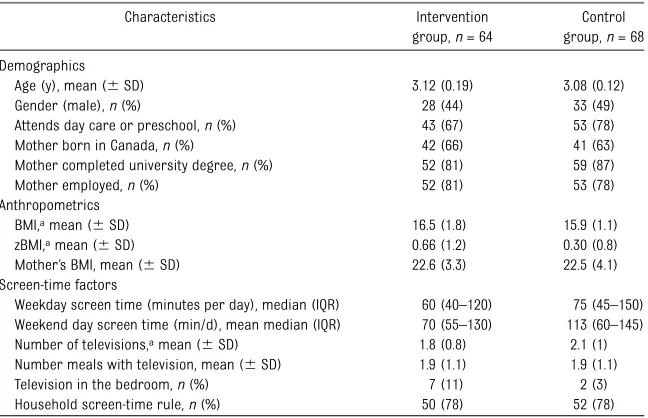
Over the study period, 351 children were scheduled to attend a 3-year-old visit in the practice; 187 of these children were assessed for eligibility and approached for consent to participate in the study. One hundred sixty families were as-signed randomly to intervention or control groups, with 79% and 86% follow-up in the intervention and con-trol groups, respectively (see Fig 1). There were no baseline differences between the intervention and control group for age, gender, maternal educa-tion and employment, television owner-ship, total weekday and weekend day screen time, meals in front of the screen, television in the bedroom, par-ent screen time, or maternal BMI. The intervention group had a clinically sig-nificantly higher BMIzscore at baseline, compared with the control group (0.66
61.18 vs 0.3060.83; see Table 1).
Intention-to-Treat Analysis
.03), but no differences were seen in BMI or number of television sets in the bedroom (see Table 2). At 1-year follow-up, subjects in the intervention group compared with the control group reported they were more likely to rec-ommend this counseling session to others (89% vs 63%;P= .002).
DISCUSSION
This pragmatic, randomized controlled trial of a brief behavioral intervention administered to parents and 3-year-old children during a health maintenance
visit did not result in a reduction in the primary outcome measure of reported screen time or a secondary outcome measure of BMI. There was a statistically significant reduction in meals in front of the screen, a secondary outcome mea-sure, by.2 screen meals per week.
One of the major strengths of our study was the pragmatic nature of the intervention. We chose to test the in-tervention at the 3-year-old visit, when no routine vaccinations are scheduled. The intervention itself targeted behav-iors shown in the literature to be
associated with increased screen time, such as eating in front of the screen,27
and television in the bedroom,5 and
factors associated with reducing screen time such as the presence of a family rule about screen time.27 A
study from Quebec, Canada, showed that nearly 25% of children reported eating at least twice daily in front of the television, and those who ate snacks while watching TV had increased risk for other poor dietary practices such as soft drink consumption.28Meals in
front of the screen in school-aged children have also been shown to be associated with increased caloric in-take, alterations in satiety signals, and place children at risk for direct food advertising.31–33
A recently published meta-analysis of screen-time interventions showed overall no effect of screen-time inter-ventions on BMI or screen time. Our study confirms these findings in preschool-aged children. A secondary analysis of these studies in a recent meta-analysis on screen time inter-ventions showed that the 2 included studies in preschool-aged children were effective in reducing screen time, with a point estimate of–3.72 hours (95% confidence interval –7.23 to 0.20) per week of screen time.6
Dif-ferences in our study, compared with these 2 studies, may include the lower
“dose”and the pragmatic“setting”of the intervention itself; for example, the trial by Dennison et al5included
seven 1-hour sessions for children in a preschool setting and multiple parent handouts over an 18-month time period. Of note, all 13 studies in the meta-analysis were implemented in a single setting (school, home, or nutrition clinic), and none included the primary care practice setting. There may be certain interventions that are more amenable to implement in the primary care setting. A recently published pragmatic trial from the
FIGURE 1
Participantflow through the trial.
TABLE 1 Baseline Characteristics
Characteristics Intervention
group,n= 64
Control group,n= 68 Demographics
Age (y), mean (6SD) 3.12 (0.19) 3.08 (0.12)
Gender (male),n(%) 28 (44) 33 (49)
Attends day care or preschool,n(%) 43 (67) 53 (78)
Mother born in Canada,n(%) 42 (66) 41 (63)
Mother completed university degree,n(%) 52 (81) 59 (87)
Mother employed,n(%) 52 (81) 53 (78)
Anthropometrics
BMI,amean (6SD) 16.5 (1.8) 15.9 (1.1)
zBMI,amean (6SD) 0.66 (1.2) 0.30 (0.8)
Mother’s BMI, mean (6SD) 22.6 (3.3) 22.5 (4.1)
Screen-time factors
Weekday screen time (minutes per day), median (IQR) 60 (40–120) 75 (45–150) Weekend day screen time (min/d), mean median (IQR) 70 (55–130) 113 (60–145) Number of televisions,amean (6SD) 1.8 (0.8) 2.1 (1)
Number meals with television, mean (6SD) 1.9 (1.1) 1.9 (1.1)
Television in the bedroom,n(%) 7 (11) 2 (3)
Household screen-time rule,n(%) 50 (78) 52 (78)
aControls:n= 67.
TARGet Kids! team19 examined the
out-comes of an educational intervention for parents of 9-month-old children to transition from bottle use to cup. We hypothesize that this new behavior (cup use) was successfully maintained over the follow-up period, because parents are unlikely to transition back to bottle use after cup use is established. Com-plex behavior change such as reducing overall screen time may require re-peated reinforcement, and flexible, de-velopmentally appropriate approaches that change with age. Limitations of the study include potential for contamina-tion among intervencontamina-tion and control families; a cluster randomized controlled trial design by practice site may be more effective. The lack of a standardized method of measuring and reporting screen time in preschool-aged children is an important limitation in thisfield of research. We used parent report of child screen time.2,4,24,29There is evidence that
parent report of child screen time pro-vides accurate estimates of television viewing times, compared with video-taped observation;r= .70.34The
educa-tion levels of mothers in our cohort are high, but similar to education levels of women in this age group in Toronto.35
We may have diluted the effective dif-ference between control and intervention group screen time by using a screen-time based counseling session for the control group (selection of screen time pro-grams and Internet safety). Thefidelity of the intervention was not monitored, and the intervention was delivered by a single trained study staff member, by using a standardized protocol. This would not, however, be expected to alter the effec-tive difference between control and in-tervention group. The outcome was measured after 12 months; it is possible there was a significant reduction in reported screen time after the in-tervention that did not persist.
Preventive care interventions in early childhood have potential for improv-ing health outcomes. A recent
ran-domized controlled trial in the
primary care setting was effective in selective lifestyle behavior changes.36
In addition, there have been no cost-effectiveness analyses of primary care interventions for health pro-motion in children published. Studies on physical activity promotion and cessation in adults were shown to be cost-effective for interventions that
focused on individual behavior change and were implemented in practice.37,38
The health benefits associated with reduced screen time during meals have not been established in young children, and, if implemented as an additional counseling service at the primary care visit, would be a significant cost. For example, if we calculate direct costs for physician counseling for all children in Ontario attending a primary care practice and use an existing fee code for
smoking cessation counseling in
Ontario,39 the cost would be .C$2
million annually.
CONCLUSIONS
This pragmatic trial of a brief in-tervention in the primary care setting was not effective in reducing screen time or BMI in 3-year-old children. In addressing screen time and obesity prevention interventions in primary care, identifying which behaviors to target, how best to format and deliver the intervention, integration of inter-ventions across settings, and an as-sessment of cost-effectiveness should be a focus for future research.
REFERENCES
1. Christakis DA, Gilkerson J, Richards JA, et al.
Audible television and decreased adult words, infant vocalizations, and conversa-tional turns: a population-based study.Arch Pediatr Adolesc Med. 2009;163(6):554–558 2. Wake M, Hesketh K, Waters E. Television,
computer use and body mass index in Australian primary school children.
J Paediatr Child Health. 2003;39(2):130– 134
3. Gidwani PP, Sobol A, DeJong W, Perrin JM, Gortmaker SL. Television viewing and
ini-tiation of smoking among youth.Pediatrics. 2002;110(3):505–508
4. Christakis DA, Ebel BE, Rivara FP, Zimmerman
FJ. Television, video, and computer game usage in children under 11 years of age.J Pediatr. 2004;145(5):652–656
5. Dennison BA, Erb TA, Jenkins PL. Television viewing and television in bedroom associated
with overweight risk among low-income preschool children. Pediatrics. 2002;109(6): 1028–1035
6. Gortmaker SL, Must A, Sobol AM, Peterson K, Colditz GA, Dietz WH. Television viewing as
a cause of increasing obesity among children in the United States, 1986–1990.Arch Pediatr Adolesc Med. 1996;150(4):356–362
7. Dietz WH Jr, Gortmaker SL. Do we fatten our children at the television set? Obesity Weekday screen time (min), mean (6SD) 94 (101) 104 (91) 85 (81) 89 (77) –7 (–38 to 23) .65 Weekend screen time (min), mean (6SD) 116 (133) 114 (81) 107 (91) 107 (93) 2 (–16 to 20) .80 zBMI, mean (6SD) 0.66 (1.18) 0.30 (0.83) 0.38 (1.06) 0.14 (0.93) 0.01 (–0.22 to 0.24) .94 Number meals with television,n(%) 1.9 (1.1) 1.9 (1.1) 1.6 (1.0) 1.9 (1.2) –0.34 (–0.64 to–0.04) .03
and television viewing in children and adolescents.Pediatrics. 1985;75(5):807–812 8. Hancox RJ, Milne BJ, Poulton R. Association between child and adolescent television viewing and adult health: a longitudinal birth cohort study.Lancet. 2004;364(9430):257–262 9. Jago R, Baranowski T, Baranowski JC, Thompson D, Greaves KA. BMI from 3–6 y of age is predicted by TV viewing and physical
activity, not diet.Int J Obes (Lond). 2005;29 (6):557–564
10. Crespo CJ, Smit E, Troiano RP, Bartlett SJ, Macera CA, Andersen RE. Television watching, energy intake, and obesity in US children: results from the third National Health and Nutrition Examination Survey, 1988–1994.Arch Pediatr Adolesc Med. 2001;155(3):360–365 11. Maniccia DM, Davison KK, Marshall SJ,
Manganello JA, Dennison BA. A meta-analysis of interventions that target child-ren’s screen time for reduction.Pediatrics. 2011;128(1). Available at: www.pediatrics.
org/cgi/content/full/128/1/e193
12. Wahi G, Parkin PC, Beyene J, Uleryk EM,
Birken CS. Effectiveness of interventions aimed at reducing screen time in children: a systematic review and meta-analysis of randomized controlled trials.Arch Pediatr Adolesc Med. 2011;165(11):979–986 13. Epstein LH, Roemmich JN, Robinson JL, et al.
A randomized trial of the effects of reducing television viewing and computer use on body mass index in young children. Arch Pediatr Adolesc Med. 2008;162(3):239–245 14. Mangione-Smith R, DeCristofaro AH, Setodji
CM, et al. The quality of ambulatory care delivered to children in the United States.
N Engl J Med. 2007;357(15):1515–1523 15. Perrin EM, Finkle JP, Benjamin JT. Obesity
prevention and the primary care pediatrician’s office.Curr Opin Pediatr. 2007;19(3):354–361 16. Nader PR, O’Brien M, Houts R, et al; National
Institute of Child Health and Human Devel-opment Early Child Care Research Network. Identifying risk for obesity in early childhood.
Pediatrics. 2006;118(3). Available at: www. pediatrics.org/cgi/content/full/118/3/e594
17. Wardle J, Carnell S, Cooke L. Parental control over feeding and children’s fruit
and vegetable intake: how are they related?
J Am Diet Assoc. 2005;105(2):227–232 18. Mikkilä V, Räsänen L, Raitakari OT, Pietinen
P, Viikari J. Consistent dietary patterns identified from childhood to adulthood: the cardiovascular risk in Young Finns Study.
Br J Nutr. 2005;93(6):923–931
19. Maguire JL, Birken CS, Jacobson S, et al. Office-based intervention to reduce bottle use among toddlers: TARGet Kids! Prag-matic, randomized trial. Pediatrics. 2010; 126(2). Available at: www.pediatrics.org/ cgi/content/full/126/2/e343
20. American Academy of Pediatrics. Bright Futures. Elk Grove Village, IL: American Academy of Pediatrics. Available at: http:// brightfutures.aap.org/about.html. Accessed
October 10, 2012
21. Moyer VA, Butler M. Gaps in the evidence for
well-child care: a challenge to our pro-fession.Pediatrics. 2004;114(6):1511–1521 22. Ware JH, Hamel MB. Pragmatic trials—
guides to better patient care?N Engl J Med. 2011;364(18):1685–1687
23. Robinson TN. Reducing children’s television viewing to prevent obesity: a randomized controlled trial.JAMA. 1999;282(16):1561–1567 24. Dennison BA, Russo TJ, Burdick PA, Jenkins PL. An intervention to reduce television viewing by preschool children.Arch Pediatr Adolesc Med. 2004;158(2):170–176 25. Bandura A.A Social Foundation of Thought
and Action. Englewood Cliffs, NJ: Prentice-Hall; 1986
26. Canadian Pediatric Society. Caring for Kids: how to promote good television habits. October 2008. Available at: www.caringforkids. cps.ca/growinglearning/GoodTelevision.htm. Accessed October 10, 2012
27. Birken CS, Maguire J, Mekky M, et al. Pa-rental factors associated with screen time in pre-school children in primary-care practice: a TARGet Kids! study. Public Health Nutr. 2011;14(12):2134–2138
28. Dubois L, Farmer A, Girard M, Peterson K. Social factors and television use during meals and snacks is associated with higher BMI among pre-school children.
Public Health Nutr. 2008;11(12):1267–1279
29. Canadian Community Health Survey, Cycle 4.1. Ottawa, Ontario; Statistics Canada. Health Statistics Division: 2009
30. Lumeng JC, Rahnama S, Appugliese D, Kaciroti N, Bradley RH. Television exposure and overweight risk in preschoolers.Arch Pediatr Adolesc Med. 2006;160(4):417–422 31. Kotz K, Story M. Food advertisements
dur-ing children’s Saturday morning television programming: are they consistent with di-etary recommendations?J Am Diet Assoc. 1994;94(11):1296–1300
32. Matheson DM, Killen JD, Wang Y, Varady A, Robinson TN. Children’s food consumption during television viewing.Am J Clin Nutr. 2004;79(6):1088–1094
33. Bellissimo N, Pencharz PB, Thomas SG, Anderson GH. Effect of television viewing at mealtime on food intake after a glucose pre-load in boys.Pediatr Res. 2007;61(6):745–749 34. Anderson DR, Field DE, Collins PA, Lorch EP, Nathan JG. Estimates of young children’s time with television: a methodological comparison of parent reports with time-lapse video home observation. Child Dev. 1985;56(5):1345–1357
35. 2006 Census of Population. Statistics Canada catalogue no. 97-557-XCB2006006 (Ontario, Code35). Ottawa, Canada: Statis-tics Canada
36. Taveras EM, Gortmaker SL, Hohman KH, et al. Randomized controlled trial to improve primary care to prevent and manage child-hood obesity: the High Five for Kids study.Arch Pediatr Adolesc Med. 2011;165(8):714–722 37. Rigotti NA, Bitton A, Kelley JK, Hoeppner BB,
Levy DE, Mort E. Offering population-based tobacco treatment in a healthcare setting: a randomized controlled trial.Am J Prev Med. 2011;41(5):498–503
38. Müller-Riemenschneider F, Reinhold T, Willich SN. Cost-effectiveness of inter-ventions promoting physical activity.Br J Sports Med. 2009;43(1):70–76
39. Ministry of Health & Longterm Care. Billing and payment guide for blended salary model physicians family health teams, pri-mary health care. Available at: www.health. gov.ca/transformation/fht_bsm_physicians. en.pdf. Accessed October 10, 2012
(Continued fromfirst page)
PEDIATRICS (ISSN Numbers: Print, 0031-4005; Online, 1098-4275).
Copyright © 2012 by the American Academy of Pediatrics
FINANCIAL DISCLOSURE:The authors have indicated they have nofinancial relationships relevant to this article to disclose.
FUNDING:Supported in part by a Paediatric Consultants Research Grant, Hospital for Sick Children, Toronto. The Paediatric Outcomes Research Team is supported by a grant from the Hospital for Sick Children Foundation. The funding organizations were not involved in any of the following: design and conduct of the study; collection, management, analysis, and interpretation of the data; and preparation, review, or approval of the manuscript.
DOI: 10.1542/peds.2011-3088 originally published online November 5, 2012;
2012;130;1110
Pediatrics
McCrindle and Patricia C. Parkin
Beck, Julie DeGroot, Sheila Jacobson, Michael Peer, Carolyn Taylor, Brian W.
Services
Updated Information &
http://pediatrics.aappublications.org/content/130/6/1110
including high resolution figures, can be found at:
References
http://pediatrics.aappublications.org/content/130/6/1110#BIBL
This article cites 33 articles, 9 of which you can access for free at:
Subspecialty Collections
http://www.aappublications.org/cgi/collection/screen_time_sub
Screen Time
http://www.aappublications.org/cgi/collection/media_sub
Media
following collection(s):
This article, along with others on similar topics, appears in the
Permissions & Licensing
http://www.aappublications.org/site/misc/Permissions.xhtml
in its entirety can be found online at:
Information about reproducing this article in parts (figures, tables) or
Reprints
http://www.aappublications.org/site/misc/reprints.xhtml
DOI: 10.1542/peds.2011-3088 originally published online November 5, 2012;
2012;130;1110
Pediatrics
McCrindle and Patricia C. Parkin
Beck, Julie DeGroot, Sheila Jacobson, Michael Peer, Carolyn Taylor, Brian W.
Catherine S. Birken, Jonathon Maguire, Magda Mekky, Cedric Manlhiot, Carolyn E.
Children
Office-Based Randomized Controlled Trial to Reduce Screen Time in Preschool
http://pediatrics.aappublications.org/content/130/6/1110
located on the World Wide Web at:
The online version of this article, along with updated information and services, is
by the American Academy of Pediatrics. All rights reserved. Print ISSN: 1073-0397.