Design of Probability Module Based on PBL
Learning Model to Improve Critical Thinking
Skills
Yusuf Muri Salampessy, Suparman
Abstract— Critical thinking is an important skill in the 21st century learning in the industrial revolution 4.0 era. The ranking of Indonesia in TIMSS is low. 21st-century student skills in Indonesia such as critical thinking is still relatively low. Teaching materials that do not contain 21st-century skills will have an impact on the effectiveness of achieving core competencies and basic competencies. This research has several objectives. First, analyze the module needs as teaching material. Second, knowing the teacher's response to the 2013 curriculum compatibility module. Third, knowing the problem in students' critical thinking skills. The design development model used is the ADDIE model (Analysis, Design, Development, Implementation, Evaluation). This study uses a qualitative method. The research subjects were teachers and students at Sorong Muhammadiyah High School. The object of this research is critical thinking and the Analysis of the Model Problem-Based Learning model. Data collection instruments used observation guidelines and interview guidelines. Data analysis uses descriptive analysis. Research provides several results. First, teachers and schools need electronic modules. Second, the critical thinking skills of class XII students are still relatively low in material opportunities. Third, teachers need modules for curriculum compatibility in 2013. Fourth, modules that integrate critical thinking skills do not yet exist. This research can be developed based on Problem Based Learning modules to improve critical thinking skills. This research can be continued in the Implementation and Evaluation stage.
Index Terms— ADDIE, Critical Thinking, Modules, Design Development, Opportunity Material, Problem-Based Learning. —————————— ——————————
1 I
NTRODUCTIONHe development of the industrial world is growing rapidly in line with the demands of the world of education, especially in Indonesia to improve the results of professional graduates and prepare superior human resources to products [1]. Mathematics is a subject that must be mastered from an early age because it is a tool or a means of learning other fields of science [2]. With the development of 21st-century education, students are expected to be able to prepare the ability to master a variety of skills, especially creative thinking skills [3]. Critical thinking skills are skills needed in the 21st-century [4]. Critical thinking is one of the skills associated with thinking, evaluating our own and other people's ideas without guessing [5]. The ability to think critically is a form of reason where an individual can increase his thinking potential through a process of analysis and evaluation of problems [6]. Critical thinking requires encouragement from learning that requires students to achieve these abilities [7]. Mathematics has a very important contribution in achieving abilities such as the ability to connect, communication skills, problem-solving, the ability to represent (representation) reasoning and proof of ability [2]. Critical thinking skills are expected to be a part of student learning, and schools will be responsible for developing and refining critical thinking skills into the learning process [8]. Mathematics learning is a subject that can develop critical
thinking skills [9]. Evaluation of students' critical thinking skills in mathematics learning uses three components, namely (1) identifying and interpreting information, (2) analyzing information, and (3) evaluating evidence and arguments [10]. Facione 2011 said the most basic definition of critical thinking is evaluation, self-regulation, inference, explanation, interpretation, and analytical skills [8]. Indonesia still focuses on graduating students in national examinations. Teaching practice in schools only focuses on the content of the lesson and ignores students' thinking skills [10]. Essential thinking skills include several activities such as logical reasoning including analyzing, synthesizing, reducing, and concluding [11]. Preparing for the 21st-century generation, insights into critical thinking must demonstrate significant contributions [12]. Regulation of the Minister of Education and Culture of the Republic of Indonesia No. 22 of 2006 concerning Material Standards for Primary and Secondary Education states that Mathematics learning is provided to promote learners using the ability to think logically, analytically, systematically, critically, and creative thinking as well as the ability to work together. Students can have the ability to obtain, manage, and use the information to survive in a situation that is always changing, uncertain and competitive [13]. Based on PISA research (Program for International Student Assessment) in 2015, Indonesia ranked 62 out of 70 countries participating in PISA [14]. The average value of mathematics achievement in all countries is 490; meanwhile, the average score of mathematics students in Indonesia is 386. Based on that description, Indonesia's ranking is still far below the international average. This means that the mathematical abilities of Indonesian students are still low. The process of learning mathematics in elementary schools needs to be
T
————————————————
Yusuf Muri Salampessy, is currently pursuing a master’s degree program in mathematics education at Ahmad Dahlan University, Indonesia, PH-081247523030. E-mail: [email protected]
Suparman is an associate professor in mathematics at Ahmad Dahlan University, Indonesia, PH-081328201198. E-mail:
5696 IJSTR©2020
www.ijstr.org improved. Mathematical learning must be designed according to the objectives stated in the curriculum [15]. Students' thinking ability is still low, reinforced by Maharani and Waluya's research results, there are 23.33% of students included in the low category, 60% included in the medium category, and 16.67% of the high category [16]. There needs to be a breakthrough to improve critical thinking skills through teaching materials. Good and innovative teaching materials can increase student creativity [17]. Success in learning can be influenced by various factors, one of which is teaching materials used in learning mathematics [5]. The use of teaching materials allows students to understand the material in a shorter and more enjoyable time [18]. Teaching material that can be developed by a teacher is a module. The module is one type of teaching material prepared by educators and given to students to support the teaching and learning process, by using modules, students have the opportunity to learn independently [19]. Based on the results of interviews and observations with students and teachers of mathematics at Al-Amin Muhammadiyah Sorong High School, schools still use the textbooks provided. The module used does not yet exist, but the results of the teacher interviews require interesting teaching materials and innovations to improve students' critical thinking skills that are still low.
Efforts to improve critical thinking skills in addition to making interesting teaching materials is done by choosing appropriate and innovative learning models. Problem-Based Learning is one of the appropriate learning models used in learning [20]. Problem-Based Learning Model is a learning model that is centered on students, students can make education more innovative and effective because students will be directed to thinking skills and students are more active during the learning process, this will be seen when students face problems relating to daily life and students will try to find a solution when learning and discussing [21]. The Problem Based Learning (PBL) approach can improve students' abilities, curiosity, creative and critical thinking, risk-taking and flexibility [22]. Problem-based learning (PBL) has been defined as a method of inquiry in which students solve difficulties, oddities, doubts, and problems in a real-life context. Problem-based PBL is an active-learning and student-centered approach where unstructured problems are used as a starting point for the process of inquiry and learning [23]. The results of research conducted by Mergendoller on middle school students found that students who used the PBL method naturally gained more knowledge than students who still used the old learning method. As a result, the PBL approach successfully designs students for their future learning [6]. Researchers assess the learning resources in the form of modules taught in schools. The value of validation is 81.5. As for some of the deficiencies found are (1) the module does not encourage students to ask questions, (2) the display module does not match the illustrations, (3) the module does not display illustrations and pictures that clarify the material, (4) the pictures and illustrations in the module are not interesting for students, (5) The module has not made it easy for students
to understand the contents of the material.
Based on the description above, researchers intend to make teaching materials in the form of modules in learning. The purpose of this research is to design teaching materials in the form of Modules in learning opportunities by using PBL learning models and producing module designs that are feasible to be developed. This research can be continued in the implementation and evaluation stages.
2
R
ESEARCHM
ETHODS
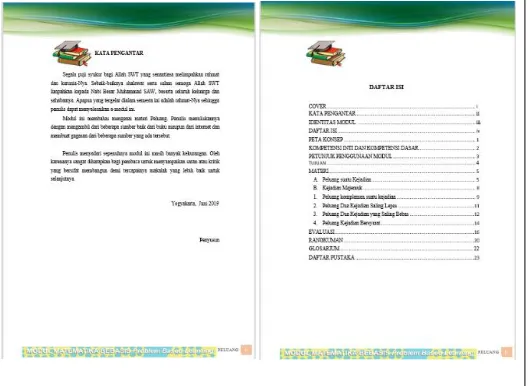
Figure 2. Cover
Figure 3. Preface and Table of Contents Figure 1. ADDIE Stages [29]
3 R
ESULT ANDD
ISCUSSIONThe analysis, the phase contains the analysis of student needs. The need for teaching materials in the form of modules to improve students' critical thinking skills, analyze the character of students, teaching materials and learning models used by teachers, how to deliver materials and materials that are difficult for students to feel, school facilities and analyze alternative solutions to improve critical thinking skills learners. At this stage, there are several conclusions, namely (1) students need teaching materials that can improve critical thinking skills (2) material that is considered difficult is opportunity material, (3) teachers still use conventional methods (4) Facilities in schools are less supportive (5) ) alternative solutions to improve critical thinking skills is to design teaching materials with learning models that fit the characteristics of students.
3.2. Design
At the design stage, the design of teaching materials is based on the results of needs analysis. The teaching material used is a module. The module contains cover, preface, table of contents, concept map, KI, KD, indicators, instructions for using the module, goals, core mastery check, material, practice questions, cognitive/evaluation tests, psychomotor/LKS test, summary, glossary, and bibliography. Figure 2 contains the title of the student worksheet that also includes classes and semesters that students will use.
The preface contains the author's thanks to those who have helped in the preparation of the design of this product and the table of contents contains the sequence in the student module and the pages in the student module. The preface and table of contents can be seen in Figure 3.
5698 IJSTR©2020
www.ijstr.org
Figure 4. Concept Map
Figure 5. KI and KD
Figure 6. Student Activities
Figure 7. Evaluation KI and KD contain what students must achieve when learning
to use Modules. KI and KD can be seen in Figure 5.
Student activities contain material and sample questions. The material is described so that students can understand the material. Examples of problems are given according to PBL steps. Learning activities can be seen in Figure 6.
Evaluations are presented in the form of essays. The aim is to evaluate the learning outcomes of students in understanding the material that has been learned. Evaluation can be seen in Figure 7.
5699 IJSTR©2020
Figure 8. Summary
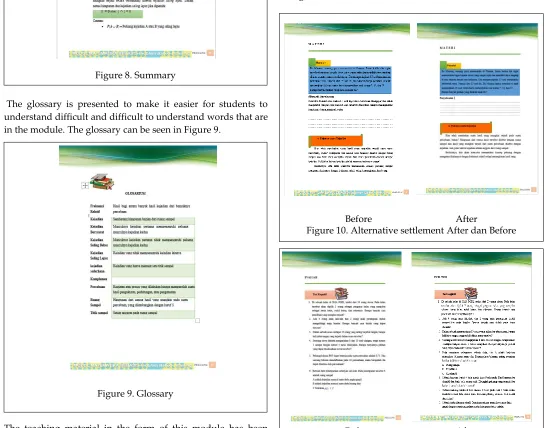
Figure 9. Glossary
Before After
Figure 10. Alternative settlement After dan Before
Before After
Figure 11. Evaluation Questions After dan Before understand the learning material discussed today. A summary
can be seen in Figure 8.
The glossary is presented to make it easier for students to understand difficult and difficult to understand words that are in the module. The glossary can be seen in Figure 9.
The teaching material in the form of this module has been assessed for eligibility by two mathematics teachers. Some
input and suggestions from material and media experts that have been summarized can be seen in Table 1.
TABLE 1
Comments and suggestions from the validator
No Comments and suggestions Repair 1 Do not include alternative
solutions to problems so students can think critically
Already repaired
2 Expand the discussion questions and improve the writing (typo)
Already repaired
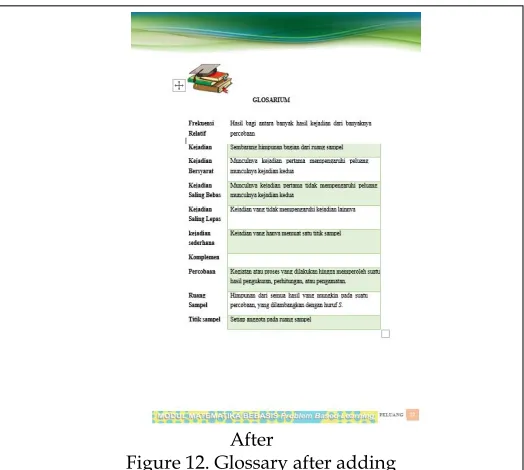
3 Add a Glossary Already repaired
5700 IJSTR©2020
www.ijstr.org
After
Figure 12. Glossary after adding
After being revised and improved the results of the calculation of the teacher questionnaire regarding the developed design can be seen in table 2.
TABLE 2
Design Assessment Results
No Validator Score Category
1 Faturahman, M.Pd 94 Good
2 Sucipto, S.Pd 88 Good
Total Score 182
Average Score 91 Good Based on Table 2, the average score for the assessment of media experts is 91. So it can be concluded that the learning media are in a good category. The student module has been validated by a validator and declared to be suitable for use with revisions. The fourth step in the ADDIE stage is implementation. At this stage, designs that have been designed and are categorized as feasibility and effectiveness are given to the school which will be used as a place of research. This stage is done to ensure students achieve their goals in learning outcomes and can improve students' critical thinking skills. The fifth step in the ADDIE stage is evaluation. At this stage, a process to provide value to the learning program that has been developed. Students will be evaluated to the extent to which students can learn the material to improve students' critical thinking skills.
4 C
ONCLUSIONBased on the explanation above, it was found that; (1) Students have difficulty in learning material opportunities, (2) students 'critical thinking skills are classified as low, (3) PBL learning models can be used to improve students' problem-solving abilities, (4) learning resources that fit the PBL model are not yet available, (5) learning resources that instill critical thinking skills are not yet available, (6) the ADDIE development model is used to produce a module design that is compatible with PBL learning models and integrates students' critical thinking skills. This research will produce a teaching material design in the form of a module based on PBL learning models to improve students' critical thinking skills by the curriculum and characteristics of students. The design of this teaching material consists of a cover, preface, table of contents, concept map, KI, KD, indicators, instructions for use of modules, objectives, core mastery checks, material, practice questions, cognitive / evaluation tests, psychomotor / LKS tests, summaries, glossary, and bibliography. The design of the results of this study has the potential to improve students' critical thinking skills in material opportunities. Based on the results of the validation with an average score of 91, it can be concluded that the design of teaching materials in the form of modules is said to be suitable to be used as guidelines in making teaching materials on material opportunities with PBL-based models.
5
S
UGGESTIONModule design in learning material opportunities based on PBL learning models to improve students' critical thinking skills. This study uses the ADDIE development design model. The stages in the ADDIE model consist of five stages namely Analysis, Design, Development, Implementation and Evaluation.
A
CKNOWLEDGMENTThe author thanks Ahmad Dahlan University for giving the writer a chance and encouraging and facilitating the writer in completing this research. The author also thanks the schools, teachers, and students who have helped the authors in this study. Finally, the authors also thank the validators who have validated the instruments used in the study to be better.
R
EFERENCES[1] N. Jalinus, R. A. Nabawi, and A. Mardin, ―The Seven Steps of Project-Based Learning Model to Enhance Productive Competences of Vocational Students‖, In 1st International Conference on Technology and Vocational Teacher (ICTVT), Atlantis Press. Advances in Social Science, Education and Humanities Research, vol. 102, pp. 251-256, 2017.
Vocational Education‖, International Journal of Science and Applied Technology, vol. 3, No. 1, 2018.
[3] M. Maulana and Suparman, ―Development of Students Worksheet based on Realistic Mathematics Education in Indonesia‖, International Journal of Engineering & Technology, vol. 7 (4.30), 45-49, 2018.
[4] A. Triyono and Suparman, "Inquiry-Based Worksheet Design to Improve Critical Thinking of Students in Indonesia", International Journal of Scientific & Technology Research, vol. 8, issue 10, ISSN 2277-8616, 2019.
[5] I. Andriani and Suparman, ―Design of Module to Increasing Critical Thinking Ability for Seventh Grade Students‖, International Journal of Scientific & Technology Research, vol. 8, issue 12, ISSN 2277-8616, 2019.
[6] S. Nursolekah and Suparman, Design of Mathematics Learning Module Based On Problem Based Learning to Improve Critical Thinking Ability Students‖, International Journal of Scientific & Technology Research, vol. 8, issue 12, ISSN 2277-8616, 2019. [7] B.P. Syafina and Suparman, ―Designing Student Worksheets to
Improve Critical Thinking Ability Based On Problem Based Learning‖, International Journal of Scientific & Technology Research, vol. 8, issue 10, ISSN 2277-8616, 2019.
[8] I. E. Ningrum and Suparman. ―Development of Students Worksheet Mathematics Based On Problem Based Learning (PBL)‖, International Summit on Science Technology and Humanity (ISETH) Integrating Knowledge for Future Sustainable Development, vol. 8, p-ISSN: 2477-3328 e-ISSN: 2615-1588, 2018. [9] I. Cemil and S. Erkus, ―The Effect of Mathematical Worksheets
Based on Multiple Intelligences Theory on the Academic Achievement of the Students in the 4th Grade Primary School‖, Universal Journal of Educational Research, vol 5, No. 8, 1372-1377, 2017.
[10] H. D. Putra, T. Herman, and U. Sumarmo, ―Development of Student Worksheets to Improve the Ability of Mathematical Problem Posing International‖, Journal on Emerging Mathematics Education (IJEME), vol. 1, No. 1, pp. 1-10, 2017.
[11] Zulyadaini, ―Development of Student Worksheets Based Realistic Mathematics Education (RME)‖, in International Journal of Engineering Research and Development, vol. 13, No. 9, pp. 01-14, 2017.
[12] M. H. M. Cheng and Z. H, ―Exploring the effects of the classroom learning environment on critical thinking skills and disposition: A study of Hong Kong 12th graders in Liberal Studies. Thinking Skills and Creativity, Elsevier, vol. 24, 152-163, 2017.
[13] I. Irwanto, E. Rohaeti, and A. K. Prodjosantoso, ―A Survey Analysis of Pre-Service Chemistry Teachers'critical Thinking Skills‖, MIER Journal of Educational Studies, Trends and Practices, vol. 8, No. 1, pp. 57-73, 2018.
[14] S.N.S.H. Ahamad, H-C. Li, M. Shahrill, and R.C.I. Prahmana, ―Implementation of Problem-based Learning in Geometry Lessons‖, Journal of Physics: Conference Series, 943(1), 012008, 2017.
[15] OECD. PISA 2015 Result in Focus. Paris: Organisation for Economic Co-operation and Development. 2018.
[16] V. A. Nurlaily, H. Soegiyanto, and B. Usodo, ―Elementary School Teacher’s Obstacles in The Implementation of Problem-Based Learning Model in Mathematics Learning‖, Journal on Mathematics Education, Vol. 10, No. 2, pp. 229-238, 2019.
[17] H. Maharani and B. Waluya, “Creative Thinking Process Based On Wallas Model in Solving Mathematics Problem‖, IJEME, Vol. 2010. No. 2, pp. 3532-3536, 2017.
[18] A. Jihad, W. Susilawati, and N. Sorbaningsih, "Improving Mathematical Understanding Ability Student Through Study of Mobile Learning Mathematical Based on the Android‖, 3rd Annual
Applied Science and Engineering Conference, 434, pp. 1-4, 2018. [19] A. Fonda and Sumargiyani, ―The Developing Math Electronic
Module with Scientific Approach Using Kvisoft Flipbook Maker Pro for XI Grade of Senior High School Students‖, Infinity Journal, vol. 7, no. 2, p109-122, 2018.
[20] A. Ahmad, ―Developing Cooperative Learning-Based E-Module to Teach Basic English Grammar of the First Semester of English Study Program Students at FKIP – UIR Riau‖, J-SHMIC, Vol. 4, No. 2, 2017.
[21] T. Akma and Suparman ―The Design of Student Worksheet Problem based Learning to Improve Problem Solving Ability of the Eighth-Grade Students Junior High School in Indonesia‖, International Journal of Engineering & Technology, vol. 7 (4.30), No. 11-15, 2018. [22] M.B. Harahap, ―The Effect of Problem-Based Learning Assisted
Concept Map to Problem-Solving Ability and Critical Thinking Ability‖, J. Educ. Pract, vol. 8, No. 19, pp. 60–65, 2017.
[23] Turiman, Punia, T. S. M. T. Wook, and Kamisah Osman, ―21st Century Skills Mastery Amongst Science Foundation Programme Students.‖ International Journal on Advanced Science, Engineering and Information Technology, vol. 9 (1): 46, 2019.
[24] H. Wiphasith, R. Narumol, and C. Sumalee, "The Design of the Contents of e-learning for teaching M 5 English language using ADDIE model, International Journal of Information and Education Technology, vol. 6(2), 127, 2016.
[25] G. Durak and M. Ataizi, ―The ABC’s of Online Course Design According to ADDIE Model‖, Universal Journal of Educational Research, vo. 4(9), 2084-2091, 2016.
[26] A. N. Hess and K. Greer, "Designing for engagement: using the ADDIE model to integrate high-impact practices into an online information literacy course", Communications in Information Literacy, vol. 10(2), 6, 2016.
[27] L.W. Harahap and E. Surya, ―Development of Learning Media in Mathematics for Students with Special Needs‖, International Journal of Sciences: Basic and Applied Research, vol. 33, No. 3, pp 1-12, 2017.