IJEDR1701100
International Journal of Engineering Development and Research (www.ijedr.org)642
Authentication Using Palm Print Recognition System
1Dr. P. Tamije Selvy, 2A.Anjugam, 3P.Arifa Begum 1Associate Professor (SG), 2UG Scholar, 3UG Scholar,
Computer Science and Engineering, Sri Krishna College of Technology, INDIA
________________________________________________________________________________________________________ Abstract: - Personal authentication plays a unique role in the public security, access control, forensic and e-banking. Palm print recognition has been recognized as an effective biometric identifier because it is more reliable and user friendly. Existing methods used in palm print recognition lacks in reliability, accuracy and have higher error rate. The proposed scheme implements palm print recognition system using Gray level co-occurrence matrix (GLCM) in feature extraction and Support vector machine (SVM) in classification. The proposed method not only uses the orientation features and also includes second order features like energy, correlation, contrast and homogeneity for recognition and comparison. It shows robustness to noise and rotation. It has a simple and effective balancing scheme to improve the precision of the orientation feature of the palm print. Experiments conducted on dataset demonstrate that proposed method give better results than existing orientation methods. The Proposed method enhances the accuracy and also it reduces the average error rate in classification.
Key-Words: - Palm print, Preprocessing, Gray level co-occurrence matrix (GLCM) and Support vector machine Classification (SVM).
________________________________________________________________________________________________________
1
Introduction1.1
BackgroundData mining is an interdisciplinary sub field of computer science. Data mining deals with the extraction of knowledge from large amount of observational data sets, to identify unsuspected relationship and patterns hidden in data. I t summarizes the data in different behavior to provide understandability to the data users.Digital image processing is the sub category of data mining which analyzes and manipulates digital image in order to improve its quality.
1.2
Digital Image ProcessingDigital image processing accords with the use of computer algorithms to implement image processing on digital images. Analog demands high quality processing which requires costly hardware, storage and high power. Digital image processing has more advantages than analog image processing; it acquiesce much wider range of algorithms to be exercised on the input data, which can avoid problems such as quality degradation due to noise and signal distortion during processing. It is easy to manipulate the images and has compact storage. Biometrics is a technology used to determine, analyze and measure an individual’s physical and behavioral characteristics. Biometrics is used for authenticating and authorizing a person. Image processing is required for analyzing an individual whose biometric image is collected in the database formerly. Faces, fingerprints, irises, etc., are image-based biometrics, which demands image processing and pattern recognition techniques. Of all the biometrics, Palm print biometric system is user-friendly and uses both first order and second order features for authentication. Image processing methods can be classified into three functional categories- Image restoration, Image enhancement and Feature extraction.
1.3
Palm Print RecognitionPalm print composed of geometric features, line features, point features, statistical features & texture features. The palm print geometric features of adults are relatively similar in terms of palm size and palm width. As a result, they are inadequate to identify individuals. Ridges are the fine lines of the palm print. Wrinkles are the coarse line of the palm print while the principle lines are major line that is accessible on most of the palm (headline, lifeline & heart line). These palm print line features are not sufficient to achieve higher accuracy. So, second order features like contrast, energy, correlation and Homogeneity are included in proposed scheme to uniquely identify the individuals.
2
Related WorksIn this section, we discuss existing solutions for the palm print authentication and several state of palm print recognition methods are reviewed.
2.1
Code Based MethodIJEDR1701100
International Journal of Engineering Development and Research (www.ijedr.org)643
filters. The code method uses six Gabor filters [3] with different orientations, jπ/6(j = 0, 1,…5), to extract one dominant orientation feature from a palm print. It is efficient in memory usage but lacks in matching speed.2.2
Binary Orientation Concurrence VectorGuo, Zhang and Zuo [4] proposed binary orientation co-occurrence vector (BOCV) representation that binaries all the filter responses of a palm print image, convolving with Gabor filters on six orientations. To further examine the BOCV, Zhang, Li, and Niu [5] propose the E-BOCV method, which involves filtering out the fragile bits of the BOCV. A normalized Hamming distance metric [7] is finally used to measure the dissimilarity between the code planes of two palm print images. The dominant orientation feature of a palm print alone is extracted, the other orientation features of the palm print will be lost. If all the orientation features of a palm print are preserved equally, the importance of the dominant orientation of the palm print is weakened.
2.3
RLOC MethodThe Robust line orientation Code (RLOC) method [8] extracts principal orientation code of a palm print by using a modified finite radon transform. Zuo, Lin, Guo and Zhang [9] design a sparse multi scale competitive code method which can extract the orientation feature of a palm print more accurately, using a bank of multi scale Gabor filters. The RLOC method designs a set of special convolution templates and the fusion code method uses four orientations of Gabor filters. RLOC extracts the dominant orientation feature of a palm print alone, other orientation features of the palm print are lost.
2.4
MotivationIn previously discussed methods, different feature extraction strategies are used, each extracting a various number of code features. Consequently, if the dominant orientation feature of a palm print alone is extracted, the other orientation features of the palm print will be lost. If all the orientation features of a palm print are preserved equally, the importance of the dominant orientation of the palm print is weakened. These methods lacks in accuracy and reliability. It shows the increased error rate. To rectify the disadvantages, the proposed scheme uses GLCM and SVM to provide more accuracy and reliability. It improves the genuine acceptance rate and also reduces the average error rate.
3
Proposed Scheme3.1
Image acquisitionImage acquisition is the action to get image from any source especially hardware based any source. It is always first step in the application because, without an image no processing is available. Ten right hand images from 100 different individuals are captured using digital camera. During the image acquisition, no pegs alignment is made. The hand image is taken without any special lighting condition. Dark intensity backgrounds, such as black and dark blue are used in this work. The usage of the low intensity background is to ease the hand image segmentation. Users are required to spread their fingers apart and lean their hand against the background during the image acquisition process. The hand image is saved using JPEG format. The hand image has the resolution of 180 dpi (dot per inches).
3.2
PreprocessingPreprocessing images frequently encompasses removing low frequency background noise, normalizing the intensity of the individual particles images, removing reflection, and concealed portions of images. Image preprocessing is the approach of enhancing data images former to computational processing. It involves converting the color images to gray level images, image rotation and resolution reduction. The hand images are preprocessed to obtain the region-of- interest (ROI). In image preprocessing stage, hand image segmentation, key point’s determination and palm print extraction are done that can be depicted in Figure 1. The skin has higher red intensity color while the background (black or dark blue color) has lower red intensity color. Thus, by referring to the red component of the hand image, the hand image is segmented.
(a) (b) (c) (d)
Figure 1. (a) Input image of Hand (b) Obtain Binary hand image from the Input (c) Extracted Palm print Image (d) Palm print Image in Gray scale Intensity Format
3.3 Feature Extraction Using GLCM
IJEDR1701100
International Journal of Engineering Development and Research (www.ijedr.org)643
I
mage Acquisition
Pre Processing
(ROI Extraction)
Feature Extraction (GLCM)
C
lassification (Svm)
Accept
Matching
Reject
Database
complete the tasks such as image matching and retrieval. T h e Second-order statistics like the probability of two pixels having particular gray levels i n spatial relationship are used to represent the Distribution of pixel gray levels. This information can be o ut l i ne d as two dimensional Gray level co-occurrence matrices (GLCM) [13], which can be computed for various distances and orientations. To use t h e information contained in the GLCM, Haralick illustrates the some statistical measures to extract textual characteristics. In this paper, the features like contrast, correlation, energy and homogeneity successfully characterized the statistical behavior (experimentally determined) of the palm print. The local variation in the gray level of GLCM is termed as Contrast. Correlation measures the joint probability of occurrence of pixel pairs of GLCM [14]. Energy provides the sum of squared pixel values and Homogeneity defines the closeness of distribution of elements to the GLCM diagonal. Homogeneous textures incorporates the ideal repetitive structures.
Figure 2.Over all Process of the System
3.4
Classification Using SVMIJEDR1701100
International Journal of Engineering Development and Research (www.ijedr.org)644
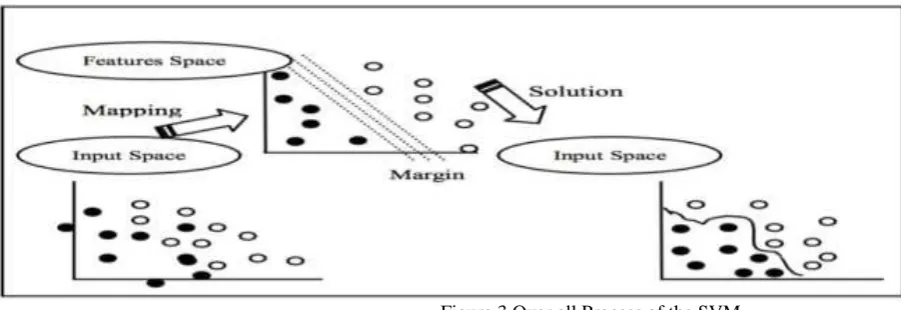
Figure 3.Over all Process of the SVMDecision trees are commonly used in decision analysis, to figure out a strategy most likely to reach a goal. The original input space is profiled into the high dimensional dot product space known as feature space which achieves better generalization performance in SVM and in the feature space the optimal hyper plane is determined as shown in Figure 3.
4.
Experimental Results4.1
Palm print DatabaseThe C A S I A d a t a b a s e ( version2)[10] contains 500 palm print images collected from 250 individuals. All palm print images are 8bit gray-level JPEG files. There are no pegs to restrict postures and position of palm. Subjects are required to put their palm into the device and lay it on a uniform colored background.
4.2
Palm print VerificationThe performance of the proposed system is demonstrated using a MATLAB R2013a platform. A dataset of 250 images are taken from the CASIA dataset. Dark intensity backgrounds, n a m e l y black and dark blue are used in this work. The usage of the low intensity back ground is to ease the hand image segmentation. Users are required to spread their fingers apart and lean their hand against the background during the image acquisition process. The hand image is saved using JPEG format in 256 x 256 pixels. The pre-processing of the Palm Print image is performed by ROI extraction. GLCM Algorithm is applied on the pre-processed image to extract four second order features like energy, correlation, contrast, homogeneity. Then Classification of palm print images is done using the Support Vector Machine method to provide the authentication on a successful classification.
4.3
Performance AnalysisIn this section, we will discuss about the Performance analysis in terms of genuine acceptance rate, false acceptance rate, and false rejection rate along with equal error rate.
Genuine Acceptance Rate (GAR): The genuine acceptance rate is the degree of the likelihood that the biometric security system will correctly recognize an access attempt by an authorized user. The system’s GAR typically is stated as the ratio of the number of genuine Acceptances divided by the number of identification attempts.
GAR= Number of accepted genuine users * 100 Total number of genuine accesses
False Acceptance Rate (FAR): This is illustrated as a percentage of false users accepted by the biometric system. In verification of biometric system the user will make claims of their identity and hence the system should not accept an unauthorized user. The number of false acceptance should be kept as small as possible. Thus False Acceptance should be minimized in comparison to False Rejection.
False Rejection Rate (FRR): This is characterized as a percentage of genuine users rejected by the biometric system. In verification of biometric system the user will make accusation of their identity and accordingly the system should not reject an enrolled user. The number of False Rejections should be kept as small as possible. Thus False Rejection should be minimized in comparison to False Acceptance.
Equal Error Rate (EER): This is defined as the point of juncture on the graph on which both FAR and FRR bends are plotted.
IJEDR1701100
International Journal of Engineering Development and Research (www.ijedr.org)645
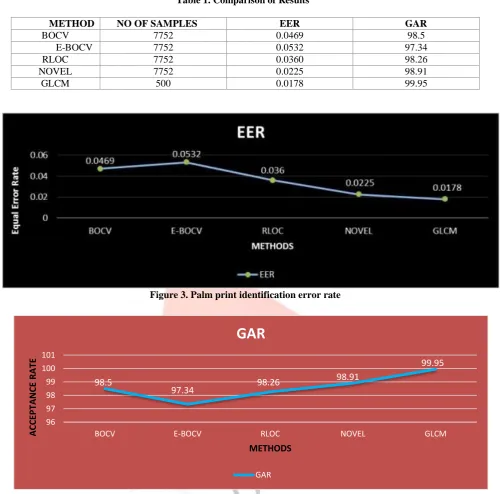
Table 1. Comparison of Results
METHOD NO OF SAMPLES EER GAR
BOCV 7752 0.0469 98.5
E-BOCV 7752 0.0532 97.34
RLOC 7752 0.0360 98.26
NOVEL 7752 0.0225 98.91
GLCM 500 0.0178 99.95
Figure 3. Palm print identification error rate
98.5
97.34 98.26
98.91
99.95
96 97 98 99 100 101
BOCV E-BOCV RLOC NOVEL GLCM
A
CCE
PTA
N
CE
R
A
TE
METHODS
GAR
GAR
Figure 3. Palm print identification genuine acceptance rate 5.Conclusion and Future Work
The proposed system is used to segment the palm print image and to extract features from the palm print images using the Gray Level Co- occurrence Matrix method (GLCM). The classification of palm print images using Support Vector Method (SVM) classification model has been proposed. This paper compares well-known classification models with SVM. Also, it compares various feature extraction methods to identify the most suitable method for the extraction of palm print. Neighboring Direction Indicator using GLCM has less execution time and high accuracy compared to other methods for feature extraction. From the experimental results obtained it is concluded that the threshold interval method is best for the pre- processing, the Gray Level Co-occurrence Matrix is suitable for feature extraction and Support Vector Method is suitable for the classification of the palm print images from normal images. Thus, through these methods less error rate and improved accuracy in Authentication has been achieved. This work can be extended to further improve the accuracy and reliability using powerful optimization techniques.
Reference
[1] W.K.Kong and D.Zhang,“Competitive coding scheme for palm print verification,”inProc.17thInt.Conf. P atternRecognit., 2004, pp. 520–523.
[2] Kong, D. Zhang, and M. Kamel, “Palmprint identification using feature-level fusion,” Pattern Recognit., vol. 39, pp. 478–487, 2006.
IJEDR1701100
International Journal of Engineering Development and Research (www.ijedr.org)646
Intell., vol. 25, no. 9, pp. 1041–1050, Sep. 2003.[4] Z. Guo, D. Zhang, L. Zhang, and W. Zuo, “Palmprint verification using binary orientation co-occurrence vector,” Pattern Recognit. Lett., vol. 30, pp. 1219–1227, 2009.
[5] L. Zhang, H. Li, and J. Niu, “Fragile bits in palmprint recognition,” IEEE Signal Process. Lett., vol. 19, no. 10, pp. 663– 666, Oct. 2012.
[6] Z. Sun, T. Tan, Y. Wang, and S. Li, “Ordinal palmprint representation for personal identification,” Comput. Vision Pattern Recognit., vol. 1, pp. 279–284, 2005.
[7] Kong, D. Zhang, and M. Kamel, “Palmprint identification using feature-level fusion,” Pattern Recognit., vol. 39, pp. 478–487, 2006.
[8] W. Jia, D. Huang, and D. Zhang, “Palmprint verification based on robust line orientation code,” Pattern Recognit., vol. 41, pp. 1504–1513, 2008.
[9] W.Zuo,Z.Lin, Z. Guo, and D. Zhang, “The multiscale competitive codevia sparse representation for palmprint verification,” in Proc. IEEE Conf.Comput. Vision Pattern Recognit., 2010, pp. 2265–2272.
[10] CASIA Palm print database, http://biometrics.idealtest.org/dbDetailF orUser.do?id=6.
[11] Tamije Selvy.P., Shilpa S.,”Ear Recognition Using Kernel Based Algorithm”,International journalOf Science, Engineering and Technology Research(IJSETR),Volume 3,Issue 4,April 2014.
[12] TamijeSelvy.P., Safiya K.M., Bhuvana S. and RadhaKrishnan R.,”Genetic Algorithm with SRM SVM Classifier Space Verification”, International journal Of Computer Science and Information Technology (IJCSIT),Volume 4,No 4,April 2012.
[13] NageswaraRao.C.,Sreehari Sastry.S., Mallika.K., Ha Sie Tiong and Mahalakshmi.K.B.,“Co-occurrence matrix and its Statistical Features as an Approach for identification of Phase transitions of Mesogens”, International journal of Innovative Research in Science, Engineering and Technology., vol. 2., Issue. 9., Sep 2013.
[14] Mohanaiah.P.,Sathyanarayana.P.,Gurukumar.L., “Image Texture Feature Extraction using GLCMApproach”, International Journal of Scientific and Research Publications., vol. 3,Issue. 5., May 2013.
Short Bio Data for the Author
Prof. P.Tamije Selvy received B.Tech (CSE), M.Tech (CSE) in 1996 and 1998 respectively from Pondicherry University and the Ph.D from Anna University, Chennai in the year 2013. Since 1999, she has been working as faculty in reputed Engineering Colleges. At present , she is working as Assistant Professor(SG) in the department of Computer Science & Engineering, Sri Krishna College of Technology, Coimbatore. Her Research interests include Image Processing, Data Mining and Pattern Recognition.
Ms.A.Anjugam is currently pursuing Bachelor of Engineering degree in Computer Science and Engineering under Anna University, Coimbatore, India. Her areas of interest are image processing and data mining.