CHALLENGES IN ADAPTING MEDIA BASED ENVIRONMENTAL LEARNING IN ENGINEERING EDUCATION
Petri Peltonen, Helena Mälkki
Aalto University, Department of Civil and Environmental Engineering, PO Box 12100, FI-00076 AALTO, Rakentajanaukio 4 A, Espoo, Finland
Abstract
Media´s environmental news are important in sharing information and affecting people´s attitudes worldwide, e.g. on the climate change. Today, new forms of mass media including the use of internet enable active learning. However, daily reportages are not systematically utilized in environmental education. The aim of this study was to develop and apply media news as a new teaching method. This pilot method called Media News based Environmental Learning (MNBEL) strategy was implemented in a Master´s Degree Course of Environmental Engineering. MNBEL motivated students to analyze complex environmental news. Results showed that global and local problems were well outlined in students´ essays. As a challenge of MNBEL, multidisciplinary skills of teachers seemed to be necessary to explain possible inaccuracies in media news. This strategy can be implemented as an informative teaching method in environmental engineering education at any university.
Key words: engineering education, environmental learning, media, reportages
1. INTRODUCTION
1.1 Earlier role of media in education
The Tbilisi declaration was published in 1978 focusing on people´s awareness on the environmental and educational challenges (UNESCO 1978). This declaration presented guidelines for environmental education at all levels and highlighted the responsibility of the mass media. It also pointed out the responsibility of the environmental specialists to carry out training courses in order to improve life and protect the environment. The visibility of environmental issues led to the publication of “Our Common Futute” in 1987 (UN Documents 1987) and ten years later, the Kyoto Climate Change Conference gathered 3500 journalists from 160 different countries. Media seems to have a big influence on people´s attitudes. Media also seems to generate collective skills for communication. A key factor for media seems to be the way how it translates knowledge from the science world to policies to be applied in the whole society. Media seems to play an influential role at individual, national, and international levels in sharing the latest news. Overall, media seems to be an effective driving force for readers in showing what is worth of reading.
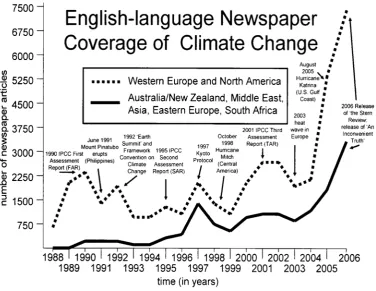
Figure 1 presents the statistics on the English-language newspaper coverage over climate change phenomena between the years 1988 – 2006 (Boykoff, Roberts 2007). The number of news has during that time increased from the zero level in 1988 to the level of about 7500 news in 2006. These news peaks seem to indicate the dates of bad disasters, hurricanes, Mount Pinatubo eruption and important Earth Summits and agreements like Kyoto Protocol. A big increase in news was in 2005 due to the bad Hurricane Katarina over North America (Boykoff, Roberts 2007). Moreover, other news has been written on the conversion from fossil fuels to less carbon containing energy solutions (Leggett 2001). In Finland, the climate change and the environmental situation of the Baltic Sea have reached wide newspaper coverage. The Baltic Sea suffers from environmental problems. The eutrophication of the coastal Baltic Sea water areas are caused by the nitrogen (N) and phosphorous (P) releases from fertilizers used in agriculture, and releases of sewage waters. Eutrophication can cause toxic algal blooming effects on swimming waters for people and animals. This is the reason why algal situation in Finland has already followed up since the year 1990 by the national algal monitoring and communication system. This follow-up system provides for citizens easy-to-use information on the algal situation. (Lyytimäki 2012)
Figure 1. Published coverage number of news in climate change over common daily newspapers in the world (Source: Boykoff, Roberts 2007)
It has gone already over 30 years when Clark (1983) presented his comparative results in an educational role of media. He claimed that media has no learning benefits. He added, however, that media could deliver instructions how media could present results between different studies so that they wouldn´t influence students´ opinions. Kozma (1994) argued in his review that it is the time to reframe Clarks´ s earlier theory. He presented that learning with media can be thought as a complementary process where representations are constructed and procedures performed. He also wanted to proceed to the new question ´ In what ways, we can use the capabilities of media in the influences of particular situations? ´, and wanted to contribute this question to the improvements of education. We should also see the role of media more as supporting than controlling the learning process according to the research by Jonassen et al. (1994). They identified that media also modifies and manipulates the context of learning by visual information. However, this argument can be taken as a supporting and awakening element for the readers in the understanding of the media news context.
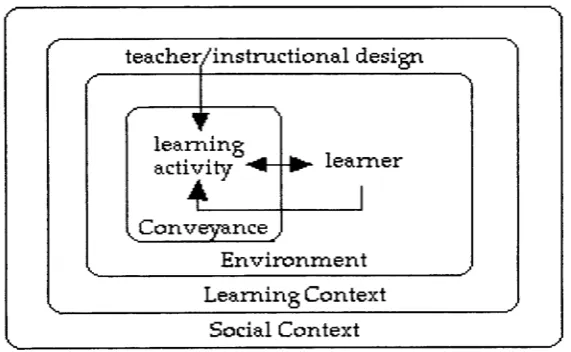
Figure 2 visualizes the relationship of the media environment in teaching and learning. Media forms the inner frame in figure 2 (Morrison 1994). The activities affecting the learning context set the learner in the center of the process. Moreover, a larger social context is needed in the learning process. Teacher´s role is to act as a facilitator and to provide the instructional design for the learning activities.
Figure 2. Factors influencing learning activities are media environment, learner and the context. (Source: Morrison 1994)
Morrison (1994) has studied the factors facilitating the learning by media. He has identified that the learning process could be facilitated by the visual and social context of the story with complex content, moving objects on screen and dynamic images.
1.2 Present role of media as an environmental information channel
After 1990, the researchers began to talk about a possible confusion of the news. It is important to avoid confusions of matters in understanding and learning of media news and issues. Confusions can be caused by the terms, for example, how people understand the influence of the ozone layer depletion or the global warming. The other example of the confusion could be how readers distinguish differences between the marine and freshwater environments (Rickinson 2001). Based on earlier education theories (e.g. Chan 1996), Rickinson focused on that readers in different ages (child, young people, adults) have different attitudes in environmental learning. He proposed that the attitudes were some kind of precursors for education in different ages when environmental learning situations are different.
The geographical scope of the research on environmental knowledge can be different. In Europe, there is a focus on studies providing environmental understanding and misunderstanding. There are also a lot of comparative research projects between countries and continents. Especially, the European environmental research seeks for scientific understanding in education. Media based education often represents the understanding of the practical phenomena (Rickinson 2001). In the report of Hastings and Tracey (2005), they asked: ´Does Media Effect Learning: Where Are We Now? ´ In particular, this report indicated the effects of the computer facilities on the present learning process. Computers are capable of supporting instructional methods. Many media forms are not enabling this. Therefore, this may limit the use of media based studies. Some media studies are, however, interchangeable and support the use of instructions. Hastings and Tracey (2005) explored in their research how media affects learning and suggested that we must identify research designs that will provide answers to this question.
After 2005, the tools of mass media have again developed a lot and today we can talk about the media as a more and more active and progressive learning platform. The modern internet can now also serve as a worldwide learning hierarchy for the environment and give massive information and issue flows. Internet has continuously increased our knowledge in climate change. In the developing countries, the role of both television and some daily newspapers is increased as a channel for the main sources of the environmental information. In modern societies we are connected in one way or another to television, computer, internet, mobile phones, twitter, tablets, blogs, web pages etc. All these communication
tools together with the daily newspapers and reportage magazines can be connected to important and current things, which are happening in the world concerning also the environmental issues. Boykoff and Roberts (2007) assumed that the role of the traditional media would be decreased in the future, when the new generations grow up, and the use of the internet would become the main source both for the daily and scientific news. In the internet as a social network, there will be available more informal knowledge by e.g. videos and YouTube (Boykoff, Roberts, 2007). In the future, it seems to be necessary to separate information pages in the internet for both formal and informal learning of knowledge.
Environmental engineering education seems to concern an actual, important and difficult teaching field. University teachers must have new ideas and tools to educate international students in many different aspects like fossil fuels, climate change, renewable energy sources, environmental protection and social and economic influences. This multi-disciplinary nature of environmental education seems to need participatory teaching methods, where media as a partner could offer new perspectives in education of sustainable development. Media influences and shapes public opinions on sustainable development, and therefore UNESCO invited electronic and print media organizations, media professionals, training institutions and students to participate in the Decade of Education for Sustainable Development. The report by Bird et al. (2008) presented that learning, understanding and imparting knowledge are essential for the survival, growth, protection and development of planet Earth. Moreover, they pointed out that education, especially, need aspects such as climate change, resource depletion, forests, fisheries, water, biodiversity and pollution. This UNESCO report on the education plan for the future also includes the integration of different group work methods into the education development of the sustainable development (Bird, Lutz and Warwick 2008).
Important aspects for the present role of media seem to be involved in the actual knowledge of the journalists, who write the news. Normally, journalists have to trust on the information of the experts; they translate information into their own language, they read reports and make interviews. In spite of the in-depth information search, the news may contain errors and inaccuracies, which can make the journalistic system unreliable. News can also be confusing in order to attract more readers. (Roser-Renouf et al. 2014).
1.3 Design of environmental education
From the teachers point of view, it may be difficult to embed the usage of daily news and reportages in environmental teaching .The use of media seems to be suitable for the master´s level students when their own level of environmental knowledge is already relatively high. However, this target group helps teachers in planning teaching practices for students to increase their motivation and professional skills. According to Viennot (2014), the motivation of the students increased using the conceptual and informative daily teaching with suitable current news and reportages. Although, the news and reportages are not the main goal in teaching, they can form a suitable tool to broaden the students´ awareness in perspectives of sustainable societies. For this purpose, the Media News based Environmental Learning (MNBEL) strategy was developed for a Master´s Degree Course in Environmental Engineering. MNBEL has the following aims: (1) to increase the awareness of students in understanding the titles of the environmental news, (2) to increase the sensitiveness of the students on the context of the news, (3) to give necessary support and valid explanations in environmental issues to the students by teachers, (4) to generate the collaborative discussions around the news and (5) to collect feedback in order to improve the MNBEL teaching and learning strategy.
2. METHODS
2.1. Teaching methods in sustainable engineering
The decision makers have searched for the approaches to transform Europe into a highly energy-efficient and low carbon economy. For obtaining these aims, the higher engineering education needs suitable methods for these challenging environmental engineering solutions. This includes also increased collaboration in universities inside the EU countries and globally (Peltonen & Mälkki 2011). As an example, in the development of the sustainable urbanized environment, we need the environmental chemistry based methods for evaluating the possible environmental impacts (Peltonen & Mälkki 2010). It is essential that we have tools and practices during the university courses to teach students on the sustainable environmental aspects. The problem based learning (PBL) strategy seems to be a suitable method where students work in groups in problem solving.
Before the developing of this MNBEL pilot method for environmental media learning purposes, the authors have especially developed the PBL method for students as a group work method in environmental problems. The studies (Peltonen, Mälkki & Värttö 2012; Peltonen, Vanhamäki & Mälkki 2013) have identified that the motivation and skills of the students could be increased by the PBL method where students were working in groups and as group members. PBL seemed to be a valid method in the higher university environmental course education, e.g. in problem solving of the resource-efficient and life-cycle based building materials. PBL based solving of problems also seemed to generate a lot of new ideas for possible new working life oriented research projects (Peltonen, Vanhamäki & Mälkki 2013).
2.2 Pilot course in exploiting environmental media learning
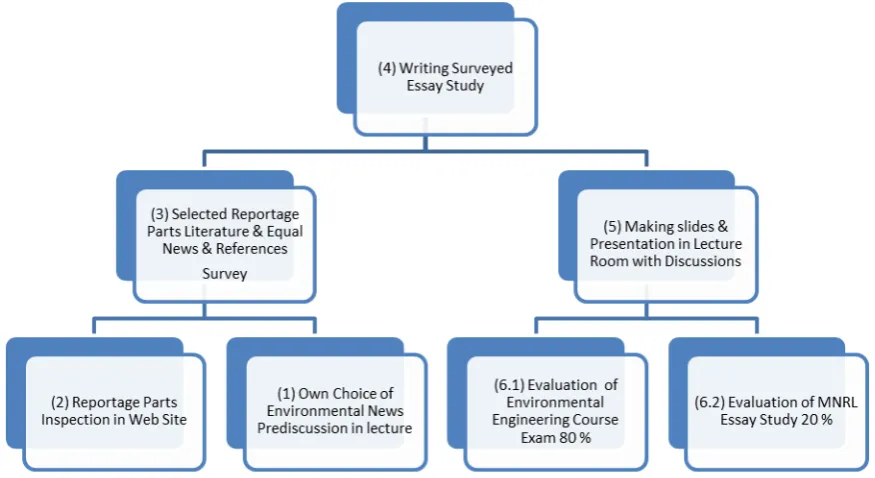
After the utilization of the PBL method as a course group work strategy, we began to develop the media learning strategy. The Media Based Environmental Learning strategy (MNBEL) was applied for first time in the course of Environmental Engineering. The scope of this course was 6 ECTS. The MNBEL exercise was 1,5 ECTS from the total scope of the course. The course belonged to the Master´s Degree Program in Environmental Engineering. Nine foreign students from different countries worldwide attended the course. The MNBEL phases and the evaluation process are presented in Figure 3. The course included also an obligatory examination.
2.3 Definition of media based environmental learning strategy
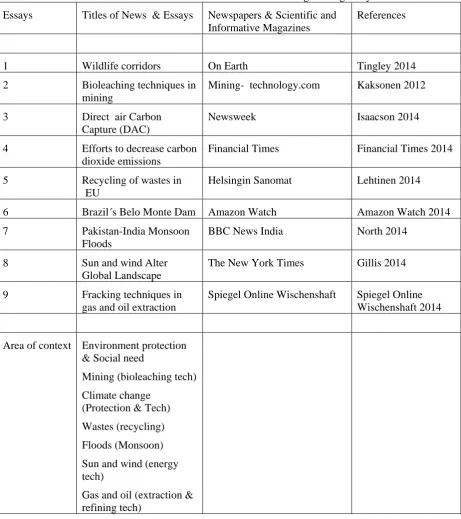
The authors have given their own definition and description for MNBEL. MNBEL means environmental engineering learning by the media news and reportages. MNBEL includes the study made by the student. The study focuses on the surveyed and analyzed content of the selected daily environmental news or reportages. The survey is needed for an essay writing study. The main objectives of the media survey are among others, to increase the actual informative learning of students in environmental problems. The origin of the news can be either from the daily newspaper or from other suitable environmental magazine. The selected titles of the essays are current or have a certain importance, if the news is not new. The title includes aspects such as important environmental problems, new environmental techniques, alternative energies, environmental phenomena, environmental impacts, emissions, purification solutions, social effects etc. In searching for the suitable news and reportages titles, it is also possible to use TV and radio channels and valid internet links with their web pages. The internet seems to be a faster way to get suitable materials than using the common library. The origin of the selected daily news titles are presented in Table 1.
2.4 Work phases
MNBEL included the sessions for the starting work group and the ending work group. In the MNBEL strategy, there were seven phases (1) – (6.2), which are presented in Figure 3. At first (1), students had
to make, based on their own interests in environmental engineering, the choice of the news or reportage and begin to analyze the contents in the selected news title. Students had to read out the context and form opinions about the problems in news. Students had to do a first rather quick preliminary inspection of the news title, e.g. based on the comparison of the equal news in the internet. This phase (2) included the information survey for the selected subject titles. In the phase (3), the students had gathered all necessary materials to make a review of the literature answer to all open questions, which possibly rose up from the confusions in the context of the news. Finally in the phase (4), the students wrote their essays. In the phase (5), the students prepared their presentations about their informative findings. The students taught the other course students about their learning in environmental engineering for discussions in the final work shop. The rest phases (6.1) – (6.2) included the course exam and the final evaluation of the student essays by the teachers as part of the total course evaluation.
Figure 3. MNBEL phases and evaluation in environmental education hierarchy of the course.
3. RESULTS
3.1 Area of content in essay surveys
In the beginning of the media work, all students actively surveyed different daily news, magazines and web pages. Everyone had to show the suggested news title and links to the responsible teacher. The titles were selected during the first survey week. Table 1 presents the referred links of the original titles of the essays in this pilot. The news and reportages were found from different sources. Main news for the essays originated from On Earth magazine, Mining Technology Newsweek, Financial Times, Helsingin Sanomat, Amazon Watch, BBC News India, The New York Times and Spiegel Online Wischensaft (see Table 1). Especially, the essays with the social aspects (Wildlife Corridors, Belo Monte Dam in Brazil) and the environmental effects were broadly discussed during the final work shop. These discussions showed that students had learnt in a more deep way to deal with their own issues by reading the news and creating additional questions which remained unanswered in media news.
3.2 Evaluation and grading of essays
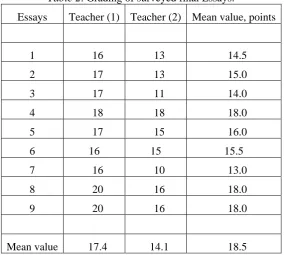
In the evaluation of the essays, teachers used five grading factors and each factor was evaluated on a scale of one to four points. In this system, the maximum points of the essay were 20 points. Before grading, the students had a possibility to improve their final essays after their presentations. Table 2 presents the grading points given by the two teachers for each final essay.
In grading, the total course points were 100 points, where the essay presented 20% and the obligatory exam 80% from the total 100 course points. The limit to pass the course was 50 points from 100 points, which means that the grading value is one from five (1/5).
Table 1. Titles of the news based environmental engineering essays.
Essays Titles of News & Essays Newspapers & Scientific and Informative Magazines
References
1 Wildlife corridors On Earth Tingley 2014
2 Bioleaching techniques in mining
Mining- technology.com Kaksonen 2012
3 Direct air Carbon Capture (DAC)
Newsweek Isaacson 2014
4 Efforts to decrease carbon dioxide emissions
Financial Times Financial Times 2014
5 Recycling of wastes in EU
Helsingin Sanomat Lehtinen 2014
6 Brazil´s Belo Monte Dam Amazon Watch Amazon Watch 2014
7 Pakistan-India Monsoon Floods
BBC News India North 2014
8 Sun and wind Alter
Global Landscape
The New York Times Gillis 2014
9 Fracking techniques in gas and oil extraction
Spiegel Online Wischenshaft Spiegel Online Wischenshaft 2014
Area of context Environment protection & Social need
Mining (bioleaching tech) Climate change
(Protection & Tech) Wastes (recycling) Floods (Monsoon) Sun and wind (energy tech)
Gas and oil (extraction & refining tech)
The evaluation of the essays included the five grading factors:
(1) Actual orientation and introduction to the subject of the essay title.
(2) Essay-type writing, clear text with interesting and actual context, effective length, explanations of inaccuracies.
(3) Own interest in the selected title, understanding the content of the essay, necessity and topicality of the essay, environmental problems and solutions.
(4) Type and amount of the additional references used in the essay.
(5) Discussions based on the title, importance and conclusions for the future.
The two teachers independently evaluated the essays based on the factors mentioned above. These grading results are presented in Table 2.
Table 2. Grading of surveyed final Essays.
Essays Teacher (1) Teacher (2) Mean value, points
1 16 13 14.5
2 17 13 15.0
3 17 11 14.0
4 18 18 18.0
5 17 15 16.0
6 16 15 15.5
7 16 10 13.0
8 20 16 18.0
9 20 16 18.0
Mean value 17.4 14.1 18.5
Notice: Maximum 20 points per an essay (= 20% from the total course points).
Table 2 shows that all essays were graded relatively high in their quality. The variation between the lowest and the highest points was from 11 to 20 points. Teachers' evaluations resulted different points. It seems that the evaluation process and the grading system involve some subjective elements, which need further improvements in the next implementation of the MNBEL grading instructions.
3.3 Media as a teaching tool
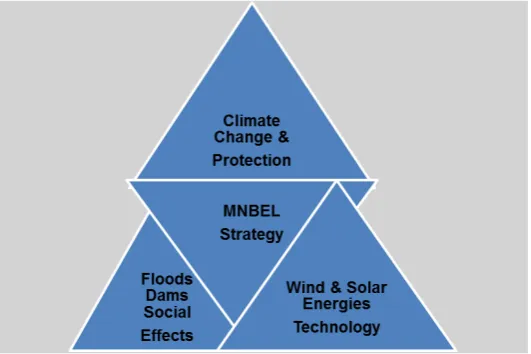
Media is a core element in the MNBEL strategy. Students search for current news in environmental information based on versatile media channels. They aim to learn latest solutions in environmental engineering and write their essays on the selected subjects. Figure 4 presents the core subjects of the essays which are situated around the MNBEL strategy. This pyramid describes the subject fields which students independently chose for their actual essay analyses. The main environmental information included items like climate change, floods and wind and solar energy. Additionally, there were latest information on the future environmental engineering techniques like bioleaching technique in mining industry, recycling in EU countries and fracking techniques in the crude oil extraction.
Students also shared their essay results to the other students. The MNBEL strategy thus formed a desirable teaching tool for the collaborative learning during this Environmental Engineering course.
Figure 4. Contextual pyramid surfaces around the MNBEL strategy for environmental learning in a master´s degree level course in Environmental Engineering.
4. DISCUSSIONS
The MNBEL strategy combines media and teaching in environmental engineering. This strategy was developed to utilize diverse media forms as a learning tool for students. Students wrote essays, presented and discussed their subjects in working groups. The discussions showed that present mass media can have a big influence and motivation on students´ opinions. From the viewpoint of the environmental aspects in learning, this study resulted that the use of media news can generate collective thinking and communication in local, national and global environmental problems. It is important for students to understand how media translates the knowledge from the science world to common environmental policies and practices applied in the whole society.
Discussions in the work groups showed that media plays an important role in sharing information on climate change and allied phenomena. Media seemed to be a driving force to introduce the latest environmental news, but it seemed to lack instructions on how the readers could search for the latest knowledge in these environmental changes. Media seemed to be an increasing information channel in the developing countries, where environmental learning has not been so strongly developed by the normal education system at different school levels. In the MNBEL strategy, the teacher´s role seemed to need, however, some sensitiveness in interpretation and selection of the titles of the news. Media with internet possibilities is becoming a more and more proactive learning platform in environmental and social effects. In environmental learning hierarchy, for higher university environmental engineering, the MNBEL strategy, as it is presented in this pilot, seemed to be a quite valid educational teaching tool for many kinds of worldwide environmental engineering issues. The authors of this article have noticed that it is crucial to start collaborating in a multi-disciplinary way with the two different sciences that are the natural sciences and the educational design science. This could help to design suitable learning instructions in environmental engineering by media. This seems to require versatile educational expertise and experiences from responsible teachers as well as from environmental journalists.
5. CONCLUSIONS
Today, the role of media has increased as a learning tool in higher education institutes. Until 1990, media provided information, and didn´t participate in education. After 2000, the situation began to change. Researchers studied the role of media in increasing the environmental awareness and understanding of the students. They noticed that the media news and discussions about environmental problems had a positive effect in education. Especially, the global environmental problems like the climate change reached the worldwide newspaper coverage. These environmental problems have influenced also on the fact that media with modern tools like daily newspapers, internet, TV etc., is now the most popular global environmental knowledge channel in all continents.
In this paper, we have introduced the first experiences from the new MNBEL strategy in teaching environmental engineering. MNBEL improved the students´ writing skills. Findings showed that MNBEL motivated students and they learnt to analyze and discuss complex environmental news. For example, the global and local problems were well outlined in the students´ essays. Our concluding remarks are based on the first experiences. MNBEL helped students in understanding of the actual daily media news in environmental engineering. Collaborative learning sessions increased the environmental understanding on the titles and contents of the essays. MNBEL improved the students´ motivation and knowledge transfer between the foreign students and the teachers. Essays based analyses took better into account the local social perspectives of the environmental problems and made the presentations very interesting for detailed discussions. MNBEL generated new environmental contents for the course. However, improvements and modifications are still needed. For example, the learning process could benefit from adding more work sessions on arising questions. The pilot showed that the planning phase of the course and grading instructions are important for this method. The grading system should also be up-dated and improved. Concluding with our experiences, we can recommend that the MNBEL strategy as an informative media teaching method could be used in environmental engineering education at any university.
REFERENCES
Amazon Watch 2014, Brazil´s Belo Monte Dam. Sacrificing The Amazon and its people for dirty Energy. Obtainable from: http://amazonwatch.org/work/belo-monte-dam Accessed 03.12.2014. Bird, E, Lutz, R & Warwick, C, 2008, Media as partners in education for sustainable development: A Training and Research Kit. UNESCO Series of Journalism Education. United Nations Educational, Scientific and Cultural Organization, Paris, France, 2008. Reference number CI/COM/2008/PI/2, 68 p. Boykoff, MT& Roberts, JT 2007, Media coverage of climate change: current trends, strengths, weaknesses. United Nations Development Programme. Human Development Report 2007. Background paper. Final version, p. 53.
Boyes, E, Stanisstreet, M & Papantoniou, VS 1999, The ideas of Greek high school students about the `ozone layer`. Science Education, 83(6), pp. 724-737.
Boyes, E & Stannisstreet, M 1996.Threats to global atmospheric environment: the extent of pupil understanding. International Research in Geographical and Environmental Education 5(3), pp. 186-195.
Chan, KKW 1996, Environmental attitudes and behavior of secondary school students in Hong Kong, The Environmentalist, 16(4), pp.297-306.
Clark, RE 1994, Media will never influence learning. Educational Technology Research and Development, Vol. 42, No. 2, 1994, pp.21-29 ISSN 1042-1629
Connell, S, Fien, J, Sykes, H et al., 1998, Young people and the environment in Australia: beliefs, knowledge, commitment and educational implications. Australian Journal of Environmental Education, 14, pp. 39-48.
Financial Times 2014, Efforts to decrease carbon dioxide emissions. World News Page 4. September 10, 2014.
Gillis, J 2014, Sun and Wind Alter Global Landscape, Leaving Utilities Behind. The New York Times
Environment The Big Fix, Sept 13, 2014. Available from:
http://www.nytimes.com/2014/09/14/science/earth/sun-and-wind-alter-german-landscape-leaving-utilities-behind.html?_r=0 (Accessed 03.12.2014)
Gutierrez, R& Ogborn, J 1992, A causal framework for analyzing alternative conceptions, International Journal of Science Education. 14 (2), pp. 201-220.
Hastings, NB& Tracey, MW 2005, Does Media Effect Learning: Where Are We Now? TLRPIL, 49(2), 28-30. ISSN 8756-3894
Isaacson, B, 2014, Direct Air Capture Makes Pollution a Cash Cow. Newsweek Tech & Science 8/25/14. Obtainable from: http://www.newsweek.com/direct-air-capture-makes-pollution-cash-cow-266587 (Accessed 03.12.2014)
Jonassen, DH, Campbell, JP & Davidson, ME 1994, Learning with media: Restructuring the debate. Educational Technology Research and Development. Vol.42, No.2, pp. 31-39. ISSN 1042-1629. Kaksonen, A 2012, Mineral-munching microbes: the future of metal mining? 2 August 2012. Mining-technology.com. News, views and contacts from the global Mining industry. The Mining newsletter, product of Kable. Obtainable from: http://www.mining-technology.com/features/featuremineral-munching-microbes-future-metal-mining/ Accessed 03.12.2014
Kozma, RB 1994, Will media influence learning? Reframing the debate. Educational Technology Research and Development, Vol. 42, No.2, 1994, pp.7-19, ISSN 1042-1629
Kuhlemeier, H, van den Bergh, H & Lgerweij, N, 1999, Environmental knowledge, attitudes, and behavior in Dutch secondary education, Journal of Environmental Education, 30(2), pp.4-14.
Lehtinen, T & Saavalainen, H 2014, Suomalaiset ovat läntisen Euroopan laiskimpia kierrättäjiä. Suomessa into hiipuu, muualla EU:ssa kasvaa. Kannustimiksi aiotaan sekajätemaksuja.
Helsingin Sanomat Kotimaa 27.3.2014. Obtainable in Finnish from: http://www.hs.fi/kotimaa/a1395817915745 (Accessed 03.12.2014)
Legget, J 2001, The Carbon War: Global Warming and the End of Oil Era. New York, Routledge. 2001.
Lyytimäki, J 2012, The environment in the headlines - Newspaper coverage of climate change and eutrophication in Finland. Monographs of the Boreal Environment Research No. 42. 72 p. ISBN 978-952-11-4086-0 (PDF)
Membiela, P, Nogueiras, E & Suarez, M 1993, Students´ preconceptions about urban environmental problems and solid waste. Journal of Environmental Education, 24(2), pp. 30-34.
Membiela, P, Nogueiras, E & Suarez, M 1994, Preconceptions of students about the natural urban environment in a small Spanish town. The Environmentalist 14(2), pp. 131-138.
Morrison 1994, The media effects question: “Unresolvable” or asking the right question. Educational Technology Research and Development, Vol. 42, No. 2, pp. 41.44 ISSN 1042-1629
North, A 2014, Pakistan-India monsoon floods: Averting future disasters. BBC News India, 33 September 2014. Obtainable from: http://www.bbc.com/news/world-asia-india-29171823 (Accessed 03.12.2014)
Peltonen, P & Mälkki, H 2011, Sustainable energy reform comparison in bilateral Finnish – Mediterranean regional collaboration. SDEWES, 6th Sustainable Development of Energy, Water and Environment Systems, Conference, Dubrovnik University, Croatia, 2011.
Peltonen, P, Mälkki, H & Värttö, H 2012, Problem-based learning in the teaching of environmental technology in collaboration between students and working life. International Conference on Problem- Based Learning, 12-13 April 2012, Rovaniemi, Finland. Article in: Poikela, E & Poikela, S (eds.) Competence and Problem-Based Learning. Rovaniemi University of Applied Sciences, Publications A:3. Rovaniemi, Finland.
Peltonen, P & Mälkki, H, 2010, Sustainable Urbanization in Context of Environmental Chemistry and Life Cycle Issues. The Sustainable City 2010. Sixth International Conference on Urban Regeneration and Sustainability 14 – 16 April 2010, A Coruña, Spain
Peltonen, P, Vanhamäki, S & Mälkki, H 2013, Problem-based environmental learning in building and demolition waste technology. 7th International Technology, Education and Development Conference INTED2013, Valencia 4.-6.3.2013, INTED2013 Proceedings, pages: 1967-1975, ISBN: 978-84-616-2661-8
Rickinson, M 2001, Learners and Learning in Environmental Education: a critical review of the evidence. Environmental Education Research 7(3): 207-320
Roper Starch Worldwide 1994.Environmental Attitudes and Behavior of American Youth with an Emphasis on Youth from Disadvantaged Areas (ED 381 599) (Washington, DC, National Environmental Education and Training Foundation)
Roser-Renouf, C, Stenhouse, N, Rolfe-Redding, J et al. 2014, Engaging Diverse Audiences with Climate Change: Message Strategies for Global Warming's Six Americas. Available from.
http://environment.yale.edu/climate-communication/files/Global_Warmings_Six_Americas_book_chapter_2014.pdf (Accessed 25 November 2014)
Spiegel Online Wischenshaft 2014, Gutachten: Umweltbundesamt fordert weitgehendes Fracking-Verbot. Spiegel Online Wischensaft, Mittwoch, 30.07.2014. Available in German from: http://www.spiegel.de/wissenschaft/technik/fracking-uba-fordert-in-einem-gutachten-strengere-regeln-a-983577.html (Accessed 03.12.2014)
Tingley, K 2014, Forging a new path. On Earth. A survival guide for the planet September 15, 2014. Natural Resources Defense Council (NRDC). http://archive.onearth.org/articles/2014/09/designing-wildlife-corridors-how-to-build-a-better-mouse-trip, (Accessed 03.12.2014)
UN Documents 1987, Our Common Future. Report of the World Commission on Environment and Development. From A/42/427.
UNESCO 1978, Tbilisi Declaration. Intergovernmental Conference of Environmental Education October 14-26, 1977. UNESCO/UNEP Environmental Education Newsletter, Vol. III, No 1 (January 1978).
Viennot, L 2014, Learning and conceptual understanding: Beyond simplistic ideas, what have we learned? https://web.phys.ksu.edu/icpe/Publications/teach2/Viennot.pdf, (Accessed 26 November 2014)