SAFETY POSSIBILITIES, SOCIALIZATION, AND INTEGRATION OF PEOPLE WITH DISABILITIES
Silviya M. Mladenova
Medical University – Sofia, Faculty of Public health, Dept. „Medical pedagogy”
Sofia 1528, 8 Bialo more str.
Abstract
Society humanity is judged by its attitude towards the vulnerable, one of which is the group is people with disabilities. The aim of the study is to investigate the attitudes and relations towards people with disabilities and the possibilities for their social protection. Materials and methods: We carried out a standardized survey among 52 students studying in the specialty "Management of health care". These are students with a basic medical specialty who work as health professionals. The results show that the respondents are not sufficiently aware of the opportunities for social protection and safety of the disabled. The majority of respondents believe that people with disabilities have the necessity of a so-called personal assistant whom they can use when it is needed. They also share the opinion that Aids for people with disabilities are insufficient.
Key words: people with disabilities, socialization, integration, safety possibilities
Introduction
In our country in the last years is observed a rise of the number of people who receive various benefits or retire due to illness. For the humanity of a society is judged by the attitude towards the vulnerable groups, one of which is the group is people with disabilities. It is particularly important for these people to receive the necessary help and support from the community.
L. Gateva notes that Everyone born in this world has a moral right to respect his dignity, human feelings and emotions. People with disabilities, regardless of the extent of these ailments have the equal legal and human rights. They are entitled with the right to live like all other citizens of the country they live in. Because of their limitations, they have special needs and require special care and support. All societies owe to all their fellow citizens help, as far as this relates to the conditions of life which have to be similar to those of other people./Lyudmila Gateva, 2002 /
People with disabilities must be given the opportunity to receive adequate assistance and support that will allow them to be socialized and integrated successfully into the society without breaking their rights and integrity. The gaining of specialized benefits and services must be provided without harming their human dignity and self-esteem.
According to Deborah Marx: As with other clients in a socially disadvantaged position, the physically disabled clients need to be informed of their rights or to be helped to gain access and control over their benefits and services. It is therefore important for them to have a contemporary understanding of the legislation and policy related to disability./ Deborah Marx, 2008 /
Experts identify three models of disability:
A medical approach which treats physical disability as a dysfunction or abnormality in the body of the individual.
Psychological models /behavioral, cognitive and psychoanalytic/ are approaches centered mainly on the individual personal psychological response to disability.
The social model defines the disability in society: in the way environment is built, its values and social practices that discriminate people with certain differences. / Deborah Marx, 2008 /
The aim of the study was to investigate the attitudes and relation towards people with disabilities and the opportunities for their social protection.
Material and methods
Conducted was a standardized survey among 52 students studying in the specialty "Management of health care" with a basic medical specialty who work as health professionals in the healthcare sphere.
Results and Discussion
The results show that respondents are not sufficiently aware of the opportunities for social protection of people with disabilities. It is vital for people with disabilities to rely on the state institutions for help and realization of their social protection. Therefore, the respondents were asked: "What is your
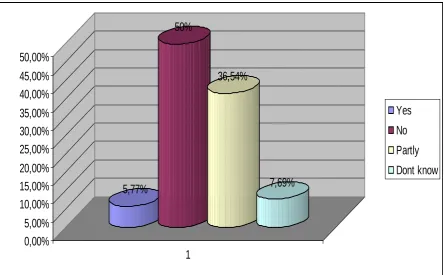
opinion, in our country do we have enough institutions that protect and care for people with disabilities?". The results obtained are presented in Figure 1.
Fig. 1. Availability in the country of institutions assisting persons with disabilities
5,77%
50%
36,54%
7,69%
0,00%
5,00%
10,00%
15,00%
20,00%
25,00%
30,00%
35,00%
40,00%
45,00%
50,00%
1
Yes
No
Partly
Dont know
The highest relative share / 50% / is of those according to whom in Bulgaria there is no institution to protect and care for the interests of people with disabilities. The next group that follows is of 36.54% of the respondents, according to whom there are institutions that care only partially for the problems of people with disabilities. Another part of 7,69 % of respondents chose the answer "do not know". The least group of the surveyed, only 5.77% are of the opinion that there are institutions that care for them.
The results are very negative and show that in our country there is a large deficit of institutions which to fend for the socialization and the integration of people with disabilities. Another problem of the people with disabilities and their relatives is that if there are institutions they do not administer a comprehensive support and protection, but only partially meet some of their needs.
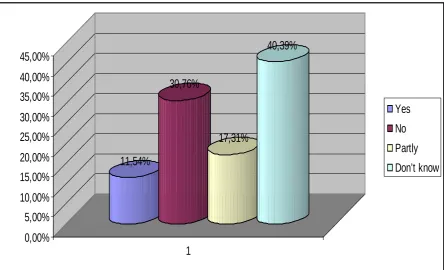
In order to establish how much trust and to what extent people with disabilities can rely on these organizations we asked the question "Is there an organization in our country, which you would trust if you or someone close to you with disabilities would need help?"
Fig. 2. Availability of support and help from an organization for people with disabilities
11,54%
30,76%
17,31%
40,39%
0,00%
5,00%
10,00%
15,00%
20,00%
25,00%
30,00%
35,00%
40,00%
45,00%
1
Yes
No
Partly
Don’t know
The results obtained show that the highest share / 40.39% / of respondents do not know whom to address when people with disabilities or their relatives have problems. According to 30,76% of the respondents there is not any organization that could be trusted. For about 17,31 % there are partial possibilities some organization to satisfy their need for support. The lowest share / 11,54 % / is of respondents who believe that there is an opportunity to get help.
The data reveals a very negative result, that in our country there is not any organization or institution that is clearly recognizable that has earned the trust of the population and of people with disabilities which can offer help and support to people who need it.
It is especially important that people with disabilities have the rights like everyone else. This can be achieved by providing equal access to all institutions, establishments and public buildings and by enabling them to fulfill their personal and social functions and commitments.
For Deborah Marx "Disability has its personal, social and psychological dimensions. The attempts to describe and integrate these different levels can provide a more comprehensive understanding of the life of clients with specific physical disability." /Deborah Marx, 2008/
According to Tzvetkova - Arsova The majority of children and adults with physical disabilities will need to use aids for motion, such as orthopedic / aid / canes, crutches, wheelchairs. /Tzvetkova - Arsova, 2008/
The successful socialization and integration of people with disabilities in the society can be
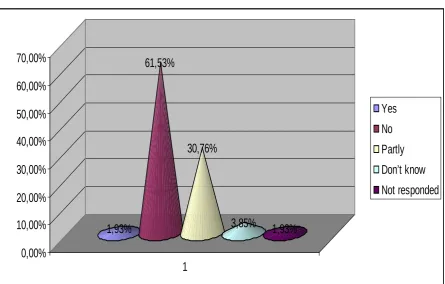
implemented by means of an accessible environment and opportunity to use a variety of tools. That is why we stated the question: "Are there provided enough facilities for people with disabilities to ensure them a good quality of life?"
Fig. 3. Provision of aids for people with disabilities
1,93%
61,53%
30,76%
3,85%
1,93%
0,00%
10,00%
20,00%
30,00%
40,00%
50,00%
60,00%
70,00%
1
Yes
No
Partly
Don’t know
Not responded
According to the majority of respondents / 61,53 % / the aids for people with disabilities are insufficient. The group that follows is of 30,76 % according to whom people with disabilities are provided partially with facilities. 3.85% have responded that they do not know what is the provision and availability of aids. The lowest share / 1,93 % / is this according to whom people with disabilities have access to adequate facilities, 1,93% do not answer.
The results obtained show the very negative trend people with disabilities to have no access to
sufficient aids and tools, which significantly hampers their socialization and reintegration into society, their movement and free mobility. The lack of sufficient in type and quantity aids significantly reduces the quality of life of disabled people and hinders their mobility.
Environment can become more accessible if people with disabilities have personal assistants. That is why we asked the question: "Do you think that people with disabilities need personal assistants? "
Fig.4. Need of a personal assistant for people with disabilities
86,53%
0 7,69% 3,85% 1,93%
0,00% 10,00% 20,00% 30,00% 40,00% 50,00% 60,00% 70,00% 80,00% 90,00%
1
Yes No Partly Don’t know Not responded
The majority of respondents / 86,53 / believe that people with disabilities need to have a personal assistant, whom they can enjoy when they have to. According to 7,69 % of the surveyed people with disabilities need a personal assistant or someone to help only from time to time. 3.85% have responded that they do not know. 1.93% did not respond, and none of the surveyed believes that people with disabilities do not need a personal assistant to help them in certain cases.
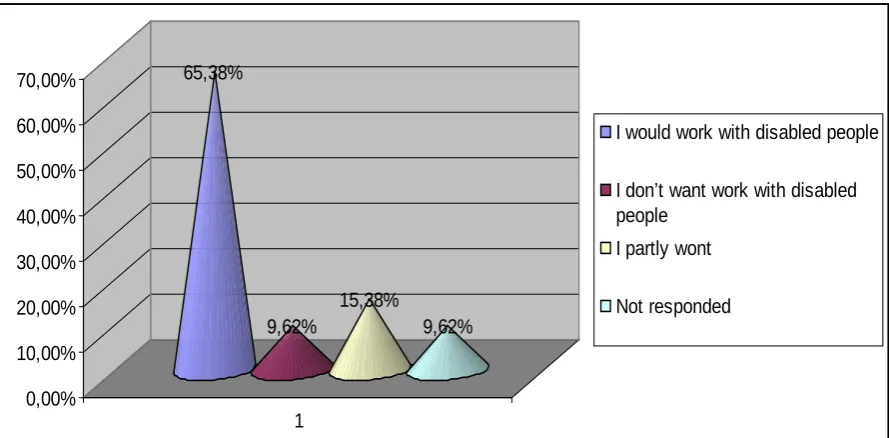
In their professional activity medical specialists often work with people with various disabilities. In order to determine whether the health staff works willingly with this contingent we stated the question: "Are you willing to work with people with disabilities? "
Fig . 5. Willingness to work with disabled people.
65,38%
9,62%
15,38%
9,62%
0,00% 10,00% 20,00% 30,00% 40,00% 50,00% 60,00% 70,00%
1
I would work with disabled people
I don’t want work with disabled people
I partly wont
Not responded
The results obtained show that the majority of medical professionals 65,38% are willing to work with people with disabilities. For 15.38% the willingness is partial, 9.62% say they do not want to work with people with disabilities, and 9,62% do not respond.
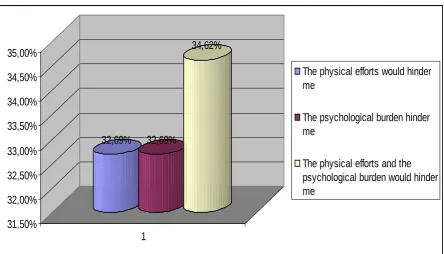
Healthcare professionals have many contacts with people with disabilities because they often need medical care and assistance and visit different healthcare services. In order to find out the difficulties that medical specialists encounter we asked the question: "What would you find difficult when working with people with disabilities? "
Fig . 6 Possible difficulties of medical professionals working with people with disabilities
32,69% 32,69%
34,62%
31,50% 32,00% 32,50% 33,00% 33,50% 34,00% 34,50% 35,00%
1
The physical efforts would hinder me
The psychological burden hinder me
The physical efforts and the psychological burden would hinder me
The highest relative share / 34,62% / is of those who believe that working with people with disabilities could impose significant physical and mental effort and the loads are larger than with other patients with whom they work. Equally 32.69% are the shares of those who say that the physical efforts would hinder them and those who indicate to have difficulties with the psychological load, which could affect their mental and emotional condition when working with people with disabilities.
The results obtained enable us to draw the following conclusions:
1. Disabled people in Bulgaria do not receive the necessary physical, social and psychological assistance.
2. In our country there is no institution and organization, which to provide a comprehensive care for people with disabilities.
3. The aids for people with disabilities are insufficient.
4. For a better socialization and integration people with disability need personal assistants or aides whom they can enjoy when necessary.
5. The work with people with disabilities loads significantly the medical professionals, but very few of them share not to want to work with people with disabilities.
It is necessary the Bulgarian society to provide equal opportunities for people with disabilities by providing accessible environment and sufficient in quantity and type aids. The institutions and organizations which help and support the disabled people need to synchronize their activities with the leading European documents and practices. They must provide comprehensive care for people with disabilities that will enhance their quality of life and contribute to their successful socialization and integration into society. This will help to unleash the potential of people with disabilities and their successful inclusion in society.
Bibliography
Гатева, Л., (2002) Педагогически модели, В Грижи за лица с умствени увреждания, Учебно помагала за следдипломна специализиция „Медицинска сестра за социални дейности”, изд. „Филвест”, София.
Карагьозов, Ив. В. Кацарска, (2008) Ресурсна /специална/ педагогика /първа част/, изд. „Ивис”, Велико Търново.
Маркс Дебора, (2008) Физическа инвалидност, В Антология Социална работа, съставител Мартин Дейвис, УИ „Св. Климент Охродски”, София.
Цветкова – Арсова, Мира, (2002) Обучение на зрително затруднени с множество увреждания и сляпоглухи, изд. ЕкоПринт, София.
Чакърова, Л, (2013) Макроетика и устойчиво развитие в здравеопазването, изд. „ЕКС-ПРЕС”, Габрово.
Цветкова – Арсова, Мира, (2002) Обучение на зрително затруднени с множество увреждания и сляпоглухи, изд. ЕкоПринт, София.
Цветкова – Арсова, Мира, (2008) Оринтиране и мобилност, изд. ЕкоПринт, УИ „Св. Климент Охридски”, София.
Шулман, Лоурънс, (1994) Изкуството да се помага на индивиди, семейства и групи, изд. Невронауки и повдение, София.