Construction SMEs
Ernawati Mustafa Kamal(Universiti Sains Malaysia, Malaysia)
Roger Flanagan(University of Reading, UK)
Abstract
Absorptive capacity has been acknowledged as a critical component for organisations to sustain, grow and compete in their markets. Many researchers have used the concept of absorptive capacity in their analysis at different levels: individual, organisation, industry and country. However, most of the studies focus on very large organisations with sophisticated structures and strong R&D orientation. Very few studies address the theory of absorptive capacity in the context of SME organisations. This paper presents part of the findings of research that investigated absorptive capacity in the context of Malaysian rural construction SMEs. The aim of this paper is to prescribe a model of absorptive capacity for rural construction SMEs. The model is based on validation drawn from five case studies of construction SMEs operating in the rural area in Malaysia. The developed model serves two functions: Firstly, to help rural construction SMEs to understand the issues and process related to absorptive capacity and the implementation, and use of, new technology; secondly, to provide a mechanism for policy makers to transfer new technology to rural contractors. This research contributes to the body of knowledge of absorptive capacity by highlighting issues related to absorptive capacity and implementation of new technology in the context of rural SMEs.
Keywords: Absorptive Capacity, Malaysia, Rural Construction, Small and medium sized enterprise (SME).
Introduction
The concept of absorptive capacity originates from macroeconomics where it refers to the ability of an economy to effectively utilize its capital resources (Adler, 1965). Cohen and Levinthal (1990, p.128) defined organisation absorptive capacity as ‘an ability to recognize the value of new information, assimilate it and apply it to commercial ends.’ Zahra and George (2002) give a comprehensive definition of absorptive capacity in which they described it as a set of organizational routines and processes by which firms acquire, assimilate, transform and exploit knowledge to produce a dynamic organizational capability. It has also been acknowledged as a critical component for organisations to sustain, grow and compete in their market. Many researchers have used the concept of absorptive capacity in their analysis at different levels: individual (Bower & Hilgard, 1981; Cohen & Levinthal, 1990; Deng, Doll, & Cao, 2008; Lenox & King, 2004), organisation (Bosch, Volberda, & Boer, 1999; Cohen & Levinthal, 1990; Lin, Tan, & Chang, 2002; Smallbone, North, & Leigh, 1993), industry (Abecassis-Moedas & Mahmoud-Jouini, 2008; Liao, Wu, Hu, & Tsuei, 2009; Rawski, 1975; Stock, Greis, & Fisher, 2001) and country (Hou & Gee, 1993). However, most of the studies focus on very large organisations with sophisticated structures and strong R&D orientation.Very few studies address the theory of absorptive capacity in the context of SME organisation.
Kamal, E.M & Flanagan, R. 2014, ‘Model of absorptive capacity and implementation of new technology for rural construction SMEs’, Australasian Journal of Construction Economics and Building Conference Series,
2(2), 19-26.
20 from five case studies of construction SMEs operating in the rural area in Malaysia. The first section of this paper discusses the literature review on the model of absorptive capacity and absorptive capacity in construction SMEs. The second section presents the discussion of the research method, followed by the findings and discussion of the validated model. The last section presents the conclusion from the research.
Literature Review
This section begins with a discussion of the model of absorptive capacity, followed by the concept of absorptive capacity in the context of construction SMEs
Model of Absorptive Capacity by Zahra and George
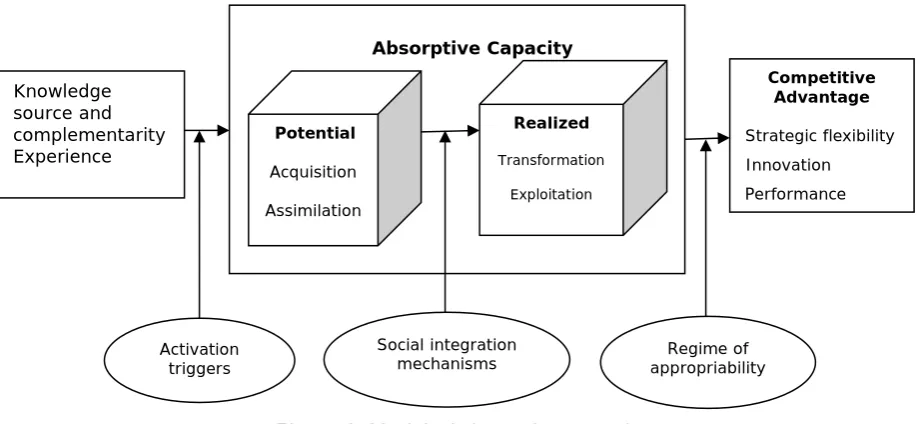
Based on their definition of absorptive capacity, Zahra and George (2002) proposed a conceptual model of absorptive capacity that connects the external knowledge sources, the elements of absorptive capacity and the outcomes of the process.
Figure 1. Model of absorptive capacity
Source: Zahra and George (2002) Absorptive capacity: a review, reconceptualization, and extension, Academy of Management Review, 27(2) (Page 192)
The model in figure 1 suggests that a firm’s potential absorptive capacity is influenced by its experience, plus the sources of external knowledge, including acquisition of knowledge through, purchasing, licensing, contractual agreements, R&D, and joint ventures. The model indicates that internal and external activation triggers have an impact on a firm’s development of absorptive capacity. Absorptive capacity involves both transformation and exploitation of knowledge. Zahra and George (2002) suggest that, in order to have successful exploitation of newly acquired knowledge, there must be a sharing of knowledge among members of the firm. Social integration mechanisms can facilitate the process and reduce the gap between potential absorptive capacities and realized absorptive capacity. The successful development of absorptive capacity will contribute to a firm’s achievement of competitive advantage. The model proposed by Zahra and George (2002) provides some overview on the process of absorptive capacity. However, the model presented is not comprehensive enough. Although there is an emphasis on exploitation, as an ability to apply
Absorptive Capacity
Knowledge source and complementarity Experience
Competitive Advantage
Strategic flexibility Innovation Performance Potential
Acquisition
Assimilation
Realized
Transformation
Exploitation
Activation
triggers appropriability Regime of
Kamal, E.M & Flanagan, R. 2014, ‘Model of absorptive capacity and implementation of new technology for rural construction SMEs’, Australasian Journal of Construction Economics and Building Conference Series,
2(2), 19-26.
21 knowledge, it should be extended to implementation. The implementation issue is much more complex than exploitation. Exploitation of knowledge usually involves an intellectual level and an organisation’s decision to apply the acquired knowledge to operations. Implementation involves the process after exploitation, which is to put the newly acquired knowledge and technology into practical effect. It involves new sets of people and new sets of skills to make it happen. It deals with people at the production stage that produces the final output. The main issue in implementation is not only new knowledge and technology, but also how to get people to accept new knowledge and technology and what needs to be done to make it work.
The Zahra and George (2002) model also assumes that the firm’s successful development of absorptive capacity will contribute to a firm’s achievement of competitive advantage. However, in practice there is no guarantee that the application of new knowledge and technology, resulting from successful development of absorptive capacity, will improve an organisation’s performance and productivity. It is acknowledged that, for some organisations, the application of new knowledge and technology may improve their performance, but for others it may not make any difference, or it may even decrease their productivity.
Absorptive Capacity in Construction SMEs
Research on absorptive capacity in the SME construction organisation is still ambiguous. The theory and concept of absorptive capacity is drawn from other industries i.e manufacturing, management and technology. Walker, Maqsood, and Finegan (2005) suggest that a strong absorptive capacity in construction organisation will help to synchronize people’s capabilities, the process involved and the technologies used, as the assimilation of these components will contribute towards organisations’ productivity. However, construction organisations are different from many other types of organisation as they are driven by projects, and they involve a wide range of participants with various background knowledge and different levels of competency. For example, most construction professionals, such as architects and engineers, with strong background knowledge in their field may also have familiarity with the overall construction process. Their capability to absorb new knowledge is higher. However, most on-site labour with lower levels of education may have little, or no proper background knowledge of construction, and so may be slower or less able to absorb new knowledge. Therefore, in construction organisations, especially in the project phase, the knowledge absorption process is more complex.
Kamal, E.M & Flanagan, R. 2014, ‘Model of absorptive capacity and implementation of new technology for rural construction SMEs’, Australasian Journal of Construction Economics and Building Conference Series,
2(2), 19-26.
22 literature review identified significant differences between large companies and SMEs, in their approach and ability to absorb new knowledge. At the same time the characteristics and motivations of SMEs have a huge impact on their absorptive capacity.
Research Methodology
This research is a combination of both a deductive and inductive approach to provide a balanced perspective between theory and real case understanding. It starts with a deductive approach using existing literature, reports and theory to identify issues related to the research that further lead to the development of a model. The research then progresses to the inductive phase at the case studies stage, to understand the factors influencing rural construction SME’s absorptive capacity, their characteristics and to test and validate the model.
The overall research process was divided into three stages. The first stage involved understanding the background, characteristics and overall scenario of the Malaysian construction industry through a literature review and discussions with the Construction Industry Development Board (CIDB) to identify the research focus and objectives.
The second stage involved a literature review on the theoretical underpinning of the research. Interviews were also carried out with the CIDB’s senior managers to understand their experience with the SMEs, and the challenges encountered by the CIDB towards the introduction of new technology. Through the literature review, together with the CIDB’s input, and analysis of the Malaysian construction industry, the model of absorptive capacity and implementation of new technology for Malaysian construction SMEs in rural areas was developed. The model utilizes part of Zahra and George’s (2002) model as a starting point, which was then expanded from the case studies conducted. The second stage also involved the process of selecting a technology as a tool to test the model in rural construction SMEs. The technology chosen was concrete pumping technology to replace the conventional method of concrete placing and distribution. The selection of the technology was made through recommendations from the CIDB, based on the need to introduce and encourage wider application of the technology in the Malaysian construction industry.
The third stage of the research involved multiple case studies to validate the model and factors influencing absorptive capacity. The multiple case studies include five construction SMEs operating in rural areas in four different states in Malaysia (Perlis, Kedah, Kelantan and two in Sarawak). The multiple case studies conducted utilized a combination of both qualitative and quantitative data. It involved interviews with the companies’ top management on their company policies and approach towards knowledge absorption. A questionnaire survey was undertaken with the site workforces to understand their attitude towards knowledge absorption, the factors influencing their ability to use the technology, and their awareness and observations of the work routine. At the end of each case study, a small seminar was conducted with the top management and on site workforce to validate the findings. After all the five case studies were validated with each company, the second stage validation was conducted with CIDB representatives. In this validation all the findings/results from the five case studies were gathered together and the final model was discussed with CIDB officers.
Findings and Discussion
Kamal, E.M & Flanagan, R. 2014, ‘Model of absorptive capacity and implementation of new technology for rural construction SMEs’, Australasian Journal of Construction Economics and Building Conference Series,
2(2), 19-26.
23 technology. The model fills the gap; it provides a mechanism to help construction SMEs in the rural areas to understand how they could absorb, implement and benefit from new technology.
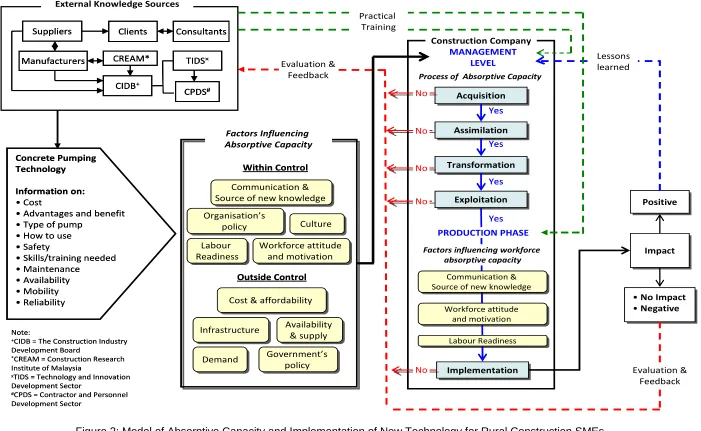
The model as shown in figure 2 consists of four main components that connect to each other:
1) External knowledge sources – the model acknowledges the role of clients (from public and private sectors); consultants; suppliers; manufacturers; Construction Research Institute of Malaysia (CREAM); and CIDB through the Technology and Innovation Development Sector and the Contractor and Personnel Development Sector, as an enabler and source of information/knowledge and technology for the construction companies. The conducted case study found that the crucial information needed for construction SMEs to absorb and use new technology includes: costs (capital maintenance, running costs etc), advantages and benefits of the technology, types of technology available, how to use the technology, skills needed, safety, maintenance issues, availability, reliability of the technology and mobility issues for the technology to reach the site in the rural areas. The comprehensive information provided by the external sources will impact on company’s/owner’s decision to acquire new technology and implement it.
2) Factors influencing absorptive capacity – the companies’ ability to absorb new knowledge and technology are influenced by various factors. The model includes ten factors that have been validated from the case studies and grouped according to their two categories: factors within their control to overcome and those and outside of their control to overcome. In order for the company to absorb and move further toward the implementation of the technology, they need to overcome and tackle these factors.
3) Process of absorptive capacity – this involves the construction companies’ abilities to acquire, assimilate, transform and exploit new technology at management level; and the ability of the on site workforce to implement the technology at the production phase. The validated model moves from the existing theory of absorptive capacity. It is identified that absorptive capacity in construction companies should extend to the implementation stage, focusing on production and involving the on site workforce who use the technology. It was found that the issue includes communication and the source of new knowledge; labour readiness, attitude and motivation are also important factors influencing workforce absorptive capacity at the implementation stage.
4) Outcomes of the process – this involves the impact of new technology after the implementation stage. The model acknowledges the possibility that new technology may not improve or may even decrease companies’ performance and productivity. If the situation occurs, the companies need to evaluate the technology and overall process undertaken. If implementation of new technology results in a positive impact, it becomes the lesson learned for the company, and they may consider using it for their next project to give them a competitive advantage.
Kamal, E.M & Flanagan, R. 2014, ‘Model of absorptive capacity and implementation of new technology for rural construction SMEs’, Australasian Journal of Construction Economics and Building Conference Series, 2(2), 19-26.
24 Communication &
Source of new knowledge Communication & Source of new knowledge Organisation’s policy Organisation’s policy Labour Readiness Labour Readiness Culture Culture Workforce attitude and motivation Workforce attitude and motivation
Cost & affordability Cost & affordability
Availability & supply Availability & supply Demand Demand Infrastructure Infrastructure Government’s policy Government’s policy Outside Control Factors Influencing Absorptive Capacity Suppliers Manufacturers CREAM* CIDB+ Clients Consultants TIDS× CPDS# External Knowledge Sources
Concrete Pumping Technology
Information on: •Cost
•Advantages and benefit
•Type of pump
•How to use
•Safety
•Skills/training needed
•Maintenance •Availability •Mobility •Reliability Acquisition Acquisition Assimilation Assimilation Transformation Transformation Exploitation Exploitation Process of Absorptive Capacity
Communication & Source of new knowledge
Communication & Source of new knowledge
Workforce attitude and motivation Workforce attitude and motivation Labour Readiness Labour Readiness Note:
+CIDB = The Construction Industry
Development Board
*CREAM = Construction Research
Institute of Malaysia
xTIDS = Technology and Innovation
Development Sector
#CPDS = Contractor and Personnel
Development Sector Practical Training Impact Impact Positive Positive
•No Impact •Negative •No Impact •Negative Evaluation & Feedback Evaluation & Feedback Yes Yes Yes Yes PRODUCTION PHASE Implementation Implementation No No No No No Lessons learned
Factors influencing workforce absorptive capacity MANAGEMENT LEVEL Construction Company Within Control Communication & Source of new knowledge
Communication & Source of new knowledge Organisation’s policy Organisation’s policy Labour Readiness Labour Readiness Culture Culture Workforce attitude and motivation Workforce attitude and motivation
Cost & affordability Cost & affordability
Availability & supply Availability & supply Demand Demand Infrastructure Infrastructure Government’s policy Government’s policy Outside Control Factors Influencing Absorptive Capacity Suppliers Manufacturers CREAM* CIDB+ Clients Consultants TIDS× CPDS# External Knowledge Sources
Suppliers Manufacturers CREAM* CIDB+ Clients Consultants TIDS× CPDS# External Knowledge Sources
Concrete Pumping Technology
Information on: •Cost
•Advantages and benefit
•Type of pump
•How to use
•Safety
•Skills/training needed
•Maintenance •Availability •Mobility •Reliability Acquisition Acquisition Assimilation Assimilation Transformation Transformation Exploitation Exploitation Process of Absorptive Capacity
Communication & Source of new knowledge
Communication & Source of new knowledge
Workforce attitude and motivation Workforce attitude and motivation Labour Readiness Labour Readiness Note:
+CIDB = The Construction Industry
Development Board
*CREAM = Construction Research
Institute of Malaysia
xTIDS = Technology and Innovation
Development Sector
#CPDS = Contractor and Personnel
Development Sector Practical Training Impact Impact Positive Positive
•No Impact •Negative •No Impact •Negative Evaluation & Feedback Evaluation & Feedback Yes Yes Yes Yes PRODUCTION PHASE Implementation Implementation No No No No No Lessons learned
Factors influencing workforce absorptive capacity
MANAGEMENT LEVEL
Construction Company
Within Control
Kamal, E.M & Flanagan, R. 2014, ‘Model of absorptive capacity and implementation of new technology for rural construction SMEs’, Australasian Journal of Construction Economics and Building Conference Series,
2(2), 19-26.
25
Conclusion
The model contributes to the Malaysian construction industry by serving two purposes: 1) to help rural construction SMEs understand and create awareness of the issues and processes of absorptive capacity and the implementation and of new technology in order for them to absorb the technology; 2) to provide policy makers/CIDB with a mechanism to transfer the new technology available to the rural contractors.
The research contributes to the body of knowledge of absorptive capacity by highlighting issues related to absorptive capacity and moves further by considering the implementation stage in the context of rural construction SMEs. The research has filled a gap in studies of absorptive capacity as most of the previous research focuses on absorptive capacity in the context of large organizations.
Acknowledgements
This research paper is funded by the Universiti Sains Malaysia and Ministry of Education Malaysia. The support is gratefully acknowledged.
References
Abecassis-Moedas, C & Mahmoud-Jouini, S. B. 2008, 'Absorptive Capacity and Source-Recipient Complementarity in Designing New Products: An Empirical Derived Framework', The Journal of Product Innovation Management 25, 473-90.
Adler, J. H. 1965, Absorptive Capacity: The Concept and Its Determinants. The Brookings Institution, Washington D.C.
Barrett, P, Sexton, M & Lee, A. 2008, Innovation in Small Construction Firms. Taylor & Francis, London.
Bosch, F. A. J. V. d., Volberda, H. W & Boer, M. d. 1999, 'Coevolution of Firm Absorptive Capacity and Knowledge Environment: Organizational Forms and Combinative Capabilities', Organization Science, 10(5), 551-68.
Bower, G. H & Hilgard, E. R. 1981, Theories of Learning 5th Edition (5th Edition). Prentice-Hall, Englewood Cliffs, N.J.
Cohen, W. M & Levinthal, D. A. 1990, 'Absorptive Capacity: A New Perspective on Learning and Innovation', Administrative Science Quarterly, 35, 128-52.
Deng, X, Doll, W. J & Cao, M. 2008, 'Exploring the absorptive capacity to innovation/productivity link for individual engineers engaged in IT enabled work', Information & Management, 45, 75-87. Gann, D. 2001, 'Putting Academic Ideas into Practice: Technological Progress and the Absorptive
Capacity of Construction Organizations', Construction Management and Economics, 19(3), 321-330.
Gray, C. (2006). Absorptive Capacity, knowledge management and innovation in entrepreneurial small firms. [Journal Article]. International Journal of Enterpreneurial Behaviour & Research, 12(6), 345-360.
Hou, C.-M., & Gee, S. (1993). National Systems Supporting Techincal Advance in Industry. In R. R. Nelson (Ed.), National Innovation Systems - A Comparative Analysis. New York: Oxford University Press.
Lenox, M., & King, A. (2004). Prospects for Developing Absorptive Capacity Through Internal Information Provision. Strategic Management Journal, 25,331-345.
Kamal, E.M & Flanagan, R. 2014, ‘Model of absorptive capacity and implementation of new technology for rural construction SMEs’, Australasian Journal of Construction Economics and Building Conference Series,
2(2), 19-26.
26
Lin, C, Tan, B & Chang, S. 2002, 'The Critical Factors for Technology Absorptive Capacity', Industrial Management and Data Systems, 102(6), 300-308.
Ndiege, J. R, Herselman, M. E & Flowerday, S. V. 2012, 'Absorptive Capacity: Relevancy for Large and Small Enterprise', SA Journal of Information Management, 14(1),1-9.
Nooteboom, B. 1994, 'Innovation and Diffusion in Small Firms: Theory and Evidence', Small Business Economics, 6, 327-47.
Rawski, T. G. 1975, 'Problems of Technology Absorption in Chinese Industry', The American Economic Review, 65(2), 383-8.
Sexton, M & Barrett, P. 2003, 'Approriate innovation in small construction firms', Construction Management and Economics, 21(6), 623-33.
Smallbone, D, North, D & Leigh, R. 1993, 'The growth and survival of mature manufacturing SMEs in the 1980s: an urban-rural comparison', In J. Curran & D. Store (Eds.), Small Firms in Urban and Rural Location. Routledge, London.
Spithoven, A, Clarysse, B & Knockaert, M. 2011, 'Building Absorptive Capacity to Organise Inbound Open Innovation in Traditional Industries', Technovation, 31(1), 10-21.
Stock, G. N, Greis, N. P & Fisher, W. A. 2001, 'Absorptive Capacity and New Product Development', Journal of High Technology Management Research, 12, 77-91.
Walker, D. H. T, Maqsood, T & Finegan, A. 2005, 'The Culture of the Knowledge Advantage (K-Adv): A Holistic Strategic Approach to the Management of Knowledge', In A. S. Kazi (Ed.), Knowledge Management in the Construction Industry : A Socio-Technical Perspective, Idea Group Publishing, London.