Open Access
Research article
Sequential solvent extraction for the modes of occurrence of
selenium in coals of different ranks from the Huaibei Coalfield,
China
Ying Zhang
1, Guijian Liu*
1, Chen-Lin Chou
2, Lei Wang
1and Yu Kang
1Address: 1CAS Key Laboratory of Crust-Mantle Materials and the Environment, School of Earth and Space Sciences, University of Science and Technology of China, Hefei 230026, China and 2Illinois State Geological Survey (Emeritus), Champaign, IL 61820, USA
Email: Ying Zhang - [email protected]; Guijian Liu* - [email protected]; Chen-Lin Chou - [email protected]; Lei Wang - [email protected]; Yu Kang - [email protected]
* Corresponding author
Abstract
Forms of selenium in bituminous coal, anthracite, and cokeite (natural coke) from Huaibei Coalfield, Anhui, China, have been determined by sequential solvent extraction. The selenium content in bulk samples is 4.0, 2.4, and 2.0 µg/g in bituminous coal, anthracite, and cokeite, respectively. The six forms of selenium determined by six-step solvent extraction are water-leachable, ion-exchangeable, organic matter-associated, carbonate-associated, silicate-associated, and sulfide-associated. The predominant forms of selenium in bituminous coal are organic matter-associated (39.0%), sulfide-matter-associated (21.1%), and silicate bound (31.8%); these three forms account for 92% of the total. The organic matter bound-selenium decrease dramatically from bituminous coal (39.0%) to anthracite (11.6%) and to cokeite (0%), indicating that organic matter bound selenium is converted to other forms during metamorphism of the coal, most likely sulfide-form. The sulfide-associated form increased remarkably from bituminous coal (21.1%) to anthracite (50.4%) and cokeite (54.5%), indicating the formation of selenium sulfide, possibly in pyrite during the transformation of bituminous coal to anthracite and cokeite. The silicate-associated selenium in bituminous coal (31.8%) is much higher than that in anthracite (16.4%) and cokeite (15.8%), indicating that silicate-associated selenium is partly converted to sulfide during metamorphism.
1. Introduction
China is the largest coal producer and consumer in the world. It has been estimated that more than 75% of the energy production in China is based on coal and more than 400 million people in China rely on coal for their domestic energy needs [1,2]. Due to the limited petro-leum and natural gas reserves, and huge coal reserve in China, coal may remain to be a dominant energy source in China for many years to come [3-6]. Unfortunately, coal utilization may bring with it environmental and
human health costs [7-9]. Many of the environmental and health problems attributed to coal combustion are due to mobilization of potentially toxic elements [7-11].
Selenium (Se) is one of the volatile elements in coal. Dur-ing minDur-ing and utilization of coal Se is largely released into the environment with potential environmental and human health impacts [12-16]. There was massive water-fowl aberrance and death that happened in Kesterson Res-ervoir of California, and selenium-poisoning of the Published: 20 December 2007
Geochemical Transactions 2007, 8:14 doi:10.1186/1467-4866-8-14
Received: 27 August 2007 Accepted: 20 December 2007
This article is available from: http://www.geochemicaltransactions.com/content/8/1/14
© 2007 Zhang et al; licensee BioMed Central Ltd.
residents in Yutangba, Enshi, Hubei, China which pro-vided impetus for study envitronmental geochemistry of Se. Although selenium metal has little toxicity, the sele-nide, selenite, and other selenium compounds such as selenium fluoride have a high toxicity. Because of high toxicity of Se and its compounds, Se is detrimental to plants and animals [9]. Human selenosis in some areas in China is attributed to the practice of using high-Se com-bustion residues as a soil amendment [7,17,18]. It is desir-able to reduce Se content in coals prior to combustion. Selenium in coal is regarded as a source of Se for soils and plants which have caused selenosis in some areas of Se-rich coal and carbonaceous shale[7,9,19-24].
The mode of occurrence of an element is a description of the manner in which an element is chemically bound in the host material. In coal, elements can be associated with the inorganic constituents or with the organic constitu-ents. The element's modes of occurrence can strongly influence its behavior during coal cleaning, weathering, leaching, combustion, and conversion [25,26]. These dif-ferent modes of occurrence will cause the element to behave differently during coal cleaning and coal combus-tion and thus will have different environmental and human health impacts. Detailed knowledge of the forms of Se in coals is needed for a better understanding its behavior during coal processing and utilization, and con-sequent environmental impacts[18,27]. In this paper we studied the forms of Se in different ranks of coals from Huaibei coalfield, Anhui Province, China, by sequential solvent extraction.
2. Samples and Methods
2.1 Geological Setting
The Huaibei Coalfield is located in the northern Anhui province, China (Fig. 1 and Fig. 2) with longitude at E115°58' to E117°12' and latitude at N33°20' to N34°28'. The Huaibei coalfield has an area of approxi-mately 9,600 km2, in which 4,100 km2 are covered by
Car-boniferous and Permian coal-bearing strata. The Huaibei coalfield is unique because it is intruded by igneous bod-ies, and the coal is metamorphosed to a broad range of coal ranks from bituminous coal to anthracite and to cokeite (natural coke) by the influence of igneous heat source [28]. The annual production of the Huaibei Coal-field is over 30 Mt, which is mainly used for power gener-ation and industrial boilers.
2.2 Sample collection and preparation
We collected samples of bituminous coal, anthracite and cokeite (natural coke) from Huaibei Coalfield. The sam-ples were stored immediately in bags to prevent contami-nation and weathering. The samples were air-dried, milled and split until a representative sample of 0.5 kg was pulverized to pass the 100-mesh sieve and dried for
12 hours in a desiccator. The samples were analyzed for proximate and ultimate compositions at the Energy Insti-tute, the Pennsylvania State University.
2.3 Sequential extraction procedure
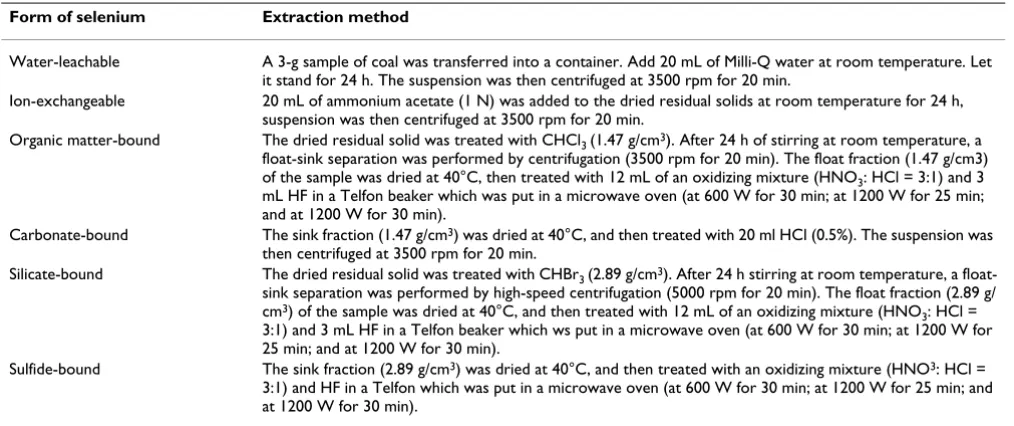
The sequential extraction procedure was originally devel-oped to analyze soil samples [29], and it is later modified for analyzing coal [26,30]. A variety of sequential extrac-tion procedures have been successfully applied to coal [31-35]. Based on these studies, we devised a sequential extraction procedure for determining the forms of sele-nium in coals. The six-step sequential extraction proce-dure is outlined in Table 1. The forms of selenium in coals may be determined as water-leachable, ion-exchangeable, organic matter-associated, carbonate-associated, silicate-associated, and sulfide-associated.
3. Results and discussion
3.1 Proximate and ultimate analysis
The results of proximate analyses (ash, moisture, volatile matter, and fixed carbon) and ultimate analyses (C, H, N, S, ash) are listed in Table 2. These data were designed to provide information on the technological performance of coal. The carbon content increases with increasing coal rank.
3.2 Results of sequential solvent extraction
The results of sequential extraction of selenium from three coals from Huaibei coalfield are listed in Table 3. The sele-nium content in the bulk sample of bituminous coal, anthracite and cokeite are 4.0, 2.43, and 2.0 µg/g, respec-tively. The total recoveries of selenium from the six sol-vent extraction steps are 68.9%, 79.5%, and 82.1%, which are acceptable considering cumulative errors of extraction steps and analytical errors in the determination of Se in six fractions. The selenium content decreases with increasing rank of the three coals. There is a possibility that selenium was partially lost during metamorphism.
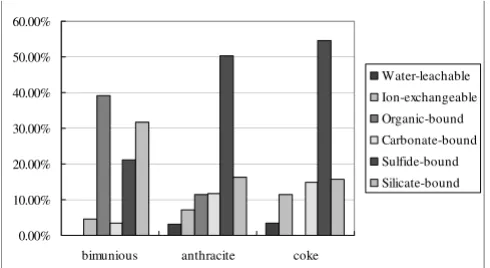
The amounts of selenium in each fraction extracted from the three coals are plotted in Figure 3.
(1) Water-leachable Se
The water-leachable Se is determined by refluxing the coal with double-distilled deionized water. During coal min-ing, storage, and transport, water-leachable Se is readily leached into the soil and ground water. The water-leacha-ble Se in different ranks of coals of Huaibei coalfields are very low (Table 3) and the values are 0, 0.063, and 0.057
Location of the Huaibei Mining District in Anhui Province, China
Figure 1
Location of the coal mines in Huaibei mining district
Figure 2
(2) Ion-exchangeable Se
Ion-exchangeable Se in coal is soluble in a solvent such as ammonium acetate (NH4OAc). The ion-exchangeable Se in bituminous coal, anthracite and cokeite are 0.128, 0.138, and 0.186 µg/g, which are 4.66%, 7.14% and 11.34% of the total, respectively. In some previous stud-ies, the water-leachable and ion-exchangeable Se are com-bined. In a study of Se in coal and overburden in the power River basin by [36], Se is present at the ppm level and occurs in at least six different forms. They found that the fraction of water soluble selenium in 14 overburden samples was 5–73%, with an average of 22%, of the total. Up to 50% of the selenium in the overburden samples was ion exchangeable (an average of 21%). Selenium was sorbed by clays and other phases in the overburden sam-ples. Querol et al. studied the forms of Se in a subbitumi-nous Spanish coal with an ash yield of 26.5% by sequential solvent extraction. The found that the fraction of water-soluble and ion-exchangeable Se was less than 10%[37]. Yang studied the abundances and modes of occurrence of trace elements in the Late Permian coals in
the Puan Coalfield, Guizhou, China, and found that the water-soluble Se fraction was about 0.03%[38].
(3) Carbonate-associated Se
The carbonate-associated Se content in bituminous coal, anthracite and cokeite of Huaibei Coalfield is 0.093, 0.224, and 0.245 µg/g, which are 3.36%, 11.6%, and 14.9% of the total, respectively. The carbonate-associated selenium has previously been studied sequential extrac-tion. Querol et al. found that the carbonate-associated fraction of Se was only less than 1%[37]. Yang reported that carbonate-associated Se fraction was about 0.33%. Their values are substantially lower than our results on Huaibei coals[38].
(4) Sulfide-associated Se
The sulfide-associated selenium in bituminous coal, anthracite, and cokeite is 0.581, 0.975, and 0.895 µg/g, which are 20.1%, 50.5%, and 54.5% of the total, respec-tively. The amount of sulfide-associated Se increases with increasing rank of coals. The sulfide-associated Se is the dominant mode of occurrence in anthracite and cokeite.
Table 1: Sequential chemical extraction procedure
Form of selenium Extraction method
Water-leachable A 3-g sample of coal was transferred into a container. Add 20 mL of Milli-Q water at room temperature. Let it stand for 24 h. The suspension was then centrifuged at 3500 rpm for 20 min.
Ion-exchangeable 20 mL of ammonium acetate (1 N) was added to the dried residual solids at room temperature for 24 h, suspension was then centrifuged at 3500 rpm for 20 min.
Organic matter-bound The dried residual solid was treated with CHCl3 (1.47 g/cm3). After 24 h of stirring at room temperature, a float-sink separation was performed by centrifugation (3500 rpm for 20 min). The float fraction (1.47 g/cm3) of the sample was dried at 40°C, then treated with 12 mL of an oxidizing mixture (HNO3: HCl = 3:1) and 3 mL HF in a Telfon beaker which was put in a microwave oven (at 600 W for 30 min; at 1200 W for 25 min; and at 1200 W for 30 min).
Carbonate-bound The sink fraction (1.47 g/cm3) was dried at 40°C, and then treated with 20 ml HCl (0.5%). The suspension was then centrifuged at 3500 rpm for 20 min.
Silicate-bound The dried residual solid was treated with CHBr3 (2.89 g/cm3). After 24 h stirring at room temperature, a float-sink separation was performed by high-speed centrifugation (5000 rpm for 20 min). The float fraction (2.89 g/ cm3) of the sample was dried at 40°C, and then treated with 12 mL of an oxidizing mixture (HNO
3: HCl = 3:1) and 3 mL HF in a Telfon beaker which ws put in a microwave oven (at 600 W for 30 min; at 1200 W for 25 min; and at 1200 W for 30 min).
Sulfide-bound The sink fraction (2.89 g/cm3) was dried at 40°C, and then treated with an oxidizing mixture (HNO3: HCl = 3:1) and HF in a Telfon which was put in a microwave oven (at 600 W for 30 min; at 1200 W for 25 min; and at 1200 W for 30 min).
Table 2: Proximate and ultimate analyses and total Se concentrations of different ranks of coals
% Bituminous coal Anthracite Cokeite
Ultimate analyses Carbon 78.1 81.3 86
Hydrogen 4.64 3.52 1.77
Nitrogen 0.92 0.95 0.56
Sulfur 0.48 0.25 0.48
Proximate analyses Moisture 1.26 2.15 5.41
Volatile matter 24.64 12.06 4.75
Ash 14.51 13.14 6.94
Both selenium and sulfur are Group 6a elements in the Periodic Table with similar covalent radii and electroneg-ativities. Selenium may have diffused from non-sulfide phases into pyrite during coal metamorphism. Selenides may also form in anthracite and cokeite.
Previous studies have found a positive correlation between Se and S. Palmer and Lyons analyzed some Euro-pean and American coals and found that pyrite has a higher Se content than illite, kaolinite, and quartz[39]. Zhang et al. found that the Se content of pyrite in anthra-cite from southwestern Guizhou is significantly higher than that in calcite and clay minerals. Statistical analysis of 24 samples of typical coals from main British coal basins shows that pyrite is the main carrier of Se [40,41]. A positive correlation between Se and S in the three anthracite samples from the i3B seam in the eastern Don-bas suggests that Se is associated with pyrite [42]. Other studies also suggested that Se and S are highly correlated in coal and Se mainly occurs in pyrite from several coal-fields [43-48]. Some researchers have reported
sulfide-associated selenium by sequential extraction. Liu per-formed a sequential extraction experiment to identify the forms of Se in coal as part of their study on volatilization of lignite, bituminous coal and anthracite[48]. The forms of selenium were determined as ion-exchangeable, organic matter-bound, sulfide-associated, and in residues. They showed that the sulfide-associated fraction of sele-nium accounts for 77% in lignite, 65% in bituminous coal, and 67% in anthracite. Yang has reported that sulfide-associated fraction of Se was 57.7%. Thus, the sulfide-associated selenium is the dominant mode of occurrence in coals[38].
(5) Organic matter-associated Se
The organic matter-associated Se in bituminous coal, anthracite and cokeite samples from Huaibei Coalfield is 1.08, 0.219, and 0 µg/g, respectively. The organic matter-associated fraction accounts for 39.1%, 11.3% of total Se in bituminous coal and anthracite, respectively (Figure 3). There is no organic matter-associated selenium in cokeite. When bituminous coal is converted to anthracite during metamorphism, the chemical structure of organic matter is changed, and selenium in the organic fraction may largely diffuse into other phases, most likely sulfides. Fur-ther, when anthracite is metamorphosed to cokeite, all selenium in the organic matter is incorporated into sulfides.
Other studies also showed that the organic matter-associ-ated Se is a major mode of occurrence of Se in coal. Xu et al. performed sequential extraction tests and found that more than 70% of Se is associated with the organic mat-ter[49]. Zhu et al. studied the modes of occurrence of Se in the Se-rich black shale in Yutangba area, Hubei, China, and found that Se resides dominantly in the residues and organic matter along with other forms of sulfide, selenide, and elemental Se[15,50,51]. Dreher and Finkelman reported that 10–20% of Se is in organic association in
Histogram of fractions of Se forms determined by sequential extraction from three coals
Figure 3
Histogram of fractions of Se forms determined by sequential extraction from three coals.
0.00% 10.00% 20.00% 30.00% 40.00% 50.00% 60.00%
bimunious anthracite coke
Water-leachable
Ion-exchangeable
Organic-bound
Carbonate-bound
Sulfide-bound
Silicate-bound
Table 3: Abundance of six forms of Se in sequential extraction fractions of the bulk sample (in µg/g) and fraction of each form of Se in three coals (in %)
Bituminous coal Anthracite Cokeite
Content (µg/g) Fraction (%) Content (µg/g) Fraction (%) Content (µg/g) Fraction (%)
Water-leachable ND 0.00 0.063 3.23 0.057 3.45
Ion-exchangeable 0.128 4.66 0.138 7.14 0.186 11.3
Organic matter-bound 1.08 39.1 0.219 11.3 ND 0.00
Carbonate-bound 0.093 3.36 0.224 11.6 0.245 14.9
Sulfide-bound 0.581 21.1 0.975 50.4 0.895 54.5
Silicate-bound 0.875 31.8 0.316 16.4 0.259 15.8
Total 2.76 100 1.93 100 1.64 100
Bulk coal (µg/g) 4.00 2.43 2.00 Recovery (%) 68.9 79.5 82.1
overburden sediments from a surface mine in Power River Basin, U.S.A[36].
(6) Silicate-associated Se
The silicate-associated Se content in bituminous coal, anthracite and cokeite samples from the Huaibei Coal-field is 0.875, 0.316, and 0.259 µg/g (Table 3), which are 30.2%, 16.4%, and 15.8% of the total, respectively (Fig. 3). The silicate-associated Se fraction in our Huaibei sam-ples are higher than the literature results, which may be related to the influence of magmatic intrusions in the Huaibei Coalfield.
Dreher and Finkelman reported that the silicate-associ-ated fraction of Se was about 15% of the total in overbur-den sediments of a surface mine in Wyoming, U.S.A.[36] Zhang et al. found that silicate-associated Se is less than 1%[40]. Palmer et al. found that their samples of U.S. coals have about 15% silicate-associated Se fraction [52]. Yang determined abundances and modes of occurrence of trace elements in the Late Permian coals in the Puan Coal-field, Guizhou, China, and found that the silicate-associ-ated fraction of Se was about 3.81% of the total[38].
4. Conclusion
(1) We have performed sequential extraction tests to determine the forms of Se in three coals of bituminous, anthracite, and cokeite rank in the Huaibei Coalfield, Anhui, China. The Se content in bulk samples are 4.0, 2.4, and 2.0 µg/g in bituminous coal, anthracite, and cokeite, respectively. The Se content decreases with increasing rank of coals, which suggest that selenium may be partially lost during metamorphism.
(2) The results of six-step sequential extraction experi-ments show that the distribution of selenium forms varies with the rank. The fractions of water-leachable, ion-exchangeable, carbonate-associated and sulfide-associ-ated selenium increase with increasing rank. On the con-trary, organic-bound and silicate-associated Se decreases with increasing rank.
(3) The predominant form of Se in bituminous coal is organic matter-associated (39.1%), sulfide-associated (21.1%), and silicate-bound (31.8%). These three forms of Se account for 92% of the total.
The sulfide-associated fraction is 21.1%, 50.4%, and 54.5% of total Se in bituminous, anthracite and cokeite, respectively. Sulfide-bond selenium is much higher in anthracite and cokeite than in bituminous coal, indicating the formation of sulfide and selenide minerals during metamorphim.
The organic matter-associated fraction accounts for 39.1% and 11.3% of total Se in bituminous coal and anthracite, but it is totally depleted in cokeite. During metamor-phism, organic matter-associated selenium in bituminous coal diffuses into other phases, most likely sulfides, in anthracite and cokeite.
Acknowledgements
This work was supported by the National Natural Science Foundation of China (40772095) and the Anhui Natural Science Excellent Youth Foundation . We thank reviewers for constructive comments.
References
1. Chen BH, Hong CJ, Kan HD: Exposures and health outcomes from outdoor air pollutants in China. Toxicology 2004,
198:291-300.
2. Florig HK: China's air pollution risks. Environmental Science Tech-nology 1997, 31:274A-279A.
3. Ni B: New progress in high-precision and high resolution seis-mic exploration technology in coal industry of China. Acta Geological Sinica 2000, 74(2):311.
4. Xu X, Chen C, Qi H: Development of coal combustion pollu-tion control for SO2 and NOx in China. Fuel Processing Technology 2000, 62:153-160.
5. Zhong Tang, Yang Wang: Efficient and environment friendly use of coal. Fuel Processing Technology 2000, 62:137-141.
6. Liu G, Yang P, Peng Z, Chou C-L: Petrographical and geochemi-cal contrasts and environmentally significant trace elements in marine-influenced coal seams, Yanzhou Mining Area, China. Journal of Asian Earth Sciences 2004, 23:491-506.
7. Liu G, Zheng L, Duzgoren-Aydin NS, Gao L, Liu J, Peng Z: Health effects of arsenic, fluorine, and selenium from indoor burn-ing of Chinese coal. Review of Environmental Contamination and Tox-icology 2007, 189:89-106.
8. Liu G, Zheng L, Qi C, Zhang Y: Environmental geochemistry and health of fluorine in Chinese coals. Environmental Geology 2007,
52:1307-1313.
9. Liu G, Zhang Y, Qi C, Zheng L, Chen Y, Peng Z: Comparative on causes and accumulation of selenium in the tree-rings ambi-ent high-selenium coal combustion area from Yutangba, Hubei, China. Environmental Monitoring and Assessment 2007,
133:99-103.
10. Wilson R, Colome SD, Spengler JD, Wislson DG: Health effects of fossil fuel burning. Ballinger Publishing, Cambridge, MA; 1980:392. 11. Swaine DJ, Goodarzi F: Environmental Aspects of Trace Ele-ments in Coal. Kluwer Academic Publishers, The Netherlands; 1995:312.
12. Sun J, Jervis RE: Distribution characterization of trace ele-ments during coal combustion. China Science Bulletin (A) 1986,
16:1285-1294.
13. Clarke LB, Sloss LL: Trace elements from coal combustion and gasification. IEACR/49, IEA Coal Research, London; 1992:111. 14. Liu G, Zheng L, Peng Z: Distribution of hazardous trace
ele-ments during coal beneficiation. Geochimica et Cosmochimica Acta
2004, 67(18 supplement):522.
15. Zhu J, Zuo W, Liang X, Li S, Zheng B: Occurrence of native sele-nium in Yutangba and its environmental implications. Applied Geochemistry 2004, 19:461-467.
16. Yudovich YaE, Ketris MP: Selenium in coal: A review. International Journal of Coal Geology 2006, 67:112-126.
17. Zheng B, Hong T, Zhao W, Zhou H, Xia W, Su H, Mao D, Yan L, Thornton I: The Se rich carbonaceous siliceous rock and endemic Se poisoning in southwest Hubei, China. Chinese Sci-ence Bul1etin 1992, 37(11):l027-l029.
18. Finkelman RB, Orem W, Castranova V: Health impacts of coal and coal use: possible solutions. International Journal of Coal Geol-ogy 2002, 50:425-443.
19. Yan B, Wu T: Investigation of the environmental selenium area in the Enxi autonomous prefecture. China Endemic Journal
Publish with BioMed Central and every scientist can read your work free of charge "BioMed Central will be the most significant development for disseminating the results of biomedical researc h in our lifetime."
Sir Paul Nurse, Cancer Research UK
Your research papers will be:
available free of charge to the entire biomedical community
peer reviewed and published immediately upon acceptance
cited in PubMed and archived on PubMed Central
yours — you keep the copyright
Submit your manuscript here: BioMedcentral 20. Mao D, Su H: Geographic factors affecting selenium poisoning
in southwestern Hubei province. Hubei Journal of Preventive Med-icine 1993, 4(3):23-25.
21. Mao D, Zheng B, Su H: The medical geography characteristics of Se poisoning in Yutangba. Endemic Diseases Bulletin 1997,
12(2):59-6l.
22. Zheng B, Ding Z, Huang R, Zhu J, Yu X, Wang A, Zhou D, Mao D, Su H: Issues of health and disease relating to coal use in south-western China. International Journal of Coal Geology 1999,
40:119-132.
23. Zhu J, Ling H, Wang M, Li S, Su H: Distribution, transportation and bioavailability of selenium in Yutangba, Hubei province, China. Acta Pedologica Sinica 2005, 42(5):838-843.
24. Finkelman RB: What we don't know about the occurrence and distribution of trace elements in coals. The Journal of Coal Quality
1989, 8:3-4.
25. Finkelman RB: Modes of occurrence of potentially hazardous elements in coal: levels of confidence. Fuel Processing Technology
1994, 39:21-32.
26. Finkelman RB: Potential health impacts of burning coal beds and waste banks. International Journal of Coal Geology 2004,
59:19-24.
27. Han S: Coal-forming Conditions and Coalfield Prediction in Huaibei-Huainan Region. Geological Publishing House, Beijing, China; 1990:234.
28. Tessier A, Campbell PGC, Bisson M: Sequential extraction pro-cedure for the speciation of particulate trace metals. Analyti-cal Chemistry 1979, 51:844-851.
29. Finkelman RB, Palmer CA, Krasnow MR, Aruscavage PJ, Sellers GA, Dulong FT: Combustion and leaching behavior of elements in the Argonne Premium Coal Samples. Energy and Fuels 1990,
4:755-766.
30. Bool LE, Helble JJ: A laboratory study of the partitioning of trace-elements during pulverized coal combustion. Energy Fuels 1995, 9:880-887.
31. Cavender PF, Spears DA: Analysis of forms of sulfur within coal, and minor and trace element associations with pyrite by ICP analysis of extraction solutions. In Coal Science, Vol Coal Science TechnologyVolume 24. Edited by: Pajares JA, Tascon JMD. Amsterdam: Elsevier; 1995:1653-1656.
32. Palmer CA, Mroczkowski SJ, Kolker A: Chemical analyses and modes of occurrence of selected trace elements in a Powder River Basin coal and its corresponding simulated cleaned coal. U.S. Geological Survey, Open-File Report 00-323; 2000:52. 33. Davidson RM: Modes of occurrence of trace elements in coal.
International Energy Agency Coal Reserch, London; 2000:36. 34. Zheng L, Liu G, Qi C, Zhang Y, Wong Minghong: The use of
sequential extraction to determine the distribution and modes of occurrence of mercury in Permian Huaibei coal, Anhui Province, China. International Journal of Coal Geology 2007. 35. Dreher GE, Finkelman RB: Selenium mobilization in a surface
coal mine. Powder River Basin, Wyoming, USA. Environmental Geology and Water Sciences 1992, 19:155-167.
36. Querol X, Fernández-Turiel JL, López-Soler A: Trace elements in coal and their behaviour during combustion in a large power station. Fuel 1995, 74:331-343.
37. Yang JY: Concentrations and modes of occurrence of trace elements in the Late Permian coals from the Puan Coalfield, southwestern Guizhou, China. Environmental Geochemistry Health
2006, 28:567-576.
38. Palmer CA, Lyons PC: Selected elements in major minerals from bituminous coal as determined by INAA: Implications for removing environmentally sensitive elements from coal.
International Journal of Coal Geology 1996, 32:151-166.
39. Zhang J, Ren D, Xu W, Zhao F: Advances in the studies of sele-nium in coal. Coal Geology and Exploration 1999, 27:16-19. 40. Spears DA, Zheng Y: Geochemistry and origin of elements in
some UK coals. International Journal of Coal Geology 1999,
38:161-179.
41. Kizilstein LYa, Shokhina OA: Geochemistry of selenium in coal: environmental aspect. Geokhimiya 2001, 4:434-440.
42. Martinez-Tarazona MR, Vega JMG, Garcia AB: Pyrite and trace ele-ments in high rank coals. In Proc 9th International Conference on Coal ScienceVolume 1. Edited by: Ziegler A, et al. DGMK, Essen; 1997:397-400.
43. Huang W, Yang Q, Tang D, Kang X, Liu D: Trace element geo-chemistry of the coals in the Taiyuan formation from Zaozhuang coalfield. Journal of Graduate School of China University of Geoscience 2000, 14:61-68.
44. Lu XW: Study on selenium contents and specification and its environmental effect in coal of all coal forming periods of Sha'anxi Province. Journal of Arid Land Resources and Environment
2004, 18:27-31.
45. Wu ZY, Li YH, Zhou YC: Geochemical behavior of trace ele-ments in coals in Baishan area, Jilin Province. Coal Geology and Exploration 2004, 32:8-10.
46. Li DH, Tang YG, Chen K, Deng T, Cheng FP, Liu D: Distribution of twelve toxic trace elements in coals from southwest China.
Journal of China University of Mining and Technology 2006, 35:15-20. 47. Liu SQ, Wang YT, Yu L, Oakley J: Volatilization of mercury,
arsenic and selenium during underground coal gasification.
Fuel 2006, 85:1550-1558.
48. Xu WD, Zeng RS, Ye DN, Querol X: Distribution and environ-mental impact of selenium in wastes of coal from a power plant. Environmental Science 2005, 26:64-68.
49. Zhu J, Zheng B: Distribution of selenium in mini-landscape of Yutangba, Enshi, Hubei Province, China. Applied Geochemistry
2001, 16:1333-l344.
50. Zhu JM, Zheng BS, Su HC, Li HC, Mao D, Lei P, Finkelman RB: New occurrence of native selenium and its preliminary investiga-tion. Geochimica 2001, 30:236-241.