© 2010 Kurakin; licensee BioMed Central Ltd. This is an Open Access article distributed under the terms of the Creative Commons Attri-bution License (http://creativecommons.org/licenses/by/2.0), which permits unrestricted use, distriAttri-bution, and reproductiion in any medium, provided the original work is properly cited.
Open Access
R E V I E W
Review
Order without design
Alexei Kurakin
Abstract
Experimental reality in molecular and cell biology, as revealed by advanced research technologies and methods, is manifestly inconsistent with the design perspective on the cell, thus creating an apparent paradox: where do order and reproducibility in living systems come from if not from design?
I suggest that the very idea of biological design (whether evolutionary or intelligent) is a misconception rooted in the time-honored and thus understandably precious error of interpreting living systems/organizations in terms of classical mechanics and equilibrium thermodynamics. This error, introduced by the founders and perpetuated due to institutionalization of science, is responsible for the majority of inconsistencies, contradictions, and absurdities plaguing modern sciences, including one of the most startling paradoxes - although almost everyone agrees that any living organization is an open nonequilibrium system of continuous energy/matter flow, almost everyone interprets and models living systems/organizations in terms of classical mechanics, equilibrium thermodynamics, and engineering, i.e., in terms and concepts that are fundamentally incompatible with the physics of life.
The reinterpretation of biomolecules, cells, organisms, ecosystems, and societies in terms of open nonequilibrium organizations of energy/matter flow suggests that, in the domain of life, order and reproducibility do not come from design. Instead, they are natural and inevitable outcomes of self-organizing activities of evolutionary successful, and thus persistent, organizations co-evolving on multiple spatiotemporal scales as biomolecules, cells, organisms, ecosystems, and societies. The process of self-organization on all scales is driven by economic competition, obeys empirical laws of nonequilibrium
thermodynamics, and is facilitated and, thus, accelerated by memories of living experience persisting in the form of evolutionary successful living organizations and their constituents.
The cell is a fundamental building block of all living organisms. A typical cell represents a highly concentrated (300-400 mg/ml of proteins and RNA alone [1]) aqueous solution of macromolecules, small molecules, and ions enveloped in a semi-permeable lipid mem-brane. Due to their physicochemical and structural versatility, proteins perform the vast majority of biological functions in the cell. Individual proteins and self-assembled multi-protein complexes operate as exquisite nanomachines optimized by evolution for efficient performance of an immense variety of specific tasks required for proper functioning of the cell as a whole [2]. Through the regulatory circuitry of signal transduction pathways, vari-ous cellular programs control and direct cellular machinery in accordance with the evolu-tionary design of the cell.
To understand design means to control the designed. Naturally, in order to gain some measure of control over our diseases and inevitable aging and death, we direct our best * Correspondence:
efforts and resources at deciphering the evolutionary design of the cell, using our most reliable and successful analytical methods, reductionism and reverse engineering. The incessant and rapid progress of research technology enables us to isolate and analyze increasingly smaller parts on an increasingly larger scale with increasingly better preci-sion and at an increasingly faster pace. We have sequenced our own genome and know the blueprints of almost every protein and RNA produced in our cells. Modern biophys-ical and computational methods allow us to analyze individual proteins on both popula-tion and single-molecule levels, as well as to scrutinize and model protein structure and dynamics at atomic resolution and on multiple timescales, from femtoseconds to sec-onds. Internationally coordinated initiatives in structural genomics aim at high-through-put determination of all relevant biomolecular structures, with thousands of protein structures being deposited in the Protein Data Bank each year. Mass spectrometry-based proteomics technologies allow us to obtain "parts lists" for virtually any macromolecular complex, organelle, or sub-cellular structure. Robotics-assisted large-scale protein inter-action studies reveal the relationships between individual parts of the cellular machinery on the scale of whole proteomes. Hundreds of years' expertise in engineering is com-bined with the unprecedented powers of modern computational technologies to equip systems biology for the analysis and modeling of systems of almost any degree of com-plexity. Paradoxically, extraordinary advances in our understanding of the parts do not seem to bring about significant progress in our understanding of the whole. In fact, it appears that the design of the cell becomes increasingly elusive as experimental data accumulate.
pro-teins," is increasingly perceived today as an inherent property of proteins that can be assumed for most, perhaps all, of them. Altogether, the recent findings and discoveries amassed in various research fields with the help of advanced technologies and methods appear to converge on one and the same conclusion, suggesting that the localization, interactions, and functions of proteins in the cell are inherently ambiguous, i.e., unspeci-fied. Needless to say, such a conclusion not only makes the inference of cellular design an increasingly elusive goal, it questions the very existence of such a thing as biological design. Yet, this seemingly radical conclusion is in perfect harmony with recent break-throughs in our understanding of protein structure and dynamics.
Defying traditional, static views on proteins embodied in such metaphors as "locks," "keys," and "Lego blocks," recent technological and conceptual advances in protein bio-physics have brought about a new image of the protein as a highly dynamic, versatile, and continuously changing physicochemical organization [11-13]. It is now evident that any protein exists in solution not as a pre-defined structure, but as a population of conform-ers incessantly interconverting on multiple timescales. A protein molecule continuously and stochastically samples its different conformations, undergoing relatively slow struc-tural transitions between different families of related conformers and relatively fast tran-sitions within a given conformer family [12,14]. The rates of interconversion are defined by the heights of energy barriers separating individual conformational states that are represented as relative energy minima in the protein energy landscape (Figure 1). More-over, the energy landscape is not fixed. Binding of ligands, post-translational modifica-tions, temperature, pressure, solvent and other factors may alter the shape of the energy landscape, triggering a redistribution of conformers and/or changing heights of the
Figure 1 The concept of the energy landscape. A) As a ball rolling down a rugged landscape under the force
energy barriers separating alternative conformations [12,13,15]. Because different con-formers can potentially bind different ligands and perform different cellular functions, inherent ambiguity in protein interactions, localization, and function is an inevitable and natural consequence of the conformational heterogeneity and structural plasticity of proteins [14,16].
The so-called natively unfolded proteins, which do not possess a defined structure when isolated in solution, but acquire a structure upon interactions with other mole-cules, represent an extreme example of protein ambiguity and plasticity. The discovery of intrinsically disordered proteins came as a total surprise, for the concept of natively unfolded proteins is incommensurate within the design perspective on the cell [17]. Sub-sequent bioinformatics analyses of various genomes revealed that intrinsically disor-dered proteins are present in all domains of life, with the relative abundance of intrinsically disordered proteins in genomes rapidly increasing from archaea and eubac-teria through single cell eukaryotes and multicellular eukaryotes. It is estimated that in mammals approximately 75% of signaling proteins and about 50% of all proteins contain at least one large unstructured region (> 30 amino acids), while about 25% of all proteins are fully disordered [18]. Since unstructured regions and proteins are apparently impor-tant for cellular functions [19], and structured regions and proteins are multi-conforma-tional entities, the ordering and functioning of proteins inside the cell cannot possibly rely on the specificity provided by protein structure alone, but should be driven by some unknown principles that are different from, but complementary to, the conventional principles of molecular recognition embodied in the "lock-and-key" and "Lego block" metaphors. Structurally ambiguous and simply flexible proteins have a choice, for they can interact with different partners, join different macromolecular organizations, per-form different actions, and contribute in different ways to the functioning of diverse macromolecular complexes and structures.
To summarize, the experimental reality in molecular and cell biology, as revealed by advanced technologies and methods, is manifestly inconsistent with the design perspec-tive on the cell, creating an apparent paradox: where do order and reproducibility in liv-ing systems come from if not from design?
A recent theoretical study may provide an answer to this and other questions accumu-lated in biology over many years of research. This study demonstrates that the experi-mental reality in molecular and cell biology becomes largely devoid of paradoxes, inconsistencies and contradictions, and is thus best understood if the cell and biological organization in general are reinterpreted within an alternative paradigm of biological organization based on the concepts and empirical laws of nonequilibrium thermody-namics [20].
observed in living systems are a consequence of design. What is really surprising is that, even though today very few scientists would argue that the cell is not an open nonequi-librium physicochemical system of interacting molecules, the vast majority of research-ers working in molecular and cell biology continue to treat and interpret the cell and its components in terms of classical mechanics, equilibrium thermodynamics, and engi-neering, i.e., in terms and concepts that are fundamentally incompatible with the physi-cal nature of the cell, thus faithfully reproducing and reinforcing the mistakes and misconceptions of the founders. This is in itself a good example demonstrating that many things in life can be faithfully reproduced in the absence of any design.
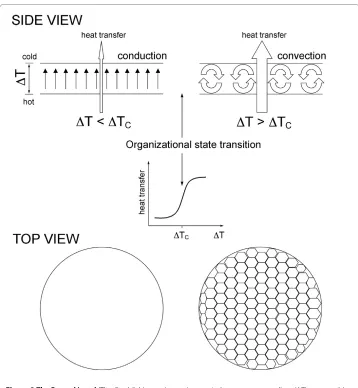
Studies of relatively simple inorganic nonequilibrium systems such as the Belousov-Zhabotinsky (BZ) reaction, Benard instability (Figure 2), and others show that creating a gradient (e.g., temperature, concentration, chemical) within a molecular system of inter-acting components normally causes a flux of energy/matter in the system and, as a con-sequence, the emergence of a countervailing gradient, which, in turn, may cause the emergence of another flux and another gradient, and so on. The resulting complex sys-tem of conjugated fluxes and coupled gradients is manifested as a spatiosys-temporal macro-scopic order spontaneously emerging in an initially featureless, disordered system, provided the system is driven far enough away from equilibrium [21-23]. As a rule, the emergence of macroscopic order is a highly nonlinear, cooperative process. When a crit-ical threshold value of flow rate is exceeded, the system spontaneously organizes itself by partitioning its components into interdependent and interconnected steady state macro-scopic structures. The macrostructures emerging in far-from-equilibrium systems are of a steady-state nature in the sense that what is actually preserved and evolves over rele-vant timescales is an organization of relationships between interacting components, a form, but not physical components comprising a given macrostructure. Members come and go, but the organization persists. Normally, the same set of interacting microcompo-nents can generate multiple alternative organizational configurations differing in the organization of energy/matter exchanges transiently maintained among the interacting components that make up and flow through a given configuration. As a consequence, macrostructures emerging in far-from-equilibrium systems are dynamic in two different senses, for they display both configurational dynamics and flow dynamics [20].
embodied in more or less specific, yet flexible and adaptive, structures and dynamics of its interacting constituents. It should be pointed out that, since the organizational dynamics of individual proteins, cells, organs, organisms, and economies display long-range correlations in time [24-29], the structure and dynamics of any living system - be it a protein, a cell, an organism, an organization, or an economy - carry within them the memories of previous experience accumulating at multiple scales. Continuous reproduc-tion of such memories in the form of the specific structures and dynamics of system's constituents (e.g., proteins, cells, organisms, organizations) is that which makes the self-organization and performance of any living nonequilibrium system - be it a cell, an
Figure 2 The Benard instability. Establishing an increasing vertical temperature gradient (ΔT) across a thin
organism, an organization, an ecosystem, or an economy - increasingly fast, reliable, and reproducible as its experience accumulates.
The other empirical (self-) organizational laws of nonequilibrium thermodynamics that are especially helpful in understanding the organizational dynamics of living sys-tems are as follows. Increasing the rate of energy/matter flow through an open nonequi-librium organization/system of interacting components normally leads to the growth of the organization/system in size and complexity. The increase in complexity proceeds through stepwise organizational transitions from states of relatively low order (low nega-tive entropy) to states of relanega-tively high order (high neganega-tive entropy) and is accompanied by the formation of multiscale organizational hierarchies. Maintaining a nonequilibrium organization/system at a given level of order and complexity requires a continuous and stable flux of energy/matter through the system. Decreasing the rate of energy/matter flow through an organization/system leads to a stepwise hierarchical relaxation of its organizational structure and a loss of complexity and order, ultimately culminating in the dissolution and death of the organization [20].
One of the practically important predictions that can be immediately made from these empirical laws is that the critical parameters defining the physiological state of any living system, such as the cell or the organism, for example, are flow rates of their constituents (nonequilibrium thermodynamics) and not concentrations, as commonly assumed (equilibrium thermodynamics) [20]. Indeed, a momentary survey of research literature confirms this prediction. The measurements performed on over 60 different metabolites in different metabolic pathways show that intracellular metabolite concentrations are homeostatic and do not change significantly upon transitions in the physiological state of the cell, such as, for example, a shift from resting state to a high workload state, while metabolic fluxes through corresponding pathways change dramatically upon such tran-sitions [30]. At the scale of a whole organism, the steady-state level of glucose in the blood is maintained within a remarkably narrow concentration range, whether after a large meal or during fasting, whether at rest or during endurance exercise. The parame-ter reflecting the physiological state of the organism is not glucose concentration but the rate of glucose flow/circulation. The same is true for oxygen, phosphate, iron, calcium, and many other metabolites circulating with the blood flow.
implies that whenever one observes the emergence, growth, persistence, or increasing influence of a biological organization/structure, one should assume the existence of a relatively stable, rapid, and accelerating flux of energy/matter passing through the bio-logical organization/structure in some form. The converse is also true: behind the deteri-oration, disorganization, and dissolution of any biological organization/structure there is always a weakening of the energy/matter flux(es) sustaining the organization/structure [20]. Of note, the interpretation of organisms, ecologies, organizations, and economies in the same conceptual terms is an accepted convention in organization theory [31]. In economics, static general equilibrium theory is ridiculed for being in stark and obvious contradiction with the dynamic disequilibrium of economic reality [32,33]. In his recent book, Geerat J. Vermeij, a distinguished paleontologist and evolutionary biologist, con-cludes that evolution and economics are one, that human institutions are built and func-tion as living organisms, and that both of the latter should be treated in exactly the same terms within a single theoretical framework [34].
In addition to what can be called the anima ex anima principle, another fundamental difference between nonliving nonequilibrium systems and living nonequilibrium organi-zations is that, while nonliving macrostructures emerge and persist only when provided with a flux of energy/matter, living nonequilibrium organizations strive to live long and prosper, i.e., to persist as specific dynamic structures and to grow in size, complexity, and influence. As a consequence, at each and every level of the biological organizational hier-archy, living nonequilibrium organizations continuously compete and cooperate one with another as they search for, obtain, transform, and exchange energy/matter forms to ensure a continuous and accelerating flux of energy/matter, which they need both indi-vidually (hence competition) and collectively (hence cooperation) for their maintenance and growth in size, complexity, and influence. As time passes, surviving life forms become increasingly interconnected and integrated - both within and across organiza-tional levels and spatiotemporal scales - into a multiscale continuum of structured energy/matter circulation/flow, which favors cooperation and organization over unbri-dled competition. In this way, proteins and other molecules self-organize into cells, cells self-organize into organisms, organisms self-organize into ecosystems and organizations, and organizations self-organize into economies [29].
To summarize, the self-organization of living systems is driven by economic competi-tion, obeys empirical laws of nonequilibrium thermodynamics, and is facilitated and, thus, accelerated by memories of living experience embodied in the adaptive structures and dynamics of interacting constituents. Because the structures and dynamics (i.e., behaviors) of individual constituents at all levels of organizational hierarchy always remain ambiguous and unspecified, albeit shaped by evolution and experience, the indi-vidual choice as a force of both innovation and conservation becomes a decisive factor in organizational dynamics, either promoting or inhibiting the survival and success of the developing and adapting whole.
by virtue of their own incessant reproduction, adapt to the present by making individual choices and acting upon them, and mold the future by interacting with and molding their environments that, in turn, mold them. In this way, the past, the present, and the future, as well as multiple spatiotemporal scales, converge within one self-organizing process of life. Life is intelligence. Intelligence implies and involves order, reproducibility, continuous change and development, but no design. Life/intelligence is an open-ended, evolving structure-process of energy/matter flow, a stream of consciousness. And we all are a part of it.
Competing interests
The author declares that they have no competing interests.
Authors' contributions
AK is the sole author of this paper and is responsible for developing the concepts and for writing and revising the manu-script.
Acknowledgements
I thank Paul S. Agutter (Theoretical Medicine and Biology Group, UK) for his thoughtful comments on the manuscript and suggestions on improving it. This work was supported in part by the grant AG031380 from NIA to AK. The views and ideas expressed in this article are solely that of the author and do not necessarily represent the official views of the National Institute on Aging or the National Institutes of Health.
Author Details
Department of Pathology, Beth Israel Deaconess Medical Center and Harvard Medical School, Boston, MA 02215, USA
References
1. Ellis RJ: Macromolecular crowding: obvious but underappreciated. Trends Biochem Sci 2001, 26:597-604. 2. Review issue: Macromolecular machines. Cell 1998, 92:291-390.
3. Mootha VK, Bunkenborg J, Olsen JV, Hjerrild M, Wisniewski JR, Stahl E, Bolouri MS, Ray HN, Sihag S, Kamal M, et al.: Integrated analysis of protein composition, tissue diversity, and gene regulation in mouse mitochondria. Cell
2003, 115:629-640.
4. Garin J, Diez R, Kieffer S, Dermine JF, Duclos S, Gagnon E, Sadoul R, Rondeau C, Desjardins M: The phagosome proteome: insight into phagosome functions. J Cell Biol 2001, 152:165-180.
5. Ito T, Chiba T, Ozawa R, Yoshida M, Hattori M, Sakaki Y: A comprehensive two-hybrid analysis to explore the yeast protein interactome. Proc Natl Acad Sci USA 2001, 98:4569-4574.
6. Uetz P, Giot L, Cagney G, Mansfield TA, Judson RS, Knight JR, Lockshon D, Narayan V, Srinivasan M, Pochart P, et al.: A comprehensive analysis of protein-protein interactions in Saccharomyces cerevisiae. Nature 2000, 403:623-627. 7. Kurakin A: Self-organization versus Watchmaker: stochastic dynamics of cellular organization. Biol Chem 2005,
386:247-254.
8. Misteli T: The concept of self-organization in cellular architecture. J Cell Biol 2001, 155:181-185. 9. Jeffery CJ: Moonlighting proteins: old proteins learning new tricks. Trends Genet 2003, 19:415-417. 10. Sriram G, Martinez JA, McCabe ER, Liao JC, Dipple KM: Single-gene disorders: what role could moonlighting
enzymes play? Am J Hum Genet 2005, 76:911-924.
11. Frauenfelder H, McMahon BH, Austin RH, Chu K, Groves JT: The role of structure, energy landscape, dynamics, and allostery in the enzymatic function of myoglobin. Proc Natl Acad Sci USA 2001, 98:2370-2374.
12. Henzler-Wildman K, Kern D: Dynamic personalities of proteins. Nature 2007, 450:964-972.
13. Goodey NM, Benkovic SJ: Allosteric regulation and catalysis emerge via a common route. Nat Chem Biol 2008, 4:474-482.
14. Ma B, Shatsky M, Wolfson HJ, Nussinov R: Multiple diverse ligands binding at a single protein site: a matter of pre-existing populations. Protein Sci 2002, 11:184-197.
15. Kumar S, Ma B, Tsai CJ, Sinha N, Nussinov R: Folding and binding cascades: dynamic landscapes and population shifts. Protein Sci 2000, 9:10-19.
16. Kurakin A: Self-organization versus Watchmaker: ambiguity of molecular recognition and design charts of cellular circuitry. J Mol Recognit 2007, 20:205-214.
17. Uversky VN: What does it mean to be natively unfolded? Eur J Biochem 2002, 269:2-12.
18. Dunker AK, Silman I, Uversky VN, Sussman JL: Function and structure of inherently disordered proteins. Curr Opin Struct Biol 2008, 18:756-764.
19. Uversky VN, Oldfield CJ, Dunker AK: Intrinsically disordered proteins in human diseases: introducing the D2 concept. Annu Rev Biophys 2008, 37:215-246.
20. Kurakin A: Scale-free flow of life: on the biology, economics, and physics of the cell. Theor Biol Med Model 2009, 6:6.
21. Nicolis G, Prigogine I: Self-organization in Nonequilibrium Systems New York: John Wiley & Sons, Inc; 1977. 22. Prigogine I, Stengers I: Order out of Chaos. Man's New Dialogue With Nature New York: Bantam Books; 1984. 23. Winfree AT: Spatial and temporal organization in the Zhabotinsky reaction. Adv Biol Med Phys 1977, 16:115-136. Received: 19 February 2010 Accepted: 14 April 2010
Published: 14 April 2010
This article is available from: http://www.tbiomed.com/content/7/1/12 © 2010 Kurakin; licensee BioMed Central Ltd.
24. Mandelbrot BB: The Fractal Geometry of Nature New York: W.H. Freeman and Company; 2006. 25. Lu HP, Xun L, Xie XS: Single-molecule enzymatic dynamics. Science 1998, 282:1877-1882.
26. Lowen SB, Cash SS, Poo M, Teich MC: Quantal neurotransmitter secretion rate exhibits fractal behavior. J Neurosci
1997, 17:5666-5677.
27. Linkenkaer-Hansen K, Nikouline VV, Palva JM, Ilmoniemi RJ: Long-range temporal correlations and scaling behavior in human brain oscillations. J Neurosci 2001, 21:1370-1377.
28. Goldberger AL, Amaral LA, Hausdorff JM, Ivanov P, Peng CK, Stanley HE: Fractal dynamics in physiology: alterations with disease and aging. Proc Natl Acad Sci USA 2002, 99(Suppl 1):2466-2472.
29. Kurakin A: The universal principles of self-organization and the unity of Nature and knowledge. 2007 [http:// www.alexeikurakin.org/text/thesoft.pdf].
30. Hochachka PW: The metabolic implications of intracellular circulation. Proc Natl Acad Sci USA 1999, 96:12233-12239.
31. Aldrich HE, Ruef M: Organizations Evolving London: SAGE Publications; 2006. 32. Beinhocker ED: The Origin of Wealth Boston: Harvard Business School Press; 2006.
33. Keen S: Debunking Economics: The Naked Emperor of the Social Sciences New York, NY: Zed Books; 2001. 34. Vermeij GJ: Nature: An Economic History Princeton, NJ: Princeton University Press; 2004.
doi: 10.1186/1742-4682-7-12