S H O R T R E P O R T
Open Access
Multiple microRNAs regulate human
FOXP2
gene expression by targeting sequences in its
3
′
untranslated region
Lijuan Fu
1†, Zhimin Shi
1†, Guanzheng Luo
2, Weihong Tu
1, XiuJie Wang
2, Zhide Fang
3and XiaoChing Li
1*Abstract
Background:Mutations in the humanFOXP2gene cause speech and language impairments. The FOXP2 protein is a transcription factor that regulates the expression of many downstream genes, which may have important roles in nervous system development and function. An adequate amount of functional FOXP2 protein is thought to be critical for the proper development of the neural circuitry underlying speech and language. However, howFOXP2 gene expression is regulated is not clearly understood. TheFOXP2mRNA has an approximately 4-kb-long 3′ untranslated region (3′UTR), twice as long as its protein coding region, indicating thatFOXP2can be regulated by microRNAs (miRNAs).
Findings:We identified multiple miRNAs that regulate the expression of the humanFOXP2gene using sequence analysis andin vitrocell systems. Focusing on let-7a, miR-9, and miR-129-5p, three brain-enriched miRNAs, we show that these miRNAs regulate humanFOXP2expression in a dosage-dependent manner and target specific sequences in theFOXP23′UTR. We further show that these three miRNAs are expressed in the cerebellum of the human fetal brain, whereFOXP2is known to be expressed.
Conclusions:Our results reveal novel regulatory functions of the humanFOXP23′UTR sequence and regulatory interactions between multiple miRNAs and the humanFOXP2gene. The expression of let-7a, miR-9, and miR-129-5p in the human fetal cerebellum is consistent with their roles in regulatingFOXP2expression during early cerebellum development. These results suggest that various genetic and environmental factors may contribute to speech and language development and related neural developmental disorders via the miRNA-FOXP2regulatory network. Keywords:miRNAs,FOXP2, 3′UTR, Post-transcriptional regulation, Speech and language, Cerebellum
Background
Dysfunctions of the humanFOXP2gene have been impli-cated in speech and language impairments [1-6]. As a tran-scription factor, the FOXP2 protein controls the expression of hundreds of downstream genes, many of which play im-portant roles in nervous system development and function [7-11]. An adequate amount of functional FOXP2 protein is thought to be critical for the proper development of the distributed neural circuits underlying speech and language [12,13]. However, how the expression of the humanFOXP2 gene is regulated is not clearly understood. miRNAs are
small nonprotein-coding RNA molecules that regulate gene expression post-transcriptionally by targeting specific sequences in the 3′-UTRs of mRNAs, leading to mRNA degradation and/or translational suppression [14,15]. The FOXP2 mRNA has an approximately 4-kb long 3′ UTR, twice as long as its protein coding region [1], raising the possibility thatFOXP2expression is regulated by miRNAs. Here we report the identification of multiple miRNAs that downregulate the expression of the humanFOXP2gene by targeting specific sequences in its 3′UTR.
Results
Identification of miRNA binding sites in the humanFOXP2 3′UTR
Using cDNAs made from human fetal brains combined with polymerase chain reaction (PCR), we cloned a
* Correspondence:[email protected]
†Equal contributors
1
Neuroscience Center of Excellence, LSU Health Sciences Center, New Orleans, LA 70112, USA
Full list of author information is available at the end of the article
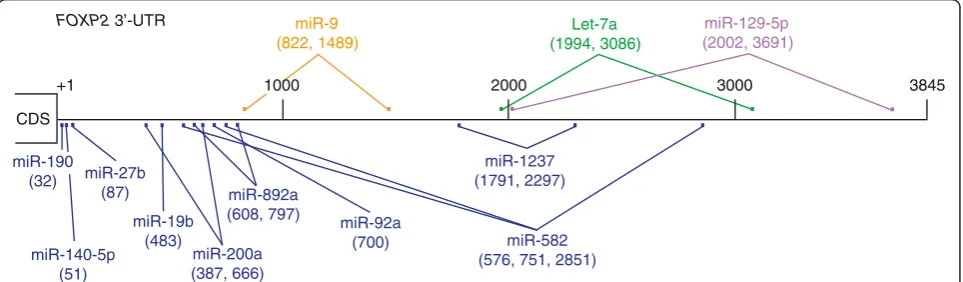
3845 nt sequence fragment that matched 100% to the humanFOXP23′UTR sequence annotated in the NCBI database. We searched thisFOXP23′UTR sequence for miRNA binding sites, requiring a perfect match to the 7-nt seed sequence in a miRNA [15,16]. This search predicted numerous miRNAs that potentially target the FOXP23′UTR. Some of these miRNAs have more than one binding site and the binding site sequences are conserved in higher vertebrate species. We selected 12 miRNAs: miR-9, miR-19b, miR-27b, miR-92a, miR-140-5p, 190, 200a, let-7a, 129-5p, 582-5p, miR-892a, and miR-1237 (Figure 1) and tested whether they downregulateFOXP2expression in cell culture systems.
Multiple miRNAs downregulate human FOXP2 protein and mRNA expression
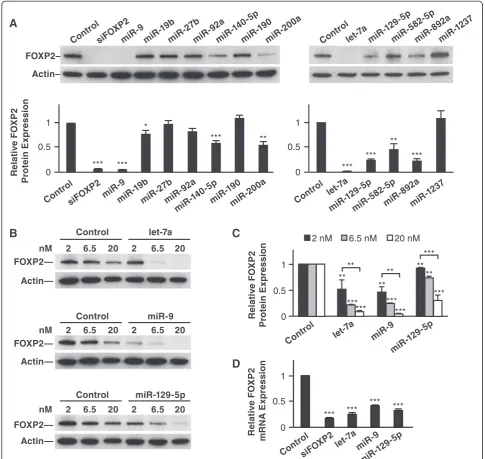
We transfected mimics of each candidate miRNA into hu-man HEK293 cells (where FOXP2 is expressed endogen-ously) and measured FOXP2 protein levels 72 hours later by Western blot analysis. We found that miR-9, miR-19b, miR-140-5p, miR-200a, let-7a, miR-129-5p, miR-582-5p, and miR-892a reduced FOXP2 protein levels significantly (Figure 2A). Of these miRNAs, let-7a, 9, and miR-129-5p were among the most effective regulators, redu-cing FOXP2 protein by 70-90%; they are also known to be abundantly expressed in vertebrate brains [17,18]. We fo-cused on these three miRNAs and tested whether their regulatory effects were dose-dependent at three dosages: 2, 6.5, and 20 nM. At 2 nM, comparing to the control, let-7a and miR-9 each decreased FOXP2 protein levels by about 50%, while miR-129-5p decreased FOXP2 protein by less than 10% (p< 0.01 for all). At 20 nM, let-7a and 9 decreased FOXP2 protein levels by 90%, and miR-129-5p decreased FOXP2 protein by 70% (p< 0.001 for all, Figure 2B and C). The dose-dependent downregulation was significant for each miRNA (p< 0.0018 for let-7a and miR-9; p< 0.0006 for miR-129-5p, Jonckheere-Terpstra test). Using quantitative real time PCR (qRT-PCR), we also
found thatFOXP2mRNA level was downregulated by let-7a, miR-9, and miR-129-5p in similar transfection experi-ments (Figure 2D).
let-7a, miR-9, and miR-129-5p target specific sequences in the humanFOXP23′UTR
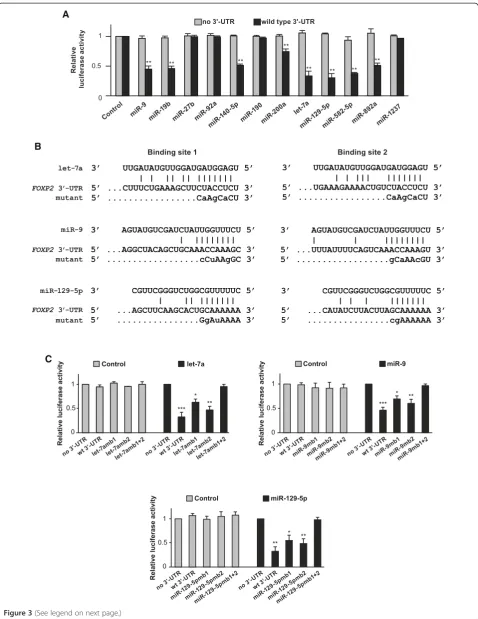
Next, we tested whether the regulatory effects of candi-date miRNAs were mediated by the 3′ UTR of the hu-man FOXP2 gene using luciferase reporter assays. We co-transfected miRNA mimics and a luciferase reporter construct containing a wild type FOXP2 3′ UTR or no 3′UTR into SH-SY5Y cells, where no endogenous FOXP2 was expressed, and performed luciferase reporter assays. Compared to a control miRNA with scrambled sequence, the eight candidate miRNAs, miR-9, miR-19b, miR-140-5p, miR-200a, let-7a, miR-129-miR-140-5p, miR-582-miR-140-5p, and miR-892a significantly repressed luciferase activity when co-transfected with a reporter construct containing a wild type FOXP2 3′UTR (p< 0.01 for all), but had no effect when co-transfected with a reporter construct containing no FOXP2 3′ UTR. In contrast, miR-27b, miR-92a, miR-190, and miR-1237 did not repress lucif-erase activity whether the reporter constructs contained aFOXP23′UTR or not (Figure 3A). These results were consistent with the Western blot results obtained from HEK293 cells as described in Figure 2A, indicating that the regulatory functions of these miRNAs were inde-pendent of the cell lines we used.
We focused on let-7a, miR-9, and miR-129-5p and fur-ther tested whefur-ther their regulatory effects were sequence-specific. Each of these miRNAs has two binding sites in the humanFOXP23′UTR. For each miRNA, we made three mutant luciferase reporter constructs with sequences in binding site 1, binding site 2, and binding sites 1 + 2 mu-tated respectively by site-directed mutagenesis (Figure 3B). Using luciferase reporter assays, we showed that each of these miRNAs significantly repressed luciferase activity when only one binding site was mutated (p< 0.05 or
+1 1000 2000 3000 3845
CDS
FOXP2 3’-UTR
miR-92a (700) miR-9 (822, 1489)
miR-129-5p (2002, 3691) Let-7a
(1994, 3086)
miR-1237 (1791, 2297)
miR-140-5p (51)
miR-200a (387, 666)
miR-582 (576, 751, 2851) miR-190
(32) miR-27b
(87)
miR-19b (483)
miR-892a (608, 797)
p< 0.01 for all three miRNAs), but their regulatory effects were completely abolished when both binding sites were mutated (p> 0.98 for all three miRNAs, Figure 3C). In comparison, the negative control miRNA had no effect on all reporter constructs whether it had no 3′ UTR, wild
type 3′UTR, or mutated 3′UTRs (Figure 3C). These re-sults suggested that the downregulatory effects of these miRNAs were mediated through specific sequences in the FOXP23′UTR, and each of their respective two binding sites was functional.
Cont rol siFOXP 2 miR -9 miR -19b miR -27b miR -92a miR -14 0-5p miR -190 miR -200 a FOXP2– Actin– R e la ti ve FO X P 2 P rotein E x p re s sion miR -9 miR -19b miR -27b miR -92a miR -14 0-5p miR -190 miR -200 a Cont rol siFOXP 2 0 1 0.5 * ** *** *** let-7 a miR -129 -5p miR -892 a miR -582 -5p miR -123 7 let-7 a miR -129 -5p miR -892 a miR -582 -5p miR -123 7 Cont rol Cont rol 0 1 0.5 *** ** *** *** 0 0.5 1
2 nM 6.5 nM 20 nM
** *** *** ****** Relati v e F O XP 2 Pr o te in E x p re s s io n
A
B
let-7 a miR -129 -5p Cont rol miR -9 let-7 a miR -129 -5p Cont rol 0 1 0.5 miR -9 R e la ti ve FO X P 2 mRNA E x pr ession *** *** *** *** siFOXP 2D
*** ** ** ** *** ** ** ***C
FOXP2— Actin— FOXP2— Actin— FOXP2— Actin— Control let-7a Control miR-9 Control miR-129-5p 2 6.5 20 2 6.5 20 nM2 6.5 20 2 6.5 20 nM
2 6.5 20 2 6.5 20 nM
Figure 2Multiple miRNAs downregulate human FOXP2 expression. (A)Representative Western blot images and quantitative results showing that miR-9, miR-19b, miR-140-5p, miR-200a, let-7a, miR-129-5p, miR-582-5p, and miR-892a downregulated human FOXP2 protein expression when transfected into HEK293 cells.(B and C)The downregulatory effects of let-7a, miR-9, and miR-129-5p were dosage-dependent.
A
B
C
Let-7a, miR-9, and miR-129-5p are expressed in the cerebellum of the human fetal brain
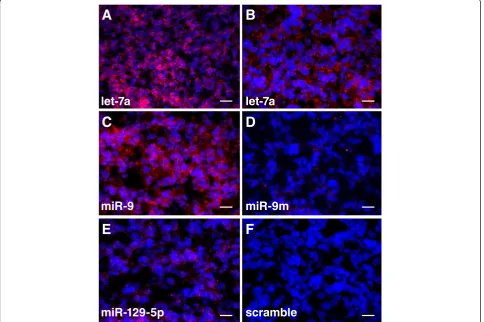
FOXP2is known to be expressed in several brain regions in the human fetal brain, including the cerebellum, the basal ganglia, the thalamus, and the cortical plate [19]. miRNAs that regulateFOXP2expression and play a role in brain development are expected to be expressed in similar brain regions. We examined the expression of let-7a, miR-9, and miR-129-5p in human fetal brain
tissue by in situ hybridization using Locked Nucleic Acid (LNA) modified miRNA detection probes. Due to limited tissue availability, only the cerebellum (16 weeks old) was examined. We found that all these three miR-NAs, let-7a, miR-9, and miR-129-5p, were expressed in the cerebellum of the human fetal brain (Figure 4). These observations were consistent with the roles of these miRNAs in regulating FOXP2 expression during human cerebellum development.
(See figure on previous page.)
Figure 3The downregulatory effects of let-7a, miR-9, and miR-129-5p are mediated via specific sequences in the humanFOXP23′UTR. (A)miR-9, miR-19b, miR-140-5p, miR-200a, let-7a, miR-129-5p, miR-582-5p, and miR-892a significantly repressed luciferase activity when
co-transfected with a reporter construct containing a wild-typeFOXP23′UTR, but had no effects when co-transfected with a reporter construct containing no 3′UTR.(B)Mutations in the binding sites for let-7a, miR-9, and miR-129-5p in the humanFOXP23′UTR. Mutated nucleotides are in lower case letters.(C)Mutations in both the two binding sites for let-7a, miR-9, and miR-129-5p in theFOXP23′UTR abolished the repressive effects of these miRNAs in luciferase reporter assays. Transfection was performed three times (n = 3) for each miRNA, and luciferase assays were performed in duplicate. To control for transfection efficiency,Renillaluciferase activity was normalized to the internal control firefly luciferase activity. Error bars = SEM; *p< 0.05, **p< 0.01, and ***p< 0.001, Tukey’s“Honest Significant Difference”test.
A
B
C
D
E
F
let-7a
let-7a
miR-9
miR-9m
miR-129-5p
scramble
Discussion
A heterozygous missense mutation in the humanFOXP2 protein coding region (i.e., R553H) results in a transcrip-tion factor with compromised DNA binding and tran-scriptional regulatory activity [1,20]. Presumably, reduced functional dosage of cellular FOXP2 protein causes speech and language impairments [12]. Our results, together with recent reports that miR-9, miR-132, and miR-140-5p regu-lateFoxp2/FoxP2expression (Foxp2andFoxP2denote re-spective rodent and avian genes) in animal models [21,22], highlight the importance of theFOXP23′UTR sequence and the roles for miRNAs in regulatingFOXP2expression. These results raise the possibility that sequence variations in the FOXP2 3′ UTR, particularly in miRNA binding sites, due to mutations and/or polymorphism may con-tribute to dysregulation and/or functional variations of the FOXP2 gene. In addition, various genetic, physio-logical, and environmental factors may influence the ex-pression of miRNAs, thus indirectly impacting FOXP2 expression.
Human subjects carrying FOXP2 mutations exhibit structural and functional abnormalities, presumably due to FOXP2 malfunction, in several brain regions, includ-ing the cerebellum [23], where FOXP2 is known to be expressed [19]. The expression of let-7a, miR-9, and miR-129-5p in the human fetal cerebellum is consistent with their roles in regulating FOXP2 expression during early cerebellum development in humans. Recently, dys-regulation of miR-129-5p is found in the cerebellum of autistic brains, albeit only a limited number of brains were examined [24]. Further investigation of in vivo functions of these miRNAs will bring insights into their roles in speech and language development and related neural de-velopmental disorders.
Methods
Cloning of the humanFOXP23′UTR and prediction of miRNA binding sites
Human fetal brain poly(A)+RNA (Clontech) was reverse-transcribed into cDNA using an oligo-dT primer. Using primers designed based on the humanFOXP23′UTR se-quence in the NCBI database [NCBI: NM148898, variant II], we PCR amplified two overlapping fragments represent-ing theFOXP23′UTR. The two fragments were ligated at a BamH1 site to obtain a 3845-nt full length humanFOXP2 3′UTR. This sequence was used for miRNA binding sites prediction using the software TargetScan. Sequences in the FOXP2 3′ UTR matching perfectly to the 7-nt seed se-quence of a miRNA were accepted as putative miRNA binding sites [16].
Transfection, Western blotting, and qRT-PCR
miRNA mimics (Ambion) were transfected into hu-man HEK293 cells (60 nM) using Lipofectamine 2000
(Invitrogen) and cells were harvested 72 hours later for protein and mRNA assays. Proteins were separated by electrophoresis on 10% SDS–PAGE gel. After blotting, membranes were probed with an antibody against the hu-man FOXP2 protein (sc-21069, Santa Cruz Biotechnol-ogy). Protein bands were visualized using ECL-Plus and quantified with Image J. For qRT-PCR, total RNA was extracted from transfected cells and reverse-transcribed (iScript cDNA synthesis kit, Bio-Rad). qRT-PCR was performed using the SYBR Green Supermix (Bio-Rad). Primer sequences are listed in the Additional file 1: Figure S1. The specificity of PCR amplification products were validated by electrophoresis and the melting-curve analysis. For each miRNA, transfection was performed at least three times. For each transfection, Western blot and qRT-PCT were performed at least two times, and qRT-PCR was performed in triplicate.
Luciferase reporter assays
Plasmid constructs carrying wild-type or mutant human FOXP2 3′ UTRs in the psiCHECK vector (Promega, 100 ng) were co-transfected with miRNA mimics (100 nM) into SH-SY5Y cells. Cells were harvested 48 h later and luciferase activity was assayed using the Dual-Luciferase Reporter System (Promega). To control for transfection efficiency, Renilla luciferase activity was normalized to the internal control firefly luciferase activ-ity. For each miRNA, transfection was performed three times and luciferase activity was assayed in duplicate.
Mutagenesis of miRNA binding sites
The full length humanFOXP23′UTR sequence was used as a template in site-directed mutagenesis of miRNA binding sites using the QuikChange II XL Mutagenesis Kit (Agilent). Specific PCR primers were designed using the QuikChangePrimer Design tool (see Additional file 1: Figure S1) and synthesized by Integrated Device Technol-ogy (IDT: http://www.idt.com). In some cases, to mutate three nucleotides in a binding site, we performed 2 rounds of mutagenesis. For example, we mutated 2 nucleotides in the first round, and used the mutated plasmid as a tem-plate in the second round to mutate the third nucleotide. All mutated binding sites were sequence verified.
In situhybridization
customer designed mutant miR-9 probe (miR-9m: 5′ -TCATAGAGCTACATAACCATACA-3′, underlined are mutated nucleotides); miR-129-5p probe (38482–15); negative control probe (99004–01). The human fetal brain (16 weeks old) cerebellum sections were obtained from a commercial source (Biochain Institute, CA).
Additional file
Additional file 1: Figure S1.Sequences of primers used in respective experiments.
Abbreviations
3′UTRs:3′untranslated regions; qRT-PCR: Quantitative real time polymerase chain reaction.
Competing interest
All authors declare that they have no competing interests.
Authors’contributions
XCL designed the experiment; LF, ZS, WT carried out the experiments and analyzed the results; GZL and XJW contributed to bioinformatics analysis; ZF performed statistical analysis; XCL wrote the manuscript. All authors read and approved the manuscript.
Acknowledgements
This work was supported by NIH grant (MH081254) and the Brain Behavior Research Foundation’s Young Investigator Award to XCL.
Author details
1Neuroscience Center of Excellence, LSU Health Sciences Center, New Orleans, LA 70112, USA.2Key Laboratory of Genetic Network Biology, Institute of Genetics and Developmental Biology, Chinese Academy of Sciences, Beijing 100101, China.3Biostatistics Program, LSU Health Sciences Center, New Orleans, LA 70112, USA.
Received: 8 July 2014 Accepted: 18 September 2014
References
1. Lai CS, Fisher SE, Hurst JA, Vargha-Khadem F, Monaco AP:A forkhead-domain gene is mutated in a severe speech and language disorder.
Nature2001,413(6855):519–523.
2. Feuk L, Kalervo A, Lipsanen-Nyman M, Skaug J, Nakabayashi K, Finucane B, Hartung D, Innes M, Kerem B, Nowaczyk MJ, Rivlin J, Roberts W, Senman L, Summers A, Szatmari P, Wong V, Vincent JB, Zeesman S, Osborne LR, Cardy JO, Kere J, Scherer SW, Hannula-Jouppi K:Absence of a paternally inherited FOXP2 gene in developmental verbal dyspraxia.Am J Hum Genet2006,79(5):965–972.
3. Lennon PA, Cooper ML, Peiffer DA, Gunderson KL, Patel A, Peters S, Cheung SW, Bacino CA CA:Deletion of 7q31.1 supports involvement of FOXP2 in language impairment: clinical report and review.Am J Med Genet A2007,143A(8):791–798.
4. Shriberg LD, Ballard KJ, Tomblin JB, Duffy JR, Odell KH, Williams CA:Speech, prosody, and voice characteristics of a mother and daughter with a 7;13 translocation affecting FOXP2.J Speech Lang Hear Res2006,49(3):500–525. 5. Zeesman S, Nowaczyk MJ, Teshima I, Roberts W, Cardy JO, Brian J, Senman L,
Feuk L, Osborne LR, Scherer SW:Speech and language impairment and oromotor dyspraxia due to deletion of 7q31 that involves FOXP2.Am J Med Genet A2006,140(5):509–514.
6. MacDermot KD, Bonora E, Sykes N, Coupe AM, Lai CS, Vernes SC, Vargha-Khadem F, McKenzie F, Smith RL, Monaco AP, Fisher SE: Identification of FOXP2 truncation as a novel cause of developmental speech and language deficits.Am J Hum Genet2005,76(6):1074–1080. 7. Shu W, Yang H, Zhang L, Lu MM, Morrisey EE:Characterization of a new
subfamily of winged-helix/forkhead (Fox) genes that are expressed in the lung and act as transcriptional repressors.J Biol Chem2001, 276(29):27488–27497.
8. Spiteri E, Konopka G, Coppola G, Bomar J, Oldham M, Ou J, Vernes SC, Fisher SE, Ren B, Geschwind DH:Identification of the transcriptional targets of FOXP2, a gene linked to speech and language, in developing human brain.Am J Hum Genet2007,81(6):1144–1157.
9. Vernes SC, Oliver PL, Spiteri E, Lockstone HE, Puliyadi R, Taylor JM, Ho J, Mombereau C, Brewer A, Lowy E, Nicod J, Groszer M, Baban D, Sahgal N, Cazier JB, Ragoussis J, Davies KE, Geschwind DH, Fisher SE:Foxp2 regulates gene networks implicated in neurite outgrowth in the developing brain.
PLoS Genet2011,7(7):e1002145.
10. Vernes SC, Spiteri E, Nicod J, Groszer M, Taylor JM, Davies KE, Geschwind DH, Fisher SE:High-throughput analysis of promoter occupancy reveals direct neural targets of FOXP2, a gene mutated in speech and language disorders.Am J Hum Genet2007,81(6):1232–1250.
11. Konopka G, Bomar JM, Winden K, Coppola G, Jonsson ZO, Gao F, Peng S, Preuss TM, Wohlschlegel JA, Geschwind DH:Human-specific
transcriptional regulation of CNS development genes by FOXP2.
Nature2009,462(7270):213–217.
12. Fisher SE, Scharff C:FOXP2 as a molecular window into speech and language.Trends Genet2009,25(4):166–177.
13. Graham SA, Fisher SE:Decoding the genetics of speech and language.
Curr Opin Neurobiol2013,23(1):43–51.
14. Lee RC, Feinbaum RL, Ambros V:The C. elegans heterochronic gene lin-4 encodes small RNAs with antisense complementarity to lin-14.Cell1993, 75(5):843–854.
15. Bartel DP:MicroRNAs: target recognition and regulatory functions.
Cell2009,136(2):215–233.
16. Friedman RC, Farh KK, Burge CB, Bartel DP:Most mammalian mRNAs are conserved targets of microRNAs.Genome Res2009,19(1):92–105. 17. Landgraf P, Rusu M, Sheridan R, Sewer A, Iovino N, Aravin A, Pfeffer S,
Rice A, Kamphorst AO, Landthaler M, Lin C, Socci ND, Hermida L, Fulci V, Chiaretti S, Foa R, Schliwka J, Fuchs U, Novosel A, Muller RU, Schermer B, Bissels U, Inman J, Phan Q, Chien M, Weir DB, Choksi R, De Vita G, Frezzetti D, Trompeter HI,et al:A mammalian microRNA expression atlas based on small RNA library sequencing.Cell2007,129(7):1401–1414. 18. Pena JT, Sohn-Lee C, Rouhanifard SH, Ludwig J, Hafner M, Mihailovic A, Lim C,
Holoch D, Berninger P, Zavolan M, Tuschl T:miRNA in situ hybridization in formaldehyde and EDC-fixed tissues.Nat Methods2009,6(2):139–141. 19. Lai CS, Gerrelli D, Monaco AP, Fisher SE, Copp AJ:FOXP2 expression during
brain development coincides with adult sites of pathology in a severe speech and language disorder.Brain2003,126(Pt 11):2455–2462. 20. Vernes SC, Nicod J, Elahi FM, Coventry JA, Kenny N, Coupe AM, Bird LE,
Davies KE, Fisher SE:Functional genetic analysis of mutations implicated in a human speech and language disorder.Hum Mol Genet2006, 15(21):3154–3167.
21. Clovis YM, Enard W, Marinaro F, Huttner WB, De Pietri Tonelli D: Convergent repression of Foxp2 3′UTR by miR-9 and miR-132 in embryonic mouse neocortex: implications for radial migration of neurons.Development2012,139(18):3332–3342.
22. Shi Z, Luo G, Fu L, Fang Z, Wang X, Li X:miR-9 and miR-140-5p target FoxP2 and are regulated as a function of the social context of singing behavior in zebra finches.J Neurosci2013,33(42):16510–16521. 23. Watkins KE, Vargha-Khadem F, Ashburner J, Passingham RE, Connelly A,
Friston KJ, Frackowiak RS, Mishkin M, Gadian DG:MRI analysis of an inherited speech and language disorder: structural brain abnormalities.
Brain2002,125(Pt 3):465–478.
24. Abu-Elneel K, Liu T, Gazzaniga FS, Nishimura Y, Wall DP, Geschwind DH, Lao K, Kosik KS:Heterogeneous dysregulation of microRNAs across the autism spectrum.Neurogenetics2008,9(3):153–161.
doi:10.1186/s13041-014-0071-0
Cite this article as:Fuet al.:Multiple microRNAs regulate humanFOXP2 gene expression by targeting sequences in its 3′untranslated region.