Experiences of using an interactive audience response system in
lectures
Matti Uhari*
1, Marjo Renko
1and Hannu Soini
2Address: 1The Department of Paediatrics, University of Oulu, FIN-90014 University of Oulu, Finland and 2Behavioural Sciences, University of
Oulu, FIN-90014 University of Oulu, Finland
Email: Matti Uhari* - [email protected]; Marjo Renko - [email protected]; Hannu Soini - [email protected] * Corresponding author
Abstract
Background: Lectures are good for presenting information and providing explanations, but because they lack active participation they have been neglected.
Methods: Students' experiences were evaluated after exposing them to the use of voting during lectures in their paediatrics course. Questions were delivered to the students taking paediatrics course. Thirty-six students out of the total of 40 (90%) attended the opening lecture, at which the first survey concerning previous experiences of lectures was performed. Thirty-nine students (98%) answered the second series of questions at the end of the paediatrics course.
Results: Most of the students felt that voting improved their activity during lectures, enhanced their learning, and that it was easier to make questions during lectures than earlier.
Conclusions: The students gained new, exciting insights much more often during the paediatrics course than before. We as teachers found that voting during lectures could easily overcome some of the obstacles of good lecturing.
Background
Lecturing is a much used teaching method because it is an economical and efficient method of conveying informa-tion to large groups of students. Didactically, lectures are good for presenting information and providing explana-tions, but because they lack active participation they have been neglected, especially as active participation has become the dominant postulate of student learning. It has even been suggested that lectures should be steered towards problem-based learning for large groups [1,2].
Students criticise lectures because they may be boring, or even useless when given badly. It has been suggested that only one tenth of what the lecturer is teaching is assimi-lated by the students [3]. Lecturing is not a good method
for all teaching purposes. Clinical problem solving, for example, is more effectively taught in group sessions [4]. Yet lectures are at least as effective as other methods of teaching [5]. An AMEE guide for lectures was published recently to revive the art of lecturing [5], and we believe that instead of criticising lectures, the reasons for criticism should be analysed and this information used to improve lectures. We have been using voting with individual dig-ital response transmitters during our paediatrics course to improve our responsiveness to the audience and to increase students' active participation. We report here on our experiences with this approach.
Published: 17 December 2003
BMC Medical Education 2003, 3:12
Received: 12 September 2003 Accepted: 17 December 2003
This article is available from: http://www.biomedcentral.com/1472-6920/3/12
Methods
We purchased a voting system (Interactive Presenter®, Dolphin Interactive Ltd, Finland, http://www.interac tivepresenter.com) three years ago and have used it regu-larly both in our undergraduate and postgraduate teach-ing and in our meetteach-ings to the staff of our department. In addition to the voting system a computer with a data
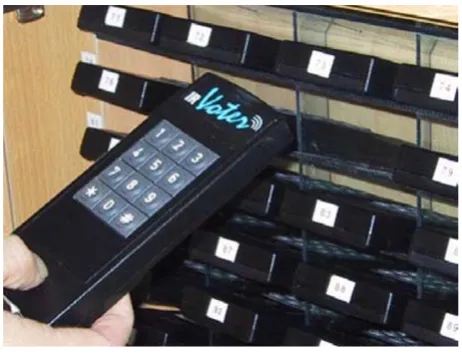
pro-jector is needed. The costs of the system depend on the number of transmitters for the students and on the quality of computer and data projector. We did not have any additional costs of the use of the system. At the time we purchased the system we could have bought six well equipped microcomputers at the same price. The device includes a fixed infrared receiver on the wall of the lecture room that is connected to a computer, also in the lecture room. Each student picks up a transmitter from a box when arriving in the lecture room (Figure 1). The PC-based software interface allows the teacher to construct the lecture using PowerPoint slides, www addresses and videos and to add questions between the slides (Figure 2). The students' answers are shown to the audience under each question and presented as bars or as percentages. The right answer, if there is one, can be highlighted (Figure 3). The voting device allows multiple choice questions with from 0 to 9 alternatives to be used and each respondent can select only one answer. The whole teaching staff was trained to use the voting device during a half day session. After that some personal guidance and support from other teachers were needed. Four of six teachers adopted the method and used it during 33 lectures out of the total of 63 forty-five minutes lectures given in our paediatrics course.
The students attending our paediatrics course are in their fifth year of medical studies. The course lasts ten weeks and is held twice a year, with about 40 to 50 students on each occasion. All the teachers use a data projector and PowerPoint for audio-visual purposes. This has enabled
The transmitters are kept in a locker in the lecture room which is opened before the lecture
Figure 1
The transmitters are kept in a locker in the lecture room which is opened before the lecture. Students pick them up as they enter the room and return them after the lecture. Each transmitter is numbered.
The PC-based software interface of the voting device
Figure 2
The PC-based software interface of the voting device. The play list includes PowerPoint files and questions, which can be written with the software or imported from a text editor.
A question and its alternative answers can be shown to the whole audience, with voting percentages and the right answer highlighted if desired
Figure 3
us to produce a booklet of handouts which is given to the students at the beginning of each course [6].
We asked the students attending the paediatrics course in the spring 2002 sixteen questions about lecturing during the first introductory lecture of the course. We repeated 15 of them at the end of the course and asked three more questions specifically about the voting practice during the preceding paediatrics course. Since the same experience was asked in more than one way we report here the results only of the 12 unique responses. To ensure true answers the students responded anonymously. The students were not informed that we were interested in voting per se but merely on their experiences on lecturing in general. The questions were put before them using the voting device but without commenting on their answers, to avoid any interference due to the survey itself. However, because of these arrangements we were only able to use the unpaired chi-square test in the analyses even though each student answered twice and the responses were actually paired. Hence the results of the statistical tests should be treated with caution.
Results
Four of the six lecturers used the voting system in 33 lec-ture hours (52% of the total). The usual number of ques-tions during a 45 minutes lecture was six. Thirty-six students out of the total of 40 (90%) attended the
open-dents (98%) answered the second series of questions at the end of the course.
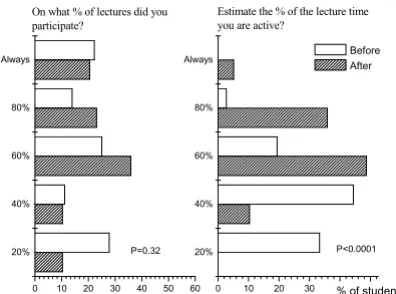
Students attended actively in the lectures, since 80% of them attended on more than 60% of the occasions. This level of activity did not change significantly during the course. The students estimated that they had been active less than half of the time during previous lecture courses, but their activity increased markedly at the paediatrics lec-tures (Figure 4).
Before the use of voting one quarter of the students had totally disagreed with the statement that "it is easy to ask questions during lectures", but the number of students agreeing with it increased significantly during the paediat-rics course (Figure 5). Similar changes occurred in the level of learning during lectures and in their knowledge of what their fellow students thought about the topic of the lecture (Figure 5). Our prior distribution of handouts was reflected in a change in the time taken to make notes dur-ing lectures (Figure 5).
More than 80% of the students felt that voting improved their learning, and most of them felt that it enhanced questioning during lectures, although some students dis-agreed on this latter point (Figure 6).
Students felt that lectures helped them realize what was important. This is a finding which voting did not alter (Figure 7). Also, most of the students disagreed with the statement that there should be less lectures in the teaching of medicine, even though more than 80% had found lec-tures annoying or boring before the paediatrics course (Figure 7). The students gained new, exciting insights much more often during the paediatrics course than before, 23% of them got new insights often or almost always during lectures before the paediatrics course as compared to 61% after paediatrics (P < 0.01 for the differ-ence of the proportions) (Figure 7).
Discussion
As teachers we found voting an exciting and useful tool for activating students during lectures, and this survey shows that the students were similarly excited about it. Our expe-riences were so positive that at present all the teachers are using voting during the lectures in paediatrics. The main pedagogical goal of a lecture is to convey information and explanations, and we think that this was achieved, as about 80% of the students felt that lectures enhanced their learning as compared with studying on their own. Voting did not increase the activity of the students to participate on our lectures. We think that this happened because the participation was active already before the use of voting.
Student attendance and activity in lectures
Figure 4
Student attendance and activity in lectures. The x-axis shows the percentages of students giving the respective estimates of their attendance at lectures or their activity during them. Questions were asked immediately before (Before) and after (After) the paediatrics course of 40 students in the spring 2002. 20% 40% 60% 80% Always
0 10 20 30 40 50 60
Estimate the % of the lecture time you are active?
Before After
On what % of lectures did you participate? P=0.32 20% 40% 60% 80% Always
However, voting could increase the activity of participation in situations where it is low without any interactivity during lectures.
According to McLaughlin and Mandin [3], teachers' views of the reasons for failure in lecturing were mostly a misjudgement of the learners/context or flawed imple-mentation of the teaching strategy. The use of voting may improve the teaching strategy, but it cannot otherwise improve a poorly organised or poorly judged lecture. Vot-ing can help the lecturer to be organised and responsive to the students, however.
Voting can be used for several purposes. By asking ques-tions the lecturer can find out what the students know already and can concentrate on those aspects of the topic which are not well understood. The voting system allows
Percentage student responses to four statements about lecturing, and the effect of voting on these responses (before vs. after a lecture course that included voting)
Figure 5
Percentage student responses to four statements about lecturing, and the effect of voting on these responses (before vs. after a lecture course that included voting).
Fully agree Agree Disagree Totally disagree
0 10 20 30 40
P=0.012
P=0.0001
P=0.005
0 10 20 30 40 50 60
It is easy to make questions during lectures
Before After
I learned better during lectures than alone
Fully agree Agree Disagree Totally disagree
0 10 20 30 40 50
In a lecture I know what my colleagues think
0 10 20 30 40 50 60 70
P=0.0001
% of students
Taking notes takes too much time of the lecture
Student responses to statements about voting during lectures
Figure 6
Student responses to statements about voting during lectures.
Fully agree Agree Disagree Totally disagree
0 10 20 30 40
Voting improved my learning
% of students 0 10 20 30 40 50
all the students to express their opinions and not only those opinion leaders who are active and brave enough to express their thoughts aloud. A lecture given with ques-tions can be used to know students' attitudes. Without anonymous voting it is often too difficult for the students to express their attitudes, especially if they differ from those that they assume the lecturer has. In our experience voting made this possible and opened the way to useful discussions. Voting can be used for organising examina-tions, especially if there is no need to evaluate each stu-dent's grade but merely to give the students feedback on their knowledge for their own future use.
Students' explanations for poor lecturing include a non-responsive lecturer, a boring lecture and a lecturer who does not provide opportunities to ask questions [3]. These are aspects which improved significantly during our course where we used voting. The validity of students'
ratings when used as we did here has been found to be good [7].
New audiovisual devices make it possible to show pictures of patient cases and to improve understanding by using complex illustrations during lectures. The same devices can also be used to prepare handouts so that the students do not have to make notes and are able to concentrate on learning and to take part in voting [6]. There are several aspects which should be kept in mind when using voting [8]. First of all, the questions should be clear and easy to understand quickly. There should not be more than five alternative answers. More time should be allowed for dis-cussions than earlier. The students in our survey reported that voting helped them to participate in discussions, and a lecturer using voting should be prepared to allow time for this.
Percentage distribution of students' responses to statements about lecturing
Figure 7
Percentage distribution of students' responses to statements about lecturing.
Fully agree Agree Disagree Totally disagree
0 10 20 30 40 50 60 70
Lectures have helped me to realize what is important
P=0.19
0 10 20 30 40 50
Before After
There should be less lectures
P=0.042
Never Seldom Often Almost always
0 10 20 30 40 50 60 70
I get new exciting insights during lectures
P=0.002
0 10 20 30 40 50 60 % of students70
I find lectures annoying or boring
Publish with BioMed Central and every scientist can read your work free of charge "BioMed Central will be the most significant development for disseminating the results of biomedical researc h in our lifetime."
Sir Paul Nurse, Cancer Research UK
Your research papers will be:
available free of charge to the entire biomedical community
peer reviewed and published immediately upon acceptance
cited in PubMed and archived on PubMed Central
yours — you keep the copyright
Submit your manuscript here:
http://www.biomedcentral.com/info/publishing_adv.asp
BioMedcentral
Even though the new technical devices provide new opportunities for teaching techniques at the same time, they also introduce new possibilities for technical prob-lems. Thus the devices should be tested beforehand, espe-cially if the location where the lecture is given has to be changed. Lecturers report difficulties with audiovisual devices as one important reason for the failure of lectures [3]. We have organized teaching and support for the lec-turers in using the voting device. Similarly, the students should be instructed on how to use the transmitter. We found this easy and there have been no problems for the students once this has been explained.
Conclusions
Instead of merely criticising lectures, efforts should be made to improve them and attention should be paid to the reasons for the criticism. There have been surprisingly few surveys published recently on improving lecturing [9]. The AMEE medical education guide no. 22 gives excellent hints and instructions on this [5], and our present survey suggests that voting using individual digital response transmitters during lectures could easily overcome some of the obstacles.
Competing interests
None declared.
Authors' contributions
MU participated in the planning, execution, analysing and writing of the project.
MR participated in the planning, execution, analysing and writing of the project.
HS participated in the planning, analysing and writing of the project.
References
1. Joorabchi B: Construct and use a problem-based programmed
lecture.Med Teach 1982, 4:6-9.
2. Georgiev G, Macpherson C, Rooney PJ: A novel extension of problem-based learning: problem-based lecture
presenta-tion by students.Med Educ 1995, 29:255-256.
3. McLaughlin K, Mandin H: A schematic approach to diagnosing
and resolving lecturalgia.Med Educ 2001, 35:1135-1142.
4. Renko M, Uhari M, Soini H, Tensing M: Peer consultation as a method for promoting problem-based learning during a
pae-diatrics course.Med Teach 2002, 24:408-411.
5. Brown G, Manogue M: AMEE Medical Education Guide No. 22:
Refreshing lecturing: a guide for lecturers.Med Teach 2001,
23:231-244.
6. Uhari M, Rantala H: Preparing lectures using microcomputers.
Med Teach 1994, 16:101-105.
7. McKeachie W,J: Student ratings. The validity of use.Am Psychol
1997, 52:1218-1225.
8. Robertson L,J: Twelve tips for using a computerised
interac-tive audience response system.Med Teach 2000, 22:237-239.
9. Nierenberg DW: The challenge of "teaching" large groups of learners: strategies to increase active participation and
learning.Int J Psychiatry Med 1998, 28:115-122.
Pre-publication history
The pre-publication history for this paper can be accessed here: