S O F T W A R E A R T I C L E
Open Access
Accelerating calculations of RNA secondary
structure partition functions using GPUs
Harry A Stern
1and David H Mathews
2*Abstract
Background: RNA performs many diverse functions in the cell in addition to its role as a messenger of genetic information. These functions depend on its ability to fold to a unique three-dimensional structure determined by the sequence. The conformation of RNA is in part determined by its secondary structure, or the particular set of contacts between pairs of complementary bases. Prediction of the secondary structure of RNA from its sequence is therefore of great interest, but can be computationally expensive. In this work we accelerate computations of base-pair
probababilities using parallel graphics processing units (GPUs).
Results: Calculation of the probabilities of base pairs in RNA secondary structures using nearest-neighbor standard free energy change parameters has been implemented using CUDA to run on hardware with multiprocessor GPUs. A modified set of recursions was introduced, which reduces memory usage by about 25%. GPUs are fastest in single precision, and for some hardware, restricted to single precision. This may introduce significant roundoff error.
However, deviations in base-pair probabilities calculated using single precision were found to be negligible compared to those resulting from shifting the nearest-neighbor parameters by a random amount of magnitude similar to their experimental uncertainties. For large sequences running on our particular hardware, the GPU implementation reduces execution time by a factor of close to 60 compared with an optimized serial implementation, and by a factor of 116 compared with the original code.
Conclusions: Using GPUs can greatly accelerate computation of RNA secondary structure partition functions, allowing calculation of base-pair probabilities for large sequences in a reasonable amount of time, with a negligible compromise in accuracy due to working in single precision. The source code is integrated into the RNAstructure software package and available for download at http://rna.urmc.rochester.edu.
Keywords: RNA, Secondary structure, Partition function, Graphical processing unit, CUDA
Background
RNA performs many diverse functions in the cell in addi-tion to its role as a messenger of genetic informaaddi-tion. It can form enzymes, for example for cleavage of itself or of other RNA, or to create peptide bonds as a fundamental constituent of the ribosome [1]. It can act as a signalling molecule for regulation of gene expression, for protein export, or for guiding post-translational modifications [2-5].
*Correspondence: [email protected]
2Department of Biochemistry & Biophysics and Center for RNA Biology, University of Rochester Medical Center, 601, Elmwood Avenue Box 712, Rochester, NY, 14642, USA
Full list of author information is available at the end of the article
As for proteins, RNA function depends on its folding to a well-defined three-dimensional shape. In contrast to proteins, the folding of RNA is hierarchical [6]. Secondary structure, or the particular set of contacts between pairs of complementary bases mediated by hydrogen bonding and stacking of bases, provides a significant amount of information. This can be helpful in predicting function or accessibility to ligands [7-10]. Computational predic-tion of the secondary structure of RNA from its sequence is therefore of great interest. The most widely-used auto-mated prediction methods attempt to estimate the ther-modynamic stability of RNA, using empirical parame-ters determined from experiments on oligonucleotides [11,12].
CUDA is a programming interface developed by the company NVIDIA to facilitate general-purpose, parallel high-performance computing on multiprocessor graph-ics processing units (GPUs) [13]. In recent years, many scientific computing applications have been implemented on GPUs using CUDA, in many cases yielding speed-ups of several orders of magnitude [14,15]. However, to our knowledge, only a handful of publications have appeared describing GPU implementations of codes for RNA sec-ondary structure prediction. Rizk and Lavenier described a CUDA implementation of structure prediction by free energy minimization [16]. Their work was limited to rel-atively short sequences (up to 120 bases) and a simplified energy model that neglects coaxial stacking. The GPU implementation was faster than the serial implementa-tion by a factor of 10 and 17 depending on the particular hardware. More recently, Lei et al. [17] also reported a parallelized implementation of free energy minimization using CUDA. They used only a coarse-grained paralleliza-tion scheme where the minimum-free-energy structures for subsequences of a given length are calculated in par-allel, but the search over structures for each subsequence is done serially. Their work was also limited to rela-tively short sequences (up to 221 bases). They reported speedups of up to a factor of 16. It should be noted that these parallelized implementations neither use the latest thermodynamic parameters for loops [18], nor include coaxial stacking interactions [19].
In addition, recent work demonstrates that calcula-tions of base-pairing probabilities calculated with parti-tion funcparti-tions can provide addiparti-tional useful informaparti-tion [20]. Structures composed of highly probable pairs are more accurate than lowest free energy structures [20,21]. The base pair probabilities provide confidence intervals for prediction of individual pairs. Base pairing probabili-ties can also be used to predict pseudoknots [22]. We have additionally extended this work to predictions using mul-tiple, homologous sequences, where the same principles hold true [23-26].
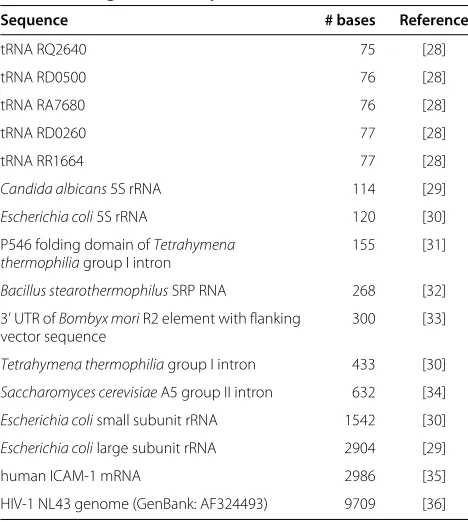
In this paper, we present the calculation of base-pair probabilities for 44 sequences containing up to 10,000 bases, using an optimized and parallelized version of the “partition” code in the RNAstructure package [27]. Our test set contained both random sequences of varying lengths (up to 10,000 bases) and actual sequences of bio-logical importance (see Table 1), the longest being the HIV-1 NL43 genome (GenBank: AF324493) containing 9709 bases.
We employed a sophisticated and accurate energy calcu-lation that includes coaxial stacking [19]. Before attempt-ing a parallel implementation, we first wrote an optimized serial version of the original code (the “partition” pro-gram in RNAstructure), implementing only a subset of its functionality, while improving efficiency and reducing
Table 1 Biological RNA sequences examined*
Sequence # bases Reference
tRNA RQ2640 75 [28]
tRNA RD0500 76 [28]
tRNA RA7680 76 [28]
tRNA RD0260 77 [28]
tRNA RR1664 77 [28]
Candida albicans5S rRNA 114 [29]
Escherichia coli5S rRNA 120 [30]
P546 folding domain ofTetrahymena thermophiliagroup I intron
155 [31]
Bacillus stearothermophilusSRP RNA 268 [32]
3’ UTR ofBombyx moriR2 element with flanking vector sequence
300 [33]
Tetrahymena thermophiliagroup I intron 433 [30]
Saccharomyces cerevisiaeA5 group II intron 632 [34]
Escherichia colismall subunit rRNA 1542 [30]
Escherichia colilarge subunit rRNA 2904 [29]
human ICAM-1 mRNA 2986 [35]
HIV-1 NL43 genome (GenBank: AF324493) 9709 [36]
*28 random sequences of length 10–10,000 were also examined.
memory usage. Subsequently, we parallelized the opti-mized code for GPU hardware, using CUDA. Here we made use of a fine-grained parallelization scheme, in which the calculation of the restricted partition function for each subsequence of a given length is parallelized, as well as the calculation of the restricted partition func-tion for each subsequence. We found that this fine-grained parallelization resulted in greater speedups than a sim-pler coarse-grained-only parallelization (up to factors of
∼60 compared to the optimized serial version and∼116 compared to the original code).
Implementation
Calculating base pair probabilities
The probabilitypi,jof a canonical pair between basesiand
jrelated to the standard free energy changeG0i,j of the restricted ensemble of structures containing the pair, and the standard free energy changeG0of the unrestricted ensemble of all possible structures, both relative to the state in which all bases are unpaired:
pi,j=
w
G0i,j
wG0 (1)
where
The standard free energy changesG0i,jandG0are estimated using the Turner nearest-neighbor rules [11,18,37], and pseudoknots are excluded. In that case,G0i,jdepends on two independent contributions, one for the interior fragment containing the pairi,jand bases in between (but excluding bases from the 5’ end toi−1 and fromj+1 to the 3’ end), and one for the exterior fragment containing the pair and bases from the two ends (but excluding bases fromi+1 to
j−1). We defineVi,jto be the relative standard free energy change for the interior fragment in the case thati<jand for the exterior fragment otherwise, following the convention used in the mfold prediction software [38]. In that case,
G0i,j= −RTlogexp−Vi,j/RT
+exp−Vj,i/RT
(3)
or more succinctly
w
G0i,j
=wVi,j
+wVj,i
(4)
The standard free energy changesVi,jare calculated using the following set of recursions:
wVi,j
=
⎧ ⎨ ⎩
Qhairpini,j +Qstacki,j +Qinternali,j +Qmultibranchi,j fori<j Qexteriori,j +Qstacki,j +Qinternali,j +Qmultibranchi,j fori>j
(5)
where
Qhairpini,j = w
Ghairpini,j
(6)
Qstacki,j = wVi+1,j−1+Gstacki,j,i+1,j−1
(7)
Qinternali,j =
i<i<j<j
wVi,j+Ginternali,j,i,j
(8)
Qmultibranchi,j = wWiMB+1,j−1+a+c+wWiMB+2,j−1+Gi3,jdangle,i+1 +a+b+c+ wWiMB+1,j−2+G5i,jdangle,j−1 +a+b+c+
w
WiMB+2,j−2+Gterminal mismatchi,j,i+1,j−1 +a+2b+c
+
i<k<j
wVi+1,k+Yk+1,j−1+Gcoaxial flushj,i,i+1,k +a+2c
+
i<k<j
w
Vi+2,k+Yk+2,j−1+Gcoaxial mismatchj,i,i+2,k (2)+a+2b+2c
+
i<k<j
w
Vi+2,k+Yk+1,j−2+Gcoaxial mismatchj,i,i+2,k (1)+a+2b+2c
+
i<k<j
wVk,j−1+Yi+1,k−1+Gcoaxial flushk,j−1,j,i +a+2c
+
i<k<j
wVk,j−2+Yi+1,k−2+Gkcoaxial mismatch,j−2,j,i (1)+a+2b+2c
+
i<k<j
w
Vk,j−2+Yi+2,k−1+Gcoaxial mismatchk,j−2,j,i (2)+a+2b+2c
Qexteriori,j = wWi3+1+Wj5−1+wWi3+2+Wj5−1+G3i,jdangle,i+1 ++
wWi3+1+Wj5−2+G5i,jdangle,j−1 ++wWi3+2+Wj5−2+Gterminal mismatchi,j,i+1,j−1 +
i<k<j
wVi+1,k+W3
k+1+W5
j−1+Gcoaxial flushj,i,i+1,k
+
i<k<j
wVi+2,k+W3
k+2+W5
j−1+Gcoaxial mismatch (2) j,i,i+2,k
+
i<k<j
w
Vi+2,k+W3
k+1+W5
j−2+Gcoaxial mismatch (1) j,i,i+2,k
+
i<k<j
w
Vk,j−1+W3
i+1+W5
k−1+Gcoaxial flushk,j−1,j,i
+
i<k<j
wVk,j−2+W3
i+1+W5
k−2+G
coaxial mismatch(1) k,j−2,j,i
+
i<k<j
wVk,j−2+W3
i+2+W5
k−1+G
coaxial mismatch(2) k,j−2,j,i
(10)
w
WiL,j
= w
WiL+1,j+b
+wVi,j+c
+w
Vi,j−1+G3
dangle
j−1,i,j +b+c
+
wVi+1,j+G5
dangle
j,i+1,i +b+c
+wVi+1,j−1+Gjterminal mismatch−1,i+1,j,i +2b+c
(11)
w
WiQ,j
= wVi,j
+w
Vi,j−1+G3
dangle
j−1,i,j
+w
Vi+1,j+G5
dangle
j,i+1,i
+
w
Vi+1,j−1+Gterminal mismatchj−1,i+1,j,i
(12)
wWi,j
= wWi,j−1+b
+w
WiL,j
(13)
wWicoax,j =
i<k<j
wVi,k+Vk+1,j+Gcoaxial flushi,k,k+1,j +2c
+
i<k<j
w
Vi+1,k+Vk+2,j+Gcoaxial mismatchi+1,k,kj+2,j (1)+2b+2c
+
i<k<j
w
Vi,k+Vk+2,j−1+Gcoaxial mismatchi,k,k+2,j−1 (2)+2b+2c
(14)
wZi,j
= w
Wicoax,j
+wVi,j+c
+w
Vi,j−1+G3
dangle
j−1,i,j +b+c
+
wVi+1,j+G5
dangle
j,i+1,i +b+c
+wVi+1,j−1+Gjterminal mismatch−1,i+1,j,i +2b+c
(15)
wWiMBL,j = wWiMBL+1,j+wWicoax,j +
i<k<j
wZi,k+YkL+1,j
(16)
w
WiMB,j
= w
WiMB,j−1+b
+w
WiMBL,j
(17)
wYi,j = wWi,j+w
WiMB,j
(18)
w
YiL,j
= w
WiL,j
+w
WiMBL,j
(19)
wWi5 = wWi5−1+
j<i
wWj5−1+WjQ,i (20)
w
Wi3
= w
Wi3+1
+
j>i
w
Wj3+1+WiQ,j
These recursions are slightly different from—but equiv-alent to—those presented in reference [20] and used in the previous code. It should be noted that there was an error in equation 15 of reference [20]: in the second line, WMBL(k+1, j) should be replaced by [WMBL(k+1, j)+WL(k+1, j)].
The quantitiesV,W,WMB,WL,Wcoax,W5, andW3
are simply−RTtimes the logarithms of the quantities in reference [20]. In addition, four new arrays are introduced:
1. WQis the standard free energy change
corresponding to the sum of terms on the right hand side of equation 11 of reference [20] not including the scaling by W5(k).
2. Elements ofY are−RTtimes the logarithm of the sum of the Boltzmann weights of corresponding elements ofW andWMB.
3. Elements ofYLare−RTtimes the logarithm of the
sum of the Boltzmann weights of corresponding elements ofWLandWMBL.
4. Elements ofZ are−RTtimes the logarithm of the sum of the Boltzmann weights of corresponding elements ofWL(except for the term depending on the next-smallest fragment) andWcoax.
Reorganizing the recursions in this way might appear to use more memory because of the additional arrays. In fact, the modified version requires less memory, because sev-eral of the arrays do not need to be stored in their entirety. Specifically, using the modified recursions, storage is only required for two diagonals ofW,WL, andWMBL; for five diagonals ofWMB; and for a half-triangle ofWQ. Reduc-ing memory usage is important as the size of the full arrays scales as O(N2) and the available GPU memory on our
hardware was limited to ∼2.5 GB. The modified recur-sions use four full N ×N arrays and one half-triangle, rather than the six fullN×Narrays used in the original recursions, and therefore reduce memory usage by about 25%. In addition, the calculation ofW5 andW3 is sim-plified (compare equations 20 and 21 above with equation 11 of reference [20]).
As in the previous work, the variousG parameters above are from the Turner nearest-neighbor rules [11], whilea,b, and care from the following estimate of the standard free energy change for multibranch loop initia-tion:
G0=a+bn+ch (22)
Herenis the number of unpaired nucleotides andhis the number of branching helices [21]. By convention, the size of internal loops is limited to thirty unpaired nucleotides, so the number of terms in equation 8 and the overall com-putational expense scales asO(N3)whereNis the size of the sequence.
The largest difference in the new implementation is that logarithms of probabilities and partition functions (i.e., standard free energy changes) are used rather than prob-abilities themselves, which is convenient when working in single precision in order to avoid overflow or underflow errors. This requires that exponentials and logarithms are calculated at each step of the calculation where sums are performed. This approach is a departure from the pre-vious implementation, which used scaling factors. Hav-ing to compute logarithms and exponentials does entail some additional computational expense, but this does not appear to be exhorbitant on the GPU, because opti-mized intrinsic mathematical functions are used. (i.e., the code was compiled with the NVIDIA compiler using the -use_fast_math option). The function required for the sum of two free energiesaandb(expressed in units such thatRT=1) is
f(a,b)= −loge−a+e−b (23)
We calculated this in the following way:
f(a,b)=
⎧ ⎪ ⎨ ⎪ ⎩
a−log1+ea−b a<b
b−log1+eb−a a>b a−log(2) a=b
(24)
This was done for two reasons: it requires at most a sin-gle call toexp, rather than two; and it can make use of the log1p function from the standard math library, which calculates log(1+x) accurately even for smallx. This is important because oftene−aande−bwill differ by several orders of magnitude, and simply adding them and then taking the logarithm can lead to significant roundoff error. In order to determine how much additional computa-tional overhead was imposed by the calculation ofexp andlog1p we performed a comparison with an artifi-cial reference calculation, which was identical except that calls to these functions were omitted. We found that for a 1,000-mer, the actual GPU calculation is only∼20% more expensive than this reference calculation.
Parallelization of the partition function calculation using CUDA
In the CUDA programming model, overall execution of the program is still governed by the CPU. Compute-intensive portions of the program are then delegated to subroutines executed by the GPU, or kernels. In general, the GPU has its own memory, so data must be copied to and from the GPU before and after kernel execu-tion. Many copies of a kernel, or threads, run in parallel, each of which belongs to a block. During kernel exe-cution, threads belonging to the same block can share data and synchronize, whereas threads belonging to differ-ent blocks cannot. A program can contain many kernels, which can execute either serially or in parallel [13].
The algorithm for calculating partition functions is recursive: partition functions for larger fragments depend on those for smaller fragments. As such, the overall cal-culation proceeds serially, in order of fragment size. We used two levels of parallelization, a block level and a thread level. Calculations for all fragments of a given size may be done in parallel, with no communication. This was imple-mented in CUDA at the level of blocks of threads. The partition function for a given fragment depends on sums, with the number of terms on the order of the fragment size (e.g., equation 9). These sums were parallelized at the level of threads within a block, since calculating a sum in parallel relies on communication between the threads. In our experience, a greater speedup was obtained from this “inner loop” parallelization, even though it requires more communication between threads. Most likely, this is because optimal efficiency on GPU hardware is obtained when identical mathematical operations are performed in lockstep on different data [13]. We stress that these two different levels of parallelization are not mutually exclusive and optimal performance was obtained from including both. A separate block of threads was run for each fragment, while 256 threads were run within a block. The number of threads per block was chosen by trial and error and was optimal for our hardware (the simple sum reduction scheme we chose requires it to be a power of two). In our code, this value is set at compile time (but this is not required by CUDA—it could be set at run time if desired).
Results and discussion
Accuracy
Peak floating point performance for NVIDIA Tesla GPUs are faster by a factor of two when working in single compared with working in double precision (www.nvidia.com), but single precision introduces greater roundoff error. In order to examine accuracy, we calcu-lated base-pair probabilities for the same sequences using both the parallel CUDA/GPU implementation in single
precision, and the serial implementation in double preci-sion. We also calculated probabilities in double precision using a set of nearest-neighbor parameters slightly modi-fied by adding a random variate chosen from a Gaussian distribution with mean 0 and standard deviation 0.01 kcal/mol, which is comparable to or smaller than their experimental uncertainty (0.1 kcal/mol for parameters describing helical stacking and 0.5 kcal/mol for parame-ters describing loops [18,37]).
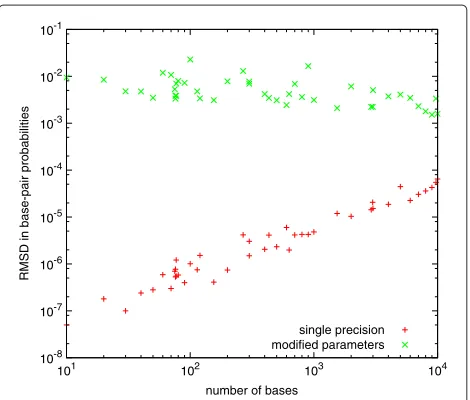
Figure 1 shows the root-mean-square deviation (RMSD) between base-pair probabilities calculated using double precision and either single precision, or the modified parameters. The RMSD of the calculation using modi-fied parameters decreases as the size of the sequences increases (because the fraction of pairs with very small probabilities increases). In contrast, the roundoff error due to working in single precision increases as the cube of the number of bases in the sequence (i.e., the num-ber of operations involved in the calculation). However, it remains relatively small for sequences of up to 10,000 bases, and negligible compared with the differences result-ing from the modified parameters. Our conclusion is that working in single precision does not introduce unaccept-able roundoff error for RNA secondary structure predic-tion for sequences of this size and most likely substantially larger.
We also used the calculated base pair probabilities to determine a single consensus structure for each sequences, using the ProbKnot algorithm [22]. In this
10-8 10-7 10-6 10-5 10-4 10-3 10-2 10-1
101 102 103 104
RMSD in base-pair probabilities
number of bases
single precision modified parameters
case, working in single precision led to differences with double precision only for one sequence (a random sequence of 6000 bases) out of the 44 we examined, and these were very small (only three bases out of the 6000 were matched with a different partner). Working with the modified parameters led to larger discrepancies although these were still fairly small (for sequences con-taining more than 100 bases, at most 6% of bases were matched with different partners). This is consistent with a previous report that predictions using base pair proba-bilities are significantly less sensitive to errors in thermo-dynamic parameters than using only lowest free energy structures [39].
Computational expense
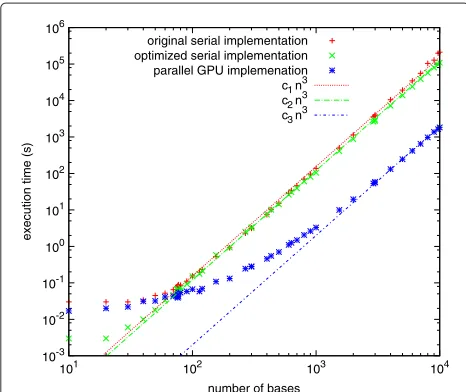
We compared overall execution time for the original serial code developed in our laboratory, the optimized serial code, and the parallel CUDA/GPU implementation. Cal-culations were performed for sequences containing from 10 to 10,000 bases, on compute nodes containing dual hex-core Intel Xeon 2.67 GHz CPUs and dual NVIDIA Tesla M2050 GPUs, each of which contains 448 multi-processor cores (only a single GPU was used). Figure 2 shows the execution time (from the user time reported by the UNIX “time” command) of the original and optimized serial codes as well as the parallel CUDA/GPU implemen-tation. The execution time for all codes scales as the cube of the sequence length for large sequences. The CUDA version was able to calculate base-pair probabilities for
10-3 10-2 10-1 100 101 102 103 104 105 106
101 102 103 104
execution time (s)
number of bases original serial implementation optimized serial implementation parallel GPU implemenation c1n3 c2n3 c3n3
Figure 2Computational expense.Execution time in seconds for the original serial implementation (red plus signs), optimized serial implementation (green crosses), and parallel GPU implementation (blue asterisks). The red, green, and blue lines are the cube of the number of basesnin the sequences, multiplied by a constant chosen to best fit the corresponding execution times.
the sequence for the full HIV-1 NL43 genome (9709 nucleotides) in 27 minutes. We note that there is a small overhead (a few hundredths of a second) involved in run-ning calculations with either the original serial code or the CUDA code, which is not present for the optimized serial code. This overhead has different origins: for the original code, it is probably due to reading the parameter files from disk, while for the CUDA code, it is most likely due to copying parameters and other data between the GPU and CPU.
Conclusions
In this work, we introduced a modified set of recur-sions for calculating RNA secondary structure partition functions and base-pairing probabilities using a dynamic programming algorithm, and implemented these in paral-lel using the CUDA framework for multiprocessor GPUs. For large sequences, the GPU implementation reduces execution time by a factor of close to 60 compared with an optimized serial implementation, and by a factor of 116 compared with the original code. It is clear from our work that using GPUs can greatly accelerate computation of RNA secondary structure partition functions, allowing calculation of base-pair probabilities for large sequences in a reasonable amount of time, with a negligible com-promise in accuracy due to working in single precision. It is expected that parallelization using CUDA should be applicable to other implementations of dynamic program-ming algorithms [12] besides ours, and result in similar speedups.
Two levels of parallelization were implemented. Calcu-lations for all fragments of a given size were done in par-allel, with no communication between threads. This was implemented in CUDA at the level of blocks of threads. In addition, the sums contributing to the partition func-tion for a given fragment were calculated in parallel, with communication required between threads. These sums were parallelized at the level of thread within a block. We found that this “inner loop” parallelization resulted in a significantly greater speedup than the “outer loop” parallelization alone.
Availability and requirements
• Project name: partition-cuda; part of RNAstructure, version 5.5 and later
• Project home page: http://rna.urmc.rochester.edu/ RNAstructure.html
• Operating system(s): Unix
• Programming languages: C and CUDA
• Other requirements: CUDA compiler, available from http://www.nvidia.com/object/cuda_home_new.html
• License: GNU GPL
Competing interests
The authors declare that they have no competing interests.
Authors’ contributions
HAS and DHM conceived of this work. HAS implemented the new partition function recursions for serial and parallel execution and performed the test calculations. HAS wrote the first draft of the manuscript, and DHM provided input to the final manuscript. Both authors read and approved the final manuscript.
Acknowledgements
This work was supported by NIH grant R01GM076485 to D. H. M. and the Center for Integrated Research Computing at the University of Rochester.
Author details
1Center for Integrated Research Computing, Taylor Hall, University of
Rochester, Rochester, NY, 14627, USA.2Department of Biochemistry &
Biophysics and Center for RNA Biology, University of Rochester Medical Center, 601, Elmwood Avenue Box 712, Rochester, NY, 14642, USA.
Received: 31 January 2013 Accepted: 14 October 2013 Published: 1 November 2013
References
1. Doudna JA, Cech TR:The chemical repertoire of natural ribozymes.
Nature2002,418:222.
2. Bachellerie JP, Cavaille J, Huttenhofer A:The expanding snoRNA world.
Biochimie2002,84:775.
3. Walter P, Blobel G:Signal recognition particle contains a 7S RNA essential for protein translocation across the endoplasmic reticulum.Nature1982,299:691.
4. Dykxhoorn DM, Novina CD, Sharp PA:Killing the messenger: Short RNAs that silence gene expression.Nat Rev Mol Cell Biol2003,4:457. 5. Wu L, Belasco JG:Let me count the ways: Mechanisms of gene
regulation by miRNAs and siRNAs.Mol Cell2008,29:1. 6. Tinoco I Jr, Bustamante C:How RNA folds.J Mol Biol1999,293:271. 7. Nawrocki EP, Kolbe DL, Eddy SR:Infernal 1.0: Inference of RNA
alignments.Bioinformatics2009,25:1335.
8. Li X, Quon G, Lipshitz HD, Morris Q:Predictingin vivobinding sites of RNA-binding proteins using mRNA secondary structure.RNA2010, 16:1096.
9. Lu ZJ, Mathews DH:Efficient siRNA selectrion using hybridization thermodynamics.Nucleic Acids Res2007,36:640.
10. Tafer H, Ameres SL, Obernosterer G, Gebeshuber CA, Schroeder R, Martinez J, Hofacker IL:The impact of target site accessibility on the deseign of effective siRNAs.Nat Biotechnol2008,26:578.
11. Turner DH, Mathews DH:NNDB: The nearest neighbor parameter database for predicting stability of nucleic acid secondary structure.
Nucleic Acids Res2010,38:D280.
12. Lorenz R, Bernhart SH, zu Siederdissen CH, Tafer H, Flamm C, Stadler PF, Hofacker IL:ViennaRNA package 2.0.Algorithms Mol Biol2011,6:26. 13. Sanders J, Kandrot E:CUDA by Example: An Introduction to General-Purpose
GPU Programming. Boston: Addison-Wesley; 2011.
14. Farber RM:Topical perspective on massive threading and parallelism.J Mol Graph Model2011,30:82.
15. Gotz AW, Williamson MJ, Xu D, Poole D, Le Grand S, Walker RC:Routine microsecond molecular dynamics simulations with AMBER on GPUs. 1. Generalized Born.J Chem Theory Comput2012,8:1542.
16. Rizk G, Lavenier D:GPU accelerated RNA folding algorithm.Lect Notes Comput Sci2009,5544:1004.
17. Lei G, Dou Y, Wan W, Xia F, Li R, Ma M, Zou D:CPU-GPU hybrid accelerating the Zuker algorithm for RNA secondary structure prediction applications.BMC Genomics2012,13(Suppl 1):S14. 18. Mathews DH, Disney MD, Childs JL, Schroeder SJ, Zuker M, Turner DH:
Incorporating chemical modification constraints into a dynamic programming algorithm for prediction of RNA secondary structure.
Proc Natl Acad Sci USA2004,101:7287.
19. Kim J, Walter AE, Turner DH:Thermodynamics of coaxially stacked helices with GA and CC mismatches.Biochemistry1996,35:13753.
20. Mathews DH:Using an RNA secondary structure partition function to determine confidence in base pairs predicted by free energy minimization.RNA2004,10:1178.
21. Lu ZJ, Gloor JW, Mathews DH:Improved RNA secondary structure prediction by maximizing expected pair accuracy.RNA2009, 15:1805.
22. Bellaousov S, Mathews DH:ProbKnot: Fast prediction of RNA secondary structure including pseudoknots.RNA2010,16:1870. 23. Harmanci AO, Sharma G, Mathews DH:PARTS: Probabilistic alignment
for RNA joint secondary structure predcition.Nucleic Acids Res2008, 36:2406.
24. Harmanci AO, Sharma G, Mathews DH:Stochastic sampling of the RNA structural alignment space.Nucleic Acids Res2009,37:4063.
25. Harmanci AO, Sharma G, Mathews DH:Efficient pairwise RNA structure prediction using probabilistic alignment constraints in Dynalign.
BMC Bioinformatics2011,27:626.
26. Seetin MG, Mathews DH:TurboKnot: Rapid prediction of conserved RNA secondary structures including pseudoknots.Bioinformatics 2012,28:792.
27. Reuter JS, Mathews DH:RNAstructure: software for RNA secondary structure prediction and analysis.BMC Bioinformatics2010,11:129. 28. Sprinzl M, Vassilenko KS:Compilation of tRNA sequences and
sequences of tRNA genes.Nucleic Acids Res2005,33:D139. 29. Szymanski M, Barciszewska MZ, Barciszewski J, Erdmann VA:5S
ribosomal RNA database Y2K.Nucleic Acids Res2000,28:166. 30. Cannone JJ, Subramanian S, Schnare MN, Collett JR, D’Souza LM, Du Y,
Feng B, Lin N, Madabusi LV, Muller KM, Pande N, Shang Z, Yu N, Gutell RR: The compariative RNA web (CRW) site: An online databae of comparative sequence and structure information for ribosomal, intron, and other RNAs.BMC Bioinformatics2002,3:2.
31. Cate JH, Gooding AR, Podell E, Zhou K, Golden BL, Kundrot CE, Cech TR, Doudna JA:Crystal structure of a group I ribozyme domain: Principles of RNA packing.Science1996,273:1678.
32. Larsen N, Samuelsson T, Zwieb C:The signal recognition particle database (SRPDB).Nucleic Acids Res1998,26:177.
33. Mathews DH, Banerjee A R Luan, D D, Eickbush TH, Turner DH:Secondary structure model of the RNA recognized by the reverse transcriptase from the R2 retrotransposable element.RNA1997,3:1.
34. Michel F, Umesono K, Ozeki H:Comparative and functional anatomy of group II catalytic introns—a review.Gene1989,82:5.
35. Staunton DE, Marlin SD, Stratowa C, Dustin ML, Springer TA:Primary structure of ICAM-1 demonstrates interaction between members of the immunoglobulin and integrin supergene families.Cell1988, 52:925.
36. Adachi A, Gendelman HE, Koenig S, Folks T, Willey R, Rabson A, Martin MA: Production of acquired immunodeficiency syndrome-associated retrovirus in human and nonhuman cells transfected with an infectious molecular clone.J Virol1986,59:284.
37. Xia T, Santa Lucia J Jr, Burkhard ME, Kierzek R, Schroeder SJ, Jaio X, Cox C, Turner DH:Thermodynamic parameters for an expanded
nearest-neighbor model for formation of RNA duplexes with Watson-Crick pairs.Biochemistry1998,37:14719.
38. Zuker M:On finding all suboptimal foldings of an RNA molecule.
Science1989,244:48.
39. Layton DM, Bundschuh R:A statistical analysis of RNA folding algorithms through thermodynamic parameter perturbation.
Nucleic Acids Res2005,33:519.
doi:10.1186/1748-7188-8-29