A Method of An Anonymous Authentication For
Flat-rate Service
Yoshio KAKIZAKI
†, Hiroshi YAMAMOTO
††, Hidekazu TSUJI
‡ †Graduate School of Science and Technology, Tokai University, Japan ††,‡School of Information Science and Technology, Tokai University, Japan Email:†[email protected],††[email protected], ‡[email protected]Abstract— As the ubiquitous society spreads rapidly, various
private information circulates in large quantities. Informa-tion increases explosively in recent years, the importance of privacy protection has risen. When the Web services are used, they need not identify who is the user in some cases. In this paper, we propose the authentication method that achieves privacy protection with authorization without identification. Our method makes it possible to protect user’s privacy information when the services. We discuss the security of the attacks, and the untraceability from attribute information to identity information. Thereby we show the effectiveness of our method.
Index Terms— role-based access control, anonymous
authen-tication, privacy protection, attribute authentication
I. INTRODUCTION
As the ubiquitous society spreads rapidly, data with various private information circulates in large quantities. Request for the privacy protection has risen in Japan along with the overall enforcement of Act for Protection of Computer Processed Personal Data held by Adminis-trative Organs [1] from April, 2005. Moreover, privacy information is used for purposes other than the original intent. Therefore, it has strong resistance to disclosing needless private information.
The eavesdropping, the spoofing, the modification and the other threats on the network are prevented by the PKI applications. PKI is only a means to lower the threat that exists on the network relatively. Moreover, the eavesdrop-ping prevention by the encryption of the communication is possible. However, the function of anonymity is not provided, so the problem of privacy protection is not solved.
When the Web services are used, there is a case that they need not identify who is the user. However, the authentication and the authorization are done at the same time in ID/password method. In such case, the service provider might record the service usage information: what services are used and who used them. So the authentica-tion scheme becomes more and more necessary.
This paper is based on “A Proposal of An Anonymous Authentication Method For Flat-rate Service”, by Y. Kakizaki, H. Yamamoto and H. Tsuji, which appeared in the Proceedings of International Symposium on Frontiers in Availability, Reliability and Security (FARES), in conjunc-tion with the First Internaconjunc-tional Conference on Availability, Reliability and Security, ARES 2006, Vienna, AUSTRIA, April 2006. c⃝2006 IEEE.
In this paper, we propose the authentication method that achieves privacy protection by using services based on user’s authority without identifying. In this method, the regular user who has a regular authority can receive the services with authority but without identifying by service provider, and service provider does not know who the user is. Therefore, our method makes it possible to protect user’s privacy information when the services, such as Web service etc., are used.
II. RELATEDWORKS
The method of achieving privacy protection is re-searched with various approaches. Anonymous method and pseudonyms method are typical methods of con-cealing identity. Anonymous method is an approach that cannot identify an individual from the crowd. Pseudonyms method is an approach that cannot identify by using fake name with untraceability. However, when the same person uses the same fake name, an individual can be specified in this method.
As the research of anonymity using certificate, there is the research that separates authentication and autho-rization using SPKI (Simple PKI) [2], [3], [4]. SPKI certificate is a kind of authorization certificate that does not contain identity information, and identity information can be prevented from leaking by the access control that uses this. However, we employ PKIX (PKI X.509) from the point of the recycling of infrastructure and the easiness of the implementation, because many PKI applications such as SSL and S/MIME use X.509 certificate.
As the research of anonymous authentication using dig-ital signature, there is k-Times Anonymous Authentication (k-TAA) [5], [6]. k-TAA can achieve the access to the application provider of k-times with anonymity by using escrow/group signature. However, it is based on group signature. Its approach is different from our method that aims achievement on PKI.
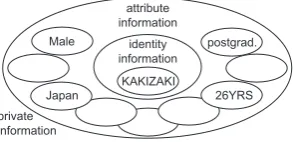
Figure 1. Basic Idea: private information is composed of identity information and attribute information
to contain attribute information is a method of using the extensions field of public-key certificate. However, there is a problem that the reissuing of public-key certificate is needed along with the revocation of attribute infor-mation because the lifetime of attribute inforinfor-mation is shorter than the lifetime of public-key generally. Attribute certificate solves this problem by containing attribute information to attribute certificate, and make it possible to reduce the cost of public-key generation and management. RFC3281 [7] just explains the framework of attribute certificate, and details about actual operation are not explained. Chiba et al. examine the details of registration and the use of attribute information [8]. Imaeda et al. consider the problems and the solutions when attribute certificate is linked to public-key certificate with the ob-jectDigestInfo [9]. They took notice of anonymity because attribute certificate does not contain identity information, and they pointed out that additional research is needed. However, the method of achieving anonymity in using attribute certificate remains as a problem. Therefore, it is necessary to examine the authentication method that effectively uses attribute information and the application scene.
III. ANANONYMOUSAUTHENTICATIONMETHOD
A. Basic Idea and Approach
Private information is composed of identity information and attribute information as shown in Figure 1. Identity information identifies the object person, and attribute information shows the qualification and the authority given to the object person. For instance, “KAKIZAKI” is identity information, and “Postgraduate” is attribute information on “KAKIZAKI”. Attribute information is the one component of private information. Thus, attribute information separated from identity information loses value as private information. Attribute information is ef-fective in the case of combining with identity information. If attribute information has no link to identity infor-mation, attribute information has the anonymity. When the questionnaires data are processed statistical, identity information is discarded and only attribute information is tallied. This is our basic idea.
Our approach is to apply this basic idea to digital certificate. Our method is an anonymous authentication method that makes it possible that the user can take the services without identifying. The following steps achieve this: identity information and attribute information are
separated from private information. Next, public-key cer-tificate with identity information is used to prove the au-thenticity. Attribute certificate with attribute information is used to prove the authority.
Our method protects user’s usage information by con-cealing what services are used and who used them.
B. Structure
The structure of our method is shown in Figure 2. Our method is a trusted third party model, and attribute authority, service provider, and user compose it.
1) Entity:
a) Attribute Authority (AA): issues Attribute Certifi-cate. Attribute Authority and Service Provider have the mutual trust. Attribute Authority is assigned privilege by Service Provider to issue Attribute Certificate.
Attribute Authority issues Attribute Certificate for the services and the authentication information. Attribute Cer-tificate verifier can confirm the user who the regular user is. The hash of the authentication information and attribute information that is user’s authority is contained in Attribute Certificate.
b) Service Provider (SP): provides the services that are Web service and others for user. Service Provider and Attribute Authority have the mutual trust. Service Provider assigns privilege to Attribute Authority to issue Attribute Certificate.
Service Provider verifies that Attribute Certificate is from User, and that the authentication information is from Attribute Authority. Service Provider confirms that User is Attribute Certificate owner by using the authentication in-formation, and that User is correct user. Service Provider provides the service after confirming that attributes of Attribute Certificate is User’s.
c) User: takes the services that are Web service and others from Service Provider.
User pushes Public-key Certificate to Attribute Author-ity. User pushes Attribute Certificate to Service Provider after issuing Attribute Certificate, and takes the service which is based on attributes of Attribute Certificate after confirming.
2) Certificate: Our method is using public-key cer-tificate and attribute cercer-tificate as digital cercer-tificate. Two certificates are explained in this section. The features of these are shown in TABLE II.
a) Public-key Certificate (PKC): is X.509 certificate that proves certificate owner’s authenticity. Public-key Certificate shows public-key which is signed by Certifi-cate Authority that proves validity.
TABLE I.
PROFILE OFATTRIBUTECERTIFICATESTANDARDFIELDS
Fields Name Definition
version v2
holder identity of the holder
issuer identity of the AA that issued the certificate signature algorithm used to sign the certificate serialNumber unique identifier of the certificate
attrCertValidityPeriod time period for the validity of the certificate attributes attributes associated with the holder issuerUniqueID additional issuer identification extensions addition of new fields to the certificate
Figure 2. The Structure of Our Method
TABLE II.
A COMPARISON OFPUBLIC-KEYCERTIFICATE ANDATTRIBUTECERTIFICATE
Public-key Certificate Attribute Certificate Purpose to prove the authenticity to prove the authorization Article subject name and public-key attributes
Validity Period long short
Issuer Certificate Authority Attribute Authority
The holder field has three options as shown in TA-BLE III: baseCertificateID, entityName, and objectDi-gestInfo. With the baseCertificateID option, Attribute Certificate and Public-key Certificate are bound by the holder’s Public-key Certificate serialNumber and issuer. With the entityName option, Attribute Certificate and key Certificate are bound by the holder’s Public-key Certificate subject or subjectAltName. These two op-tions bind Attribute Certificate to Public-key Certificate, and the verifier can identify an individual by Public-key Certificate. With the objectDigestInfo option, Attribute Certificate and Public-key Certificate are bound by the target object’s hash. Therefore, it is possible to bind Public-key Certificate or also the other objects by using the objectDigestInfo option.
Attribute Certificate is not bound to Public-key Certifi-cate in our method, thus, the objectDigestInfo is used for the holder field of Attribute Certificate. Attribute Certifi-cate verifier cannot identify who the Attribute CertifiCertifi-cate owner is though it can confirm that Attribute Certificate owner is a regular user, by setting the authentication information to the target object of objectDijestInfo.
AuthInfo is decided as follows. First, two random numbers are generated. One is the authentication key between User and Service Provider, and the other is the session key for User. The user key is calculated with XOR of the authentication key and the session key. AuthInfo
is made from the authentication key and the user key encrypted with public-key of Attribute Certificate owner which are encrypted with public-key of Service Provider. Hash of AuthInfo is set in objectDigestInfo of the holder field of Attribute Certificate.
There is a possibility to be traced from service usage information when same Attribute Certificate is used. So, we decided to make Attribute Certificate disposable to preclude the possibility of it. Basically, Attribute Certifi-cate is set to one certifiCertifi-cate per one session. Therefore, the validity period of Attribute Certificate can be set very short. Thus, Attribute Certificate revocation and CRL (Certificate Revocation List) or OCSP (Online Certificate Status Protocol) might be unnecessary by this setting.
C. Procedure
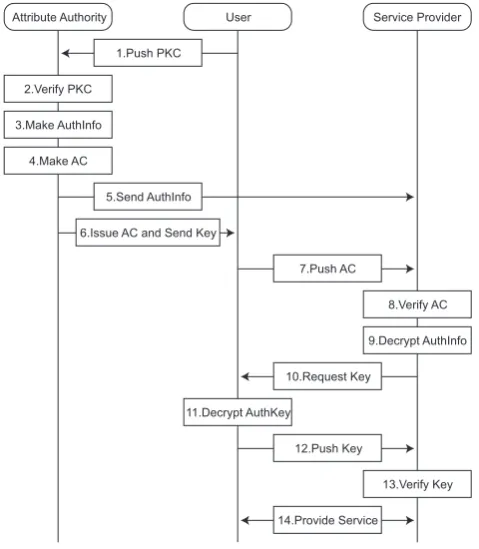
User operates as follows to take the services of Service Provider and the system flow is shown in Figure 3.
Issuing Attribute Certificate:
1) User pushes PKC to AA.
2) AA verifies PKC validity. Moreover, AA verifies whether User has private-key which is another of a pair of PKC.
TABLE III.
PROFILE OF HOLDERFIELDOPTIONS
Options Name Definition
baseCertificateID the holder’s PKC serialNumber and issuer entityName the holder’s PKC subject or subjectAltName objectDigestInfo a hash of the target object
Figure 3. The Flow of Our Method
session key for User. The user key is calculated with XOR of the authentication key and the session key. AuthInfo is made from the authentication key and the user key encrypted with public-key of AC owner which are encrypted with public-key of SP. 4) AA calculates a hash of the object that is AuthInfo, it is written into objectDigestInfo of AC.holder. More-over, User’s attributes are written into attributes field of AC, and AA makes AC.
5) AA sends AuthInfo to SP.
6) AA issues AC to User. And AA sends the session key to User.
Pushing Attribute Certificate:
7) User pushes AC issued by AA to SP.
8) SP verifies digital signature of AC is correct, and confirms AC issuer is assigned privilege AA. More-over, SP confirms the modification and the forgery, and confirms validity period.
9) SP verifies AC.holder with hash of AuthInfo that is from AA. AuthInfo is decrypted by private-key, and the authentication key and AuthKey are taken out. 10) SP sends the user key which is encrypted by
public-key of AC owner to User for confirming User is a regular user.
TABLE IV. NOTATION
Symbol Meaning
E(M, A) encrypt M by A’s public-key D(M, A) decrypt M by A’s private-key H(M) hash of M
AC.holder holder field of AC KEY as random integer
AuthKey as a key for the authentication AuthInf o authentication information SP Service Provider
U User
Asendto−→ B A is sent to B
A=? B comparison whether A is equal to B
Authorization:
11) User decrypts AuthKey which is from SP with private-key of User. And the authentication key is calculated with XOR of the user key and the session key.
12) User pushes the authentication key to SP.
13) SP judges that User is correct owner of AC if the authentication key from User is equal to the key which is taken out of AuthInfo.
14) SP provides the service based on authority of AC.
D. Effectiveness
The effectiveness of privacy protection and safe use of our method are explained with the notation of Table IV.
Attribute Authority:
GenerateKEYA, KEYS as random integer KEYU =KEYA⊕KEYS
AuthKey=E(KEYU, U)
AuthInf o=E((KEYA, AuthKey), SP)
AC.holder=H(AuthInf o)
AuthInf osendto−→ SP
KEYS sendto
−→ U
Service Provider:
H(AuthInf o)=? AC.holder
KEYA, AuthKey=D(AuthInf o, SP)
AuthKeysendto−→ U
User:
KEYU =D(AuthKey, U)
KEYA=KEYU ⊕KEYS
KEYA sendto
Service Provider:
KEYA fromAuthInf o ?
=KEYA from U AA has User’s identity and authority information, and issues AC for the service, though AA cannot know what services User actually used. AA issues AC including the authority information and AuthInfo including the authen-tication information. AA generates KEYA, KEYS and KEYU for the authentication information.
KEYA=KEYU ⊕KEYS
and
KEYS =KEYU⊕KEYA
though User hasKEYS andKEYU encrypted by User’s public-key. User can obtain KEYA from KEYS and decryptedKEYU. Therefore, AC can be used when both KEYSis issued from AA and the private-key correspond-ing to AC owner’s public-key.
AuthInfo includes the confirmation information which is the AC user is regular, but it cannot identify who the AC user is. Therefore, AC verifier cannot confirm who the AC user is.
AuthInfo does not include who the AC user is although it includes the confirmation information that is the AC user is regular. Therefore, SP knows what services User actually used, but cannot identify who the AC user is.
Thus, privacy information can be protected because it is distributed with SP and AA.
IV. DEVELOPMENT
A. Application Scope
We separate authentication and authorization with iden-tity information and attribute information respectively. Herewith, the method makes it possible that the user take the service without identifying by service provider, and it achieves privacy protection by hiding the service usage information. The method is useful under the following conditions.
• The service that is not including privacy information
• Two or more services must exist
• No meter rate service
At the service that is including privacy information, Pri-vacy information can be specified from the service used. As an example of this problem is healthcare information service. Healthcare information is attribute information extremely near privacy information, and the demand of user who wants to be protecting it is strong. However, both identity information and attribute information are needed in the greater part of services of healthcare field. Thus, the method is not useful in such a scene.
At just single service, the user’s purpose is to use the only service. Therefore, there is no point in hiding the service usage information.
At meter rate service, the content of service used can be guessed according to the charge of service, because the charge of service is different depending on the content of service or the amount used. Therefore, it is difficult
to protect privacy information only by hiding the service usage information.
B. Operative Example
E-learning, the books browsing service, and the video delivery service, etc. are thought as an example of apply-ing our method.
We assume e-learning: the user can freely attend the class which is providing, as long as the user pays the tuition. The user does not want the service provider to ever know what class the user attends. Service provider does not mind as long as the user has regular authority even if the user attends which class. Moreover, service provider can know the popularity of each class although it cannot know who to which class is attending.
The user registers to service provider that provides e-learning. Service provider assigns privilege to attribute authority for issuing attribute certificate that is necessary of the service use. Attribute authority issues attribute certificate and the authentication key to the user. The user pushes attribute certificate to service provider, proves the regular user by the authentication key, and takes e-learning.
Attribute authority cannot know which class the user attended although it knows which class can be attended and who is the user. Service provider cannot know who the user is although it can confirm which class the user can attend and can know the popularity of each class. As mentioned above, service provider and attribute authority never know who to which class is attending.
In the same way, we assume the books browsing ser-vice: a free member can browse only for a free member’s although the dues-paying member can browse all books. The user does not want the service provider to ever know what books the user browses. Service provider does not mind as long as the user has regular authority even if the user browses which books.
Last, we assume the video delivery service: there are many genres such as the movie, sports, and dramas, and the user who has contracted the genre can freely watch contents in the genre. The user does not want the service provider to ever know what contents the user watches. Service provider does not mind as long as the user has regular authority even if the user watches which contents. Moreover, service provider can know the popularity of each content.
Thus, the user can freely use the services; howbeit service provider does not record the service usage in-formation. It is possible to protect the service usage information that is privacy information.
V. DISCUSSION
A. Advantage
actually. Service Provider can know what services are used and what authority user has, although it cannot know who is user. Nobody can know what services are used and who is user. The method has the advantage that user’s privacy information is protected and the authority can be managed efficiently.
The method has adaptability with PKIX because it uses the Public-key Certificate and Attribute Certificate. Many PKI applications such as SSL and S/MIME use X.509 certificate. PKIX is in widespread than SPKI. Therefore, our method achieved on PKIX has more adaptability to current infrastructure than the method achieved on SPKI [3], [4].
Attribute Certificate is made to be disposable to prevent the traceability from service usage information. However, it is preferable to be able to recycle Attribute Certificate as long as attribute does not change. Especially, there is the problem that the issuing cost of Attribute Certificate becomes high in case of the service frequently used. Even if Attribute Certificate is recycled several times, it might be safe enough. However, the possibility that an individual is specified increases by using same Attribute Certificate. Therefore, the level of privacy protection and the issuing cost of Attribute Certificate are trade-offs.
B. Security
1) Modification and Forgery: Attribute Certificate is X.509 certificate. Attribute Certificate is signed by At-tribute Authority which is AtAt-tribute Certificate issuer. The modification and forgery can be detected by verifying digital signature. The security level of this certificate is equal to others of PKI.
2) Reusing: The lifetime of Attribute Certificate is very short, because of one certificate per one session. In addition, Service Provider records the serialNumber of Attribute Certificate which is used. Thus, Attribute Certificate cannot be reused.
The reason why our method does not permit reusing Attribute Certificate is that an individual is specified by reusing, and privacy protection becomes difficult. If Attribute Certificate is reused, it is a pseudonyms method because the serialNumber can be assumed the fake name. Oppositely, if Attribute Certificate is made disposable, it is an anonymous method. Our goal is privacy protection by anonymous. Therefore, there was a necessity for making Attribute Certificate disposable because we had to have employed an anonymous method.
3) Fraud and Spoofing: We discuss the case that malicious user gets Attribute Certificate by the fraud method. Malicious user pushes Attribute Certificate to Service Provider. To confirm the Attribute Certificate user is correct, Service Provider sends AuthKey which is encrypted by Attribute Certificate owner’s public-key to Attribute Certificate user who is malicious user. At this time, the malicious user cannot decrypt AuthKey because malicious user is not regular Attribute Certificate owner. Malicious user does not have private-key of regular Attribute Certificate owner. Therefore, even if malicious
user illegally gets Attribute Certificate, one cannot use it. Furthermore, regular user is not permitted to take the services by the illegal authority, too.
Even if it does not know KEYS or KEYU, KEYA can be estimated. However, if the authentication is failed at one trial, service provider rejects the session because it is easy to calculate KEYA from KEYS andKEYU. New Attribute Certificate is needed for re-authentication because Attribute Certificate is disposable. Therefore, it is difficult for malicious user to attack it.
C. Untraceability
Identity information is not contained in Attribute Cer-tificate which is necessary in the services. Attribute Certificate verifier cannot identify user from Attribute Certificate directly. However, user activity can be traced by service usage information. For instance, user who uses same Attribute Certificate can identify that one is same user. Moreover, there is a possibility that an individual can be identified in the some situations. There is the problem that is the traceability from service usage information from the side of privacy protection. Therefore, we propose the method that Attribute Certificate cannot reuse to prevent it.
VI. CONCLUSION
In this paper, we propose the authentication method that achieves privacy protection by using services based on user’s authority without identifying. Our method makes it possible to protect user’s privacy information when the services, such as Web service etc., are used.
Identity information that identifies an individual is not contained in attribute certificate. And only attribute information for authorization is contained in it. However its holder is bound in the holder field. Attribute certificate verifier can confirm that attribute certificate owner is a regular user although it cannot identify attribute certificate owner directly. Thus, the user can take the services without identifying an individual, and the service provider can provide the services only for a regular user. Our method makes it possible to protect user’s privacy because service provider cannot identify user.
We discuss the security of the attacks that are modifi-cation, forgery, fraud and spoofing, and the untraceability from attribute information to user’s usage information and identity information. Thereby we show the effectiveness of our method.
REFERENCES
[1] G. of Japan, Act for Protection of Com-puter Processed Personal Data held by Ad-ministrative Organs, 2005. [Online]. Available: www.kantei.go.jp/jp/it/privacy/houseika/hourituan/ [2] C. Ellison, B. Frantz, B. Lampson, R. Rivest, B. Thomas,
[4] T. Saito, K. Umesawa, and H. Okuno, “A Privacy-Enhanced Access Control,” IEICE Transactions, vol. J84-D1, no. 11, pp. 1553–1562, 2001.
[5] L. Nguyen and R. Safavi-Naini, “Dynamic k-Times Anonymous Authentication,” in ACNS 2005, vol. 3531 of LNCS, 2005, pp. 318–333.
[6] I. Teranishi, J. Furukawa, and K. Sako, “k-Times Anony-mous Authentication,” in ASIACRYPT 2004, vol. 3329 of LNCS, 2004, pp. 308–322.
[7] S. Farrell and R. Housley, An Internet Attribute Certificate
Profile for Authorization, 2002, RFC3281.
[8] M. Chiba, K. Urushima, and Y. Maeda, “Personal Attribute Provider: A Secure Framework for Personal Attribute Exchange on the Internet,” IPSJ Journal, vol. 47, no. 3, pp. 676–685, 2006.
[9] N. Imaeda, H. Odahara, and H. Masamoto, “A considera-tion to tie PKCs to ACs at using ACs,” IEICE, Tech. Rep., 2003, ISEC2002-106.
[10] T. Nakanishi and Y. Sugiyama, “Anonymous Statistical Survey of Attributes,” in ACISP2001, vol. 2119 of LNCS, 2001, pp. 460–473.
[11] J. S. Park, R. Sandhu, and G. Ahn, “Role-Based Access Control on the Web,” ACM Transactions on Information
and System Security, vol. 4, no. 1, pp. 37–71, 2001.
[12] V. Benjumea, J. Lopez, J. A. Montenegro, and J. M. Troya, “A First Approach to Provide Anonymity in Attribute Certificates,” in PKC 2004, vol. 2947 of LNCS, 2004, pp. 402–415.
[13] N. Sato and H. Suzuki, “An Authentication System that Can Verify an Anonymous Person’s Rights,” IPSJ Journal, vol. 41, no. 8, pp. 2138–2147, 2000.
[14] Y. Kakizaki, H. Yamamoto, and H. Tsuji, “A Proposal of An Anonymous Authentication Method For Flat-rate Service,” in ARES 2006, 2006, pp. 551–557.
Yoshio KAKIZAKI is currently a Ph.D. candidate at Tokai
University, Japan. He received his MS and BS degrees in engineering from Tokai University, Japan, in 2005 and 2003, respectively. His research interests include information security and network communication.
Hiroshi YAMAMOTO was born in Osaka, Japan. He received
his PhD degree in engineering from Osaka University in 1996, his MS degree in engineering from Osaka University 1993, and his BS degree in engineering from Osaka University 1991. He is currently an Associate Professor of School of Information Science and Technology, Tokai University, Japan. His current research interests include coding theory and information secu-rity. He is a member ofthe Institute of Electronics, Information and Communication Engineers, Engineering Sciences Society.
Hidekazu TSUJI received the BS, MS and Ph.D degree in