CATHARINE WARD THOMPSON
BUILDING ON THE WORK OF KELLY (1955) in personal construct psychology, and Peled (1976, I990) in ecoanalysis, this paper develops projective techniques-which use concepts of personal and phenomenological space-as a means for articulating
approaches to landscape design. The projective approach involves two stages. In stage one, projective techniques are used to elicit personal constructs (which may be held at a pre-conscious or sub-conscious level), allowing the holistic experience of landscape to be explored. In stage two, using a 'projection location task' derived from the way we experience and construe the regions of our own bodies, elements of these
constructs can then be articulated so as to inform the way we interact and engage with the space around us. This gives insight into the meaning of spatial layouts, which can then be translated into a design language for the structural ordering of space.
The author draws on original research conducted with children as well as adults, using projective techniques to draw out their desires and needs in relation to designing their landscape environment. The paper discusses the value of such methods for landscape designers and their clients, and outlines some ongoing research to test the validity of the projection location task.
T
HE WORK DESCRIBED IN THIS PAPER is a development of projective techniques, essentially phenomenological in approach, for use in the landscape design process. The techniques, based on environmental psychology, are aimed at eliciting an account of people's experience of place. In design tasks, the designer, the client and those who ultimately interact with the design may all have wishes and needs, perhaps held at a pre-conscious level, which are not fully articulated, and which may be poorly served by the conventional design brief. Any method which encourages an awareness of a person's experiential goals and the spatial conditions which facilitate or inhibit these, is of importance to design (Aspinall & Ujam 1992). Underlying the approach taken here is a distinction between space as it may be objectively defined, and space as it is perceived and encountered. Perception, according to Merleau-Ponty (1964), starts with the body, the primary reference from which all spatial understanding is derived. His notions of 'lived-space' and 'lived-body' emphasise that perceiver and perceived inhabit the same space, with the body, being at the centre of the experience, determining the directional axes and existential distance.In an architectural design context, such approaches have been used by Peled (I976) to analyse the experience of being in, and interacting with, a given temporal/spatial zone. The techniques, based on personal construct psychology (PCP) (Kelly I955) and Peled's ecoanalysis (1990), have been developed further by Aspinall & Ujam (1992) and Ward Thompson (I995) over the last six years in landscape design projects involving children. There is a need for techniques which allow a child's perspective to inform environmental development proposals, but to date, there has been little work on using projective techniques specifically for this purpose.
LANDSCAPE REVIEW I998:4(2) PAGES 27-40
Catharine Ward Thompson is Head of the School of Landscape Architecture, Edinbm;gh College of ArtjHeriot-Watt University, Lauriston Place Edinburgh EH3 9DF, UK. Telephone: (131) 221 6091 Fa.v: (131) 22I 6005
Email: [email protected]
KEY WORDS
Personal construct Spatial design language Playground design Projective method Ecoallalysis
RESEARCH
28
Much concern has been voiced over the poor quality of outdoor environments provided for children in institutional contexts, especially those at schools, nurseries and day-care centres (Herrington 1997; Titman I994; Moore 1986; Hart I979). Recommendations for improving this situation rightly emphasise that the design process should be informed by a holistic understanding of child development needs. Many authors have further suggested that 'it is mandatory to inquire into their (children's) own particular system of constructs' in order to understand the environment from a child's perspective (Little I980). The literature on landscape aesthetics and perception includes a wide range of theoretical and empirical studies (Zube et al 1982; Ulrich I986; Nasar 1988; Kaplan & Kaplan I989; Porteous 1996), but relatively little on phenomenological approaches or on children's landscape perception and preference (Lyons I983; Purcell et al 1994; Porteous 1996). The work described here is an attempt by those involved with landscape design to find appropriate techniques for eliciting an account of people's desires and perceptions, including those of children, in a way that can usefully and directly inform the design process.
The projective methods
The projective techniques used in this research are born out of a response to evidence in the literature that our actions are based on 'pre-conscious' factors (Eiser I986 )1. The techniques are designed to raise these factors to the level of consciousness so that they can be recorded. This is of particular importance for understanding children's desires and actions. The detailed theoretical support for the methods used is described by Aspinall & Ujam (1992), but a summary of the principles is set out below.
Personal construct psychology (Kelly 1955) takes as its premise the idea that we mediate reality through 'constructions' which influence how we perceive reality and how we respond to it. The construct system is like a pair of spectacles which not only filters information (for example, what we see and how we see it), but also influences our future expectations. The system consists of two components: elements, such as objects, events, places and people; and constructs which operate on this field of elements; that is, the aspects of these elements which allow us to discriminate between them.'
Peled's ecoanalysis (1990) uses aspects of pCP and, in the 'location task', explores the relationship between how we interact with the space around us, and how we experience and construe the regions of our own bodies.l In exploring a design proposal with individuals, the researcher can generate a set of constructs across similar and dissimilar places to the one proposed, thereby creating a contextual view. In the location task, the meanings and feelings which are invested in places are made more explicit, giving an insight into spatial layouts. The task is arranged so as to be free from actual design constraints, without being detached in the manner of a bubble diagram. Individuals imagine a place as they would like it to be, listing the components they wish to include (usually generated through pCP exploration). Counters representing spaces or component elements are manipulated on a large, abstract diagram. An important aspect of the resulting arrangement is the way in which these spaces and elements are experienced; for example, as core or peripheral, front or back, left or right. According to Peled, the placement of elements relates to commonly known (but
often unconscious) interpretations we make of the space around us in relation to our own bodies. He suggests that such body-centred spatial ordering reflects an actual, structured ordering of physical space, and not merely a symbolic relationship with the world. Peled has successfully used the location task to explore the layout of buildings in discussion with clients. The use of such a technique for landscape design proposals brings greater challenges for the interpretation of results, but also allows some interesting insights.
The research project
The research described here focused on the playground environment and involved primary school pupils and their teachers. The principal participants were nine to ten year old children, which added to the interest and challenge of the project, allowing some exploration of the way in which children's landscape perceptions are different from those of adults. The project arose initially out of the author's desire to respond appropriately to opportunities for playground redesign in two primary schools. It involved two stages. In stage one, the author used 20 photographs as a starting point to elicit an account of individual perceptions and desires for the playground environment, using a questionnaire based on pCP. In stage two, the author, using a location task diagram, invited groups of respondents to explore the spatial qualities and relationships of elements chosen in stage one. The project was intended to tap into the participants' desires and perceptions of which they themselves may not have been consciously or initially aware. It was an attempt to elicit wishes and values unconstrained by the physical realities of the existing playground, rather than the participants' own version of a design solution-the more conventional (and often unsatisfactory) method of inviting community participation in landscape design.+
In a subsequent project, whose findings are still being analysed, the author carried out further empirical work on the location task (using school pupils) in an attempt to address some of the questions raised by the initial project.
The
pCPelements
The 20 A4 colour photographs used for the first stage of the project were taken from magazines and from the author's own collection, and were chosen with a view to providing some consistency of lighting, focal range and depth. The photographs showed a variety of landscapes which either were, or could conceivably have been, part of a school playground. It is recognised that the use of photographs is less satisfactory than visits to real sites, and that the choice of photographs inevitably influences the responses obtained. However, practical constraints precluded more elaborate and costly alternatives, and moreover, it has been demonstrated that photographs can be used to provide a meaningful guide to environmental perceptions (Kaplan & Kaplan 1989), particularly when they are used as a starting point for exploring responses based on imaginative conjecture beyond the limitations of the photographic image itself.
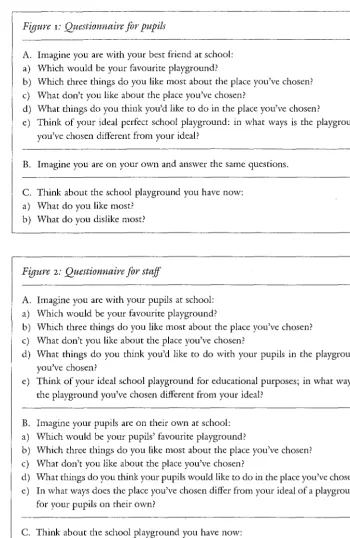
The author invited pupils and staff to respond to a series of questions whilst looking through the same set of 20 photographs. Questions were framed to encourage responses on what it would be like to be actively engaged in and with
the landscape, rather than merely a passive viewer of the landscape. Each pupil was given an in-depth interview, allowing them time and opportunity to express their ideas and responses in their own way. Pupils were first asked to imagine they
30
were with their best friends at school, and then to imagine they were on their own (see fig.! for the list of questions). The author invited school staff to respond to the photographs using a modified questionnaire. They were first asked to imagine they were with their pupils, and then to imagine their pupils were on their own (see fig.2).
Figure r: Questionnaire for pupils
A. Imagine you are with your best friend at school: a) Which would be your favourite playground?
b) Which three things do you like most about the place you've chosen? c) What don't you like about the place you've chosen?
d) What things do you think you'd like to do in the place you've chosen?
e) Think of your ideal perfect school playground: in what ways is the playground you've chosen different from your ideal?
B. Imagine you are on your own and answer the same questions.
C. Think about the school playground you have now: a) What do you like most?
b) What do you dislike most?
Figure 2: Questionnaire for staff
A. Imagine you are with your pupils at school: a) Which would be your favourite playground?
b) Which three things do you like most about the place you've chosen? c) What don't you like about the place you've chosen?
d) What things do you think you'd like to do with your pupils in the playground you've chosen?
e) Think of your ideal school playground for educational purposes; in what way is the playground you've chosen different from your ideal?
B. Imagine your pupils are on their own at school: a) Which would be your pupils' favourite playground?
b) Which three things do you like most about the place you've chosen? c) What don't you like about the place you've chosen?
d) What things do you think your pupils would like to do in the place you've chosen? e) In what ways does the place you've chosen differ from your ideal of a playground
for your pupils on their own?
C. Think about the school playground you have now: a) What do you like most?
b) What do you dislike most?
The first stage of the project yielded a list of elements identified in the responses to the questionnaire. These can be broadly classified under three headings as follows:
@ aspects of place experience: such qualities as clean, quiet, shady, secret activities: such things as climbing, playing games, sitting, running about
® artefacts: such things as trees, slides, grass, benches.
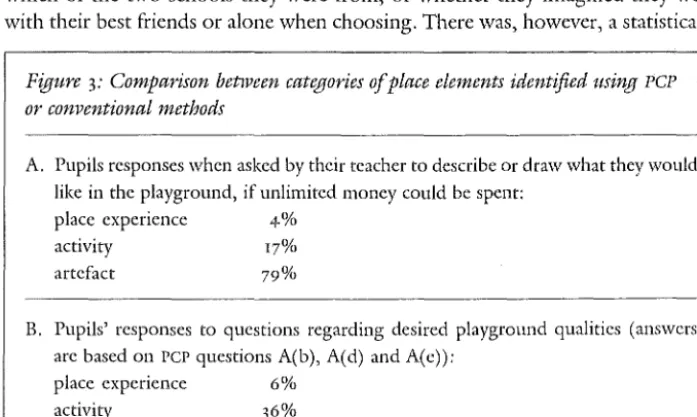
These elements of perception (PCP elements) were used in stage two of the project. The proportion of elements falling into each category varied significantly depending on the preferred photograph, but there was also a difference between the overall results obtained using the pCP methods described here, and the more conventional responses produced when, on a separate occasion, teachers asked pupils to draw or describe items they would like to have if unlimited money could be spent on their playground (see fig.3). The paper discusses the results of the first stage further below, but the difference between conventional and pcP-based responses demonstrates that projective techniques are capable of eliciting different kinds of information about how children engage actively with their environment. pCP theory suggests that such responses tap into core values, which are relatively stable constructs and therefore more able to be generalised and applied to other contexts.
Ecoanalysis and the location task
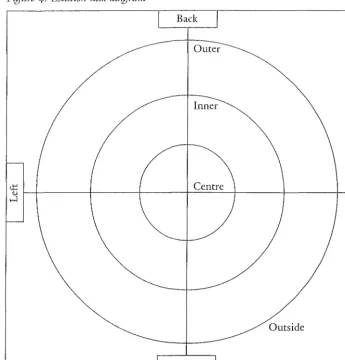
In stage two,. pupils were put into groups of between four and six students, whilst staff were asked to form a single group (consisting of seven or eight adults for each school). Each group was asked to draw all the elements their peers had identified from stage one onto an abstract location task diagram (see fig.4), imagining it to be a diagram of a new playground which was not necessarily their own. The diagram distinguishes four quadrants by dividing the area between back, front, left and right. It also has concentric zones which move from the centre, through an inner and outer circle, to the outside zone.
Summary of
pCPelements results
There was no significant difference in the pupils' choice of photographs based on which of the two schools they were from, or whether they imagined they were with their best friends or alone when choosing. There was, however, a statistically
Figure 3: Comparison betlVeen categories of place elements identified using pCP
or conventional methods
A. Pupils responses when asked by their teacher to describe or draw what they would like in the playground, if unlimited money could be spent:
place experience 4-%
activity 17')/0
artefact 79%
B. Pupils' responses to questions regarding desired playground qualities (answers arc based on PCP questions A(b), A(d) and A(e));
place experience 6%
activity 36%
artefact 58%
32
Figure 4: Location task diagrarn
Back Outer
Inner
~ ~
v ~+---~---+---+-~==~~---+---~~
~ M
Outside
Front
Participants sit on this side facing the diagram significant difference (X2
= 14.5, df= I, P < .01) between pupils' choices and staff anticipation of their choices. Figures 5 and 6 show the most popular photographs chosen (for detailed analysis, see Ward Thompson 1995).
The overall ratio of pCP elements determined from responses by both pupils and staff was:
" place experience 12 % " activity 45%
" artefact 43%
The proportion of elements in each category varied according to the photograph chosen. A scene of a hard, constructed play area, chosen almost exclusively by boys (photo b), for example, produced no place experience elements and 55% activity elements. By contrast, a photograph (popular with boys and girls but very few staff) of a curving path with grassy banks, low trees and shrubs (photo d)
produced nearly 20% place experience elements and only 41% activity elements. Figures 7 and 8 summarise the most liked and disliked elements revealed in pupils' responses to preferred photographs, and the elements, not present in the preferred photographs, most favoured by pupils and staff for their ideal playground.
Figure 5: The most popular photographs (78% of all choices, n=96)
Photographs (b) and (f) were most popular with boys and chosen predominantly by them. Photographs (a), (e) and (i) were most popular with girls. The two photographs which most clearly distinguish gender choice, almost exclusively chosen by boys and girls respectively, are (b) and (i) , neither of which were chosen by staff at all.
a b
d e
g h
Summary
of
location task findings
Pupils placed a significantly greater proportion of elements in the centre of the diagram than did staff (X'=24.3, df=1, p<.OI); significantly more activity elements (X'=19.8, df=1, p< .01), as well as more artefact elements (X'=8.6, df= I, P < .or). These results can be interpreted as the expression of a greater need on the part of children, than of staff, for stmcture and integrating elements, whilst also highlighting the importance of activity for children. Figure 9 shows the distinctive placement of particular elements in different parts of the diagram by pupils and staff.
Interpretation of these results according to Peled's ecoanalysis hypothesis would result in the following observations: natural elements, and the ability to manipulate or study them, have primacy for children; pupils, unlike staff, want an attractive, soft and comfortable landscape to be part of the school's public
CATHARINE WARD THOMPSON
c
f
34
Figure 6: summary of tnost popular photograph choices (female pupils) tl = 32;
male pupils) n= 34; staff, n= 30) 16
14 b: OJ
12
Vl
0
.c
u
10
II)
OJ E
';:; 8
....
0 '- 6
Q) .0 E ::J 4 Z
2
0
a b c d e
D staff III male pupils III female pupils
g h
photograph identification number
Figure 7: Summary of the most and least liked pCP elements
in the most popular photographs
Elements most lilled (in order of popularity for pupils):
climbing/climbing equipment/climbing trees running/running about/chasing/playing tig trees
slides/sliding
water + benches/sitting + greenery/flowers/country-like relaxing/resting/quiet/peaceful
hide and seek + other adventure equipment/play
Elements least lilud (in order of dislike for pupils):
hard surface/materials safety/danger/supervision
Figure 8: Summary of elements not in preferred photographs most favoured for the ideal playground (pupils and staff)
other adventure equipment/play greenery/flowers/country-like swings/swinging(for pupils) trees (for pupils)
organisation/separation of space (for staff)
image; and pupils reject aspects of the status quo-playgrounds which almost entirely lack elements of greenery or opportunities for wildlife study.
The location task was also carried out with some pupils using an accurate plan of their actual playground, although these results have not been formally analysed. Whilst the placement of elements onto plans can be useful to landscape architects in deciding on the layout of a site's design, it is important to differentiate between the interpretation of an abstract diagram and the
Figure 9: SUlttmary of distinctiFc placemCtlt of elemCtlts Ott location tasll diagram
Centre/inner Ferms olltn/olttside
Pupils elements mainly centre/inner (centre/inner versus outer 4: I) (centre/inner versus outer 2: I)
Front perms back
Pupils elements mainly in front (front versus back 2:1)
Staff elements mainly in back (front versus back 1:5)
Staff elements exclusively in front
Left FentlS right
Pupils elements mainly to the left (left versus right 2: 1)
Pupils elements mainly to the right (left versus right 1:5) Staff elements mainly to the left
(left versus right 7: I)
Staff elements mainly to the right (left versus right I: 4)
wildlife/nature study/fishing p lanting/gardening/gardens
chatting
formal games courts/equipment shelter and shade
sitting areas running
greenery/flowers/plants shelter and shade sitting areas
greenery and flowers wildlife/nature study, etc. formal games courts/equipment
greenery and flowers wildlife, nature study, etc. trees
playing generally formal games equipment water/pond
large open space
formal games equipment talking/chatting
relaxing/quiet/reading greenery and flowers wildlife, nature study, etc. planting and gardening soft surfaces
climbing/climbing equipment
configuration of a real site. For example, an element which is of central importance in psychological terms to the user of a site, may not need to be centrally located on an actual site plan, although it is likely to demand a prime location of some sort at the core of the design.
Discussion of initial findings
The first project produced a vvealth of data, some of which were more readily interpreted than others. Activity, or provision for activity (such as places in which to climb or sit, whether or not designed as such) seemed to attract greater interest from children than the mere presence of artefacts or plants which did not offer this potential. This supports the work of environmental psychologists such as Gibson (I979), who coined the term 'affordance' to describe the way people perceive their surroundings in terms of what they offer for human interaction or, as Appleton (I990) puts it, 'What's in the landscape for me?'. Properties related specifically to human comfort and refuge (such as shelters and sitting areas) were seen to be particularly important to children and part of a desirable public image for their play areas, along with greenery and flowers. The popularity of elements such as trees, shrubs and dens for playing hide-and-seek is perhaps explained by Appleton's theories (I975) on the importance of prospect and refuge in making landscapes attractive. Appleton believes that such concerns are at least partly determined by innate, biological factors, which should, therefore, be as powerful in children as in adults, although Lyons (I983) finds no clear evidence for this.
Whatever the theoretical underpinnings of the way children respond to landscape, the use of PCP techniques seems to elicit a greater differentiation of behavioural preferences as compared with simply asking children what they want in terms of facilities. If possibilities for activity and issues of 'affordance' are as important to children as they appear, then pCP techniques can playa useful role in determining them. A semiotics approach such as Titman has used (1994) can produce similar results in terms of the range and proportion of elements produced, but it does not allow for exploration of the spatial relationships between these elements in the manner of ecoanalysis.
Significant differences between adult and children's preferences were evident in much of the initial study data. This was exemplified by the location task in which the children seemed to show a greater desire for the integration of elements (in particular, activity-based and natural elements) than did the adults. Two of the seven elements which were most popular with the children were ones which they predominantly placed in the front of the diagram, and which adults placed almost exclusively at the back. This reinforces research (see Titman I994) which indicates that children consider the appearance of their playground to be symbolic of the value the school places upon them. Thus, an attractive playground, which meets children's needs in a publicly visible way, reflects the image of the school and the worth of the children in the eyes of society. The aspect of the location task least amenable to interpretation was the left/right placement of elements. It was concluded at the end of this project that further work was needed to refine and validate the technique.
U¥.F.!IIIf!:¥ ¥'~fP,:tI.¥r.1iI
on
The initial project, whose findings are discussed above, raised a number of questions about the location task: the value of performing such a task in groups as opposed to individually-this could result in the initial response of an individual representing unconscious or instinctive preferences being overridden; the validity of interpretation based on the different areas of the diagram, in particular, the left/right divide; and the extent to which placement of elements on an abstract diagram matches the real, physical layout people desire, as opposed to merely representing the psychological significance of the elements.
Discussions with Peled in 1997 assisted the author in devising a further research project which attempted to address some of these issues. The project was based at one of the schools used in the initial project, but involved different pupils who had only recently moved into the nine to ten year old category. A list of 20 elements was prepared from those identified in project one, covering place experience, activity and artefact, and including some which had been disliked as well as some of the most popular. Twenty-two pupils were interviewed individually, and an additional two boys and two girls were interviewed in pairs, to see if there was a difference when more than one person was involved. They were told that the 20 chosen elements were ones which pupils at their age, and at their school, had picked out a few years earlier as things they might experience or do in their ideal playground. The original photographs were laid out in the room to help pupils imagine the kinds of elements being discussed, but were not formally used during the interview. Pupils were asked to place the elements, in any order and in any way they wished, onto the location task diagram, explaining what those places might be like (or why the elements were being placed there) as they put down each one. The interviews were taped (with the pupils' consent) to allow analysis of the terms they used to describe their completion of the location task. At the end they were allowed to name four additional elements which had not already been included: two they liked and two they disliked. They were asked to point to their favourite place on the diagram and to locate the position of the school building. This last request was included in case the location of the building appeared to influence the placement of elements, since their existing school building was to the left of their playground when entering from the street.
Analysis of the data from this project is ongoing, but some initial results allow some aspects of the location task to be re-evaluated. The value of the quick, individual responses obtained in this project may be greater than responses gained from the group, which necessitated individual justification and common agreement. The order of placement for the elements appears to be important, with, for example, water/pool being more often placed first than any other element
(25% of all cases) and danger placed last or second to last in ,p% of all cases. This
provides an interesting link with other work on landscape preferences; for example, Appleton (1975) and Kaplan & Kaplan (1989) confirm that the presence of water has a positive affect, and that mystery can have a negative affect when it is so extreme as to appear threatening.
The significant number of nature elements placed centrally in this project (x"=ro.7, df=I, p< .002) confirms earlier results which point to a desire by children for natural elements to provide an integrated and intensely experienced
core to the playground environment. Conversely, shelter and secret places,
significantly more often placed in the outer areas (X2
= 8.2-10.7, df= I, P < .004-), might be considered elements which allow for escape from the playground environment. The fact that secret places-when grouped with dangerous places, fighting and adult supervision-were predominantly at the back (X2=8.2, df=I,
P < .005), again suggests escape or even offence, which might be why adult supervision was also frequently placed at the back. The finding of the first study that children desire formal and natural elements to be positioned at the front has not been borne out by the second project. The left/right split of active and passive elements of behaviour (X2
=7.7, df=I, p< .006) suggests this classification of elements is a meaningful construct, with passive behaviour interpreted as an ordered part of the system, whilst active behaviour is seen as free, impulsive or independent of the system. The placement of some elements on the left (principally nature elements) which seemed important in the first study, is not reflected in this later study, with the exception of playing generally,
which might be interpreted as parallel to the active elements of the second study. The author used principal component analysis with varimax rotation as a data reduction technique on the coordinates of each element placement. In an initial factor analysis, five factors emerged, accounting for 62% of the variance. These factors can be labelled as: active and dangerous games; fighting and supervision; natural elements and relaxing; privacy and communication; and eating and eating places. When the data was forced into only three factors, they were sharply differentiated into active games (including danger); natural and passive elements; and eating, sitting and shelter. This suggests that active and passive behaviour are meaningful constructs, as is a construct based on natural elements. Eating, and places to sit and eat, are also an important part of the spatial ordering of the children's environment. Privacy or secrecy, and danger and supervision, are evidently complex issues, and the children's responses may reflect a number of personal constructs.
Further analysis of the data will look separately at groupings of elements by each child, and their verbal justifications for placement of elements, to see if, at an individual level, the location task provides a meaningful tool for analysis of personal values and perceptions.
These preliminary findings suggest that the location task may provide a useful tool for eliciting a body-centred language which can be translated into a spatial design language for landscape architects working with clients. The fact that it can be used with children (including, in this project, a number with special needs and learning difficulties) is valuable. The methods used here may also turn out to be helpful in dealing with a range of clients where conventional communication between designer and user is not easy, for whatever reason. The first project confirmed the views of Little (1980), Moore (1986) and others on the importance of working directly with children when design has implications for their welfare. Whilst work on the techniques discussed is ongoing, if the location task does prove to be a reliable tool in indicating the temporal/spatial role different elements play in a person's interaction with their environment, then this can assist the landscape architect. The fact that the location task produces a structured, spatial ordering of preference should not be over-simplistically interpreted, but it does incorporate a spatial design language familiar to landscape architects, and therefore it is potentially of great value.
NOTES
'The idea of 'pre-conscious' factors is essentially a phenomenological one that has been explored throughout history by philosophers (see for example Berleant 1992), psychologists (see for example Nasar 1988, Purcell et a11994, Bruce et al 1996) and designers (see for example Norberg-Schulz 1980). The phenomenological approach, and in particular techniques based on personal construct psychology, offer potentially fruitful ways of exploring pre-conscious factors in design.
'Kelly (1955), the originator of personal construct psychology (rcr), believed human behaviour to be based on individual constructions of reality rather than on direct contact with reality-whatever that may turn out to be. These constructions of reality mediate between the person and the environment, and are the basis for choices, judgements and actions, acting as a representative model of the world which is built up and modified over time through experience.
A construct is an axis of discrimination onto which events or elements are projected, and it is fundamental to all thinking operations. It involves a basic contrast of similarity and difference; for example, if the word 'domestic' is used to discriminate between landscapes, it is important to Imow whether domestic is being contrasted with 'institutional' or 'large scale'; that is, the meaning of domestic is contained in the contrast. Constructs represent the fundamental perceptual discrimination which we make across the set of elements being experienced. According to Kelly, the construct system, comprising individual constructs, is hierarchical: constructs have a limited range over which they operate, with those near the top of the hierarchy, 'core constructs', being more evaluative and general. Empirical work by Purcell (1987) suggests that the perception of landscapes is prototypically based, and that the prototype is stored in the memory more strongly than other category members.
l Peled (1976) defines the context in which spatiality is experienced by a participant as an 'environmental event' (shortened to 'envent') - the experience of being or interacting in a given temporal/spatial zone. He sees ecoanalysis as an approach to the participant/envent dialogue, much as the phenomenological psychologist approaches the dialogue between person and world. He quotes Erikson's (1965) attempts to show that body spatiality remains a concrete, direct, rather than symbolic, facet of experience. In Peled's location task, the core or central spatial zone has implications of high and intense involvement in the total 'en vent', and of easy access to and control or integration of all parts of the envent. The periphery or outer zone is less important and symbolises negligibility, not belonging, escapism and exposure i:o the outside. The front zone which faces the participant implies communicating and interacting in a social or public way. The back is seen as private, intimate, messy, informal or, in 'turning one's back', as escape or offence. The right side is taken to imply self-control, adherence to authority and order, and is focused on the functioning and operation of the system, whilst the left implies freedom, impulsiveness, disorder and independence of the system.
4The work of Harrison & Sarre (1976) and Kearney & Kaplan (1997) provides us with two examples of the way in which personal construct theory and cognitive mapping techniques have been used to explore people's core values and conceptual schemata.
REFERENCES
Appleton, J (1975) Tile Experience of Landscape)
London & New York: Wiley.
Appleton, J (1990) The Symbolism of Habitat: all Intelpretatioll of Landscape ill the Alts, Seattle & London: University of Washington Press
Aspinall, A & Ujam, F (1992) A Projective Approach to Designing with Children,
Landscape Research 17(3), pp.124-13I.
Berleant, A (1992) The Aesthetics of EIlJ'il"Ol1l1lC1lt,
Philadelphia: Temple University Press.
Bruce, V; Green, P R & Georgeson, MA (1996)
ViSllal Perceptioll, Hove: Psychology Press.
Eiser, J (1986) Social Psychology: Attitlldes, Cognition and Social Behapiollr, Cambridge:
Cambridge University Press.
Erikson, E H (1965) Childhood and Society,
London: Penguin Books.
Gibson, J J (1979) The Ecological Approach to ViSllal Perceptioll, Boston: Houghton Mifflin.
Harrison, J & Sarre, W (1976) Personal Construct Theory, the Repertory Grid and Environmental Cognition, in Moore G T & Gollege G G (eds) Em)iromnelltaIKnowing: Theories) Research alld Methods, Stroudsburg,
Pennsylvania: Dowden, Hutchison & Ross.
Hart, R (1979) ChildrC/l's Experience of Place: a D"1,e/0plllelltal Study, New York: Irvington
Publishers Inc.
Herrington, S (1997) The Received View of Play and the Subculture of Infants, LalJdscape joltl11al 16(2), pp.149-160.
Kaplan, R & Kaplan, S (1989) Experience of Nature-a Psychological Pel'spectil'e, New York:
Cambridge University Press.
Kearney, A R & Kaplan, S (1997) Toward a Methodology for the Measurement of the Knowledge Structures of Ordinary People: the Conceptual Content Cognitive Map (3CM),
EIlJ,irolJlIlent and Be/Jal'ior 29(5), pp.579-617.
Kelly, G (1955) The Psychology of Personal COIIStmcts, New York: Norton.
Little, B R (1980) The Social Ecology of Children's Nothings, EKISTleS 47(281).
Lyons, E (1983) Demographic Correlates of Landscape Preference, Em'il'Onlllent and Behal'ior 15(4), pp.487-5II.
Merleau-Ponty, M (1964) The Primacy of Perception, Evanston, Ill: Northwest University
Press.
Moore, R (1986) Children's Domain-Play and Place in Cbild DCl'e/opIIICllt, London: Croom
Helm Ltd.
Nasar, J (ed) (1988) Enl'ironlllentalAestbetics: Tbeory, Researcb audApplications, Cambridge:
Cambridge University Press.
LANDSCAPE REVIEW I998:4(2)
Norberg-Schultz (1980) GenillS Loci: Towards a Pbeno1llenology of Architecture, New York:
Rizzoli.
Peled, A (1976) The Place as a Metapbol'ic Body,
Haifa, Israel: Monograph, Centre for Urban and Regional Studies, Technion.
Peled, A (1990) Understanding Buildings: the Ecoanalysis of Places, Architectural jonmal 192
(7), p·49.
Porteous, J D (1996) E1lJ'il'o/11IJCI1taIAesthetics,
London: Routledge.
Purcell, AT (1987) Landscape Perception, Preference and Schema Discrepancy,
EIlJ,ir0111l1Cnt and Planning B 14( 67).
Purcell A T; Lamb, R J; Mainardi Peron, E & Falchero S (1994) Preference or Preferences for Landscape?, journal of ElIl'iroll1nental Psychology
14, pp.195-209.
Titman, W (1994) Leaming Through Landscapes, Surrey: World Wide Fund for
Nature (WWF) UK.
Ulrich, R S (1986) Human Responses to Vegetation and Landscape, Landscape and Urban Planning 13(1), pp.29-44.
Ward Thompson, C (1995) School Playground Design: a Projective Approach with Pupils and Staff, Landscape Research 20(3), pp.I24-140.