INTRODUCTION
Fertilizer inputs are used primarily to increase crop yields. Nevertheless, fertilization may also accelerate SOC decomposition (Luo et al. 2015). On the other hand, there is published informa-tion regarding the positive effects of chemical
fertilizers on the increase of SOC [Subbian et al. 2000], which ameliorates the physical soil con-ditions. Soil properties such as: pH, texture and native soil organic matter (SOM) are main driv-ers that also influence the abundance and diver-sity of microorganisms in soil after application of organic amendments and fertilizers [Zornoza
THE EFFECT OF DIFFERENT DOSES OF N FERTILIZATION ON THE
PARAMETERS OF SOIL ORGANIC MATTER AND SOIL SORPTION COMPLEX
Vladimír Šimanský1, Peter Kováčik2, Jerzy Jonczak3
1 Department of Soil Science, Faculty of Agrobiology and Food Resources, Slovak University of Agriculture, Tr. A. Hlinku 2, 949 76 Nitra, Slovakia, e-mail: [email protected]
2 Department of Agrochemistry and Plant Nutrition, Faculty of Agrobiology and Food Resources, Slovak
University of Agriculture, Tr. A. Hlinku 2, 949 76 Nitra, Slovakia
3 Department of Soil Environment Sciences, Warsaw University of Life Sciences – SGGW, Poland
Volume 18, Issue 3, May 2017, pages 104–111
DOI: 10.12911/22998993/69366 Research Article
ABSTRACT
Mineral N fertilizer application may have an effect on soil organic matter and other soil parameters. Therefore, we studied the effects of different doses of N fertilization on soil organic matter and chemical properties of Haplic Luvisol in the locality of Dolná Malanta (Slovakia) during 2014–2016. Soil samples were collected from the plots exposed to the following treatments: 1. N0 – no N fertilization as control dur-ing 2014–2016, 2. N40 – N fertilizer at the rate of 40 kg N ha–1 in 2014 and 2016, 3.
N80 – N fertilizer at the rate of 80 kg N ha–1 in 2014 and 2016, 4. N160 – N fertilizer
at the rate of 160 kg N ha–1 in 2015, and 5. N240 – N fertilizer at the rate of 240 kg N
ha–1 in 2015. The results showed that in N80 the soil organic carbon (SOC) content
increased by 32% in comparison to N0. The addition of 80 kg ha-1 of N significantly
decreased the humic substances (HS) content in the soil by 16% compared to N0. The higher doses of N fertilization 80 rather than 40 kg ha-1 as well as 240 rather than
160 kg ha-1 significantly decreased humus stability. The addition of N fertilization
decreased the average values of soil pH. Values of hydrolytic acidity (Ha) increased by 41% and 46% in N40 and N80, respectively than N0, but on the other hand, this one decreased by 36% and 27% in N160 and N240, respectively in comparison to N0. Positive statistically significant correlations were determined between soil pH and SOC in N40 and N80 treatments. The increase of soil pH was connected with higher humus quality in N160 and N240. Negative correlations between humic acids (HA) and sum of basic cations (SBC) and cation exchange capacity (CEC) were observed in N80 < N160 < N240 treatments. Higher values of fulvic acids corresponded with lesser CEC in N80 and N160 treatments. In N160, with increased humus quality, CEC significantly decreased. The same effect was observed in N240. In addition, in N240, we also observed that with increased HA:FA ratio SBC and base saturation signifi-cantly decreased.
Keywords: nitrogen, fertilization, Luvisol, soil organic matter, hydrolytic acidity, cat-ion exchange capacity.
et al. 2016]. From a long-term view, the applica-tion of only NPK fertilizers to soil has a negative impact, which means that this alternative, from the view of sustainable farming, is not suitable for the future [Šimanský 2015]. N fertilizer is of great importance in crop production. Mineral N fertilizer application may also enhance the CO2 efflux [Sainju et al. 2008] and effected SOC pools [Li et al. 2013]. Soil nitrogen concentration and its availability are generally associated with the SOC, because N increases production and there-fore SOC, and SOC can serve as an N reservoir [Kaur et al. 2008]. Adequate N application could not only enhance production and N stocks, but as a result also increase soil microbial abundance or functionality, potentially feeding back to facili-tate suitable conditions for root growth of plants. On the other hand, the degradation of soil struc-ture and subsequent decline of crop yield could occur, especially in the intensively cultivated soils [Shisanya et al. 2009, Pelster et al. 2011]. Therefore, one of the main aims of scientists is the search for an efficient N strategy, to strike a balance between potential benefits and risks of N fertilization [Chandel et al. 2010].
On the basis of the above, the prediction of potential fertilization on C balance, as well as oth-er charactoth-eristics of the soil, is complicated [Cu-sack et al. 2011, Schmidt et al. 2011]. Therefore, the objectives of the study were (1.) to quantify the extent to which doses of N fertilization influ-ence soil organic matter and chemical properties of Haplic Luvisol, (2.) to determine the relation-ships between parameters of soil organic matter and chemical properties of Haplic Luvisol with dependence on dose of N fertilization.
MATERIAL AND METHODS
Study area
Nitra-Malanta is located in the lower part of Selenec Creek basin with its tributaries and it be-longs to the central part of Nitra River basin. It is located east of Nitra, on the Žitavská upland. The annual average temperature and precipitation are 9.8 °C and 573mm, respectively. The study area (lat. 48°19´00´´; lon. 18°09´00´´) is very impor-tant for Slovak University of Agriculture because there are a few experiments. The experimental area is flat, with a slight incline southwards. The
geological substratum consists of little previous rocks with high quantities of fine materials. Young Neogene deposits are composed of various clays, loams, sand and gravels, on which loess was de-posited in the Pleistocene Epoch. The soil type is classified as a loamy Haplic Luvisol [WRB 2006]. Before initiating the experiment (spring 2014), soil samples (0–20cm) were collected from a plot. The initial soil analysis showed that the experimental soil had a pHKCl of 5.71, soil or-ganic carbon content of 9.13 g kg-1 and soil was
silt loam with content of clay 25.2 %.
Experimental design
The experiment was laid out in a randomized block design (with 4 replications) having spring barley (Hordeum vulgare L.), maize (Zea mays
L.) and spring wheat (Triticum aestivum L.) crop rotation in 2014, 2015 and 2016, respectively. The experiment consisted of the following treat-ments: 1. N0 – no N fertilization as control during 2014–2016, 2. N40 – N fertilizer at the rate of 40 kg N ha–1 in 2014 and 2016, 3. N80 – N fertilizer
at the rate of 80 kg N ha–1 in 2014 and 2016, 4.
N160 – N fertilizer at the rate of 160 kg N ha–1 in
2015, and 5. N240 – N fertilizer at the rate of 240 kg N ha–1 in 2015. Applied N fertilizer was
ammo-nium nitrate with 27 % of N during experiment.
Soils sampling and analysis
HS and HA was measured at 465 and 650nm (us-ing a Jenway Model 6400 spectrophotometer) to calculate the colour quotients of humic substances (QHS) and humic acids (QHA). We determined also soil pHH2O potentiometrically (1:2.5 – soil:distiled water) and sorptive parameters such as: hydrolyt-ic acidity (Ha), sum of bashydrolyt-ic cations (SBC), cat-ion exchange capacity (CEC), and base saturatcat-ion (Bs) [Hanes 1999].
Statistical analysis
The statistical evaluation of the data was performed according to the Statgraphics Centu-rion XV.I software (Statpoint Technologies, Inc., Warrenton, VA). The changes of the soil organic matter and sorptive parameters of soil were eval-uated by using a Kruskal–Wallis test. The corre-lation analysis to determine the recorre-lationships be-tween soil sorptive parameters and quantity and quality of soil organic matter was used. Significant correlation coefficients were tested on P < 0.05.
RESULTS AND DISCUSSION
Soil organic matter
The primary effect of fertilization is that it improves the nutrient management with increas-ing plant productivity. Enough nutrients in the soil will provide the optimum condition for the increase in over and underground biomass, result-ing in the increase in SOC [Subbian et al. 2000]. Used fertilizers can also improve residue qual-ity and quantqual-ity, but this does not necessarily in-crease the SOC pool [Halvorson et al. 2002]. Fur-thermore, as stated by Munkholm et al. [2002], under some conditions, fertilizers may also de-crease SOC concentration. In the long-term, organic fertilization alone proved unable to in-crease SOC concentration [Triberti et al. 2008, Chandel et al. 2010]. In our case, the SOC in N0, N40, N80, N160 and N240 were 12.4, 13.5, 16.3, 12.2 and 12.1 g kg-1 respectively. The results of
the Kruskal-Wallis test in the most cases did not show statistically significant differences between the SOC due to N fertilization except treatments with application of 80 kg N ha-1 (Fig. 1a). In N80,
the SOC increased by 32% in comparison to N0. When crop residues are incorporated, N fertil-ization can improve SOC content indirectly, by
increasing crop biomass production [Hati et al. 2006]. Figures 1 b, c, d summarize the application effect of nitrogen fertilization on the soil organic matter parameters. The rates and forms of N ad-dition have also affected the chemical structure of humic substances [Cheng et al. 2017]. In our case, the addition of 80 kg ha-1 of N significantly
decreased the humic substances content in the soil by 16% compared to N0. At the same time, the addition of 40 and 80 kg ha-1 of N significantly
decreased the humic acids content in the soil. The Kruskal-Wallis test showed no significant differ-ences between N treatments for content of fulvic acids. Zalba and Quiroga [1999] determined a higher content of fulvic acids was caused by fer-tilization and it affected the narrowing ratio of HA:FA. Application of fertilization to the soil can increase mineralization [Jagadamma et al. 2007] and this negatively affects the stability of organic substances and overall quality of SOM [Zalba and Quiroga 1999]. In our research, the humus quality based on HA:FA ratio significantly de-creased in the following order: N0 > N80 > N40 = N160 > N240 (Fig.1e). The higher doses of N fertilization 80 rather than 40 kg ha-1 as well as
240 rather than 160 kg ha-1 were significantly
de-creased in humus stability (Figs. 1f and g). The higher the dose there can be enhanced mineraliza-tion and resulted in unstable organic compounds. In the N fertilization treatments, some organic substances such as: O-alkyl C and carboxyl C may also further promote microbial growth and consequently increase the decomposition of re-calcitrant organic C [Li et al. 2015].
Soil pH and sorptive parameters of soil
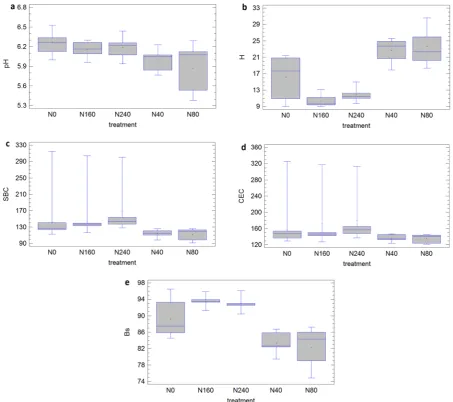
with different nutritional requirements and doses of N. During the barley farming system, the acidi-fication process was observed in comparison to the cultivation of maize, which led to a lower soil pH and an increase in Ha (Figs. 2 a, b). Corn is a crop that has higher demands for nutrients, and particularly N [Fecenko and Ložek 2000], and the
residues are alkaline in nature, which can increase the pH of the soil [Purakayastha et al. 2015]. As N fertilizer, we used ammonium nitrate which in-cluded both NH4+ and NO
3- forms. Acidification
or alkaline effects could also be linked with N intake from the soil into the plant. Barley prob-ably absorbs more NH4+ with a resulting acidity
Figure 1. Parameters of soil organic matter: a) soil organic carbon, b) humic substances, c) humic acids, d) fulvic acids, e) humic acids to fulvic acids ratio, f) colour quotient of humic substances,
effect whereas corn absorbs NO3- with a resulting
alkaline effect [Fecenko and Ložek 2000]. Re-sults show that if the hydrolytic acidity increased other sorptive parameters decreased with higher doses of N fertilization. On the other hand, if values of Ha decreased, the sum of basic cations (SBC), CEC and base saturation increased with higher doses of N fertilization (Figs. 2 c, d, e). As is mentioned above, after the application of N the soil pH was changed (Fig. 2 a), which effected electrolyte concentrations in the soil [Neff et al. 2002] with following refection in the soil sorp-tive parameters [Šimanský and Tobiašová 2010]. In our study, the decrease of soil pH resulted in decrease of base saturation in N treatments and this effect was more intensive with higher dos-es of N fertilization, which is consistent with the findings of Chodak et al. [2015].
Correlations between soil sorptive parameters and soil organic matter with dependence on N fertilization
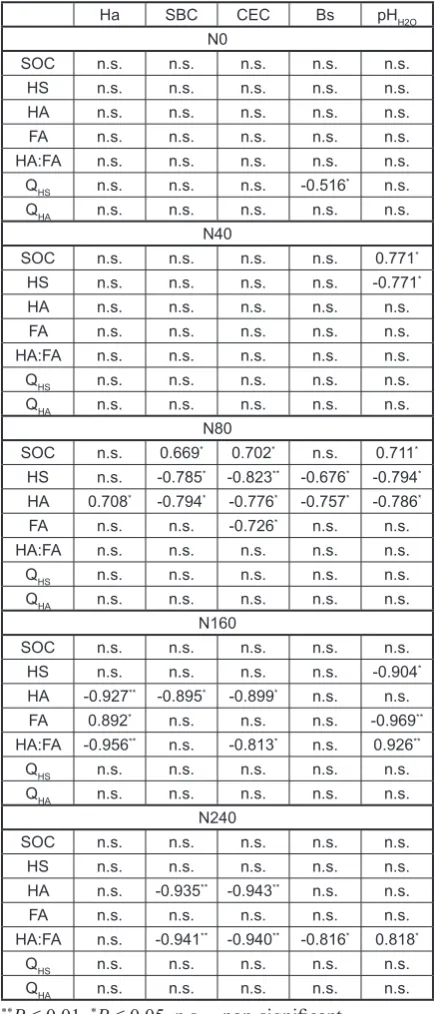
Positive statistically significant correlations were determined between soil pH and SOC in N40 and N80 treatments. In these treatments of N fertilization (N40, N80) and in addition in N160 treatment we found negative correlations between pH and HS. The increase of soil pH was connected with higher humus quality in N160 and N240. SOM performs a variety of functions and one of the most important is its sorption capacity [Stevenson 1994, Szombathová 2010]. Therefore, the correlations between soil organic matter and sorptive parameters of soil were calculated under different N fertilization. In control treatment no significant correlations were observed, except
QHS and Bs. Here it was noted that lower humus stability decreased base saturation. We also de-tected an important correlation between soil sorp-tive parameters and soil organic matter with de-pendence on N fertilization. A high negative cor-relation between HS and CEC (-0.823**) as well as with Bs (-0.676*) were determined in N80. At the same time we determined a positive correla-tion between SOC and SBC (0.669*) and CEC (0.702*) in N80. Negative correlations between HA and SBC and CEC were observed, however, the higher dose of N fertilization in N80, N160 and N240 treatments (N80 < N160 < N240) was connected with stronger correlation relationships (Table 1). As presented by Jagadamma et al. [2007] fertilization increases mineralization and this negatively affects the stability of organic sub-stances and overall quality of SOM [Šimanský and Tobiašová 2012] with effects on sorptive pa-rameters [Šimanský and Polláková 2014]. Higher values of fulvo acids corresponded with lesser CEC in N80 and N160 treatments. In N160, with increased humus quality (HA:FA ratio), CEC (r = -0.813*) significantly decreased. In N240 except the same result as in N160 between HA:FA and CEC (r = -0.940**), we observed also that with increased HA:FA ratio SBC (r = -0.941**) and Bs (r = -0.816*) significantly decreased.
CONCLUSION
Our results indicate that the higher doses of N fertilization 80 rather than 40 kg ha-1 as well as
240 rather than 160 kg ha-1 significantly decreased
humus stability. However, the humus quality was not significantly affected.The addition of N fer-tilization decreased average values of soil pH, but statistically significant effects were observed between N0 and N40 as well as between N0 and N80. In our study, the decrease of soil pH resulted in a decrease of base saturation in N treatments and this effect was more intensive with higher dose of N fertilization.
The intensity of fertilization affected changes in quantity and quality of SOM. Therefore, it is very important to pay attention to the quantity and quality of organic matter and sorptive param-eters mainly under intensive N fertilization. In the long-term, the application of only N fertilization is not appropriate. We recommend the application of other nutrients and the best way to do so is with a combination of mineral and organic fertilizers and in amounts which are adequate for the plants as well as for healthy soil life and fertility.
Acknowledgments
Authors thank very much Danny Angus (Bel-fast, Northern Ireland) for improving the English text and also the editor and reviewers, for con-structive comments.This study was supported by the Slovak Academy of Sciences and the Slovak Research and Development Agency under the contract APVV-15–0160 and Slovak Grant Agen-cy VEGA, No. 1/0704/16 and 1/0136/17.
Table 1. Correlations between SOM parameters and sorptive parameters with dependence on N fertilization
Ha SBC CEC Bs pHH2O N0
SOC n.s. n.s. n.s. n.s. n.s. HS n.s. n.s. n.s. n.s. n.s. HA n.s. n.s. n.s. n.s. n.s. FA n.s. n.s. n.s. n.s. n.s. HA:FA n.s. n.s. n.s. n.s. n.s. QHS n.s. n.s. n.s. -0.516* n.s. QHA n.s. n.s. n.s. n.s. n.s.
N40
SOC n.s. n.s. n.s. n.s. 0.771* HS n.s. n.s. n.s. n.s. -0.771* HA n.s. n.s. n.s. n.s. n.s. FA n.s. n.s. n.s. n.s. n.s. HA:FA n.s. n.s. n.s. n.s. n.s. QHS n.s. n.s. n.s. n.s. n.s. QHA n.s. n.s. n.s. n.s. n.s.
N80
SOC n.s. 0.669* 0.702* n.s. 0.711* HS n.s. -0.785* -0.823** -0.676* -0.794* HA 0.708* -0.794* -0.776* -0.757* -0.786* FA n.s. n.s. -0.726* n.s. n.s. HA:FA n.s. n.s. n.s. n.s. n.s. QHS n.s. n.s. n.s. n.s. n.s. QHA n.s. n.s. n.s. n.s. n.s.
N160
SOC n.s. n.s. n.s. n.s. n.s. HS n.s. n.s. n.s. n.s. -0.904* HA -0.927** -0.895* -0.899* n.s. n.s. FA 0.892* n.s. n.s. n.s. -0.969** HA:FA -0.956** n.s. -0.813* n.s. 0.926** QHS n.s. n.s. n.s. n.s. n.s. QHA n.s. n.s. n.s. n.s. n.s.
N240
SOC n.s. n.s. n.s. n.s. n.s. HS n.s. n.s. n.s. n.s. n.s. HA n.s. -0.935** -0.943** n.s. n.s. FA n.s. n.s. n.s. n.s. n.s. HA:FA n.s. -0.941** -0.940** -0.816* 0.818*
QHS n.s. n.s. n.s. n.s. n.s. QHA n.s. n.s. n.s. n.s. n.s.
REFERENCES
1. Chandel G., Banerjee S., See S., Meena R., Sharma D.J., Verulkar S.B. 2010. Effects of different nitro-gen fertilizer levels and native soil properties on rice grain Fe, Zn and protein contents. Rice Sci-ence, 17, 213–227.
2. Cheng S., He S., Fang H., Xia J., Tian J., Yu G., Geng J., Yu G. 2017. Contrasting effects of NH4+ and NO3- amendments on amount and chemical characteristics of different density organic matter fractions in a boreal forest soil. Geoderma, 293, 1–9. 3. Chodak M., Pietrzykowski M., Sroka K. Physi-ological profiles of microbial communities in mine soils afforested with different tree species. Ecolo-logical Enginiering, 81, 462–470.
4. Cusack, D.F., Silver,W.L., Torn, M.S., Burton, S.D., Firestone, M.K. 2011. Changes in microbial community characteristics and soil organicmat-ter with nitrogen additions in two tropical forests. Ecology, 92, 621–632.
5. Dziadowiec H., Gonet S.S. 1999. Methodical guide-book for soil organic matter studies. Polish Society of Soil Science, Warszawa (in Polish). 6. Fecenko J., Ložek O. 2000. Nutrition and
fertiliza-tion of field crops. Slovak University of Agricul-ture, Nitra (in Slovak).
7. Halvorson, A.D., Wienhold, B.J., Black, A.L. 2002. Tillage, nitrogen, and cropping system effects on soil carbon sequestration. Soil Science Society of American Journal, 66, 906–912.
8. Hanes J. 1999. Analyzes of sorptive characteris-tics. SSCRI, Bratislava (in Slovak).
9. Hati, K.M., Swarup, A., Singh, D., Misra, A.K., Ghosh, P.K. 2006. Long term continuous cropping, fertilisation, and manuring effects on physical properties and organic carbon content of a sandy loam soil. Aust. J. Soil Res., 44(5), 487–495. 10. Jagadamma S., Lal R., Hoeft R.G., Nafziger, E.D.,
Adee, E.A. 2007. Nitrogen fertilization and crop-ping systems effects on soil organic carbon and total nitrogen pools under chisel-plow tillage in Il-linois. Soil and Tillage Research, 95, 348–356. 11. Kaur T., Brar B.S., Dhillon N.S. 2008. Soil organic
matter dynamics as affected by long-term use of or-ganic and inoror-ganic fertilizers under maize-wheat cropping system. Nutrients Cycling of Agroeco-system, 81, 59–69.
12. Li Z.Q., Zhao B.Z., Wang Q.Y., Cao X.Y., Zhang J.B. 2015. Differences in chemical composition of soil organic carbon resulting from long-term fertil-ization strategies. PLoS One, 10(4), 1–14.
13. Li, Y., Zhang, J., Chang, S.X., Jiang, P., Zhou, G., Fu, S., Yan, E.,Wu, J., Lin, L. 2013. Long-term in-tensivemanagement effects on soil organic carbon
pools and chemical composition in Moso bamboo (Phyllostachys pubescens) forests in subtropi-cal China. Forest Ecology and Management, 303, 121–130.
14. Luo, Z.,Wang, E., Smith, C. 2015. Fresh carbon input differentially impacts soil carbon decomposi-tion across natural and managed systems. Ecology, 96, 2806–2813.
15. Munkholm L.J., Schjonning P., Debosz K., Jensen H.E., Christensen B.T. 2002. Aggregate strength and mechanical behaviour of a sandy loam soil under long-term fertilization treatments. European Journal of Soil Science, 53, 129–137.
16. Neff J.C., Townsend A.R., Gleixner G., Lehman S.J., Turnbull J., Bowman W.D. 2002. Variable ef-fects of nitrogen additions on the stability and turn-over of soil carbon. Nature, 419, 915–917. 17. Pelster D.E., Larouche F., Rochette P., Chantigny
M.H., Allaire S., Angers D.A. 2011. Nitrogen fer-tilization but not soil tillage affects nitrous oxide emissions from a clay loam soil under a maize–soy-bean rotation. Soil and Tillage Research, 115–116, 16–26.
18. Purakayastha T.J., Kumari S., Pathak H. 2015. Characterisation, stability, and microbial effects of four biochars produced from crop residues. Geo-derma, 239–240, 293–303.
19. Sainju, U.M., Jabro, J.D., Stevens,W.B. 2008. Soil carbon dioxide emission and carbon content as af-fected by irrigation, tillage, cropping system, and nitrogen fertilization. Journal of Environmental Quality, 37, 98–106.
20. Schmidt, M.W., Torn, M.S., Abiven, S., Dittmar, T., Guggenberger, G., Janssens, I.A., Kleber, M., Kögel-Knabner, I., Lehmann, J., Manning, D.A. 2011. Persistence of soil organic matter as an eco-system property. Nature, 478, 49–56.
21. Shisanya C.A., Mucheru M.W., Mugendi D.N., Kungu J.B. 2009. Effect of organic and inorganic nutrient sources on soil mineral nitrogen and maize yields in central highlands of Kenya. Soil and Till-age Research, 103, 239–246.
22. Šimanský V. 2015. Fertilization and carbon se-questration. Acta fytotechnica et zootechnica, 18(3), 56–62.
23. Šimanský V., Polláková N. 2014. Soil organic matter and sorption capacity under different soil management practices in a productive vineyard. Archives of Agronomy and Soil Science, 60(8), 1145–1154.
and chemical properties in Haplic Luvisol as af-fected by tillage and fertilizers intensity. Acta fyto-technica et zoofyto-technica, 15(2), 52–56.
26. Stevenson J.F. 1994. Humus chemistry. John Wiley & Sons, New York.
27. Subbian P., Lal R., Akala V. 2000. Long-term ef-fects of cropping systems and fertilizers on soil physical properties. Journal of Sustainable Agri-culture, 16, 89–100.
28. Szombathová N. 2010. Chemical and physico-chemical properties of soil humus substances as an indicator of anthropogenic changes in ecosystems (Báb a Dolná Malanta localities). Slovak Univer-sity of Agriculture, Nitra (in Slovak).
29. Triberti L., Nastri A., Giordani G., Comellini F., Bal-doni G., Toderi, G. 2008. Can mineral and organic fertilization help sequestrate carbon dioxide in crop-land? European Journal of Agronomy, 29, 13–20. 30. World Reference Base for Soil Resources. 2006.
World Soil Resource Report No. 84. Food and Ag-riculture Organisation of the United Nations, Rome. 31. Zalba P., Quiroga A.R. 1999. Fulvic acid carbon
as a diagnostic feature for agricultural soil evalua-tion. Soil Science, 164, 57–61.