Multicriteria Model of Preventive
Maintenance
Cristiano Alexandre Virgínio Cavalcante
Universidade Federal de Pernambuco (UFPE), Recife, PE, Brazil E-mail: [email protected]
Ana Paula Cabral Seixas Costa
Universidade Federal de Pernambuco (UFPE), Recife, PE, Brazil E-mail: [email protected]
Abstract
It is extremely important to guarantee that the performance levels required by productive systems can be maintained. As well, it is essential to assure the quality of process outputs. For this reason, preventative maintenance has become a very useful instrument to gain a competitive edge. In maintenance decisions, there are some contradictory criteria or points of view that are vital and must to be looked at simultaneously. Optimization approaches are not so useful in this situation, since usually no decision or solution exists which is the best from all points of view at the same time. So, in this context, the multicriteria decision aid (MCDA) approach is very important, allowing not only for the trade-off of multiple factors, but also taking in account the preference structure of the decision-maker with respect to these contradictory criteria. To address this issue, this article proposes a multicriteria decision aid model to support the decision-maker in the choice of times for preventative maintenance. The model preserves some important concepts from the classic models of component replacement and improves an existing multicriteria model, by taking criterion downtime into consideration, making a more appropriate treatment possible than the previous model for situations in cases where repair time cannot be ignored.
Keywords: multicriteria decision, preventive maintenance, maintenance policies
Introduction
maintenance planning by allowing for the consideration of different and important criteria related to the characteristics of the operational performance of equipment parts, and also treats existing conflicts among criteria, taking into account the preferences of the decision-maker.
Changes in familiar contexts and dominant scenarios require the observation of more than one criterion. With respect to productive systems, a growing importance of service production system can be seen. Thus, many of the most predominant objectives function have become standards of judging or criteria (Belton and Stewart, 2003). The constraints involved thus become important criteria in the decision-making process.
This paper deals with the construction of a multicriteria model for aiding the decision for component replacement time. The model not only enables the decision-maker to consider a number of possible maintenance actions, thus allowing for a more complete evaluation in the light of several criteria, but also self adjusts to the operational characteristics of the equipment part. The model is a mathematical representation of reality, formulated to capture the crux of the decision-making problem. The multicriteria decision aid model proposed here is a realistic representation of a problem in component replacement, where planning had to take into account a number of important aspects in order to support a program of preventative maintenance.
Using Dekker’s (1996) classification, the maintenance policies discussed here belong to the area of prevention policy, since the actions are planned in advance. In the proposed model, equipment is subject to stochastic failure and the state of the equipment is always known with certainty. The equipment shows an increasing failure rate and it is more expensive to replace equipment that has failed than to replace it before this happens. The problem then is how to draw up a plan for replacement before the failure occurs (Glasser, 1969; Barlow and Proschan, 1965).
This paper is concerned with the application of the model. This concern has already been the subject of research in this area, particularly because of the gap between the need to find a solution to maintenance problems and the results presented by new models. There has always been a trade-off between the complexity of the models and the practicality of the solutions they suggest (McCall, 1965; Jorgenson and McCall, 1963).
The Present Proposal for a Decision Model
might have catastrophic consequences beyond mere financial considerations. The costs of the actual failure may be difficult to calculate and may not represent the real loss arising from the prolongation of the undesirable situation where the inclusion of downtime would aid in determining a more realistic view. The model deals with conflicts among the criteria involved, making it possible to respond to the preferences of the decision-maker, resulting in a complete preorder of the time alternatives, using the PROMETHEE II method.
Furthermore, the model under discussion is suitable for occasions where there is a record of previous failures, since its essential assumption, distinguishing it from the previous model, is that the lifetime distribution of failure is known. As a result it is very important an early process of data analysis.
The Data Analysis Process
An analysis of the failure data regards failure in a generic sense, going beyond the restricted meaning of incapacity to perform a function, which is usually employed in the context of component failure. This meaning of failure may be applied to anything from the death of living beings to machine breakdown (Elandt-Johnson and Johnson, 1980).
In the process of analyzing data failure, the principal concern is with the association of the failure to the most important variables, such as run-time before the failure occurred, or age at failure. This means that the basic variable representing survival or failure will have only two values (binary), denominated the state variables (Nelson, 1982; Kalbfleisch and Prentice, 1980).
The main goal of reliability theory is to provide a numerical representation of the characteristics of reliability. In spite of its complex methods and the development of its stochastic analysis based on these methods, there must be data input which can provide numerical results (H∅yland and Rausand, 1994).
As a result, the starting point for reaching a theoretical result is information about the distribution of lifetimes. This information may be available in a number of forms, from very general to very specific hypotheses (Gertsbakh, 1989).
This present article is based on the assumption that the function which describes lifetime behavior is known and accepted in advance, so that only the parameters need to be ascertained. As usual, we have used the Weibull distribution, because of its characteristics of easily adapting to the data and its direct relation with the physical state of the equipment (Gertsbakh, 1989).
The PROMETHEE II Method
Compromise solutions have to be considered. The PROMETHEE Methods are known as some of the most efficient and also some of the easiest to use in the multicriteria decision aid field. They begin with a decision matrix of evaluations of alternatives with respect to an appropriate set of criteria (see Table 1):
Where A is the countable set of n potential actions and fj(.), j = 1, 2,..., k, is the set of evaluation criteria. In this paper the criteria are cost, reliability and downtime. The set of alternatives A is the set of feasible times for component replacement.
The preference structure of the PROMETHEE methods is based on pairwise comparisons. In this case the deviation between the evaluations of two alternatives of a particular criterion is considered. For each criterion a specific preference function Pj () must be defined. This function is used to compute the intensity of preference associated with the deviation or difference dj() between the evaluations in criterion fj() for a pair of alternatives. The greater the deviation, the greater the preference. Thus, the frame of preference is based on these differences and not on the absolute values of the evaluation of alternatives for each criteria (Brans and Mareschal, 2002).
(1)
Pj(a,b)=Pj [dj(a,b)] (2)
Where:
The preference function plays important rule in the calculation of the π(a,b) that is analogous to the credibility index defined in ELECTRE III (Belton and Stewart, 2003).
The index π(a, b) is a measure of preference of a on b taking into account all criteria. This measure supports the hypothesis that a is preferable to b through the following relation:
(3)
Similarly, π(b, a) indicates how much b is preferred to a. In most of the cases there are some criteria in favor of b and others in favor of a. Thus, both π(b, a) and π(a, b) are usually positive.
Table 1 - Matrix of evaluations of alternatives.
f1 f2 fk
a1 f1(a1) f2(a1) fk(a1)
a2 f1 (a2) f2(a2) fk(a2)
: : : :
ai f1(ai) f2(ai) fk(ai)
: : : :
As soon as π(b, a) and π(a, b) are computed for each pair of alternatives of A, a set of complete valued outranking measures can be derived, named outranking flows.
PROMETHEE methods calculate positive and negative outranking flows for each alternative. The positive outranking flow expresses by how much an alternative outranks the others; and the negative outranking flow expresses by how much it is outranked by the others.
(4)
where φ+ is the positive outranking flow.
(5)
where φ- is the negative outranking flow.
Based on the net outranking flow, corresponding to the difference between both positive and negative outranking flows, the PROMETHEE II provides a complete ranking, where a is preferable to b if φ(a)>φ(b), and they are indifferent if φ(a) = φ(b).
φ(a) = φ+(a) – φ –(a) (6)
where φ is the net outranking flow.
Below is a short description of the criteria involved in the proposed model.
The Criterion of Expected Cost Per Unit of Time
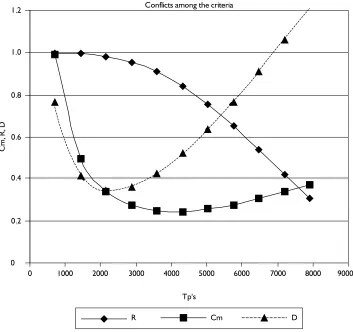
When measuring time between preventative maintenance actions, the usual criterion in decision making is the expected cost per unit of time, also called the rate of expected cost, represented by Cm. It is often used in replacement models, where it corresponds to the objective function that must be optimized (Glasser, 1969; Makis and Jardine, 1992; Percy and Kobbacy, 2000). In the present model, it is one of the criteria that can be seen in the decision of time alternatives (tp). In practice, the criterion describes the expected cost at the end of a long period of time where a replacement policy has already been applied. Actually there are two costs which must be considered: that of replacement before a failure; and the cost of replacement after a failure has occurred. These are represented by Cb and Ca, respectively.
The Criterion of Reliability R(TP)
Reliability behaves with a decreasing monotonic function, that is, the longer the time between replacements, the greater the likelihood that equipment will fail. Because of these monotonic characteristics, this criterion is not usually employed as an objective function when determining replacement policies. On the other hand, it may be used as a restriction in some cases, as has been reported in the literature (Scarf, et al. 2005; Inagaki et al., 1978). But, there are indications that decision-makers prefer to control and to judge this aspect, instead of have a unique value of reference. So the reliability must be inserted in the decision problem as a criterion of choice.
The Criterion of Downtime D(TP)
Machine downtime is obviously related to the time when a component is not functioning because it has failed. In many cases, this criterion is significant, particularly where the continuity of a production process is vital, for example in systems of mass production and energy supply where repair times takes long enough to be considered seriously. Similar to the criterion of cost, downtime has a explicit optimum, which illustrates a paradox because by trying to reduce downtime, many small stops in operation must be made.
Like the criterion of unitary cost, downtime cost is also included as a criterion to determine the best action, having a role of the objective function (Jardine, 1973).
When Conflicts Arise Among the Criteria of Cost, Reliability and Downtime
Above, different behaviors for the criteria of cost, reliability, and downtime have been identified. In practice, for preventive maintenance, it is desirable that the cost should be as low as possible. On the other hand, the better the reliability value, the worse the value of downtime, in the sense that in order to get a high reliability value, it is necessary to make a lot of interruptions. So downtime should be minimized. Taking all this into consideration, within the perspective of optimization, three different kinds of problems might be formulated, where one of the criteria is set as the objective function and the others as restrictions.
Minimize Cm(tp) (7)
Maximize R(tp) (8)
Minimize D(tp) (9)
Hypotheses of the Decision Model
The model is based on the following hypotheses: 1. The state of the system is known;
2. The group of alternatives is limited;
3. The equipment and its components are subject to wear, that is the longer it is used, the more likely it is to fail;
4. There are only two states of the component: working or not working;
5. Replacement of the component before failure is more economical than waiting for it to break down;
6. Replacement implies that the new component will function as well as the previous one;
7. Repair means that the component will be as good as new;
8. There is a known probability distribution for component failure time; and Conflicts among the criteria
0 0.2 0.4 0.6 0.8 1.0 1.2
0 1000 2000 3000 4000 5000 6000 7000 8000 9000
Tp's
C
m
, R
, D
R Cm D
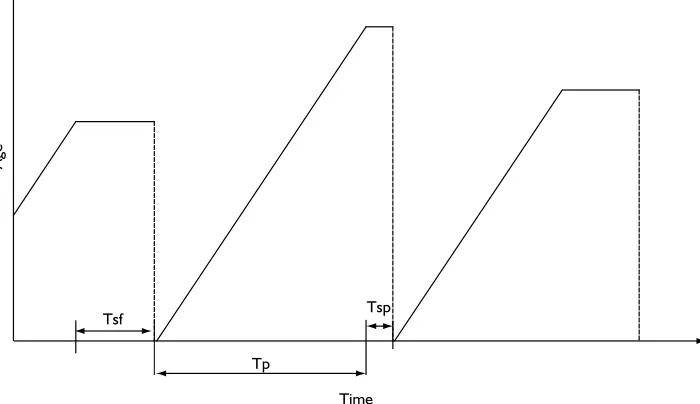
9. Repair time (Tsf) and replacement time (Tsp) are important enough to be included in the model. As they have little variation, they are treated as a constant.
Figure 2 shows some of the above hypotheses. Note that the age of the component is updated with each replacement. Note also that the replacements are not immediate.
Structuring Multiple-criteria Decision Aiding Model
The application of the model follows a well-defined sequence. At first, a group of alternatives is drawn up, seeking to identify those times when replacement might be made. These alternatives are evaluated with respect to the criteria of cost, reliability and downtime. Following this, to make the decision, the steps of the PROMETHEE II method are invoked, which will be discussed below, together with the next stages.
Determination of Alternative Actions
Selection of the model replacement alternatives is a relatively simple procedure. As proposed by Dekker (1996) replacement times must be chosen when the shut-down of the equipment will not upset production, for example during empty shifts or on unproductive days. The point is that this shutdown cannot always be programmed for convenient times.
Evaluation of the Alternatives in the Different Criteria
The criteria, which have been discussed above, may be represented analytically as follows. The cost per unit of time:
Tp
Tsp
Age
Time Tsf
(10)
where:
ca is the cost of a replacement due to a failure; cb is the cost of a preventive replacement; t is the time between replacements; R is the reliability for the time t;
tsp is the time it takes to make a preventive replacement;
tsf is the time it takes to make a replacement or repair due to a failure; and f(x) is the probability density function for time to failure.
Reliability is represented by:
(11)
where:
β is the shape parameter of the Weibull distribution; and η it is the scale parameter of the Weibull distribution. The downtime is represented by:
D tspR tsf R
xf x dx tsf R tsp t R
t
= +
-+ - + +
Ú
( )
( ) ( ) ( )
1 1 0
(12)
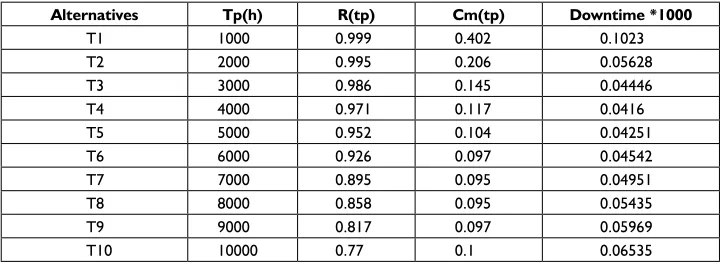
The alternatives are evaluated using all criteria. These evaluations are presented on a matrix (Table 2) which gives rise to what is called the criteria performance matrix, fij , corresponding to evaluation i using criteria j.
In general, the information on Table 2 does not lead to a ranking of the A alternatives, and none of the alternatives is best for all the criteria at the same time, owing to the conflicts that exist among the criteria. In this case, it is appropriate to use the multicriteria decision approach (Brans and Mareschal, 2002).
Table 2 - Evaluation of alternatives.
R Cm D
A1 R(a1) Cm(a1) D(a1)
A2 R(a2) Cm(a2) D(a2)
: : : :
Ai R(ai) Cm(ai) D(ai)
: : : :
Aggregation of the Criteria
The PROMETHEE method has been considered appropriate for the construction of maintenance policies, even though it does not represent a theory. It is, however, supported by a mathematical framework that gives it a strong structure. Easy to understand, the PROMOTHEE method enables comparisons between pairs of alternatives, rather than using absolute values, and establishes preferential relationships between the alternatives on the basis of an evaluation of their differences.
The aggregation process finishes by exploring the outranking relationships, as is usual in all outranking methods. The goal of this exploratory phase is to provide information to the decision-maker with respect to the relationships constructed, the goals and restrictions of the decision-maker, and the characteristics of the problem. Taking these into consideration, the PROMETHEE method is defined and applied, resulting in either a complete preorder of the alternatives, a partial preorder, or a sophistication of one or the other (Cavalcante and Almeida, 2005).
The present model uses the PROMOTHEE II method to draw up a complete preorder of the time alternatives for periodic component replacement.
Application of the Decision Model
Let us consider the failure behavior for a particular component used in civil aviation. The item under consideration is an air recycler, responsible for maintaining permissible operative air levels. Failure of this piece of equipment, besides representing loss of the item, results in downtime for the airplane as it cannot meet the required standards of air quality in the airplane cabin environment.
Owing to the characteristics of this particular component, a replacement policy based on age was deemed appropriate. So the age when the equipment ought to be replaced becomes the only decision variable. To apply this policy, the failure times and cost of replacement (Cb) and repair (Ca) have to be estimated. To choose the age at which the replacement should be made, the three criteria discussed above, reliability, cost per unit of time, and downtime must be taken into consideration.
Table 3 presents the input needed in the model. This input constitutes the parameters of failure times of the component, as well as the costs Ca and Cb.
Following the steps of the decision model, once the component has been identified, the alternatives of the problem which correspond to the time values which are best for the replacement must be drawn up.
where the alternatives can be considered in the light of all the criteria and according to the preferences of the decision-maker.
Following the steps set out by the PROMETHEE method, once the evaluation of alter-natives has been carried out, through an interactive process between the decision-maker and the decision-analyst, the preference function (Pj (.)) can be determined. This is the one that models most closely the behavior of the decision-maker given the differences (dj (.)) among the evaluations of each criterion ((fj (.)). Table 6 illustrates the preference functions and their respective parameters.
Having done this, obtaining the preferential intensities between each pair of actions in the light of each separate criterion, a degree of outranking, ∏(a,b), can be established,
Table 3 - Input data.
Weibull β 3.6
η 17500
Costs Replace cost Cb 400
Failure cost Ca 3000
Times Preventive time to replace tsp 0.10 hour
Time to replace due to a failure or time to repair tsf 2.5 hours
Table 4 - Possible replacement time alternatives.
Alternatives Time in flight hours
T1 1000
T2 2000
T3 3000
T4 4000
T5 5000
T6 6000
T7 7000
T8 8000
T9 9000
T10 10000
Table 5 - Evaluation matrix of the decision problem.
Alternatives Tp(h) R(tp) Cm(tp) Downtime *1000
T1 1000 0.999 0.402 0.1023
T2 2000 0.995 0.206 0.05628
T3 3000 0.986 0.145 0.04446
T4 4000 0.971 0.117 0.0416
T5 5000 0.952 0.104 0.04251
T6 6000 0.926 0.097 0.04542
T7 7000 0.895 0.095 0.04951
T8 8000 0.858 0.095 0.05435
T9 9000 0.817 0.097 0.05969
representing the degree of preference for a over b, for all the criteria. Following the sequences of steps of the PROMETHEE method, the next thing to do is to calculate the positive outranking flow and negative outranking flow for each alternative, allowing for the establishment of the outranking relationships, as can be seen in Table 7. When this done, then the PROMETHEE II method is applied, using the net outranking flow, that is the difference between the positive and negative flows for each alternative, to establish a complete pre-order of the evaluated alternatives, which constitutes the decreasing order of the net outranking flows. The result of this application of the multicriteria decision aiding model is a complete pre-order of the alternatives, as can be seen in Figure 3.
In Figure 4, the best alternative can be seen, that is, the one that is in the first place in the complete pre-order, alternative T7, corresponding to component replacement after every 7000 hours of flight.
Table 6 - Preference functions and characteristics of criteria.
Characteristics R Cm D
Max/min Max Min Min
Weight 0.24 0.5074 0.2526
Preference functions Kind 5 Kind1 Kind2
Indifference threshold 0.001 - 0.005
Preference threshold 0.01 -
-Table 7 - Ranking of the alternatives.
Alternatives Tp(h) φ+ φ− φ
T1 1000 0.2222 0.76 -0.5378
T2 2000 0.3229 0.6003 -0.2774
T3 3000 0.4678 0.445 0.0228
T4 4000 0.4975 0.4183 0.0792
T5 5000 0.5272 0.3886 0.1386
T6 6000 0.5853 0.2461 0.3392
T7 7000 0.6433 0.2442 0.3991
T8 8000 0.5886 0.2989 0.2897
T9 9000 0.4211 0.4945 -0.0734
T10 10000 0.31 0.69 -0.38
T7 T6 T8 T5 T4 T3 T9 T2 T10 T1
Sensibility Analysis
Once the results of the previous stage have been obtained, adjustments to the parameters of the model can be made. The behavior of the model was considered to be robust as there was no alteration of the results even when the variation interval was considerable.
Variations assigned to the weights of the criteria showed that the best alternative remained T7, with respect to these weight intervals: cost weight (43.06 to 55.68), reliability weight (14.47 to 38.04) and downtime weight (19.26 to 34.14). Thus even if the decision-maker hesitated over the importance of each criterion; there would still be a permissible (more than 9.7% above or below) variation in the weights without alternation in the result.
Even when there was a considerable parameter variation (more than 20%) in the decision-maker’s preferences, p and q, for the reliability criterion, and q for the criterion of downtime, there was no difference in the initial result.
Conclusions
All over the world, maintenance costs represent one of the largest portions of the costs of productive systems, besides the fact that most of this sum is used for emergency actions. Thus, the establishment of policies for preventive maintenance is recognized as a means of reducing costs and improving the performance of equipment. Through a multicriteria
-0,6 -0,4 -0,2 0 0,2 0,4
Net outranking flow
T1 T2 T3 T4 T5 T6 T7 T8 T9 T10
Tp Alternatives scores
decision aid approach as proposed in this article, the decision-maker is given a means of support for the choice of times for preventative maintenance, in order to control failures, taking in account not only the cost, but reliability and downtime as well. This model is an improvement over the previous one proposed by Cavalcante and Almeida (2005), since it allows for the time of repair as a value different from zero, which means that the repair could take a considerable time and should not be underestimated. These considerations embrace a number of real situations, making a more realistic treatment possible than in the previous model for situations where repair time cannot be ignored and time wasted in downtime is very difficult to translate in monetary values.
Acknowledgments
This work was partially supported by CNPq.
References
Almeida, A. T. de (2005), Modelagem Multicritério para Seleção de Intervalos de Manutenção Preventiva Baseada na Teoria da Utilidade Multiatributo. Pesquisa Operacional, Vol. 25, No. 1, pp. 69-81.
Barlow, R. E.; Proschan, F. (1965), Mathematical Theory of Reliability. New York: John Wiley & Sons.
Belton, V.; Stewart, T. J. (2003), Multiple Criteria Decision Analysis: an Integrated Approach. Massachusetts: Kluwer Academic Publishers.
Brans, J. P.; Mareschal, B. (2002), Promethee-Gaia, une Methodologie d´Aide à la Décision em Présence de Critères Multiples. Bruxelles, Éditions Ellipses.
Cavalcante, C. A. V.; Almeida, A. T. (2005), Modelo Multicritério de Apoio a Decisão para o Planejamento de Manutenção Preventiva Utilizando PROMETHEE II em Situações de Incerteza. Pesquisa Operacional, Vol. 25, No. 2, pp. 279-296.
Chareonsuk, C.; Nagarura, N.; Tabucanona, M. T. (1997), A multicriteria approach to the selection of preventive maintenance intervals. International Journal of Production Economics, Vol. 49, No. 1, pp. 55-64.
Climaco, N. C.; Antunes, C. H.; Alves, M. J. G. (2003) Programação Linear Multiobjetivo: Do Modelo de Programação Linear Clássico à Consideração Explícita de Várias Funções Objetivo, Imprensa da Universidade de Coimbra.
Dekker, R. (1996), Application of Maintenance optimization models: review and analysis Reliability Engineering and System Safety. Vol. 51, No. 3, pp. 229-240.
Elandt-Johnson, R. C.; Johnson, N. L. (1980), Survival models and data analysis, New York: Chichester: John Wiley.
Gertsbakh, I. B. (1989), Statistical Reliability Theory. New York: Marcel Dekker.
Glasser, G. J. (1969), Planned Replacement: Some Theory and its Application. Journal of Quality Technology, Vol. 1, No. 2, pp. 110-119.
H∅yland, A.; Rausand M. (1994), System Reliability Theory – Models and Statistical Methods. New Jersey, John Wiley & Sons.
Inagaki, T.; Inoue, K.; Akashi, H. (1978), Optimal Reliability Allocation Under Preventive Maintenance Schedule. IEEE Transaction on reliability, Vol. 27, No. 1, pp. 39-40. Jardine, A. K. S. (1973), Maintenance, Replacement and Reliability. New York: John Wiley. Jorgenson, D. W.; McCall, J. J. (1963), Optimal Replacement Policies for a Ballistic Missile.
Management Science, Vol. 9, No. 3, pp. 358-379.
Kalbfleisch, J. D.; Prentice, R. L. (1980), The statistical analysis of failure time data. Chichester, NY: John Wiley & Sons).
Kralj, B.; Petrovic, R. A. (1995), Multiobjective Optimization Approach To Thermal Generating Units Maintenance Scheduling. European Journal of Operational Research. Vol. 84, No. 2, pp. 481-493.
Le Téno, J. F.; Mareschal, B. (1998), An interval version of PROMETHEE for the comparison of building products design with ill-defined data on environmental quality. European Journal of Operational Research, Vol. 109, No. 2, pp. 522-529.
Lotfi, V. (1995), Implementing Flexible Automation: A Multiple Criteria Decision Making Approach. International Journal of Production Economics, Vol. 38, No. 2-3, pp. 255-268.
Makis, V.; Jardine, A. K. S. (1992), Optimal Replacement in the Proportional Hazards Model. INFOR, Vol. 30, No. 2, pp. 172.
McCall, J. J. (1965), Maintenance Policies for Stochastically Falling Equipment: a Survey. Management Science, Vol. 11, No. 5, pp. 493-624.
Nelson, W. (1982), Applied Life Data Analysis. New Jersey: John Wiley & Sons.
Percy, D. F.; Kobbacy, K. A. H. (2000), Determining Economical Maintenance Intervals”. International Journal of Production Economics, Vol. 67, No. 1, pp. 87-94.
Radojevic, D.; Petrovic, S. (1997), A Fuzzy Approach to Preference Structure in Multicriteria Ranking. International Transactions in Operational Research, Vol. 4, No. 5-6, pp. 419-430.
Scarf, P. A.; Dwight, R.; Al-Musrati, A. (2005), “On reliability criteria and the implied cost of failure for a maintained component”, Reliability Engineering and System Safety, Vol. 89, pp. 199–207.
Vincke, P. (1992), Multicriteria decision-aid. Bruxelles: John Wiley & Sons.
Biography
Cristiano Alexandre Virgínio Cavalcante received his B.Sc. degree in mechanical engineering from the Universidade Federal de Pernambuco (UFPE), Recife, Brazil and MSc and Ph.D. degrees in production engineering from the same (UFPE), Brazil. Currently, he is a lecturer in the Department of Production Engineering at (UFPE) and member of the Research group on Information and Decision Systems (GPSID). His research interests include optimal maintenance, maintenance policies, multicriteria decision aid.