The International Journal of Digital Curation
Volume 8, Issue 1 | 2013Towards Standardization: A Participatory Framework for
Scientific Standard-Making
Lynn Yarmey,
National Snow and Ice Data Center, University of Colorado at Boulder
Karen S. Baker,
Graduate School of Library and Information Science, University of Illinois at Urbana-Champaign
Abstract
In contemporary scientific research, standard-making and standardization are key processes for the sharing and reuse of data. The goals of this paper are twofold: 1) to stress that collaboration is crucial to standard-making, and 2) to urge recognition of metadata standardization as part of the scientific process. To achieve these goals, a participatory framework for developing and implementing scientific metadata standards is presented. We highlight the need for ongoing, open dialogue within and among research communities at multiple levels. Using the Long Term Ecological Research network adoption of the Ecological Metadata Language as a case example in the natural sciences, we illustrate how a participatory framework addresses the need for active coordination of the evolution of scientific metadata standards. The participatory framework is contrasted with a hierarchical framework to underscore how the development of scientific standards is a dynamic and continuing process. The roles played by ‘best practices’ and ‘working standards’ are identified in relation to the process of standardization.
Introduction
Expectations for the sharing and reuse of scientific data are increasing, as evidenced by current attention to data access technologies, funding agency data policies and data management education. Though data in the natural sciences are heterogeneous and difficult to standardize (e.g. Madin et al., 2008; Reichman et al., 2011; Mayernik, 2011; Willis et al., 2012), data sharing and reuse depend in part on metadata
standardization through the development and enactment of metadata standards. The development of scientific metadata standards is sometimes mistakenly perceived as a well-defined, one-time undertaking. While efficiencies-of-scale drive the process for developing standards in economic arenas, such frameworks do not adequately characterize the process of developing metadata standards for scientific data.
To open up discussion, we introduce a participatory framework for the development of science metadata standards grounded by respect for complexities-of-scale. A framework that is explicitly participatory:
1. Opens up standards development efforts to ensure broader representation from science communities,
2. Formalizes collaboration as a necessary component of standardizing scientific data descriptions, and
3. Anticipates management of a trajectory of change throughout the process.
We argue for envisioning standard-making as an evolving, continuing design process, as opposed to a set of defined steps leading to a solution in the form of an enduring standard. The term ‘framework’ is used instead of ‘standards lifecycle’ in order to emphasize the complexity and relationships within broader, longer-term standardization efforts. Our aim is to foster dialogue and increase awareness of processes as central to developing useful and usable scientific standards.
The perspective of the authors is that of practicing information managers in the natural sciences. Years of experience with researchers, science networks and data centers have shown how conceptual development and inclusive, collaborative efforts are essential to standardization in the sciences.
Background
Standards are mechanisms of coordination that facilitate the exchange and
comparability of information and products in the global community. Mature standards that are broadly accepted and implemented become authoritative resources for
Standards were developed early on as physical specifications required in
engineering and economic arenas – weights, measures and strengths (Thompson & Taylor, 2008). In the current era of global interconnectivity, standards are needed for the exchange and coordination of digital information, as well as material goods. deVries (2005) assembled a diverse set of definitions that reveal the multiple roles for standards as the need for standards beyond industry arenas was recognized (Rumble et al., 2005). The European Information and Communications Technologies Standards Board (ICTSB) defines a standard as a formal document within an existing context:
“[A] document, established by consensus and approved by a recognized body, that provides, for common … use, rules, guidelines or characteristics for activities or their results, aimed at the achievement of the optimum degree of order in a given context.”1
Hierarchical Framework for Development of Standards
Commercial and engineering standards play a significant role in successes and failures of systems and infrastructures (e.g. Edwards, 2003; Edwards et al., 2007; Star & Ruhleder, 1996). Schmidt and Werle (1998) report:
“The availability of standards not only helps firms to achieve economies of scale; it also facilitates the building of
comprehensive, integrated technical systems.”
The goal of commercial development is to create a final, fully-functional product quickly. Participants in this standard-creation process include large national or
international bodies with economic and political perspectives. As in the case of typing keyboards (Lewin, 2002; David, 2007) and mobile communications standards
(Akhtar, 2005; Fomin, 1999), the process frequently involves selection of one approach from existing options.
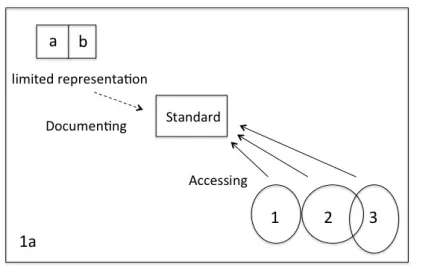
Figure 1. Hierarchical framework for developing standards where boxes a and b represent participants developing the standard and the circles represent organizational units.
1 The Information and Communication Technologies Standards Board:
In a stylized presentation, Figure 1 presents a hierarchical framework for
development of a standard using a stepwise ‘top-down’ approach. The upper boxes (labelled ‘a’ and ‘b’) signify exclusive agents who undertake creation of a standard through bounded, short-term discussions driven by efficiencies-of-scale. In this case, the process of creating standards is about reducing differences through elimination or selecting from alternatives, and/or through consolidation by generalizing details. The process is influenced by political considerations, limited time and desire to maximize return on investment. Once a standard has been finalized, the development process is complete, the standard is published and support for discussion ends. Individuals and groups (denoted 1, 2, 3) have access to the standard.
Metadata Standards in a Scientific Context
Shifting to a research context in the natural sciences, we find an arena of extreme complexity. To study the nonlinearities and interdependencies of interacting, living systems, scientific research incorporates rapidly changing observational methods that contribute to knowledge generation. The research process requires an adaptable infrastructure for the organization of scientific data described by metadata (Greenberg et al., 2009; Greenberg, 2010). The National Academy of Science defines metadata standards as descriptions of:
“...the content, context, and structure of information objects, including research data, at any level of aggregation (for example, a single data item, many items, or an entire database).” (NAS, 2009).
In considering processes of collaboration and development for science metadata standards, we expand from technical factors and end products to socio-organizational factors and design.
The development of science metadata standards involves many different socio-organizational units, defined here as individuals or groups with their own situated culture, practices, resources and needs. Examples of socio-organizational units include a researcher’s lab, a field project, a data center, a government agency, a field station, or a research community. Bringing these units together despite their differences is challenging, though there are a number of approaches that can help.
Design is an integrative activity able to address complex issues as well as a
multiplicity of organizational arrangements and political agencies (Green, 1996; Berg, 1998; Millerand et al., 2013). Participatory design highlights local engagement and expands to the long-term in continuing design (Schuler & Namioka, 1993; Dittrich et al., 2002; Karasti et al., 2010). Whelton and Ballard (2002) identify three design activity models that provide a context for learning: rational problem-solving, social process, and an experiential process. Efforts in the field of information systems design have explored a variety of approaches to support individual learning and group
many socio-organizational levels, the dynamic interplay of social, political and learning processes in the natural sciences is acknowledged and accommodated.
Heterogeneous data result from the many technologies, domains, and diverse sampling and processing methods used to study complex natural systems. Differences encountered in science are not necessarily seen as non-conformity or a failure to unify (Cragin et al., 2010; Star, 1991; Gasser, 1986). Instead, heterogeneity is appreciated as that which informs scientists about systems at a variety of scales, though data reuse, automation and even discovery are made extremely difficult by non-standard data and metadata. Complexities-of-scale define the scientific context, though
economies-of-scale, such as automated data processing and integration, are recognized as goals. Heterogeneous data and anomalies are features of the scientific process that require social and cultural as well as technical adaptation in standard-making efforts. Scientific metadata standards help document and mitigate heterogeneity. However, an existing multitude of standards has not been sufficient to achieve the promise of scientific data integration and reuse.
Metadata Standards in Practice
Metadata development initiatives have been underway for some time in national and international arenas. The Text Encoding Initiative (TEI) for marking up humanities documents was established in 1987, Dublin Core Metadata Initiative for cataloguing web-based resources started in 1995, and Darwin Core for documenting specimen data emerged around 1999. The Data Documentation Initiative (DDI) was funded in 1997 for describing social, behavioural and economic science metadata. Within the
observational sciences, the Federal Geographic Data Committee (FGDC) was established in 1993 and created a Content Standard for Digital Geospatial Metadata (CSDGM) for describing geospatial data. Subsequently, a paper by an Ecological Society of America committee was published on non-geospatial ecological data (Michener et al., 1997), from which developed the Ecological Metadata Language (EML). Each standard has a story that provides insight into development efforts; we explore the EML story of scientific standard-making in practice.
metadata is needed?’ and ‘what is a dataset?’ As understanding evolved,
implementation participants realized that EML would require further refinement. Over time, LTER Information Managers worked with local scientists, shared site
experiences and practices, and negotiated the standardization of content across sites. Information managers collaboratively developed a keyword controlled vocabulary (Porter, 2010) and a unit registry (Karasti et al., 2010), while scientists discussed language ambiguity and network-level developers pursued ontology-related data integration (Michener & Jones, 2012). As a case example, EML illustrates the interplay of hierarchical and participatory standard-making activities over time.
The development timeframe for EML was more than five years; this was followed by an even longer period of redesign, redeployment and re-enactment of the standard. The integrative work of identifying collaborative arenas, articulating requirements, as well as sharing, communicating and negotiating across differing participant needs, traditions and languages all take time. The process of standardization, including the enactment of standards, is best recognized in the sciences as occurring at all times and at differing paces in various spheres-of-context (Baker & Yarmey, 2009). As a result, the implementation of metadata standards is far less definitive and immediate than might be anticipated.
Challenges
Lack of adequate consideration for development frameworks makes it difficult to map expectations for science metadata standards to true standardization. Defaulting to a hierarchical development framework within a scientific context impacts timelines, roles and expectations; the ramifications can be extensive. Introducing metadata requirements prematurely can lead to rushed and incomplete data representation, misguiding future efforts and defeating the objective of data reuse. Adoption of a ‘young’ metadata standard can stifle capture of contextual metadata at the local level, for example by missing new facets of methodology or integration-enabling elements, as is currently the case with biological units. This can be perceived as prioritizing standards over scientific needs, exacerbating researcher disenfranchisement and widening the cultural gap between data professionals and scientists. Mismatching standards and functionalities is an issue as well; applying a metadata standard meant for discovery to capture deep contextual metadata may lead to inappropriate
cross-walking of detailed data descriptions into general metadata fields. Further, high-level standards that generalize data description can increase provider concerns about data misuse. Implementing a standard is further complicated in cases where the evolution of the standard is faster than enactment efforts, so that enactors are
constantly playing catch-up. Adding urgency, the phenomena of path dependence (Puffert, 2010) describes the situation where an approach introduced early on may become ‘locked in’ regardless of its usefulness (Edwards et al., 2007; David, 2007).
Proposing a Participatory Framework
Considering the creation and implementation of standards as an activity completely separate from the conduct of science divides resources and increases the
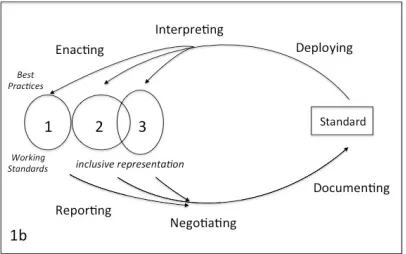
propose a participatory framework for scientific metadata standard-making, as shown in Figure 2. Aligning with scientific research processes introduces an opportunity to partner with researchers in describing their science and data, rather than imposing external metadata requirements. The proposed participatory framework has several key characteristics appropriate to the research context. First, the process is open and inclusive. Second, the process is designed to maximize capture of scientific
understanding rather than simply implement a standard. Third, scientific heterogeneity is consciously identified and strategically managed through informed consensus and negotiation. As with scientific work, the focus is not solely on final outcomes but on awareness and reconciliation of differences. Fourth, the process is ongoing, reflecting the long-term process of learning. The longer planning window allows flexibility for diverse participants to anticipate change and align as needed, given local
circumstances and resources.
Figure 2. Participatory framework for developing standards, with points of divergence (interpreting) and convergence (negotiating) shown as part of a cyclical process.
Circles 1, 2, and 3 on the left of Figure 2 symbolize three different formal or informal socio-organizational units that could include scientists, librarians, standard-making bodies and others. Emerging roles, such as data scientists, data managers and data curators, contribute key mediation work. Each socio-organizational unit has its own sphere-of-context, characterized by a unique configuration of
organizational placement, project definition, technical aptitude, resources, research perspective and available infrastructure. Rather than needing to have a specific skill set, participants with all types of expertise are sought out and welcomed. In addition to being participants in development of a scientific metadata standard, those engaged in the process are continuing learners. Standard-making participants co-construct an evolving scientific understanding by carrying out data curation in a research context.
Moving along the lower part of Figure 2, negotiation occurs at the point of convergence. Faced with disparate metadata, participants can decide upon reconciliation through an agreed-upon standard. Possible negotiation outcomes include resolution or postponement, in addition to elimination and generalization. Ideally, negotiation is inclusive, with each participant representing local priorities, infrastructures, resources and needs. Negotiation points and agreements are articulated and captured through documentation. Documentation of scientific metadata standards and processes serves the same purpose as peer-reviewed publication; it keeps science open and cognizant of decisions that shape community understanding and research trajectories.
The outcome of the negotiation stage is a strategically released version of a standard (seen in the right-hand box). Necessary tools, guidelines and other implementation mechanisms are identified and addressed through collaborative efforts. As partners in the process, participants are empowered to take their new knowledge back to their local community for incorporation in decision-making and planning. Once deployed (upper right arrow, Figure 2), the implementation process includes expected divergence, as each socio-organizational unit separately interprets the standard in their respective sphere-of-context. Enactment (upper left arrows) involves essentially a site-specific implementation cycle of design, development and deployment, taking into account local circumstances (Millerand et al., 2012; Millerand & Bowker, 2009). Since the situated practices, systems, and infrastructures – human, cultural and technological – differ, the standard and any new requirements must be aligned with existing practices. Any socio-organizational unit may find there are multiple ways to integrate the new standard with their own existing practices; formal or informal governance structures are used to decide among options. With
standardization occurring in different ways depending upon local contingencies and readiness, timeframes and outcomes will differ as well.
Time may be needed for local redesign and to develop best practices for use of the standard. Best practices develop from local decisions made in interpreting a standard to ensure that local circumstances are managed uniformly (see Figure 2). A working standard, an ad hoc convention developed pragmatically to describe locally-developed procedures in response to a local need, may already exist and require modification or replacement as shown on the left of Figure 2. Alternatively, a site-specific working standard may develop as an enhancement to a community standard. As noted by Gasser (1986), local adjustments may appear initially as ‘out of specification’ but in time contribute via the proposed participatory process.
Realities of Participatory Approaches
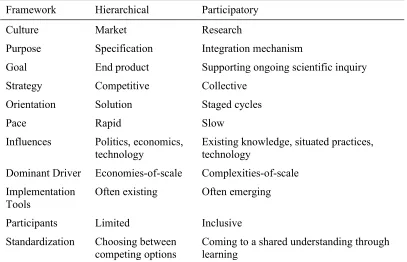
The participatory development of scientific metadata standards is distinguished from a hierarchical approach by the framework characteristics in Table 1. A hierarchical framework within a competitive market culture develops specifications in order to create an end product rapidly. Alternately, a participatory framework within a research culture develops integrative mechanisms over the long term that facilitate learning and support scientific inquiry.
Framework Hierarchical Participatory
Culture Market Research
Purpose Specification Integration mechanism
Goal End product Supporting ongoing scientific inquiry Strategy Competitive Collective
Orientation Solution Staged cycles Pace Rapid Slow
Influences Politics, economics,
technology Existing knowledge, situated practices, technology Dominant Driver Economies-of-scale Complexities-of-scale
Implementation Tools
Often existing Often emerging
Participants Limited Inclusive Standardization Choosing between
competing options
Coming to a shared understanding through learning
Table 1. Characteristics of two standard-development frameworks.
While participatory design can enhance thinking about standard-making, short funding cycles favor product-driven, hierarchical frameworks. Resources,
infrastructure and expertise within the natural sciences are generally lacking as yet for inclusive activities, cooperation across socio-organizational units, and
cross-community dialogue and engagement. Emerging roles for social scientists (e.g. Ribes & Baker, 2007), data curators (e.g. Cragin et al., 2010; Heidorn, 2011;
Thompson, 2012), and data managers (e.g. Michener et al., 2011; Baker & Chandler, 2008) formalize engagement with scientists on these issues and integrate
understanding back into the standard-making process. It is also important to consider how the many scientific socio-organizational units engage with technical agencies and thereby shape subsequent requirements and policies.
The participatory process does not come without difficulties. It is time consuming, costly, and leans heavily on governance structures that often don’t yet exist.
Organizing units are needed as decision-making bodies. Lower (2010) highlights two dimensions: a coordinating unit (community, consortium, government, market) and a standards object (process, semantics, performance and product). The kind of
approaches, i.e. expert advice, widespread participation, consensus. Further governance is required to coordinate multiple organizing units when addressing a single standard.
Despite the difficulties associated with standard-making, we have promising examples at hand to consider. In addition to the LTER EML case example illustrating a hybrid model (hierarchical with participatory follow-up), the field of health science has early experience in community-based participatory research (CBPR), an approach that recognizes and addresses the value of engaging with diverse public participants (e.g. Israel et al., 1998). Envisioning the metadata standardization process in scientific research using a participatory framework highlights the need for early planning of time, resources, expectations and infrastructure to support incremental changes throughout an ongoing process.
The Process of Standardization
‘Standardization’ refers to the process of aligning standards, practices and content within and across socio-organizational units. Hierarchical standardization involves establishing compliance to set specifications, while scientific metadata standardization requires a participatory strategy for growing a shared pool of knowledge.
Standardization is essentially a process of learning; Ribes and Finholt (2007) note:
“...the creation of a metadata standard could be viewed as a form of new knowledge.” (Ribes & Finholt, 2007).
The creation of science metadata standards developed in a participatory framework will necessarily involve negotiations to resolve disparate understandings and forge consensus through common terminology. The participatory framework presents an opportunity to articulate and develop common views, despite layers of complexity, thus linking standard-making more closely to standardization.
Collaboration is at the heart of human organization and growth of infrastructure (Lee et al., 2006; Bowker et al., 2010); it can take many forms depending on
participant needs. While some commercial and scientific standards remove much of the need for interpersonal communication between those wishing to interoperate, the ongoing process of metadata standardization across the complex realms of science requires users and developers to work as co-designers in continuing collaboration.
Levels and Scales
Scientific research occurs in diverse socio-organizational units, where the work of standardizing local practices is ongoing for each unit through a variety of activities. With both overlapping and contradictory interests, each unit has a sphere-of-context defined along local-remote, higher-lower, and/or large-small continuums that collectively may be called levels. ‘Level’ refers to an ordering with differing scopes and responsibilities for the work that occurs in different contexts. From the
Fomin (1999) argues that the standard is a boundary-crossing object that enables integration across different organizational levels. His multi-level analysis considers the roles and function of standards in terms of micro-meso-macro scaled categories associated with social, technical, and economic forces, respectively (Fomin, 2003). With scientific metadata standards, we map instead to three socio-organizational levels: local, community and large-scale. Scientific metadata standards develop and are enacted at all levels, eventually interfacing with local, or micro, best practices and prompting development of working standards. Community gateways develop at the meso-scale as data repositories, such as the Global Biodiversity Information Facility (GBIF) and GenBank. At the macro-scale, recommendations about systemic solutions are meant to address large-scale issues.
Conclusions
This paper discusses standard-making as one part of the process of standardization for scientific metadata. A participatory framework is conceptualized and characterized by the expectation of ongoing collaboration. The framework highlights how ‘a standard’ is only one aspect of a complex process; standards alone do not inherently achieve standardization. Data reuse and automated processing rely not on metadata
shoehorned into ill-fitting standards to meet minimum requirements, but rather on the advancement of science through collaborative learning at many levels and in many spheres-of-context. In both the scientific arena and with metadata standards, a participatory approach is essential for supporting scientific inquiry.
The development of multiple standards is an important part of research and is by no means a failure to solve the problem of metadata development in the natural sciences. The cyclical standard-making process illustrates that divergence due to local
interpretation and enactment is as important as the convergence that removes barriers to standardization. Both are integral to the evolution of scientific metadata standards and to scientific inquiry. Further study of standards enactment, the roles of best practices and working standards, and standardization across levels is needed.
Given the infinite variety of ways to organize and classify digital data that
represent observations of our world, participatory development of scientific metadata standards is required to capture the complexity of natural systems. Bringing experts from different arenas together through a participatory framework supports the research needed to answer grand challenge science questions of our day. In its provisionality, the process of standardization parallels the ongoing nature of the scientific
knowledge-making process itself.
Acknowledgements
References
Akhtar, S. (2005). 2G-5G networks: Evolution of technologies, standards, and deployment. Retrieved from http://www.webcitation.org/5z9JxJryv
Baker, K.S. & Chandler, C.L. (2008). Enabling long-term oceanographic research: Changing data practices, information management strategies and informatics.
Deep Sea Research II, 55(18-19), 2132-2142. doi:10.1016/j.dsr2.2008.05.009
Baker, K.S. & Yarmey, L. (2009). Data stewardship: environmental data curation and a web-of-repositories. International Journal of Digital Curation,4(2), 12-27. doi:10.2218/ijdc.v4i2.90
Berg, M. (1998). The politics of technology: On bringing social theory into technological design. Science, Technology & Human Values, 23(4), 456-490. doi:10.1177/016224399802300406
Bowker, G.C. & Star, S.L. (1999). Sorting things out: Classification and its consequences. Cambridge, MA: MIT Press.
Bowker, G.C., Baker, K., Millerand, F. & Ribes, D. (2010). Toward information infrastructure studies: Ways of knowing in a networked environment. In J. Hunsinger (Ed.), International Handbook of Internet Research. Springer Science+Business Media. doi:10.1007/978-1-4020-9789-8_5
Cragin, M.H., Palmer, C.L., Carlson, J.R. & Witt, M. (2010). Data sharing, small science and institutional repositories. Philosophical Transactions of the Royal Society A,368, 4023-4038. doi:10.1098/rsta.2010.0165
David, P.A. (2007). Path dependence: A foundational concept for historical social science. Cliometrica, 1(2), 91-114. doi:10.1007/s11698-006-0005-x
de Vries, H.J. (2005). IT standards typology. In K. Jakobs (Ed.) Advanced Topics in Information Technology Standards and Standardization Research. New York: Idea Group Publishing.
Dittrich, Y., Eriksén, S, & Hansson, C. (2002). PD in the wild: Evolving practices of design in use. In T. Binder, J. Gregory & I. Wagner (Eds.) Proceedings of the Participatory Design Conference. Malmö, Sweden. CPSR: Palo Alto, CA.
Dix, A., Finlay, J., Abowd, G. & Beale, R. (2004). Human-Computer Interaction. London: Prentice Hall.
Edwards, P.N. (2003). Infrastructure and modernity: Force, time, and social
Edwards, P.N., Jackson, S.J., Bowker, G.C. & Knobel, C. (2007). Understanding infrastructure: Dynamics, tensions, and design. NSF Report of a Workshop on History and Theory of Infrastructure: Lessons for New Scientific
Cyberinfrastructures. Retrieved from http://hdl.handle.net/2027.42/49353
Fomin, V.V. (1999). The dynamics of standard setting: Equilibrium and
transformation in social networks. In K. Jakobs (Ed.) Proceedings of FirstIEEE Conference on Standardization and Innovation in Information Technology.
Aachen, Germany.
Fomin, V.V. (2003). The role of standards in the information infrastructure development, revisited. Proceedings of the Management Information Systems Quarterly Special Issue Workshop: Standard Making - A Critical Research Frontier for Information Systems (pp. 302-313). Seattle, WA.
Gasser, L. (1986). The integration of computing and routine work. ACM Transactions on Office Information Systems 4, 205-225. doi:10.1145/214427.214429
Green, S.D. (1996). A metaphorical analysis of client organizations and the briefing process. Construction Management and Economics14, 155-164.
doi:10.1080/014461996373593
Greenberg, J. (2010). Metadata and Digital Information. In Encyclopedia of Library and Information Sciences. New York: Taylor & Francis.
Greenberg, J., White, H.C., Carrier, S. & Scherle, R. (2009). A metadata best practice for a scientific data repository. Journal of Library Metadata9, 194-212.
doi:10.1080/19386380903405090
Hanseth, O., Monteiro, E. & Hatling, M. (1996). Developing information infrastructure: The tension between standardization and flexibility. Science, Technology & Human Values 21(4), 407–426. doi:10.1177/016224399602100402
Hasselbring, W. (2000). The role of standards for interoperating information systems: The traditional bottom-up integration. In K. Jacobs (Ed.) Information Technology Standards and Standardization. Hershey, PA: IGI.
Heidorn, P.B. (2011). The emerging role of libraries in data curation and e-science.
Journal of Library Administration, 51(7-8), 662-672. doi:10.1080/01930826.2011.601269
Israel, B.A., Schulz, A.J., Parker, E.A. & Becker, A.B. (1998). Review of
community-based research: Assessing partnership approaches to improve public health. Annual Review of Public Health,19, 173–202.
doi:10.1146/annurev.publhealth.19.1.173
Jakobs, K. (2005). Advanced topics in information technology standards and standardization research. New York: Idea Group Publishing.
Jones, M.B., Schildhauer, M.P., Reichman, O.J. & Bowers, S. (2006). The new
bioinformatics: Integrating ecological data from the gene to the biosphere. Annual Review of Ecology, Evolution, and Systematics,37, 519-544.
doi:10.1146/annurev.ecolsys.37.091305.110031
Karasti, H., Baker, K.S. & Millerand, F. (2010). Infrastructure time: long-term matters in collaborative development. Computer Supported Cooperative Work: An
International Journal, 19, 377-415. doi:10.1007/s10606-010-9113-z
Lampland, M. & Star, S.L. (Eds.) (2009). Standards and their stories: How
quantifying, classifying, and formalizing practices shape everyday life. Cornell University Press.
Lee, C.P., Dourish, P. & Mark, G. (2006). The human infrastructure of
cyberinfrastructure. In proceedings of the Computer Supported Cooperative Work Conference (CSCW), Banff.
Lehr, W. (1992). Standardization: Understanding the process. Journal of the American Society for Information Science 43(8), 550-555. doi:10.1002/ (SICI)1097-4571(199209)43:8%3C550::AID-ASI5%3E3.0.CO;2-L
Lewin, P. (2002). The economics of QWERTY: History, theory and policy. New York: New York University Press.
Lower, U.M. (2010). Interorganisational standards, managing web services specifications for flexible supply chains. Heidelberg: Physica-Verlag.
LTER Information Management. (2011). EML Best Practices for LTER sites. Retrieved from
http://im.lternet.edu/sites/im.lternet.edu/files/emlbestpractices-2.0-FINAL-20110 801_0.pdf
LTER Information Management. (2009). Review criteria for LTER information management systems. Retrieved from
http://im.lternet.edu/sites/im.lternet.edu/files/LTER_IM_Review_Criteria_V1.1.p df
Lyytinen, K. (1987). Different perspectives on information systems: problems and solutions. ACM Computing Surveys (CSUR) 19(1), 5–46.
doi:10.1145/28865.28867
Lyytinen, K. & King, J.L. (2006). Standard making: A critical research frontier for information systems research. Management Information Systems Quarterly30(1): 405-411.
Mayernik, M.S. (2011). Metadata realities for cyberinfrastructure: Data authors as metadata creators. Doctoral thesis, UCLA, Los Angeles.
Michener, W.K., Brunt, J.W., Helly, J.J., Kirchner, T.B. & Stafford, S.G. (1997). Nongeospatial metadata for the ecological sciences. Ecological Applications,7, 330-342. doi:10.1890/1051-0761(1997)007[0330:NMFTES]2.0.CO;2
Michener, W.B. & Jones, M.B. (2012). Ecoinformatics: Supporting ecology as a data-intensive science. Trends in Ecology and Evolution, 27(1), 85-93. doi:10.1016/j.tree.2011.11.016
Michener, W.K., Porter, J., Servilla, M. & Vanderbilt, K. (2011). Long term ecological research and information management. Ecological Informatics, 6, 13-24. doi:10.1016/j.ecoinf.2010.11.005
Millerand, F., & Baker, K.S. (2010). Who are the users? From a single users to a web of users in the design of a working standard. Information Systems Journal,20, 137-161. doi:10.1111/j.1365-2575.2009.00338.x
Millerand, F. & Bowker, G.C. (2009). Metadata standards: Trajectories and enactment in the life of an ontology. In S.L. Star & M. Lampland (Eds.) Standards and Their Stories: How Quantifying, Classifying, and Formalizing Practices Shape Everyday Life. Cornell University Press.
Millerand, F., Ribes, D., Baker, K.S. & Bowker, G.C. (2013).Making an issue out of a standard: Storytelling practices in a scientific community. Science, Technology, & Human Values, 38, 7-43. doi:10.1177/0162243912437221
Molka, J. (1992). Surrounded by standards, there is a simpler view. Journal of the American Society for Information Science 43(8), 526-530. doi:10.1002/ (SICI)1097-4571(199209)43:8%3C526::AID-ASI2%3E3.0.CO;2-F
NAS. (2009). Ensuring the integrity, accessibility, and stewardship of research data in the digital age. Washington, D.C.: The National Academies Press.
Porter, J.H. (2010). A controlled vocabulary for LTER datasets. LTER Databits Spring 2010. Retrieved from
http://databits.lternet.edu/spring-2010/controlled-vocabulary-lter-datasets
Puffert, D. (2010). Path dependence. In R. Whaples (Ed.), EH.Net Encyclopedia of Economic and Business History. Tucson, AZ: Economic History Association. Retrieved from http://eh.net/encyclopedia/article/puffert.path.dependence
Reichman, O.J., Jones, M.B. & Schildhauer, M.P. (2011). Challenges and opportunities of open data in ecology. Science, 703-705.
Ribes, D. & Baker, K.S. (2007). Modes of social science engagement in community Infrastructure Design. In C. Steinfield, B. Pentland, M.S. Ackerman and N. Contractor(Eds.) Proceedings of the Third Communities and Technologies Conference. London: Springer.
Ribes, D. & Finholt, T.A. (2007). Planning infrastructure for the long-term: Learning from cases in the natural sciences. Proceedings of the Third International
Conference on e-Social Science. Ann Arbor, MI.
Rumble, J., Carroll, B., Hodge, G. & Bartolo, L. (2005). Developing and using standards for data and information in science and technology. Paper presented at
Ensuring long-term preservation and adding value to scientific and technical data (PV 2005). Edinburgh: The Royal Society.
Schmidt, S. & Werle, R. (1998). Coordinating technology: Studies in the international standardization of telecommunications. Boston: MIT.
Schuler, D. & Namioka, A. (1993). Participatory design: Principles and practices. New Jersey: Lawrence Erlbaum Associates.
Sherif, M.H. (2001). A framework for standardization in the telecommunications and information technology. IEEE Communications Magazine39(4), 94-100.
doi:10.1109/35.917510
Star, S.L. (1991) Power, technologies and the phenomenology of conventions: On being allergic to onions. In J. Law (Ed.) A Sociology of Monsters: Essays on Power, Technology and Domination. London: Routledge.
Star, S.L. & Ruhleder, K. (1996). Steps toward an ecology of infrastructure: Design and access for large information spaces. Information Systems Research 7(1), 111–134. doi:10.1287/isre.7.1.111
Thompson, A. & Taylor, B.N. (2008). The NIST guide for the use of the international system of units (SI). NIST Special Publication 811, 2008 Edition. Retrieved from http://www.nist.gov/pml/pubs/sp811/index.cfm
Thompson, C.A. (2012). Answering the call for data curation: An exploration of the
careers of LIS professionals managing data. Master’s thesis, University of North Carolina, Chapel Hill.
Wagner, I., Bratteteig, T. & Stuedahl, D. (Eds.) (2010). Exploring digital design: Multi-disciplinary design practices. London: Springer.
Whelton, M. & Ballard, G. (2002). Wicked problems in project definition. Paper presented at the Tenth International Group for Lean Construction, Brazil.