THE EFFECTS OF ENRICHED WORKSHOP
TRAINING GIVEN TO PRE-SCHOOL
STUDENTS ON CREATIVE THINKING
SKILLS OF STUDENTS
Mustafa Özgenel
Istanbul Sabahattin Zaim University, Turkey E-mail: [email protected]
Ömer Canpolat
Sabahattin Zaim Religious Secondary School Ministry of National Education, Turkey E-mail: [email protected] Ersin Yağan
Necip Fazıl Kısakürek Secondary School, Ministry of National Education, Turkey
E-mail: [email protected]
Özge Canlı Mehmet Akif Ersoy Secondary School, Ministry of National Education, Turkey E-mail: [email protected]
Abstract
The aim of the research was to explore the effects of enriched workshop training given to pre-school students on students’ creative thinking skills. The research was conducted during the 2016-2017 and 2017-2018 academic year. The mixed research design was used in the study. On the quantitative stage of the research, a single-group pre-test-posttest experimental design was applied. In order to identify the effects of the enriched training provided at different workshops, students were administered Torrance Test of Creative Thinking (Figural Form) as a pre-test-post-test. The study group of the research was comprised of 129 students in total including 81 students in the first group and 48 students in the second group, all taking training at the “Curious Junior Education Center” supported by Istanbul Development Agency and implemented by Pendik District National Education Directorate. According to the findings obtained from the quantitative method, a variation was identified in the test averages for student creative thinking skills (fluency, originality, elaboration, abstractness of titles, resistance to premature closure) before and after the training. Post-test averages for students’ creative skills increased. Paired samples t test was performed to determine whether or not the variation- increase- was significant. According to the t test result, enriched workshop training affects students’ total creative thinking skills significantly. In other words, enriched workshop training has developed students’ creative thinking skills positively. In the qualitative method, parents, students and teachers reported their views about the quality and effectiveness of the enriched workshop training.
Vol. 77, No. 5, 2019 617
Introduction
Creativity is a concept that is of interest in any domain one could think of including such as education, arts and business world. There have naturally been many studies conducted on a concept that receives interest in that many domains. The definition, development, measuring of creativity, factors affecting creativity are some of the points of discussions.
Several scientists, artists, musicians, politicians and writers have been regarded as “creative brains” in many societies across the world. Figures such as Einstein, T. S. Eliot, Pablo Picasso and Sigmund Freud studied different fields and created a difference with the ideas and products they offered (Gardner, 2011). So, what is “creativity” that makes these people different than the society to which they belong? Several researchers have striven to answer to this question. According to Guilford (1967), who was the President of the American Psychology Society and had creativity enter into the psychology literature in 1950, creativity is a combination of sensitivity to problems, fluency of ideas, flexibility or potential to change perspective, originality or individual response tendency and capacity to redefine and interpret. According to Torrance (1965, pp. 663-664) who considered creativity as a process;
On the basis of an analysis of the diverse ways of defining creativity and what I consider the requirements of a definition for keeping a program of research on factors affecting creative growth in context, I defined creativity as the process of becoming sensitive to problems, deficiencies, gaps in knowledge, missing elements, disharmonies, and so on; identifying the difficulty; searching for solutions, making guesses, or formulating hypotheses about the deficiencies; testing and retesting these hypotheses and possibly modifying and retesting them; and finally communicating the results.
Stein (1953, pp. 311-322) looks at creativity from the perspective of the product presented and notes that the product must be satisfying and useful. Also, he argues that the culture in which one lives affects creativity and impacts the quantity and quality of the product presented. Stein defines creative works as presenting a product acceptable to the culture, useful and new. According to Thurstone (1952), for an idea to be considered creative, the society must accept it as a new and creative idea (as cited by Parkhurst, 1999). At this point, Thurstone and Stein emphasized - to the role of culture and society in the creativity process. Additionally, Mumford (2003) defines creativity as producing new and different products. Mumford is in agreement with Thurstone and Stein at this point. In other words, creativity has been dealt with in different domains and dimensions and considered a product, skill, ability to solve a difficulty or a problem, all of which are valuable to the society (Barron & Harrington, 1981, 4). Torrance (1978, p. 903) defined the personality traits of creative people. According to Torrance, creative individuals have higher self-confidence, are more energetic, independent, open to change, flexible and original than other individuals. They focus on their mind and can control their energy (Csikszentmihalyi, 1996, p. 39). In this respect, creativity can be regarded as an invaluable cognitive source (Özgenel, 2018).
Vol. 77, No. 5, 2019
618 The research suggested a positive correlation between creativity and intelligence (Barron & Harrington, 1981; Benedek, Jauk, Sommer, Arendasy, & Neubauer, 2014; Kim, Cramond, & VanTassel-Baska, 2010). However, the nature of this correlation is unknown. That is, it is not possible to say that an individual with a high IQ is more creative, or reversely, an individual with a lower IQ is less creative (Batey & Furnham, 2006). Therefore, having a certain intelligence score is not enough for creativity and it can be said that creativity is a phenomenon that can be improved through education.
To improve creativity, a teacher that supports creative activities in a class environment, enhances the student’s self-confidence, autonomy and self-control, encourages the student to produce many ideas and ask many questions plays an important role. Also, a class environment must be developed where students are encouraged to be tenacious and curious (Morais & Azevedo, 2011) and have new ideas, play with ideas, create projects on their own (Gomez, 2007).
Gregory, Hardiman, Yarmolinskaya, Rinne and Limb (2013) have made some recommendations in relation to supporting creativity through teaching and creative problem solving. Accordingly, 1) a teacher must provide the student in the class with sufficient information to produce ideas and enforce knowledge with art activities. 2) Students must present problems and be asked to produce several ideas for the solution and share them with the class. 3) Students must also think about the effects of the solutions they recommend. 4) Group studies are effective and must be encouraged for multi-faced problems. 5) Students must be asked to establish different relationships between irrelevant ideas. 6)Group studies must be supported with art events improving creative thinking. In summary, considering its importance in today’s world, preparing educational programs required to improve creativity, raise creative individuals and achieve the desired advancement and creating class environments and paying attention to teachers’ and students’ needs, in other words, enriching the education is both necessary and important.
Enrichment is deepening the educational content to a higher level and dealing with the subjects in such manner as supports students’ creative activities, their areas of interest (Renzulli & Reis, 1997, p. 14). For gifted pre-school students to maximize their potential, enrichment studies are crucial for school administrators, educators in particular, experts working on university program development and families (Karnes & Roberts, 2005, pp. 10-12). Many models have been developed and implemented for the enrichment of gifted individuals’ educational programs. Some are the Autonomous Learner Model (Betts, 1986), The Grid Model, the Integrated Curriculum Model (ICM) (Van Tassel-Baska & Brown, 2007), the Triarchic Componential Model (Renzulli & Reis, 1997).
The enrichment model used most commonly in the U.S. and Canada is Renzulli’s Enrichment Triad Model, Enrichment Triad Model (ETM) was developed as an alternative to the existing models for talent development in the early 1970s (Bain, Bourgeois, & Papas, 2003). ETM is a structured teaching model. In the model, defining high-order learning is associated with four principles. The first one is that the learning experience must appeal to individual skills, areas of interest and learning styles because each student is different. The second is that it will be more effective when students have fun. The third is that learning that brings out creative products is more meaningful and fun when the content and process are learned in the context of the real problems, Lastly, the final objective of the model is to develop thinking skills and develop student’s skills of using relevant information/knowledge that will allow them to exhibit their creativity (Garcia-Cepero, 2008).
Vol. 77, No. 5, 2019 619
and plans to improve motivation. In Enrichment Type 3, students conduct research activities on their own and assume responsibility in project production themselves. Students who succeed in the first two stages want to specialize in further stages and make use of this enrichment type (Renzulli & Reis, 2010). In this context, it can be suggested that enrichment training may improve creative thinking skills. However, there are very few scientific publications researching the effects of enrichment activities on creativity in the pre-school period.
As a result of the studies on the development of creativity in children at various age groups (ages 3-18), Torrance (1963) found that there was a development curve that usually increased with age and however decreased at some ages in relation to the development of creativity in children. According to Torrance, the decrease in the creativity potential of children at age 5 results from the social activities. Meeting with the school life for the first time has also brought with it some expectations such as submitting to or accepting the social authority, and such social changes have also affected the development of creativity for children at such age. Urban (1991) conducted a developmental study on children between ages 4 and 8. As a result of the study conducted with a sample comprising 272 people in five different age groups, the curve derived, which hints about the development of creativity, seems to support the findings of Torrance’s studies (as cited by Yontar, 1993, pp. 22-27). Based on Torrance's and Urban’s research findings, creative individuals can be suggested to have creativity scores getting lower in the conventional/standard educational curriculum. In other words, the pre-school education, the most critical period during which the child begins to produce creative elements for the first time, affects the child’s potential creativity during a time when the child begins to learn about the authority, rules and a structured environment because of beginning school (Ataman, 1993, p. 112). In this context, it is considered important to seek answers to the questions “how should a school, class and learning-teaching environment be, what materials, tools and equipment must be used or how should the current curriculum be changed in the formal education, in pre-school education in particular, to develop creativity?”.
Wrong attitudes, behaviors or practices resulting from family, school, teacher or different variables may affect the development of creativity negatively in an early and critical period such as pre-school in the development of creativity i.e. the education of individuals who think creatively. Therefore, since the developmental characteristics of individuals who think creatively may be different from their peers, it is crucially important to provide an enriched education that can improve their potential in early ages/periods to support their development appropriate for their areas of interest. Based on the literature provided above, the aim of the research was determined to explore whether or not enriched workshop training has an effect on creative thinking skills of pre-school children of 48-60 months of age and explore the views of parents, teachers and students. For this overall purpose, answers to the following research questions were sought:
1. Does enriched workshop training given to pre-school children of 48-60 months of age have an effect on creative thinking skills of students?
2. What are the views of teachers, students and parents about enriched workshop training given to pre-school children of 48-60 months of age?
Research Methodology
General Background
Vol. 77, No. 5, 2019
620 2016-2017 and 2017-2018 education years. The research includes enriched workshop training designed to develop creative thinking skills of preschool students.
Research Design
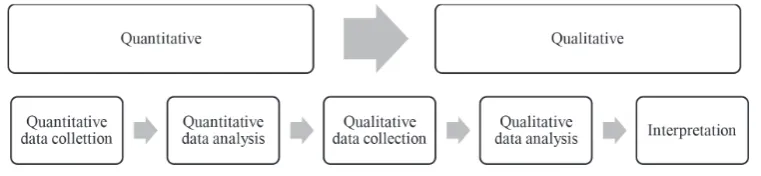
In the research, the mixed research model. The mixed method was preferred because it allows identifying multi-world views (Creswell & Plano Clark, 2015, p. 51), as well as minimizing the limitations of both research types (Creswell, 2014, p. 218). While the mixed design offers some opportunities to researchers, some risks also await researchers (Doyle, Brady, & Byrne, 2009). As an opportunity, it facilitates especially inter-disciplinary cooperation and offers new learning opportunities to researcher. However, the disciplines and the importance of the theories must not be diminished (Brannen, 2010, p. 6). The mixed model used in the present research is provided in Figure 1.
Figure 1. Sequential explanatory strategy (Terrel, 2012).
When Figure 1 is examined, a mixed research method, “sequential explanatory strategy”, is seen to be used. Sequential explanatory method is applied in two ways. 1) After collecting and analyzing quantitative data, qualitative data is collected and analyzed. Both stages are treated with equal importance. They are combined at data interpretation. Primary goal is to reach quantitative results and later use the qualitative method to better understand the results of the quantitative research. 2) It can also be conducted by collecting and analyzing qualitative data and collecting and analyzing quantitative data (Terrell, 2012, p. 262). In other words, quantitative research findings are sought to be explained with qualitative research findings (Whitehead & Schneider, 2007, p. 266). On the quantitative research stage of the study, experimental design was used to determine whether or not the enriched workshop training had an impact on the creative thinking skills of students, and thereafter, on the sequential qualitative research stage, parent, student and teacher views were referred to obtain detailed information on the quality and effectiveness of the training given.
Quantitative Research Design
Vol. 77, No. 5, 2019 621
the cause assumed to affect the outcome is manipulated. It is measured whether a change in the cause affects the outcome. Various measures are taken to mitigate the impact of other factors during the effect (Cook, Campbell, & Shadish, 2002, pp. 7-8). The design used in the research is presented in Table 1.
Table 1. One-group pre-test-posttest experimental design.
Experimental group Pre-test Experimental process Post-test
Student group with which enriched
workshop training was conducted Torrance Figural Test of Creative Thinking Enriched workshop training Torrance Figural Test of Creative Thinking
As seen from Table 1, only one group was selected in the one-group pre-test-posttest experimental design. This group is called the experimental group. The measurement of creative thinking skills of the experimental group before beginning the experimental process (dependent variable=result variable) was performed by applying a pre-test. After the pre-test was performed, enriched workshop training (experimental process=variable affecting/causing) was implemented, and thereafter, a re-measurement was performed by applying a posttest. The pre-test and posttest measurement results of the experimental group were compared.
Quantitative Study Group
Two study groups were identified in the research. While determining the groups, teachers working at official-public kindergartens and kindergarten classes under Pendik District National Education Directorate were trained in creativity, creative thinking skills, characteristics of creative individuals and creative thinking process. An observation form was developed by three experts (preschool, special education and gifted) that defines the observable characteristics in creative individuals in preschool period. A 50-item observation form used in the pre-selection of students was introduced to the teachers. Preschool teachers identified the students performing better than their peers using this form and referred them to the educational center. Forms received from the teachers were examined, 119 students who scored the highest from the form were selected for the first application and 71 students were selected for the second application by the purposeful sampling method, which is not a random/probability method. Purposeful sampling is a sampling method by which the sample is selected as non-probability in accordance with the research objective (Neuman, 2017, p. 322). In the first application, 34 of 81 students out of 119 students who volunteered to participate in both the pre-test and posttest are female and 47 thereof are male. In the second application, 23 of 48 students out of 71 students who volunteered to participate in both the pre-test and posttest are female and 25 thereof are male. The parents of these students were informed about the content of the enriched workshop training and their permission was obtained, and the students who volunteered to participate in the test application were administered Torrance Test of Creative Thinking Skills.
Quantitative Data Collection Instruments and Collection of Data
Vol. 77, No. 5, 2019
622 is comprised of figural subtests in two parallel forms (A-B forms) and is simply an individual paper-pencil application that does not need any additional work. This test aims to reveal the skills of the number/multitude of related responses or solutions (fluency); diversity of responses and adjustment (flexibility); remarkable or surprising solution or innovation (originality); defining and detailing how to use ideas (elaboration) (Torrance, 1972, p. 598). 10 Psychological Counselor teachers were caused to receive a training from a foundation authorized to use Torrance Figural Test of Creative Thinking Skills and train to administer the test. Administering and scoring the test took 35 minutes in average. The overall reliability coefficient of the test in this research was calculated as 0.864.
Quantitative Data Analysis
The analysis of the quantitative data obtained in the study was performed using the SPSS (Statistical Package for the Social Sciences) and their significance level was accepted as 0.05. In data analysis, related samples t test was performed. Related group t test is performed to test whether or not the arithmetic means of two related sample groups create a significant variation (Büyüköztürk, 2012, p. 67).
Experimental Process
Vol. 77, No. 5, 2019 623
Qualitative Research Design
Qualitative research is a method where individuals make sense of and interpret a phenomenon (Denzin& Lincoln, 2005). In the research, a qualitative research method, phenomenology design, was used to learn in more detail and depth about the student, parent and teacher views of the enriched workshop training. The phenomenological design reveals an individual’s understanding of a phenomenon and real-life world. The results of phenomenological design help understand a phenomenon in different ways and in depth (Ashworth & Lucas, 1998, p. 415).
Qualitative Research Study Group
In qualitative research, a small sample/study group is preferred to analyze a phenomenology or situation in depth and in its own context (Miles & Huberman, 2016, p. 27). In determining the study group, a non-probability sampling method, criterion-sampling technique, was used. Criterion sampling is identifying person(s) or groups as sample who have vast knowledge about the selected phenomenology and fit the pre-determined criteria (Patton, 2014, p. 238). Under the study, in-depth interviews were held with 22 parents in total including 15 females and 7 males, and with 20 students. Again, with the participation of 5 female teachers (3 pre-school, 1 art and 1 music teachers) working at the center, a focus group interview was held.
Qualitative Data Collection Instruments and Collection of Data
In the qualitative part of the research, two different interview methods were implemented with the participants. Semi-structured interview technique was used to identify parent, student and teacher views about the enriched training. Face-to-face interviews were held with students that received the enriched workshop training and with their parents. A face-to-face interview is a data collection process in which a researcher asks questions to each of participants individually one by one and records the responses given (Creswell, 2017, p. 282). A focus group interview was held with the teachers giving the enriched workshop training. Focus group interviews are practical and useful for action and assessment studies where participants express different perspectives (Glesne, 2012, p. 176). The purpose here is to reveal in depth the views of students who take advantage of the enriched training, teachers who give the enriched training and parents who can observe the development of the student from this training best as an external observer and present proofs to explain the nature of the training process.
20 parents were selected from among the parents, and each interview lasted about 40 minutes and was recorded using a voice recorder. Again, interviews were held with 20 students selected from among the students that received training at the education center. Each interview held with the students lasted about 20 minutes and semi-structured interview form was used in the interviews. A focus group interview was held with the participation of all teachers (3 preschool, 1art, 1 music teachers) that worked at the education center. The interview lasted about one hour and was recorded using a voice recorder. The interviews were transferred to text/word form for analysis purposes.
Quantitative Data Analysis
Vol. 77, No. 5, 2019
624 coding. Thereafter, codes are grouped under similar concepts to relate them to more meaningful and research situation, problem. Themes are created from these concepts.
Research Results
Quantitative Research Findings
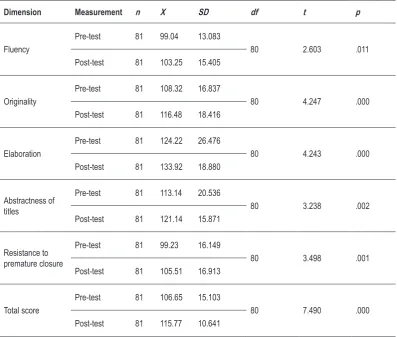
On the quantitative research stage of the study, related groups t test was performed to compare the pre-test-posttest scores from the Figural Test of Creative Thinking Skills. The results of related groups t test performed to compare the pre-test-posttest scores for creative thinking skills of students that participated in the first application are presented in Table 2.
Table 2. Results of dependent groups test analysis to compare the pre-test and posttest scores for creative thinking skills of students who participated
in the first application.
Dimension Measurement n X SD df t p
Fluency
Pre-test 81 99.04 13.083
80 2.603 .011
Post-test 81 103.25 15.405
Originality
Pre-test 81 108.32 16.837
80 4.247 .000
Post-test 81 116.48 18.416
Elaboration
Pre-test 81 124.22 26.476
80 4.243 .000
Post-test 81 133.92 18.880
Abstractness of titles
Pre-test 81 113.14 20.536
80 3.238 .002
Post-test 81 121.14 15.871
Resistance to premature closure
Pre-test 81 99.23 16.149
80 3.498 .001
Post-test 81 105.51 16.913
Total score
Pre-test 81 106.65 15.103
80 7.490 .000
Post-test 81 115.77 10.641
Vol. 77, No. 5, 2019 625
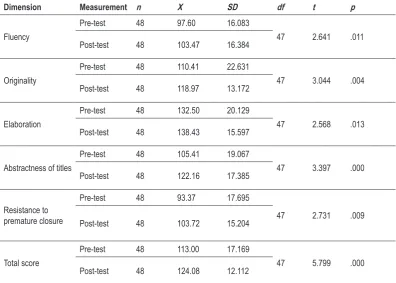
Dependent groups t test performed to compare the scores obtained from the second application of the research are provided in Table 3.
Table 3. Results of dependent groups test analysis to compare the pre-test and post-test scores for creative thinking skills of students who participated in the second application.
Dimension Measurement n X SD df t p
Fluency
Pre-test 48 97.60 16.083
47 2.641 .011 Post-test 48 103.47 16.384
Originality
Pre-test 48 110.41 22.631
47 3.044 .004 Post-test 48 118.97 13.172
Elaboration
Pre-test 48 132.50 20.129
47 2.568 .013 Post-test 48 138.43 15.597
Abstractness of titles
Pre-test 48 105.41 19.067
47 3.397 .000 Post-test 48 122.16 17.385
Resistance to premature closure
Pre-test 48 93.37 17.695
47 2.731 .009 Post-test 48 103.72 15.204
Total score
Pre-test 48 113.00 17.169
47 5.799 .000 Post-test 48 124.08 12.112
When Table 3 is examined, a comparison the pre-test and posttest scores of fluency (X=97; X=103), originality (X=110; X=118), elaboration (X=132; X=138), abstractness of titles (X=105; X=122), resistance to premature closure (X=93; X=103) and total creative thinking skills (X=113; X=124) of 48 students of 48-60 months of age pointed to a significant variation in favor of the posttest. In other words, enriched workshop trainings given to the students have affected and developed the students’ creative thinking skills positively.
Qualitative Research Findings
Findings Obtained from Parent Interviews
Vol. 77, No. 5, 2019
626 Expectations from Education
In the interviews with the parents, it was sought to identify generally what their expectations were when sending their children to the education center. When the responses given were analyzed, the “expectations from education” theme was derived from interest, opportunity, talent, guidance, prevalence codes. The expectations from education theme was examined under the sub-theme headings “meeting expectations” and “generalizing training”.
Meeting Expectations
Responses given revealed that parents expected the center to identify their children’s talents in different areas, plan their education according to these areas and develop their talents.
“Like every parent, we thought that our child’s learning level and interest was different. We care very much about it because it has given us the opportunity to assess and evaluate how right our thought was” (KE1).
“I was thinking that it would contribute to the child’s physical and mental development. I think my expectation is met satisfactorily” (KK1).
“I first hoped that every child was evaluated based on his/her talent” (KK5).
“I think that areas at which children are successful and competent must be determined and children must be directed to that area” (KK7).
Generalizing the Training
Students’ parents stated that their expectations were generally met. They stated that they observed an improvement in children’s talents and that such practices should be reflected to the educational policies across the country.
“An invaluable training. It is very important that our government has begun to pay the required care to its own human resource” (KE2).
“I like the training given very much. Such works should have been done year ago.” (KE4).
Educational Outputs
In the interviews with the parents, it was sought to determine the changes the parents observed in their children. When the responses given were examined, the “educational outputs” theme was derived from the awareness, permanent learning, explorer, curious, creative, responsible codes. The educational outputs theme, on the other hand, was examined under “benefits of education” and “behavioral changes observed in children” sub-theme headings.
Benefits of Education
Vol. 77, No. 5, 2019 627
“It gives the opportunity to learn by living. And this creates a more permanent scheme in my daughter’s mind” (KK2)
…“…. My child's participation in such training early has also caused me to become conscious. This education has helped me realize the things I couldn’t realize” (KK4).
“My child’s areas of interest have increased. His/her different sides have appeared. He/she has had the opportunity to acquire more different knowledge compared to his/her age” (KK8).
… “… I have seen the works done here leave a positive effect on my child. Here is a different world for him/her. It has become a place he/she loves going to. Now, he/she demands logical answers from us. It is now hard to circumvent them. I have seen that he/she is now better here” (KK4).
“This exciting, exploring, surprising and developer training he/she has taken at the beginning of his/her educational life has also got us exited and makes us contribute further to the support we give” (KK10).
Behavioral Changes Observed in Children
In the interviews, the parents stated that they had observed very positive behavioral changes in their children as a result of the trainings given. The parents stated that their children had begun to express themselves better, their language skills had developed, they had become more inclined to and curious about research, their self-confidence had improved, their imagination and creative hand skills had improved, their awareness had improved and their sense of responsibility and sacrifice had improved.
“He/she expresses himself/herself more clearly” (KK1).
“He/she is trying to do rhythm works at home about music. For example, he/she says he/she wants to play violin. He/she tries to do the same activities using some materials at home and, most importantly, has begun to do presentation at home. We sit at home and think that his/her presenting the product he/she has done that day contributes greatly to the development of his speech expressing language skills” (KK2).
“He/she has begun to show interest in different areas. Especially, his/her interest has emerged in science. He/she has begun to be curious about the reason for, background of everything, His/her curiosity has increased” (KK8).
“It is great to hear more scientific and consistent meaning in sentences he/she constructs, it is even very different and great that he/she knows the name of a scientist and what he/she has discovered. I think the responsibility and sacrifice of getting up early has contributed a lot to him/her” (KE5).
“Of course, his/her areas of interest have changed. He/she has become a more curious and creative child. He/she asks questions and wants to try things constantly during the day” (KK12).
“My child has displayed extraordinary awareness about scientific teachings during this training” (KE6).
Feedback
Vol. 77, No. 5, 2019
628 satisfaction, pleasant codes. The feedback theme was examined under “positive feedbacks to parents” and “satisfaction” sub-theme headings.
Positive Feedbacks to Parents
In the interviews, in general, the parents appear to have stated that their children had described them the education environment they had experienced at the education center in detail. The parents stated that their children were quite happy at the workshops, felt excited for being at the education center and that such practices should be increased.
“Rendering education more specific with the workshop activities becomes more productive and fun. The richness of the materials, educating by appealing to all senses is great” (KK2).
“I have been following this training since it started last year. I am happy about my child’s getting this training in every aspect” (KK3).
“He/she is very excited, loves going there and his/her excitement starts from the night. Preparing his/her lunch box together at nigh is even fun. He/she is not talking anything about what was done in his/her other school, but here, he/she tells everything after I pick up my child. Sometimes, he/ she surprises us by blending the subjects he/she hasn’t told with a subject in a completely different environment” (KK10).
“I find it very useful for a child at this age to have the opportunity to meet with different areas of interest. I thank everyone who has given the opportunity to take this training very much. Because we receive great feedbacks in the evening to the question what you have done today” (KE5).
Satisfaction
One of the points that attracts attention in the interviews is that children tell their parents that they are quite happy with the training they get, enjoy the activities done and thus tell their parents in person about their satisfaction. The parents were seen to be satisfied with the rich material supply offered to children at the workshops that are designed according to different areas of interest.
“He/she says that he/she is very happy and having great time” (KK13).
“I feel from everything he/she says that he/she is enjoying what he/she is doing, learning during the day very much” (KK11).
“He/she simply tells briefly that he/she is having fun” (KE3).
“We understand that he/she spends this day very happy and fully” (KK6).
Findings Obtained from Student Interviews
Vol. 77, No. 5, 2019 629
Effectiveness of Enriched Workshop Training
Fun
In the interviews, the children stated that they were generally happy at the education center, had quite fun and learned new things at the workshops without getting bored. In addition, the children responses show that the purpose for the creation of different enriched workshops have been met and that the students that attended the training performed activities at different workshops which made them feel happy.
“I am happy. Because it is full of fun here. Classes are great, I am excited. I love doing the activities” (S1).
“Activities that are easy for me are generally at the science workshop. And this is where I love the most, I love the school, I never feel bored here” (S17).
“I find the activities great. It is sometimes easy, sometimes hard, but it is very little hard. But I have great time” (S2).
Informative
The fact that each child interviewed expressed their satisfaction also for different workshops show that “one of the goals of the enriched workshop training, “teaching children in line with their different talents” has been achieved.
“I like intelligence workshop. I can do the activities there. I love my school here more because there are many workshops here and we do all of them differently. That's why, I think it is better than my own school” (S13).
“Activities are fun and easy. I love the drama workshop very much. I like reading, completing the stories. I also love drawing. My favorite activity is flower painting. When I go home, I do what I learn here, I tell about it to my family” (S4).
“… When I go home, I try the activities here. I can do them with little help. Classrooms are great, for example. I learn new things when I go there. I love learning new things as much as the world. My favorite is science activities, I also like the intelligence. I learn a lot of new things” (S5).
Findings Obtained from Teacher Interviews
In the focus group interview with the teachers working at the education center, in light of the responses to the questions, three themes were derived including “Characteristics of Students”, “Superior Aspects of Enriched Workshop Training” and “Teacher Acquisitions”. The data obtained from the teacher interviews were examined under these theme headings.
Characteristics of Students
Vol. 77, No. 5, 2019
630 that these children were more enthusiastic about learning, therefore the current knowledge levels were never adequate for them and that their detailed nature always drove them to desire to search. The students were observed to show interest in very different areas, and particularly have a developed sense of rhythm.
“I think the children coming here are a little better than their peers at their own school in terms of their basic skills. They are constantly curious i.e. always want more as you give them. They are active and constantly searching...” (T1).
“I see the students here being more active and having a lot higher perception than the students receiving formal education at other kindergartens. I see them as children not satisfied with the knowledge since, they comprehend more quickly, think faster and are more open to learning. (T2).
“…We all are already aware that their availability level is higher than that of their peers. They already have most of the acquisitions and capabilities in the primary education” (T3).
“They were thinking very fast, making decision very fast and putting them into practice right away. They were able to finish something in an instant, which is great” (T5).
“...Something drew my attention; most of them were feeling disturbed and didn’t want it when I showed them programs or classes that had a high volume. I mean, perceptively, they do not accept high volume musically” (T4).
In the interviews, it is important that the teachers stated that these students were alienated, pressurized because of the listed characteristics, and therefore felt very happy at the education center since they were able to express themselves better.
“Also, children who are alienated by their teacher calling them outsiders say that they love it here very much and express it” (T3).
“One parent came one day to say that the teacher at his/her child’s school complained about the child asking too many questions. And he/she said ‘you say he/she is asking great questions.’ She/ he said, ‘we experienced such discrepancy.’ I like it very much; Children are actually described as negative children when they ask many questions at the other school” (T2).
Superior Aspects of Enriched Workshop Training
The teachers stated that the large variety of the rich training materials offered to the students were the most important elements that strengthened their hand in the enriched workshop training. They stated that the rich material opportunity both contributed positively to them in terms of motivation and paved the way for more creative and innovative designs.
“... We are motivated here because we can access everything here. We even waited for the results of the activity we drafted anxiously or prepared the materials with great pleasure and fun” (T1). “...The richness of materials makes our job easier. Because we move on theme basis and when we do so, we need many visuals, materials.” (T3).
Vol. 77, No. 5, 2019 631
It was stated that, with such practices, many students who had been told by their parents and family members to be introvert, shy exhibited very positive behavioral changes during the workshop trainings and noted that such positive feedback were also received from the parents.
“... I see that children we describe as introvert, which is, to me, nonsense actually, who are known to be talking less, having difficulty expressing their ideas, expressing their ideas more and more loudly” (T2).
“... Students coming here were introvert and were having difficulty expressing themselves. They were not showing themselves, were hiding. We give them a comfortable environment, I mean, for example, there are not as many rules as in their school, I mean, we always communicate the rules, but do not apply overbearing rules or something. Since they feel comfortable, they have opened up in time” (T1).
“Toward the end of the first term, we saw children who were not attending workshops such as leadership, drama or intelligent games attending these. I mean we have given them a perspective. All of them, how to put it, have reached a certain level. They were no longer good at life sciences or arts only, but they all achieved a certain level. They had some idea about everything” (T3).
Teacher Acquisitions
The teachers stated that the opportunity given to them to have some acquisitions during the application of the activities they had designed at the workshops created at the education center helped them get job satisfaction. The teachers expressed that significant behavioral changes had happened in them after they had begun to work at the education center. The point noted the most is that the teachers used more effort to come to the class prepared after they had begun to work at the education center compared to their previous professional life. The teachers stated that they had realized that they also had to improve themselves to provide adequate education to this student group, which had contributed quite positively to their professional development. Especially creating activities and determining acquisitions appeared to have motivated the teachers significantly in terms of professional development and self-confidence.
“..., here, since we produce and prepare the activities ourselves, I have to prepare one-two days in advance. It has contributed to me greatly since I have come from a middle school at the same time” (T4).
“...Frankly, I used to say that there were ones already prepared and available and why I should write one. But it is so great to prepare your own activity that I think it has contributed greatly to me. I mean, in the future, I’d prefer creating my own activity to using the prepared templates” (T1).
“The training we give is the apple of my eye because I think that this year has been full and fun professionally; maybe, the year I have been at the top” (T2).
“I think this has been the best year in my entire professional life. Because after a while, it turns into, well, I mean, the things you cannot give to the student turns into a learned helplessness. You say, ‘Since I cannot teach, I’ll get away with teaching something simple. And then, you also get lazier. So, its contributions, in this respect, high beyond discussion” (T3).
Discussion
Vol. 77, No. 5, 2019
632 enriched workshop training given to students at preschool education age (48-60) on the creative thinking skills of the students. In line with this objective, a workshop training was given based on Renzulli’s Enrichment Triad Model to improve the creative thinking skills of students who exhibited a more advanced progress than their peers at preschool education age. Under the study, the teachers who worked at the education center were trained in the developmental characteristics of the children and how to perform enrichment activities. The teachers enriched the preschool education's curriculum and wrote activities and gave workshop trainings in line with these activities.
Before giving preschool students the enriched training, a pre-test was administered to measure their creative thinking skills, and with the post-test administered after the 14-week enriched training, students’ creative thinking skills were re-measured. The scores derived from the pre-test and posttests were compared. On the experimental research stage, it was concluded that the enriched workshop training affected and improved students’ creative thinking skills positively. From the perspective of the teachers of the enriched workshop training, the students were found to have improved their creative thinking skills and progressed socially and affectively as well and exhibited positive behavioral changes. The developed language skills in the students, the increased self-confidence in the students who were described as introvert and shy, and their ability to express themselves better are the examples of these social and affective changes. Also, the teachers expressed that the enriched workshop training had contributed positively to their professional development. On the other hand, the parents stated that they had failed to meet their children's educational needs adequately, in which respect, the enriched workshop training had contributed to the satisfaction of their needs and that such training should be generalized, and expressed their satisfaction with the training. The students, on the other hand, noted that the training process had been fun and informative and that they were happy with taking this training.
Vol. 77, No. 5, 2019 633
Conclusions
Developing creative thinking skills at an early age in individuals is considered important and necessary. Because it was seen that the creative thinking skills of the children who encountered school rules for the first time and started to receive education with a standard curriculum were negatively affected. Particularly in the pre-school age, students with enriched education can make positive progress in the field of cognitive and social development. However, with this study, it was seen that the enriched workshop education had a positive effect on preschool children. Although there are many studies on creative thinking skills in the literature, it is seen that there are not enough studies about developing creative thinking skills of preschool age students or improving their creativity through enriched education. This gap in literature has been the mainstay of this study. In this context, this research has contributed to the literature which has both a sample application and limited number of studies on developing creative thinking skills of preschool children. In addition to this, it is considered valuable that the research is designed in the form of mixed research using both experimental and qualitative methods. However, in the quantitative stage of this research, a single-group pre-test-posttest experimental design was used. The lack of a control group for comparison in a single-group pretest-posttest experimental design can be considered a limitation of this research. When evaluated from this perspective, pre-test and post-test experimental design with control group can be done and the results can be compared.
Creativity has been considered individuals’ and societies’ wealth from past to present, even its contribution to the individuals who are creative at the art, science and technology level of our age is noticed, and there are different practices in different societies aiming at the education of such individuals. In this respect, the education policy makers and planners may be recommended generalizing the enriched workshop training for individuals who perform better than their peers, for children at preschool age to improve their existing potential, integrating it into the preschool educational programs and continuing it also in further educational levels.
References
Al-Zoubi, S. M. (2014). Effects of enrichment programs on the academic achievement of gifted and talented students. Journal for the Education of Gifted Young Scientists, 2(2), 22-27.
Ashworth, P., & Lucas, U. (1998). What is the “World” of phenomenography? Scandinavian Journal of Educational Research, 42(4), 415-431. Retrieved fromhttps://doi.org/10.1080/0031383980420407. Aslan, A. E. (2001). Torrance Yaratıcı Düşünce esti'nin Türkçe versiyonu [Turkish version of the Torrance
Creative Thinking Test]. M.Ü. Atatürk Eğitim Fakültesi Eğitim Bilimleri Dergisi, 14, 19-40. Ataman, A. (1993). Eğitim sürecinde yaratıcılık [Creativity in the education process]. A. Ataman (Ed.),
Yaratıcılık ve eğitim içinde. Ankara: Türk Eğitim Derneği.
Bain, S. K., Bourgeois, S. J. Y., &Papas, D. N. (2003). Linking theoretical models to actual practices: A survey of teachers in gifted education. Roeper Review, 25(4), 166-172. https://doi. org/10.1080/02783190309554224.
Barron, F., & Harrington, D. M. (1981). Creativity, intelligence, and personality. Annual Review of Psychology, 32(1), 439-476.
Batey, M., & Furnham, A. (2006). Creativity, intelligence, and personality: A critical review of the scattered literature. Genetic, Social, and General Psychology Monographs, 132(4), 355-429. Beecher, M., & Sweeny, S. M. (2008). Closing the achievement gap with curriculum enrichment and
differentiation: One school's story. Journal of Advanced Academics, 19(3), 502-530.
Benedek, M., Jauk, E., Sommer, M., Arendasy, M., & Neubauer, A. C. (2014). Intelligence, creativity, and cognitive control: The common and differential involvement of executive functions in intelligence and creativity. Intelligence, 46, 73-83. https://doi.org/10.1016/j.intell.2014.05.007.
Vol. 77, No. 5, 2019
634 Betts, G. T. (1986). The autonomous learner modelfor the gifted and talented. In J. S. Renzulli, (Ed.), Systems and models for developing programs for the giffed and talented (pp. 27-56). Connecticut: Creative Learning Press.
Bolen, L. M., & Torrance, E. P. (1978). The influence on creative thinking of locus of control, cooperation, and sex. Journal of Clinical Psychology, 34(4), 903-907.
Brannen, J. (2010). Mixed methods research: A discussion paper. ESRC National Centre for Research Methods NCRM Methods Review Papers. Retrieved from http://eprints.ncrm.ac.uk/89/1/ MethodsReviewPaperNCRM-005.pdf.
Büyüköztürk, Ş. (2012). Sosyal bilimler için verianalizi el kitabı [Manual of data analysis for social sciences]. Ankara: Pegem Akademi.
Cook, T. D., Campbell, D. T., & Shadish, W. (2002). Experimental and quasi-experimental designs for generalized causal inference. Boston: Houghton Mifflin.
Creswell, J. W. (2014). Araştırma deseni: Nitel, nicel ve karma yöntem yaklaşımları [Qualitative, quantitative and mixed method approaches] (S. B. Demir, Trans. Ed.). Ankara: Eğiten Kitap. Creswell, J. W. (2017). Eğitim araştırmaları: Nicel ve nitelar aştırmanın planlanması, yürütülmesi ve
değerlendirilmesi [Educational research: Planning, conducting, and evaluating quantitative] (H. Demir, Trans. Ed.). İstanbul: Edam Yayın.
Creswell, J. W., & Plano Clark, V. L. (2015). Karma yöntem araştırmaları tasarımı ve yürütülmesi [Mixed methods research designing and conducting] (Y. Dede & S. B. Demir, Trans. Ed.). Ankara: Anı Yayıncılık.
Csikszentmihalyi, M. (1996). Creativity: Flow and the psychology of discovery and invention. New York: Harper Collins.
Dean, K. M. (2011). The effects of gifted programming on student achievement: Differential results by race/ethnicity and income. Dissertation, Georgia State University, 2011. Retrieved from https://scholarworks.gsu.edu/pmap_diss/33
Denzin, N. K., & Lincoln, Y. S. (Eds.). (2005). The Sage handbook of qualitative research (3rd ed.). Thousand Oaks, CA: Sage.
Doyle, L., Brady, A. M., & Byrne, G. (2009). An overview of mixed methods research. Journal of Research in Nursing, 14(2), 175-185.
Garcia‐Cepero, M. C. (2008). The Enrichment Triad Model: nurturing creative & productivity among college students. Innovations in Education and Teaching International, 45(3), 295-302.
Gardner, H. (2011). Creating minds: An anatomy of creativity seen through the lives of Freud, Einstein, Picasso, Stravinsky, Eliot, Graham, and Ghandi. New York: Basic Books.
Glesne, C. (2012). Nitel araştırmaya giriş [Becoming qualitative researchers: An introduction] (A. Ersoy & P. Yalçınoğlu, Trans.). Ankara, Turkey: Anı.
Gomez, J. G. (2007). What do we know about creativity? Journal of Effective Teaching, 7(1), 31-43. Gregory, E., Hardiman, M., Yarmolinskaya, J., Rinne, L., & Limb, C. (2013). Building creative thinking
in the classroom: From research to practice. International Journal of Educational Research, 62, 43-50. https://doi.org/10.1016/j.ijer.2013.06.003.
Gribbons, B., & Herman, J. (1997). True and quasi-experimental designs. Retrieved from https://files. eric.ed.gov/fulltext/ED421483.pdf
Guilford, J. P. (1967). Creativity: Yesterday, today and tomorrow. The Journal of Creative Behavior, 1(1), 3-14.
Hennessey, B. A. & Amabile, T. M. (2010). Creativity. Annual Review of Psychology, 61, 569-598. Kagitcibasi, C., Sunar, D., Bekman, S., Baydar, N., & Cemalcilar, Z. (2009). Continuing effects of early
enrichment in adult life: The Turkish Early Enrichment Project 22 years later. Journal of Applied Developmental Psychology, 30(6), 764-779.
Karnes, F. A., & Roberts, J. L. (2005). Enrichment opportunities for gifted learners. USA: Prufrock Press. Kim, K. H., Cramond, B., & VanTassel-Baska, J. (2010). The relationship between creativity and intelligence. In J. C. Kaufman, & R. J. Sternberg (Eds.), The Cambridge handbook of creativity (pp. 395–412). New York, NY: Cambridge University Press.
Kolloff, M. B., & Feldhusen, J. F. (1984). The effects of enrichment on self-concept and creative thinking. Gifted Child Quarterly, 28(2), 53-57.
Vol. 77, No. 5, 2019 635
Miles M. B., & Huberman, A. M. (2016). Nitel very analizi [Qualitative data analysis: An expanded sourcbook] (A. Ersoy, Trans. Ed.). Ankara, Turkey: Pegem Yayıncılık.
Morais, M. F., & Azevedo, I. (2011). What is a creative teacher and what is a creative pupil? Perceptions of teachers. Procedia-Social and Behavioral Sciences, 12, 330-339. https://doi.org/10.1016/j. sbspro.2011.02.042.
Mumford, M. D. (2003). Where have we been, where are we going? Taking stock in creativity research. Creativity Research Journal, 15(2-3), 107-120.
Neuman, W. L. (2017). Toplumsal Araştırma yöntemleri 1: Nitel ve nicel yaklaşımlar [Social research methods: Qualitative and quantitative approaches] (S. Özge, Trans.). İstanbul: Yayın Odası. Olenchak, F. R. (1995). Effects of enrichment on gifted/learning-disabled students. Talents and
Gifts, 18(4), 385-398.
Özgenel, M. (2018). Modeling the relationships between school administrators’ creative and critical thinking dispositions with decision making styles and problem-solving skills. Educational Sciences: Theory & Practice, 18(3), 673-700. doi: 10.12738/estp.2018.3.0068.
Parkhurst, H. B. (1999). Confusion, lack of consensus, and the definition of creativity as a construct. The Journal of Creative Behavior, 33(1), 1-21.
Patton, M. Q. (2014). Nitel araştırma ve değerlendirme yöntemleri [Qualitative research and evaluation methods] (M. Bütün ve S. B. Demir, Trans. Eds.). Ankara: Pegem Akademi.
Punch, F. K. (2011). Sosyal araştırmalara giriş: Nicel ve nitel yaklaşımlar [Introduction to social research: Quantitative and qualitative approaches] (D. Bayrak, H. B. Arslan ve Z. Akyüz, Trans.). Ankara: Siyasal.
Renzulli, J. S., & Reis, S. M. (1997). The schoolwide enrichment model: A how-to guide for educational excellence. Mansfield: Creative Learning Press.
Renzulli, J. S., & Reis, S. M. (2010). The schoolwide enrichment model: A focus on student strengths and interests. Gifted Education International, 26(2-3), 140-156.
Runco, M. A. (2004). Creativity. Annual Review of Psychology, 55, 657-687.
Stein, M. I. (1953). Creativity and culture. The journal of psychology, 36(2), 311-322. Terrell, S. (2012). Mixed-research methodologies. The Qualitative Report, 17(1), 254-280.
Torrance, E. P. (1965). Scientific views of creativity and factors affecting its growth. Daedalus, 663-681. Torrance, E. P. (1972). Creative young women in today's world. Exceptional Children, 38, 597-603. VanTassel-Baska, J., & Brown, E. F. (2007). Toward best practice: An analysis of the efficacy of curriculum
models in gifted education. Gifted Child Quarterly, 51(4), 342-358.
Whitehead, D., & Schneider, Z. (2007). Mixed-methods research. Nursing and Midwifery research: methods and appraisal for evidence-based practice, 249-267.
Yontar, A. (1993). İnsanda yaratıcılığın gelişimi [Development of creativity in human]. A. Ataman (Ed.), Yaratıcılık ve eğitim içinde. Ankara: Türk Eğitim Derneği.
Received: February 28, 2019 Accepted: September 08, 2019
Mustafa Özgenel PhD, Lecturer, Faculty of Education, Istanbul Sabahattin Zaim University, Altunizade Mahallesi Kuşbakışı Cad. No: 2/1/1, Üsküdar / Istanbul, 34662 Turkey. E-mail: [email protected]
Ömer Canpolat Teacher, Sabahattin Zaim Religious Secondary School Ministry of National Education, Turkey. E-mail: [email protected]
Ersin Yağan Teacher, Necip Fazıl Kısakürek Secondary School, Ministry of National Education, Turkey. E-mail: [email protected]