Research
A four-column theory for the origin of the genetic code: tracing the
evolutionary pathways that gave rise to an optimized code
Paul G Higgs
Address:1Dept of Physics and Astronomy, McMaster University, Hamilton, Ontario L8S 4M1, Canada E-mail: Paul G Higgs* - [email protected]
*Corresponding author
Published: 24 April 2009 Received: 31 March 2009
Biology Direct2009,4:16 doi: 10.1186/1745-6150-4-16 Accepted: 24 April 2009
This article is available from: http://www.biology-direct.com/content/4/1/16 ©2009 Higgs; licensee BioMed Central Ltd.
This is an Open Access article distributed under the terms of the Creative Commons Attribution License (http://creativecommons.org/licenses/by/2.0), which permits unrestricted use, distribution, and reproduction in any medium, provided the original work is properly cited.
Abstract
Background: The arrangement of the amino acids in the genetic code is such that neighbouring codons are assigned to amino acids with similar physical properties. Hence, the effects of translational error are minimized with respect to randomly reshuffled codes. Further inspection reveals that it is amino acids in the same column of the code (i.e. same second base) that are similar, whereas those in the same row show no particular similarity. We propose a 'four-column' theory for the origin of the code that explains how the action of selection during the build-up of the code leads to a final code that has the observed properties.
Results: The theory makes the following propositions. (i) The earliest amino acids in the code were those that are easiest to synthesize non-biologically, namely Gly, Ala, Asp, Glu and Val. (ii) These amino acids are assigned to codons with G at first position. Therefore the first code may have used only these codons. (iii) The code rapidly developed into a four-column code where all codons in the same column coded for the same amino acid: NUN = Val, NCN = Ala, NAN = Asp and/or Glu, and NGN = Gly. (iv) Later amino acids were added sequentially to the code by a process of subdivision of codon blocks in which a subset of the codons assigned to an early amino acid were reassigned to a later amino acid. (v) Later amino acids were added into positions formerly occupied by amino acids with similar properties because this can occur with minimal disruption to the proteins already encoded by the earlier code. As a result, the properties of the amino acids in the final code retain a four-column pattern that is a relic of the earliest stages of code evolution.
Conclusion: The driving force during this process is not the minimization of translational error, but positive selection for the increased diversity and functionality of the proteins that can be made with a larger amino acid alphabet. Nevertheless, the code that results is one in which translational error is minimized. We define a cost function with which we can compare the fitness of codes with varying numbers of amino acids, and a barrier function, which measures the change in cost immediately after addition of a new amino acid. We show that the barrier is positive if an amino acid is added into a column with dissimilar properties, but negative if an amino acid is added into a column with similar physical properties. Thus, natural selection favours the assignment of amino acids to the positions that they occupy in the final code.
Reviewers: This article was reviewed by David Ardell, Eugene Koonin and Stephen Freeland (nominated by Laurence Hurst).
Background
It is well known that the arrangement of amino acids in the standard genetic code is distinctly non-random and is such that neighbouring codons (i.e. those that differ at only one of the three positions) are assigned to amino acids with similar physical properties. Given that naturally occurring protein sequences have already been selected for efficient function for long periods, most random amino acid changes introduced into a protein sequence are likely to be deleterious. The magnitude of the deleterious effect is likely to be larger for amino acid substitutions that make a larger change in the physical properties. A mutation at a single DNA site will cause an amino acid to be replaced by the amino acid assigned to the neighbouring codon; hence the arrangement of genetic code is such that mutations are likely to be less deleterious than in a random code. Errors in proteins also arise during translation, i.e. a mispairing between the tRNA and the mRNA introduces an amino acid into the protein that is different from the one specified by the gene sequence. The most frequent mispairing events are likely to involve only one out of three of the nucleotide pairs between the codon and anticodon; hence a translational error has a similar effect to a point mutation. It thus appears that the standard code is optimized to reduce the effects of both translational error and deleterious mutations.
These conclusions are reached by studies that compare the standard code with large numbers of randomly reshuffled codes [1-8]. It is usually assumed that translational error is more important than deleterious mutations. A function F is defined that measures the mean cost of a translational error. This depends on the arrangement of amino acids in the code.Fis calculated for the real code and for many random codes. The fraction of random codes,f, that have lower cost than the real code is then obtained. The standard code is often said to be 'one in a million', becausef= 10-6in the study of Freeland and Hurst [2]. The value of f varies widely among the studies cited above and it depends on many details of the way the cost function is defined. For our purposes, the precise value of f is unimportant. We accept that f is small for reasonable choices of the cost function and we focus on the question of how this came to be. The obvious implication is that evolution and natural selection have shaped the code in some way.
The majority of bacteria, archaea and eukaryotic nuclear genomes use the standard code that has remained unchanged since the common ancestor of these three domains of life. However, many alternative codes exist in modern organisms in which one or more codons have been reassigned from their meaning in the standard code [9-11]. These alternative codes demonstrate that
evolution of the code is possible and that it is not completely frozen. A shortcoming of statistical studies on randomly reshuffled codes is that they do not provide an evolutionary mechanism by which an optimized code is reached. Clearly, evolution does not proceed by creating a million random alternatives and selecting the best. We need to understand how a code can change by gradual steps, and why each successive code was selected over the previous one. Dynamical models have also been studied [12,13] in which the code changes by swapping the amino acids assigned to two codon blocks. If the swap leads to a decrease in F, the change is accepted. This model shows that the code can evolve by a series of local moves towards a local optimum. The local optima typically have much smaller F than random codes; hencefis small for the local optima codes that are reached by the evolutionary trajectories. Both these papers concluded that the standard code is not a local optimum because there are some swaps that can reduce F further. However, the standard code is still much better than most random codes, and hence has a smallf.
Whether the real code is a local optimum depends on the set of local moves allowed. We believe that allowing swaps of the positions of any two amino acids is unrealistic, and overestimates the ease with which the code can change. None of the many known examples of codon reassignment in alternative codes occurs by swapping the amino acids assigned to two codon blocks [11]. Instead, one or more codons assigned to one amino acid are reassigned to another, so that one block of codons decreases in size and the other increases. Furthermore, the amino acid that acquires the codon is almost always a neighbour of the one that loses it (e.g. the AUA codon, which is initially Ile, can be reassigned to Met, which initially occupies the neighbouring AUG codon). The reason for this is that reassignments of codons to neighbouring amino acids can be done by changing only a single base in the tRNA anticodon (see examples in [11]). The local moves used in [12] and [13] do not incorporate these constraints. Secondly, this picture assumes that all 20 amino acids are present initially, whereas it seems more likely that the code began with a small number of amino acids and built up gradually by sequential addition of new amino acids. In a code that contains 20 amino acids, the factor on which selection can operate is proportional to the translational error rate. If the error rate were zero, then the cost function F would be zero, and all codes would be equivalent. On the other hand, if the code evolves by sequential addition, then there is a major selective advantage every time a new amino acid is added because vastly more proteins can be made with an alphabet of
exists even if there is no translational error, as we will show below. A key step in the theory we present in this paper is to modify the cost function to deal with codes with fewer than 20 amino acids. Although translational error does play a role in the theory below, it is positive selection for increasing protein diversity that drives the evolution of the code, rather than error minimization. We will show that the dynamics of addition of new amino acids leads to a code in which error rates are minimized (i.e. f is small), even though this is not the driving force.
Following Crick [14], the genetic code is sometimes described as a frozen accident. It is clear that codon reassignments have occurred in relatively recent evolu-tionary history because there are many different changes in separate lineages of mitochondria, so the code is not strictly frozen. Nevertheless, the conclusion we draw from our previous studies of codon reassignment [10,11] is that it is rather difficult to change the code after a full code with 20 amino acids has become established. Codon reassignment requires either that the codon disappears completely from the genome during the reassignment process, or that the population passes through a deleterious intermediate stage when a codon is either ambiguous or unassigned. All these possibilities are unlikely events, but they become slightly easier in small genomes where the number of occurrences of any given codon is small. This explains why the majority of codon reassignments occur in the small genomes of mitochondria. There are virtually no codon reassign-ments in prokaryotes or in most groups of eukaryotes, and there are a large number of codons that have never been found to be reassigned in genomes of any type. As reshuffling the positions of amino acids in the code at a late stage of evolution is difficult, the easiest way to ensure that an amino acid ends up in a good position in the code is to assign it to a good position in the first place. In other words, we will argue that the selective forces that lead to the non-random positioning of amino acids in the code act at the time when a new amino acid is first added, rather than during subsequent reshuffling events. The strongest non-random pattern in the standard code is that amino acids in the same column have similar physical properties, which has been noted by many authors [15-18,3]. This pattern is not an accident, because the dynamics of natural selection drive the addition of new amino acids into positions that are consistent with this pattern, as we will show below. However, we will argue that this pattern is indeed frozen, because it has remained in place since the earliest stages of code evolution.
This theory owes a debt to the coevolution theory for the origin of the genetic code developed by Wong [19,20]
and Di Giulio [21,22], and shares several important features with it. The coevolution theory proposes that the first code incorporated only a small number of amino acids and that the later amino acids were added sequentially to the code. The earliest amino acids are those that are simplest to synthesize, either by prebiotic chemistry in the environment or by short metabolic pathways inside the cell. The later amino acids are those that cannot be synthesized non-biologically, and require multi-step metabolic pathways to synthesize inside the cell. We have recently carried out our own survey of amino acid frequencies in non-biological contexts [23,24]. This leads to a prediction of which amino acids are early and late that is largely in agreement with that proposed in the coevolution theory. The coevolu-tion theory also supposes that early amino acids initially were assigned to large codon blocks, and that as new amino acids were added, the earlier amino acids relinquished some of their codons to the newer ones. We will refer to this as 'subdivision', meaning that a large codon block is divided into two, one of which is retained by the earlier amino acid and one of which is reassigned to the new amino acid. The code also evolves by subdivision according to our theory. Another essential aspect of the coevolution theory is that the positions in which the later amino acids are added are determined by the precursor-product relationships. A product amino acid takes over some of the codons of its precursor. In our theory, this is usually not true. We will consider this aspect of the theory below, and we will show that natural selection does not usually favour the addition of an amino acid in a position that follows its precursor-product relationship; instead the favourable positions for addition of an amino acid are determined by its physical properties.
Vetsigian et al. [29]. This model emphasizes the role of horizontal gene transfer during the evolution of the code. Organisms that share the same code can also share transferred genes. Therefore there is an advantage to using common codes. It could be true that horizontal transfer was frequent at the time of the origin of the code and, if so, this could help to explain why a universal code spread through all organisms. However, a new and fitter code could also spread by vertical descent; there-fore, for the theory that follows, it is unimportant whether there was a high rate of horizontal transfer.
The models in [25-29] are somewhat abstract, in that they do not consider specific amino acids or try to predict the specific layout of the real code. In contrast, our aim here is to try to explain why particular amino acids end up in particular places in the real code. For this reason, we need a realistic measure of the cost of substitution of one amino acid by another. In this paper, we will proceed as follows. Firstly, we will consider the choice of matrix of amino acid substitution costs. Then we will develop a measure for the cost of the code, which is based on the standard F function used in studies of randomly reshuffled codes, but which applies to codes with variable numbers of amino acids. From this, we can consider the dynamics of addition of a new amino acid by the subdivision process, and predict which amino acids should be selected to be added into which positions of the code. We propose that the code had a four-column layout early on, and show that the properties of the current code can be understood as a natural outcome of the dynamics of code evolution beginning from this state.
Choice of a cost function for amino acid substitutions
A basic ingredient of the F function that measures the cost of a code is the functiong(a, b), which is the cost of insertion of amino acidbinto a site where amino acida
is preferred. The cost is presumed to derive from the reduced level of functionality of the protein sequence if a non-optimal amino acid is used or from the toxicity of misfolded proteins that might arise when translational errors are made. The cost function is presumed to be symmetrical, i.e. g(a, b) =g(b, a), and such thatg(a, a) = 0. The cost is larger for amino acids with more dissimilar physical properties. It may therefore be thought of as a distance between amino acids in physical property space.
Most previous studies have considered cost functions that depend on differences between single physical properties. In particular, the difference in the polar requirement (PR) scale [30] is often used (this is listed in column 9 of Table 1). Studies of reshuffled codes have shown that the code appears to be more optimized with respect to PR than any other single property [1];
therefore it is clear that PR is a relevant property. However, we do not think that it is possible to adequately represent molecular properties by a single number. Higgs and Attwood [31] defined a distance based on 8 properties from the protein folding literature (listed in columns 1–8 of Table 1, and see [32-37]). These properties were normalized such that the mean was 0 and the standard deviation was 1, for each property. Let zka be the normalized value of property k for amino acid a. A useful distance measure is the Euclidean distance between amino acids in the 8-dimensional z space. These properties are correlated with each other to a considerable extent. A principal component analysis shows that 79% of the variance of these 8 properties is explained by the first two component axes. The projection of the amino acids onto the first two components is shown in Chapter 2 of [31] and in [18]. This makes it clear that amino acids in the first and second columns of the code form two tight clusters in property space. Those in the third column form a rather more disperse cluster, while those in the fourth column are not clustered at all. The fourth column contains the smallest (Gly), largest (Trp) and most basic (Arg) amino acids, as well as Cys, which is unusual due to the formation of disulphide bonds. The principal components plot also shows that there is no particular similarity between amino acids in the same row. The small value of f seen in random code studies therefore derives from the similarity of amino acids in columns and not rows. Urbina et al. [18] showed that several aspects of protein sequence evolution can be understood from this distance matrix. Substitution rates at 1st position are faster than those at 2nd position because 1st-position substitution rates are more con-servative than 2nd-position substitutions. Also, the frequencies of amino acids vary among genomes because of the variation in base frequencies that arises from biased mutation rates. It was shown that amino acids in the 1st and 2nd columns of the code vary substantially under mutation pressure, whereas those in the 3rd and 4thcolumns vary much less. This can be predicted based on the degree of similarity of an amino acid to its neighbouring amino acids in the code.
Regrettably, PR was not included in our original choice of 8 properties because it does not appear in the protein folding literature, even though it is prominent in the genetic code literature. Recently, we have added PR as a ninth property. We have also considered weighted distance measures,dW, that allow different weights to be assigned to different properties:
dW a b const w zk ka zkb
k
( , ) . ( ) ,
/
= ×⎛ −
⎝ ⎜ ⎜
⎞
⎠ ⎟ ⎟
∑
21 2
where thezkaare the normalized property values andwk is the weight assigned to propertyk. In this paper, we set
g(a, b) =dW(a, b). The initial multiplying constant makes no difference for the conclusions of this paper; therefore we multiply by a constant such that the mean distance between pairs of non-identical amino acids is 100. The values of the weights in equation 1 were estimated by fitting an evolutionary model to sequence data using a maximum likelihood method [38]. A codon-based substitution model was used in which the rate of substitution from codoni to codonjis defined as
rij =acat ijk pjexp(−dW( ,a ai j) / ),D (2)
where acat is a rate parameter that depends on whether there are 1, 2 or 3 substitutions between codons,ijis a factor that distinguishes transitions and transversions, and πj is the equilibrium frequency of codon j. The amino acids assigned to codonsiandjareaiandaj. The model supposes that the rate of non-synonymous substitutions is an exponentially decreasing function of the distance between the amino acids. Dis a parameter that controls the rate of this decrease. Details of the
model and the procedure for estimating the parameters are explained in [38]. Having chosen the maximum likelihood values of the weights, the distancedW should be a realistic measure of the distance between amino acids that is actually 'seen' by evolution.
Previous authors have tried to use PAM substitution matrices to define cost functions for use in genetic code studies [4,8]. However, this is known to be problematic because the PAM scores depend on the structure of the code (i.e. on how many DNA substitutions are required to change the amino acid); therefore using PAM scores to measure optimality of the code is circular. Our method avoids this problem because the rate defined in equation 2 separates the factors that depend on mutation rate and number of substitutions (acatijπj) from the factor that depends on amino acid properties (exp(-dW/D)). Thus, the dW matrix that we obtain can be used as a cost function with no problem of circularity.
The largest data set that we have analyzed with this model is a set of paralogous gene pairs fromS. cerevisiae. The weight parameters obtained from this are shown at
Table 1: Amino acid physical properties
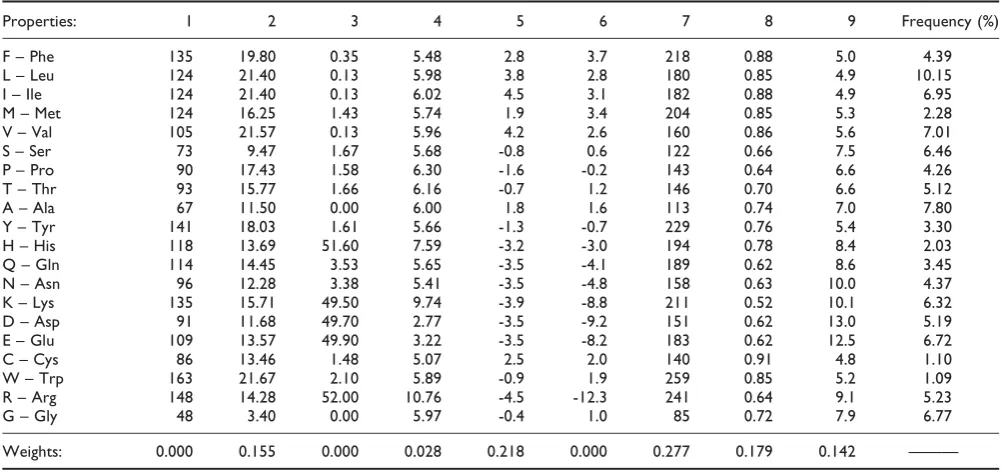
Properties: 1 2 3 4 5 6 7 8 9 Frequency (%)
F–Phe 135 19.80 0.35 5.48 2.8 3.7 218 0.88 5.0 4.39 L–Leu 124 21.40 0.13 5.98 3.8 2.8 180 0.85 4.9 10.15 I–Ile 124 21.40 0.13 6.02 4.5 3.1 182 0.88 4.9 6.95 M–Met 124 16.25 1.43 5.74 1.9 3.4 204 0.85 5.3 2.28 V–Val 105 21.57 0.13 5.96 4.2 2.6 160 0.86 5.6 7.01 S–Ser 73 9.47 1.67 5.68 -0.8 0.6 122 0.66 7.5 6.46 P–Pro 90 17.43 1.58 6.30 -1.6 -0.2 143 0.64 6.6 4.26 T–Thr 93 15.77 1.66 6.16 -0.7 1.2 146 0.70 6.6 5.12 A–Ala 67 11.50 0.00 6.00 1.8 1.6 113 0.74 7.0 7.80 Y–Tyr 141 18.03 1.61 5.66 -1.3 -0.7 229 0.76 5.4 3.30 H–His 118 13.69 51.60 7.59 -3.2 -3.0 194 0.78 8.4 2.03 Q–Gln 114 14.45 3.53 5.65 -3.5 -4.1 189 0.62 8.6 3.45 N–Asn 96 12.28 3.38 5.41 -3.5 -4.8 158 0.63 10.0 4.37 K–Lys 135 15.71 49.50 9.74 -3.9 -8.8 211 0.52 10.1 6.32 D–Asp 91 11.68 49.70 2.77 -3.5 -9.2 151 0.62 13.0 5.19 E–Glu 109 13.57 49.90 3.22 -3.5 -8.2 183 0.62 12.5 6.72 C–Cys 86 13.46 1.48 5.07 2.5 2.0 140 0.91 4.8 1.10 W–Trp 163 21.67 2.10 5.89 -0.9 1.9 259 0.85 5.2 1.09 R–Arg 148 14.28 52.00 10.76 -4.5 -12.3 241 0.64 9.1 5.23 G–Gly 48 3.40 0.00 5.97 -0.4 1.0 85 0.72 7.9 6.77
Weights: 0.000 0.155 0.000 0.028 0.218 0.000 0.277 0.179 0.142 ———
Definitions of the 9 properties used to construct the distance matrix: 1. Volume from van der Waals radii [32].
2. Bulkiness–a measure of the shape of the side chain [33].
3. Polarity–a measure of the electric field strength around the molecule [33]. 4. Isoelectric point [33].
5. Hydrophobicity scale [34]. 6. Hydrophobicity scale [35].
7. Surface area accessible to water in an unfolded peptide [36]. 8. Fraction of accessible area lost when a protein folds [37]. 9. Polar requirement [30].
the bottom of Table 1 (specifically, these are the values from model W3, shown in Table Four of [38]). In this paper we will use these values of the weights to define
dW. Waglechner [39] considered several other data sets and showed that the weights are surprisingly consistent between sequences from different organisms. There are three properties for which wk = 0, i.e. the distance does not depend on these properties. This is due to the relatively strong correlation between some of the proper-ties. If one property captures an aspect of the data well, the weight associated with a slightly different, but strongly correlated property can become zero.
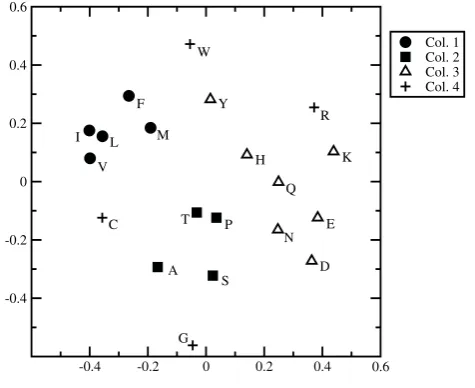
The choice of distances is important in what follows; therefore the full dW matrix with these weight values is shown in Additional file 1. As a help to visualize what these distances mean, Figure 1 shows a two-dimensional representation of the matrix obtained by multi-dimen-sional scaling using the Permap program [40]. The program positions points in two dimensions such that the distances in the two-dimensional space are as close as possible to the original distances in the multi-dimensional space. The result is invariant to rotation; therefore we have rotated the figure so that the similarity with the principal components plot of [31] and [18] can be seen. Thex axis correlates strongly with hydrophobi-city and theyaxis correlates strongly with size. Figure 1 also illustrates that the amino acids in the first three columns of the genetic code are clustered in property
space, but those in the fourth column are not. It also shows several other points that are intuitively reason-able, e.g. the particularly tight clustering of the three amino acids with simple hydrocarbon side chains (I, L and V), and the closeness of the two acids (D and E), the two amines (N and Q), the two most basic amino acids (R and K), and the aromatic amino acids (F, Y and W).
In summary, the weighted distance measure defined in this way is our best estimate of an evolutionarily meaningful distance measure, and we will use this as a cost function in this paper. Note that the multidimen-sional distance defined in equation 1 is used. The projection to two dimensions in Figure 1 is merely shown as a visual aid.
Defining cost and fitness for codes with fewer than 20 amino acids
We begin with the standard function for the cost of the code used for comparing alternative codes with 20 amino acids [6-8,13]. For any given substitution cost function,g, the mean cost of an error,F, is defined to be the average value of g for all possible types of error, weighted by the frequency with which they occur. This can be written
Φ =
∑
∑
F p g a ai ij i jj i
( , ) (3)
where Fi is the frequency of codon i in the gene sequences, pij is the probability that codon i is mistranslated as codon j and ai and aj are the amino acids assigned to codons iand j.Fis a property of the arrangement of amino acids in the code. Thus, for convenience, we will refer toFas the 'cost of a code'. We will follow Giliset al. [6] and take
Fi=P a( ) / ( ),i n ai (4)
where P(ai) is the frequency of amino acid ai in the protein sequences of the organism and n(ai) is the number of codons assigned toaiin the code in question. This assumes that all codons for a given amino acid have equal frequency, but amino acids have different frequencies that can be estimated from protein sequence data. We will use the average amino acid frequencies calculated from representative genomes of all three domains of life [6]. These frequencies are reproduced in the final column of Table 1.
Letεbe a parameter that controls the rate of translational error. Following Freeland & Hurst [2], we will use a form of the error probability matrix that makes transition errors more frequent than transversion errors and makes -0.4 -0.2 0 0.2 0.4 0.6
-0.4 -0.2 0 0.2 0.4 0.6
Col. 1 Col. 2 Col. 3 Col. 4 F
L
I M
V
S P T
A Y
H
Q
N K
D E W
C
R
G
Figure 1
2ndposition errors less frequent than 1stand 3rdposition errors.
pij=e (5)
if iand jdiffer by any change at third position or by a transition at first position;
0.5εifiandjdiffer by a transversion at first position or a transition at second position;
0.1εifiandjdiffer by a transversion at second position; 0 ifiandjdiffer at more than one position.
The probability of correct translation is pii pij j i = −
≠
∑
1 .
With these choices of Fi and pij, F is equivalent to equation (2) of Gilis et al. [6]. Possible alternatives would be to assume all codons have equal frequencies (Fi = 1/61 for all sense codons) or to assume that all single-base errors occur with equal probability (pij=εin each case). In fact, the evidence to support the relative rates of error in equation (5) is rather weak (see the comments of Ardell on the paper of Novozhilov et al. [13]). However, it is very likely true that the error rate at 2nd position is lower than that at 1st and 3rd positions; therefore, we feel that the parameterization above is significantly better than setting all single-base errors rates to be equal.
For an evolutionary argument, we need to relate the cost, F, to fitness. Consider an organism that makes many proteins using a given code. At each site there is some probability of an error, and the cost of an error will be given by thegfunction for the substitution that occurs. If we assume that the costs of the errors are additive over sites, that there are many sites, and that each gene is translated many times, then the typical cost to an organism using this code is proportional the mean value of the g function, which is F, defined as in equation 3. If we then suppose that fitness varies linearly with cost, the typical fitness of an organism can be writtenw= 1 -sF, wheresis a parameter representing the strength of selection against translational error. Thus, minimizing Fis equivalent to maximizing fitness. This assumption is made implicitly by previous authors, although it is not often stated. We will also make the same assumption, but we wish to emphasize that it is only true if we assume that the costs and the fitness effects of errors are additive over sites.
Previous studies have assumed that the same set of 20 biological amino acids was present in all the random codes considered. We now wish to modify the F function to consider code variants with fewer than 20 amino acids that may have existed prior to the standard code. Suppose that, at each site in a protein, one particular amino acid is preferred according to
selection for molecular structure and function. A site where amino acid a is preferred will be called a type-a
site. We suppose the that the average frequencies of sites can be estimated from the frequencies of amino acids in current proteins, i.e. the frequency of type-asites isP(a), as was used in equation 4. If the full set of amino acids is represented in the genetic code, then a codon for amino acidawill be used at every type-asite in the genome. The possible occurrence of codons for other amino acids at a type-a site is neglected, because it is assumed that translational error is more important than deleterious mutations.
Now consider a code withKamino acids, whereK< 20. It is not always possible to use a codon for the preferred amino acid at every site because the preferred amino acid may not be in the code. For every amino acida, letB(a) be the best available amino acid, i.e. B(a) is the amino acid in the current code for whichg(a,B(a)) is smallest. If
ais included in the code already, thenB(a) =a, andg(a,B
(a)) = 0. Ifais not yet included in the code, thenB(a)≠
a, andg(a,B(a)) > 0. The best protein sequences that can be produced using the current code will use a codon for
B(a) in every type-asite. We may now write
Φ =
∑
∑
∑
P i p gij ajj i
( ) ( )a f a ( ,a ),
a
(6)
where a labels the type of site (a runs over all the 20 biological amino acids), and i(a) is the frequency of codoniat sites of typea. Suppose that the genome uses a codon for the best available amino acid at every site, and that synonymous codons are used with equal frequency. In this case
f ai( )=d( , ( )) / ( ),a Bi a n ai (7)
where theδ-function is 1 if the two arguments are equal and is 0 otherwise. This says that codoniwill be used at sites of typeaif the amino acid assigned to codoniisB
(a). For a code withK= 20,B(a) =afor everya. In this case
P( ) ( )a f ai =P( ) ( , ) / ( )a d ai a n ai =Fid( , ).ai a (8)
tends to zero, thenpij=δ(i, j). Hence, from equation (6), Ftends to a limiting valueF0, given by
Φ0=
∑
∑
P g ai a B n ai
i i
( ) ( , ) ( , ( )) / ( ).a a d a a
(9)
F0is no longer a cost of translational error, it is a cost of
using the best available amino acid instead of the preferred amino acid. As we are assuming fitness decreases linearly with cost, F0 should be interpreted
as the reduction in the fitness of proteins using the best available amino acids with respect to 'ideal' proteins that use the preferred amino acids at every site. We now have a way of comparing codes with different numbers of amino acids, and we have a way of quantifying the advantage to introducing a new amino acid into the code.
The driving force for adding new amino acids is the reduction inF0, not the reduction in translational error.
F0will always decrease every time a new amino acid is
added, because for everya, the best available amino acid after addition of a new code is either more similar to a than it was before or the same as it was before (i.e.g(a,B
(a)) either decreases or stays the same). When the translational error rate, ε, is non-zero, the cost function in equation (6) contains the leading term,F0, and an O
(ε) term that represents translational error. AlthoughF0
decreases when a new amino acid is added, the O(ε) term usually increases because there are fewer synon-ymous substitutions when codons are divided into smaller blocks. The balance of the two terms therefore determines whether the addition of the new amino acid is favourable.
Changes in the code cost function when a new amino acid is added
Suppose that the current code at any stage of evolution is defined by a specific set of assignments aicur of codons to
amino acids, and that the current set of best available amino acids is Bcur(a). Hence the codon frequencies at each type of site and the code cost can be determined:
ficur( )a =d(aicur,Bcur( )) / (a n aicur), (10)
Φcur
icur ij jcur j
i
P p g a
=
∑
∑
∑
( )a f ( )a ( ,a ).a
(11)
Now suppose a change happens in the code such that a former block of codons is subdivided, and a new amino acid is added to the code. The new code is defined by ainew. For the codons that have been reassigned, ainew is an amino acid that was not previously in the code. For the majority of codons that have not changed assign-ment, ainew=aicur. Immediately after this change in the
translation system, the gene sequences are the same as they were before; therefore the codon frequencies are still the same as before. In this intermediate state the code cost is
Φint
( ) ( ) ( , ),
=
∑
∑
∑
P icur p gij anewjj i
a f a a
a
(12)
where the amino acids of the new code appear in the cost function but not in the codon frequencies. After the change has occurred, the new set of best available amino acids is Bnew(a). Mutations can occur in the coding sequences in order to adapt to the new code. Codon i
will now be used at sites of type a if ainew = B
new (a). Hence, after adaptation to the new code, the codon frequencies and code cost are:
finew( )a =d(ainew,Bnew( )) / (a n anewi ), (13)
Φnew
inew ij newj j
i
P p g a
=
∑
∑
∑
( )a f ( )a ( ,a ),a
(14)
where the new values are used both in the cost function and the codon frequencies. The change in the cost between the new and old codes isΔF =Fnew-Fcur. The more negativeΔF, the greater the increase in fitness due to the addition of the new amino acid.ΔFwill be negative for adding almost any amino acid in almost any position of the code in the early stages of code evolution because of the decrease in theF0term, as discussed in the previous
section. However, this decrease in F only applies after many mutations have occurred in the coding sequences and the sequences have adapted to the new code. The difference in cost immediately after the code has changed and before the genes have adapted to the new code isδF= Fint
-Fcur. The value ofδFis strongly dependent on which new amino acid is added in which position. If an amino acid is added in a random position, δF is likely to be positive, because the codons previously specified the best available amino acid for the site, whereas they now specify a new randomly added amino acid. In other words, there is a barrier to adding an amino acid in a random position because it disrupts the protein sequences that were being synthesized using the old code. IfδFis positive, selection will tend to prevent the addition of the new amino acid to the code because the organism that first tries out the new code will initially have a lower fitness than the rest of the population. Note thatδFis likely to be positive even ifΔFis negative, so the short-term cost will prevent addition of the new amino acid even if there would be a long-term benefit after the genes adapted to the new code.
causes minimal disruption to genes coded by the existing code, it is possible for bothδFandΔFto be negative. In this case, natural selection will favour the addition of the new amino acid because the organism that tries out the new code will have an increased fitness initially, and an even further increased fitness after its genes adapt to the new code. To see this, letabe the new amino acid. Before the addition of a, the most similar amino acid in the current code was b= Bcur(a). At sites of type a, codons coding for b were used because these were the best available. Now suppose some of the codons of b are reassigned toa. Codons that code foraare now used at sites of type a. These codons are now in the right place without any mutation in the gene sequence; hence cost is reduced at sites of type a. It should be remembered, however, that there are also sites of type b at which codons for bwere already being used in the right place before the code was changed. Thus, when some of these codons are given toa, the cost at sites of typebincreases initially. Furthermore, the addition of a can cause changes in costs at sites that are neither type a or type
b. So the value ofδF depends on a mixture of all these effects. The main goal of the rest of this paper is to demonstrate that there are indeed some cases for which δFis negative, and that the evolution of the code is likely to follow the pathways for whichδFis negative.
Several aspects of the above theory are similar to that of Ardell and Sella [26]. These authors also consider a set of sites of different types and calculate frequencies of each codon and each site type. These authors calculate the invasion fitness of a variant code, which is the fitness of an individual using the variant code to translate a message that has the expected equilibrium codon usage of the established code. The variant code can spread if the invasion fitness is higher than the fitness of the established code. This is equivalent to our criterion that δFis negative. However, the changes in the code used in [26] correspond to reduction of ambiguity of codon blocks that previously coded for more than one amino acid as well as reassignment of a codon block from one single amino acid to another. Also, code fitness depends on mutational load in Ardell and Sella's model; whereas in our case it only depends on translational error. We have ignored mutation because of the expectation that if the code evolved in a late-stage RNA world, the organism must already have evolved an efficient means of accurate replication of long RNAs, so the mutation rate would already be small. On the other hand, if the translation process is new, it is likely to be inaccurate initially. Practically, it is much more complex to deal with mutations than translational error. The method of [26] requires calculating the quasispecies distribution that describes mutation-selection balance. This is an infinite-population approximation. A full treatment of mutation
would need to introduce finite population size and fixation rates, as in population genetics theory. We showed above that leading termF0in the code cost does
not depend onε. If mutation rate,u, were also added to the theory, then in the limit of small u, F0 would not
depend onueither. As it is the changes inF0that are the
major component ofδFandΔF, we expect that ignoring mutational load will affect the conclusions very little.
The earliest amino acids and the four-column code
Before we can consider pathways of code evolution, we need to consider the starting point. It has been noted that there is a strong correspondence between the amino acids found in meteorites and Miller-Urey experiments [41,42] and it has been suggested that the amino acids that are found in these situations are the ones most likely to have been early additions to the genetic code [19,20]. Trifonov [43] assembled many papers in which a huge variety of criteria had been used to predict the order of addition of amino acids to the code, and used these to obtain a consensus rank order. This ranking appears useful to us, but we were concerned that it incorporates many very speculative criteria. Therefore, we repeated a similar procedure using only criteria based on measured concentrations of amino acids in non-biological contexts [23,24]. The order that emerges is very similar to that of Trifonov [43]. The criteria we use include prebiotic synthesis experiments of the Miller-Urey type, observed frequencies in carbonaceous chondrite meteorites, synth-esis in hydrothermal vent conditions, experiments mimicking the chemistry on icy dust grains in proto-planetary disks, and a variety of other attempts at prebiotic chemical synthesis. These different experiments are related to completely different theories about the mechanisms and locations of amino acid formation–on Earth versus outside Earth, high versus low temperature,
etc. Nevertheless, there is a surprising consensus onwhich
amino acids are easy to form, even if there is no agreement at all on where and how. The following 10 amino acids are found in many of these experiments, and these can be ranked in order of decreasing relative concentrations, as follows:
Gly, Ala, Asp, Glu, Val, Ser, Ile, Leu, Pro, Thr.
only be added to the code at a later stage, after biochemical synthesis pathways evolved. We agree with proponents of the coevolution theory of the code [19-22] that the evolution of biochemical synthesis pathways alongside the development of the code is important. The top 10 according to our procedure are exactly those in the Miller experiments, however, we wish to remain agnostic on the mechanism of amino acid formation because completely different mechan-isms give rise to essentially the same amino acids. The reason for this appears to be thermodynamics. Higgs and Pudritz [23,24] showed that the rank order for the 10 early amino acids correlates extremely well with the free energy of formation of the amino acids. The amino acids that are thermodynamically least costly to form are at the top of the list.
It is remarkable that the top 5 amino acids on our list (i.
e. those with highest prebiotic concentrations) are precisely those that occupy codons with G at first position. This leads us to propose a very early version of the code that used only these GNN codons. This same early stage of the code is also proposed in a recent version of the coevolution theory [22], and this also forms the starting point for several much earlier treatments of genetic code evolution [17,44-47]. It has also been proposed that that a regular pattern of G's at first position could have been important in keeping the early ribosome in frame [48]. However, if three quarters of the codons were unassigned, then all mutations occurring at 1st position would render the gene non-functional or impossible to translate. We therefore propose that the code rapidly expanded to give the four-column structure in Figure 2. As both Asp and Glu are in our top 5 early amino acids, it is possible that the third column could have been Glu instead of Asp, or that there was a mixture of Asp and Glu codons in this column, or that this column coded both Asp and Glu ambiguously. For concreteness in Figure 2, we have taken the simplest possibility, which is that this column coded only for Asp.
The four-column code is a triplet code, although only the middle base in the codon specifies any information. Although it is possible to code for only four amino acids with codons of length two (or even one) base, it is unlikely that this was ever the case, because the evolution of such a code to a triplet code would require the complete reinvention of the mechanism by which the ribosome shifts along the mRNA and the complete rewriting of all the gene sequences that were written in the two-base or one-base code. Furthermore, it is likely that the earliest tRNAs – or at least the anticodon loop of these tRNAs – had the same structure as modern tRNAs. The structure of the anticodon loop is
thermodynamically stable and has remained evolutio-narily stable in modern tRNAs of all types. The codon-anticodon interaction involves the bases at all three positions. It is unlikely that stable codon-anticodon recognition and discrimination could have been achieved with fewer than three bases.
The typical set of tRNA genes found in modern prokaryotes is such that there is at least one tRNA gene for every pair of codons: a tRNA with a G (or modified G) at the wobble position pairs with codons ending U and C, and a tRNA with U (or modified U) at the wobble position pairs with codons ending A and G [49,50]. In mitochondria, there are many cases where a single tRNA with wobble-U pairs with all four codons in a four-codon block, however, it seems clear that these are derived from bacterial ancestors that used two different tRNAs for every four-codon block. There are also a few cases where bacteria use only one tRNA for a four-codon block, but these are probably also due to tRNA gene deletions, as they occur principally in parasitic or endosymbiotic bacteria with very reduced genome sizes. Thus, under the assumption that each tRNA paired with two codons, it would have required 32 different tRNAs to translate the four-column code–8 for each amino acid.
If the GNN code existed before the four-column code, as suggested above, then all tRNAs would have had C at Figure 2
the 3rdanticodon position (which matches the 1stcodon position). It is straightforward for the GNN code to progress to the four column code by duplication of these tRNAs and mutation of the C to any of the other bases. The 8 tRNAs for each amino acid would then have differed from each other at the 1st and 3rd anticodon positions, but may have been almost identical in the rest of the sequence. The tRNAs must have been 'recharge-able', as they are now. After each amino acyl-tRNA has had its amino acid used in protein synthesis, it must be recognized by an amino acyl-tRNA synthetase and recharged with the correct amino acid. The synthetases are proteins in modern organisms, but as the earliest stages of code evolution occurred in the RNA world, we must suppose that there were synthetase ribozymes that did the charging. Correct charging requires accurate molecular recognition that distinguishes one tRNA from another. The proposed four-column code makes this relatively easy. If early synthetase ribozymes used the anticodon to recognize the correct tRNA (as do many modern synthetase enzymes), then all they would need to do is recognize the middle base of the anticodon. All tRNAs with the same middle base would be charged with the same amino acid. Thus, possibly only four synthetase ribozymes were required at this stage.
The proposed four-column code has one further impor-tant advantage–it minimizes the effects of translational error. If the relative rates of different types of error are as in Equation (5), then the total error rate of any codon in the four-column code is 0.7ε, because only 2ndposition errors have an effect. This may be compared with a codon in a two-codon family in the modern code, in which the total error rate is 4.7ε. The value of ε is a property of the ribosome. Early ribosomes were prob-ably error-prone. It would therefore be important to begin with a code with a simple structure in which the effects of errors were minimized. There would also have been selection on rRNA to reduce the error rate of the ribosome at the same time as the code was evolving, and this may have helped to minimize the increasing number of errors that would be inevitable as the number of amino acids in the code increased and the codon blocks got smaller.
Although the relative rates of errors of different types may not be precisely as in Equation (5), the reason that the error rate at 2ndposition is lower than the other two positions is easy to see from the point of view of RNA structure. It is known that a large proportion of the free energy associated with helix formation is due to stacking of neighbouring base pairs in a helix rather that hydrogen bonding of single pairs between the two strands. For this reason, single base pairs are unstable in the standard set of energy rules used for RNA
secondary structure prediction (see [51] and references therein). If a mismatch occurred at the 2nd position in the codon-anticodon interaction, this would leave two unstacked single pairs; therefore this would be very unstable and the corresponding error would never occur. If the mismatch occurred at 1st or 3rd position, this would still leave two stacked pairs. This might be marginally stable for sufficiently long for the ribosome to make an appreciable error rate. Given the importance of the middle base in the codon-anticodon interaction, it seems logical that it should be the middle base that contains the coding information in the four column code that we propose.
In summary, the thermodynamics of amino acid synth-esis, the simplicity of tRNA charging, and the low rate of translational error all point to the four-column code as a good candidate for an early stage in genetic code evolution. We therefore treat this code as a starting point in what follows.
Evolution of the four-column code by subdivision of codon blocks
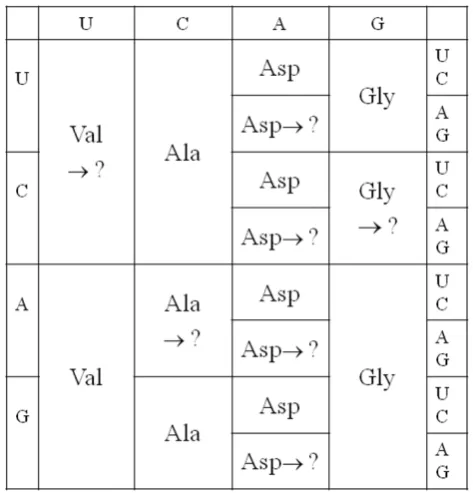
Figure 3 shows several possible steps by which the four-column code could have evolved via subdivision. One possible example of subdivision has been chosen in each column. In column 1, we consider the reassignment of
Figure 3
the 8 codons UUN and CUN from Val to some other amino acid, and we aim to determine which other amino acids might be added to this position. It would appear that, in fact, Leu was added to this position, and we wish to see whether the theory can predict this. In order to reassign these codons, there must have been some change to the amino acyl-tRNA synthetase ribozyme that was charging these tRNAs. The tRNAs for the UUN and CUN codons would have had A and G at the third anticodon position, whereas those for AUN and GUN would have had U and C. Hence, the new synthetase needs to evolve the ability to distinguish between purines and pyrimidines at the 3rd anticodon position (in addition to discrimination of the 2ndposition base, which it does already). We suppose that the original synthetase for the Val column duplicates and that the two synthetases diverge evolutionarily and specialize to different amino acids and different codons. In this way the organism can 'try out' using a new amino acid in the UUN and CUN codon blocks.
In column 2, the ACN block was chosen as an example. This is now occupied by Thr. To distinguish this four-codon block would require the evolution of a synthetase that recognized U at the 3rd anticodon position. The example chosen in column 4 is CGN, which is now Arg. This could have occurred by a similar kind of evolution of the synthetases. In Column 3, we considered a possible subdivision into 8 blocks of 2 codons. This would only require a new synthetase that discriminates between purines and pyrimidines at the 1st anticodon position (i.e. the wobble position). Creation of 8 blocks of 2 in column 3 is thus no more difficult than creation of 2 blocks of 8 in column 1. The synthetase simply learns to discriminate a different base in the anticodon. We will consider the possible addition of Glu to the 4 blocks of 2 that are reassigned (as shown in Figure 3). We know that Glu occupies GAR in the final code, but CAR and AAR are occupied by Gln and Lys, both of which are similar to Glu (see Figure 1). This points ahead to what might have happened at a later stage of code evolution. As a first step, however, we will simply look at addition of Glu.
We acknowledge immediately that we have no reason to say why a particular pattern of subdivision into 8's, 4's or 2's should have occurred in one column rather than another. At this point, we have simply picked possibi-lities that look like they are consistent with the positions of the codon blocks in the final code. The proposed method for trying out a new amino acid in the code depends on the evolution of a new synthetase ribozyme that handles an amino acid that was not previously in the code. It does not necessarily require evolution of the tRNAs. This is in contrast to what occurs in codon
reassignments in modern codes, where the reassignment is constrained to keep the same 20 amino acids. In the modern reassignments, it is usually the tRNA that changes by an anticodon mutation or a base modifica-tion so that it gains the ability to pair with a new codon [10,11]. The synthetase enzyme does not change, because it is important that the mutated or modified tRNA is still charged with its original amino acid.
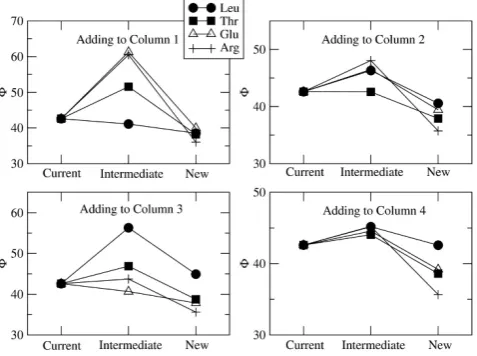
The four amino acids that appear to have been added in the positions shown in Figure 3 are Leu, Thr, Glu and Arg. We will therefore consider what happens to the cost of the code when we try adding each of these amino acids in each of the four positions. Figure 4 shows the cost of the current code (Fcur in equation 11), the
intermediate state when the new amino acid is first tried out (Fint in equation 12), and the new code after the
codons have adapted to the code (Fnewin equation 14).
The current code is the four-column code in Figure 2 in each case; thereforeFcuris the same in each case. These
examples were done withε= 0.05, which we consider to be a relatively large error rate.
In column 1, it can be seen that ΔF is negative for addition of all four of these amino acids, but δF is
Figure 4
negative only for Leu. Thus it would pay to add any of them in the long term, but the change that causes the reassignment is only favoured selectively in the short term for Leu. In column 2,δFis slightly negative for Thr, but substantially positive for the others. In column 3,δF is negative for Glu and positive for the others. Thus in the first three columns, selection favours the addition of the correct amino acid in each case. In column 4, however, δF is positive for all four amino acids. Selection does not favour the addition of Arg in column 4 or in any of the other positions considered in Figure 3. Notice also that ΔFfor Arg is the most negative of the four amino acids considered for each of the four columns. There is a lot to gain from adding Arg because it is very different from any of the amino acids already present in the code, and by adding it, the diversity of possible protein sequences would be increased more than by addition of Leu, Thr or Glu. However, because Arg is very different, it is disruptive to the existing sequences and therefore there is a large barrier prevent-ing its addition to the code.
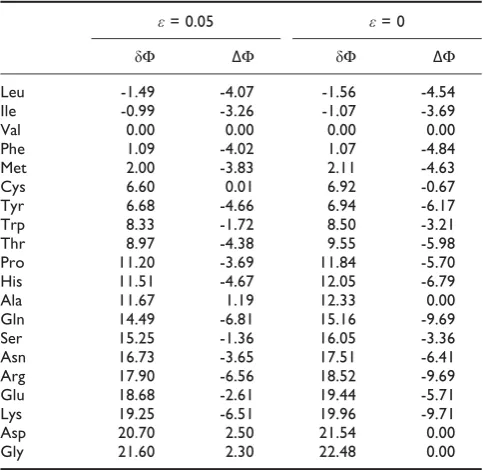
Figure 4 illustrates the fact that there is a selective barrier for addition of most amino acids in most positions, but that the barrier can be negative for particular amino acids in particular positions. We now consider the details of this more carefully. Table 2 shows the values of δFand
ΔF for the attempted addition of all 20 amino acids to the 8-codon block in column 1. Results are shown when error is present (ε= 0.05) and when error is absent
(ε= 0). The amino acids are listed in order of increasing δFwhen error is present. Leu has the most negativeδF, i.
e. Leu is the amino acid whose addition at this position is most strongly favoured by selection. Of course, Leu is exactly the amino acid that is added at this position in the real code. The addition of Ile is also favourable. For Val, bothδFandΔFare zero, because these codons are already assigned to Val. The other amino acids all have positiveδF. As the other three columns are occupied by a single amino acid, it makes no difference which position in column 1 is reassigned. If the calculation is repeated with a block of 4 or 2 codons anywhere in column 1, then the result is thatδF is negative for Leu and Ile only. In particular, if the AUN block (which is Ile in the standard code) is considered,δFis negative for Ile. Thus selection favours the addition of both Leu and Ile to their correct positions.
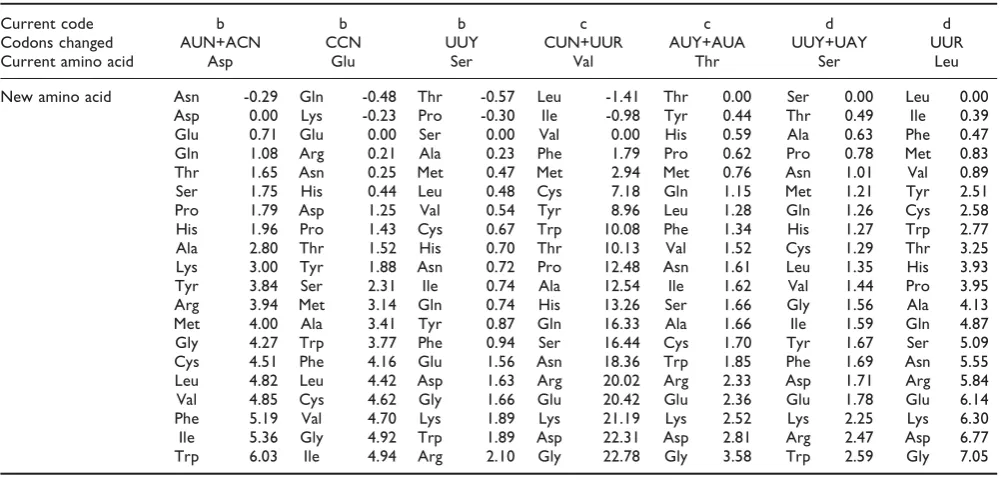
Table 2 also shows that the two amino acids with the smallest positive barrier are Phe and Met, which also are found in column 1 in the standard code. These two amino acids are probably later additions; therefore we will return to them later.
It can be seen that there is little difference between the results withε= 0.05 andε= 0. This is because there is a big potential gain in the leading cost term (F0 in
equation 9), which is not affected by translational error. One difference that is apparent is that whenε= 0,ΔF= 0 for Ala, Asp and Gly, which are already in the code elsewhere, whereasΔFis positive for these amino acids whenεis non-zero. This is because there is no gain in the F0 term for adding an amino acid to column 1 that is
already present elsewhere, but the translational error term is made worse by doing this. The fact that the error term makes little difference is good news, because this term depends on quantities that we do not know precisely, such as the relative rates of errors of different types. Thus, the conclusion that the addition of Leu and Ile into column 1 is selectively favourable is valid, despite the uncertainty of these details.
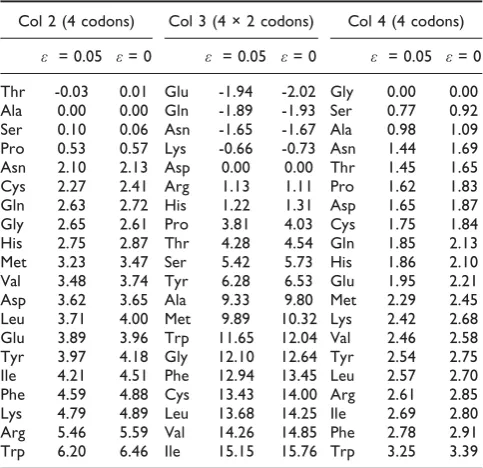
Table 3 considers possible additions to the other three columns in the positions illustrated in Figure 3. For simplicity, onlyδFis shown in these tables, becauseΔF tells us little about the evolutionary dynamics. For additions to the ACN box, which is Thr in the standard code, the only amino acid with negativeδFis in fact Thr. The two smallest positive barriers are for Ser and Pro, which are also found in column 2. Thr, Pro and Ser are, of course, the amino acids that need to be added into column 2. The addition of these three amino acids is thus either selectively favourable or can be achieved by overcoming only a small positive barrier. We will consider small positive barriers again below.
Table 2: Barriers (δF) and net changes in cost (ΔF) for addition of amino acids to an 8-codon block in column 1
ε= 0.05 ε= 0
δF ΔF δF ΔF
Leu -1.49 -4.07 -1.56 -4.54 Ile -0.99 -3.26 -1.07 -3.69
Val 0.00 0.00 0.00 0.00
For the calculations shown in Table 3, it was supposed that the other columns were still uniform, i.e. the whole of column 1 was still Val. In this case it makes no difference whether we consider addition to the UCN or CCN block instead of the ACN block. The assignments of Thr, Pro and Ser in column 2 may have occurred before the assignments of Leu and Ile in column 1. According to current biosynthetic pathways [20,22], Thr is a precursor of Ile, so it might make more sense to add Thr first. However, Ser, Ile, Leu, Pro and Thr, which are assigned to columns 1 and 2, are all found non-biologically to some extent. Therefore they appear in our list of 10 early amino acids. If these amino acids were present in sufficient quantities in the environment, they could have been incorporated into the code before biosyn-thetic pathways evolved. Note that, if ε = 0, then the columns are completely independent, so the order of addition of these amino acids to columns 1 and 2 makes no difference to the calculation. If εis non-zero, it only makes a small difference, because the 2nd-position error rate is small. Furthermore, Val, Leu and Ile are all similar, so when we consider addition of Thr to the ACN block, for example, it only makes a very small difference whether the AUN block is assigned to Val, Leu or Ile at this point.
For additions to the four 2-codon blocks in column 3, Table 3 shows that the most negative δF is for Glu, exactly as expected.δFis also negative for Gln, Asn and Lys. These amino acids are also found in column 3 in the standard code, so this makes sense. However, these three
are late amino acids, so we will presume that Glu was added at this early stage, and we will return to the other three amino acids at a later stage. The splitting of column four into 8 blocks of 2 codons in this way is speculative, but is appealing because, in one step, it creates the structure of 8 blocks that is a feature of column 3 in the standard code. We have explained above, why creation of 8 blocks of 2 is no more difficult than creation of 2 blocks of 8. An alternative would be that only the two GAR codons were reassigned at this stage. The same amino acids have negative δF if only GAR codons are considered. Thus, either way, this theory successfully predicts that Glu can be added into its correct position.
Table 3 also considers additions to the CGN block in column 4. No amino acid has negativeδF. The smallest positive barrier is for Ser, which is suggestive because Ser does occur in column 4 in the standard code. The barrier is pretty large for all the other amino acids, including Arg, which is found in the CGN position in the standard code. Thus, we conclude is that it is not selectively favourable to add any new amino acids to column 4 at this stage. It should also be noted that Arg, Cys, and Trp (which need to be added to column 4 at some stage) are all late amino acids, so they may not have been around at this early stage of code evolution in any case.
Later stages of code evolution
In the previous section, it was demonstrated that the amino acids Ser, Ile, Leu, Pro and Thr, can all be added to their correct positions in the code either by positive selection (negative δF) or by overcoming only a small selective barrier. It therefore seems reasonable to propose a 10 amino acid code shown in Figure 5, which is an intermediate stage of code evolution that incorporates all 10 of the amino acids that we classed as early [23,24]. We will now consider possible evolution of the code from this point on.
Table 4 shows values of δF and ΔF for attempted reassignment of the two UUY codons from Leu to other amino acids. There are no amino acids with negativeδF. The smallest positive barriers are for Ile and Phe. The standard code has Phe in this position. For the amino acids that are already in the code, including Ile, ΔF is positive (not shown in the table). This is because assigning UUY to these amino acids gains nothing in improved protein diversity but increases translational error with respect to the 10 amino acid code. Thus, there is no driving force for adding Ile in the UUY position. On the other hand ΔF is negative for adding Phe. So the theory predicts that Phe is the easiest amino acid to add at this point that is not already in the code, but suggests that there is a small barrier to overcome during the
Table 3: Barriers (δF) for addition of amino acids to codon blocks in columns 2, 3 and 4 in the positions indicated in Figure 3
Col 2 (4 codons) Col 3 (4 × 2 codons) Col 4 (4 codons)
ε = 0.05 ε= 0 ε = 0.05 ε= 0 ε = 0.05 ε= 0
reassignment. The next easiest after Phe is Met, and Met is also found in column 1. We repeated the analysis with the AUG codon, which is Met in the standard code, and found similar results, i.e. the two amino acids with the smallest positive barriers that are not already included in the code are Phe and Met.
Table 4 shows three further examples of reassignment of two codon blocks from the 10 amino acid code. For the AAY block, which is Asn in the final code, the only amino acid with negativeδFis Asn. For the AAR block, which is Lys in the final code, the most negative δF occurs for Lys, and Gln also has negative δF. The calculation for the CAR block, which is currently Gln, is not shown because it is almost identical to the AAR block, i.e. both Lys and Gln have negative δF for addition to the CAR block. Thus, the theory predicts that the addition of Asn, Lys and Gln into their current positions in column 3 are all selectively favourable. Finally, Table 4 considers addition the AGR block, which is currently Arg. These results are similar to those in Table 3 for the CGN block. There are no additions that are favourable. The general conclusion of the last two sections is that the theory is able to predict the evolution of the first three columns of code very well, but does not apply well to column 4.
Discussion of puzzles remaining
When δF is negative, selection should immediately favour codon reassignment by the subdivision process. The results above show many cases where amino acids can be directly added into their current positions with negativeδF(Leu, Ile, Thr, Glu, Asn, Lys, Gln). However, there are also several examples where the amino acid in the current code is the easiest one to add at that position but there is a slightly positiveδFto overcome (Ser, Pro, Phe, Met). The code cost is dependent to some extent on the choice of amino acid distance function, the frequencies of sites of different types, and the relative rates of errors of different types. It is therefore possible that there is some other slightly different choice of these parameters that would turn these slightly positive δF's into slightly negative ones. However, it would be extremely fortuitous if there were some set of parameters for whichδF turned out to be negative in every case. It therefore seems important to consider how small positive barriers might be overcome.
The theory given above is deterministic. It assumes that all types of sites occur in the genome and that all types of errors occur with given probabilities. It thus ignores fluctuations that would occur in finite size genomes. We suggest that small positive barriers can easily be turned into small negative ones due to fluctuations in finite size Figure 5
Proposed structure of the code after the 10 early amino acids have been added.
Table 4: Barriers (δF) for addition of amino acids to four different 2-codon blocks beginning from the 10 amino acid code in Figure 5
UUY (Phe) AAY (Asn) AAR (Lys) AGR (Arg)
Leu 0.00 Asn -0.02 Lys -0.27 Gly 0.00 Ile 0.32 Asp 0.00 Gln -0.16 Ser 0.36 Phe 0.41 Glu 0.23 Glu 0.00 Ala 0.48 Met 0.73 Gln 0.53 Arg 0.24 Asn 0.68 Val 0.75 Lys 1.09 Asn 0.46 Thr 0.69 Tyr 2.17 His 1.11 His 1.04 Pro 0.77 Cys 2.21 Ser 1.20 Asp 1.13 Asp 0.80 Trp 2.37 Pro 1.21 Pro 1.89 Gln 0.86 Thr 2.83 Thr 1.27 Thr 2.10 Cys 0.86 His 3.38 Arg 1.55 Tyr 2.27 His 0.88 Pro 3.41 Ala 1.92 Ser 2.66 Glu 0.92 Ala 3.55 Tyr 2.11 Met 3.62 Met 1.11 Gln 4.18 Gly 2.20 Ala 3.84 Lys 1.14 Ser 4.39 Met 2.50 Trp 3.86 Val 1.22 Asn 4.76 Cys 2.79 Phe 4.48 Tyr 1.22 Arg 4.98 Leu 3.05 Leu 4.81 Arg 1.23 Glu 5.24 Phe 3.06 Gly 4.81 Leu 1.26 Lys 5.37 Val 3.06 Cys 4.99 Ile 1.32 Asp 5.77 Trp 3.06 Val 5.06 Phe 1.36 Gly 6.02 Ile 3.29 Ile 5.26 Trp 1.58
genomes. Consider the reassignment of UUY from Leu to Phe (Table 4). The theory assumes that there are some sites where the optimal amino acid is Leu and some where it is Phe. The most similar amino acid to Phe in the 10 amino acid code is Leu; therefore Leu codons are used at Phe-type sites as well as Leu-type sites. The deterministic theory assumes that all 8 codons in the UUN and CUN blocks are used with equal frequency at both types of sites. If the UUY codons are reassigned to Phe, this is advantageous where these codons occur at Phe-type sites and deleterious where they occur at Leu-type sites. In a small genome however, there will only be a small number of sites of each type. It is therefore possible that by chance, the number of UUY codons at Phe-type sites will be slightly higher than the number at Leu-type sites. This will tip the balance, and mean that the variant code will be selectively favoured at the point when it first arises. This argument only works because Leu and Phe are relatively similar and because Leu codons were used at Phe-type sites. If one tries to assign a completely different amino acid to UUY–say Lys–this will not occur even in a small genome because the UUY Leu codons would not be used in Lys-type sites prior to the origin of the variant code that incorporates Lys. Thus, a variant code that assigned UUY to Lys would be selected against, even in a small genome.
One piece of evidence that led us to propose the four-column code is that the five earliest amino acids (Gly, Ala, Asp, Glu and Val) are assigned to bottom-row codons (GNN), and this naturally suggests a code in which the 2nd position is the one which specifies the coding information, as discussed above. However, if all the codons in a given column are equivalent in the four-column code (Figure 2), there is no logical reason why the earliest amino acids should remain on the bottom row. For example, it would be equally likely for the AUN and GUN codons to be reassigned to Leu, the CUN to Ile, and for Val to retain the UUN codons. The fact that the earliest amino acids remain on the bottom row means that there must be some special significance of the GNN codons that is retained throughout the early period of code evolution from the four-column code (Figure 2) to the 10 amino acid code (Figure 5). We suggest that this is to do with codon bias. It will always be easier to reassign codons that are rarer, especially if the barrier is slightly positive (as in the previous paragraph). Thus if GNN codons are preferred with respect to the other synon-ymous codons in the same column, this provides a reason why the earliest amino acids retain the frequent GNN codons and the other rarer codons are reassigned. If 1st position G was important in keeping the early ribosome in frame, as suggested above, then it may have been advantageous to retain a G at first position wherever possible. Alternatively, if the first tRNAs were
those that translated the GNN codons, it is possible that these tRNAs remained at higher concentrations in the cell even after tRNAs for the other codons arose. In that case translational selection would favour codons that matched the most frequent tRNAs and would therefore maintain a bias in favour of GNN codons. Whatever the reason, it is necessary for there to be some asymmetry of the code in favour of GNN codons, or else the earliest amino acids would have ended up randomly positioned in their respective columns, and the compelling pattern of early amino acids in GNN codons would not be retained in the final code.
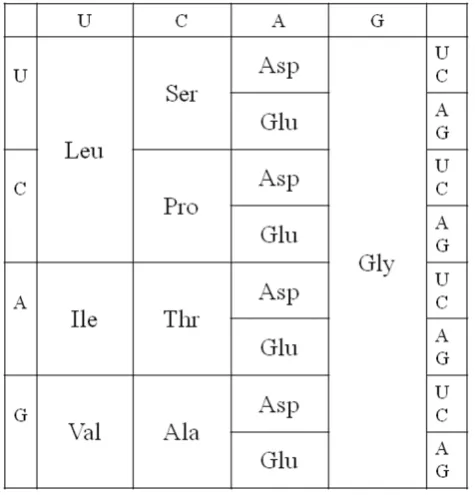
The obvious problem for this theory is that it does not seem to apply well to column 4. Addition of Arg, Cys and Trp all require overcoming relatively large barriers in the calculations above. This may be partially under-standable, however. Although, Gly is the most frequent prebiotic amino acid, and therefore is assumed to be included in the earliest code, it is an outlier in physical property space, as shown in Figure 1. As each new amino acid is added, it is always more similar to at least one of Val, Ala, or Asp than it is it to Gly. Therefore, the new amino acids prefer to join the other three columns and Gly is left all alone in column 4.
By the time we reach the 10 amino acid stage there is a good diversity of amino acids in the code. There is no reason to use Gly as a best alternative to anything else, i.

![Figure 6Early structure of the code predicted by coevolutiontheory (stage b of Di Giulio and Medugno [56]).](https://thumb-us.123doks.com/thumbv2/123dok_us/384865.1531189/19.610.57.295.86.346/figure-early-structure-predicted-coevolutiontheory-stage-giulio-medugno.webp)