R E S E A R C H A R T I C L E
Open Access
Utilisation of internet resources for
continuing professional development:
a cross-sectional survey of general
practitioners in Scotland
Gordon MacWalter
1, John McKay
1and Paul Bowie
1,2*Abstract
Background:Participation in continuing professional development (CPD) is a professional and regulatory expectation of general practitioners (GPs). Traditionally, CPD activity was undertaken face-to-face in educational settings, but internet based formats have found increasing favour. The need for doctors to use the internet for service and educational purposes is growing, particularly in support of specialty training and appraisal. We aimed to determine how GPs in Scotland utilise online resources in support of their CPD. This involved identifying which resources are used and how frequently, along with their preferences as to how and why they access these resources.
Methods:A cross sectional study was undertaken using an online questionnaire to survey general practitioners across Scotland. Data were subjected to descriptive analysis and differences in attitudinal responses between groups and Fischer's exact tests were calculated.
Results:Three hundred and eighty-three GP responses were received, with the majority being female (n= 232, 60.6 %) and GP partners (n= 236, 61.6 %). The majority used the internet on three or more working days per week or more frequently (n= 361, 94.3 %) with the three most common reasons being to obtain information for a patient (n= 358, 93.5 %), answering a clinical question (n= 357, 93.2 %) and CPD purposes (n= 308, 80.4 %). Of 37 online resources used by respondents, the top five were SIGN Guidelines (n= 303, 79.3 %), BMJ Learning (n= 279, 73.0 %), NICE Guidelines (n= 255, 66.8 %), GP Notebook (n= 243, 63.6 %) and Google (n= 234, 61.3 %). Low use of social media such as Facebook (n= 11, 2.9 %) and Twitter (n= 11, 2.9 %) was reported for CPD. A majority agreed that 'reading information online' (95.0 %) and 'completing online learning modules' (87.4 %) were the most valued online activities. Slow internet connections (n= 240, 62.7 %), website access restrictions (n= 177, 46.2 %) and difficulties logging into online CPD resources (n= 163, 42.6 %) were reported barriers. Significant response differences (P< 0.05) were found between groups based on high volume online usage, gender and age.
Conclusions:The majority of respondents had positive attitudes to using online resources for continuing professional development, and a preference for evidence-based and peer reviewed online resources. Information technology (IT) difficulties remain a barrier to effective utilisation. The findings have implications for future planning and design of online resources and IT infrastructure.
Keywords:Online resources, Internet, e-learning, Continuing professional development, General practice
* Correspondence:[email protected]
1NHS Education for Scotland, 2 Central Quay, 89 Hydepark Street, Glasgow
G3 8BW, UK 2
Institute of Health and Wellbeing, University of Glasgow, Glasgow, UK
Background
Participation in continuing professional development (CPD) has long been part of the professional expecta-tions of medical doctors, including general practitioners (GPs). CPD is defined by the Academy of Medical Royal Colleges (2009) as“a continuing process that enables in-dividual doctors to maintain and improve standards of medical practice through the development of knowledge, skills, attitudes and behaviour” [1]. The CPD process is underpinned by the values of adult learning which should be self directed based on learning needs or devel-opment goals and be particularly relevant to frequently encountered tasks [2]. It is vitally important for medical professionals to continuously refresh, update and im-prove their clinical knowledge. This is problematic given that estimations suggest that by 2001 the volume of medical knowledge was doubling at least every 3.5 years, compared with every 50 years in the 1950s [3]. A more recent study has shown that global total scientific publi-cation, including medical publipubli-cation, continues to grow at a rate of 3 % annually from 1980 to 2012 [4].
The introduction of professional appraisal in 2004 re-quired GPs to complete and record CPD activities as part of an annual educational review process. Medical revalidation, introduced in 2012 for all doctors in the United Kingdom, formalised this process with appraisal evidence supporting the periodic revalidation of doctors over a five-year cycle. The evidential appraisal process comprises six main elements: CPD, Quality improve-ment activity, Significant event analyses, Feedback from colleagues, Feedback from patients and Review of com-plaints and compliments [5].
Traditionally, CPD has been undertaken at medical conferences, professional meetings and included talks from experts, along with problem based small group learning (PBSGL) and reading professional printed jour-nals. Advances in information technology (IT) have pre-sented an opportunity for CPD learning to take place using online internet resources and in a less formally structured way.
Previous research has shown that internet based CPD formats can be equally effective as live face-to-face CPD sessions [6–8]. It has also been argued that less-structured learning such as using online resources should be eligible for CPD accreditation [9], as this volves complex high order cognitive processing (e.g. in-formation searching and differentiating, and evaluating information sources). This is also reflected in the advice from the Academy of Medical Royal Colleges that “self-accreditation of relevant activities and documented re-flective practice should be allowed and encouraged” for CPD purposes [1].
For the purposes of this study, the term “online re-sources” was used to describe all relevant World Wide
Web based resources including, for example: clinical guidelines, patient resources, online simulated patient exercises, online learning modules, full-text journal arti-cles and any other useful hyperlink or multimedia based websites. This approach was taken to distinguish from the concept of “e-Learning” which is difficult to define precisely [10] and often includes virtual learning environments (VLE) which are currently more com-monly used at undergraduate level by higher education institutions, rather than for post-qualification CPD purposes [10].
General practitioners in the UK are required to submit a learning log of CPD at each appraisal, that should con-sist of 50 self-assessed credits, where each hour of learn-ing activity accompanied with a reflective record is one learning credit [11].This differs from the use of certified CPD credits that have been utilised by medical profes-sionals throughout the world, although internationally there is a shift to increased use of self-accreditation and reflection [12, 13]. The use of online resources is consid-ered part of CPD for the purposes of this study; as such learning can be self-accredited by UK GPs provided there is an accompanying reflective record. Medical re-validation for licensure via the General Medical Council (GMC) is granted on a 5 year cycle, provided that GPs have participated in five annual appraisals covering an appropriate spread of their work [14].
The use of IT and the internet continues to rapidly increase in Scotland, with a survey in 2014 stating that 81 % of households in Scotland have access to the inter-net [15]. The use of IT in Scottish general practice was accelerated with the introduction of electronic record keeping in the mid 1980s [16]. Since then there has been a rise in the use of the internet within the medical pro-fession as a whole with, for example, 79 % of GPs in Greater Glasgow being connected to the internet in 1999 via health board maintained IT [17]. From 2007 onwards, GP trainees have been required to keep an on-line electronic portfolio of evidence of learning as part of the basis for postgraduate license, making the use of the internet obligatory during training. Similarly, the Scottish online appraisal process necessitates the use of web based technologies, with participation also mandatory for all GPs in Scotland [18]. It can therefore be seen that use of IT and the internet has increased to the extent it is now inextricably linked with everyday general practice activities, including collating and sub-mitting evidence of CPD.
differences in, or barriers to, the uptake of online re-sources. This is important as the results will help inform the future of CPD provision and delivery, as well as pro-vide potential insights into possible training require-ments for users in accessing online resources nationally. It may also serve to guide future developments in local health organisation IT provision and delivery. To our knowledge no recent research has been undertaken on this topic with this specific study population.
Method
Study design
A cross sectional online questionnaire survey was used.
Development and testing of questionnaire
An online questionnaire was created by the authors using Questback software, comprising questions used in previous validated surveys on satisfaction with e-learning [19] and those developed by one of the investi-gators. The survey used a combination of true/false questions, tick all that apply and five-point Likert style responses. There were two sections for free text re-sponses or comments. All responses were kept anonymous.
The draft survey was reviewed by a local clinical edu-cator expert in e-learning and online resources. To in-form face and content validity, it was then piloted in a regional educational office by GPs involved in CPD, ap-praisal and postgraduate training, as well as educational researchers and national practice manager and practice nursing educational leads. Revisions were made at this point to the wording, with clarifications and restructur-ing of the format of some questions. The final survey consisted of 21 items and had a completion time of ap-proximately 10 mins. A copy of the questionnaire survey used is accessible in Additional file 1.
Setting, subjects and recruitment
GPs were recruited via electronic mailshot using a data-base from the national medical education organisation [20] for promoting CPD opportunities on a national basis to GPs, and member lists of three regional ses-sional and locum GP groups, as these individuals are often not included on such organisational lists. Sessional and Locum GPs are defined as GPs whom undertake work on a session by session basis, whom are not GP partners or salaried by one practice. Sessional GPs may work in GP practices as well as in hospital or educa-tional roles, whereas Locum GPs would work in a variety of GP practices. After eliminating duplicates, a total of 3336 individual GPs were invited to complete the ques-tionnaire via an email link sent in February 2015. The questionnaire was open for completion for a total of four weeks. A reminder email was sent after two weeks to
those who had not already responded. Responses were motivated by goodwill, with no incentive for completion offered.
Data analysis
The collected data was analysed and basic descriptive statistics generated including frequency counts and mean values related to individual question/statement re-sponses. A 5-point Likert style scale was used alongside attitudinal statements (using a scale where 1 = strongly disagree and 5 = strongly agree) and the mean rating with standard deviation calculated. The proportion of re-sponses rated as 4 or more was calculated as a proxy in-dicator of positive agreement with the statements posed. Fisher’s exact test was used to analyse comparative groups, with P< 0.05 deemed significant. This was per-formed using Microsoft Excel 2007 and IBM SPSS ver-sion 22.
Ethical considerations
Under UK ‘Governance Arrangements for Research Ethics Committees,’ethical research committee review is not required for service evaluation or research which, for example, seeks to elicit the views, experiences and knowledge of health care professionals on a given sub-ject area [21]. Similarly ‘service evaluation’that involves NHS staff recruited as research participants by virtue of their professional roles also does not require ethical re-view from an established NHS research ethics committee.
Results
Response rate and respondent characteristics
A total of 383 unique general practitioners responded, giving a response rate of 11.5 %. Respondents were more likely to be a member of the Royal College of General Practitioners (RCGP) (n= 248, 64.8 %), female (n= 232, 60.6 %) and to be a GP Partner (n= 236, 61.6 %). A full summary of respondent demographic details is outlined in Table 1.
Internet usage and reasons for use
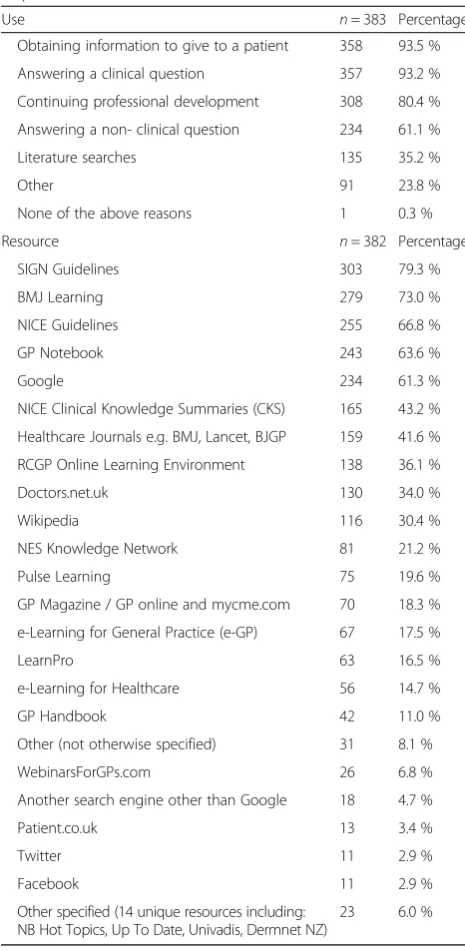
The three most common reasons for using the internet were for obtaining information to give to a patient (n= 358, 93.5 %), answering a clinical question (n= 357, 93.2 %) and for self directed continuing pro-fessional development (n= 308, 80.4 %). A wide var-iety of online resources were used by respondents for work-related purposes, including CPD, which amounted to 37 unique sources in total (Table 2). The mean number of unique online resources used per respondent was seven, although the range amongst respondents was 0 to 17. Respondents reported using 37 unique online resources, the top five were SIGN Guidelines (n= 303, 79.3 %), BMJ Learning (n= 279, 73.0 %), NICE Guidelines (n= 255,
66.8 %), GP Notebook (n= 243, 63.6 %) and Google (n= 234, 61.3 %).
When using online resources, there was strong agree-ment that reading information online (95 %≥4 valued, 94.5 %≥4 frequently used) and utilising online learning modules (87.4 %≥4 valued, 84.8 %≥4 frequently used) were the most highly valued and commonly used. As so-cial media can be seen a novel format for CPD, we in-cluded this in evaluation of the value and frequency of use. Respondents reported low value and use of both so-cial media resources, Facebook and Twitter, for CPD purposes (Table 3).
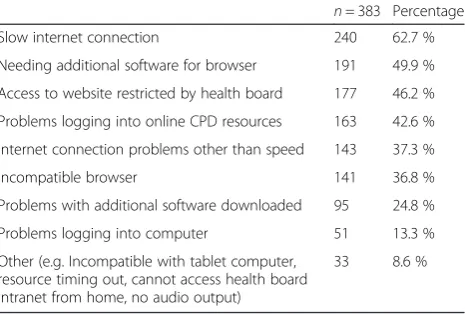
Barriers to use of online resources included technical issues such as connectivity, compatibility and problems with logging-in. Internet connection speed was deemed to be slow by 62.7 % (n= 240) of respondents, with a further 37.3 % (n= 143) reporting problems with inter-net connection other than speed. (Table 4)
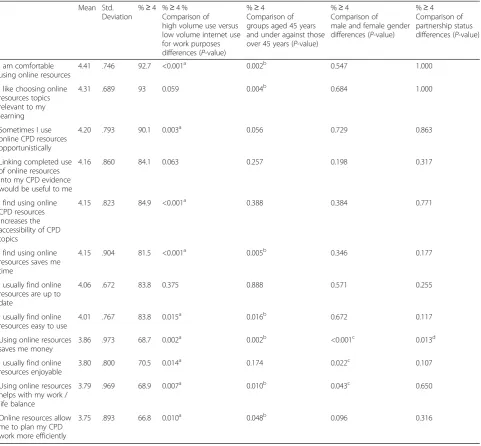
The vast majority of respondents stated that they enjoyed choosing resources relevant to their own learn-ing (93 %), were comfortable uslearn-ing online resources (92.7 %), and use online resources opportunistically (90.1 %). Further attitudinal responses to online re-sources can be found in Table 5.
Intergroup comparisons
Comparative analysis of GP respondent groupings demonstrated significant differences in GPs attitudes to online CPD resources (Table 5). For example, high volume internet users, identified by their use of the inter-net on three or more working days per week, showed sig-nificant tendencies to: be comfortable using online resources (p= <0.001), find using online resources in-creases accessibility of CPD topics (p= <0.001), saves time (p= <0.001) and money (p= 0.002) and finds online CPD resources enjoyable (p= 0.014) and easy to use (p= 0.015) compared to low volume users (use of the internet less than 3 days per working week). Respondents under the age of 45 were more likely than the older age group to be comfortable using online resources (p= 0.002), and agree that they helped with work/life balance (p= 0.01), were easy to use (p= 0.016) and allowed more efficient planning of CPD (p= 0.48). Female respondents were more likely to find using online resources helped with work/life balance (p= 0.043).
Discussion
This study examined the frequency and type of use of online resources by a population of general practitioners based in Scotland. It showed that a variety of different styles of online resources are often utilised for CPD. The most commonly used resources included accessing clin-ical guidelines as well as those of leading professional bodies in the field. A non-medical search engine
Table 1Demographic details of GP survey respondents
Characteristic n= 383 %
Gender
Female 232 60.6
Male 151 39.4
Age group in years
25–34 53 13.8
35–44 107 27.9
45–54 127 33.2
55–64 91 23.8
>65 5 1.3
Role
GP Partner 236 61.6
Locum GP 64 16.7
Salaried GP 47 12.3
Sessional GP 18 4.7
GP Retainer 15 3.9
GP Trainee 3 0.8
RCGP Status
Member 248 64.8
Non-member 135 35.2
Hours of work
Part-time 194 50.7
Full-time 189 49.3
Practice Location
Inner city 78 20.4
Urban 150 39.2
Semi-rural 81 21.1
Remote and rural 36 9.4
Locum (varied) 38 9.9
GP involved in training of healthcare professionals
Yes 156 40.7
(Google) was also frequently used. In this study popula-tion, the flexibility, specificity of topic, opportunistic use and time were found to be important factors to using online resources.
The data show that 94 % of Scottish GP respon-dents reported that they use the internet on most days. This is higher than the 88 % reported in a study of GPs surveyed in Denmark in 2008 [22]. There is also in increase in weekly internet use (99 %) versus a population of German GPs (75 %), surveyed in 2009 [23]. However, both studies were over 5 years ago
and it is likely that internet use has also increased in these study populations.
Online resources were most often used to obtain infor-mation for a patient or to answer specific clinical ques-tions. This is perhaps unsurprising as it has been shown that over time, patient encounters have been increasingly generating more clinical questions that require add-itional information to be sourced quickly and in a readily accessible format by clinicians [24, 25].
The top five most frequently used resources included two clinical guideline resources - NICE guidelines [26] and SIGN guidance [27]–an international medical jour-nal e-learning website (BMJ Learning) [28] and a point of care resource (GP Notebook) [29]. This suggests that GPs are choosing learning based on current best practice guidelines and preferring peer reviewed sources. The ex-ception of this is GP Notebook, which has been de-scribed as being “unclear in peer review status” and “evidence base” in a recent review of point of care re-sources [30]. The use of guidelines as a preferred CPD resource may be a reflection of primary care in the UK being increasingly guideline driven, particularly with the introduction of the Quality Outcomes Framework, a pay for performance incentive that is largely guideline based [31].
In contrast, it was interesting to note the non-medical search engine Google also featured highly, with it ranked as the fifth most used resource. Previous research involv-ing medical students use of Google suggested that the use of the search engine was down to perceived useful-ness, rather than reliability of search results [32]. This raises some questions in relation to the information seeking behaviour in the GPs surveyed. This study did not assess how the search engine was used for CPD in detail. Previous research regarding doctors’ use of Google suggested that search engines were easier to use than research search resources such as PubMed and that the search engines would often link to PubMed in search results [33].
Despite widespread uptake of social media for private leisure use, it did not feature highly for use in CPD. The low uptake for social media platforms for professional use by doctors mirrors previous research which found comparatively low uptake of Facebook and Twitter com-pared with the general population. This might be ex-plained by these platforms being deemed more social than professional, with potential adverse publicity and medico-legal complications with their use. As such it has been proposed that medical professionals might con-sider creating a separate account for more professional use of these platforms [34, 35].
It was evident that respondents were comfortable with the use of online resources. This is encouraging as a re-cent systematic review has shown that learning is more
Table 2Work related use of the internet reported by respondents and the online resources used
Use n= 383 Percentage
Obtaining information to give to a patient 358 93.5 %
Answering a clinical question 357 93.2 %
Continuing professional development 308 80.4 %
Answering a non- clinical question 234 61.1 %
Literature searches 135 35.2 %
Other 91 23.8 %
None of the above reasons 1 0.3 %
Resource n= 382 Percentage
SIGN Guidelines 303 79.3 %
BMJ Learning 279 73.0 %
NICE Guidelines 255 66.8 %
GP Notebook 243 63.6 %
Google 234 61.3 %
NICE Clinical Knowledge Summaries (CKS) 165 43.2 %
Healthcare Journals e.g. BMJ, Lancet, BJGP 159 41.6 %
RCGP Online Learning Environment 138 36.1 %
Doctors.net.uk 130 34.0 %
Wikipedia 116 30.4 %
NES Knowledge Network 81 21.2 %
Pulse Learning 75 19.6 %
GP Magazine / GP online and mycme.com 70 18.3 %
e-Learning for General Practice (e-GP) 67 17.5 %
LearnPro 63 16.5 %
e-Learning for Healthcare 56 14.7 %
GP Handbook 42 11.0 %
Other (not otherwise specified) 31 8.1 %
WebinarsForGPs.com 26 6.8 %
Another search engine other than Google 18 4.7 %
Patient.co.uk 13 3.4 %
Twitter 11 2.9 %
Facebook 11 2.9 %
Other specified (14 unique resources including: NB Hot Topics, Up To Date, Univadis, Dermnet NZ)
effective when the educational resources were chosen by the learners [36]. Although this is a key principle in adult learning (Knowles, 1980) in which learners want to choose what, how and where they learn [37], it is crucial that these resources are of high quality.
The frequency of technical issues encountered with using resources may well be an explanation for the var-ied locations of internet use reported. For example, it may be that users find internet browsing software and internet connections to be more stable at home and so find this to be a convenient location for learning. This concurs with a study amongst newly qualified doctors, that also showed a near equal distribution in location of use of an e-learning programme due to reasons of con-nectivity [38]. Previous research exploring GPs use of health informatics has called for increased training in IT skills for GPs, which may also help to reduce problems utilising online resources [16]. Whilst considering that investment in IT is a complex multi-organisational undertaking [16], stability of internet connection would appear to remain an issue.
It is unsurprising that higher users of the internet would find online resources useful to them. Younger GPs are more likely to have been users of the internet during previous aspects of their training or undergradu-ate studies, which may prepare them for continued use of online resources [23, 39]. The gender difference in at-titudes may stem from differences in work pattern, with a higher proportion of female GPs working part-time, but also that female doctors have been shown to be early adopters of online CPD, with a diffusion of such re-sources within networks of female GPs a suggested reason [40].
Study limitations
This study has highlighted the utilisation of online re-sources by 383 GPs for CPD purposes. The low response rate to the survey will introduce an aspect of non-responder bias. Furthermore, the CPD email distribution list used may well introduce an aspect of respondent bias of those with a particular interest in structured or formal CPD. Some addresses in the email shot were addressed to practice leads or managers, and therefore may not have been cascaded to GPs [41]. It could also be deduced that those that utilise online resources more often, will be more likely to respond to an online survey. For financial reasons it was not possible to introduce the control meas-ure of a postal version of the questionnaire survey, to re-duce any bias from higher volume users of the internet. A selection of online resource options was chosen as an aide memoire for respondents to indicate which resources they used. This will have introduced an aspect of bias in the se-lection, as more respondents will chose options available than if they had to record each resource used individually.
A greater proportion of females responded (60.6 %) than those on the GMC GP register (50.1 %). It is likely that a combination of the above factors contributed to the low response rate. Caution needs to be exercised with questionnaire surveys as data are self-reported and
Table 3Type of online resources: perceived value and frequency of use of resource for CPD (n= 383)
Value Frequently use
Mean Std. Deviation %≥4 Mean Std. Deviation %≥4
Reading information online 4.40 .708 95.0 4.42 .677 94.5
Completing online learning modules 4.28 .807 87.4 4.16 .919 84.8
Simulated patient scenarios 3.55 .991 53.3 2.91 1.172 35.0
Watching online videos 3.52 .957 58.2 3.02 1.139 40.7
Reading a journal online 3.34 1.028 51.7 3.13 1.220 46.7
Participation in webinar 2.75 1.019 19.3 2.15 1.058 12.5
Online discussion board 2.56 .872 10.9 1.96 .942 6.8
Twitter 1.79 .973 5.2 1.52 .912 5.2
Facebook 1.72 .907 3.9 1.48 .824 4.4
(mean ratings, standard deviation and proportion of responses greater than 4 - based on Likert scale 1 = strongly disagree, 5 = strongly agree)
Table 4Reported difficulties encountered when using online CPD resources
n= 383 Percentage
Slow internet connection 240 62.7 %
Needing additional software for browser 191 49.9 %
Access to website restricted by health board 177 46.2 %
Problems logging into online CPD resources 163 42.6 %
Internet connection problems other than speed 143 37.3 %
Incompatible browser 141 36.8 %
Problems with additional software downloaded 95 24.8 %
Problems logging into computer 51 13.3 %
Other (e.g. Incompatible with tablet computer, resource timing out, cannot access health board intranet from home, no audio output)
their veracity cannot be checked. The results are not generalisable to GPs in Scotland as a whole. Due to re-source limitations, no further in depth statistical analysis was performed.
Conclusions
The study shows that GPs are using online resources for CPD often and that these are well accepted and valued. However, attitudinal differences to online CPD resource utilisation between different GP groups and technical bar-riers to use were also evident. This study did not differen-tiate the preferences of online resources against face-to-face events or small group learning, an area that might be
of interest to this population. However, the findings should be of interest to medical educators, health service organisations and policy makers involved in designing or supporting implementation of educational interventions across training, frontline service, CPD and regulatory environments.
Additional file
Additional file 1:Questionnaire survey used in the study‘Utilisation of internet resources for continuing professional development: a
cross-sectional survey of general practitioners in Scotland’.(PDF 21 kb)
Table 5GPs attitudes to online CPD resources
Mean Std. Deviation
%≥4 %≥4 % Comparison of high volume use versus low volume internet use for work purposes differences (P-value)
%≥4 Comparison of groups aged 45 years and under against those over 45 years (P-value)
%≥4 Comparison of male and female gender differences (P-value)
%≥4 Comparison of partnership status differences (P-value)
I am comfortable using online resources
4.41 .746 92.7 <0.001a 0.002b 0.547 1.000
I like choosing online resources topics relevant to my learning
4.31 .689 93 0.059 0.004b 0.684 1.000
Sometimes I use online CPD resources opportunistically
4.20 .793 90.1 0.003a 0.056 0.729 0.863
Linking completed use of online resources into my CPD evidence would be useful to me
4.16 .860 84.1 0.063 0.257 0.198 0.317
I find using online CPD resources increases the accessibility of CPD topics
4.15 .823 84.9 <0.001a 0.388 0.384 0.771
I find using online resources saves me time
4.15 .904 81.5 <0.001a 0.005b 0.346 0.177
I usually find online resources are up to date
4.06 .672 83.8 0.375 0.888 0.571 0.255
I usually find online resources easy to use
4.01 .767 83.8 0.015a 0.016b 0.672 0.117
Using online resources saves me money
3.86 .973 68.7 0.002a 0.002b <0.001c 0.013d
I usually find online resources enjoyable
3.80 .800 70.5 0.014a 0.174 0.022c 0.107
Using online resources helps with my work / life balance
3.79 .969 68.9 0.007a 0.010b 0.043c 0.650
Online resources allow me to plan my CPD work more efficiently
3.75 .893 66.8 0.010a 0.048b 0.096 0.316
(Based on Likert scale 1 = strongly disagree, 5 = strongly agree) a
Abbreviations
CPD:continuing professional development; GMC: General Medical Council; GP: general practitioner; IT: information technology; PBSGL: problem based small group learning; RCGP: Royal College of General Practitioners; VLE: virtual learning environment.
Competing interests
The authors declare that they have no competing interest. The authors alone are responsible for the content and writing of this article.
Authors’contributions
GM participated in the design of the study, implemented the survey, analysed and interpreted the data and drafted the manuscript. JM and PB participated in design of the study and drafting of the manuscript. All authors read and approved the final manuscript.
Authors’information
GM is a Medical Education Fellow, Postgraduate GP education, NHS Education for Scotland, Glasgow, UK.
JM is Assistant Director of GP Postgraduate Educations, NHS Education for Scotland, Glasgow, UK
PB is Programme Director (safety & improvement), Postgraduate GP education, NHS Education for Scotland, Glasgow, UK.
Acknowledgements
We thank Leon Zlotos, Pharmacy practice education co-ordinator, NHS Education for Scotland, Glasgow, UK, for his input into the design of the survey and the Postgraduate GP education team at NHS Education for Scotland, Glasgow, UK, for their assistance with piloting the survey.
Received: 22 July 2015 Accepted: 7 January 2016
References
1. Academy of Medical Royal Colleges. Continuing Professional Developement - Guidelines for recommended headings used to describe a college or faculty CPD scheme 2009. http://www.rcgp.org.uk/professional- development/~/media/Files/Revalidation-and-CPD/ACADEMY-GUIDANCE-CPD-HEADINGS.ashx. Accessed 14 May 2015.
2. Kaufman DM. ABC of learning and teaching in medicine: Applying educational theory in practice. Br Med J. 2003;326:213–6. doi:10.1136/bmj. 326.7382.213.
3. Densen P. Challenges and opportunities facing medical education. Trans Am Clin. 2011;122:48–58.
4. Bornmann L, Mutz R. Growth rates of modern science : A bibliometric analysis based on the number of publications and cited references. J Assoc Inf Sci Technol. 2015. doi:10.1002/asi.
5. General Medical Council. Supporting information for appraisal and revalidation 2012. http://www.gmc-uk.org/RT___Supporting_information_ for_appraisal_and_revalidation___DC5485.pdf_55024594.pdf. Accessed 14 May 2015.
6. Fordis M, King JE, Ballantyne CM, Jones PH, Schneider KH, Spann SJ, et al. Comparison of the instructional efficacy of Internet-based CME with live interactive CME workshops: a randomized controlled trial. JAMA. 2005;294: 1043–51. doi:10.1001/jama.294.9.1043.
7. Wutoh R, Boren SA, Balas EA. eLearning: a review of Internet-based continuing medical education. J Contin Educ Health Prof. 2004;24:20–30. doi:10.1002/chp.1340240105.
8. Cook DA, Levinson AJ, Garside S, Dupras DM, Erwin PJ, Montori VM. Internet-based learning in the health professions: a meta-analysis. JAMA. 2008;300:1181–96. doi:10.1001/jama.300.10.1181.
9. Moja L, Kwag KH. Point of care information services: a platform for self-directed continuing medical education for front line decision makers. Postgrad Med J. 2015;91:83–91. doi:10.1136/postgradmedj-2014-132965. 10. Rice S, Mckendree J. e-learning. In: Swanwick T, editor. Underst. Med. Educ.
2nd ed., ASME, John Wiley & Sons, Ltd; 2014, p. 161–73.
11. RCGP Guide to the Credit-Based System for CPD. R Coll Gen Pract 2010. http://www. rcgp.org.uk/revalidation/~/media/FC5DDB69A33B4A9EBE8BAFAA1D1389F8.ashx Credits and Appraisal/CPD creditsAug13 v30 FINAL.ashx. Accessed 17 Sept 2015.
12. Tran D, Tofade T, Thakkar N, Rouse M. US and International Health Professions’Requirements for Continuing Professional Development. Am J Pharm Educ. 2014;78.
13. Balmer JT. The transformation of continuing medical education (CME) in the United States. Adv Med Educ Pract. 2013;4:171–82. doi:10.2147/ AMEP.S35087.
14. The RCGP. Guide to the Revalidation of General Practitioners. R Coll Gen Pract. 2014. http://www.rcgp.org.uk/revalidation/~/media/Files/Revalidation- and-CPD/Revalidation/Guidance-for-GPs/Guide-to-Revalidation-September-2014.ashx. Accessed 1 Oct 2015.
15. Ofcom. Communications Market Report: Scotland 2014. http://stakeholders. ofcom.org.uk/binaries/research/cmr/cmr14/2014_CMR_Scotland.pdf . Accessed 23 June 2015.
16. Bouamrane M, Mair F. A study of general practitioners’perspectives on electronic medical records systems in NHSScotland. BMC Med Informatics. 2013;13. doi:10.1186/1472-6947-13-58.
17. Wilson SM. Impact of the internet on primary care staff in Glasgow. J Med Internet Res 1999;1. doi:10.2196/jmir.1.2.e7
18. Scottish Online Apprasial Resource (SOAR) n.d. http://www.appraisal.nes. scot.nhs.uk/. Accessed 23 June 2015.
19. Sun P-C, Tsai RJ, Finger G, Chen Y-Y, Yeh D. What drives a successful e-Learning? An empirical investigation of the critical factors influencing learner satisfaction. Comput Educ. 2008;50:1183–202. doi:10.1016/j.compedu. 2006.11.007.
20. NHS Education for Scotland n.d. http://www.nes.scot.nhs.uk/. Accessed 23 June 2015.
21. Department of Health. Governance Arrangements for Research Ethics Committees 2011. http://webarchive.nationalarchives.gov.uk/ 20130107105354/http://www.dh.gov.uk/en/Publicationsandstatistics/ Publications/PublicationsPolicyAndGuidance/DH_4005727. Accessed 3 Dec 2015.
22. Waldorff FB, Steenstrup AP, Nielsen B, Rubak J, Bro F. Diffusion of an e-learning programme among Danish General Practitioners: a nation-wide prospective survey. BMC Fam Pract. 2008;9:24. doi:10.1186/1471-2296-9-24. 23. Vollmar HC, Rieger M a, Butzlaff ME, Ostermann T. General Practitioners’
preferences and use of educational media: a German perspective. BMC Health Serv Res. 2009;9:31. doi:10.1186/1472-6963-9-31.
24. Salinas GD. Trends in physician preferences for and use of sources of medical information in response to questions arising at the point of care: 2009–2013. J Contin Educ Health Prof. 2014;34 Suppl 1:S11–6. doi:10.1002/chp.21224.
25. Casebeer L, Bennett N, Kristofco R, Carillo A, Centor R. Physician Internet medical information seeking and on-line continuing education use patterns. J Contin Educ Health Prof. 2002;22:33–42. doi:10.1002/chp.1340220105. 26. National Institute of Clinical Excellence (NICE) n.d. http://www.nice.org.uk/.
Accessed 23 June 2015.
27. Scottish Intercollegiate Guidelines Network (SIGN) n.d. http://www.sign.ac. uk/. Accessed 23 June 2015.
28. BMJ Learning n.d. http://learning.bmj.com/learning/home.html. Accessed 23 June 2015.
29. GP Notebook n.d. https://www.gpnotebook.co.uk. Accessed 23 June 2015. 30. Banzi R, Liberati A, Moschetti I, Tagliabue L, Moja L. A review of online
evidence-based practice point-of-care information summary providers. J Med Internet Res. 2010;12, e26. doi:10.2196/jmir.1288.
31. Sutcliffe D, Lester H. NICE and the Quality and Outcomes Framework (QOF) 2009–2011. Qual Prim Care. 2012;20:47–55.
32. Judd T, Kennedy G. Expediency-based practice? Medical students’reliance on Google and Wikipedia for biomedical inquiries. Br J Educ Technol. 2011; 42:351–60. doi:10.1111/j.1467-8535.2009.01019.x.
33. Steinbrook R. Searching for the right search–reaching the medical literature. N Engl J Med. 2006;354:4–7. doi:10.1056/NEJMp058128.
34. George D.“Friending Facebook?”A minicourse on the use of social media by health professionals. J Contin Educ Heal. 2011;31:215–9. doi:10.1002/chp. 35. Von Muhlen M, Ohno-Machado L. Reviewing social media use by clinicians. J Am Med Inform Assoc. 2012;19:777–81. doi:10.1136/amiajnl-2012-000990. 36. Murad MH, Coto-Yglesias F, Varkey P, Prokop LJ, Murad AL. The effectiveness of
self-directed learning in health professions education: a systematic review. Med Educ. 2010;44:1057–68. doi:10.1111/j.1365-2923.2010.03750.x. 37. Kaufman DM, Mann KV. Teaching and learning in medical education. In:
38. Goh J, Clapham M. Attitude to e-learning among newly qualified doctors. Clin Teach. 2014;11:20–3. doi:10.1111/tct.12117.
39. Yee M, Simpson-Young V. How do GPs want to learn in the digital era? Aust Fam…2014;43:399–402. doi:10.1109/GCCE.2014.7031336.
40. Harris JM, Novalis-Marine C, Harris RB. Women physicians are early adopters of on-line continuing medical education. J Contin Educ Health Prof. 2003; 23:221–8. doi:10.1002/chp.1340230505.
41. GMC. List of Registered Medical Practitioners - Statistics (May 2015) 2015. http://www.gmc-uk.org/doctors/register/search_stats.asp . Accessed 15 June 2015.
• We accept pre-submission inquiries
• Our selector tool helps you to find the most relevant journal
• We provide round the clock customer support
• Convenient online submission
• Thorough peer review
• Inclusion in PubMed and all major indexing services
• Maximum visibility for your research
Submit your manuscript at www.biomedcentral.com/submit