HELGOL,~NDER MEERESUNTERSUCHUNGEN Helgol~nder Meeresunters. 49, 255-281 (1995)
Induction and r e g u l a t i o n of m e t a m o r p h o s i s in
planktonic larvae: Phoronis
m i i l l e r i
(Tentaculata) as
archetype
K. Herrmann
Institut ffJr Zoologie der Universitfit Erlangen-Nfflrnberg; Staudtstr. 5, D-91058 Erlangen, G e r m a n y
ABSTRACT: The larvae of Phoronis nffilleri are comprised of m a n y diverse behavioural forms that can be m a n i p u l a t e d experimentally to facilitate precise asseruons about the induction of m e t a m o r - phosis. Various p a r a m e t e r s for inducing metamorphosis as exemplified in Phoronis. such as species- specific substrate bacteria, the cations Rb ~ Cs* and Hg 2+ a n d tensides, are considered, a n d their ecologic r e l e v a n c e to natural factors in the sea is demonstrated. Findings on metamorphosis in other m a r i n e larvae are summarized The function of m a r i n e bacteria as "ecological ushers" is particularly emphasized.
I N T R O D U C T I O N
T h e p l a n k t o n i c - b e n t h i c life c y c l e is of i m m e n s e i m p o r t a n c e for m a n y s e s s i l e or h e m i s e s s i l e b e n t h i c i n v e r t e b r a t e s of t h e s e a . D r i f t i n g i n t h e s u r f a c e l a y e r s of t h e w a t e r , t h e l a r v a e a r e a b l e to c o l o n i z e n e w e c o l o g i c n i c h e s , a n d t h e a b u n d a n t p h y t o p l a n k t o n t h e r e p r o v i d e s a m p l e n o u r i s h m e n t . T h e c r i t i c a l p h a s e of t h i s s u r v i v a l s t r a t e g y is f i n d i n g a n d r e c o g m z i n g t h e s u b s t r a t e t h a t is a p p r o p r i a t e for t h e s p e c i e s . S i n c e t h e i r s e n s o r y i n v e n t o r y is m o d e s t , it w a s f o r m e r l y t h o u g h t t h a t t h e l a r v a e r e a c h t h e s p e c i e s - s p e c i f i c s u b s t r a t e b y c h a n c e a c c o r d i n g to t h e " h i t or m i s s " p r i n c i p l e ( C o l m a n , 1933} a n d e i t h e r s u r v i v e or p e r i s h . M o r e r e c e n t l y , e c o l o g i c s t u d i e s a n d e x p e r i m e n t s h a v e d e m o n s t r a t e d t h a t . d e s p i t e t h e p a u c i t y of s e n s o r y a p p a r a t u s , m a r i n e l a r v a e a r e i n d e e d a b l e to r e c o g n i z e t h e i r s p e c i e s - s p e c i f i c s u b s t r a t e ( W i l s o n , 1932, 1937, 1952; C o l e & K n i g h t - J o n e s . 1949: K n i g h t - J o n e s . 1951: C r i s p & M e a d o w s , 1963: G r a y , 1966: C h i a & Rice. 1978). T h e l a r v a p e r c e i v e s e x t e r n a l s i g n a l s w h i c h t h u s t r i g g e r r e a c t i o n s a c c o r d i n g ro t h e l o c k - a n d - k e y p r i n c i p l e {Mfiller, 1969; H e r r m a n n , 1976, 1979} In t h e f o l l o w i n g w o r k , r e c o g n i t i o n of t h e s u b s t r a t e a n d i n d u c t i o n of m e t a m o r p h o s i s is i l l u s t r a t e d e s s e n t i a l l y o n Phoronis m [ / / / e r / a s a m o d e l , a l t h o u g h t h e s y s t e m is v a l i d for v e r y m a n y o t h e r m a n n e l a r v a e of s e s s i l e a n d h e m i s e s s i l e b e n t h i c i n v e r t e b r a t e s .
256 K. H e r r m a n n
MATERIALS AND M E T H O D S L a r v a l m a t e r i a l
D u r i n g the s u m m e r months, larvae of sessile i n v e r t e b r a t e s can b e p i p e t t e d out of p l a n k t o n from the waters of H e l g o l a n d in sufficient quantities. The stage of maturity of the larvae of Phoronis mfJlleri c a n b e d e t e r m i n e d exactly on the basis of particular features (Fig. 1), such as the n u m b e r of larval tentacles, the p r e s e n c e of c e n t r e s in which red blood cells are p r o d u c e d a n d the existence of the s e c o n d a r y nerve c o m p l e x (Herr- m a n n , 1976).
. F
sec. nerve complex
/
episphq
tentacle:
. ' i
telotrocP
i i
a
b
:
:i = c
Fig. 1. Larva (Actinotrocha) of Phoronis mfil]eri, not activated (la), slightly activated (lb) and highly activated by bacteria or cations (lcL Scale bar 500 ttm
Mature larvae can b e m a i n t a i n e d i n good condition in sterile s e a w a t e r at 15~ for 6-7 days by r e g u l a r f e e d i n g with p h y t o p l a n k t o n or c u l t u r e d A m p h i d i n i u m carteri. Scrippsiella faerdrense or Coccolithus sp. (Hagmeier, 1978). S u b s t a n t i a l c o n t a m i n a t i o n by bacteria m u s t b e a v o i d e d by c h a n g i n g the s e a w a t e r frequently.
M e t a m o r p h o s i s in P h o r o n i s m~illeri 257 I n d u c e r s of m e t a m o r p h o s i s
E x p e r i m e n t s on the induction of m e t a m o r p h o s i s e m p l o y e d both n a t u r a l (various substrates, bacteria) a n d artificial (cations, tensides) inducers.
T h e s p e c i e s - s p e c i f i c substrate ("tiefe Rinne", H e l g o l a n d ) was r e m o v e d u s i n g a p u n c h from the V a n - V e e n sampler, t r a n s p o r t e d in a vertical position w i t h the w a t e r a b o v e and u s e d i m m e d i a t e l y for e x p e r i m e n t a t i o n . T h e u p p e r m o s t parts of the substrate are most important. Bacteria w e r e g r o w n in liquid culture u s i n g yeast extract (0.3-0.4 g/1 seawater) as the m e d i u m . Bacterial c o n c e n t r a t i o n s w e r e d e t e r m i n e d u s i n g a N e u b a u e r c h a m b e r or n e p h e l o m e t r y with an E p p e n d o r f p h o t o m e t e r . Isolated strains of b a c t e r i a w e r e o b t a i n e d by p l a t i n g from dilution series onto a g a r surfaces for m a r i n e b a c t e r i a ("2216 E", G u n k e l , BAH, pers. comm.) and further g r o w n in liquid culture (Herrmann, 1976).
Cations as inductors w e r e a p p l i e d in the form of chlorides (analysed r e a g e n t s , purity 99.5 %; Merck. Darmstadt). T h e r e s p e c t i v e 0.572 tool stock solutions r e p r e s e n t approxi- m a t e ionic c o n t e n t of artificial s e a w a t e r (Dietrich & Kalle. 19651. T h e m o l a r c o n c e n - trations g i v e n are c o r r e c t e d for dilution and thus are final concentrations.
T e n s i d e s in p u r e form w e r e o b t a i n e d from the analytic laboratory of Hills (Marl. G e r m a n y ) . E x p e r i m e n t s w e r e carried out with an ionic tenside. Marlon R A (linear C10- C13-alkylbenzol sulfonate. LAS. ABS) and a non-ionic tenside. M a r l o p h e n R 810 (Nonyl~ p h e n o l o x e t h y l a t e . 10 mo] e t h y l e n e oxide). During e x p e r i m e n t a t i o n , the actual c o n c e n - tration was d e t e r m i n e d using the r i n g - s h e a r m e t h o d with a Krilss t e n s i o m e t e r . All e x p e r i m e n t s w e r e carried out in the glass v e s s e l p r e s c r i b e d for the t e n s i o m e t e r type. T e n s i d e residues w e r e r e m o v e d by w a s h i n g with acetone.
E x p e r i m e n t a l p r o c e d u r e
During the e x p e r i m e n t s , a specific a m o u n t of the i n d u c i n g a g e n t w a s a d d e d to a c o n s t a n t a m o u n t of sterile s e a w a t e r o b t a i n e d by m e m b r a n e filtration (0.22 ~tm p o r e size). T h e e x p e r i m e n t s w e r e p e r f o r m e d at room t e m p e r a t u r e or in constant t e m p e r a t u r e rooms in e v a p o r a t i o n dishes (Jena glass, 50- or 100-ml} or Boveri vessels. In e a c h of a total of o v e r 3000 e x p e r i m e n t s 10 m a t u r e l a r v a e w e r e u s e d that h a d b e e n p r e v i o u s l y tested for r e a d i n e s s to u n d e r g o m e t a m o r p h o s i s a n d h e l d [or at least half a day in sterile s e a w a t e r . C o m p a r e d to the total volume, the a m o u n t of w a t e r carried o v e r with the larva (max. approx. 0.1 ml~ w a s negligible. T h e results w e r e c o r r o b o r a t e d by m e a n s of p a r a l l e l and control e x p e r i m e n t s and by m a n y d u p l i c a t e e x p e r i m e n t s carried out in v a r i o u s years. Larvae that did not u n d e r g o m e t a m o r p h o s i s u n d e r the g i v e n e x p e r i m e n t a l conditions w e r e tested s u b s e q u e n t l y for inducibility.
258 K. H e r r m a n n
c o n c e n t r a t i o n of i n d i v i d u a l s (20 000 m -3) in the p l a n k t o n a r o u n d H e l g o l a n d , h a v e m a d e the e x p e r i m e n t s possible.
RESULTS
T h e c a u s a l relationships in the m e t a m o r p h o s i s of m a r i n e b e n t h i c i n v e r t e b r a t e s are d e m o n s t r a t e d u s i n g P h o r o n i s m ~ i l l e r i as a model, b e c a u s e m a n y different i n d u c e r s a n d their e c o l o g i c r e l e v a n c e h a v e b e e n e x p e r i m e n t a l l y tested on this species.
B e h a v i o u r of t h e l a r v a b e f o r e a n d d u r i n g m e t a m o r p h o s i s
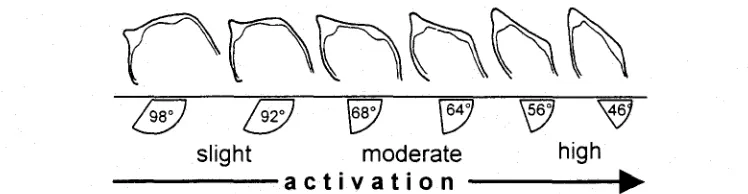
T h e l a r v a of P h o r o n i s mf/fleri c a n n o t u n d e r g o m e t a m o r p h o s i s unless a c t i v a t e d by e x t e r n a l i n d u c e r s . This activation (Fig. 1) b e c o m e s manifest by m o r e rapid motility a n d by m u s c l e contractions in the b o d y (dorsal b e n d i n g ) a n d in the e p i s p h e r e ( c h a n g e in form). T h r e e s t a g e s of activation can b e d i s c e r n e d (Fig. 2):
S 1 i g h t a c t i v a t i o n b e g i n s with u n d i r e c t e d exploratory b e h a v i o u r . T h e larva swims in c u r v e s and turns f r e q u e n t l y a b o u t its c e n t r e of gravity (tumbling). It shows a so- called " s e i s m i c b e h a v i o u r " . W h e n vibration occurs in the l a b o r a t o r y or w a v e action in the
slight
moderate
high
a c t i v a t i o n
Fig. 2. Shape of the episphere of the larva of P h o r o n i s m f i l l e r i drawn from living material. Changes m form due to contraction of the episphere muscles caused by activation by bacteria or cations. The angle data denote the angle subtended by the front end of the larva with the secondary nerve
complex at its tip
o p e n water, cihary b e a t i n g on the telotroch c e a s e s p e r i o d i c a l l y and the l a r v a sinks. T h e l e n g t h of t h e p a u s e s is directly c o r r e l a t e d with the d e g r e e of a c t i v a t i o n or w i t h the s t r e n g t h of t h e inducer. W h e n the l a r v a t o u c h e s the " s u b s t r a t e " , the l o n g axis of the b o d y forms a n a c u t e a n g l e w i t h it. T h e s e c o n d a r y n e r v e c o m p l e x t h e r e b y t a k e s u p c o n t a c t with the substrate. This is t h e first p h a s e prior to successful m e t a m o r p h o s i s . In e x p e r i m e n t s w i t h s u b s t r a t e s of low i n d u c i n g power, the s e e k i n g m o v e m e n t s of the l a r v a m a k e circular a r e n a - l i k e tracks in the h g h t m u d w i t h o u t t h e initiation of m e t a m o r p h o s i s ( H e r r m a n n . 1976)
M o d e r a t e a c t i v a t i o n o f a P h . raft/fen" l a r v a r e a d y for m e t a m o r p h o s i s initiates
M e t a m o r p h o s i s in Phoronis mfilleri 25. c A h i g h d e g r e e of activation is e v i d e n t w h e n further c h a n g e s in s h a p e of th~ e p i s p h e r e into a sharp cone occur (Fig. lc). Brief contractions of the m u s c l e fibrils al intervals of 3-15 sec press the s e c o n d a r y n e r v e c o m p l e x as a proboscis far forward, eveE w h e n no substrate is p r e s e n t in the vessel. I n c r e a s i n g activation shortens the intervals b e t w e e n m u s c l e contractions. T h e b e g i n n i n g of m e t a m o r p h o s i s , c h a r a c t e r i z e d by the e v a g i n a t i o n of the m e t a s o m e diverticulum, t a k e s p l a c e at the point of h i g h e s t activation T h e s e b e h a v i o u r a l forms a n d particularly the c h a n g e s in the s h a p e of t h e epispher~ are suitable for testing the maturity of the larva. U s i n g s u b t h r e s h o l d c o n c e n t r a t i o n s oJ bacteria, for e x a m p l e , e v e r y larva can be t e s t e d for its r e a d i n e s s to u n d e r g o m e t a m o r - phosis w i t h o u t actually c a u s i n g m e t a m o r p h o s i s to begin. T h e activation can be r e v e r s e d fully by p l a c i n g the l a r v a so t e s t e d in sterile s e a w a t e r . Previous slight or m o d e r a t e activations h a v e no effect either on time for i n d u c t i o n or on the s t r e n g t h of induction.
A successful i n d u c t i o n of m e t a m o r p h o s i s is a c u m u l a t i v e process. W h e n i n d u c t i o n is optimal, all stages of activation are u n d e r g o n e w h e n the larva is p l a c e d into the e x p e r i m e n t a l vessel. T h e duration of the i n d i v i d u a l p h a s e s d e p e n d s u p o n t h e quality and q u a n t i t y of the inducer. T h e p h a s e s t a k e p l a c e m o r e r e g u l a r l y w h e n cations are u s e d in p l a c e of bacteria. At optimal cation c o n c e n t r a t i o n s the m i n i m u m duration is n i n e minutes. W h e n optimal c o n c e n t r a t i o n s a n d compositions of bacteria are e m p l o y e d , the time c a n be r e d u c e d to one minute, w h e r e a s w h e n other bacterial compositions are used, m e t a m o r - phosis can be e x t e n d e d to 1 0 - t 5 min.
This is also valid for the Phoronis-specific s u b s t r a t e In general, the substrate particles a c c e l e r a t e the process of m e t a m o r p h o s i s by stimulating the s e c o n d a r y n e r v e c o m p l e x such that 5 10 rain of i n d u c t i o n time is e n o u g h .
I n d u c e r s of m e t a m o r p h o s i s i n t h e l a r v a of P h o r o n i s rnfilleri
Various i n d u c e r s can b e i d e n t i f i e d e x p e r i m e n t a l l y as causes for t r i g g e r i n g m e t a m o r - phosis in Ph. mfilleri. E v e r y i n d u c e r r e q u i r e s different p a r a m e t e r s and is functional by itself T h e s t r e n g t h of an i n d u c e r can b e g i v e n as the n e c e s s a r y time of e x p o s u r e {induction timej until m e t a m o r p h o s i s b e g i n s Isee above).
S u b s t r a t e as i n d u c e r : T h e most logical i n d u c e r is the s p e c i e s - s p e c i f i c substrate for Phoronis. Only the u p p e r layer of the substrate, a mixture of m u d and s a n d with an organic content of a b o u t 4% and a grain size of 0.2-0.63 mm for the most, exhibits an inductory effect. T h e inductory effect lasts only a f e w days, p r o b a b l y b e c a u s e the nutritive c o n t e n t of the substrate is u s e d up by bacteria. E x p e r i m e n t s w i t h sterilized Phoronis-substrate s h o w e d no successful induction of m e t a m o r p h o s i s .
T h e substrate of Phoronis mfilleri lies in the transition a r e a b e t w e e n sand a n d mud. Ph. mfilleri c a n n o t survive in p u r e s a n d or mud. Substrates w i t h i n c r e a s e d p r o p o r t i o n s of sand can b e c o l o n i z e d by j u v e n i l e animals, but l o n g e r t u b e s a n d older a n i m a l s are n e v e r found there. Phoronis t u b e s o v e r 10 cm in l e n g t h are occasionally found in pure m u d but they do not contain animals.
260 K. H e r r m a n n
e x p e r i m e n t s t h e p o s s i b i l i t y t h a t t h e s t r u c t u r e of t h e s u b s t r a t e itself, s u c h as g r a i n size, s u r f a c e t e x t u r e or c h e m i c a l c o m p o s i t i o n , i n d u c e s m e t a m o r p h o s i s i n Phoronis miilleri c a n b e e x c l u d e d .
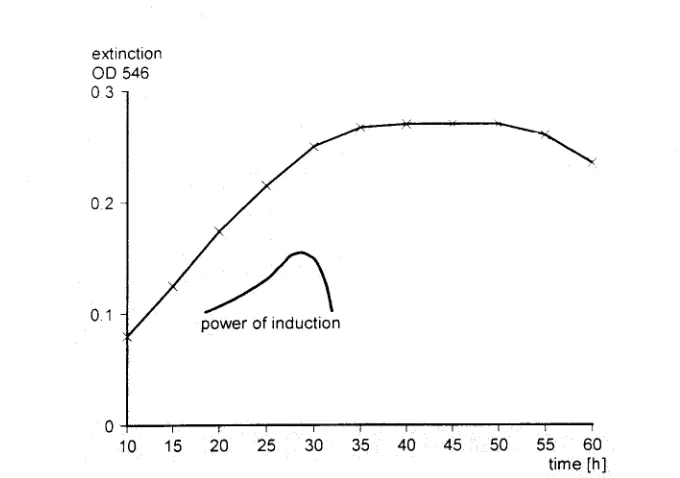
B a c t e r i a a s i n d u c e r s - T h e r e a l i n d u c e r s i n t h e n a t u r a l s u b s t r a t e a r e b a c t e r i a . T h i s w a s s h o w n b y t e s t i n g c u l t u r e d b a c t e r i a . M o r e o v e r , b a c t e r i a f r o m d e c o m p o s i n g p l a n k t o n f r o m t h e l i t t o r a l r e g i o n a n d b a c t e r i a l s t r a i n s f r o m t h e N a t i o n a l C o l l e c t i o n of M a r i n e B a c t e r i a ( N C M B , A b e r d e e n ) w e r e u s e d . I n t h e e x p e r i m e n t s o n t h e i n d u c t i o n of m e t a m o r - p h o s i s , t w o c o n d i t i o n s h a d to b e fulffilled: (1) t h e b a c t e r i a l c u l t u r e u s e d h a d to b e i n t h e e x p o n e n t i a l g r o w t h p h a s e (Fig: 3) a n d (2) t h e b a c t e r i a l c o n c e n t r a t i o n i n t h e e x p e r i m e n t a l s e t - u p h a d to e x c e e d a c e r t a i n c o n c e n t r a t i o n .
T h e b a c t e r i a l c o n c e n t r a t i o n n e c e s s a r y d e p e n d s u p o n w h e t h e r a p u r e or m i x e d c u l t u r e is u s e d . M i x e d c u l t u r e s a r e m o r e e f f i c i e n t ; for l o w e r c o n c e n t r a t i o n s of b a c t e r i a ,
5 • 1 0 6 m l - t suffice, o n t h e a v e r a g e . W h e n p u r e c u l t u r e s a r e u s e d , t h e n e c e s s a r y b a c t e r i a l
c o n c e n t r a t i o n r a n g e s f r o m 1 5 - 5 5 • 106 m l - t for c u l t u r e s i n t h e l o g a r i t h m i c g r o w t h p h a s e a n d c a n r i s e to 90 x 1 0 6 m1-1 a t t h e e n d of t h e g r o w t h p h a s e . T h e a d v a n t a g e of u s i n g p u r e b a c t e r i a l c u l t u r e s l i e s i n t h e s h o r t e r t i m e s for i n d u c t i o n to t a k e p l a c e ; m i x e d c u l t u r e s d o n o t t r i g g e r m e t a m o r p h o s i s u n t i l a f t e r 1 0 - 1 5 r a i n .
B a c t e r i a t h a t i n d u c e m e t a m o r p h o s i s h a v e t h e f o l l o w i n g c h a r a c t e r i s t i c s : t h e y a r e f a c u l t a t i v e l y a e r o b i c a n d t h e m a j o r i t y a r e m o t i l e ; t h e y a r e c o m m o n g r a m - p o s i t i v e a n d g r a m - n e g a t i v e b a c t e r i a of t h e f a m i l i e s M i c r o c o c c a c e a e , P s e u d o m o n a d e a c e a e a n d Spiril-
extinction
OD }46
03
) (
02
0.1
~ ~ l n
0
10
15
20
25
30
35
40
45
50
55
60
time [h]
Fig. 3. G r o w t h curve of a bacterial p o p u l a t i o n in liquid m e d i u m (yeast extract i n seawater. 0.3 g x [-1} b a s e d on extinction m e a s u r e m e n t s with a p h o t o m e t e r (Eppendorf. filtre OD 5461 The small curve r e p r e s e n t s the inductive power of the bacterial culture relative to growth. The inductive s t r e n g t h b e c o m e s gradually manifest at a certain bacterial concentration t h e n i n c r e a s e s rapidly a n d
M e t a m o r p h o s i s i n
Phoronis mfilleri
261l a c e a e ; f l a g e l l a t e d b a c t e r i a t h a t s h o w p i g m e n t e d c o l o n i e s o n a g a r a r e m o r e e f f e c t i v e ( H e r r m a n n , 1976).
A m o n g t h e s t r a i n s f r o m t h e N a t i o n a l C o l l e c t i o n of M a r i n e B a c t e r i a , A b e r d e e n , N C M B 129
(Pseudomonas fluorescens),
N C M B 308 ( M o r a x e l l - l i k eCoccobacillus).
N C M B 1495(Planococcus citreus)
a n d N C M B 407(Vibrio anguillarum)
i n d u c e d m e t a m o r p h o s i s . T h e l a t t e r d i d n o t p r o d u c e p i g m e n t e d c o l o n i e s o n a g a r , b u t t h e v i b r i o n e s a n d s p i r i l l o c h e t e s i n d u c e d m e t a m o r p h o s i s p a r t i c u l a r l y r e a d i l y . T h e b a c t e r i a f r o m t h e S c h l e i r i v e r u s e d b y R i e p e r (1976),Agrobacterium
sp. a n dBrevibacterium
sp., l i k e w i s e i n d u c e d m e t a m o r p h o s i s . M o r e p r e c i s e m i c r o b i o l o g i c a l e x p e r i m e n t s o n t h e r e a l c a u s e s of b a c t e r i a l i n d u c t i o n a n d o n t h e c o m m o n p h y s i o l o g i c a l a n d g e n e t i c f e a t u r e s of i n d u c i n g a n d n o n - i n d u c i n g b a c t e r i a a r e p l a n n e d i n c o n n e c t i o n w i t h t h e BAH.C a t i o n s a s i n d u c e r s : All t h e c o m m o n l y a v a i l a b l e c h l o r i d e s w e r e t e s t e d for t h e i r i n d u c t i v e e f f e c t o n m e t a m o r p h o s i s i n
Phoronis mfilleri.
E x p e r i m e n t s w i t h b r o m i d e s a n d i o d i d e s i n v a r i a b l y r e s u l t e d i n d a m a g e to t h e l a r v a e ( h i s t o l y s i s of t h e e p i s p h e r e or of t h e t e l o t r o c h ) a n d n o t i n s u c e s s f u l i n d u c t i o n . T h e o n l y c a t i o n s t h a t i n d u c e d m e t a m o r p h o s i s i nPhoronis mfJlleri
w e r e RbC1, CsC1 a n d HgC12.T h e o n s e t of m e t a m o r p h o s i s , a n i m p o r t a n t p a r a m e t e r for t h e i n d u c t i v e c a p a c i t y of t h e c a t i o n s , d e p e n d s o n (1/ t h e c o n c e n t r a t i o n . (2~ t h e t e m p e r a t u r e ( n o r m a l l y r o o m t e m p e r a - ture} a n d (3) t h e t o t a l i o n c o m p o s i t i o n of t h e e x p e r i m e n t a l s e t - u p . T h e list of c h e m i c a l s u b s t a n c e s w i t h i n d u c t i v e e f f e c t c a n b e e x t e n d e d , w h e n t h e n e r v o u s s y s t e m of t h e l a r v a is e x p e r i m e n t a l l y m o d i f i e d I H e r r m a n n . in p r e p . J .
R b C I IFig. 4a~: R u b i d i u m c h l o r i d e i n a v e r y n a r r o w r a n g e of c o n c e n t r a t i o n i n d u c e s m e t a m o r p h o s i s . A c l e a r r e l a t i o n s h i p b e t w e e n t h e c o n c e n t r a t i o n u s e d a n d t h e m i n i m a l t i m e n e c e s s a r y for i n d u c t i o n c a n b e d e t e r m i n e d . T h e i n d u c t i o n t i m e for 10 -2 tool RbC1 i n s e a w a t e r is 36 m i n , d e c r e a s i n g w i t h i n c r e a s i n g RbC1 c o n c e n t r a t i o n . T h e o p t i m a l c o n c e n - t r a t i o n is 1.71 x 10 -2 tool a n d at t h i s c o n c e n t r a t i o n t h e m i n i m a l t i m e for i n d u c t i o n is 9 m i n .
A t i n c r e a s i n g c o n c e n t r a t i o n s t h e t i m e n e c e s s a r y for i n d u c i n g m e t a m o r p h o s i s r i s e s to 25 r a i n a n d a t c o n c e n t r a t i o n s h i g h e r t h a n 0.03 m o l a b e r r a n t f o r m s ( y - a n o m a l i e s ~ a r e e n c o u n t e r e d in t h e c o u r s e of m e t a m o r p h o s i s . In t h e l a t t e r c a s e . t h e m e t a s o m e d i v e r - t i c u l u m b e c o m e s o n l y h a l f e v a g i n a t e d a n d a p o r t i o n of t h e l a r v a l t e n t a c l e is c a s t off. M e t a m o r p h o s i s is a b o r t e d .
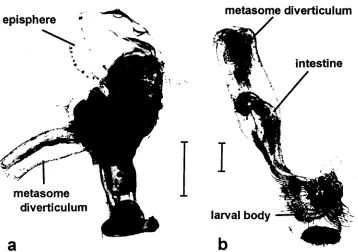
C s C l [Fig. 4b): C e s i u m c h l o r i d e e x h i b i t s a v e r y w i d e s p e c t r u m w i t h r e s p e c t to t h e m o l a r c o n c e n t r a t i o n n e e d e d for i n d u c i n g m e t a m o r p h o s i s . T h e c o n c e n t r a t i o n r a n g e s f r o m 0.57 x 10 - 2 m o l i n s e a w a t e r w i t h a n i n d u c t i o n t i m e of 16 h to a c o n c e n t r a t i o n of 7,4 x 10 - 2 m o l w i t h a n i n d u c t i o n t i m e of 23 m i n . A s w i t h RbC1. a f u r t h e r i n c r e a s e in c o n c e n t r a t i o n c a u s e s a n o m a l i e s , a l t h o u g h i n a l t e r e d f o r m . In t h i s c a s e , t h e m e t a s o m e d i v e r t i c u l u m b e c o m e s h a l f e v a g i n a t e d a n d m e t a m o r p h o s i s a b o r t e d I h - m e t a m o r p h o s i s a n o m a l y , Fig. 7A).
T h e m i n i m a l i n d u c t i o n is as is t h e c a s e w i t h R b C I 9 m i n a t a c o n c e n t r a t i o n of 5.7 x 10 - 2 m o l .
M e t a m o r p h o s i s in Phoronis m f i / / e r i 263 T e n s i d e s a s i n d u c e r s : T h e a d d i t i o n of t e n s i d e s l o w e r s t h e s u r f a c e t e n s i o n of s e a - w a t e r . H o w m u c h , d e p e n d s o n (1) t h e k i n d of c h e m i c a l a d d i t i v e a n d (2) t h e p r o p o r t i o n of t e n s i d e . M a r l o n R A r e d u c e s t h e s u r f a c e t e n s i o n l e s s t h a n M a r l o p h e n R 810. T h e b e h a v i o u r e x h i b i t e d b y Phoronis miifleri l a r v a e d e p e n d s u p o n t h e t e n s i d e u s e d a n d its c o n c e n - tration.
T h e e f f e c t of M a r l o p h e n R 810 in t h e r a n g e of c o n c e n t r a t i o n f r o m 0.001 p p m to 10 p p m o n m e t a m o r p h o s i s w a s s t u d i e d . C o n c e n t r a t i o n s h i g h e r t h a n 0.7 p p m for 2 h, c a u s e d h i s t o l y s i s of t h e b o d y e p i t h e l i u m . A t c o n c e n t r a t i o n s l o w e r t h a n 0.7 p p m , t h e l a r v a e s h o w e d d i s t e n t i o n of t h e t e n t a c l e s , a r r e s t of ciliary m o v e m e n t o n t h e t e l o t r o c h a n d o n t h e t e n t a c l e s .
At c o n c e n t r a t i o n s b e l o w 0.4 p p m , t h e l a r v a b e g i n s e x p l o r a t o r y m o v e m e n t s a n d e l e v a t e s t h e m e t a s o m e d i v e r t i c u l u m ; f u r t h e r d i l u t i o n a m p l i f i e s t h e " s e i s m i c b e h a v i o u r " (see b e l o w ) . T h e i n d u c t i o n of m e t a m o r p h o s i s b e g i n s at a p p r o x i m a t e l y 0.5 p p m (43 d y n e x c m - 1).
T h e a n i o n i c t e n s i d e M a r i o n R A f o r m s a n i n s o l u b l e c o m p l e x w i t h t h e C a ++ i o n s of s e a w a t e r . T h e f e w p r e c i p i t a t e s t h a t arise a d h e r e , on contact, to t h e t e n t a c l e s of t h e l a r v a a n d c a u s e l o c a l histolysis, e s p e c i a l l y on t h e e d g e of t h e e p i s p h e r e a n d o n t h e tips of t h e t e n t a c l e s . N e v e r t h e l e s s , c o n c e n t r a t i o n s of 10 p p m a r e t o l e r a t e d for short i n t e r v a l s b y t h e l a r v a , w h e r e b y t h e t e n t a c l e s a r e a n n e x e d to t h e b o d y a n d t h e v o l u m e of t h e c o e l o m c h a n g e s , c a u s i n g t h e p r o c o e l o m to s h r i n k a n d t h e m e s o c o e l to e x p a n d , w h e r e a s t h e m e t a c o e l o m r e m a i n s u n c h a n g e d .
surface tension [dyne/cm] 7o
65
60
55
50
4 5 -
40
0 30 60 90 120 150
time [rain]
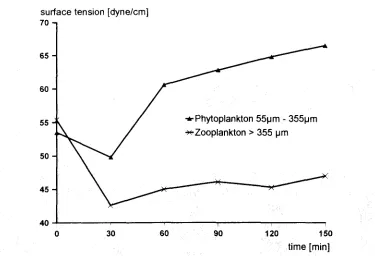
Fig. 5. Changes in surface tension in a plankton sample separated into two particle sizes. 55-355 ~m (mostly phytoplankton) and > 3 5 5 ~m (mostly zooplankton). Phytoplankton cause a more rapid
264 K. H e r r m a n n
C o n c e n t r a t i o n s u n d e r 1 p p m cause p r o n o u n c e d d i s t e n s i o n of the tentacles. At this concentration, the "seismic b e h a v i o u r " e x t e n d s to larvae that are not r e a d y for metamor- phosis. The i n d u c t i o n of m e t a m o r p h o s i s takes place at a c o n c e n t r a t i o n of 0.1 p p m (64-67 d y n e • cm-1).
The previously d e s c r i b e d i n d u c t i o n of m e t a m o r p h o s i s in P h o r o n i s m~///eri larvae u s i n g d e c o m p o s e d p l a n k t o n c a n n o w be explained. It is k n o w n that p h y t o p l a n k t o n (55-355 am) i n d u c e m e t a m o r p h o s i s more readily t h a n z o o p l a n k t o n (> 355 'am).
The difference in the ability to i n d u c e m e t a m o r p h o s i s w a s b e l i e v e d to b e d u e to the different composition of the bacterial p o p u l a t i o n s ( H e r r m a n n , 1975a). However, mea- s u r e m e n t s of surface t e n s i o n have s h o w n that d e c o m p o s i n g m i c r o p l a n k t o n cause the surface t e n s i o n to i n c r e a s e rapidly a n d that the surface t e n s i o n rises to v a l u e s (65 d y n e • cm -1) c a p a b l e of c a u s i n g i n d u c t i o n of m e t a m o r p h o s i s w i t h i n 2 h (Fig. 5).
Thus, w h y freshly d e c o m p o s i n g bacteria are suitable for reliably i n d u c i n g m e t a m o r - phosis can be easily explained: bacteria i n the logarithmic growth p h a s e a n d c a p a b l e of i n d u c i n g m e t a m o r p h o s i s are present, a n d the surface t e n s i o n rises to a v a l u e which i n d u c e s metamorphosis. This d o u b l e i n d u c t i o n also explains w h y so m a n y s e m i - m a t u r e
P h o r o n i s larvae in p l a n k t o n samples are forced to u n d e r g o a b e r r a n t m e t a m o r p h o s i s .
E c o l o g i c s i g n i f i c a n c e of t h e r e s u l t s
The results of e x p e r i m e n t a l i n d u c t i o n of m e t a m o r p h o s i s in the l a b o r a t o r y can b e e x t e n d e d by further observations on the b e h a v i o u r of the larvae in their n a t u r a l habitat.
b
i s - t u b e s i e v e d m
0
! 5 0 0 p m o
0
0
o pm
P h o r o n i s - s a n d c o a ~ e
o
o o
9 o
9 o o o
o o o o o
P h o r o n i s - ~an~ O f i n e ~ o
o
o:
o 9 o
: . .
:-."
s h e l l s > 2 m m
r
L
s a n d < 2 0 0 p m
o o o o
o o O o
P h o r o m s - s u b s t r a t e o o o o ,
o n o r m a l
o o
o o
o 9 9
h o r o m s - t u b e . n a t u r a l , e m p t y
o o 9 o o
L
o
a
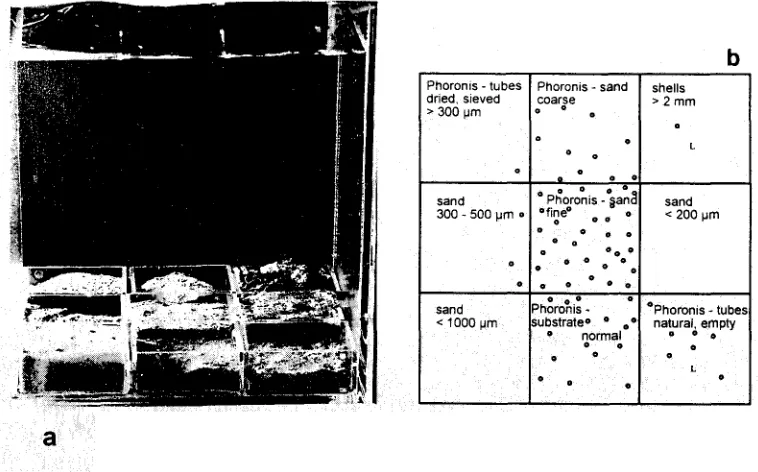
Fig. 6. Experiment to find the appropriate substrate for I00 Phoronis m~lleri larvae ready to metamorphose. 6a: Nine plexiglas vessels 6 x 6 cm with different substrates. 6b: Results showing
M e t a m o r p h o s i s in Phoronis mfilleri 265 In e x p e r i m e n t s w i t h a l a b y r i n t h in w h i c h Phoronis l a r v a e c o u l d s w i m e i t h e r t o w a r d t h e e n d at w h i c h a b a c t e r i a l s u s p e n s i o n c a p a b l e of i n d u c i n g m e t a m o r p h o s i s h a d b e e n a p p l i e d or to a n e u t r a l e n d , 95 % of t h e l a r v a e m o v e d to t h e e n d w i t h the b a c t e r i a . S h o r t l y b e f o r e t h e y r e a c h e d t h e e n d w i t h t h e b a c t e r i a l s u s p e n s i o n , m o s t of t h e l a r v a e b e g a n m e t a m o r p h o s i s [bacterial c o n c e n t r a t i o n 10.7 x 10⁶ m l - l j . Light a n d o t h e r [actors w e r e c o n t r o l l e d . T h u s . t h e l a r v a e c o u l d p e r c e i v e a b a c t e r i a l g r a d i e n t
A f u r t h e r e x p e r i m e n t w i l l b e d o c u m e n t e d b e c a u s e of its e c o l o g i c r e l e v a n c e : N i n e p l a s t i c d i s h e s e a c h filled w i t h d i f f e r e n t s u b s t r a t e s w e r e p l a c e d in t h e w e l l s of a n 18- cm l a r g e c u b i c a l c o n t a i n e r of c l e a r plastic [Fig. 6a). S e a w a t e r w a s a d d e d w i t h e x t r e m e c a r e to p r e v e n t m i x i n g of t h e s u b s t r a t e s - e s p e c i a l l y t h e i r f i n e particles. Of t h e 100 Phoronis mdlleri l a r v a e r i p e for m e t a m o r p h o s i s t h a t w e r e a d d e d 80 m o v e d to t h e w a t e r s u r f a c e a n d o n l y 20 s a n k a b o u t 10 cm. A f t e r a n hour, t h e r e w e r e o n l y 11 l a r v a e at the s u r f a c e .
A f t e r 48 h, o n l y 2 l a r v a e w e r e f r e e in t h e w a t e r a n d 74 y o u n g Phoronis a n d o n e a b e r r a n t m e t a m o r p h o s i s w e r e f o u n d . T h e r e m a i n m g a n i m a l s w e r e m i s s i n g , p r o b a b l y b e c a u s e t h e y w e r e so s m a l l t h a t t h e y w e r e lost d u r i n g e x p l o r a t i o n of t h e s u b s t r a t e s .
T h e r e s u l t s i n d i c a t e d that t h e v a r i o u s Phoronis-specific s u b s t r a t e s c o n t a i n e d a total of 93 % of t h e m e t a m o r p h o s e s p a r t i t i o n e d as follows: e m p t y Phoronis t u b e s 10 %. c o a r s e c o m p o n e n t of s i f t e d Phoronis s a n d 15 %. fine c o m p o n e n t of sifted Phoronis s a n d 46 %. a n d u n m a n i p u l a t e d Phoronis s a n d 22 %. T h e o t h e r n o n s p e c i e s - s p e c i f i c s u b s t r a t e s c o n - t a i n e d t h e r e m a i n i n g m e t a m o r p h o s e s (shells 1 % ; sifted s a n d from t h e n o r t h b e a c h of H e l g o l a n d , p a r t i c l e s > 2 0 0 [tm: 0 %: 3 0 0 - 5 0 0 [~m: 5 %: > 1000 [tm: 0 Y,,I w h e r e b y these. e s p e c i a l l y the s u b s t r a t e of 3 0 0 - 5 0 0 [tm l a r g e n o r t h b e a c h s a n d . m a y h a v e b e e n i n d u c e d d u e to t h e i r p r o x i m i t y to t h e s p e c i e s - s p e c i f i c s u b s t r a t e s (Fig. 6bL
T h i s result, also a p p a r e n t in o t h e r s i m i l a r e x p e r i m e n t s , c o n s p i c u o u s l y d e m o n s t r a t e s t h e i n t e r p l a y b e t w e e n Phoronis l a r v a e a n d t h e i r s p e c i e s - s p e c i f i c s u b s t r a t e .
In t h e s e a in spring, the b a c t e r i a l c o n c e n t r a t i o n in t h e Phoronis-specific s u b s t r a t e is m u c h l o w e r . H i c k e l & G u n k e l (1968} f o u n d a b a c t e r i a l c o n c e n t r a t i o n in m u d w i t h s a n d of 3 . 5 - 1 3 x 1 0 6 m1-1 D u e to s u c c e s s i v e c o l l a p s e s of t h e p h y t o p l a n k t o n b l o o m s d u r i n g e a r l y s u m m e r , so m u c h o r g a n i c m a t e r i a l is r e l e a s e d in t h e s e a s u c h that [1) t h e b a c t e r i a l c o n c e n t r a t i o n in t h e s e a w a t e r b e c o m e s h i g h e r ; (2) t h e s u r f a c e t e n s i o n of t h e w a t e r is e l e v a t e d ; a n d [3) e n o u g h o r g a n i c m a t t e r s e t t l e s o n t h e o c e a n floor, l i k e w i s e c a u s i n g t h e b a c t e r i a l c o n c e n t r a t i o n t h e r e to rise.
Thus, s e v e r a l e s s e n t i a l p a r a m e t e r s for a s u c c e s s f u l m e t a m o r p h o s i s a r e p r e s e n t in t h e r i g h t s u b s t r a t e .
T h e m a t u r e l a r v a e b e c o m e s e n s i t i z e d b y t h e h i g h b a c t e r i a l c o n c e n t r a t i o n in t h e f r e e w a t e r . In l a b o r a t o r y e x p e r i m e n t s , t h e initial b e h a v i o u r a l f o r m s [slight a n d m o d e r a t e a c t i v a t i o n , s e e a b o v e ) a r e p r o d u c e d . T h e " s e i s m i c b e h a v i o u r " of t h e l a r v a p l a y s a n i m p o r t a n t role. for. in t h e p r e s e n c e of w a v e a c t i o n , t h e ciliary b e a t o n t h e t e l o t r o c h a n d o n t h e t e n t a c l e s c e a s e s a n d t h e l a r v a s i n k s d o w n w a r d at a s p e e d r a t e of c a 5 m m x s e c -1
A s l i g h t l y a c t i v a t e d Phoronis l a r v a r e a c t s e x t r e m e l y s e n s i t i v e l y to w a v e m o v e m e n t s In t h e l a b o r a t o r y , a s i n g l e s h a k i n g of t h e b e n c h is e n o u g h to c a u s e t h e l a r v a to s i n k d o w n T h e s p e e d of s i n k i n g d o w n a n d t h e d e p t h to w h i c h t h e l a r v a sinks d e p e n d u p o n (1) t h e m a g n i t u d e of t h e v i b r a t i o n : (2) its d u r a t i o n ; (3) t h e m a t u r i t y of t h e larva; a n d [4) its d e g r e e of a c t i v a t i o n .
266 K. H e r r m a n n
episphere
;I
I
metasome diverticulum
intestine
\
larval body
-':--="%
a
b
Fig. 7. Metamorphosis stages in larvae of Phoronis mfilleri. 7a: h-aberrant metamorphosis stage as found in plankton containers. The metasome diverticulum is evaginated at right angles to the body axis. This metamorphosis does n o t reach compIetion. Scale bar 500 am. 7b: Normal initial stage of metamorphosis. The metasome diverticulum is evaginated in the direction of the episphere. Scale
bar 500 ~xm
P h o r o n i s l a r v a c a n s i n k t h e r e q u i r e d 30-40 m to t h e s e a floor. M e t a m o r p h o s i s i n t h e w a t e r
c o l u m n is i m p r o b a b l e a n d h a s b e e n p o s t u l a t e d o n t h e b a s i s of t h e p r e s e n c e of m e t a m o r - p h o s i s s t a g e s in p l a n k t o n pails (Cori, 1939). H e r e . a h i g h b a c t e r i a l c o n c e n t r a t i o n that c a u s e s all P h o r o n i s l a r v a e , i n c l u d i n g e v e n i m m a t u r e o n e s , to u n d e r g o m e t a m o r p h o s i s , is r a p i d I y r e a c h e d d u e to d e c o m p o s i n g p l a n k t o n .
G e n e r a l l y , a b e r r a n t m e t a m o r p h o s i s f o r m s a r i s e t h a t h a v e b e e n d e p i c t e d as " m e t a m o r p h o s i s s t a g e s " in the h t e r a t u r e of t h e p a s t 100 y e a r s ( S c h n e i d e r , 1862; I k e d a 1901; S i e w i n g 1969). L a b o r a t o r y f i n d i n g s o n s e i s m i c b e h a v i o u r , c a r r i e d o u t i n a m e a s u r - i n g c y l i n d e r 80 cm in h e i g h t , c a n b e s u b s t a n t i a t e d b y o b s e r v a t i o n s in t h e field. In q u a n t i t a t i v e s t u d i e s of p l a n k t o n t o w s in 0.5 a n d 5 m d e p t h as w e l l as in p l a n k t o n s a m p l e s m t h e v i c i n i t y of t h e " K a b e l t o n n e " . H e l g o l a n d , f o l l o w i n g l a r g e r w a v e m o v e m e n t s , m o r e m a t u r e l a r v a e a r e n o t f o u n d in t h e sea, as is to b e e x p e c t e d .
T h e m a t u r e l a r v a e a r r i v e at t h e s e a floor a f t e r c e s s a t i o n of t h e i r ciliary b e a t , b e c o m e " t r a p p e d " b y t h e l i g h t m u d a n d its a d h e r e n t b a c t e r i a , a n d a r e f o r c e d to u n d e r g o m e t a m o r p h o s i s . T h e s e c o n d a r y n e r v e c o m p l e x s e r v e s as t h e t r i g g e r i n g c e n t r e that u l t i m a t e l y g i v e s t h e s t a r t i n g s h o t for t h e r a p i d t r a n s f o r m a t i o n w h i c h lasts 15 m i n at t h e most,
M e t a m o r p h o s i s in P h o r o n i s m f i l l e r i 267
/•_
Surface
Lprot~z~a
/ ~ T T T T
1 1 1 _ L 1 1 Macromolecule
(bound on surface)
Chemistry
- i n o r g a n i c s u b s t a n c e s
organic substances
9 Physics
L wetting tension
surface tension
- potential alteration
l a r v a bacteria
T T T T T T J..L _L J_ _L Substrate
Fig. 8. Schematic representation of induction of metamorphosis in marine sessile invertebrates. The possible succession of adsorption to. and colonization of. solid surfaces in the sea as the preparatory
step for the subsequent settlement by sessile or hemisessile invertebrates is depicted
again, w h e n the w e a t h e r calms, a n d drift farther on. As maturity a n d h y p e r m a t u r i t y are a p p r o a c h e d , t h e t h r e s h o l d n e c e s s a r y for initiating m e t a m o r p h o s i s d e c r e a s e s (Fig. 10), a n d the l a r v a e r e a c t m o r e strongly to w a v e m o v e m e n t s a n d bacterial concentration. This l e a d s to c o l o n i z a t i o n of s u b o p t i m a l a r e a s (e.g. substrates w i t h h i g h e r proportions of sand).
D I S C U S S I O N
268 K. H e r r m a n n
On a c c o u n t of their sessile or h e m i s e s s i l e form of life, the i n h a b i t a n t s in or on the substrate of t h e sea floor are relatively protected. Difficulties are e n c o u n t e r e d w h e n further sexually p r o d u c e d g e n e r a t i o n s are r e q u i r e d . P r o g e n y that b e c o m e i m m o b i l e in the i m m e d i a t e vicinity of their parents m e a n c o m p e t i t i o n for nutrition a n d s p a c e and s o m e t i m e s i n b r e e d i n g .
T h e p e l a g i c - b e n t h i c hfe cycle avoids b o t h problems. T h e supply of food in the u p p e r layers of the w a t e r is bountiful a n d the l a r v a e drift and are able to c o l o n i z e n e w substrates. W h e n o n e c o m p a r e s this strategy with that of h o l o m e t a b o l i c insects, it is clear that c o m p e t i t i o n for food in both groups is a v o i d e d by the larvae. T h e larval form in the h o l o m e t a b o l i c insects is m e r e l y a f e e d i n g stage, the adult is the r e p r o d u c t i v e and redistribution stage. T h e place w h e r e nutrition is available is s o u g h t by the a d u l t as the e g g s are laid. In m a r i n e larvae, in contrast, the larval stages r e p r e s e n t the f e e d i n g and redistribution stages.
Thus, the choice of substrate is the most critical s t a g e in the life cycle of sessile m a r i n e b e n t h i c i n v e r t e b r a t e s . The question is, h o w do the larvae with their m o d e s t a r s e n a l of s e n s e organs r e c o g n i z e the substrate that will b e suitable for the s u r v i v a l of the adult animal? E x p e r i m e n t s on the induction of m e t a m o r p h o s i s in b e n t h i c i n v e r t e b r a t e s are almost i n v a r i a b l y sucessful w h e n the n a t u r a l substrate is u s e d (J~gersten. 1940: Wilson. 1952: Sil~n, 1954: Slewing, 1974). F r e q u e n t l y the substrate itself (grain size. surface, i n d i v i d u a l c o m p o n e n t s l is ineffective, and it is p r o b a b l y the a d m i x e d o r g a m c c o m p o n e n t s that are m o r e responsible for the succession characteristic of the substrate (see T a b l e IL T h e s e c o m p o n e n t s c o m p r i s e the c o n t e n t of o r g a m c material, the a r r a n g e - m e n t of m a c r o m o l e c u l e s and the surfaces c o v e r e d with bacteria, m i c r o o r g a n i s m s and a l g a e (Fig. 101.
T h e interaction b e t w e e n the substrate a n d l a r v a e of various a n i m a l g r o u p s has b e e n s t u d i e d v e r y closely (Chia & Rice 1978). In m a n y cases, the various i n d u c e r s disclosed h e r e can be t r a c e d b a c k to the b a c t e r i a l p o p u l a t i o n characteristic of the r e s p e c t i v e substrate in the s e n s e of the e c o l o g y of colonization. In the sea e v e r y surface - r a n g i n g from e v e r y g r a m of sand to scums, to slime, to o r g a n i c m a t e r i a l (proteins. arthropodin) a n d to different a l g a e e v e r y solid surface b e c o m e s c o l o n i z e d by bacteria (see abovel. T h e i r n u m b e r s , species and the species c o m p o s i t i o n d e p e n d s u p o n t h e substrate. It is easily i m a g i n a b l e that Rhodophytes, such as Laurencia pacifica, h a v e a b a c t e r i a l compos- ition on their surfaces quite different from that on t h e surfaces of C h l o r o p h y t e s , such as Ulva spp. Both a l g a e act as an i d e a l s u b s t r a t e for m e t a m o r p h o s i s for d i f f e r e n t AplFsia species (Hadfield, 19781. For Phoronis m~fl/en, the i n d u c i n g b a c t e r i a can o n l y b e ideally r e c r u i t e d on Laminaria saccharina (Herrmann. 1976).
Formerly, diatoms and sand w e r e c o n s i d e r e d to be the t r i g g e r i n g a g e n t s (Wilson. 19551, but it has b e e n p r o v e n that i n d u c t i o n c a n be initiated, free of t h e s u b s t r a t e , by u s i n g b a c t e r i a (Mtiller, 1969: H e r r m a n n , 1975a, 1975b, 1976.. E i b e n et al.. 1976]. T h e a m o u n t s of i n o r g a n i c a n d o r g a n i c c o m p o u n d s such as Zn, Cu, Li, Cs, Rb and. for e x a m p l e , extracts of a r t h r o p o d s etc. u s e d as i n d u c e r s in the e x p e r i m e n t s , are n o t r e p r e s e n t a t i v e of t h e q u a n t i t i e s f o u n d in the sea. T h e s e i n d u c e r s a n d t h e i r p h y s i c a l effects c a n be c o n s i d e r e d as s p a r e k e y s for i n d u c i n g m e t a m o r p h o s i s , albeit b y u s i n g fhem. t h e i n d u c t i o n of m e t a m o r p h o s i s can b e m o r e p r e c i s e l y e x p l a i n e d (Mtiller, 1973; Eiben, 1976; Berkinq, t988),
M e t a m o r p h o s i s in P h o r o n i s mfilleri 269 Table 1. List of diverse inducers in metanmrphosis of marine larvae (see also Fig. 8)
Factor Species/phylum Authors
F a c t o r s u b s t r a t e S i z e o f g r a i n
Hard rock with some mud Sand
Sand
Sand 0.1-0.9 mm
Fine sand 0.2-0.45 mm Fine sand 0.05-0.1 mm Fine sand/silt
M u d d y sand Sandy mud 0.047 mm
C o n t e n t o f o r g a n i c m 3 %
6.9 %
Rich in detritus Mud
Mud from adult habitat
F a c t o r s u r f a c e S t r u c t u r e o f s u r f a c e Fibrous. spiny surface Silk material
Aporrhais sp. (Gastropoda/Prosobranchia)
Placopecten magellanicus (Lamellibran-
chiata)
Nlercenaria mercenaria (Lamellibran-
chiata)
Nassarius obsoletus (Gastropoda/
Prosobranchia)
Ophelia bicornis (Polychaeta)
Owenia fusiformis (Polychaeta)
Golfingia misakiana (Sipunculida)
Notomastus sp. (Polychaeta)
Scolecolepis fulginosa (Polychaeta)
a t e r i a l
Owenia fusiformis (Polychaeta)
Scolecolepis fulginosa (Polychaeta)
Nfelinna eristata (Polychaeta)
Armandia brevis (Polychaeta)
Nassarius obsoletus (Gastropoda/
Prosobranchia,
Tubularia larynx i Gnidaria/Hydrozoal
I~fytilus edulis i Lamellibranchiatm
C o v e r e d w i t h m i c r o o r g a n i s m s
Living organic film Ophelia bicornis/Polychaeta/
Film of bacteria Ostrea edulis Lamellibranchiatal
Film of bacteria Film of bacteria
, Pseudomonas F l a v o b a c t . I
Surface w i t h bacteria
Film of microorganisms Film of microorganisms
~bacteria, diatoms, flagellata)
Film of bacteria and diatoms
Film of microorganisms
Spirorbis borealis (Polychaeta]
Protodrilus symbioticus ,Archiannelida,
Cassiopea xamachana I Cnidaria/
Scyphozoa)
Bugula flabeliata [Tentaculata/Bryozoa
Spirorbis borealis /Polychaeta)
Pocillopora damicornis I Cnidaria/
Anthozoal
Haminoea solifaria (Gastropoda/
Opisthobranchial
Film oI microorganisms Elysia chlorotica Gastropoda/
Opisthobranchia)
Aerobic bacteria Hydractinia echinata (Cnidaria/Hydrozoal
Facultatively aerobic bacteria Phoronis m iilleri fTentaculata/Phoronida)
Yonge (1937) Culliney (1975)
Keck et al. (1971)
Scheltema (1961)
Wilson (1948) Wilson (1932) Rice (1978) Wilson (1937) Day & Wilson (1934)
Wilson (1932) Day & Wilson (1934) Nyholm (1950) Hermans (1978) Scheltema (196I)
Barnes & Poweli 19501 Bayne (1965)
Wilson [1955J Cole & Knight-Jones
19491
Knight-Jones 11951/ Gray (1966)
Wieker ~1975)
Crisp & Ryland [19601 M e a d o w s & Williams [19631
Harrigan (1972)
270 K. H e r r m a n n
Table 1 (continued)
Factor Species/phylum Authors
C o v e r e d w i t h m i c r o o r g a n i s m s
Bacteria (0.8 [tm) Nassarius obsoletus (Gastropoda/
Bacteria (vibrio) With bacteria and algae Film of bacteria (Eucus
serratus, Phaeophyta)
Pulmonata)
Cassiopea andromeda (Cnidaria/ Syphozoa)
Larvae of Mytflus sp. (Lameltibranchiata) A l c y o n i d i u m p o l y o u m (Tentaculata/ Bryozoa)
O r g a n i s m s
Ophlitaspongia p e n n a t a (Porifera)
Cliona celata (Porifera)
Porites lobata (Cnidaria)
Tubularia indivisa (Cnidaria)
A l c y o n i u m digitatum (Cnidaria]
Kirch enpa uaria pinna ta -[Cnidaria
Porites compressa (Cnidaria]
Living coral epithelium Electra pilosa (Bryozoal Electra crustulen ta
(BryozoaJ Filamentous algae Unidentified blue-green algae (Cyanophyta) Lyngbya majuscula (Cyanophyta)
Ulva fasciata (Chlorophyta)
A s c o p h y l l u m nodosum (Phaeophycea) La urencia p a cffica
(Rhodophyta) Callithamn-ion hafliaE
(Rhodophyta)
Rostanga pulchra (Gastropoda/ Opisthobranchia)
M e m b r a n o b a l a n u s orcutti (Crustacea/ Cirripedia)
Philippia radiata (Gastropoda/ Prosobranchia)
Trinchesia aurantia (Gastropoda/ Opisthobranchia)
Tritonia h o m b e r g i (Gastropoda/ Opisthobranchia)
Eubranchus exiguus (Gastropoda/ Opisthobranchia)
Phestilla sibogae IGastropoda/ Opisthobranchial
Boscia anglica ICrustacea/Cirripedia) Adalaria proxima (Gastropoda/ Opisthobranchia)
Doridella obscura (Gastropoda/ Opisthobranchia)
Nlytilus edulis [Lamellibranchiata) Dolabella auricularia [Gastropoda/ Opisthobranchia)
Stylocheflus longicauda (Gastropoda/ Opisthobranchia)
Aplysia juliana (Gastropoda/ Opisthobranchia)
Clava squamata (Cnidaria/Hydrozoa) Aplysia californica fGastropoda/ Opisthobranchia)
Aplysia brasiliana IGastronoda/ Opisthobranchia)
L a u r e n d a sp. (Rhodophyta) Aplysia dactylomela (Gastropoda/ Opisthobranchia)
Chondrococcus h o m e . Aplysia parvula (Gastropoda/ m a n n i (Rhodophyta) Opisthobranchia)
Lithophyllum + -thamnion Tonicella lineata (Mollusca/
sp. (Rhodophyta) Polyplacophora)
Scheltema (1961) Neumann (1979) Scheer (1945) Crisp & Ryland (1960)
Chia & Rice (1978) Newman & Ross (1976) Hadfield (1976) Swennen (1961) Thompson (1962) Tardy ( 1962. cited in Chia & Rice 1978, p. 178) Hadfield & Karlson ~1969)
Moyse (1971) Hadfield 119761 Perron & Turner (1977] Bayne (1965)
Switzer-Dunlap & Had- field {1977 )
Switzer-Dunlap & Hadfield { 1977) Switzer-Dunlap & Hadfield (1977) Williams ( 1965, cited in Chia & Rice. 1978. p. 3) Kriegstein et al. (1974) Strength & Blankenship 11979 cited in Chia & Rice, p. 169)
Factor
M e t a m o r p h o s i s in P h o r o n i s rn 6 l l e r i
Table 1 (continued)
Species/phylum Authors
271
A r r a n g e m e n t o f m a c r Calcareous shells
(1-2 days in SW) Protein network (Quinone
t a n n e d protein) Dense film of extracts (monomolecule) Arthropodin b o u n d e d on
surfaces
Mucus of host polychaete
C h e m i c a l f a c t o r I n o r g a n i c Zn
K - b i c h r o m a t e
Na. Cu Cu. Fe. AI Cu
Li. Cs. Rb K. Cs
Cs, Rb
Cs
Cs Cs Cs Rb. Cs Hg
Hyperacidity
O r g a n i c
Vinegar acid, apple acid Amino-acid
Strychnin
Quinone t a n n e d protein Protein-carbohydrate
compl. (ovalbumim Shellfish glycogen
Pankrea. caseinhydrolysate
Epoxide of d-tocotrienol C27H4003
DMSO Pine wood Wood
Coal from sugar ArthroDodin
o - m o l e c u l e s
Protodrilus rubropharyngeus
(Archiannelida)
Balanus crenatus (Crustacea/Cirripedia)
B a l a n u s b a l a n o i d e s (Crustacea/
Cirripedia)
B a l a n u s sp. (Crustacea/Cirripedia)
Proboscidactyla flavicirrata (Cnidaria/
Hydrozoa)
Echin us larva e ( E c h i n o d e r m a ta)
Botryllus schlosseri (Tunicata)
B u g u l a neritina Tentaculata/Bryozoal
A s c i d i a larvae ~Tunicata
Tubularia l a r y n x I Cnidaria/Hydrozoal
H y d r a c t i n i a e c h i n a t a JCnidaria/Hydrozoal
B o w e r b a n k i a gracilis (Tentaculata/
Bryozoa
Phoronis p s a m m o p h i l a ITentaculata/
Phoronida~
P s a m m e c h i n us miliaris ~ Echino dermataj
P o l y g o r d i u s a p p e n d i c u l a t u s {Annelidal
A s t e r i a s r u b e n s E Echinodermata b
P a r a c e n t r o t u s l i v i d u s lEchinodermata~
Phoronis m [illeri ITentaculata/Phoronida)
Phaflusia, Acidella. Ciona (Tunicata)
T e r e d o n o r v e g i c a (Lameltibranchiata)
A s c i d i a larvae (Tunicata)
Botryllus s c h l o s s e r i [Tunicata)
B a l a n u s c r e n a t u s (Crustacea/Cirripedial
S e m i b a l a n u s b a l a n o i d e s tCrustacea/
Cirripedial
Crassostrea v~rginica (Lamellibranchiata)
C a s s i o p e a a n d r o m e d a (Cnidaria/
Syphozoaj
C o r y n e urchidai (Cnidaria/Hydrozoa}
Larvae of A s c i d i a {Tunicatal
T e r e d o n a v a B s t LamelhbranchiataJ
B a n k i a g o u d i (LamellibranchiataJ
O p h e l i a bicornis {Polythaeta)
B a l a n u s SD. [Crustacea/Cirripedial
J~gersten (1940)
Knight-Jones (1953)
Crisp & M e a d o w s (1962)
Crisp & M e a d o w s (1963)
Nishihira (1967)
R u n n s t r d m & R u n n - strdm (1919)
Zinkin (1938) Lynch f19611 Grave & Nicol1119391 Prefinch & Downing ( 19491
Miiller (19731 Eiben (1976)
Herrmann t 19791
H e r r m a n n f 1983 H e r r m a n n , 19861 Herrmann fin prep.) Herrmann fin prep.) H e r r m a n n f 1994. p r e s e n t paper~ Berrill (1947)
Harington ( 1921) Grave & Nicoll (1939) Zinkin (1938) Knight-Jones f 1953) Larman & Gabbott (1975)
Keck et al. ( 1971) Hofmann & Brand (1987)
Kato et al. f19751
272 K. H e r r m a n n
Table 1 (continued)
Factor Species/phylum Authors
O r g a n i c
Organic material of bacteria
Inner shell of chicken eggs
Tube cement Tube cement Humic substances Skeleton of gorgonians Muscle extract of adult Extract of arthropods Extract of gorgonian
axial skeleton Sargassum extract
P h y s i c a l f a c t o r Charact. of surface
of sandgram Impulse 150 V 1 msec
[ s e c
Electro-kinetic potentia] Wetting-tension Alteration of surface
tension
C o l o u r of t h e s u r f a c e Colour
Green light (530-545 ~tmj Green light is avoided
Lytechin us pictus (Echinodermata)
Bowerbankia gracilis (Tentaculata/ Bryozoa)
Sabeflaria alveolata (Polychaeta) Sabeflaria spinulosa (Potychaeta) Teredo navalis (Lamellibranchiata) Conopea galatea (Crustacea/Cirripedia)
Ostrea edulis (Lamellibranchiata) Semibalanus balanoides (Crustacea/ Cirripedia)
AlcFonium sp. (Cnidaria/Anthozoa)
Coryne urchidai ICnidaria/Hydrozoa
Ophelia bicornis (Polychaeta)
Arbacia punctulata Echinodermatm Phoronis mfilleri iTentaculata/Phoronida, Bowerbankia gracilis (Tentaculata/ Bryozoa)
Phoronis rnfilleri ITentaculata/PhoronidaJ
Spirorbis sp. (Polychaeta)
Balanus improvisus ICrustacea/Cirripedial Balanus amphitrite {Crustacea/Cirripedia)
Cameron & Hinegard- net (1974)
Hasper (1913) Wilson (1968) Wilson (1970) Culliney (1975) Patton (1963, cited in Chia & Rice, 1978, p. 211] Bayne (1969)
Crisp & Meadows (1963)
Bourdillon (1954) Nishihira 119681
Wilson [1955j Cameron N Hinegard- net [19741
Herrmann (1976) Eiben [1976) Herrmann [1994. present paperl
Neu [1933] Neu [19331 Neu 11933)
plants t o g e t h e r . Normally, b a c t e r i a function d e s t r u c t i v e l y in ecosystems. In the sea t h e y h a v e a n o t h e r purpose, viz. to l e a d the m a r i n e l a r v a e to their s p e c i e s - s p e c i f i c substrate. In fact, t h e y c a n b e r e g a r d e d as " e c o l o g i c a l u s h e r s "
This f u n c t i o n can b e m o r e e x a c t l y s h o w n for P h o r o n i s mfilleri, but is t h o r o u g h l y a p p l i c a b l e to o t h e r l a r v a e that are also i n d u c e d by b a c t e r i a to u n d e r g o m e t a m o r p h o s i s .
M e t a m o r p h o s i s in Phoronis m (illeri 273
Induction of m e t a m o r p h o s i s by bacteria occurs in other m a r i n e l a r v a e e.g. Hydrac-
tinia echinata (M~iller, 1969, 1973), Cassiopea andromeda (Hofman & Brand, 1987;
N e u m a n n , 1979), Phoronis p s a m m o p h i l a (Herrmann, 1981) a n d P s a m m e c h i n u s miliaris ( C a m e r o n & H i n e g a r d n e r , 1974; H e r r m a n n , 1981). T h e m e t h o d s e m p l o y e d in older studies also i n d i c a t e that various larvae are s t i m u l a t e d to u n d e r g o m e t a m o r p h o s i s by bacteria.
For Phoronis mfflleri and Hydractinia echinata it has b e e n s h o w n that the b a c t e r i a l i n d u c e r s are not identical; a t t e m p t s to i n d u c e m e t a m o r p h o s i s by e x c h a n g i n g the i n d u c e r b a c t e r i a failed. Bacteria that i n d u c e d m e t a m o r p h o s i s in Ph. mfilleri w e r e also effective in eliciting m e t a m o r p h o s i s in Ph. psammophila. A tenfold h i g h e r c o n c e n t r a t i o n of b a c t e r i a w a s necessary, h o w e v e r , e v e n t h o u g h i n d u c t i o n with the s a m e c o n c e n t r a t i o n of anor- g a n i c c o m p o u n d s w a s effective for both species (Herrmann, 1979).
T h e ion c o n c e n t r a t i o n s u s e d in the e x p e r i m e n t s did not in .any w a y r e p r e s e n t the c o n c e n t r a t i o n s f o u n d in natural seawater. R u b i d i u m occurs in the h i g h e s t c o n c e n t r a t i o n (0.17 m g x 1-1), f o l l o w e d by c e s i u m (0.0005 m g x 1-1) a n d m e r c u r y (0.00003 m g x ml-1). T h e s e ions r e p r e s e n t minor trace e l e m e n t s in s e a w a t e r (Goldberg, 1965). T h e c o n c e n - tration u s e d in the e x p e r i m e n t s e x c e e d e d the natural q u a n t i t y by 3500-fold (RbCI) to a millionfold. Thus, i n d u c t i o n of m e t a m o r p h o s i s u s i n g i n o r g a n i c c o m p o u n d s is an artificial induction. T h e s e cations can be c o m p a r e d with a spare key, in a l o c k - a n d - k e y system. T h e l e n g t h i e r t i m e t a k e n for induction to occur a n d the slower process of the e n s u i n g activities than t h o s e o b s e r v e d w h e n induction is i n d u c e d by b a c t e r i a shows that this key d o e s not quite fit.
M e t a m o r p h o s i s could be t r i g g e r e d with CsC1 in other l a r v a e b e s i d e s Phoronis mfilleri, e.g. in Hydractinia echinata (Spindler & Mfiller. 1972L Phoronis p s a m m o p h i l a (Herrmann. 1979L P s a m m e c h i n u s miliaris lHerrmann. 19831, Polygordius a p p e n d i c u l a t u s [Herrmann. 19861 a n d Laeospira (Spirorbis) borealis ~Herrmann. in prep.).
Differences b e t w e e n Hydractinia echinata and Phoronis mfilleri in the effective c o n c e n t r a t i o n s of cations are s h o w n h e r e b e c a u s e m a n y studies h a v e b e e n carried out (Mfiller & Buchal, 1973: S c h w o e r e r - B 6 h n i n g et al.. 19901.
Induction in Phoronis with CsC1 shows a larger effective r a n g e than with RbC1 C o m p a r e d to H y d r a c t i n i a h o w e v e r , the r a n g e is quite narrow. T h e c o n c e n t r a t i o n n e e d e d to t r i g g e r m e t a m o r p h o s i s with RbC1 is e x c l u s i v e for both species, w h e r e a s for CsC1 it Table 2. Comparison of the induction of metamorphosis in Phoronis mf///eri and Hydractinia
echinata using canons fconcentrations are given as final concentrations m seawaterl
Compound parameter Phoronis mfilleri Hydractinia echinata
C s C I / S W (tool x 1-11 Effective range Optimal concentration
R b C I I S W (tool • i-I}
Effective range Optimal concentration
Induction time
0.015-0.075 0.007-0.4
0.05 -0.07 0.06 -0.3
0.01 -0.028 0.03 -0.2
0.012-0.023 0.08
minimum: 9 min I20-I80 min and then
274 K. H e r r m a n n
concentration 8. x 102 [ m o l / I ]
6 .
1.1 1.48 x 10 .2 [tJm] 1.69 Hg 2~ Rb ~ radius of ion Cs*
Fig. 9. Comparison of the ranges of concentrations for inducing metamorphosis in Phoronis mfilleri and their relationship to the ion radiuses of HgC12, RbC1 and CsC1
overlaps. T h e c o n c e n t r a t i o n r a n g e for i n d u c t i o n in Hydractinia with CsC1 i n c l u d e s that for RbC1. In Phoronis, the optimal c o n c e n t r a t i o n r a n g e s are separate.
T h e variation in the optimal c o n c e n t r a t i o n r a n g e s for Rb, Cs a n d H g are p r o b a b l y a t t r i b u t a b l e to the ion r a d i u s e s of t h e s e cations (Fig. 9). Cs § has an ion r a d i u s of 1.69 • 10 -3 ~tm that of Rb ~ is 1.48 • 1 0 - 3 9.m. a n d thus is significantly smaller. A m i x t u r e of both ions c a n take on a h i g h e r c o n f i g u r a t i o n t h a n either alone. It is possible t h a t the m u c h - r e d u c e d t r i g g e r i n g c o n c e n t r a t i o n w h e n both are a p p l i e d together, is r e l a t e d to this fact (Herrmann. in prep.). This is an i n d i c a t i o n that the configuration of the cations in the i m m e d i a t e vicinity of t h e larval e p i t h e l i u m plays an i m p o r t a n t role in i n d u c i n g m e t a m o r - phosis.
T h e motility of b a c t e r i a u s e d as i n d u c e r s of m e t a m o r p h o s i s is an e s s e n t i a l factor, an i n d i c a t i o n that i n t i m a t e contact with t h e larval e p i t h e l i u m is essential. It m a y be post- u l a t e d that there, a r e c e p t o r system exists that is c o m m o n to all the l a r v a e m e n t i o n e d above. T h e e p i d e r m i s m a y be i m p l i c a t e d here, for all p l a n k t o n i c l a r v a e live u n d e r e s s e n t i a l l y similar p h y s i o l o g i c a l conditions of the e x t e r n a l m e d i u m . T h i s s p e c u l a t i o n a g r e e s with the opinion of MOiler & B u c h a l (1973), w h o m a i n t a i n e d t h a t the r e c e p t i v e system is l o c a l i z e d in the cell m e m b r a n e a n d possesses b i n d i n g sites for cations,
C o n t a c t of the larva with the real solid surface c a n t r i g g e r n e r v o u s s t i m u l i w h i c h act synergistically with b a c t e r i a l induction, thus l o w e r i n g the s t r e n g t h of t h e i n d u c t i v e stimulus n e e d e d . This can b e s e e n in Phoronis mfilleri in cases w h e r e c o n t a c t of the s e c o n d a r y n e r v o u s system w i t h a s a n d g r a i n or a p i e c e of h n t m a k e s i n d u c t i o n effective i m m e d i a t e l y , For certain mollusc larvae, H a d f i e l d (1978) p o s t u l a t e d t h a t t h e stimulus m u s t be p e r c e i v e d strictly t h r o u g h s u r f a c e m e c h a n o r e c e p t o r s .
M e t a m o r p h o s i s in Phoronis mfiHeri 275 larval e p i t h e l i u m w h i c h l e a d to i n c r e a s e d p r e s s u r e in the coelomic spaces d u e to active p r o c e s s e s in the cell m e m b r a n e . Miiller & Buchal (1973) i m p l i c a t e d N a - K - A T P a s e that plays a role in the transport of m o n o v a l e n t cations in the cell m e m b r a n e , a process that can be b l o c k e d by ouabain.
T h e s a m e i n d u c t i o n time (9 min) for all cations in Phoronis s u g g e s t s that the m e c h a n i s m of action of the cations is via the epithelium. T h e brief i n d u c t i o n time u s i n g b a c t e r i a as i n d u c e r s e x c l u d e s structural c h a n g e s in the larva and, for the s a m e reason, no h o r m o n a l p r o c e s s e s (neurosecretion) can t a k e place. T h e s e c o n d a r y n e r v e c o m p l e x gives the starting signal for m u s c l e contraction in the w h o l e body. Muscle contraction a n d the a m p l y filled c o e l o m i c spaces in the Phoronis larva press the m e t a s o m e diverticulum, the muscle s h e a t h of Phoronis, outward. In the majority of the a b e r r a n t m e t a m o r p h o s e s , the i n d u c t i o n of m e t a m o r p h o s i s w a s i n c o m p l e t e or the i n d u c e r was p r e s e n t in less than threshold amounts.
T h e n a t u r a l surface tension of s e a w a t e r is lowest in the w i n t e r months (56 d y n e x cm-1), i n c r e a s e s slightly d u r i n g the spring a n d rises rapidly b e t w e e n the e n d of J u l y and the b e g i n n i n g of A u g u s t by 10 d y n e s • cm -~ to r e a c h 67 d y n e s • cm -~ (Gunkel, 1968). This is exactly the o r d e r of m a g n i t u d e n e c e s s a r y to trigger m e t a m o r p h o s i s in Phoronis mfiHeri e x p e r i m e n t a l l y . It can be a s s u m e d that i n d u c t i o n in the natural substrate is c a u s e d by a d o u b l e sensitization due to b a c t e r i a and to an i n c r e a s e in surface tension.
T h e c h a n g e in surface tension as the ultimate m e c h a n i s m of i n d u c t i o n in early e x p e r i m e n t s cannot be e x c l u d e d T h e factors r e p o r t e d by earlier authors, such as substrate grain size IWilson. 1932. 1937), various c o n c e n t r a t i o n s of organic c o m p o u n d s (Day & Wilson. 1934) surfaces colonized by m i c r o o r g a n i s m s (Knight~ 1951, 1953: Crisp & M e a d o w s . 1963: Gray, 1966) a n d i n o r g a n i c c o m p o u n d s | G r a v e & Nicoll. 1939.. Lynch. 1961; Crisp, 1956. 1974), indicate that a c h a n g e in surface tension m a y w e l l h a v e p l a y e d a role as the i n d u c e r (Fig. 8).
T h e w e t t i n g action of B o w e r b a n k i a gracilis (Eiben. 1976) a n d c h a n g e s in e l e c t r o k i n e - tic potential f H e r r m a n n . 1976) h a v e b e e n g i v e n as g e n e r a l physical c a u s e s for the induction of m e t a m o r p h o s i s .
It is a s s u m e d that tensides affect the m e m b r a n e , causing a redisposition of m e m - b r a n e lipids as has b e e n p o s t u l a t e d by Rockstroh (1967) for ciliates. T h e i n d u c t i o n of m e t a m o r p h o s i s by bacteria and a n o r g a m c c o m p o u n d s m a y also take p l a c e this way. It is a p p a r e n t that all i n d u c e r s of m e t a m o r p h o s i s in Phoronis mfilleri that h a v e b e e n t e s t e d up to n o w ( d e c o m p o s i n g p l a n k t o n i c o r g a m s m s , bacteria a n d a n o r g a n i c compounds] attain a similar v a l u e in surface ten
![Fig. 1. Larva (Actinotrocha) of Phoronis mfil]eri, not activated (la), slightly activated (lb) and highly activated by bacteria or cations (lcL Scale bar 500 ttm](https://thumb-us.123doks.com/thumbv2/123dok_us/459061.1540223/2.504.63.439.240.480/actinotrocha-phoronis-activated-slightly-activated-activated-bacteria-cations.webp)