Open Access
Research article
Physical function and self-rated health status as predictors of
mortality: results from longitudinal analysis in the ilSIRENTE study
Matteo Cesari*
1,2, Graziano Onder
1, Valentina Zamboni
1, Todd Manini
2,
Ronald I Shorr
2,3, Andrea Russo
1, Roberto Bernabei
1, Marco Pahor
2and
Francesco Landi
1Address: 1Dipartimento di Scienze Gerontologiche, Geriatriche e Fisiatriche, Università Cattolica del Sacro Cuore, Roma, Italy, 2Department of
Aging and Geriatric Research, University of Florida – Institute on Aging, Gainesville, FL, USA and 3Veterans Affairs Geriatric Research, Education
and Clinical Center, Gainesville, FL, USA
Email: Matteo Cesari* - [email protected]; Graziano Onder - [email protected];
Valentina Zamboni - [email protected]; Todd Manini - [email protected]; Ronald I Shorr - [email protected]; Andrea Russo - [email protected]; Roberto Bernabei - [email protected]; Marco Pahor - [email protected]; Francesco Landi - [email protected]
* Corresponding author
Abstract
Background: Physical function measures have been shown to predict negative health-related events in older persons, including mortality. These markers of functioning may interact with the self-rated health (SRH) in the prediction of events. Aim of the present study is to compare the predictive value for mortality of measures of physical function and SRH status, and test their possible interactions.
Methods: Data are from 335 older persons aged ≥ 80 years (mean age 85.6 years) enrolled in the "Invecchiamento e Longevità nel Sirente" (ilSIRENTE) study. The predictive values for mortality of 4-meter walk test, Short Physical Performance Battery (SPPB), hand grip strength, Activities of Daily Living (ADL) scale, Instrumental ADL (IADL) scale, and a SRH scale were compared using proportional hazard models. Kaplan-Meier survival curves for mortality and Receiver Operating Characteristic (ROC) curve analyses were also computed to estimate the predictive value of the independent variables of interest for mortality (alone and in combination).
Results: During the 24-month follow-up (mean 1.8 years), 71 (21.2%) events occurred in the study sample. All the tested variables were able to significantly predict mortality. No significant interaction was reported between physical function measures and SRH. The SPPB score was the strongest predictor of overall mortality after adjustment for potential confounders (per SD increase; HR 0.64; 95%CI 0.48–0.86). A similar predictive value was showed by the SRH (per SD increase; HR 0.76; 95%CI 0.59–0.97). The chair stand test was the SPPB subtask showing the highest prognostic value.
Conclusion: All the tested measures are able to predict mortality with different extents, but strongest results were obtained from the SPPB and the SRH. The chair stand test may be as useful as the complete SPPB in estimating the mortality risk.
Published: 22 December 2008
BMC Geriatrics 2008, 8:34 doi:10.1186/1471-2318-8-34
Received: 3 June 2008 Accepted: 22 December 2008
This article is available from: http://www.biomedcentral.com/1471-2318/8/34
© 2008 Cesari et al; licensee BioMed Central Ltd.
Background
Over the past two decades, there has been a growing rec-ognition of the functional status assessment as a key factor in the evaluation of older persons[1]. This importance is mainly due to the large evidence that physical function measures are not only associated with clinical and sub-clinical age-related modifications[2,3], but are also able to predict future health-related events, including disabil-ity[4,5], institutionalization [6-8], and mortality[6,9].
Among the different possible options to evaluate the physical functioning of older persons, the use of specifi-cally designed questionnaires aimed at evaluating how the subject interacts with the surrounding environment and identifying his impairments is one of the more com-monly chosen. Best examples of this kind of tests are the Activities of Daily Living (ADL)[10], and Instrumental Activities of Daily Living (IADL)[11] scales, which were designed about 30–40 years ago. More recently, objective measures of physical performance and muscle strength have been developed to obtain objective estimates of the older persons' physical function. It has been shown that physical performance and muscle strength measures are able to identify more limitations in physical functioning than self-reported or subjective measures[12,13], and may be more useful for longitudinal evaluations because more sensible to changes[14]. Among these objective measures of physical function, the Short Physical Performance Bat-tery (SPPB)[4], the 4-meter walking test[5], and the hand grip strength[15] are the most commonly used in clinical as well as research settings. Unfortunately, despite of the demonstrated critical role of physical function in the eval-uation of older persons, the screening visit of an older per-son still mostly relies on self-reported questions (mainly due to time and/or space restrains commonly present especially in the clinical practice).
Similarly to physical function measures, self-rated health (SRH) has been shown to significantly predict negative outcomes (including disability[16] and mortality [17-20]). It has been explained that SRH might better capture the burden of clinical and subclinical conditions com-pared to the traditionally adopted measures of disease, or that positive self-ratings may mirror a general optimistic disposition[21] (consequently promoting a virtuous cycle with beneficial effects on neurological, immunological and endocrinological pathways[22]). The relationship between SRH and mortality has recently been shown to be independent of several potential confounders, including physical function (i.e., isometric muscle strength)[22].
However, some issues about the use of all these measures are still present and need clarification. Firstly, although all of the above-presented measures have shown to be predic-tive of mortality, a direct comparison among them for this
outcome has not yet been formally conducted in litera-ture. Secondly, physical performance and muscle strength measures (which on a broader extent represent markers of well-being) may interact with the self-perception of the health status in the prediction of events, but this hypoth-esis has never been explored. Investigating it may provide useful insights on the best way to manage all these screen-ing instruments. It is noteworthy that evidence is particu-larly lacking for the very old persons. This aged group is the one in which evidence-based medicine is often very difficult to apply and clinical decisions are often driven by the subject's feelings. Therefore, all the screening instru-ments we plan to examine play a major rule in the deter-mination of the frail older individual physical, functional, and biological reserves. Finally, the age-related decline in physical function due to the higher number of clinical and subclinical conditions may modify the predictive value of the commonly used measures of physical function as well as the self-perceived health status in the oldest old. Con-sequently, the clinical meaning of these markers may change in this age group.
In the present study, we hypothesized that 1) physical function and self-rated health (SRH) measures are predic-tive of negapredic-tive health-related events in very old persons, and 2) a possible added effect of these instruments may allow a better prediction of events compared to when a single test is used. Therefore, we compared the predictive value for mortality of several measures of physical func-tion (i.e. two measures of physical performance, the SPPB[4] and the 4-meter walking speed test; a marker of muscle strength, the hand grip strength; and two scales of disability, the ADL[10] and the IADL[11] scales), and a self-perceived measure of well-being (i.e. a SRH scale[23]) in a sample of very old persons (aged 80 years and older) enrolled in the "Invecchiamento e Longevità nel Sirente" (Aging and longevity in the Sirente geographic area, ilSI-RENTE) study[24].
Methods
assess-ment were performed at the study clinics located in each town. Home visit was performed if participant was unable to reach the study clinic. Information was obtained by the participant or, if he/she was incapable, by a proxy. The Università Cattolica del Sacro Cuore (Roma, Italy) Ethical Committee approved the study protocol. All the partici-pants signed an informed consent at the baseline visit.
The present analyses were conducted in 335 participants, after exclusion of 29 participants with missing data for the main variables of interest.
The Minimum Data Set for Home Care (MDS-HC) The Minimum Data Set for Home Care (MDS-HC) instru-ment[25] was administered to all study participants. The MDS-HC contains a variety of different, multi-item sum-mary scales, exploring socio-demographics, clinical diag-noses, and physical function status. Besides, the MDS-HC includes information about an extensive array of signs, symptoms, syndromes, and treatments. The MDS items have shown an excellent inter-rater and test-retest reliabil-ity when completed by nurses performing usual assess-ment duties (average weighted Kappa = 0.8[26,27]). A questionnaire exploring family history, lifestyle, nutri-tion, physical activity, and other behavioral factors shared with the "Invecchiare in Chianti" (Aging in the Chianti geographic area, InCHIANTI) study[28] was also addi-tionally administered.
Mortality
Vital status of all the study participants was ascertained from the general practitioners, and confirmed by the National Death Registry until 24 months after the base-line visit. The follow-up time considered for the present analyses was calculated as the time from the date of base-line visit to the date of death (for participants who died during the follow-up), and censored to 24 months for par-ticipants who did not die during the study follow-up.
Physical performance, muscle strength and functional status measures
Physical performance measures
Physical performance was assessed by the 4-meter walking speed and the Short Physical Performance Battery score. This latter measure is composed of three timed tests: 4-meter walking speed, balance, and chair stand tests[5]. Timed results from each test were categorized into 5-level variables ranging from 0 (worst performers) to 4 (best per-formers) according to well-established cut-points[5]. The sum of the results from the three categorized tests (rang-ing from 0 to 12) was used for the present analyses.
Walking speed was evaluated measuring the participant's usual gait speed (in m/sec) over a 4-meter course. The fol-lowing cut-points were used to categorize the variable:
<0.46 m/s, a score of 1; 0.46 to 0.64 m/s, a score of 2; 0.65 to 0.82 m/s, a score of 3; ≥ 0.83 m/s, a score of 4. Partici-pants unable to complete the task were scored 0.
To assess the chair stand test, participants were asked to stand up from a chair with their arms folded across the chest five times in a row as quickly as possible. The time needed to complete the task was recorded. The following cut-points were used to categorize the variable: ≥ 16.7 sec-onds, a score of 1; 13.7 to 16.6 secsec-onds, a score of 2; 13.6 to 11.2 seconds, a score of 3; and ≤ 11.1 seconds, a score of 4. Subjects unable to complete the test received a score of 0.
To assess the balance test, participants were asked to per-form three increasingly challenging standing positions: side-by-side position, semi-tandem position, and tandem position. Participants were asked to hold each position for 10 seconds. Participants were scored as 1 if they were able to hold a side-by-side standing position for 10 seconds, but were unable to hold a semi-tandem position for 10 seconds; a score of 2 if they were able to hold a semi-tan-dem position for 10 seconds, but were unable to hold a tandem position for more than 2 seconds; a score of 3 if they were able to stand in tandem position for 3 to 9 sec-onds; and a score of 4 if they were able to hold the tandem position for 10 seconds. Participants unable to complete the test were scored 0.
Muscle strength measure
Muscle strength was assessed by hand grip strength meas-ured by a dynamometer (North Coast Hydraulic Hand Dynamometer, North Coast Medical Inc, Morgan Hill, CA, USA). One trial for each hand was performed, and the result from the strongest hand was used in the present analyses. Hand grip strength has shown to be predictive of major health-related events in older persons[15,29].
Functional status measures
following tasks: eating, dressing, personal hygiene, mobil-ity in bed, dressing, transferring (from/to bed, chair or stand position), use of the toilet. The IADL scale (range 0– 7, a higher number indicates higher impairment) included: meal preparation, shopping, telephone use, housekeeping, responsability for medication intake, han-dling finances, use of transportation.
Self-assessed health status
At the baseline visit, a single-item measure of SRH was administered to all the participants[23]. Subjects were asked to answer to the question ''How is your health in general?'' rating their status as ''Very Poor'', ''Poor'', ''Sometimes Good, Sometimes Poor'', ''Good'', or ''Very Good''. The relative score ranging from 1 (worst) to 5 (best) was used for the present analyses. SRH has shown to be a powerful predictor of mortality[17].
Covariates
Covariates considered in the present analyses include: sociodemographic characteristics (age, gender, and smok-ing habit), body mass index (BMI), comorbidity, medica-tions, and biological marker levels (albumin and total cholesterol). Body weight was measured with light clothes using a calibrated scale. Body height was measured using a standard stadiometer. BMI was defined as weight (in kil-ograms) divided by the square of height (in meters). The cognitive performance scale (CPS) was used to assess cog-nitive status[30]. The CPS has shown an excellent inter-rater and test-retest reliability when completed by nurses performing usual assessment duties[26]. The CPS score ranges from 0 (intact cognition) to 6 (severely impaired cognition). The following clinical diagnoses were assessed by a study physician on the basis of self- (or proxy-) reported history and clinical records review and consid-ered in the adjusted analyses: coronary heart disease, con-gestive heart failure, cerebrovascular disease, diabetes, cancer, depression, dementia. A cumulative index of comorbidity defined by the number of clinical conditions was used for the present analyses. Standard determina-tions of total cholesterol and serum albumin concentra-tions were determined by using commercialy available kits suitable for use on Olympus 2700 instrumentation (Olympus, Milano, Italy). C-Reactive protein (CRP) con-centrations were determined by a high sensitivity Enzyme-Linked ImmunoSorbent Assay kit (Bender MedSystems, Vienna, Austria). The CRP assay had a sensitivity of 3 pg/ mL. The intra-assay coefficient of variation was 6.9%.
Statistical analysis
Means (and standard deviations, SD), proportions (in percentage) were calculated to describe the main charac-teristics of the study sample. Unadjusted and adjusted proportional hazard models were performed to estimate the hazard ratios (HR, and 95% confidence intervals,
95%CI) of mortality (dependent variable) for physical performance, muscle strength, physical function, and SRH variables (independent variables). To permit direct com-parisons of predictors, all the results are shown per SD increase of the measures. Kaplan-Meier survival curves for mortality were also performed according to physical per-formance and SRH groups. Receiver Operating Character-istic (ROC) curve analyses were also computed to estimate the predictive value of the independent variables of inter-est for mortality (alone and in combination) through the evaluation of the Areas Under the Curves (AUCs). A p value < 0.05 was chosen for statistical significance for all the present analyses. All the analyses were performed using SPSS software (version 13.0, SPSS Inc., Chicago, IL).
Results
Main characteristics of the study sample population (n = 335; mean age 85.6 [SD 4.8] years) are presented in Table 1 according to vital status at the end of follow-up (mean length 1.8 [SD 0.5] years; 71 [21.2%] events). Compared to participants alive at the end of the follow-up, those who died were older and had a higher prevalence of con-gestive heart failure, cerebrovscular disease, depression, diabetes, and dementia. They also had lower BMI, albu-min, and total cholesterol, and higher CRP concentration. For what concern the variables of interest for the present study, all the measures of physical function as well as the SRH score were significantly higher in participants alive at the end of the follow-up compared to cases.
Results from unadjusted and adjusted proportional haz-ard models predicting mortality for all the variables of interest (per their SD increases) are shown in Table 2. Inverse and significant relationships of all the measures of physical function and SRH with mortality were found, even when models were adjusted for age and gender (all p values < 0.001). However, when additional potential con-founders (i.e. number of clinical conditions and biologi-cal markers) were included into the models, the hand grip strength and the ADL score lost their statistical signifi-cance. In the final adjusted model, when also CRP con-centration (log value) was included as covariate, the only SPPB and the SRH scores maintained their statistical sig-nificance in their association with mortality (HR 0.64, 95%CI 0.48–0.86; p = 0.003, and HR 0.76, 95%CI 0.59– 0.97; p = 0.03, respectively).
and 85.7% lower mortality risk compared to the reference group (i.e. subjects scoring 0), respectively. Similar find-ings were also found for the chair stand (45.9%, 72.8%, 92.5%, and 86.6%, respectively) and the balance (47.0%, 58.0%, 69.7%, and 79.2%, respectively) tests.
Analyses were also conducted to evaluate which of the three subtasks composing the SPPB score was the most strongly associated with mortality. Results showed that the chair stand test was the only significantly associated with mortality, while only borderline significances were found for the balance, and the 4-meter walk test. No sig-nificant interaction for the prediction of mortality was
found between physical function measures and SRH. No significant gender interaction was found between all the independent variables of interest and mortality (all p val-ues for interaction terms >0.3).
Since the chair stand test was the SPPB subtask showing the strongest association with mortality, secondary analy-ses were performed to evaluate the possible existence of an additive predictive value for mortality of this SPPB component with the SRH.
No significant differences were found among AUCs designed by ROC curve analyses for mortality when the chair stand test (AUC 0.725, 95%CI 0.661–0.789), the SRH (AUC 0.656, 95%CI 0.582–0.730), and their combi-nation (AUC 0.751, 95%CI 0.686–0.816) were tested. Similar findings were reported when testing the SPPB score (AUC 0.743, 95%CI 0.679–0.806), and its combi-nation with the SRH (AUC 0.749, 95%CI 0.683–0.814).
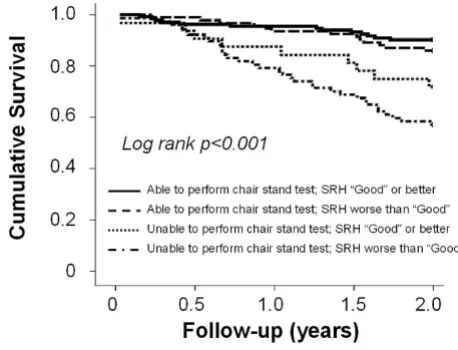
The chair stand test was then categorized according to the ability (n = 226, 67.5%) or not (n = 109, 32.5%) to per-form the task. The SRH score was categorized according to the median value in two groups (i.e. SRH score ≤ 3: n = 170 [47.9%]; SRH score >3: n = 165 [52.1%]). Figure 1 shows results from Kaplan-Meier survival curves for mor-tality according to physical performance and SRH groups. Participants able to complete the chair stand test were sig-nificantly less likely to die compared to those with poor physical performance (p < 0.001). No significant differ-ences were found 1) among participants able to complete the chair stand test, or 2) among participants unable to complete the chair stand test, according to the SRH status groups (pairwaise comparisons p = 0.47, and p = 0.17, respectively). An adjusted multivariable proportional haz-ard model (Table 3) confirmed these findings, showing that participants unable to complete the chair stand test and with worse SRH had a higher risk of mortality (HR 2.36, 95%CI 1.16–4.79; p = 0.02) compared to the refer-ence group (i.e. able to complete the chair stand test and SRH score >3), even after adjustment for all the potential confounders. Consistent results were obtained when the overall SPPB score was tested in combination with the SRH.
Discussion
In the present study, we compared the predictive value for mortality of two physical performance measures (i.e. 4-meter walk test, and the SPPB score), a measure of muscle strength (i.e. hand grip), two measures of disability (i.e. ADL and IADL scores) and a self-reported measure of well-being (i.e. a SRH scale). Our results from unadjusted and partially adjusted analyses showed that all the tested physical function variables were able to predict mortality. However, the SPPB score was the strongest predictor of Table 1: Main characteristics (mean ± standard deviation, or
percentage) of the study sample according to mortality.
Death
(n = 71)
No death
(n = 264)
p
Sociodemographic
Age (years) 87.5 ± 5.2 85.0 ± 4.6 <0.001 Gender (women) 64.8 67.0 0.72 Education (years) 4.9 ± 1.1 5.2 ± 1.8 0.14 Current smoking 2.8 2.3 0.79 Body Mass Index (kg/m2) 24.4 ± 4.2 26.1 ± 4.5 0.003
Cognitive Performance Scale 1.6 ± 1.9 0.6 ± 1.3 <0.001
Clinical conditions
Coronary artery disease 15.5 11.0 0.30 Congestive heart failure 15.5 3.4 <0.001 Cerebrovascular disease 14.1 1.9 <0.001 Cancer 8.5 3.4 0.07 Depression 35.2 23.9 0.05 Diabetes 36.6 25.0 0.05 Dementia 14.1 5.3 0.01 Number of clinical conditions 1.4 ± 1.2 0.7 ± 0.8 <0.001
Biological markers
Albumin (g/dL) 4.1 ± 0.4 4.2 ± 0.3 0.001 Total cholesterol (mg/dL) 178.7 ± 38.0 203.6 ± 45.2 <0.001 C-reactive protein (mg/L) 5.1 (2.5–7.4) 2.5 (1.3–4.6) <0.001
Physical performance measures
4-meter walking speed 0.35 ± 0.30 0.55 ± 0.28 <0.001 SPPB score (0–12) 4.0 ± 3.3 7.1 ± 3.3 <0.001 Walk test (0–4) 1.3 ± 1.1 2.1 ± 1.2 <0.001 Chair stand test (0–4) 0.7 ± 1.1 1.8 ± 1.4 <0.001 Balance test (0–4) 2.0 ± 1.6 3.1 ± 1.3 <0.001 Hand grip strength (kg) 27.7 ± 14.4 33.2 ± 13.7 <0.001
Functional status measures
ADL score 4.3 ± 2.2 6.2 ± 1.8 <0.001 IADL score 2.4 ± 2.5 4.7 ± 2.3 <0.001
Self-rated health status
Self-Rated Health score 2.97 ± 0.89 3.48 ± 0.83 <0.001 SPPB: Short Physical Performance Battery; ADL: Basic Activities of Daily Living (range 0 [totally dependent] – 7 [totally independent]); IADL: Instrumental Activities of Daily Living (range 0 [totally dependent] – 7 [totally independent]).
overall mortality in these very old community-dwelling subjects, even after considering several socio-demo-graphic, clinical, and biological confounders. A lower, but still significant, predictive value was only showed by the SRH measure. Among the three subtasks of the SPPB, the chair stand test was the one showing the highest prognos-tic value. The combination of the chair stand test and the SRH score did not provide significant additional benefits in predicting mortality. In fact, participants with a good physical performance had a lower risk of dying compared to those with poor performance, independently of their self-perceived health status. Moreover, no significant dif-ferences were reported when comparing the AUC designed by ROC curve analyses for mortality. However, when the chair stand test and the SRH results were com-bined, the selection of the participants poorly scoring at both tests, led to the identification of a smaller number of subjects characterized by the highest risk of mortality compared to participants with good physical performance and SRH.
Previous studies have already explored the relationship existing between objective and self-reported measures of physical function for major health-related events[31,32]. Moreover, the strong relationship between physical per-formance tests and negative health-related outcomes in the elderly has already been documented[4,6,33,34]. However, besides of being confirmatory of previous find-ings showing the importance of physical performance in older persons, our study still adds some novel contribu-tions to the topic.
To our knowledge, a direct comparison of the predictive value for mortality of different screening instruments (particularly aimed at the evaluation of the physical func-tion and the health status) is not yet available in literature, especially among very old subjects. This comparison led to the identification of the SPPB (in particular, of the chair stand test subtask) and the SRH as the best predictors of mortality. It is noteworthy that both these instruments are quick and inexpensive measures whose implementation Table 2: Proportional hazard models between measures of health status (per standard deviation increase) and mortality.
Unadjusted Model 1 Model 2 Model 3
HR (95%CI) HR (95%CI) HR (95%CI) HR (95%CI)
Objective measures
4-meter walking speed 0.49 (0.38–0.63)† 0.53 (0.40–0.69)† 0.73 (0.54–0.99)* 0.77 (0.56–1.05)
SPPB score 0.44 (0.34–0.57)† 0.46 (0.36–0.60)† 0.62 (0.47–0.83)† 0.64 (0.48–0.86)†
SPPB Walk test 0.48 (0.36–0.64)† 0.52 (0.39–0.70)† 0.71 (0.52–0.97)* 0.73 (0.54–1.01)
SPPB Balance test 0.55 (0.44–0.68)† 0.58 (0.47–0.74)† 0.77 (0.60–1.00) 0.78 (0.60–1.01)
SPPB Chair stand test 0.38 (0.27–0.53)† 0.40 (0.29–0.56)† 0.51 (0.36–0.72)† 0.54 (0.38–0.76)†
Hand grip strength (kg) 0.55 (0.43–0.71)† 0.57 (0.44–0.75)† 0.77 (0.58–1.04) 0.78 (0.58–1.05)
ADL score 0.54 (0.45–0.65)† 0.58 (0.48–0.71)† 0.77 (0.59–1.00) 0.81 (0.62–1.06)
IADL score 0.48 (0.38–0.61)† 0.51 (0.40–0.67)† 0.70 (0.50–0.99)* 0.77 (0.54–1.09)
SRH score 0.62 (0.50–0.77)† 0.65 (0.52–0.80)† 0.78 (0.60–0.99)* 0.76 (0.59–0.97)*
* p < 0.05; † p < 0.01
SPPB: Short Physical Performance Battery; ADL: Basic Activities of Daily Living; IADL: Instrumental Activities of Daily Living; SAHS: Self-assessed health status.
Standard deviations: 4-meter walking speed 0.29714; SPPB score 3.50676; SPPB Walk test score 1.22735; SPPB Balance test score1.45514; SPPB Chair stand test score 1.42872; Hand grip strength 14.28956 kg; Basic Activities of Daily Living 2.19641; Instrumental Activities of Daily Living 2.51375; Self-rated health 0.86923
Model 1: Adjusted for age and gender.
Model 2: Adjusted for Model 1 + body mass index, cognitive performance scale, number of clinical conditions, albumin, total cholesterol.
Model 3: Adjusted for Model 2 + C-reactive protein (log value)
Table 3: Results from a single multivariable proportional hazard model* exploring the relationship of physical performance and self-rated health with mortality.
N/N (%) Hazard Ratio (95% Confidence Interval)
SPPB Chair stand test > 0, SRH > 3 14/133 (10.5) 1 (Reference group) SPPB Chair stand test > 0, SRH ≤ 3 14/93 (15.1) 1.02 (0.46–2.25) SPPB Chair stand test = 0, SRH >3 9/32 (28.1) 1.45 (0.57–3.74) SPPB Chair stand test = 0, SRH ≤ 3 34/77 (44.2) 2.36 (1.16–4.79) n/N: number of events/number of participants; SPPB: Short Physical Performance Battery; SRH: Self-rated health
in clinical settings may not be particularly honerous in terms of training, costs, and time.
Our results did not show evidence of a statistical interac-tion between SPPB, SRH and mortality. However, the sur-vival analyses we performed seem to suggest such interaction. In fact, the SPPB score was able to discrimi-nate participants with higher mortality risk regardless of their SRH status. This was not evident for the SRH instru-ment, which tended to discriminate individuals at higher risk only among those with poor physical performance. This finding may support the use of SPPB (and physical performance measures in general) as optimal screening tools for older persons, independently of their health sta-tus.
Our analyses of the three subtests composing the SPPB demonstrated that the chair stand test was more strongly associated with the mortality outcome than the walk and balance tests. Moreover, the chair stand test was able to predict mortality in a very similar way to the complete SPPB score. This may suggest that the adoption of this only subtask in those settings with time and/or space restrains might already be sufficient to identify older per-sons at risk of events. In the attempt to facilitate the pos-sible implementation of this test in the clinical setting, our secondary analyses tested a dichotomous variable of the chair stand test defined as the ability or not to stand up from the chair five times in a row. The adoption of this single SPPB subtask as screening tool for older persons may be very easy to implement, even more than a walking speed test. Interestingly, Ensrud and collesgues recently proposed a frailty index including the inability to rise
from a chair 5 times without using arms as a component criterion[35]. Authors compared the predictive value of this new index to that of the more commonly used (but more complex) Fried and colleagues' one[36], reporting similar results. Our results showing the higher prognostic value of the chair stand test in comparison with the other SPPB subtasks is not completely in line with the sparse previous evidence. In fact, the few studies available on the topic suggest that the walking speed is the most sensitive subtask of the SPPB in predicting incident disabil-ity[4,37], and mortality[38]. A possible explanation to the different results we found might be the older age of our sample population. It might be that the three subtests composing the SPPB may present different age-related declines. If the 4-meter walk test is more prematurely affected by aging (and the related underlying conditions), a "floor" effect may limit the predictive value of it in favor of a possible more stable test (i.e. chair stand test).
The predictive value for mortality of SRH, independently of health risk factors is well-demonstrated in litera-ture[17]. Several explanations to this relationship have been provided. It is possible that SRH may better capture the burden of diseases and symptoms. Another explana-tion might be related to the wider spectrum of informa-tion (inclusive of personal sensainforma-tions) that a person can describe when self-reporting the own health status, and which may partially be excluded by "external" evalua-tions[39].
Significant results in the prediction of mortality were reported by the hand grip strength, and the IADL and ADL scales only in the unadjusted and partially adjusted mod-els. It is noteworthy that the predictive values of the hand grip strength, ADL, and IADL scores for mortality were strongly weakened by inclusion in the statistical models of clinical conditions and, later, CRP concentrations. Con-sistent results have previously been reported in studies testing the associations of these measures with comorbid-ity[32], health status[14], and incident health-related events[33,40]. The hand grip strength is a standardized measure of a specific muscular district strength which is generalized to the overall individual muscular function-ing[15,41]. On the other hand, the SPPB requires a good overall physical functioning of the subject to be success-fully completed. The ADL and IADL scales are designed to evaluate the ability of a subject to interact with the sur-rounding environment and independently accomplish crucial tasks of life[10,11]. Thomas and colleagues recently showed that objective measures of physical per-formance are able to improve the assessment of func-tional status provided by subjective measures of physical function in older persons[13]. Therefore, it is likely that the SPPB is able to capture a wider scope of information from different sources related to physical functioning than
Kaplan-Meier survival curves for mortality according to the ability to perform the chair stand test and self-rated health (SRH) score
Figure 1
hand grip strength, and ADL and IADL scales. In this con-text, it may also not be surprising that a general SRH meas-ure is more strongly associated to mortality than specifically-aimed subjective screening tests (i.e. ADL and IADL scales) or too sectorial measures (i.e. hand grip strength).
Our study presents some limitations. The limited sample size may have influenced some of our results, potentially leading to type I errors. However, the risk of false negative results may be limited due to the overall consistency of our findings (even with previous reports). Our sample population was composed by older community-dwelling persons aged 80 years and older. Further studies confirm-ing our findconfirm-ings, and extendconfirm-ing them to different age groups, settings and populations are needed. Third factors not considered in our study (e.g. body composition), and potentially explaining (at least partly) our results may rep-resent a further limit of the prep-resent analyses.
Conclusion
Our study shows that all the tested measured are able to predict mortality with different extents. However, the only which are not influenced by sociodemographic, clinical, and biological factors in their prediction are the SPPB and the SRH. The chair stand test may be as useful as the com-plete SPPB in estimating the mortality risk, and the testing of the only ability to perform it may already be sufficient to provide useful prognostic information.
Competing interests
The authors declare that they have no competing interests.
Authors' contributions
MC conceived and designed the study, carried out the data analysis and interpreted the results, drafted the manu-script, and gave the final approval. GO conceived and designed the study, carried out the data analysis and inter-preted the results, helped in drafting the manuscript, pro-vided critical review of the manuscript, and gave the final approval. VZ conceived and designed the study, was involved in the data acquisition, helped in the interpreta-tion of the data, provided critical review of the manu-script, and gave the final approval. TM helped in the interpretation of the data, provided critical review of the manuscript, helped in drafting the manuscript, and gave the final approval. RIS helped in the interpretation of the data, provided critical review of the manuscript, and gave the final approval. AR conducted the acquisition of the data, provided critical review of the manuscript, and gave the final approval. RB helped in the interpretation of the data, provided critical review of the manuscript, and gave the final approval. MP was involved in the conception and design of the study, helped in the interpretation of the data, provided critical review of the manuscript, and gave
the final approval. FL conceived and designed the study, was responsible for the acquisition of the data, helped in the analysis and interpretation of the data, provided criti-cal review of the manuscript, and gave final approval.
Acknowledgements
The "Invecchiamento e Longevita' nel Sirente" (ilSIRENTE) study was sup-ported by a grant from the "Comunita' Montana Sirentina" (Secinaro, L'Aquila, Italy). Drs. Cesari and Pahor are supported by the University of Florida Institute on Aging and the Claude D. Pepper Older Americans Inde-pendence Center (NIH grant 1P30AG028740).
References
1. Applegate WB, Blass JP, Williams TF: Instruments for the func-tional assessment of older patients. N Engl J Med 1990,
322:1207-1214.
2. St-Onge MP: Relationship between body composition changes and changes in physical function and metabolic risk factors in aging. Curr Opin Clin Nutr Metab Care 2005, 8:523-528.
3. Guralnik JM, Branch LG, Cummings SR, Curb JD: Physical perform-ance measures in aging research. J Gerontol 1989,
44:M141-M146.
4. Guralnik JM, Ferrucci L, Simonsick EM, Salive ME, Wallace RB:
Lower-extremity function in persons over the age of 70 years as a predictor of subsequent disability. N Engl J Med 1995,
332:556-561.
5. Guralnik JM, Ferrucci L, Pieper CF, Leveille SG, Markides KS, Ostir GV, et al.: Lower extremity function and subsequent disability: consistency across studies, predictive models, and value of gait speed alone compared with the Short Physical Perform-ance Battery. J Gerontol A Biol Sci Med Sci 2000, 55(4):M221-M231. 6. Guralnik JM, Simonsick EM, Ferrucci L, Glynn RJ, Berkman LF, Blazer DG, et al.: A short physical performance battery assessing lower extremity function: association with self-reported dis-ability and prediction of mortality and nursing home admis-sion. J Gerontol 1994, 49:M85-M94.
7. Studenski S, Perera S, Wallace D, Chandler JM, Duncan PW, Rooney E, et al.: Physical performance measures in the clinical setting.
J Am Geriatr Soc 2003, 51:314-322.
8. Fogel JF, Hyman RB, Rock B, Wolf-Klein G: Predictors of hospital length of stay and nursing home placement in an elderly medical population. J Am Med Dir Assoc 2000, 1:202-210. 9. Inouye SK, Peduzzi PN, Robinson JT, Hughes JS, Horwitz JS, Horwitz
RI, et al.: Importance of functional measures in predicting mortality among older hospitalized patients. JAMA 1998,
279:1187-1193.
10. Katz S, Ford AB, Moskowitz RW, Jackson BA, Jaffe MW: Studies of illness in the aged. The index of ADL: a standardized meas-ure of biological and psychosocial function. JAMA 1963,
185:914-919.
11. Lawton MP, Brody EM: Assessment of older people: self-main-taining and Instrumental Activities of Daily Living. Gerontolo-gist 1969, 9:179-186.
12. Brach JS, VanSwearingen JM, Newman AB, Kriska AM: Identifying early decline of physical function in community-dwelling older women: performance-based and self-report measures.
Phys Ther 2002, 82:320-328.
13. Thomas DR, Marren K, Banks W, Morley J: Do objective measure-ments of physical function in ambulatory nursing home women improve assessment of functional status? J Am Med Dir Assoc 2007, 8:469-476.
14. Rozzini R, Frisoni GB, Bianchetti A, Zanetti O, Trabucchi M: Physical Performance Test and Activities of Daily Living scales in the assessment of health status in elderly people. J Am Geriatr Soc 1993, 41:1109-1113.
15. Rantanen T, Guralnik JM, Foley D, Masaki K, Leveille SG, Curb JD, et al.: Midlife hand grip strength as a predictor of old age disa-bility. JAMA 1999, 281:558-560.
Publish with BioMed Central and every scientist can read your work free of charge "BioMed Central will be the most significant development for disseminating the results of biomedical researc h in our lifetime."
Sir Paul Nurse, Cancer Research UK
Your research papers will be:
available free of charge to the entire biomedical community
peer reviewed and published immediately upon acceptance
cited in PubMed and archived on PubMed Central
yours — you keep the copyright
Submit your manuscript here:
http://www.biomedcentral.com/info/publishing_adv.asp
BioMedcentral 17. Idler EL, Benyamini Y: Self-rated health and mortality: a review
of twenty-seven community studies. J Health Soc Behav 1997,
38:21-37.
18. Mossey JM, Shapiro E: Self-rated health: a predictor of mortal-ity among the elderly. Am J Public Health 1982, 72:800-808. 19. Benyamini Y, Blumstein T, Lusky A, Modan B: Gender differences
in the rated health-mortality association: is it poor self-rated health that predicts mortality or excellent self-self-rated health that predicts survival? Gerontologist 2003, 43:396-405. 20. Kaplan GA, Camacho T: Perceived health and mortality: a
nine-year follow-up of the human population laboratory cohort.
Am J Epidemiol 1983, 117:292-304.
21. Benyamini Y, Idler EL, Leventhal H, Leventhal EA: Positive affect and function as influence on self-assessments of health: expanding our view beyond illness and disability. J Gerontol B Psychol Sci Soc Sci 2000, 55:P107-P116.
22. Lyyra TM, Heikkinen E, Lyyra AL, Jylhä M: Self-rated health and mortality: could clinical and performance-based measured of health and functioning explain the association? Arch Geron-tol Geriatr 2006, 42:277-288.
23. Simon JG, De Boer JB, Joung IMA, Bosma H, Mackenbach JP: How is your health in general? A qualitative study on self-assessed health. Eur J Publ Health 2005, 15:200-208.
24. Landi F, Russo A, Cesari M, Barillaro C, Onder G, Zamboni V, et al.:
The ilSIRENTE study: a prospective cohort study on persons aged 80 years and older living in a mountain community of Central Italy. Aging Clin Exp Res 2005, 17:486-493.
25. Morris JN, Fries BE, Bernabei R, Ikegami N, Gilgen R, Steel K, et al.: RAI – Home Care assessment manual Washington, DC: InterRAI Copo-ration; 1996.
26. Hawes C, Morris JN, Phillips CD, Mor V, Fries BE, Nonemaker S:
Reliability estimates for the Minimum Data Set for nursing home resident assessment and care screening (MDS). Geron-tologist 1995, 35:172-178.
27. Landi F, Tua E, Onder G, Carrara B, Sgadari A, Rinaldi C, et al.: Min-imum data set for home care: a valid instrument to assess frail older people living in the community. Med Care 2000,
38:1184-1190.
28. Ferrucci L, Bandinelli S, Benvenuti E, Di Iorio A, Macchi C, Harris TB, et al.: Subsystems contributing to the decline in ability to walk: bridging the gap between epidemiology and geriatric practice in the InCHIANTI study. J Am Geriatr Soc 2000,
48:1618-1625.
29. Al Snih S, Markides KS, Ray L, Ostir GV, Goodwin JS: Handgrip strength and mortality in older Mexican Americans. J Am Ger-iatr Soc 2002, 50:1250-1256.
30. Morris JN, Fries BE, Steel K, Ikegami N, Bernabei R, Carpenter GI, et al.: Comprehensive clinical assessment in community setting: applicability of the MDS-HC. J Am Geriatr Soc 1997,
45:1017-1024.
31. Guralnik JM, Simonsick EM, Ferrucci L, Glynn RJ, Berkman LF, Blazer DG, et al.: A short physical performance battery assessing lower extremity function: association with self-reported dis-ability and prediction of mortality and nursing home admis-sion. J Gerontol 1994, 49:M85-M94.
32. Cesari M, Onder G, Russo A, Zamboni V, Barillaro C, Ferrucci L, et al.: Comorbidity and physical function – Results from the ilSI-RENTE study. Gerontology 2005, 52:24-32.
33. Onder G, Penninx BWJH, Lapuerta P, Fried LP, Ostir GV, Guralnik JM, et al.: Change in physical performance over time in older women: the Women's Health and Aging Study. J Gerontol A Biol Sci Med Sci 2002, 57A:M289-M293.
34. Cesari M, Kritchevsky SB, Penninx BWJH, Nicklas BJ, Simonsick EM, Newman AB, et al.: Prognostic value of usual gait speed in well-functioning elders – Results from the Health, Aging and Body Composition (Health ABC) study. J Am Geriatr Soc 2005,
53:1675-1680.
35. Ensrud KE, Ewing SK, Taylor BC, Fink HA, Cawthon PM, Stone KL, et al.: Comparison of 2 frailty indexes for prediction of falls, dis-ability, fractures, and death in older women. Arch Intern Med 2008, 168:382-389.
36. Fried LP, Tangen CM, Walston J, Newman AB, Hirsch C, Gottdiener J, et al.: Frailty in older adults: evidence for a phenotype. J Ger-ontol A Biol Sci Med Sci 2001, 56:M146-M156.
37. Ostir GV, Markides KS, Black SA, Goodwin JS: Lower body func-tioning as a predictor of subsequent disability among older
Mexican Americans. J Gerontol A Biol Sci Med Sci 1998,
53:M491-M495.
38. Rolland Y, Lauwers-Cances V, Cesari M, Vellas B, Pahor M, Grandjean H: Physical performance measures as predictors of mortality in a cohort of community-dwelling older French women. Eur J Epidemiol 2006, 21:113-122.
39. Stenback A: Physical health and physical disease as objective fact and subjective experience. Arch Gen Psychiatry 1964,
11:290-301.
40. Markides KS, Black SA, Ostir GV, Angel RJ, Guralnik JM, Lichtenstein M: Lower body function and mortality in Mexican American elderly people. J Gerontol A Biol Sci Med Sci 2001,
56(4):M243-M247.
41. Rantanen T, Volpato S, Ferrucci L, Heikkinen E, Fried LP, Guralnik JM:
Handgrip strength and cause-specific and total mortality in older disabled women: exploring the mechanism. J Am Geriatr Soc 2003, 51:636-641.
Pre-publication history
The pre-publication history for this paper can be accessed here: