Optimal Dispatch for Deregulated Power
Systems using Fuzzy Logic Decision Making
Technique
Amninder Singh Shivani Mehta Chintu Rza Dept. of Electrical Engineering Deptt. of Electrical Engineering Deptt. of Electrical Engineering DAVIET Jalandhar, India DAVIET Jalandhar, India DAVIET Jalandhar, India
ABSTRACT
Economic Dispatch (ED) optimization problem is the most important issue which is to be taken into consideration in power systems. In this paper, the economic dispatch problem has been modified to minimization of network congestion. The problem has been sub divided into two parts: (i) minimization of generation cost and (ii) minimization of network congestion; subject to power balance constraints. As the two sub-problems have conflicting objectives, fuzzy decision making multi-objective optimization has been applied to obtain single optimal solution from conflicting objectives of generation cost and network congestion. To the proposed approach, it has been tested on IEEE 57-bus system. The results describe the capability of the proposed approach of reducing network congestion while maintaining economy in the load dispatch...
Keywords— Economic Load Dispatch, Fuzzy Decision Making, Multi-Objective Optimization, Network Congestion
1. INTRODUCTION
Economic load dispatch is an important function of the energy management system, which aims at minimization of the operating cost of power generation from thermal power plant subject to the satisfaction of power demand of the consumers and losses in transmission system. Network congestion occurs when there is overload of transmission lines; as a result it obstructs desired trading of power among suppliers and consumers. Occurrence of congestion may also increases the cost of electricity delivered at consumer end. Hence, it becomes necessary to incorporate the network congestion problem within economic load dispatch, so that power is delivered to the consumers with reliability and at optimal cost.
Niimura T., and Nakashima T.[1] introduce indices to represent environmental impacts and network congestion in the deregulated power system, and
analyze the tradeoff relations among the different aspects of power system operation. In addition to social welfare maximization, the minimization of the
environmental impact of thermal power generation, and the minimization of network congestion are incorporated into the multiobjective optimization framework.
Prasanna. S.T. and Somasundaram. P[2] presents an efficient and simple approach for solving the emission constrained economic dispatch problem using FMEP. The convergence and usefulness of the proposed FMEP is demonstrated through its application to a test system.
Gong.-D.and Zhang Y.[3] presents a hybrid multi-objective optimization algorithm based on PSO and DE (MO-DE/PSO) is proposed for solving the constrained EED problem. An improved PSO algorithm that emphasizes on exploring the entire search space and a local version of DE algorithm that emphasizes on exploiting the sub-space with sparse solutions, are proposed respectively and are combined to achieve better performance. Finally, several optimization trials of the proposed algorithm are carried out on the IEEE 30-bus test system.
Rajangam K., Arunachalam V.P, Subramanian R.[6] present a novel implementation of the AIS algorithm is based on pattern recognition and anomaly detection proposed to solve the economic dispatch problems. The effectiveness of proposed algorithm is demonstrated using IEEE 30 bus six generator system considering emission constraints.
Bhuyan S., Hazarika S. and Bardalai A. [9] develop an user friendly software to perform load flow analysis for IEEE 57 bus system. The software will be helpful for researchers, practising engineers, students of power system of various levels to carry out power flow quickly and efficiently as per their requirement. The software is developed using MATLAB programming.
Anand R. and Balaji V. [10] proposed to conducting the power flow analysis for an IEEE 57 bus test system to obtain fast and accurate results. Also the system network must be editable for different load conditions with different elements to add or remove for different analysis2. This will help for many researchers; those are interested on power system stability and enhancement.
Kaur G., Kumar D. and Kaur M.[11] Fuzzy Decision Making technique is applied to economic power generation for six generating units. Fuzzy Decision Making Technique was employed to solve the ELD problem for four cases of six generating unit system without losses, with losses, with minimization of line flow and fuzzy decision making technique with linear membership function.
Tejlavwala A. A[12] The simulation of a Load flow analysis on IEEE-30 bus system was conducted and the effects of load modelling. The reactive power modelling greatly affected the voltage difference, whereas the active power modelling has a greater effect on phase angle differences. load flow models in load flow analysis is advantageous than conventional load flow analysis as generation cost and losses are reduced and security and stability of the system increases.
.In this paper fuzzy decision making technique has been applied to solve the multi-objective optimization problem with conflicting objectives of generation cost and network congestion. Fuzzy decision making technique is considered to be more effective than other techniques as far as conflicting objectives are included in the optimization problem [13]. The proposed technique optimizes the said objective functions under a set of system constraints such as real and reactive power balance equations
and generating capacity limits. The performance of proposed technique is tested on IEEE 57-bus system.
The performance of proposed technique on IEEE 57-bus system has been presented in section 3. Section 4 presents the conclusion.
2. PROBLEM FORMULATION
The aim of the proposed multi-objective optimization problem is to determine the generation levels, which will minimize the conflicting objectives of generation cost and network congestion, subject to real and reactive power balance and generation capacity constraints. The problem formulation has been sub-divided into following parts:
To minimize the fuel cost and line flow parameters (V, δ, P,Q,θ,Y) for economic load dispatch problem for IEEE 57 bus system.
To minimize the fuel cost & Line Flow for IEEE 57 bus system by implementing Fuzzy Decision Making Technique.
To compare the results obtained with other method & Fuzzy Decision Making Technique for IEEE 57 bus system.
2.1 FORMULATION OF PROBLEM
2.1.1Economic Load Dispatch
As the main objective minimize the conflicting objectives of generation cost and network congestion, subject to real and reactive power balance and generation capacity constraints. Hence the objective function is taken equivalent to the total cost for supplying the indicated load which is represented by Fi Pgi . It can be formulated as follows
Minimize
Fi Pgi = aiPgi2+ biPgi+ ci (1)
Where
𝑎𝑖, 𝑏𝑖, 𝑐𝑖 are the fuel cost coefficient.
Pgi is the real power output of the generator.
Mathematically, the problem is defined as
pi = ni=1Fi Pgi (2)
Fpi is the total operating cost over the whole dispatch period.
Subject to:
a) Real power dispatch in constraint
Pgi− Pdi − Vi nk=1VkYikcos θik +δk−δi = 0 (3)
Where I=1, 2, 3…..n
Pdi is load demand of real power at the ith bus
Pgi is generation of real power at the ith bus
Vi is magnitude of votage at bus ith
δi is voltage phase angle at bus ith
Yik is admittance matrix of bus ith and kth
b) Reactive power dispatch in the network
The reactive power dispatch is an optimization problem which reduces the grid congestion by minimizing the grid power losses. The reactive power dispatch is used to solve the power flow equations. Hence as a result an improved voltage profile can be obtained. RPD is defined as following by using load flow equations.
Qgi− Qdi+ Vi nk=1VkYiksin θik+δk−δi = 0 (4)
Where I=1, 2, 3…..n
QdiIs total system demand of reactive power bus
Qgi is total system generation of reactive power bus
Vi is magnitude of votage at bus ith
δi is voltage phase angle at bus ith Bus.
Yik is admittance matrix of bus ith and kth Bus.
c) Generating capacity constraints
To stabilize the operation, the generator output, bus voltage magnitudes and voltage angles are restricted by upper and lower limits. These upper and lower bounds are defined as following
Pgimin ≤ Pgi≤ Pgimax I=1,2,3…..n (5)
Where
Pgi min is mini. O/p power of the gith unit
Pgimax is mini. O/p power of the gith unit Voltage magnitude satisfy the inequality
≤ 𝑉_𝑖 ≤ 𝑉_(𝑖 )^𝑚𝑎𝑥 I=1, 2, 3…..n (6) Where
Vgimin = mini. Voltage of the gith unit
Vgi max= maxi. Voltage of the gith unit Voltage angle also satisfy the inequality
𝛿𝑖𝑚𝑖𝑛 ≤ 𝛿
𝑖 ≤ 𝛿𝑖𝑚𝑎𝑥 I=1, 2, 3…..n (7) Where
δgimin = mini. Voltage angle of the gith unit
δgi max= maxi. Voltage angle of the gith unit
d) Computation of line flows
Consider that line is connecting the buses I and m. The Real power is injected from bus I to k and is given as following.
Pim+ jQim = Vi Vi∗− Vm∗ Yim∗ + Vi∗Yim 0∗ (8)
Reactive power is injected from bus k to bus I as following
Pmi+ jQmi = Vm Vm∗ − Vi∗ Ymi∗ + Vi∗Ymi 0∗ (9)
Where
Yim∗ Is the series admittance
Yim 0∗ Is the shunt admittance
Vi is the voltage at the ith bus
Sim= Pim+ jQim (10)
Smi = Pmi+ jQmi (11) Power losses in the (I-k) 𝑡ℎ line is the sum of the power flows in the (I-k) 𝑡ℎ line from the ith bus and the kth bus.
𝑃𝐿𝑖𝑘 = 𝑆𝑖𝑚+𝑆𝑚𝑖 (12)
2.1.2 Network congestion
When transmitted power increase the capacity or transfer limit of the transmission line then network congestion is produced .Congestion is managed at the dispatch stage. In this paper to reduce the network congestion we minimized the line flow in branch 2 from bus 1 to bus 3.From section 2.1.1, calculate the computation of line flows.
2.1.3 Application of fuzzy decision making technique
According to fuzzy decision making technique we differentiate decision problems that involve an optimization problem under multi-objective criteria. To find out the membership function of cost and line flow first step is to find the minimum and maximum values of cost and line flow.
1) LinearMembership function
The membership function for cost is defined as
following:-1 fi x ≤ fi1
μ𝑓
𝑖 𝑥 𝑓𝑖 𝑥 −𝑓𝑖0
fi1−𝑓
𝑖0 fi 1< 𝑓
𝑖 𝑥 < 𝑓𝑖0 (13)
1
0 𝑓𝑖 𝑥 ≥ 𝑓𝑖0
Where
fi1=value of an original fuel cost that is
completely satisfactory
𝑓𝑖0= value of an original fuel cost that is
𝑓𝑖 𝑥 = value of an original fuel cost which is
varying Minimize𝑓𝑖 𝑥 =
1
1+min membershipfunction of multi objectives (14)
By using this function we minimize the several objectives such as cost, line flow.
2.4 Methodology
Step1. Input parameters of system, fuel cost co- efficient and specify lower and upper boundaries and define minimum fuel cost function.
Step2. Get the power generation for seven generating units and total fuel cost and total losses.
Step3. For minimizing line flow we have to check whether any line is overloaded or not.
Step4. If overload exists, find the minimum value of line flow by using equations
Step5.As the fuel cost and line flow are the conflicting objectives so an optimal solution cannot be obtained, hence to obtain the optimal solution linear membership function is applied.
Step 6.The Value of membership function is obtained using equation (2.12) for fuel cost and line flow which lies on one optimal point.
3. RESULTS AND DISCUSSIONS
The fuzzy decision making technique is tested on four different test cases of a single seven unit system of the economic load dispatch and network congestion problem. The test case 1 considers only operating cost without network congestion and loss, test case 2 considers operating cost with losses, test case 3 considers losses with network congestion and without operating cost and test case 4 considers operating cost with network congestion and losses. The cost coefficients of IEEE-57 bus system are
slightly modified to incorporate non smooth fuel cost functions with ramp rate coefficients as given in Table3.1.The base power value is on 100 MVA base. For all analysis on this system
Vimin, Vimax,δmini and δimax for ith bus are considered to be 0.9 p.u, 1.I p.u., -45 degree and 4 5 degree respectively.
Fig 3.1 single line diagram IEEE 57 bus test system [13]
𝐏𝐠𝐢𝐦𝐢𝐧
(M W)
𝐏𝐠𝐢𝐦𝐚𝐱
(M W)
𝒂𝒊 𝒃𝒊 𝒄𝒊
($/MW^2 h)
($/MW^2 h)
($/MW^2 h)
0 576 0 0.07750 20
0 100 0 0.01000 40
0 140 0 0.25000 20
0 100 0 0.10000 40
0 550 0 0.02222 20
0 100 0 0.01000 40
Table3.1: Generation and Fuel Cost Coefficient
Table 3.2 load bus data[13]
3.1 Test case 1
Here generation limit of seven unit system and the generation cost coefficients are taken from table 3.1.For this test case network congestion and losses are not considered .In this test case operating cost of seven unit systems is calculated. For this test case condition used as
Pg= Pd
Table 3.4: Result of Test Case 1
3.2 Test Case 2:
Here generation cost coefficients and generation limit of seven units system are taken from table3.1.In this test case operating cost with losses of seven unit systems is calculated at different power demand. We use line flow equations when losses are considered
PL= Pg− Pd
Different values of voltage magnitude for different load buses in test case 2 are given as following.
Graph 3.1: Voltage when losses are included
3.3 Test Case 3:
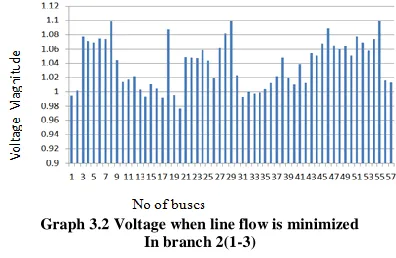
Here generation cost coefficients and generation limit of seven unit system are taken from appendix. In this test case operating cost with losses of seven unit systems is calculated. For minimizing theLine Flow equation of branch 2 from bus 1 to bus 3, load flow equations are applied.
Graph 3.2 Voltage when line flow is minimized In branch 2(1-3)
3.4 Test Case 4
In this test case operating cost including line flows with power losses of seven-unit system is calculated at different power demand using fuzzy decision
Bus no.
Load
Bus no.
Load
P(MW) Q(MVAR) P(MW) Q(MVAR)
1 0.5500 0.1700 30 0.0360 0.0180
2 0.0300 0.8800 31 0.0580 0.0290
3 0.4100 0.2100 32 0.0160 0.0080 4 0.0000 0.0000 33 0.0380 0.0190 5 0.1300 0.0400 34 0.0000 0.0000
6 0.7500 0.0200 35 0.0600 0.0300 7 0.0000 0.0000 36 0.0000 0.0000 8 1.5000 0.2200 37 0.0000 0.0000 9 1.2100 0.2600 38 0.1400 0.0700
10 0.0500 0.0200 39 0.0000 0.0000 11 0.0000 0.0000 40 0.0000 0.0000 12 3.7700 0.2400 41 0.0630 0.0300 13 0.1800 0.0230 42 0.0710 0.0440
14 0.1050 0.0530 43 0.0200 0.0100 15 0.2200 0.0500 44 0.1200 0.0180 16 0.4300 0.0300 45 0.0000 0.0000 17 0.4200 0.0800 46 0.0000 0.0000 18 0.2720 0.0980 47 0.2970 0.1160 19 0.0330 0.0060 48 0.0000 0.0000 20 0.0230 0.0100 49 0.1800 0.0850 21 0.0000 0.0000 50 0.2100 0.1050 22 0.0000 0.0000 51 0.1800 0.0530 23 0.0630 0.0210 52 0.0490 0.0220 24 0.0000 0.0000 53 0.2000 0.1000 25 0.0630 0.0320 54 0.0410 0.0140 26 0.0000 0.0000 55 0.0680 0.0340 27 0.0930 0.0050 56 0.0760 0.0220 28 0.0460 0.0230 57 0.0670 0.0200 29 0.1700 0.0260
Test Case Total Fuel Cost ( $/hr)
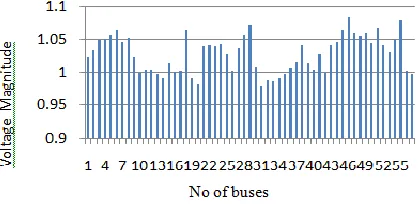
making technique. Different values of voltage magnitude for different load buses in test case 4 are given as following
Graph 3.3 when fuzzy decision making technique is applying then graph of voltage is following
3.5 Comparison between different voltages
Graph 3.4 for power generation of seven units for different cases
Table 3.6 Performance Parameters for IEEE 57- bus system
CONCLUSION
In this paper, fuzzy decision making technique have been used for solving the economic load dispatch and to minimize the network congestion. Four different test cases of single seven unit system for above problems are taken. The conclusion describes the capability of the proposed fuzzy decision multi-objective technique to solve the problems of economic load dispatch and network congestion
REFERENCES
[1] Niimura T., and Nakashima T., ―Multi-objective trade-off analysis of deregulated electricity transactions,‖ sciences direct Electrical Power and Energy Systems vol.25 pp. 179–185 (2003). [2] Prasanna. S.T. and Somasundaram. P., “Fuzzy -Tabu Search Algorithm For Combined Economic and Emission Dispatch,‖ National Systems Conference 4.
(NSC 2008), Chennai, India, Dec 2008, pp. 542-547
[3] Gong.-D.and Zhang Y., “Environmental/economic power dispatch is using a hybrid multi-objective optimization algorithm,‖ science direct Electrical Power and Energy Systems vol32, pp. 607–614 (2010).
[4] Bisen D.and Dubey H..M, ―Dynamic Economic Load Dispatch with Emission and Loss using GAMS,‖ Inter. J.of engg. Research & Tech., vol. 1, May 2012.
[5] Ramyasri N.and Reddy G.S., ―Fuzzified PSO for Multiobjective Economic Load Dispatch Problem,‖ International Journal of Research in Engineering and Technology, Volume: 02 Issue: 08, pp. 157-162, (2013).
[6] Palaniyappan S.,Ilayaranimangammal I., ―An Optimistic Solution Technique For Economic Load Dispatch Problem Using Immune Inspired Algorithm‖ , International Journal of Advanced Research in Electrical, Electronics and Instrumentation Engineering Vol. 2, Issue 12, pp. 6191-6195, (2013).
[7] Rajangam K., Arunachalam V.P, Subramanian R., ―Fuzzy Logic Controlled Genetic Algorithm to Solve The Economic Load Dispatch For Thermal Power Station‖, European Scientific Journal , edition vol. 8, No.7, pp 172-184, (2013).
[8] Kothari D.P., Dhillon J.S. ―Power System Optimization‖, PHI, (2013).
[9] Bhuyan S., Hazarika S. and Bardalai A., “Power Flow Analysis on IEEE 57 bus System
using MATLAB‖, International Journal of Engineering Research & Technology (IJERT) Vol. 3 Issue 8,( 2014)
[10] Anand R. and Balaji V. ―Power Flow Analysis of Simulink IEEE 57 Bus Test System Model using PSAT‖ Indian Journal of Science and Technology, Vol 8(23), (2015)
[11] Kaur G., Kumar D. and Kaur M. ― Multi-Objective Optimization using Linear Membership Function‖ International Conference on Advancements in Engineering and Technology,(2015)
[12] Tejlavwala A. A. ― Load Flow Analysis & Simulation on IEEE 30 Bus System‖ International Journal of Innovative and Emerging Research in Engineering Volume 3, Issue 4, (2016) [13] Appendix 18, ―Data Sheets for IEEE 57 Bus System‖ pp. 129-134.
Cases
Power Losses 𝐏𝐋(MW)
Line Flow (MW)
Fuel cost ($/h)
With Losses .28 53.72 591.29
With Minimization of Line Flow in Branch
2(1-3)
.94 20.24 1687.86
When Fuzzy is Applied
.25 42.99 662
![Fig 3.1 single line diagram IEEE 57 bus test system [13]](https://thumb-us.123doks.com/thumbv2/123dok_us/8585961.1719910/4.612.326.557.156.460/fig-single-line-diagram-ieee-bus-test-system.webp)