Published online March 13, 2015 (http://www.sciencepublishinggroup.com/j/jps) doi: 10.11648/j.jps.s.2014020601.14
ISSN: 2331-0723 (Print); ISSN: 2331-0731 (Online)
Comparative evaluation of antidiabetic activity of crude
methanolic extract of leaves, fruits, roots and aerial parts of
Coccinia grandis
Md. Ataur Rahman, Jyotirmoy Sarker, Shamima Akter, Abdullah Al Mamun,
Md. Abul Kalam Azad, Md. Mohiuddin, Seuly Akter, Md. Shahid Sarwar
*Department of Pharmacy, Southeast University, Dhaka, Bangladesh
Email address:
[email protected] (M. S. Sarwar)
To cite this article:
Md. Ataur Rahman, Jyotirmoy Sarker, Shamima Akter, Abdullah Al Mamun, Md. Abul Kalam Azad, Md. Mohiuddin, Seuly Akter, Md. Shahid Sarwar. Comparative Evaluation of Antidiabetic Activity of Crude Methanolic Extract of Leaves, Fruits, Roots and Aerial Parts of
Coccinia grandis. Journal of Plant Sciences. Special Issue: Pharmacological and Biological Investigation of Medicinal Plants. Vol. 2, No. 6-1, 2014, pp. 19-23. doi: 10.11648/j.jps.s.2014020601.14
Abstract:
Many traditional medicines in use are obtained from medicinal plants, minerals and organic matter. During the past several years, there has been increasing interest among the uses of various medicinal plants from the traditional system of medicine for the treatment of different ailments. Cocciniagrandis has been used in traditional medicine as a household remedy for various diseases. The whole plant of Coccinia grandis having pharmacological activities like analgesic, antipyretic, anti-inflammatory, antimicrobial, antiulcer, antidiabetic, antioxidant, hypoglycemic, hepatoprotective, antimalarial, antidyslipidemic, anticancer, antitussive, mutagenic. The present review gives botany, chemical constituents and pharmacological activities of coccinia grandis. This study was aimed to investigate the antidiabetic activities of methanolic extract of leaves, fruits, root and aerial part of Cocciniagrandis in alloxan induced diabetic mice. Diabetes was confirmed after 25 days of single intraperitoneal injection of alloxan (150 mg/kg) in albino mice. Different groups of diabetic animals were treated with crude plant extract of 150 mg/kg , 300 mg/kg, 400 mg /kg respectively orally administered for a period of 8 hours. The blood sugar level was monitored after 2 hour, after 4 hour, after 6 hour and after 8 hour respectively. The antidiabetic effect of crude plant extract was compared with Glibenclamide (10 mg/kg) belongs to the group of oral hypoglycemic. Our study indicate that, the root, fruit, leaf and aerial part of plant extract (150 mg/kg) reduce the blood glucose level after 8th hour 7.87±0.35, 17.9±12.18, 19.5±7.04 and 23.7±7.23 respectively. The root, fruit, leaf and aerial part of plant extract (300 mg/kg) reduce the blood glucose level after 8th hour 18±12, 19.6±11.6, 20.1±1.55 and 15.3±1.28 respectively. The root, fruit, leaf and aerial part of plant extract (450 mg/kg) reduce the blood glucose level after 8th hour 16.2±1.08, 9.4±0.46, 14.3±1.31 and 10.4±1.56 respectively. Glibenclamide (10 mg/kg) reduces the blood glucose level 11.27±4.64. From this study, it was revealed that different part of Cocciniagrandis plant extract has potential antidiabetic activity.Keywords:
Alloxan, Cocciniagrandis, Diabetes Mellitus, Glibenclamide, Hypoglycemic Activity1. Introduction
Diabetes mellitus is one type of chronic disease characterized by high blood glucose levels owing to absolute or relative deficiency of circulating insulin levels [1]. Diabetes mellitus could also mean a group of metabolic diseases which can be characterized by hyperglycemia on account of defects in insulin secretion, insulin action, or both [2].Recently the disease is noted as a prime degenerative ailment in the world today, affecting at any rate 15 million
people and having complications which include hypertension, atherosclerosis and microcirculatory disorders [3]. In most developing countries at least one in ten deaths in adults aged 35 to 64 is attributable to diabetes, and in some the figure is as high as one in five. Diabetes is a matter of serious metabolic disorder dealing with micro-(eg, retinopathy, nephropathy, and neuropathy) and macro-vascular (eg, myocardial infarction, peripheral vascular disease, and stroke) complications that result in significant morbidity and mortality [4-5].
problem throughout the world, which can be estimated worldwide prevalence of 171 million people in 2000, reported to increase to 366 million people by 2030 [6]. It is enumerated that the total number of people with diabetes in 2010 to be around 50.8 million in India, increasing to 87.0 million by 2030 [7]. Statistical projections for Bangladesh suggest that the number of diabetics will rise from 3.2 million in 2000 to 57 million in the year 2030. The American Diabetes Association (ADA) evaluated the national costs of diabetes in the USA for 2002 to be $US 132 billion, rising to $US 192 billion in 2020 [8]. In the United State, diabetes is considered as the third leading cause of death after heart disease and cancer. At present the treatment of diabetes mainly involves a sustained reduction in hyperglycemia by the use of biguanides, thiazolidinediones, sulfonylureas, D-phenylalanine and α-glucosidase inhibitors in addition to insulin. These types of drugs are producing several types of unwanted side effects. Now a days drugs these are available for diabetes causes adverse effects; that’s why research is concentrated to screen themedicinal plants that are used traditionally for diabetes to discover a newer leaddrug molecule with more therapeutic and less side effects than the existing hypoglycemic drugs [9].
In Bangladesh, about 70-80% of the population has to depend on the indigenous systems for the maintenance of their health [10]. This survey indicates an extensive use of medicinal plants where most of which are served in a crude and substandard form by people. The use of such drug could be dangerous and threatens to public health. Thus the analysis of medicinal plants for exploring of chemical entities and their biological screening is the current need for standardization of herbal medication.
Coccinia grandis is a medicinal plant having a lot of pharmacological properties. In our current study, we tried to compare the antidiabetic activity of leaves, fruits, roots and aerial parts of Coccinia grandis respectively.
2. Materials and
Methods
2.1. Plant Collection and Identification
For this present investigation leaves, fruits, roots and aerial parts of Coccinia grandis were collected from surrounding area of Hazrat Shahjalal International Airport, kurmitola, Dhaka-1229, in March, 2014. After collection leaves, fruits, roots and aerial parts of Coccinia grandis were thoroughly washed with water. The plants were identified by expert of Bangladesh National Herbarium, Mirpur, Dhaka, Bangladesh. Accession number DACB- 39526 for Cocciniagrandis.
2.2. Drying and Grinding
The collected plant parts (leaves, fruits, roots and aerial) were separated from undesirable materials or plants or plant parts. They were sun-dried for one week. The plant parts were grinding into coarse powder with the help of a suitable grinder. The powder was stored in an airtight container and kept in a cool, dark and dry place until analysis commenced.
2.3. Preparation of Methanolic Extracts
For each plant part of the dried and powdered materials (250 g for) were soaked in 1000 ml of 90% methanol for about 15 days at room temperature with occasional stirring. After 15 days the solution was filtered using cotton filter and Whatman’s filter paper.
2.4. Preparation of Test Materials
2.4.1. Preparation of Test Samples
In order to administer the extracts at doses of 150, 300 and 450mg/kg body weight of mice, calculated amount were measured for each plant and were triturated unidirectional way by the addition of small amount of distilled water. After proper mixing of sample and water, normal saline was slowly added. To stabilize the suspension, it was stirred well by vortex mixture.
2.4.2. Preparation of Alloxan Solution
Alloxan (2,4,5,6-tetraoxypyrimidine; 2,4,5,6- pyrimidinetetrone) is an oxygenated pyrimidine derivative which is present as alloxan hydrate in aqueous solution. Alloxan monohydrate (Lobachemie PVT. LTD.) was purchased from local market and used as aqueous solution and given in the dose of 150mg/kg of body weight intraperitonially to induce diabetes [11].
2.4.5. Preparation of Reference Standard Solution
Glibenclamide of Square Pharmaceuticals Ltd, Bangladesh (Brand name: DIBENOL) was purchased from local market which is an oral hypoglycemic agent [12]. Suspension in distilled water was prepared and administered in the dose of 10 mg/kg of body weight, orally, for standard comparison.
2.5. Animals Used for Experiment
Albino mice (30-35 gm) were obtained from animal house of Department of Pharmacy, Jahangirnagar University. All the mice were fed with normal diet. The animals were treated as per the following protocol.
Group I: Kept as normal group.
Group II: Alloxan Monohydrate was used to induce diabetes mellitus in mice. After 24 hrs of fasting a single dose (150 mg/ kg body weight) of 2% alloxan monohydrate in saline was injected intra peritoneally.
Group III: Alloxan induced diabetes mice treated with glibenclamide orally for 8 hours.
Group IV. A: Alloxan induced diabetes mice treated with leaf extract (150 mg/kg body weight) orally for 8 hours.
Group IV. B: Alloxan induced diabetes mice treated with leaf extract (300 mg/kg body weight) orally for 8 hours.
Group IV. C: Alloxan induced diabetes mice treated with leaf extract (450 mg/kg body weight) orally for 8 hours.
Group V. A: Alloxan induced diabetes mice treated with fruit extract (150 mg/kg body weight) orally for 8 hours.
Group V. B: Alloxan induced diabetes mice treated with fruit extract (300 mg/kg body weight) orally for 8 hours.
fruit extract (450 mg/kg body weight) orally for 8 hours.
Group VI. A: Alloxan induced diabetes mice treated with root extract (150 mg/kg body weight) orally for 8 hours.
Group VI. B: Alloxan induced diabetes mice treated with root extract (300 mg/kg body weight) orally for 8 hours.
Group VI. C: Alloxan induced diabetes mice treated with root extract (450 mg/kg body weight) orally for 8 hours.
Group VII. A: Alloxan induced diabetes mice treated with aerial part extract (150 mg/kg body weight) orally for 8 hours.
Group VII. B: Alloxan induced diabetes mice treated with aerial part extract (300 mg/kg body weight) orally for 8 hours.
Group VII. C: Alloxan induced diabetes mice treated with aerial part extract (450 mg/kg body weight) orally for 8 hours.
2.6. Determination of Blood Glucose Level
The animals were weighed and randomly divided into fifteen groups consisting of three mice in each group. Diabetes was induced by a single intraperitonial injection of alloxan monohydrate (150 mg/kg) and it takes 48 hr [13]. Blood glucose level of each group was measured during fasting condition by using Glucometer (Ez Smart 168, Tyson Bioresearch, Inc. Chu-Nan, Taiwan) and Glucose oxidase-peroxidase reactive strips (Tyson Bioresearch, Inc.). To
measure the blood glucose level, tail tip of experimental animals were cut with a sharp blade. Little amount of blood was collected and exposed to the touch of glucose test strips. Within few seconds blood glucose level was visualized in the glucometer. Standard and test samples were administered orally to the experimental animals with the help of Tuberculin syringe with ball shaped end. Then again the blood glucose level was measured after 2nd, 4th, 6th and 8th hr to observe the antidiabetic effect. The result of antidiabetic effects of the test samples were compared to control and standard groups.
3. Results
The blood glucose level was measured to the comparative study and the effects of extract was determined by the compared with glibenclamide on alloxan-induced diabetes.
3.1. Effects of Root Extracts
The effects of root extracts on blood glucose level after single administration for eight hours in alloxan-induced diabetic mice are summarized in Table 1.
Table 1. Effect of root extractsofCocciniagrandis on the blood glucose level in diabetic mice.
Sl. No Groups and doses (mg/kg, b.w.)
Blood glucose level (mmol/L)
Initial hour After 2 hour After 4 hour After 6 hour After 8 hour
1 Normal 7.67±1.12 * 7.43±1.1 * 7.63±1.1 7.67±1.1 * 7.53±0.4
2 Diabetic control 30±3.03 31±3.09 30.7±3.09* 30.5±3.25* 30.4±1.98*
3 Root extract (150 mg/kg) 20.2±4.05 9.23±3.17 8.1±2.12 7.1±0.66 7.87±0.35
4 Root extract (300 mg/kg) 23.1±0.56 20±4 15.7±5 17.8±11.9 18±12
5 Root extract (450 mg/kg) 18.9±2.01 18.5±0.89 17.6±2.16 17±1.22 16.2±1.08
6 Glibenclamide (10 mg/kg) 23.07±11.89 17.2±9.13 15.37±7.38 13±6.14 11.27±4.64
All values are expressed as mean ± S.E.M., n=3 in each group, *p<0.05
3.2. Effects of FruitExtracts
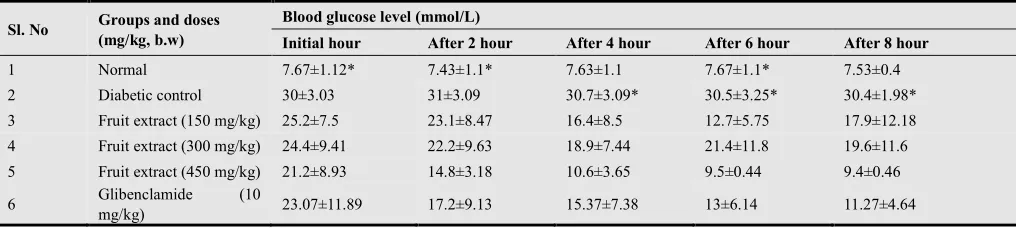
The effects of fruit extracts on blood glucose level after single administration for eight hours in alloxan-induced diabetic mice are summarized in Table 2.
Table 2. Effect of fruit extracts of Cocciniagrandis on the blood glucose level in diabetic mice.
Sl. No Groups and doses (mg/kg, b.w)
Blood glucose level (mmol/L)
Initial hour After 2 hour After 4 hour After 6 hour After 8 hour
1 Normal 7.67±1.12* 7.43±1.1* 7.63±1.1 7.67±1.1* 7.53±0.4
2 Diabetic control 30±3.03 31±3.09 30.7±3.09* 30.5±3.25* 30.4±1.98*
3 Fruit extract (150 mg/kg) 25.2±7.5 23.1±8.47 16.4±8.5 12.7±5.75 17.9±12.18
4 Fruit extract (300 mg/kg) 24.4±9.41 22.2±9.63 18.9±7.44 21.4±11.8 19.6±11.6
5 Fruit extract (450 mg/kg) 21.2±8.93 14.8±3.18 10.6±3.65 9.5±0.44 9.4±0.46
6 Glibenclamide (10
mg/kg) 23.07±11.89 17.2±9.13 15.37±7.38 13±6.14 11.27±4.64
All values are expressed as mean ± S.E.M., n=3 in each group, *p<0.05
3.3. Effects of Leaf Extracts
Table 3. Effect of Leaf extractsofCocciniagrandis on the blood glucose level in diabetic mice.
Sl. No Groups and doses (mg/kg, b.w) Blood glucose level (mmol/L)
Initial hour After 2 hour After 4 hour After 6 hour After 8 hour
1 Normal 7.67±1.12* 7.43±1.1* 7.63±1.1 7.67±1.1* 7.53±0.4
2 Diabetic control 30±3.03 31±3.09 30.7±3.09* 30.5±3.25* 30.4±1.98*
3 Leaf extract (150 mg/kg) 28.3±10.4 23.3±9.88 22.2±9.91 16.5±6.52 19.5±7.04
4 Leaf extract (300 mg/kg) 22±1.74 20.9±1.24 18±1.76 17.8±1.78 20.1±1.55
5 Leaf extract (450 mg/kg) 18±4.11 14.4±1.95 13.9±1.59 12.9±1.91 14.3±1.31
6 Glibenclamide (10 mg/kg) 23.07±11.89 17.2±9.13 15.37±7.38 13±6.14 11.27±4.64
All values are expressed as mean ± S.E.M., n=3 in each group, *p<0.05
3.4. Effects of Aerial Part Extracts
The effects of aerial part extracts on blood glucose level after single administration for eight hours in alloxan-induced diabetic mice are summarized in Table 4.
Table 4. Effect of aerial part extracts of Coccinia grandis on the blood glucose level in diabetic mice.
Sl. No Groups and doses (mg/kg, b.w) Blood glucose level (mmol/L)
Initial hour After 2 hour After 4 hour After 6 hour After 8 hour
1 Normal 7.67±1.12* 7.43±1.1* 7.63±1.1 7.67±1.1* 7.53±0.4
2 Diabetic control 30±3.03 31±3.09 30.7±3.09* 30.5±3.25* 30.4±1.98*
3 Aerial extract (150 mg/kg) 25.1±6.56 17.9±2.95 18.8±2.08 23.8±7.63 23.7±7.23
4 Aerial extract (300 mg/kg) 37±8.6 21.5±6.38 17.2±5.71 12.2±4.88 15.3±1.28
5 Aerial extract (450 mg/kg) 19.6±5 18.2±3.93 15.2±3.03 9.6±1.41 10.4±1.56
6 Glibenclamide (10 mg/kg) 23.07±11.89 17.2±9.13 15.37±7.38 13±6.14 11.27±4.64
All values are expressed as mean ± S.E.M., n=3 in each group, *p<0.05
4. Discussion
Recently available drug regimens for management of diabetes mellitus have definite disadvantages and hence, there is an urgency to find safer and more effective antidiabetic drugs [14]. Diabetes mellitus of long duration is associated with several complications such as atherosclerosis, myocardial infarction, nephropathy, etc. These complications are usually related to chronically elevated blood glucose level. Alloxan occurs a remarkable reduction in insulin release by the destruction of β-cells of the islets of Langerhans, that’s why inducing hyperglycemia [15]. A number of plants were found to possess hypoglycemic effects and the possible mechanism suggested for such hypoglycemic actions could be through the increased insulin secretion from β-cells of islets of Langerhans or its release from bound insulin. That is to say such hypoglycemic effects of plant extracts could also be owing to their insulin like actions [16]. Daily administration of the aqueous extracts of Coccinia grandis
for 8 hours resulted in decrease in the blood glucose levels of alloxan-induced diabetic mice. The antidiabetic effects of different part of Coccinia grandis at different concentration are discussed below:
In administration of single dose of root extract (150 mg/kg b.w.) was produced significant decrease in blood glucose level (7.87±0.35 mmol/L) in alloxan-induced diabetic mice (after 8 hour) rather than 300 mg/kg b.w., 450 mg/kg b.w. extract dose. On the other hand the drug glibenclamide (10 mg/kg b.w.) reduce less blood glucose level (11.27±4.64 mmol/L) rather than 150 mg/kg b.w. extract dose.
In administration of single dose of fruit extract (450 mg/kg
b.w.) was produced significant decrease in blood glucose level (9.4±0.46 mmol/L) in alloxan-induced diabetic mice (after 8 hour) rather than 150 mg/kg b.w., 300 mg/kg b.w. extract dose. On the other hand the drug glibenclamide (10 mg/kg b.w.) reduce less blood glucose level (11.27±4.64 mmol/L) rather than 450 mg/kg b.w. extract dose.
In administration of single dose of leaf extract (450 mg/kg b.w.) was produced significant decrease in blood glucose level (14.3±1.31 mmol/L) in alloxan-induced diabetic mice (after 8 hour) rather than 150 mg/kg b.w., 300 mg/kg b.w. extract dose. On the other hand the drug glibenclamide (10 mg/kg b.w.) reduce higher blood glucose level (11.27±4.64 mmol/L) rather than 450 mg/kg b.w. extract dose.
In administration of single dose of aerial part extract (450 mg/kg b.w.) was produced significant decrease in blood glucose level (10.4±1.56 mmol/L) in alloxan-induced diabetic mice (after 8 hour) rather than 150 mg/kg b.w., 300 mg/kg b.w. extract dose. On the other hand the drug glibenclamide (10 mg/kg b.w.) reduce blood glucose level (11.27±4.64 mmol/L) like 450 mg/kg b.w. extract dose.
In comparative study, the administration of single dose of root extract (150 mg/kg b.w.) reduced significant blood glucose level (7.87±0.35 mmol/L) in alloxan-induced diabetic mice (after 8 hour), just like a normal mice (7.53±0.4 mmol/L). On the other hand the fruit extract (150 mg/kg b.w.), leaf extract (150 mg/kg b.w.) and aerial part extracts (150 mg/kg b.w) could not reduce blood glucose level as a nirmal mice.
mg/kg b.w.) and root extract (300 mg/kg b.w.) respectively. The administration of single dose of fruit extract (450 mg/kg b.w.) reduced blood glucose level (9.4±0.46 mmol/L) in alloxan-induced diabetic mice (after 8 hour),just near to normal mice (7.53±0.4 mmol/L) and also neat to aerial part extract (300 mg/kg b.w.), leaf extract (300 mg/kg b.w.) and root extract (300 mg/kg b.w.) respectively.
5. Conclusion
It can be concluded that Cocciniagrandis is an important source of many pharmacological and medicinally important chemicals. Coccinia grandisis famous plant for its safe antidiabetic property. The results of this investigation indicate that the root, fruit, leaf and aerial part extracts of
Cocciniagrandis have a hypoglycaemic effect on alloxan-induced diabetes in mice. From our study, it is clear that the
Coccinia grandis play a fundamental role against diabetes mellitus. On the other hand different part of Cocciniagrandis
plant extracts have significant analgesic, antipyretic, anti-inflammatory, antimicrobial, Antiulcer, antidiabetic, antioxidant, hypoglycemic, hepatoprotective, antimalarial, antidyslipidemic, anticancer, antitussive, mutagenic activity in different animal models. So, further studies are necessary to elucidate in detail the mechanism of action of the medicinal plant at the cellular and molecular levels.
Acknowledgements
The authors are grateful to the Department of Pharmacy, Southeast University, Bangladesh, for their help and support during the research.
References
[1] S. Venkatesh, R.G. Dayanand, R.B. Madhava,M. Rameshand and A.V.N. Apparao, “Antihyperglycemic activity of Carallumaattenuta,” Fitoterapia, 2003, 74, p. 274–279.
[2] E. Edwin, E. Sheeja, S.P. Dhanabaland, and B. Suresh, “Antihyperglycemicactivity of Passifloramollissima Bailey,” Indian JournalofPharmaceuticalSciences, 2007, 64, p. 570– 571.
[3] K.S. Vivek, K. Suresh, J.P. Hitesh and, and H. Schivakumar, “Hypoglycemicacitivity of Ficusglomerate in Alloxan induced diabeticrats,” International Journal of Pharmaceutical Sciences Reviewand Research, 2010, 1, p. 18–22.
[4] R.E. Lamb and B.J. Goldstein, “Modulating an oxidative-inflammatory cascade: potential new treatment strategy for improving glucose metabolism, insulin resistance, and vascular function,”Int J ClinPract, 2008, 62 (7), p. 1087–1095.
[5] J.S. Johansen, A.K. Harris, D.J. Rychly and A. Ergul, “Oxidative stress and the use of antioxidants in diabetes: linking basic science to clinical practice,” Cardiovasc Diabetol, 2005, 4(1), p.5.
[6] S. Wild, G. Roglic, A. Green, R. Sicreeand and H. King, “Global Prevalence of Diabetes: Estimates for the year 2000 and projections for 2030,” DiabetesCare, 2004, 27, p.1047-1053.
[7] IDF Diabetes Atlas, 4th edition. International Diabetes Federation, 2009.
[8] American Diabetes Association,“Economic costs of diabetes in the USin 2002, Diabetes Care,” 2003, 26, p. 917-932.
[9] G. Chandramohan, S. Ignacimuthuand and K.V. Pugalendi, “A novel compound from Caseariae sculenta(Roxb.) root and its effect on carbohydrate metabolism in streptozotocin -diabetic rats,” EurJPharmacol, 2008, 590(1-3), p. 437-443.
[10] M. Yusuf, J.U. Chowdhury, M.A. Wahab and J. Begum, “Medicinal Plants of Bangladesh,” Bangladesh Council of Scientific and IndustrialResearch.Dhaka, 1994, p. -34.
[11] K.L. Joy and R. Kuttan, “Antidiabetic activity of Picrorrhiza kurroa extract,” J Ethanopharmacol, 1999, 67, p. 143–8.
[12] K.V. Pund, N.S. Vyawahare, R.T. Gadakh and V.K. Murkute, “Antidiabetic evaluation of DalbergiaSissooagainst alloxan induced diabetes mellitus in wistar albino rats,” Journal of Natural Product and Plant Resources, 2012, 2, p. 81-88.
[13] F.J. Alarcon-Aguilar, M. Jimenez-Estrada, R. Reyes-Chilpa, B. GonzalezParedes, C. Contreras-Weberand and R. Roman-Ramos, “Hypoglycemic activity of root water decoction, sesquierpenoids, and one Polysaccharide fraction from Psacaliumdecompositumin mice,” Journal of Ethno-Pharmacology, 2000, 69, p. 207-15.
[14] J.K. Grover, S. Yadav and V. Vats, “Medicinalplants of India with anti-diabetic potential,” J Ethanopharmacol, 2002, 81, p. 81-100.
[15] G.S. Viana, A.C. Medeiros, A.M. Lacerda, L.K. Leal, T.G. Vale and F.J. Matos, “Hypoglycemic and anti-lipemiceffects of the aqueous extract from Cissussicyoides,” BMC Pharmacol, 2004, 8, p. 4-9.