Volume 4, Issue 3, 141 - 152.
ISSN: 2469-9632 http://www.ijem.com/The Effect of the Layered Curriculum on the 6th Grade Students’ Learning
Styles in Science Lesson
*Sevda Koc Akran *
Siirt University, TURKEY Siirt University, TURKEY Burhan Uzum
Received: July 26, 2018 ▪ Revised: August 7, 2018 ▪ Accepted: August 8, 2018
Abstract: This study mainly aims to determine the effect of the layered curriculum on the 6th grade students’ learning styles in science lesson. The study group consists of students in the 6/A and 6/D at Fevzi Cakmak Secondary School in the city center of Siirt-Turkey in the academic year of 2015-2016. “Learning Styles Inventory” developed by Kolb and translated into Turkish by Askar and Akkoyunlu, diaries of students and semi-structured interview form developed by researchers and examination of the documents were used as data collection tools. As for data analysis, percent (%) and chi-square techniques were used to determine the learning styles of students, but in the analysis of students’ opinions the descriptive analysis was used. During the study, students were also asked to express their experiences and considerations about learning activities via a diary. The thoughts and feelings reflected in the diaries of students were directly quoted in findings. As a result of the analysis, in pre-test results of the students in the experimental group exposed to the layered curriculum, a significant difference was found in terms of gender; however, no significant difference was found in their post-test results.
Keywords: Curriculum, the layered curriculum, styles, learning styles, Science.
To cite this article: Koc Akran, S., & Uzum, B. (2018). The effect of the layered curriculum on the 6th grade students’ learning styles in Science lesson. International Journal of Educational Methodology, 4(3), 141-152. https://doi.org/10.12973/ijem.4.3.141
Introduction
There are a series of changes in today’s information and technology. These changes affect the family which is the basis of the society, education and the other institutions. In order to provide their children with a good education and grow them as individuals adapting to current conditions, the family buys technological tools for their children, and when necessary guide them about how they should be used. However, sometimes this guidance of the family is not sufficient. Then, the educational institutions- schools- which are as important as family in child's education involve in contributing to child's lifelong learning process. In the process of lifelong learning, guidance of schools and human profile they tend to raise are different from those of the families’. Because, the individual who is an output of the school may be the entry of another institution and the institution may probably become an indispensable element. For this reason, individuals at schools should be provided with multiple learning environments, and their learning styles, intelligence and developmental characteristics should be taken into account. The implemented curriculum will play a major role in taking into account these characteristics of individuals. The proposed method-techniques, activities, contemporary approaches in education programs help teachers, the practitioners of programs. Curriculum should give information about how the teacher can use a contemporary approach and to what students should pay attention while doing the activities. Moreover, it should show how to train individuals who can use their high level skills, give importance to their values and “learn to learn”. Otherwise, a teacher who does not know a contemporary approach/theory/model may encounter some problems that can affect the productivity of “the teaching-learning process". For example, learning styles of every student differ from each other. Some students may learn by concrete, some by abstract, some by doing and experiencing while others can learn by touching and listening. The interest and attitude of the individuals towards the teacher and lessons may change when the teacher provide abstract activities for concrete learning individuals or activities in which they can use their sense of sight for individuals learning by listening (Borman, Hanson, Oppler, Pulakos, & White 1993; Koc, 2013; Oner, 2012; Bicer, 2011). To avoid such a situation, the teacher should have knowledge about the contemporary approaches whether included or not included in the program. In other words, the teacher should have a good knowledge to make teaching-learning process efficient and effective. If an approach/model/theory recommended in the program is not sufficient for students to learn, the different contemporary approaches that are recommended by scientists and used by teachers can be used. One of those approaches is “the layered curriculum” developed by K. F. Nunley. It contributes to students’ learning and pays
* Corresponding author:
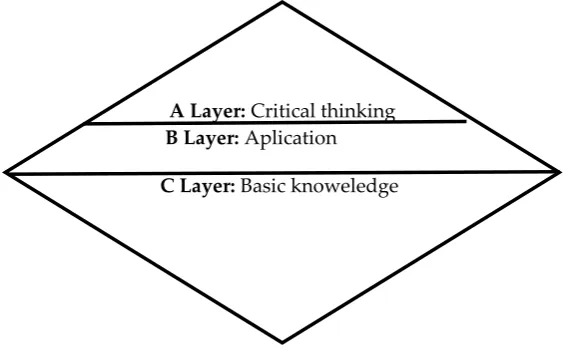
attention to their many different aspects (intelligence, learning styles, high-level skills, etc.). According to the layered curriculum, students learn in different ways, they are responsible for their own learning process, and approach to the events in a critical way and generate solutions to the problems they face. The individual achieve all those processes by using three layers. These layers are C, B and A. (Koc, 2013) (See: Figure 1).
Figure 1. Layers in the layered curriculum (Nunley, 2004).
As seen in Figure 1, Layer C is the lowest layer in which all the students are required to be successful, and it includes basic knowledge and abilities. In this layer, students are provided with most activities, and each activity and each task has a specific point according its difficulty and time. Students aren’t expected to complete all activities because too many activities are presented in this layer. After completing the activities between 65-70 points they choose, each student carry on with the next layer, B (Demirel, Sahan, Ekinci, 2006). Layer B is composed of activities in which students find the opportunity to apply the knowledge and skills they acquire in the previous layer. Students who make applications at this layer discover and generate new ideas and solve problems. At this layer, each activity is 15 points, and students select one activity according to their interests and perform it. Activities at this layer should both attract students’ attention and lead to new learning, and they should be able to take the student through a further level than the level at Layer C (Nunley, 2004; Demirel, Sahan, Ekinci, 2006; Basbay, 2011). Finally, Layer Ais the highest layer in which students are expected to question the topic, make detailed analysis and reach a synthesis. The student is required to create an original learning product. It is essential to creatively work out the knowledge learned in Layer B. He is taught to make critical analysis and each of activities is 15 points (Koc, 2013).
“An activities list” is prepared when the activities and their selection are made in the layered curriculum. While preparing and planning the activities, such tools or techniques as presentation, computer programs, book abstracts, poster preparation, poetry-story writing and video recordings are used. Students are free to choose the activity they want, and collect the activities in a progress file they created. "Why?" they choose the activities they keep in their progress file is constantly questioned in during the process (Nunley, 2004).
In order for the activities within the layered curriculum to be done, the learning-teaching environment should be arranged according to the proper conditions. The teacher’s role here is mostly to guide. The teacher informs the students about the concepts of the units to be taught by making short presentations, monitors each student, when necessary directs and encourages, and grades the activities and tasks they have completed (Demirel, Sahan, Ekinci, 2006). These studies for the layered curriculum, instruments utilized etc. are subject to various evaluation criteria (Yilmaz, 2010). In the layered curriculum, students are evaluated in different ways according to the degree of difficulty of their activities and characteristics of layers. For example, the points a student awarded for preparing a poster in the layer C are not the same with the points s/he gets for an original article/poem in the layer A (Koc, 2013).
Kolb’s Learning Style Model
According to the learning styles model developed by Kolb (1985), the individuals’ learning styles are in a cycle, and the Learning Styles Inventory is used to determine which part of this cycle is the learning style of the individual. There are four different learning styles within the scope of this cycle and respectively follow as (CE) Concrete Experience, (RO) Reflective Observation, (AC) (Abstract Conceptualization), and (AE) Active Experience. There are different ways of learning from each other that represent these learning styles. For example, while “feeling” for concrete experience and “watching” for reflective observation are important, “thinking” for abstract conceptualization and “doing” for active experience are more crucial. In spite of this, learning style is not determined by a single way. In other words, each individual's learning style emerges from the combination of these four forms (Askar & Akkoyunlu, 1993). Students can be categorized in four different learning styles according to their comprehension and information processing characteristics. These are converging, diverging, assimilating and accommodating, respectively.
A Layer: Critical thinking
B Layer: Aplication
Figure 2. Kolb’s learning styles circle (www.businessballs.com/kolblearningstyles.htm)
As seen in the figure 2, there are four distinct learning styles. First of these is converging learning style. Converging learning style is the combination of abstract conceptualization and active experience. These people pay attention to details. They analyse the parts to understand/grasp the whole event or information (Riding & Rayner, 1998). In other words, the part-whole relationship is important in this learning style. The learned new information is put into effect in the part-whole relationship and they learn from their errors (Felder, 1996). Thus, problem solving, decision making, logical analysis of thoughts, systematic plan making abilities of individuals who have this learning style are well developed (Kilic & Karadeniz, 2004). The second learning style is diverging. Diverging learning style is the combination of concrete experience and reflective observation. They can evaluate concrete events from different angles (Kolb, 1984). They are successful in concentrating on topics and establishing relations between them. These learners who enjoy observing are extremely patient and careful. However, these learners have difficulty in making decisions and taking advantage of opportunities. The third learning style is assimilating. Assimilating learning style is the combination of abstract conceptualization and reflective observation. These learners prefer systematic, sequenced, logical and detailed information. They can focus on abstract concepts and opinions. Although they are successful in making plans, creating models, developing theories, recognizing problems, daydreaming and lacking of application, their weaknesses are not being able to follow a systematic approach. The last one is accommodating learning style. Accommodating learning style is the combination of concrete experience and active experience. They take great pleasure in making researches, exploring and applying. Making plans, carrying out decisions and taking part in new experiences are their remarkable characteristics. They can take risks as they have leadership (Kurbanoglu & Akkoyunlu, 2008).
As seen above, each individual’s learning preferences are different from others. These differences have been emphasized in the studies carried out (Can, 2011; Hasirci, 2006; Kilic & Karadeniz, 2004; Koc, 2009; Kurbanoglu & Akkoyunlu, 2008; Tuna, 2008; Veznedaroglu & Ozgur, 2005). However, there are not as many studies on learning styles as those on the layered curriculum (Aydogus & Ocak, 2011; Basbay, 2005; Demirel, et all, 2006; Gomleksiz & Bicer, 2012; Koc, 2013; Oner, 2012; Yilmaz, 2010). Studies conducted so far are rather experimental and neglect its relationship/effect with/on learning styles that make important contributions to the development of the layered curriculum. Instead, learning styles are evaluated according to certain demographic characteristics. However, in this research, learning styles and the layered curriculum that is a contemporary approach are handled together. The reason for this is as Nunley (2004) pointed out that learning styles are an important phase in applying the layered curriculum. Thus, the problem of this study is to search the effect of the layered curriculum on students learning styles in the 6. Grade Science lesson. Within the framework of this objective, the answers to the following sub-problems are intended to provide:
1. Is there any significant difference by gender between pre-test learning styles of students in the experimental group who were exposed to the layered curriculum application and control group who weren’t exposed to the layered curriculum application?
2. Is there any significant difference by gender between post-test learning styles of students in the experimental group who were exposed to the layered curriculum application and control group who weren’t exposed to the layered curriculum application?
Method Research Model
Mixed method, a combination of quantitative and qualitative designs, was used to search the effect of the layered curriculum on the 6th grade students’ learning styles in science lesson. This enabled the research to be carried out in different contexts. Because, mixed research enables the researcher to use qualitative and quantitative research models together. Mixed research contains collecting both qualitative and quantitative data in relation to the same basic phenomenon in a single study or a series of studies and analysing and interpreting them (Leech and Ounwuegbuzie, 2009). Quasi-experimental pre-test and post-test with control group models were used in collecting quantitative data, and interviews and students' diaries were used in the collection of qualitative data.
DOMINANT- LESS DOMINANT MIXED METHOD
DOMINANT LESS DOMINANT
Quasi-experimental Case Study
pre-test and post-test pattern with control group
Figure 3. Research design
A quantitative method was used for 1.and 2. sub-problems to determine the learning styles, and a qualitative method was used for the 3.sub-problem to obtain data.
Study Group
The study group students studied in classes 6/A and 6/D at Fevzi Cakmak Secondary School in the city centre of Siirt during 2015-2016 academic year. The study group consists of a total of 43 students 22 of whom were at class 6/A and 21 at class 6/D. Class 6/A was attained as the experimental group and class 6/D as the control group.
Data Collection Tools
Kolb’s Learning Styles Inventory, a semi-structured interview form developed by researchers and students’ diaries were used as data collection tools. Kolb (1985) developed Learning Styles Inventory based on Experiential Learning Theory to demonstrate which learning style is appropriate for the individual. Determining the individual's learning style helps him in many fields from which profession he’d choose to how he should approach the problems. In addition to those, it is a scale that helps him discovering and understanding the strengths and weaknesses within himself (Askar and Akkoyunlu, 1993). The learning styles inventory scale developed by Kolb is a kind of scale that consists of 12 items with 4 options and contains the individual responses of people. Starting with the most suitable one according to them, the individuals number four options under each item from 1 to 4. They gave 4 to the most appropriate option, 3 to the appropriate option, 2 to less appropriate and 1 to the least appropriate option.
In this research, a “Semi-structured Interview Form” was developed to have 19 participants’ views about the application of the layered curriculum. The researcher’s identity, the aim of the interview, to whom the interview was going to be conducted, how the interview was going to be recorded were stated in the interview form. Then, a question bank was created according to the aim of the interview. “Appropriate”, “Not Appropriate”, “Should be corrected” type of the triple Likert was used to determine whether or not the questions in the form were appropriate for the aim of the interview. Afterwards, the opinions of three assistant professors about the questions in the form who had studies on “The layered curriculum” were taken. Researchers made necessary corrections by taking the experts’ opinions into account. Furthermore, during the study, students were asked to express their experiences and considerations about learning activities via diaries. The thoughts and feelings reflected in the diaries of students were directly quoted in findings. Data Analysis
The data obtained from Kolb’s Learning Styles Inventory was analyzed through SPSS 21.0 statistical package program by using percent (%) and Chi-Square. In the analysis of student diaries and interviews, the descriptive analysis method was used.
Findings
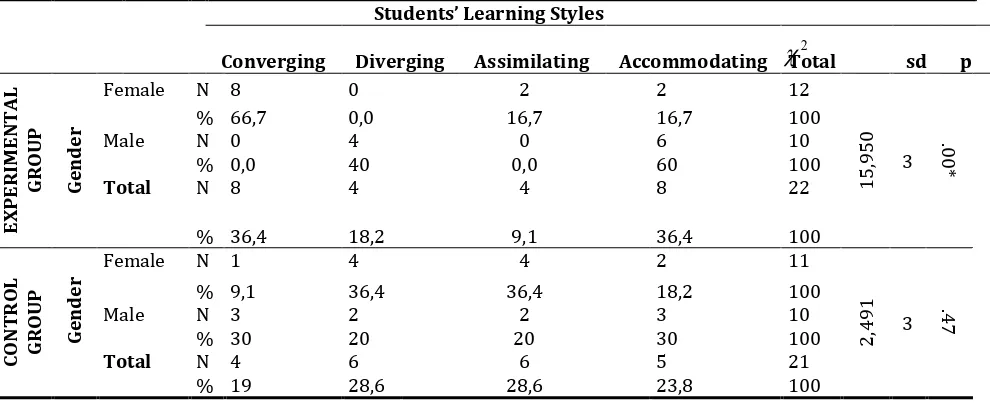
Table 1. Chi-Square results about significant difference by gender between pre-test learning styles of students in the experimental group who were exposed to the layered curriculum and students in the control group who weren’t exposed to the layered curriculum
Students’ Learning Styles
Converging Diverging Assimilating Accommodating Total sd p
EX
PERI
ME
N
TAL
G
RO
UP
G
ender
Female N 8 0 2 2 12
15,950 3
.00*
% 66,7 0,0 16,7 16,7 100
Male N 0 4 0 6 10
% 0,0 40 0,0 60 100
Total N 8 4 4 8 22
% 36,4 18,2 9,1 36,4 100
CO
N
TRO
L
G
RO
UP
G
ender
Female N 1 4 4 2 11
2,491 3
.47
% 9,1 36,4 36,4 18,2 100
Male N 3 2 2 3 10
% 30 20 20 30 100
Total N 4 6 6 5 21
% 19 28,6 28,6 23,8 100
*p<.05
In Table 1, a significant difference by gender in the pre-test styles of students in the experimental group who were exposed to the layered curriculum was observed (p=.00; p<.05).This differentiation was on behalf of female students in the experimental group who had “converging” and “assimilating” learning styles, and on behalf of male students who had “accommodating” and “diverging” learning styles. That’s to say, it was seen that the dominant learning style of female students in the experimental group was “converging” with a percentage of 66,7 whereas male students’ dominant learning style was “accommodating” with a percentage of 60. The result was obtained that the rate of “assimilating” and “accommodating” learning styles of female students was the same with a percentage of 16,7; the second dominant learning style of male students was “diverging” with a percentage of 40. In contrast, it became evident that female students didn’t have “diverging” learning style at all, and male students had neither “converging” nor “assimilating” learning styles.
In Table 1, no significant difference by gender in the pre-test learning styles of students in the control group who were not exposed to the layered curriculum was observed (p=.47; p>.05). So, it can be said that female students had diverging and assimilating learning styles at the same rate (36,4 %) and their dominant learning styles were “ diverging” and “ assimilating”; their second dominant learning style was “ accommodating” with a percentage of 18,2 and their least dominant learning style was “converging” (9,1%). Similarly, it was observed that two learning styles had the same rate between male students. The dominant learning styles of male students were “converging” (30 %) and “accommodating” (30 %), then “ diverging” (20 %) and “ assimilating” (20 %).
Findings about significant difference by gender between post-test learning styles of students in the experimental group who were exposed to the layered curriculum and students in the control group who weren’t exposed to the layered curriculum
Findings about the significant difference by gender between post-test learning styles of students in the experimental group who were exposed to the layered curriculum and students in the control group who weren’t exposed to the layered curriculum is given in the Table 2.
2
Table 2. Chi-Square results about significant difference by gender between post-test learning styles of students in the experimental group who were exposed to the layered curriculum and students in the control group who weren’t exposed to the layered curriculum
Students’ Learning Styles
Converging Diverging Assimilating Accommodating Total sd p
EX PERI ME N TAL G RO UP G ender
Female N 3 4 2 3 12
2,683 3 0,44
% 25 33,3 16,7 25 100
Male N 2 3 0 5 10
% 20 30,0 0,0 50 100
Total N 5 7 2 8 22
% 22,7 31,8 9,1 36,4 100
CO N TRO L G RO UP G ender
Female N 3 1 3 4 11
3,761 3 0,28
% 27,3 9,1 27,3 36,4 100
Male N 3 4 2 1 10
% 30 40 20 10 100
Total N 6 5 6 5 21
% 28,6 23,8 23,8 23,8 100
In Table 2, examining post-test learning styles of students in the experimental group who were exposed to the layered curriculum, no significant difference was observed (p=.44; p>.05).According to the data obtained from students in the experimental group, it was observed that the dominant learning style of female students was “diverging” with a percentage of 33,3 whereas the dominant learning style of male students was “accommodating” with a percentage of 50. The second dominant learning styles of female students were “converging” (25 %) and “accommodating” (25 %) and the least dominant learning style that had was “assimilating” (16,7 %). The second dominant learning style of male students was “diverging” with a percentage of 30, and they had “converging” learning style at a rate of 20 %.
In the Table 2, according to the post test data of the students in the control group who were not exposed to the layered curriculum applications, it can be seen that there isn’t any significant difference between their learning styles and gender (p=.28; p>.05).With regard to this data, the dominant learning styles of female students follow as accommodating (36,4 %), assimilating (27,3 %), converging (27,3 %) and diverging (9,1 %). However, the dominant learning styles of male students follow as diverging (40 %), converging (30 %), assimilating (20 %) and accommodating (10 %).
In the light of the above findings, it was observed that the dominant learning style of male students who were exposed to the layered curriculum application was accommodating and that of the female students was diverging, however, the dominant learning style of male students in the control group was diverging and that of female students was accommodating. In other words, it can be said that the learning style of students in the experimental and control group showed differences by gender.
Findings about how the layered curriculum contributed to the learning-teaching process
During the application of the layered curriculum, students were asked "why" they chose that activity both during selection and after selection of the activity, and their opinions were recorded. During the application process, students’ diaries were used to determine their thoughts and feelings about the layered curriculum. The date obtained from the diaries and interviews were collected under 5 headings; Activity Selection, Application, Research, Motivation and Understanding. Below are the headings and the distribution of students' expressions according to the headings
Activity Selection
S1 “I chose this activity because I think it will add information to my information.” (Activity: preparing a brochure) S2 and S3 “I chose this activity because I think I'd learn better from different sources and doing research.” (Activities: researching from different resources and preparing a report)
S4 “I chose this activity because it interested me.” (Activity: Preparing a brochure)
S5 “I chose this activity because in this way, I think I'm going to concentrate a lot more.” (Activity: researching from different resources and preparing a report)
S6 “I chose this activity because I think I'd reinforce more with visualizations.”(Activity: preparing a brochure)
S7 “I chose this activity because experiment will enable me to learn better” (Activity: carry out the experiment in your book, file a report about your results and findings)
2
S8 “ I chose these activities because they interested me a lot and I did them more willingly. I learnt the poster I made very well. Preparing questions was very fun.” (Activity: prepare a worksheet that consists of at least 10 questions)
S9 “ This activity made me feel more responsible towards the lesson. Preparing questions like my teacher is very enjoyable. I understood the important point of the topic better.” (Activity: prepare a worksheet that consists of at least 10 questions and ask them to your friends)
S10 “ I chose these activities because I learnt better and by making comments, I reinforced my knowledge.” (Activity: making table, writing a paragraph and answering questions)
S11 “ I chose this activity because when I asked questions to my friends, I both learnt better and it was enjoyable. I did them more willingly.” (Activity: prepare a worksheet that consists of at least 10 questions and ask them to your friends) Students mostly chose activities that they thought would reinforce the topic and help them learn the topics better. Among the activities chosen were projects, brochures, posters and making research from different sources. It can be said that these studies and activities enabled students to see themselves at the center of activity, developed a sense of responsibility, actively participated students in the process, and they added new schemas to their schemas via activities that interested them.
Application
In this category, there are excerpts from students' opinions in C, B, and A layers of the layered curriculum and diaries. S1 “I keep those in my mind more easily, because I do the experiment myself, and I like it this way.”
S2 “I prepared a report and wrote a composition on the granular structure of the matter and these enabled me to understand better.”
S3 “I have never understood a topic better than this because we ourselves examined the matters and we actively participated.”
S4 “I better understand this unit because we prepared posters and did experiments. I grasped it better because we made researchers.”
S5 “The experiment taught me a lot. When we heated butter, it melted and when we it got cold, it froze. And also, the sugar. When it was blackened when heated, and frozen when got cold, simply like a rock.”
S6 “ I best learn by posters, models. Because, in this way, learning becomes fun, and we learn easily.
S7 “We learned gases, liquids and solids. In the experiment, we saw how the butter melted, the sugar dissolved, butter froze in front of the window.”
S8 “I chose this activity because I learn better when I do something by seeing and touching.”
Figure 4. Examples of activities the students did about the granular structure of matter
During the interviews made with students in the experimental group, it was observed that the applications carried out within the layered curriculum developed a sense of confidence in students and they chose individual studies (See: Figure 4). In other words, they reinforced the information and concepts they learned with practices and experiments, and they chose studies appropriate for their own learning styles. Because, the learning style of each individuals, the way they perceive and react to the events is different from the other. Some students learn by standing in front of the board and presenting an activity to their friends, some learn by preparing posters, models, and doing experiments while others learn by studying on their own.
Research
In this category, there are students' opinions about the research activities they chose and the thoughts they wrote in their diaries.
S1 “ I distinguished between matters better. I enjoy making research from different sources.” S2 “ I think I’d learn better by making research. Preparing questions is very entertaining.” S3 “I think I’d concentrate on the topic more by making researches.”
These activities and tasks encourage students to do research and give them responsibility. In other words, it can be said that the layered curriculum activities develop students' research skills and make them learn from many sources instead of a single one by doing.
Motivation
This category includes the effects of the layered curriculum on students' motivation, their opinions about the lesson and process of course.
S1 “ When I asked questions to my friends it was both more fun and I learn better. I did more enthusiastically.” S2 “ I felt more responsibility towards the lesson. I greatly enjoyed preparing exam questions like my teacher.” S3 “I want my teachers to process their lessons in this way.”
S4 “I am active and I do it myself, I wish this to continue.”
S5 “Presentation activities were enjoyable and I want these activities to continue.” S6 “This unit was enjoyable and nice, I want the other units to be taught in this way.”
S8 “The experiment we did today impressed me very much and I learned much” S9 “Learning in this way was more exciting and joyful.”
S10 “I want this new way of processing the lesson to continue. Thus, we can improve more.”
As can be seen, the layered curriculum applications motivate students towards lessons and raise more awareness of responsibility. In addition, it can be said that applications motivate students against the lesson, make them learn by doing and experiencing, increase their interest against different topics and units.
Understanding
In this category, there are students' opinions about "having lessons according to the layered curriculum" and excerpts from students' diaries.
S1 “ I learnt the poster I made very well.” S2 “ I understood more by touching and seeing.”
S3 “I think I can keep in mind more information by experimenting.” S5 “I learnt the granular structure of the matter very well.”
S6 “I was very amused by the activities we done during this unit. I learnt better from different sources like models, experiments, etc.”
S7 “I grasped more in this unit and I want all the units to be like this.”
Based on the individual differences, the layered curriculum enables students to understand the topics easily. Because the layered curriculum both takes individual differences into account and provides students with sufficient activities. Students use their learning styles within these differences. In other words, some students learn by seeing and touching, the others learn by doing and experiencing.
Discussion and Conclusion
Nunley (2011) stated, the layered curriculum provides students with a wide range of learning opportunities. In such a learning process, the learning style of the individual can show differences by gender, age and grade level (Fox & Rankowski, 1997; Davis, 1998; Ergur, 1998; Hasirci, 2006; Dincoz, 2007). For example, it was observed that the dominant learning style of primary school students is rather “diverging” (Yoon, 2000; Kaya, 2007), 6th grade male students have “accommodating” learning style (Kural, 2009), 6,7 and 8th grade female students learn by feeling (diverging) and thoughts (accommodating) (Westman, 1993;Guven & Kurum, 2007). These results support our research findings.
Upon examining the post-test scores of students in the experimental group exposed to the layered curriculum, it was observed that students’ learning styles did not show a significant difference by gender. According to the data obtained from students in the experimental group, it is evident that the dominant learning style of female students was “diverging” and that of the male students was “accommodating”. Furthermore, according to the post-test data of students in the control group not exposed to the layered curriculum, it is understood that no significant difference between learning styles of students and their gender was found and the dominant learning style of female students followed as “accommodating”, “assimilating”, “converging” and “diverging”. On the other hand, it was reached the result that the dominant learning styles of male students sequenced as “diverging”, “converging”, “assimilating” and “accommodating”. In the study, it was observed that students chose the activities appropriate for their learning styles while they did the activities within the layered curriculum. Because, activities within the layered curriculum provides students with multiple learning environments, facilitates their learning (LaSovage, 2006; Halstead, & Martin, 2002;Maurer, 2009; Gun, 2013) and presents alternative studies appropriate for their learning styles (Bicer, 2011). In the study, it was observed that according to the post and pre-test learning style scores of students in the experimental group, their learning styles didn’t change. A reversed situation could have occurred. In other words, if the student hadn’t been provided with alternatives after the application and if he hadn’t done the activities appropriate for his learning style, he could have used different learning styles. As Loo (1997) stated, the learning styles of individuals can undergo changes. When proper environments and studies are provided, individuals may not use their dominant learning style, in time (Payne, 1999). This can affect individual’s motivation, his interest in the lesson and participation in class activities, etc. However, every student can find an appropriate activity on the layered curriculum task list and even add different activities that best suit his learning style. This enables students (female-male students) to use their dominant learning styles. For example, in this study, the dominant learning style of female students is “diverging” and that of the male students is “accommodating”. The observation ability of an individual who uses the diverging learning style develops and he learns by feeling and watching (Kolb, 1999). The people with the accommodating learning style can instantly adapt to the changes and they reflect their thoughts by doing and experiencing. In such a process, it was observed that female students preferred “diverging” and male students preferred “converging” and “accommodating” learning styles (Karamustafaoglu, Yurtyapan, Coskun, Divarci & Derin, 2015). In short, individuals using learning styles express themselves easily with the layered curriculum activities (Beckham, 2010). Because, the layered curriculum is a way of organizing teaching that pays attention to students’ intelligence and learning styles (Koc, 2013).
students. In other words, the layered curriculum develops students’ communication skills and increases their motivation. Moreover, the student with high motivation towards the lesson will be willing to undertake any responsibility (Moran, 1991; Johnson, 2007).
References
Askar, P., & Akkoyunlu, B. (1993). Kolb learning style inventory. Education and Science, 17(87), 37-47.
Aydogus, R., & Ocak, G.(2011). Effect to academic achievement of using layered curriculum in primary schools’ 6th and 7th degree science lesson. The Journal of Turkish Educational Sciences (JTES), 9(2), 343-368.
Basbay, A. (2005). The Effects of Project Based Learning Approach Supported by Layered Curriculum on Learning Process. Ege Journal of Education, 1(6), 95–116.
Beckham, H. (2010). Student perceptions of the layered curriculum vs. traditional coursework on class grades for 11th-12th grade economics and government students. Culminating Experience Action Research Projects, 17, 5-15. Bicer, S. (2011). Effects of the layered curriculum teaching method on student’s success, permanence and attitudes in
science and technology course (Unpublished Master’s Thesis), Firat University, Institute of Educational Sciences, Elazig, Turkey.
Borman, W. C., Hanson, M. A., Oppler, S. H., Pulakos, E. D., & White, L. A. (1993). Role of early supervisory experience in supervisor performance. Diaries of Applied Psychology, 78(3), 443-449.
Can, S. (2011). Investigation of the relationships between the learning styles of preservice elementary teachers and some variables. Hacettepe University Journal of Education, 41, 70-82.
Davis, N. H. (1998). A Comparative analysis of the learning style preferences of medical students and practicing physicians
using kolb’s learning style inventory. Retrieved February 2, 2016 from
http//www.lib.umi.com/dissertations/fullcilt/ 9914202.
Demirel, O., Sahan, H. H., Ekinci, N., Ozbay, A., & Begimgil, A. M. (2006). The evaluation of layered curriculum in terms of process and outcome. National Journal of Education, 172, 72–90.
Dincoz, T. (2007). Learning styles and physics learning styles of Anatolian high school students (Unpublished master’s thesis), Marmara University, Institute of Educational Sciences, Istanbul, Turkey.
Ergur, D. O. (1998). A Comparison of the Learning Styles of Undergraduate Students and Their Instructors at Hacettepe University (Unpublished doctoral dissertation). Hacettepe University, Institute of Social Sciences, Ankara, Turkey. Felder, R. M. (1996). Matters of style. ASEE prism, 6(4), 18-23.
Fox, L., Richard, S., & Ronkowski, A. (1997). Learning styles of political science students. Political Science, 30(4), 732-738.
Gomleksiz, M. N., & Bicer, S. (2012). Effects of the layered curriculum on student’s success, permanence and attitudes in science and technology course. International Diaries of Human Sciences, 2(9), 1657-1683.
Gun, E. S. (2013). The reflections of the layered curriculum to learning-teaching process in social studies course. International Journal of Instruction, 6(2), 87-98.
Guven. M., Kurum. D. 2007. Teacher candidates' learning styles and critical thinking dispositions. Electronic Journal of Social Sciences, 6(21), 60-90.
Hasirci, O. K. (2006). Learning styles of prospective primary school teachers. Cukurova University case, Journal of Theory and Practice in Education, 2(1), 15-25.
Johnson, K. J. (2007). The layered curriculum for the construction trades: a mathematics curriculum to teach trade students basic math skills to be successful apprentices. Carbondale: Southern Illinois University.
Karamustafaoglu, O., Yurtyapan, E., Coskun, O., Divarci, O. F., & Derin, M. (2015). Investigation of the relationship between some variables and the learning styles of secondary school students. Gazi University Journal of Education, 1(1), 29-44.
Kaya, F. (2007). Elementary school students' learning style based science lecture teaching level (Unpublished Master’s Thesis). Osmangazi University, Institute of Science, Eskisehir, Turkey.
Koc, S. (2009). Identifying learning styles of students attending the 5th and 6th grade of elementary education and its relation with academic success (example of Malatya and Elazig provinces) (Unpublished Master’s Thesis). Firat University, Institute of Social Sciences, Elazig, Turkey.
Koc, S. (2013). The effect of the application of layered curriculum on the problem solving skill and metacognition
awareness of students in the 6th class science and technology lesson (Unpublished doctoral dissertation). Inonu
University, Institute of Educational Sciences, Malatya, Turkey.
Kolb, D. A. (1984). Experiential learning. Englewood Cliffs, NJ: Prentice Hall
Kolb, D. A. (1985). Learning style inventory (Revised Edition). Boston, MA: McBer & Company Kolb, A.D. (1999). The Kolb learning style inventory. New Jersey: Hay Resources Direct.
Kurbanoglu, S., & Akkoyunlu, B. (2008). Learning styles of the students of the department of information management. The Journal of Turkish Librarianship, 22(3), 296-307.
LaSovage, A. J. (2006). Effect of using a layered curriculum format of instruction in a high school environmental science energy Unit (Unpublished Master’s Thesis). Michigan State University, Michigan, USA.
Leech, N. L., & Onwuegbuzie, A. J. (2009). A typology of mixed methods research designs. Quality & quantity, 43(2), 265-275.
Loo, R. (1997). Evaluating change and stability in learning style scores. Educational psychology, 17(2), 95-100.
Maurer, L. A. (2009). Evaluating the use of layered curriculum and technology to increase comprehension and motivation in a middle school classroom. Michigan State University, Michigan, USA.
Moran, A. (1991). What can learning styles research learn from cognitive Psychology?. Educational Psychology, 11(3-4), 239-245.
Nunley, K.F. (2004). The layered curriculum. Amherst: Brain.org Publication.
Nunley, K.F. (2011). Enhancing your layered curriculum classroom: Tips, tune-ups and technology. Amherst: Brain.org Publication.
Oner, U. (2012). The effect of layered curriculum supported by multiple intelligences theory of social studies on students?
academic achievement, attitude’s and permanence (Unpublished doctoral dissertation). Ataturk University,
Institute of Educational Sciences, Eskisehir, Turkey.
Payne, E. (1999). Teaching styles of faculty and learning styles of their students: congruent versus incongruent teaching styles with regards to academic disciplines and gender (Unpublished doctoral dissertation). Kent State University, OH, USA.
Riding, R. and Rayner, S. (1998). Cognitive styles and learning strategies. London: David Fulton Publishers.
Riding, R., & Rayner, S. (2013). Cognitive styles and learning strategies: Understanding style differences in learning and behavior. London: Routledge.
Sirin, A. & Guzel, A. (2006). The relationship between learning styles and problem solving skills among college students. Educational Sciences: Theory & Practice, 6(1), 233-237.
Tuna, S. (2008). The learning styles of art education students. Electronic Journal of Social Sciences, 7(25):252-261. Westman, A. S. (1993). Learning Styles are Content Specific and Probably Influenced by Content Areas Studied.
Psychological Reports, 73(2), 512-514.
Veznedaroglu, R. L., & Ozgur, A. O. (2005). Learning Styles: definitions, models and functions. Elementary Education Online, 4(2):1-16.
Yilmaz, F. (2010). Applications of layered curriculum in science and technology course (Unpublished doctoral dissertation). Anadolu University, Institute of Educational Sciences, Eskisehir, Turkey.