Meta-heuristics Algorithms: A survey
Shereen Zaki #1, and Abd El-Nasser H. Zaied #2#
Department of Operations Research, Faculty of Computers and Informatics,
Zagazig University, Egypt.
Abstract
Because of effective applications and high power, meta-heuristic research has been widely conveyed in literature, which covers algorithms, applications, comparisons, and analysis. However, slight has been evidenced on insightful analysis of meta-heuristic performance issues, and it is still a “black box” that why certain meta-heuristics perform better on specific optimization problems and not as good on others. Meta-heuristics have been revealed as the best effective scheme for solving many hard optimization problems as it has the ability to deal with NP-hard problems Mainly, meta-heuristic algorithms are classified to different classes to discriminate between them in searching schemes and explain how the algorithms mimic a particular phenomenon behaviour in the search area, diverse classification explored, This paper targets to review of all meta-heuristics related issues also hybridized meta-heuristics are discussed.
Keywords - meta-heuristics, Global optimization, optimization algorithms,Meta-heuristic Hybrids.
I.INTRODUCTION
Optimization algorithm can be classified in many ways, one way the nature of the algorithm that it can be deterministic algorithm or stochastic algorithm. The deterministic algorithms track rigorous procedures, the scenario used for computing the value of function and variables is repeatable. For example simplex method for linear programming and branch and bound for integer programming. In contrast, stochastic algorithms are highly random in nature. For example genetic algorithm, the solution in population will differ in each iteration, so the paths to each individual solution are not exactly repeatable [20]. More often another type of optimization algorithms can be exposed by mixing the deterministic and stochastic algorithms, so the novel can be called a hybrid algorithm. For example hill-climbing with a random start is a good hybrid algorithm as the start will be different initial points but using the deterministic algorithm, this gives the advantage as go away from falling in local optima.
II.NATUREINSPIREDMETA-HEURISTIC
The greatest deal of the classical methods is deterministic, as Lagrange multiplier in nonlinear, simplex and branch and bound. On the other hand, the stochastic algorithms that takes great attention of
research nowadays that classified as heuristic and meta-heuristic. Recently the two terms can be used interchangeably. Also researcher considers the term meta-heuristic is considered a development over the simple heuristic as it performs better [20]. Meta-heuristic algorithms are computational intelligence patterns particularly intended for sophisticated solving optimization problems. Despite the success of meta-heuristic in solving a given problem, it can't solve all optimization problems, and all meta-heuristics have the same performance on average (No free lunch theorems (NFL) [21, 22]), the gain from randomization in meta-heuristic is to move far from local search and search on the global scale. So the meta-heuristic seemly reliable for global optimization. In the heuristic the solutions obtained may be not the optimal solution the trial and error used to generate acceptable solution until the feasible solution that is accepted is reached but the solution will be with good quality that it be near optimal. The meta-heuristic have two major components; intensification (exploitation) and diversification (exploration) the combination of these two make the algorithm more robust [23]. As the diversification or exploration generate solutions as it explore search in the global scale and intensification that means emphasis that search in a local area and exploiting the information to find efficiently near optimal solution reached in this area this means that the global optimization will be reached. In spite of, periodically the overview are made on the meta-heuristics, there is no one covered all features. As a lot of papers converging to nature inspired and biological aspects [24 - 27]. Others reviewed some meta-heuristics without concentrate in any features [28], meta-heuristics classifications are explored by Glover [29] but lacking any examples.
A. Classification of meta-heuristics
problems. In other words, a meta-heuristic can be seen as a general algorithmic framework which can be applied to different optimization problems with relatively few modifications to make them adapted to a specific problem.‖ [Metaheuristics Network Website 2000]. Also, essential properties which describe meta-heuristics are:
Meta-heuristics are strategies that ―guide‖ the exploration procedure.
Meta-heuristics are not problem specific. Meta-heuristics are typically approximated
not deterministic.
Techniques which constitute meta-heuristic algorithms vary from simple local search procedures to complex learning processes. Meta-heuristics goal is to get (near-)
optimal solutions by explore search space competently.
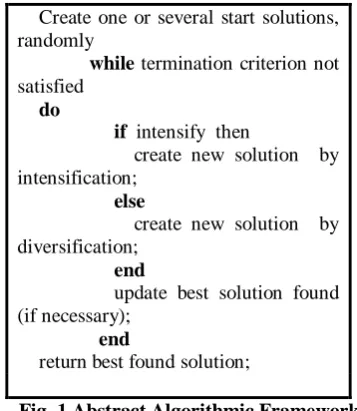
Emerging meta-heuristics use direction memory that preserves search experience. Fig 1 show an outline of how conceptual meta-heuristic Algorithm works. This abstract algorithm unifies our conceptualization of meta-heuristics. However it does not illustrate when to really do intensification or diversification. Moreover it does not show how to end the search.
Create one or several start solutions, randomly
while termination criterion not satisfied
do
if intensify then
create new solution by intensification;
else
create new solution by diversification;
end
update best solution found (if necessary);
end
return best found solution;
Fig 1 Abstract Algorithmic Framework
Briefly, we could say that meta-heuristics are high level strategies for exploring search spaces by using diverse methods. One of great importance the dynamic balance between the exploration and exploitation. Meta-heuristics have many diverse classifications that have been encountered based on the way of applying the exploration and the exploitation, and the metaphor of the search procedures.
One classification based on two ways as population based meta-heuristics and trajectory based meta-heuristic [30], in population based algorithms it produces initially a population that it improved through the advanced search iteration, at each iteration, anew produced best solutions
substitute the entire population or a portion of it. Whereas a trajectory-based algorithm initiates a single solution and, at each iteration, the current best solution is substituted wholly by a new one. Population-based meta-heuristics are further exploration oriented but trajectory-based results are more exploitation oriented. [31]The meta-heuristics classified as local search, which creates minor modifications to one solution. Or as construction-based that builds solutions from their component parts by adding one part at a time to an incomplete solution.
Fister et al. [24] divided all current meta-heuristics into non-nature inspired and nature inspired. Nature inspired meta-heuristics were divided into the following: swarm intelligence (SI) based, bio-inspired (but not SI-based), physics/chemistry-based, and additional algorithms that cannot be categorized below any preceding three classifications because they were inspired by diversified characteristics from different sources, such as social, emotional, etc.
Further characteristics used for the meta-heuristics taxonomy as the method of the objective function usage, the use of memory or not, and the number of neighborhood structures. However, the most common classification of the meta-heuristics is according to Trajectory based & Population-based [1] and Nature-inspired & Non Nature-inspired.
Quite a lot of surveys on meta-heuristics are conducted in the past; most of these are conducted to covers algorithms, applications, comparisons, and analysis. However the meta-heuristic is still black box as algorithms are better in some optimization problems than others. Few studies are those which involve real data from scientific or engineering optimization problems. (Comprehensive survey 2019) draw a picture for meta–heuristics based upon 1222 research over 33years from 1983 to 2016. It is aimed to determine the size of study conducted in this specific discipline.
Yet further main factors are to be comprehended, for example local minima versus global minima, avoidance local minima, neighborhood search, diversification or exploration, intensification or exploitation, evolutionary computing, and swarm intelligence, etc. also next to these terms some important strategies used in meta-heuristics are comprised; such as looking for furthermost promising or possible neighbors escaping unsuitable or inefficient neighbors, controlling search from dipping into unhopeful neighbors, also by make tradeoff between exploitation and exploration ,etc. [3].
a). Exploration versus exploitation
stated as, divergence and convergence, diversification and intensification, respectively) are two basic and essential assemblies of any optimization method. But, it is very hooked on the search philosophy embraced by every meta-heuristic. These features are considered as foundations of resolving any optimization problem effectively [2]. Exploration is the ability to increase search in wide range area to discover unvisited regions, while exploitation, by accrued search knowledge, permits to emphasis hopeful regions (high quality solutions) to employ and join optimally [3]. For mastering the two features, an efficient algorithm spreads new solutions, via randomization techniques and random walks, far from current area of search so that explorative move should reach all the regions within search space accessed a t least once. On the other hand, using intensive local search information about the landscape and past search experience, the algorithm tries to converge quickly without wasting too many moves [1].
b). Global versus Local search meta-heuristics
Another classification is for the local or global search procedures. Local search algorithms are built on unique single neighborhood structure which describes the nature of allowable moves, the local search begin with a neighborhood till a local optima is found, and in this case a kick-move is utilized to direct the search to another point. Local search optimization algorithms are mostly more exploitative methods [e.g., greedy randomized adaptive search procedure (GRASP) [6],tabu search (TS) [7], etc.] . Whereas Global search methods are more explorative in nature [e.g., genetic algorithms (GAs) [2], ant colony optimization (ACO)[4],, particle swarm optimization (PSO) [5], etc.]. There are moreover a lot of hybrid techniques which associate local search proficiency of local search algorithms as an improvement mechanism in global search or population based meta-heuristics [8].
C). Single versus population based meta-heuristics
The number of solutions to be supported in search procedure explains whether the meta-heuristic is a single-solution (trajectory) or population-based algorithm. With the purpose of pick out a meta-heuristic for a particular optimization problem, it is first decided to whether use a trajectory or population based algorithm. . (Regularly, rudimentary single-solution based algorithms are more exploitation oriented, whereas basic population-based meta-heuristics are more explorative in nature [9]. In the single based meta-heuristics, it completes the search with single one initial point. It will explore its neighborhood with a set of transfers to improve their solution, simulated annealing (SA), tabu search (TS), variable neighbourhood search (VNS) and greedy randomized adaptive search procedure (GRASP)
are examples of single based meta-heurstics [14]. .Trajectory methods exercise single solution at a time also start with only initial solution. Throughout the sequence of iterations, these procedures produce a trajectory in the search region. At this time, it is notable that the solution may or may not be a member of neighborhood of the current solution. For a population-based algorithm, a population of numerous solutions is created primarily. Next, in each iteration, a set of solutions are handled to find solutions on the way to better search areas. These algorithms either make recombination of multiple solutions or change each through the strategy assumed to enforce exploration and exploitation of the search area [7] .The population-based algorithm has the advantage as it can afford explore search space in an effective way. These algorithms are appropriate for searching globally as it has the ability of global exploration and local exploitation. Genetic algorithm (GA), ant colony optimization (ACO), evolution strategies (ES), particle swarm optimization (PSO) are examples of populations’ based-metaheurstics[11].
d). Memory usage versus memory-less methods Another promising classification of meta-heuristics is the use of the search experience, background (memory) to help the upcoming search direction. For example, Memory is obviously employed in tabu search. Short term memory is used to prevent go back to lately found solutions and to escape cycling, while long term memory is employed for intensification and diversification features. It is clear from ant colony optimization that there is an unintended kind of adaptive memory of before visited solutions is retained through the pheromone laid by insects in the trail matrix that used to effect the structure of new solutions. Also in genetic algorithm is a type of memory methods as genes from previous population demonstrate the new generations. In contrast, only very poor use of the recent search experience made in , simulated annealing is example for do not using memory function so they are memory less algorithms[15].
e). Dynamic versus static objective functions As particular algorithms revise the appraisal of the single search states during the run of the algorithm. Tabu search possibly will be inferred as using a dynamic objective function, as certain points in the search space are illegal, corresponding to extremely high objective function values. Nevertheless, all the other algorithms presented so far use a static objective function.
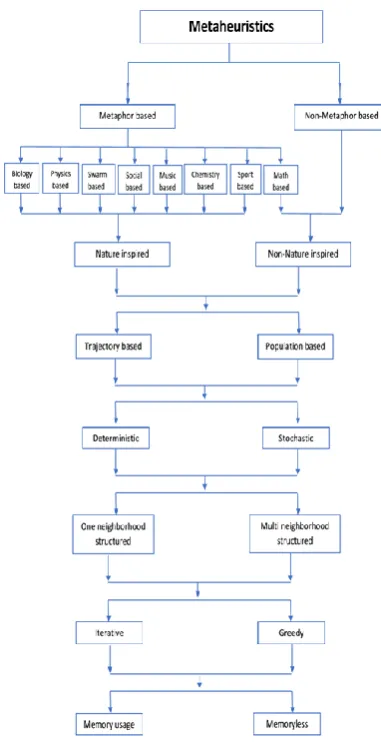
are actually inspired from these social behaviors. As the algorithmic approach attempt to yield benefit from these phenomena for the well-organized solution of combinatorial optimization problems. [16] Nature inspired meta-heuristics were separated into the following: bio-inspired (but not SI-based), swarm intelligence (SI) based, physics/chemistry-based, and further algorithms that cannot be categorized under any former three types as they were inspired by spread characteristics from diverse sources, such as social, emotional, etc. The Fig 2 displays these widespread classifications.
Table I shows the previous classification characteristic versus to some algorithms, if the
feature is present it expressed by , means that features are partially present and that the feature does not appear.
.
Fig 2. Meta-heuristics classifications
TABLE I examples some algorithms versus to different classifications
B. Taxonomy for meta-heuristic publication
a). Intensity of publication
First, what is the amount of publications in the field of meta-heuristics? The intensity of publication over nearly 37 year is depicted in fig 3. As indicated the flied of meta-heuristic paying attention of the researcher excessive from the year 2005 and this is grow until 2010 during this period experiments, applications, and investigation of meta-heuristic methods deployed.
Fig 3. Meta-heuristic-publications-year wise.
The tendency of discovering ―novel‖ meta-heuristics report high till 2015. Meanwhile this period, some of the searchers underlined the matter of metaphor-based methods, and according to them such researches scarcely offered any scientific contribution to the field of meta-heuristic research [12] , by 2016 the real systematic and critical research raised its pillars. Afterward this felid is going more attractive than before, moving in the direction of real scientific contribution that contains mathematical analysis of meta-heuristic performance rather than just measuring squared errors for performance comparisons.
It is obvious from Table II and Fig 4 that the supreme motivated avenue for publishing meta-heuristic survey was Elsevier followed by Springer with highest number of reviews, surveys, chapters, and articles among other avenues. While, Hindawi published the most amount of improved meta-heuristics. Moreover, Elsevier was also highest Piority via scholars for presenting their novel meta-heuristic techniques.
Feature
ACO GA S
A T S
G LS Trajectory
Population
Memory
Multiple neighborhoods
Dynamics
f(x)
TABLE II number of Publication-venues-with type-of-metaheuristic-publications
Also repeatedly meta-heuristics have been applied and verified on numerical problems which include constrained and unconstrained, single and multi-objective optimization problems, continuous and discrete, etc. Data mining is an additional area for applying meta-heuristics by a lot of authors, which embraces optimization tasks as classification, prediction, clustering, and system modeling, etc. moreover finding optimum solutions for power generation and electronics have adopted by meta- heuristics. Scheduling jobs in several industrial applications need to be allocated on sequential or
parallel processes to optimized cost. One more favorable area of meta-heuristic applications is combinatorial optimization differing from facility location problems to set-covering, to more difficult multi-agent task allocation in extreme teams, etc. Extra applications amongst topmost ten areas contain transportation (traveling salesman problem, routing, shortest path, etc.), communications, engineering (mechanical designs, aircraft and ship components design, etc.), and information and communications technology (cloud computing, security, software development, etc.). The applications of meta-heuristics requisite to be sightsaw in the areas of mining, traffic control,
manufacturing and production, etc. Depicted from fig 5.
b). Metaphors patterns
Second, what are the top repeatedly used metaphors or design patterns to develop new meta-heuristic algorithms? As the data engaged from the researchers, the metaphors of the meta-heuristics accessible these days are used from nine disciplines significantly are Biology, Computation, Physics, Psychology, and Chemistry (see Fig 6.for whole list of disciplines). Furthermost of the meta-heuristics are bio-based, and other than this, too there exist substantial number of methods take on from Physics. The scholars have also recycled metaphors from our regular life, for example, interior design [13,34-45].
.
Commonly, meta-heuristic methods have been considered frequently imitating the living and survival schemes of insect’s, animals, and birds. Fig 7.displays topmost 10 primary metaphors generally favored by scholars. In the midst of these, insects are the greatest preferred metaphor for imitating the social behavior to design skillful optimization methods, and between insects, bees is the highest tendency monitored by ants. Additional to these classes, the bio-logical manners of fireflies, spiders. The second best widespread tendency is natural evolution the Darwin theory of survival. Some of the animals, for example fish, bats, and monkeys have too paying attention meta-heuristic designers. Additional to these stated before, human, birds, plant, water, ecosystem, electromagnetic force, and gravitation have been interestingly articulated as metaphor-based in the designs of meta-heuristic methods.
c). Meta-heuristic Hybrids
For the last years, Hybrid optimization methods
have grown into increasingly for solving hard optimization problems. Meta-heuristics, furthermost of them do not purely stick to one particular classical meta-heuristic model but somewhat combine diverse algorithms techniques, to take the advantageous of the algortims to combined the hybridization. Concepts from different meta-heuristics are often crossed with each other, however they are frequently joined with other optimization techniques such as branch-and-bound and methods from the mathematical programming and constraint programming fields, Combinations of algorithms such as descent local search, simulated annealing, tabu search, and evolutionary algorithms have provided very powerful search algorithms..[17,34-45] Such hybridization intends to utilize the specific advantages of the individual components, andFig 5 Domains of meta-heuristic applications
Fig 6 Metaphor disciplines adopted by researchers’ f or designing
meta-heuristics
actually well-designed hybrids often perform significantly superior than their unmixed counterpart.
a). Classification
There are different categorizations and classifications of hybrid meta-heuristics presented in the publications from the literature. Mainly, hybridized meta-heuristics can be discriminated according to four principles, the level of hybridization, specifically the kinds of algorithms that are hybridized, the order of execution, and the control strategy. These taxonomy and classification are declared in the
1). Level of hybridization.
Further, we can discriminate between the hybridized meta-heuristics upon the power (level) to which the separable algorithms can joined:
High-level In this class, there is no direct, robust association of the inner mechanisms of the individual’s algorithms. Mixtures maintain in principle the individual characteristics of the original algorithms and collaborate over a relatively well-defined border.
low-level In contrast, there is strong and direct relation between individuals algorithms. Algorithms that hybridized powerfully depend on each other; individual components or functions of the algorithms are exchanged.
2). Hybridized algorithms
First, the parts of diverse meta-heuristic algorithms might be joined identified as the most popular approach. Secondly, extremely problem-specific algorithms, for example the whole simulation for gaining the superiority of candidate solutions that can used in combination with meta-heuristics. The mixture of meta-heuristics with other more common approaches from other dissimilar felids such as artificial intelligence and operations research. So we can differentiate among the hybridization with the exact methods or the other different heuristic methods. Noticeable, for instance exact methods with meta-heuristic that give successful combination, mixed integer programming (MIP) methods, constraint programming (CP), and nonlinear programming techniques.
3). Order of execution.
Simply, how the execution of the algorithms occur, for each individual algorithms it runs in a consecutive way, so the first algorithm passes its output as input to the second individual one. More sophisticated, when the individual algorithms execute in parallel way, and information is exchanged more repeatedly, typically in a bidirectional way. Parallel hybrid meta-heuristics may be an extensive area for study, it contains its own taxonomy area [18,19 ]. They distinguish the following major criteria:‖ (a) the architecture (
SIMD: single instruction, multiple data streams versus MIMD: multiple instructions, multiple data streams), (b) the granularity of parallelization ( fine- or coarse-grained), ( c) the hardware ( homogeneous or heterogeneous), (d) the memory (shared or distributed), ( e) task and data allocation ( static or dynamic), and (f) whether the parallel processes run asynchronously or are synchronized in some way‖.
4).Control strategy.
Finally, hybrids meta-heuristic can be discriminated according to their control strategy, which can be either integrative (coercive) or collaborative (cooperative).with the integrative case that is commonly used, one algorithm is embedded component of another. In contrasting, in the collaborative case, the individual algorithms cooperate in interchanging information between each other but no one embedded in the other. Additionally Collaborative approaches can be categorized into homogeneous ones, where several instances of one and the same algorithm are performed, and heterogeneous approaches.
III.CONCLUSIONS
In this work, we have presented and compared the current most important meta-heuristic methods and its basic classifications. It is discovered in literature written in recent decades that meta-heuristics have solved optimization problems with plenty of efficiency and reasonable cost of computation as compared to exact methods. We also surveyed different classification of meta-heuristics, the last recent reported researches to verify the intensity of research and the different felids that meta-heuristics inspired from and wider range of applications including engineering, business, transportation, and social sciences, etc. More importantly, this study provides a platform for new meta-heuristic researchers including new PhD. Colleagues for beginning their research by finding potential research topics highlighted here.
REFERENCES
[1] BLUM, Christian; ROLI, Andrea. Metaheuristics in combinatorial optimization: Overview and conceptual comparison. ACM computing surveys (CSUR), 2003, 35.3: 268-308.
[2] ČREPINŠEK, Matej; LIU, Shih-Hsi; MERNIK, Marjan. Exploration and exploitation in evolutionary algorithms: A survey. ACM Computing Surveys (CSUR), 2013, 45.3: 35. [3] KHAJEHZADEH, Mohammad, et al. A survey on meta-heuristic global optimization algorithms. Research Journal of Applied Sciences, Engineering and Technology, 2011, 3.6: 569-578.
[4] YANG, Xin-She, et al. Attraction and diffusion in nature-inspired optimization algorithms. Neural Computing and Applications, 2015, 1-8.
[6] Hussain, Kashif, et al. "Metaheuristic research: a comprehensive survey." Artificial Intelligence Review (2018): 1-43.
[7] DORIGO, Marco; SOCHA, Krzysztof. An introduction to ant colony optimization. Universit de Libre de Bruxelles, CP, 2006, 194.6.
[8] EBERHART, Russell; KENNEDY, James. Particle swarm optimization. In: Proceedings of the IEEE international conference on neural networks. 1995. p. 1942-1948. [9] FESTA, Paola. Greedy randomized adaptive search
procedures. AIROnews, 2003, 7.4: 7-11.
[10] LAGUNA, Manuel; TAILLARD, E.; DE WERRA,
Dominique. Tabu search. Basel: Baltzer, 1993.
[11] CHEN, Zhiqiang; WANG, Ronglong. GA and ACO-based Hybrid Approach for Continuous Optimization. In: 2015 International Conference on Modeling, Simulation and Applied Mathematics. Atlantis Press, 2015.
[12] BOUSSAÏD, Ilhem; LEPAGNOT, Julien; SIARRY,
Patrick. A survey on optimization
metaheuristics. Information sciences, 2013, 237: 82-117. [13] BLUM, Christian; ROLI, Andrea. Metaheuristics in
combinatorial optimization: Overview and conceptual comparison. ACM computing surveys (CSUR), 2003, 35.3: 268-308.
[14] HUSSAIN, Kashif, et al. Metaheuristic research: a comprehensive survey. Artificial Intelligence Review, 2018, 1-43.
[15] SÖRENSEN, Kenneth. Metaheuristics—the metaphor exposed. International Transactions in Operational Research, 2015, 22.1: 3-18.
[16] GANDOMI, Amir H. Interior search algorithm (ISA): a novel approach for global optimization. ISA transactions, 2014, 53.4: 1168-1183.
[17] SAMSUDDIN, Sherylaidah; OTHMAN, Mohd Shahizan; YUSUF, Lizawati Mi. A REVIEW OF SINGLE AND
POPULATION-BASED METAHEURISTIC
ALGORITHMS SOLVING MULTI DEPOT VEHICLE ROUTING PROBLEM. International Journal of Software Engineering and Computer Systems, 2018, 4.2: 80-93. [18] BIRATTARI, Mauro, et al. Classification of
Metaheuristics and Design of Experiments for the Analysis of Components Tech. Rep. AIDA-01-05. 2001.
[19] FISTER JR, Iztok, et al. A brief review of nature-inspired algorithms for optimization. arXiv preprint arXiv:1307.4186, 2013.
[20] RAIDL, Günther R.; PUCHINGER, Jakob; BLUM, Christian. Metaheuristic Hybrids. In: Handbook of Metaheuristics. Springer, Cham, 2019. p. 385-417. [21] ALBA, Enrique. Parallel metaheuristics: a new class of
algorithms. John Wiley & Sons, 2005.
[22] DI GASPERO, Luca. Integration of metaheuristics and constraint programming. In: Springer Handbook of Computational Intelligence. Springer, Berlin, Heidelberg, 2015. p. 1225-1237.
[23] YANG, Xin-She. Nature-inspired metaheuristic algorithms. Luniver press, 2010.
[24] WOLPERT, David H., et al. No free lunch theorems for optimization. IEEE transactions on evolutionary computation, 1997, 1.1: 67-82.
[25] HO, Yu-Chi; PEPYNE, David L. Simple explanation of the no free lunch theorem of optimization. In: Proceedings of the 40th IEEE Conference on Decision and Control (Cat. No. 01CH37228). IEEE, 2001. p. 4409-4414.
[26] BLUM, Christian; ROLI, Andrea. Metaheuristics in combinatorial optimization: Overview and conceptual comparison. ACM computing surveys (CSUR), 2003, 35.3: 268-308.
[27] FISTER JR, Iztok, et al. A brief review of nature-inspired algorithms for optimization. arXiv preprint arXiv:1307.4186, 2013.
[28] BINITHA, S., et al. A survey of bio inspired optimization algorithms. International Journal of Soft Computing and Engineering, 2012, 2.2: 137-151.
[29] YANG, Xin-She. Nature-inspired algorithms: success and challenges. In: Engineering and Applied Sciences Optimization. Springer, Cham, 2015. p. 129-143.
[30] KAR, Arpan Kumar. Bio inspired computing–A review of algorithms and scope of applications. Expert Systems with Applications, 2016, 59: 20-32.
[31] KHAJEHZADEH, Mohammad, et al. A survey on meta-heuristic global optimization algorithms. Research Journal of Applied Sciences, Engineering and Technology, 2011, 3.6: 569-578.
[32] SÖRENSEN, K.; GLOVER, F. W. Metaheuristics Encyclopedia of operations research and management science. 2013.
[33] GENDREAU, Michel; POTVIN, Jean-Yves.
Metaheuristics in combinatorial optimization. Annals of Operations Research, 2005, 140.1: 189-213.
[34] Abdel-Basset, M., El-Shahat, D., Faris, H., & Mirjalili, S. (2019). A binary multi-verse optimizer for 0-1 multidimensional knapsack problems with application in interactive multimedia systems. Computers & Industrial Engineering.
[35] Abdel-Basset, M., El-Shahat, D., & Sangaiah, A. K. (2019). A modified nature inspired meta-heuristic whale optimization algorithm for solving 0–1 knapsack problem. International Journal of Machine Learning and Cybernetics, 10(3), 495-514
[36] Abdel‐Basset, M., El‐Shahat, D., & El‐henawy, I. A modified hybrid whale optimization algorithm for the scheduling problem in multimedia data objects. Concurrency and Computation: Practice and Experience, e5137.
[37] Abdel-Basset, M., Wang, G. G., Sangaiah, A. K., & Rushdy, E. (2019). Krill herd algorithm based on cuckoo search for solving engineering optimization problems. Multimedia Tools and Applications, 78(4), 3861-3884. [38] Liu, X., Luo, Q., Wang, D., Abdel-Baset, M., & Jiang, S.
(2018, August). An Improved Most Valuable Player Algorithm with Twice Training Mechanism. In International Conference on Intelligent Computing (pp. 854-865). Springer, Cham.
[39] Zhang, S., Zhou, Y., Luo, Q., & Abdel-Baset, M. (2018, August). A Complex-Valued Encoding Satin Bowerbird Optimization Algorithm for Global Optimization. In International Conference on Intelligent Computing (pp. 834-839). Springer, Cham.
[40] Abdel-Basset, M., Manogaran, G., El-Shahat, D., & Mirjalili, S. (2018). A hybrid whale optimization algorithm based on local search strategy for the permutation flow shop scheduling problem. Future Generation Computer Systems, 85, 129-145.
[41] Abdel-Basset, M., El-Shahat, D., El-Henawy, I., Sangaiah, A. K., & Ahmed, S. H. (2018). A novel whale optimization algorithm for cryptanalysis in Merkle-Hellman cryptosystem. Mobile Networks and Applications, 1-11. [42] Abdel-Basset, M., El-Shahat, D., El-Henawy, I., &
Sangaiah, A. K. (2018). A modified flower pollination algorithm for the multidimensional knapsack problem: human-centric decision making. Soft Computing, 22(13), 4221-4239.
[43] Abdel-Basset, M., & Shawky, L. A. (2018). Flower pollination algorithm: a comprehensive review. Artificial Intelligence Review, 1-25.
[44] Hezam, I. M., Abdel-Baset, M., & Hassan, B. M. (2016). A hybrid flower pollination algorithm with tabu search for unconstrained optimization problems. Inf. Sci. Lett, 5(1), 29-34.