Received: 16.09.2011 Accepted: 15.12.2011
University of Ljubljana,
Faculty of Civil and Geodetic Engineering, Chair for Buildings and Constructional Complexes, Jamova cesta 2, 1000 Ljubljana, Slovenia * corresponding author
M. Dovnjak
phone:+386 1 4768 609; fax: +386 1 4 4250 688.
E-mail address: [email protected]
Health concerns of PVC
materials in the built
environment
M.
DOVJAK
1*, Ž.
KRISTL
1ABSTRACT
The objective of the paper is to investigate the influence of PVC use in the form of building materials and to draw attention to the problems connected with the exposure of people to PVC emitted phthalates in indoor environment. A systematic literature review is focused on health concerns associated with use of PVC building materials in everyday life and in extraordinary circumstances. The overview of studies indicates that the use of PVC in indoor environment has adverse health effects. A number of studies show association between phthalates and asthma, allergies and respiratory effects. A number of studies also focused on carcinogenic effect and impact of PVC on reproductive system. The most exposed population is young children and certain groups of adults during occupational exposure. The overview of studies on the influence of PVC materials in case of fire shows that when burning, PVC releases hydrogen chloride gas and other harmful combustion products. As a result, a list of recommendations for healthier built environment is systematically unfolded. Recommendations include actions during the whole life cycle of PVC material. Among them the most important are: adoption and implementation of regulations and standards on the marketing and use of phthalates in building materials; production and use of safer alternatives; fire safety and implementation of waste management. Further measurements of phthalate release from PVC building materials and additional research of health impacts are needed to achieve a uniform opinion about health risks associated with phthalates.
KEY WORDS:
1. INTRODUCTION
Polyvinyl chloride (IUPAC name: polychloroethanediyl, hereinafter PVC) is a thermoplastic polymer and one of the most widely used materials in our everyday life. PVC is present in a large variety of products, due to simple moulding, firmness and inexpensiveness [1]. For example floor furnishing, window frames, food wraps, hair gel, shampoo, paper clips, credit cards, automobile seats and toys are just some of the items that contain PVC. European PVC organisation [1] states that on the global level, demand for PVC exceeds 35 million tonnes per year and it is in constant growth (+5 % on global, average), with higher growth rates in the developing countries. In Europe (EU-27), the production of PVC products – including exports – totals about 8 million tons per year. Eu-ropean PVC resin consumption totals some 6.5 million tons per year, or 15 % of all plastics use in Europe, with an average growth of 2 %-3 % per year [1]. PVC is widely used in various industries, such as food, ag-ricultural, pharmaceutical, cosmetic, automotive, toy, and construction industry which consume the largest amount of PVC. As building materi-al it is mainly used for finmateri-al furnishing or coating of ceilings, wmateri-alls and floors, carpentry products (i.e. windows and doors), facade elements, roofing materials and installations (i.e. piping and cabling). Plastic pipes and construction uses account for 75 % of all PVC consumption in North America and 50 % in Western Europe. Construction is also the fastest growing PVC sector, with a projected annual average growth rate of 3.5 % between 2002 and 2007 [2].
Widespread production and use of PVC materials results in problems related to wastes. The amount of waste plastic generated in Europe (EU-27) in 2006 was 14,647,803 tones; in Slovenia this amount reached 43,486 tones. According to Eurostat [3] the amount of waste plastic generated in EU-27 in 2006 increased by 22 % compared to 2004. In Slovenia the increase rate was 12 %. The majority of waste plastic in EU as well as in Slovenia was generated by industry. House-holds, however, are responsible for approximately 15 % of the overall generated waste plastic in EU-27; the percent strongly varies depending on the country. Concerning is the information that the amount of waste packaging in 2006 in Slovenia had an increasing rate (by 14 % for in-dustry; 6 % for households) compared to 2004. The amount of waste plastic in construction and demolition in EU-27 in 2006 had increasing rate, i.e. from 3 % (Denmark from 1,513 tones to 1,556 tones) to 98 % (from 2 tones to 82 tones in Bulgaria) compared to year 2004. We have to point out that uncontrolled stages of waste management may result in potential health concerns as well as environmental problems. In Slovenia the rate of waste plastic generated in construction and dem-olition had a decreasing rate; in 2004, 592 tones were generated, in 2006 this amount fell to 365 tones. The waste material has to be man-aged - reused, recycled, incinerated or disposed. The amount of recy-cled plastic in EU-27 in 2006 was 6,428,648 tones; in Slovenia this amount was 22,274 tones (12,193 tones in 2004).
At the first stage in the PVC production process ethylene and chlorine are combined to produce an intermediate product called ethylene dichloride; this is then transformed into vinyl chloride, the basic building block of polyvinyl chloride or PVC. The process of polymerisation links together the vinyl chloride molecules to form chains of PVC. The PVC produced in this way is in the form of white powder. It is not used alone, but blended with other ingredients. To increase the flexibility, transparency, durability and longevity of PVC softeners and plasticizers are added during the production. Phthalates (or phthalate esters) are esters of phthalic acid and are the most common type of general plasti-cisers. The most widely used phthalates are di-2-ethyl hexyl phthalate (DEHP), diisodecyl phthalate (DIDP), diisononyl phthalate (DINP), and benzylbutylphthalate (BBP).PVC formulations can be shaped by a vari-ety of techniques and, using very little energy, are made into the final product form [1].
In the developed countries people spend 90 % of time indoors [4]; therefore the quality of indoor environment is extremely important. PVC building materials and everyday products often deteriorate indoor air quality. Because there is no covalent bond between phthalates and the PVC, the phthalates are easily released from PVC materials into the en-vironment [5]. Phthalates migrate during the whole life cycle of the product (from production to final disposal). They are subject to photo-degradation, biophoto-degradation, and anaerobic degradation and thus gen-erally do not persist in the outdoor environment [6]. However, their lifespan in indoor environment is relatively long. Exposure to emitted phthalates may cause the adverse effects on human health [7]. The earliest research about their adverse effects on human health goes back to 1976, when Šarič et al. [8] published the article about malig-nant tumours of the liver and lungs in an area with the PVC industry. Public health concerns about phthalate plasticizers have been growing over the last few years.
Worldwide and as well as in Slovenia public awareness on the use of PVC materials and phthalates for toys, childcare articles and also cos-metic products is quite high. Proven human toxicity with animal and human studies results in restriction of selected phthalate esters in toys and childcare products. Although the same phthalates are used in PVC building materials, there is no restriction for these products. Further-more there is no general consensus what kind of PVC products and what type of phthalates should be prohibited in buildings. Additionally, health impacts of PVC building materials are still widely unknown.The objective of the paper is to investigate the influence of PVC building ma-terials on human health and to draw attention to the problems connect-ed with the use of PVC and phthalates in indoor environment. A sys-tematic literature review focuses on health concerns associated with PVC building materials in everyday life and in extraordinary circum-stances, i.e. in case of fire. Main concerns are defined and recommen-dations for the prevention of negative health effects of PVC building materials are systematically unfolded.
2. METHODS
For literature review and selection criteria there were searched Pub Med and Science Direct for peer-reviewed publications from 1976 to 2011 written in English, with the keywords “PVC”, “plasticizers”, “phthalate esters“, “endocrine disruptors”, “DINP”, “DEHP”, “DIDP”, “DBP”, “BBP”, together with “health”, “adverse health effects“, “health haz-ard”, “toxicology”, “phthalate metabolites”, “occupational exposure”, “environmental impact”, “indoor dust”, “asthma”, “allergies”, “fire”, “combustion products”, “dioxins”, “carbon monoxide”, ”carbon dioxide”, “soot”, “hydrogen chloride”, “threshold limit values”. There were re-viewed reports of European PVC organization; European Council for Plasticisers and Intermediates; European Food Safety Authority; Inter-national Labour Organization; InterInter-national Occupational Safety and Health Information Centre; Centres for Disease Control and Prevention; World Health Organization; Institute of Public Health of the Republic of Slovenia; U.S. Green Building Council; Environmental Protection Agency United States. There were also reviewed regulations of the European Parliament; and chemical data of Occupational Safety and Health Ad-ministration; National Institute for Occupational Safety and Health; American Conference of Governmental Industrial Hygienists; UK Health Protection Agency; and articles of U.S. Centre for the Evaluation of Risks to Human Reproduction; U.S. Centre for Health, Environment and Justice. We also searched the above keywords with the Google search engine and publications of University of Ljubljana with the Cobiss online bibliographic system.
Legal aspects on the use of PVC were searched and analysed. Findings of studies were compared to regulations and guidelines. The findings of the comparative study enabled us to define the main problems associ-ated with the use of PVC building materials and were the basis for the development of recommendations for prevention of negative health ef-fects of PVC building materials. They include the actions regarding the whole life cycle of PVC material with the emphasis on the use of PVC materials in buildings during their product use phase.
3. RESULTS
3.1 Results of the state-of-art analysis
Results of the state-of art analysis include the main findings in literature review. The results are presented regarding the field of influence: health concerns associated with phthalate exposure in everyday life; phthalate exposure and risk of asthma and allergies in adults and children; health concerns associated with building materials; health concerns of PVC building materials in case of fire.
3.1.1 Health concerns associated with phthalate exposure in everyday life
Various studies have concluded that phthalates may be endocrine dis-ruptors [5,9,10]. Council of European Union[11] defined endocrine
dis-The findings of the
rupters as substances that act like hormones and disturb the normal functioning of the endocrine system. The endocrine system is a network of glands and hormones that regulate many of the body’s functions, in-cluding growth, development and maturation. Endocrine disrupters are suspected of interfering with the production and performance of hor-mones. Such effects have already been seen at animals, like impairing reproduction, development or immunity. People may be exposed to phthalates among others through food, plastic products, paints and cosmetics. These chemicals are thought to be responsible for low testo-sterone level, declining sperm counts and quality, genital malforma-tions, retarded sexual development or even reproductive abnormalities and increased incidences of certain types of cancer [5,9-11].
Health concerns related to phthalates exposure have focused primarily on cancer and reproductive effects [5,7,9,10]. However, plastic building materials present a potential chemical emission source in indoor air [12]. A number of studies [7,13-19] showed the association between phthalates and asthma, allergies, or related respiratory effects. Their health impact depends on the type of phthalate ester, dose, exposure time (i.e. short-term or acute exposure, long-term, repeated exposure or chronic exposure) and individual characteristics (gender differences and anthropometric characteristics, age, cultural differences, and health status) [20]. European Council for Plasticizers and Intermediates [21] classify the phthalate plasticizers according to their health impact (i.e. cancer, fertility and developmental effects). Table 1 summarizes the current classification and labelling of phthalates adopted in March 2001 [21,22].
According to the type of phthalate ester there are several routes of ex-posure. For example di(2-ethylhexyl) phthalate (DEHP), diethyl phtha-late (DEP), diisononyl phthaphtha-late (DINP), dibutyl phthaphtha-late (DBP) can be absorbed into the body by inhalation, by ingestion, and through the
Table 1:
Classification and labelling of phthalate plasticizers [21,22].
Phthalate ester Cancer Fertility Developmental
DBP1 None Category 3 Category 2
DEHP2 None Category 2 Category 2
DINP3 None None None
DIDP4 None None None
BBP5 None Category 3 Category 2 proposed
1dibutyl phthalate 2di(2-ethylhexyl) phthalate 3diisononyl phthalate 4diisodecyl phthalate 5benzylbutyl phthalate
Category 1 – Substances known to cause effects in humans. Based on epidemiological data. Skull and crossbones.Category 2 – Substances to be regarded as if they cause effects in humans. Based on clear evidence in animal studies. Skull and crossbones. Category 3 – Substances causing concern for humans. Based on sufficient evidence in animal studies to cause suspicion. St. Andrews Cross.
skin. The routes of exposure for diallyl phthalate (DAP) are by inhalation of its aerosol and by ingestion, and for diisobutyl phthalate (DIBP) through skin and by ingestion. Diisodecyl phthalate (DIDP) can be ab-sorbed into the body only by inhalation of its vapour [23-28]. Harmful effects depend on the type of phthalate ester as well as exposure time and dosage. Effects of short-term exposure of phthalate esters may in-clude eye irritation (i.e. DIDP, DEHP), skin irritation (i.e. DIDP), irritation of respiratory tract (i.e. DEHP), or even chemical pneumonitis (i.e. DAP). Long-term or repeated exposure may have effects on the liver (i.e. DIDP) [25], on the testicles (i.e. DEHP) [24], or may even cause skin sensitization (i.e. DAP) [23].
Animal tests show that DEHP and DIBP possibly cause toxicity to hu-man reproduction or development [23,24]. DEP may be hazardous to the environment with a moderate acute toxicity to aquatic life [23]. Ac-cording to European Union Risk Assessment Report [28] and Interna-tional Labour Organization [26] DBP is probably carcinogenic to hu-mans. Even though no adequate long-term toxicity and/or carcinogenicity studies in animals as well as humans are available, DBP is classified and labelled according to the 28th ATP of Directive 67/548/EEC4 [29]: DBP is a substance that is classified as health hazard with Repr. Cat. 3 (Category 3, Reproductive toxins)1, and labelled with risk phrases R63 (may cause harm to the unborn child), R62 (possible risk of impaired fertility), and R50 (dangerous for the environment, very toxic to aquatic organisms) [26,28].
Once phthalates enter a person’s body, they are converted into break-down products (metabolites) that pass out quickly with urine and may cause an adverse health effect [30]. Romero-Franco et al. [31] investi-gated personal care product use and urinary levels of phthalate metabo-lites in Mexican women. The study concluded that certain personal care products such as body lotion and deodorant showed higher urinary con-centrations of some DEHP metabolites. Urinary concon-centrations of phthalate metabolites showed a positiverelationship with the number of products used. Guo et al. [32] found out that Chinese population is widely exposed to phthalates. Children are exposed to higher levels of DEHP and lower levels of DEP and DEP than the adults. Additionally, study on Danish children [33] concluded that the youngest children, especially boys were the most exposed. The highest exposure levels were found for DEHP and DBP. However, biomonitoring studies on lev-els of phthalate metabolites enable us to estimate the daily intake of phthalates and can determine whether people have been exposed to higher levels. A tolerable daily intake (TDI) is an estimate of the amount of substances in air, food or drinking water that can be taken in daily over a lifetime without appreciable health risk. TDI values for phthalates are presented in the Table 2 [34-36].
1 Chemicals that produce or increase the incidence of non-heritable effects in progeny and/or the impairment in reproductive functions or capacity.
3.1.2 Phthalate exposure and risk of asthma and allergies in adults and children
Jaakkola and Knight [19] reviewed the evidence for the role of exposure to phthalates from PVC products in the development of asthma and al-lergies. The systematic review and meta-analysis are based on 27 hu-man and 14 laboratory toxicology studies (1950 to May 2007). The studies in adults assessed the relationship between PVC-related occu-pational exposure (meat wrappers, hospital and office workers, fire fighters, PVC processors) and the risk of asthma, allergies, or related respiratory effects [13-15], and one of the studies [18] also examined the role of home exposures. Exposure to phthalates (inhalation expo-sure to pyrolysis products of PVC, burning PVC) and PVC materials (damaged PVC floor, wall paper) caused the increased prevalence of respiratory symptoms, including shortness of breath, wheezing and chest pain, as well as increased occurrence of upper respiratory symp-toms (dry or sore throat, stuffy or runny nose, coughing, chest tight-ness) and eye symptoms (burning, itchy, or tearing eyes) and acute res-piratory tract illness (pleurisy, bronchitis, and pneumonia). However, study by Tukiainen [37] found out that PVC materials by themselves do not evoke immediate asthmatic reactions. The appearance of respirato-ry symptoms depends upon the health status of the exposed subject and exposure time (i.e. acute or chronic exposure). In the study 10 sub-jects were experimentally challenged to the degraded PVC products un-der controlled conditions. All the subjects had previously experienced respiratory symptoms suspected to be caused by this kind of exposure in their work place. Five subjects had doctor-diagnosed asthma. After the PVC exposure, subjects reported respiratory tract symptoms signifi-cantly more often than they did after the control test.
Epidemiologic studies at children [7,16,17] evidenced that the presence of PVC flooring and walls was related with asthma, rhinitis, wheeze, cough, phlegm, nasal congestion, nasal excretion and eczema. These findings underline the need to consider the health aspects of materials used in indoor environment. Infants are especially sensitive to the health impacts of phthalates, mainly due to their lower body weight, higher activity levels and age-related behavioural characteristics. Jaak-Table 2:
Tolerable Daily Intake (oral) for selected phthalate esters [34-36].
Phthalate TDI (Tolerable Daily Intake)
DEHP1 37 µg/kg body weight/day
DBP2 0.01 mg/kg body weight /day
DINP+DIDP3 0.15 mg/kg body weight /day
DEP4 5 mg/kg body weight /day
1di(2-ethylhexyl) phthalate 2dibutyl phthalate
3diisononyl phthalate+diisodecyl phthalate 4diethyl phthalate
kola et al. [7] assessed the role of PVC and textile materials in the home in the development of bronchial obstruction in infants in Oslo, Norway (during the first 2 years of life). The risk of bronchial obstruc-tion was related to the presence of PVC flooring and textile wall materi-als. Emissions from plastic materialsindoors may have adverse effects on the lower respiratory tracts of smallchildren. Similar conclusion was also made by Jaakkola et al. [16]. Lower respiratorytract symptoms – persistent wheezing, cough, and phlegm were strongly relatedto the presence of plastic wall materials, whereas upper respiratorysymptoms were not. The risks of asthma andpneumonia were also increased in childrenexposed to such materials.
3.1.3 Health concerns associated with building materials
Dust concentrations of different phthalate esters are related to building materials. Bornehag et al. [17] found associations between dust con-centrations and the amount of polyvinyl chloride (PVC) used as flooring and wall material in homes. Furthermore, high concentrations of n-butyl benzyl phthalate (BBzP) and di(2-ethylhexyl) phthalate (DEHP) (above median) were associated with water leakage in homes (due to degrada-tion of PVC floors caused by moisture/water and, in some cases, highly basic moist concrete surfaces), and high concentrations of DEHP were associated with buildings constructed before 1960. Both BBzP and DEHP were found in buildings without PVC flooring or wall covering, but were consistent with numerous other plasticized materials that are anticipated to be present in a typical home. Phthalates and adhesives in PVC materials may react with moisture in constructional complexes and form products that cause odours in indoor air as well as sick build-ing syndrome. Chino et al. [38] found out that moisture with high pH in concrete slabs and self-levelling sub-flooring material reacts with di-2-ethylhexyl phthalate (DEHP) in the polyvinyl chloride (PVC) flooring and compounds containing the 2-ethyl-1-hexyl group in the adhesive. In such way 2-ethyl-1-hexanol (2E1H) is formed, which was detected in indoor air at relatively high concentrations. One of the most common problems related with constructional complexes in old buildings is mould. Jaakkola et al. [19] found out that the risk of asthma was relat-ed to the presence of plastic wall materials and wall-to-wall carpeting, the latter in particular in the presence of mould. The use of floor-level-ling plaster in homes was also a determinant of onset of asthma. These findings underline the need to consider the health aspects of materials used for floor and wall coverings, and other indoor surfaces.
3.1.4 Health concerns of PVC building materials in case of fire
The main cause of injury and death in fires is exposure to toxic fire ef-fluent (smoke and gases), while the next most important cause is expo-sure to heat. Material safety data sheet [39] characterises PVC as a combustible material, with melting point at 75 oC. During combustion it forms hazardous products such as carbon monoxide (CO), carbon diox-ide (CO2), hydrogen chloride (HCl), hydrochloric acid (a solution of HCl in water), dioxins (halogenated organic compounds), smoke/soot etc.
[40]. The characteristics, exposure limits and health impacts for the most important PVC combustion products are presented below. Carbon monoxide is a toxic gas, but, being colourless, odourless, taste-less, and initially non-irritating, it is very difficult for people to detect [41]. It is produced from the partial oxidation of carbon-containing com-pounds. Carbon monoxide mainly causes adverse effects in humans by combining with haemoglobin to form carboxyhaemoglobin (HbCO) in the blood. This prevents oxygen binding to haemoglobin, reducing the oxygen-carrying capacity of the blood, which leads to hypoxia. Occupa-tional exposure limits defined by OccupaOccupa-tional Safety and Health Ad-ministration (OSHA) [41], National Institute for Occupational Safety and Health (NIOSH) [42] and American Conference of Governmental Indus-trial Hygienists (ACGIH) [43] are presented in the Table 3 [41-45]. The acute effects produced by carbon monoxide in relation to ambient con-centration in parts per million and the portion in % are listed below (Table 4) [41].
Carbon dioxide is colourless and odourless gas. It is felt by some to have a slight, pungent odour and biting taste [46]. At standard temper-ature and pressure, the density of carbon dioxide is 1.98 kg/m3, which is about 1.5 times higher than air. Carbon dioxide is an asphyxiant. It initially stimulates respiration and then causes respiratory depression. High concentrations result in narcosis. Occupational exposure limits de-fined by U.S. Environmental protection Agency (U.S. EPA), American Society of Heating, Refrigerating and Air-Conditioning Engineers (ASHRAE), NIOSH, OSHA, ACGIH are presented in the Table 5
[42,43,46,47]. The acute effects produced by carbon dioxide in
rela-Table 3:
Occupational exposure limits for carbon monoxide [41-45].
Occupational exposure standards Exposure limits
OSHA PEL (United States, 11/2006)1,2,3
OSHA PEL 1989 (United States, 3/1989)1,2,3
TWA: 55 mg/m3, 8 hour(s)
TWA: 43 mg/kg (50 ppm) 8 hour(s) CEIL: 229 mg/m3
CEIL: 177 mg/kg (200 ppm) TWA: 40 mg/m3, 8 hour(s)
TWA: 31 mg/kg (35 ppm) 8 hour(s) NIOSH REL (United States, 6/2009)4,5 CEIL: 229 mg/m3
CEIL: 177 mg/kg (200 ppm) TWA: 40 mg/m3, 10 hour(s).
TWA: 31 mg/kg (35 ppm) 10 hour(s) ACGIH TLV (United States, 2/2010)6,7 TWA: 29 mg/m3, 8 hour(s)
TWA: 22 mg/kg (25 ppm) 8 hour(s)
1OSHA – Occupational Safety and Health Administration.
2PEL – permissible exposure limit as an 8-hour time-weighted average (TWA) concentration.
3CEIL – ceiling limit, absolute exposure limit that should not be exceeded at any time ppm-part per million. 4NIOSH – National Institute for Occupational Safety and Health.
5REL – recommended exposure limit (REL) as an 8-hour TWA. The limit is based on the risk of cardiovascular effects. 6ACGIH – American Conference of Governmental Industrial Hygienist.
Table 4:
Acute effects of carbon monoxide [41].
Concentration Symptoms
31 mg/kg
(40 mg/m3; 35 ppm or 0.0035%)
Headache and dizziness within six to eight hours of constant exposure.
89 mg/kg
(115 mg/m3; 100 ppm or 0.01%)
Slight headache in two to three hours.
177 mg/kg
(229 mg/m3; 200 ppm or 0.02%)
Slight headache within two to three hours; loss of judgment.
354 mg/kg
(458 mg/m3; 400 ppm or 0.04%)
Frontal headache within one to two hours.
708 mg/kg
(916 mg/m3; 800 ppm or 0.08%)
Dizziness, nausea, and convulsions within 45 min; insensible within 2 hours.
1,417 mg/kg
(1,832 mg/m3;1,600 ppm or 0.16%)
Headache, tachycardia, dizziness, and nausea within 20 min; death in less than 2 hours.
2,835 mg/kg
(3,665 mg/m3; 3,200 ppm; 0.32%)
Headache, dizziness and nausea in five to ten minutes. Death within 30 minutes.
5,668 mg/kg
(7,329 mg/m3; 6,400 ppm or 0.64%)
Headache and dizziness in one to two minutes. Convulsions, respiratory arrest, and death in less than 20 minutes.
11,337 mg/kg
(14,659 mg/m3; 12,800 ppm or 1.28%)
Unconsciousness after 2-3 breaths. Death in less than three minutes.
Table 5:
Occupational exposure limits for carbon dioxide [42,43,46,47].
Occupational exposure standards Exposure limits
U.S. EPA1 Max=1,392 mg/kg (1800 mg/m3; 1000 ppm or 0.1%) for continuous exposure
ASHRAE standard 62-19892 Max=1,392 mg/kg (1800 mg/m3; 1000 ppm)
NIOSH REL (United States, 6/2001)3-6
STEL: 54000 mg/m315 minute(s)
STEL: 41,763 mg/kg (30000 ppm) 15 minute(s) TWA: 9000 mg/m310 hour(s)
TWA: 6,961 mg/kg (5000 ppm) 10 hour(s) OSHA PEL (United States,
1993)5,7,8
TWA: 9000 mg/m3 8 hour(s).
TWA: 6,961 mg/kg (5000 ppm) 8 hour(s). ACGIH TLV (United States,
9/2004)5,6,9,10
STEL: 54000 mg/m3 15 minute(s)
STEL: 41,763 mg/kg (30000 ppm) 15 minute(s) TWA: 9000 mg/m3 8 hour(s)
TWA: 6,961 mg/kg (5000 ppm) 8 hour(s)
1U.S. EPA – U.S. Environmental protection Agency.
2ASHRAE – American Society of Heating, Refrigerating and Air-Conditioning Engineers.
3NIOSH – National Institute for Occupational Safety and Health. The limit is based on the risk of cardiovascular effects. 4REL – recommended exposure limit (REL) as an 8-hour TWA.
5STEL – average for a short-term (15 minute) exposure limits. 6TWA – time-weighted average concentration.
7OSHA – Occupational Safety and Health Administration.
8PEL – permissible exposure limit as an 8-hour time-weighted average (TWA) concentration.
9ACGIH – American Conference of Governmental Industrial Hygienist. The limit is based on the risk of elevated carboxyhemoglobin levels. 10TLV – threshold limit value as a TWA for a normal 8-hour workday and a 40-hour workweek.
tion to ambient concentration in parts per million and the portion in % are listed in the Table 6 [47].
Another combustion product is hydrogen chloride. It is colourless to slightly yellow compressed liquefied gas, with pungent odour and heavi-er than air. It readily dissolves in watheavi-er to form hydrochloric acid, a cor-rosive solution (HCl+H2O→(H3O)++Cl-). Hydrogen chloride exposure levels and associated health impacts in acute exposure situations are presented in the Table 7 [48]. Chronic exposure to low levels may af-fect tooth enamel, cause corrosion, coughing, shortness of breath, bronchitis. It may also cause respiratory cancers and may affect the liv-er and kidneys.
During combustion of PVC materials a high amount of hydrogen chlo-ride is produced. It may cause severe chemical burns in respiratory tract. Hydrogen chloride binds on small parts of carbon, which are inha-lated and transported to the alveolus.
Table 6:
Acute effects of carbon dioxide [47].
Concentration Effects
13,918 mg/kg
(17,996 mg/m3 10,000 ppm or 1%)
Breathing rate increases slightly.
27,836 mg/kg
(35,992 mg/m3 20,000 ppm or 2%)
Breathing rate increases to 50% above normal level. Prolonged exposure can cause headache, tiredness.
41,754 mg/kg
(53,988 mg/m3 30,000 ppm or 3%)
Breathing increases to twice normal rate and becomes labored. Weak narcotic effect. Impaired hearing, headache, increased blood pressure and pulse rate. 55,672- 69,590 mg/kg
(71,984-89,980 mg/m3
40,000-50,000 ppm or 4-5%)
Breathing increases to approximately four times normal rate, symptoms of intoxication become evident, and slight choking may be felt.
69,590-139,179 mg/kg (89,980-179,959 mg/m3
50,000-100,000 ppm or 5-10%)
Characteristic sharp odour noticeable. Very labored breathing, headache, visual impairment, and ringing in the ears. Judgment may be impaired, followed within minutes by loss of consciousness.
139,179-1391,795 mg/kg (179,959-1799,591 mg/m3
100,000-1000,000 ppm or 10-100%)
Unconsciousness occurs more rapidly above 10% level. Prolonged exposure to high concentrations may eventually result in death from asphyxiation.
Table 7:
Hydrogen chloride exposure levels and associated health impacts in acute exposure (<15 minutes) situations [48].
Concentration Health impacts
0.29-11.6 mg/kg (0.37-15 mg/m3
or 0.25-10 ppm)
Readily detectable odour. Eye, nose, and throat irritation, corrosive, burning sensation. Liquid exposure to skin or exes will cause frostbite, serious skin burns, corrosion, pain, and blurred vision or blindness. Ingestion will cause nausea, vomiting, and intense thirst. Symptoms may be delayed.
>11.6 mg/kg
(>15 mg/m3 or >10 ppm)
Corrosive skin burns, sneezing, laryngitis, hoarseness, chest pain feeling of suffocation.
58 mg/kg
(75 mg/m3 or 50 ppm)
Immediately dangerous to life and health.
>58 mg/kg
(>75 mg/m3 or >50 ppm)
PVC presents serious problem in fire fighting today because it releases hydrogen chloride gas and other combustion products when burning. Inhalation of PVC combustion products leads to several respiratory symptoms including slow and shallow breading, caught, raucousness, chest pain, shortness of breath and wheezing. Dyer and Esch [49] from 1970 to 1975 studied one hundred seventy fire fighters who experi-enced symptoms from its toxicity. One died. Chemical Safety Board [50] found that a massive release of vinyl chloride led to the explosion that killed 5 workers at a PVC factory in Illiopolis, Illinois on April 23, 2004.
Lestari et al. [51] investigated an in vitro citotoxicity of combustion products of PVC and other polymers (polyethylene, polypropylene, poly-carbonate, fibreglass reinforced polymer, and melamine-faced plywood) on human lung cells. Results indicated that PVC (IC50, 50% inhibitory concentration: 1.2 mg/L) was the most toxic of the materials tested fol-lowed by polyethylene, polypropylene, fibreglass reinforced polymer, polycarbonate and melamine-faced plywood.
During PVC combustion also dioxins are produced. However, dioxins are created in the whole life cycle of PVC materials (i.e. production, recy-cling, disposal, and incineration). Dioxins are of concern because of their highly toxic potential. The characteristic adverse effect following a severe acute exposure to dioxins is chloracne, the onset of which may be delayed several months. Acute exposure to dioxins may also cause nausea, vomiting, diarrhoea, hepatic damage and neurological effects. The adverse effects of chronic exposure to dioxins are similar to those following acute exposure. Dioxins are readily absorbed by ingestion and are also likely to be absorbed by inhalation or dermal exposure. Once absorbed, they are extensively distributed throughout the body, with particular accumulation in the liver and adipose tissue. The metabolism of dioxins is extremely slow, with partial excretion in the faeces as me-tabolites. They are extremely persistent with the elimination half-life of 2,3,7,8-tetrachlorodibenzo-p-dioxin (TCDD) being 7 to 12 years; there-fore, there is potential for accumulation in body tissues. Chronic expo-sure to dioxins may also cause liver disease, increased risk of develop-ing diabetes, alterations in thyroid function, impaired immune function, cardiovascular disease, mild neuropathies and developmental effects. TCDD is classified by International Agency for Research on Cancer (IARC) as being carcinogenic to humans [52,53].
According to the risk of dioxin emissions during the whole life cycle of PVC products, Technical and Scientific Advisory Committee of the US Green Building Council [54] released a report on a PVC avoidance re-lated materials credit for the LEED Green Building Rating system. The report concludes that “no single material shows up as the best across all the human health and environmental impact categories, nor as the worst” but that the “risk of dioxin emissions puts PVC consistently among the worst materials for human health impacts” [54]. Besides the mentioned combustion products, serious hazards produced in fires are also smoke and soot. Smoke can drastically reduce visibility and has
Results indicated that PVC
(IC50, 50% inhibitory
concentration: 1.2 mg/L) was
the most toxic of the
unpleasant physiological effects. A major component of smoke from flames is soot. Sootrefers to impure carbon particles resulting from the incomplete combustion of hydrocarbon. Soot is the major factor that af-fects the visibility. As airborne particulate matter it is considered haz-ardous to the lungs and general health when the particles are less than five micrometers in diameter, as such particles are not filtered out by the upper respiratory tract [55].
The literature review showed that the field of health concerns of PVC building materials in case of fire in not thoroughly investigated. There exist some reports on actual events of PVC burning and their negative consequences on the health of fire fighters. However, studies on health concerns of PVC materials in buildings in case of fire are rare. There-fore, here are presented the results of the study by Senica [56] (the study was executed under mentorship, counselling of Kristl and Dovjak). Senica [56] conducted comparative study of various fire scenarios in an actual storage building for PVC products in Slovenia. The calculations were executed with Nist Fire Dynamic Simulator (FDS) 5.5.1 and pre-sented with Smokeview (SMW) 5.5.6 [57]. FDS is a computational flu-id dynamics (CFD) model of fire-driven fluflu-id flow. The software solves numerically a form of the Navier-Stokes equations appropriate for low-speed, thermally-driven flow, with the emphasis on smoke and heat transport from fires. SMV is a visualization program that is used to dis-play the output of FDS [57]. The dimensions of the building are 24.2 m/9.2 m. In the building there is the storage for PVC products (130 m2), an office and a depository. In the storage there are seven metal racks (4.0 m long, 1.20 m wide and 2.50 m high). The stored material is PVC sewage and drainage pipes. The overall quantity of stored PVC amounts to 2.64 m3. The simulation focused on two neighbouring spaces, the storage for PVC products and the office connected with a door.
Three fire scenarios were simulated:
• Uncontrolled spread of fire in the storage with open doors and win-dows presented state-of-art (V1).
• Limited spread of fire with mounted heat detectors and sprinklers, the doors and windows left open (V2).
• Controlled spread of fire with closed doors and windows, the door between the storage and the office is left open (V3).
During the simulations fire dynamics (fire growth and fire spread), sur-face temperatures, air temperatures, smoke dynamics and concentra-tion of combusconcentra-tion products (CO, CO2, O2, soot) were observed. Hydro-gen chloride and dioxins were not taken into consideration, because FDS calculation program enables observation just for selected combus-tion products (i.e. CO, CO2, O2, and soot). Although all the PVC com-bustion products were not simulated in the study, one can get interest-ing information about negative heath effects of the burninterest-ing PVC products. In all three scenarios the fire started at the same location in the middle of the storage near the rack. As expected, in V1 the fire quickly spreads on the racks with stored PVC products (after 70 s the
The literature review showed
first rack is burning, after 150 s the fire spreads to the neighbouring racks). The fire also spreads into the office. After 330 s (when the ma-jority of the material has burnt down) the fire gradually diminishes but does not cease completely until 830 s. As seen in this scenario, the highly flammable composition of the material and large supply of oxy-gen result in fire accelerating out of control in a fairly short time after the flashover. After 130 s in the storage there is near-zero visibility and after 270 s both spaces are completely filled with smoke; the amount of smoke does not diminish until the end of the simulation in the 900th sec. Due to intensive burning of the stored material the concentration of CO is the highest between 200 sec and 300 sec of the simulation, when the concentration reaches 132,853 mg/kg (150,000 ppm or 171,779 mg/m3). Later the concentration diminishes to 17,714 mg/kg (22,904 mg/m3 or 20,000 ppm), but the value is still high and life threatening. According to OSHRAE [41]; 11,337 mg/kg (14,659 mg/ m3; 12,800 ppm or 1.28 %) causes unconsciousness after 2-3 breaths and death in less than three minutes (Table 5). The concentration of CO does not diminish to less than 10,628 mg/kg (13,742 mg/m3 or 12,000 ppm) until 430 s of the fire simulation.
In the office the concentration of CO is lower (the maximum concentra-tion of CO is reached after 365 s and amounts to 12,400 mg/kg (16,033 mg/m3 or 14,000 ppm), the average concentration during the fire is 5,314 mg/kg (6,871 mg/m3 or6,000 ppm). Concentration of 5,668 mg/kg (7,329 mg/m3; 6,400 ppm or 0.64 %) causes headache and dizziness in one to two minutes, convulsions, respiratory arrest, and death in less than 20 minutes (Table 5) [41]. Besides high concen-tration of CO, CO2 also reaches high levels. After 220-300 s the CO2 concentration is 417,539-556,718 mg/kg (539,877-719,836 mg/m3 or 300,000-400,000 ppm). According to OSHAE [47] at 139,180-1.391,795 mg/kg (179,959-1.799,591 mg/m3; 100,000-1.000,000 ppm or 10-100%) CO2 there occurs rapidly unconsciousness and pro-longed exposure to high concentrations results in death from asphyxia-tion. The second consequence of intensive combustion of the stored material is high amount of the released heat that results in tempera-tures reaching 1.600 °C – 1.800 °C at the measuring points after 210 s and 240 s, respectively. The average temperature is 400 °C. Bearing in mind that the temperature that normally causes skin burn is 60 °C a person caught near the fire (standing at the measuring points) would suffer burns after 35 s in the storage and after 90 s in the office. The state-of-art simulation showed that the temperatures and combustion products would cause death after one to two minutes if a person would not evacuate immediately or if intervention team would enter unprotect-ed.
gases was kept low (and ventilated into the external air). The concentra-tion of CO2 in the storage reached the maximum value of 173,974 mg/ kg (224,949 mg/m3 or 12,500 ppm) and average value of 13,918 mg/ kg (17,996 mg/m3 or 10,000 ppm). At 13,918 mg/kg (17,996 mg/m3; 10,000 ppm or 1 %) the breathing rate increases slightly [47]. The maximum value of 4,871 mg/kg (6,299 mg/m3 or 3,500 ppm) in the office was reached during the time span from 600 s to 620 s and would not cause harmful effects during acute exposure. The average concentration of CO in the office was 177 mg/kg (229 mg/m3 or 200 ppm), which causes slightly headache and loss of judgement in exposed persons [41]. In the storage the concentration was kept at about 797 mg/kg (1,031 mg/m3 or 900 ppm) and did not exceed 974 mg/kg (1,260 mg/m3 or 1,100 ppm). CO concentration of 709 mg/kg (916 mg/m3 or 800 ppm) may cause dizziness, nausea, and convulsions if a person would not evacuate immediately [41]. Fire did not spread into the office.
In V3 the scenario with closed windows and doors was simulated. The calculation showed that the burning rate was slower due to prevented air inflow. At the beginning of the fire the amount of oxygen was still high. The temperature increased rapidly and at the measuring points it exceeded 100 °C after 75 s in the storage and after 77 s in the office. The maximum temperature in the storage reached 350 °C and stabi-lised at 400 °C – 500 °C after 350 s. The maximum temperature in the office was 250 °C. A person caught in the building would suffer burns after 20 s in the storage and after 50 s in the office. The smoke filled both spaces very quickly. The concentration of CO constantly increases up to 4,384 mg/kg (5,669 mg/m3 or 4,950 ppm) in the 900th s. The CO2 concentration reached 31,733 mg/kg (41,031 mg/m3 or 22,800 ppm) after 200 s. This variant showed higher concentrations of CO and CO2 at the beginning of the fire (between 0 and 200 s) that the remain-ing two variants. The concentration stabilised after 300 s (the supply of oxygen was gradually exhausted and the fire diminished).
The comparison shows that the most favourable variant was V2 with heat detectors and sprinklers that limited the fire to the first rack and did not allow spread of fire to the rest of the stored material. As a con-sequence, the amount of smoke and other combustion products as well as temperatures were lower than in the other described variants. Lower concentrations of combustion products as well as lower temperatures would enable safer evacuation of people than in other variants. Moreo-ver, the occupational exposure limits for CO and CO2 [42] were not ex-ceeded. The same conclusions were made by Yimin et al. [58]. Yimin et al. [58] showed that low pressure water mist has a strong effect on the suppression of PVC fire as well as on the reduced monoxide and smoke concentrations. The less favourable situation was V1. In the storage CO reached the maximal concentration 132,853 mg/kg between 200 s and 300 s. The maximal concentration of CO was 11,337 mg/kg (14,659 mg/m3; 12,800 ppm or 1.28%) and exceeded lethal concen-tration by 12 times [41,42]. During that time the maximal concenconcen-tration of CO2 was 695,898 mg/kg. The concentration of CO2 reached the
le-Yimin et al. showed that low
thal concentration of 139,179-1.391,795 mg/kg (179,959-1.799,591 mg/m3 100,000-1.000,000 ppm or 10-100%) in 200 s [47]. In V3, the concentration of CO was 30 times lower than concentration in V1, and concentration of CO2 was 22 times lower than concentration in V1.
4. DISCUSSION
EU and Slovenian legislations in the filed of PVC materials in the built environment are partial and ill-defined. The same phthalates are used for the production of toys, childcare articles, cosmetics, food contact applications, medical equipment and building materials. Nevertheless, the restrictions on use of PVC materials in the above mentioned prod-ucts strongly vary:
• DEHP is not permitted for use in the EU in toys and childcare arti-cles or in cosmetics and is subject to certain restrictions in food contact applications. As with all chemical substances, DEHP will have to be registered for use in Europe under the new EU Chemicals legislation REACH [59]. It will also have to eventually undergo au-thorisation, although this is expected to be granted for its current applications on the basis that its use is adequately controlled [60]. • The European Commission has confirmed that diisodecyl phthalate
(DIDP) poses no risk to either human health or the environment from any current use [61].
• In Europe DINP can no longer be used in toys and childcare items that can be put in the mouth, even though the EU scientific risk as-sessment concluded that its use in toys does not pose a risk to hu-man health or the environment [27].
• The risk assessment conclusions clearly state that there is no need for any further measures to regulate the use of DBP in finished prod-ucts [62].
• The risk assessment conclusions clearly state that there is presently no need for further information and/or testing of BBP [63].
On the basis of the review of building standards carried out by Senica [56] it can be concluded that there exist no restrictions concerning the chemical composition for PVC construction products. Methods and pro-cedures of measurements for selected phthalates are defined but no declaration of chemical composition of the materials is required. It is interesting that EU repudiates the harmful effect of phthalates that were proven with studies, but on the other side new regulations on restric-tions for their marketing and use are adopted, especially for childcare products [64].
The above cited studies on children and adults exposed to PVC building products show positive association between exposure to phthalates and appearance of asthma and allergies (odds ratio 1.20 % - 2.50, 95 % confidence interval). An odds ratio of 1 implies that the appearance of symptoms/illness in a group exposed to hazard is equal to the appear-ance in unexposed group. An odds ratio greater than one implies that
that the appearance of symptoms/illness is more likely in the exposed group [20]. Acute exposure (i.e. short-term exposure) may result in mild skin reactions, such as eczema, blush, as well as difficulty in breathing and wheezing. Chronic exposure (i.e. long-term exposure) may cause bronchial obstruction, asthma, skin irritation, mucosa irritation, and res-piratory tract irritation. Phthalates are dermal and resres-piratory irritants that can disrupt the proper functioning of the body’s endocrine system and lead to structural abnormalities in the reproductive systems, espe-cially of male population. Moreover, basic raw materials for PVC pro-duction are oil and chlorine-with proven carcinogenic effects.
Coadogan [22] argues that despite the scientific facts that have proven the negative impact of PVC materials on human health, ECPI [21] be-lieves that it is now generally agreed that the carcinogenic effects pro-duced by phthalates in rodents are species-specific and of no relevance to humans. In addition, there is no evidence that phthalates produce hormone-like effects at low dose levels that could cause reproductive problems in humans. ECPI asserts that the on-going risk assessments will only be credible and result in appropriate risk reduction strategies if the studies used to define the reproductive endpoints are chosen on their scientific merit rather than on political or precautionary. Phthalates labelled with the skull and crossbones symbol may still be used safely in the workplace. Moreover, European Commission concluded that there is no needed for further measures to regulate phthalates [27,62-64]. It should be pointed out that the second largest consumer of PVC is building industry; phthalates are present in 50 % of the overall pro-duction of PVC. Improvements have been made in the field of toys and food contact applications. It is necessary to restrict phthalates espe-cially in the construction products that are in contact with children. They present a sensitive group with higher risks (quicker accumulation due to lower body weight, higher activity levels and higher intake due to age-related behavioural characteristics).
Despite the fact that ECPI [21] classifies phthalate plasticizers as non-carcinogenic, there existspublic concern that chlorinated organics may cause cancer in adults and adverse health and reproductive effects in the offspring of both humans and wildlife. It has already brought regula-tions and the banning of selected products as well as calls from several groups for an eventual phase out of at least some sectors of the chlo-rine industry [65]. In Germany and Austria, a number of towns and cit-ies have decided not to use PVC materials for new public buildings. Four of the nine regional capitals in Austria (Vienna, Linz, Salzburg, and Innsbruck) have PVC-free construction policies for public buildings, and two Austrian states have followed suit. More than 100 German commu-nities will no longer use PVC in their new public buildings [66]. A trend to convert to PVC- and DEHP-free products is going on also in hospitals and medical institutions [67].
In the years since, because of public pressure from environmental health groups, shareholder resolutions to major manufacturers and, most significantly, hospital demand, the market has been shifting to-ward safer alternatives. A major breakthrough in safer materials was
In Germany and Austria, a
announced at CleanMed 2006, when Hospira Inc., became the first leading hospital supplier to launch a full-service, PVC-free, DEHP-free IV container [68]. At CleanMed 2006, Health Care Without Harm also announced a list of more than 100 healthcare organizations that have undertaken efforts to reduce PVC and/or DEHP, including six of the larg-est group purchasing organizations (GPOs) and some of the leading healthcare systems and hospitals in the country. Vinyl wall guards are being replaced by polycarbonate/ABS blends and polyethylene. Vinyl window treatments are being replaced by polyethylene and polyester. Furniture manufacturers are getting the last PVC out of their products. PVC carpet backings are being replaced by polyolefins, polyurethane, and recycled polyvinyl butyral. Vinyl floors are being replaced by rubber and polyolefins, as well as by the return of the classic linoleum. Re-placement of PVC products with safer alternatives has benefits for pa-tient and staff safety and caregiver efficacy, as well as increased envi-ronmental responsibility [68].
Against all expectations and against the advice of the government, on May 3rd 2011 the French National Assembly (lower house of parlia-ment) passed the first reading of the bill proposed by Yvan Lachaud which seeks to ban the use of phthalates, parabens and alkylphenols. The outcome of the vote has provoked a number of reactions and arti-cles in the media. Some of these artiarti-cles have implied a change in the regulations and as a result an immediate ban on the substances men-tioned above. However, this bill has not yet been passed by the parlia-ment and thus has not come into force.The first reading in the National Assembly is the first step in the ongoing decision-making process. This bill has been presented to the Senate (the upper house) for debate, which is likely to take place in the next couple of months [69].
5. CONCLUSIONS
PVC use in relation to building materials and health issues is not refer-enced in the legislation of the Republic of Slovenia, or in that of the Eu-ropean Union. First incentives on the local level have already been im-plemented, which points out the increasing awareness of the public regarding the PVC health impacts. Adoption and implementation of reg-ulations and standards on the marketing and use of phthalates in build-ing materials are the next probable step towards healthier indoor envi-ronment. The literature review on health concerns associated with phthalate exposure in everyday life let us conclude that phthalates have adverse health effects. Most exposed population is young children and certain groups of adults during occupational exposure. Various studies have indicated that these chemicals may be endocrine disruptors and may lead to the development of asthma, allergies, or related respiratory effects. These findings underline the need to consider the health as-pects of materials used for constructional complexes. Regarding the conclusions of the reviewed studies, the recommendations for preven-tion of negative health effects of PVC materials are systematically un-folded. They include the actions regarding the whole life cycle of PVC
Various studies have
indicated that these
chemicals may be endocrine
disruptors and may lead to
the development of asthma,
allergies, or related
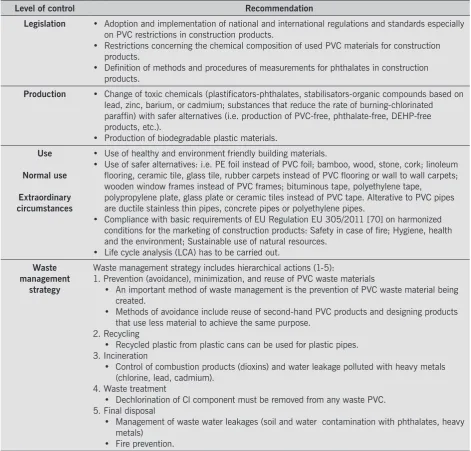
material with the emphasis on the use of PVC materials in buildings during their product use phase (Table 8).
The overview of studies on the use of PVC materials in case of fire shows that PVC presents serious problem because of high burn rate that results in high temperatures, dense soot, and other toxic combus-tion products such as hydrogen chloride gas. The results of Senica [56] show that CO and CO2 rapidly reach life threatening concentrations. Storage of PVC materials requires high level of safety measures. It can be assumed that similar effect may be detected in case of fire in build-ings, especially if PVC material is used in large quantities and as cover-ing material.
Adverse effects related with use of PVC materials can be also detected in other phases of PVC life cycle (Table 8). For example the recycled Table 8:
List of recommendations.
Level of control Recommendation
Legislation • Adoption and implementation of national and international regulations and standards especially on PVC restrictions in construction products.
• Restrictions concerning the chemical composition of used PVC materials for construction products.
• Definition of methods and procedures of measurements for phthalates in construction products.
Production • Change of toxic chemicals (plastificators-phthalates, stabilisators-organic compounds based on lead, zinc, barium, or cadmium; substances that reduce the rate of burning-chlorinated paraffin) with safer alternatives (i.e. production of PVC-free, phthalate-free, DEHP-free products, etc.).
• Production of biodegradable plastic materials. Use
Normal use
Extraordinary circumstances
• Use of healthy and environment friendly building materials.
• Use of safer alternatives: i.e. PE foil instead of PVC foil; bamboo, wood, stone, cork; linoleum flooring, ceramic tile, glass tile, rubber carpets instead of PVC flooring or wall to wall carpets; wooden window frames instead of PVC frames; bituminous tape, polyethylene tape, polypropylene plate, glass plate or ceramic tiles instead of PVC tape. Alterative to PVC pipes are ductile stainless thin pipes, concrete pipes or polyethylene pipes.
• Compliance with basic requirements of EU Regulation EU 305/2011 [70] on harmonized conditions for the marketing of construction products: Safety in case of fire; Hygiene, health and the environment; Sustainable use of natural resources.
• Life cycle analysis (LCA) has to be carried out. Waste
management strategy
Waste management strategy includes hierarchical actions (1-5):
1. Prevention (avoidance), minimization, and reuse of PVC waste materials
• An important method of waste management is the prevention of PVC waste material being created.
• Methods of avoidance include reuse of second-hand PVC products and designing products that use less material to achieve the same purpose.
2. Recycling
• Recycled plastic from plastic cans can be used for plastic pipes. 3. Incineration
• Control of combustion products (dioxins) and water leakage polluted with heavy metals (chlorine, lead, cadmium).
4. Waste treatment
• Dechlorination of Cl component must be removed from any waste PVC. 5. Final disposal
• Management of waste water leakages (soil and water contamination with phthalates, heavy metals)
waste plastic is used for new products, where the composition remains more or less the same (i.e. recycled PVC used for plastic pipes). Moreo-ver, every uncontrolled phase of waste management may be connected to environmental and health problems: i.e. uncontrolled final disposal and eventual fires result in release of toxic combustions products; un-controlled waste water leakages lead to water pollution; unun-controlled incineration may results in air pollution.
Additional research, further measurements of phthalate release from building materials and health impacts are needed to achieve the uni-form opinion about health risks of phthalates on human health. Re-search and development for Re-searching new alternatives, non toxic chemicals for safer production, use of PVC free materials and improve-ments on the level of waste treatment are needed.
6. REFERENCES
[1] European PVC organization. How is PVC used: http://www.pvc.org/ How-is-PVC-Used (25.08.2011).
[2] Belliveau M, Lester S. PVC Bad News Comes in 3s; The Poison Plastic, Health Hazards and the Looming Waste Crisis. Center for Health, Envi-ronment and Justice, EnviEnvi-ronmental Health Strategy Center: http://www. pvcinformation.org/assets/pdf/BadNewsComesIn3s.pdf (25.08.2011). [3] Eurostat. Database. Environment. Waste statistics: http://epp.eurostat.
ec.europa.eu/portal/page/portal/eurostat/home/ (10.5.2011).
[4] Evans GW, McCoy JM. When buildings don’t work: The role of architec-Evans GW, McCoy JM. When buildings don’t work: The role of architec-ture in human health. Env.Pschy. 1998; 18: 85–94.
[5] Heudorf U, et al. Phthalates: toxicology and exposure, Int J Hyg Environ Health 2007; 210: 623–634.
[6] Staples CA, et al. The environmental fate of phthalate esters: a literature review. Chemosphere 1997; 35 (4): 667–749.
[7] Jaakkola JJK, et al. Surface materials in the home and development of bronchial obstruction in young children in Oslo, Norway. Am J Public Health 1999; 84(2): 188–192.
[8] Šarič M, et al. Malignant Tumors of the Liver and Lungs in an Area with A PVC Industry. Environ Health Prespect 1976; 17: 189-192.
[9] Kavlock R, et al. NTP Center for the Evaluation of Risks to Human Re-Kavlock R, et al. NTP Center for the Evaluation of Risks to Human Re-production: phthalates expert panel report on the reproductive and de-velopmental toxicity of butyl benzyl phthalate. Reprod Toxicol 2002a; 16: 453–487.
[10] Blount BC, et al. Levels of seven urinary phthalate metabolites in a hu-Blount BC, et al. Levels of seven urinary phthalate metabolites in a hu-man reference population, Environ Health Perspect 2000; 108: 979– 982.
[11] Council of European Union. Protection against chemicals: http://consil-Council of European Union. Protection against chemicals: http://consil-ium.europa.eu/showFocus.aspx?lang=SL&focusID=434 (25.08.2011). [12] Tuomainen A, et al. Experimental PVC Material Challenge in Subjects
with Occupational PVC Exposure. Environ Health Prespect 2006; 114 (9): 1409-1413.
[13] Brooks SM, Vandervort R. Polyvinyl chloride film thermal decomposition products as an occupational illness. J Occup Med 1977; 19(3): 192– 196.
[14] Eisen EA, et al. Across-shift changes in the pulmonary function of meat-wrappers and other workers in the retail food industry. Scand J Work Environ Health 1985; 11(1):21–26.
Research and development
for searching new
alternatives, non toxic
chemicals for safer
production, use of PVC free
materials and improvements
on the level of waste
[15] Markowitz S. Self-reported short- and long-term respiratory effects among PVC-exposed firefighters. Arch Environ Health 1989; 44(1): 30– 33.
[16] Jaakkola JJK, et al. Plastic wall materials in the home and respiratory health in young children. Am J Public Health 2000; 90: 797–799. [17] Bornehag CG, et al. The association between asthma and allergic symp-Bornehag CG, et al. The association between asthma and allergic
symp-toms in children and phthalates in house dust: a nested case–control study. Environ Health Perspect 2004; 112: 1393–1397.
[18] Jaakkola JJK, et al. Interior Surface Materials and Asthma in Adults: A Population-based Incident Case-Control Study. American Journal of Epi-demiology 2006; 164 (8): 742-749.
[19] Jaakkola JJK, Knight TL. The Role of Exposure to Phthalates from Poly-Jaakkola JJK, Knight TL. The Role of Exposure to Phthalates from Poly-vinyl Chloride Products in the Development of Asthma and Allergies: A Systematic Review and Meta-analysis. Environ Health Prespect 2008; 116 (7): 845-53.
[20] Yassi A, et al. Basic Environmental Health. Oxford: Oxford University Press, 2001: 456.
[21] European Council for Plasticisers and Intermediates. Plasticisers and Flexible PVC Information Centre. EU Commission report on endocrine disruptors: http://www.plasticisers.org/media/10/56/EU-Commission-re-port-on-endocrine-disruptors/?cntnt01orderby=Date+DESC&cntnt01det ailpage=media-resources&cntnt01limit=2&cntnt01origid=15 (25.08.2011).
[22] Cadogan D. Health and environmental impact of phthalates. Plastics Ad-Cadogan D. Health and environmental impact of phthalates. Plastics Ad-ditives and Compounding 2002; 4 (6): 28-29.
[23] International Labour Organization: http://www.ilo.org/global/lang--en/in-International Labour Organization: http://www.ilo.org/global/lang--en/in-dex.htm (25.08.2011).
[24] International Labour Organization. International Occupational Safety and Health Information Centre. Di(2-ethylhexyl)phthalate: http://www2.ilo. org/legacy/english/protection/safework/cis/products/icsc/dtasht/_icsc02/ icsc0271.htm (25.08.2011).
[25] International Labour Organization. International Occupational Safety and Health Information Centre. Diisodecyl phthalate: http://www2.ilo.org/ legacy/english/protection/safework/cis/products/icsc/dtasht/_icsc08/ icsc0875.htm (25.08.2011).
[26] International Labour Organization. International Occupational Safety and Health Information Centre. Dibutyl phthalate: http://www2.ilo.org/lega-cy/english/protection/safework/cis/products/icsc/dtasht/_icsc00/ icsc0036.htm (25.08.2011).
[27] DINP Information Centre. EU Risk Assessment: http://www.dinp-facts. com/RA
[28] European Union Risk Assessment Report. Dibutyl phthalate: http:// www.dbp-facts.com/upload/documents/document30.pdf (25.08.2011). [29] Council Directive 67/548/EEC of 27 June 1967 on the approximation of
laws, regulations and administrative provisions relating to the classifica-tion, packaging and labelling of dangerous substances: http://eur-lex.eu-ropa.eu/LexUriServ/LexUriServ.do?uri=CELEX:31967L0548:en:NOT (25.08.2011).
[30] Centres for Disease Control and Prevention. National Report on human exposure to environmental chemicals. Phthalates: http://www.cdc.gov/ exposurereport/Phthalates_FactSheet.html (25.08.2011).
[31] Romero-Franco M, et al. Personal care product use and urinary levels of phthalate metabolites in Mexican women. Environment International 2011; 37 (5): 867-871.
[33] Frederiksen H, et al. Urinary excretion of phthalate metabolites in 129 healthy Danish children and adolescents: Estimation of daily phthalate intake. Environmental Research 2011; 111(5): 656-663.
[34] Public Health. Scientific committees EU: http://ec.europa.eu/health/sci-Public Health. Scientific committees EU: http://ec.europa.eu/health/sci-entific_commit tees /environmental_risks /sctee /index _en.htm (25.08.2011).
[35] European Food Safety Authority: http://www.efsa.europa.eu/EFSA/efsa_ locale-1178620753812_1178620770396.htm (25.08.2011).
[36] DEP Information Centre: http://www.dep-facts.com/Q&A (25.08.2011). [37] Tukiainen H. Experimental PVC Material Challenge in Subjects with
Oc-cupational PVC Exposure. Environ Health Prespect 2006; 114 (9): 1409-1413.
[38] Chino S., et al. Study on emission of decomposed chemicals of esters contained in PVC flooring and adhesive. Building and Environment 2009; 44: 1337–1342
[39] Material Safety Data Sheet. PVC: http://www.solusii.com/PDFs/PVC-MSDS.pdf (25.08.2011).
[40] Baitz M, et al. Life Cycle Assessment of PVC and of principal competing materials, Commissioned by the European Commission: http://ec.eu-ropa.eu/enterprise/sectors/chemicals/files/sustdev/pvc-final_report_lca_ en.pdf (25.08.2011).
[41] Occupational Safety and Health Administration. Occupational Safety and Health Guideline for Carbon Monoxide: http://www.osha.gov/SLTC/ healthguidelines/carbonmonoxide/recognition.html (25.08.2011). [42] National Institute for Occupational Safety and Health. Recommenda-National Institute for Occupational Safety and Health.
Recommenda-tions for occupational safety and health: Compendium of policy docu-ments and statedocu-ments. DHHS (NIOSH) Publication No. 92-100. Cincin-nati, OH: U.S. Department of Health and Human Services, Public Health Service, Centers for Disease Control, National Institute for Occupational Safety and Health, 1992.
[43] American Conference of Governmental Industrial Hygienists. Threshold limit values for chemical substances and physical agents and biological exposure indices for 1994-1995. Cincinnati, OH: American Conference of Governmental Industrial Hygienists, 1994.
[44] 29 Code of Federal Regulations. Table Z-1. Limits for Air Contaminants. Washington, DC: U.S. Government Printing Office, Office of the Federal Register: http://www.osha.gov/pls/oshaweb/owadisp.show_document?p_ table=standards&p_id=9992 (25.08.2011)
[45] New Jersey Department of Health. Hazardous substance fact sheet: Carbon monoxide. Trenton, NJ: New Jersey Department of Health, 1992.
[46] Material Safety Data Sheet. Carbon Dioxide: http://www.airgas.com/ documents/pdf/1013.pdf (25.08.2011).
[47] Occupational Safety and Health Administration. Chemical Sampling In-Occupational Safety and Health Administration. Chemical Sampling In-formation. Carbon Dioxide: http://www.osha.gov/dts/chemicalsampling/ data/CH_225400.html (25.08.2011).
[48] Hydrogen Chloride facts. Texas Department of State Health Services: http://www.dshs.state.tx.us/epitox/fact_sheets/hydrogenchloride.pdf (25.08.2011).
[49] Dyer RF, Esch VH. Polyvinyl Chloride Toxicity in Fires. JAMA 1976; 235(4): 393-397.
[50] Walsh B. Healthy Buildings Network. Investigation Finds PVC for Vinyl Flooring Killed Workers: http://www.healthybuilding.net/ news/070323pvc_killed_workers.html (25.08.2011).
[51] Lestari F. et al. An alternative method for fire smoke toxicity assessment using human lung cells. Fire Safety Journal 2006; 41: 605–615. [52] Health Protection Agency. Toxicological overview. Dioxins (2,3,7,8-Tetra-Health Protection Agency. Toxicological overview. Dioxins
![Table 1: Classification and labelling of phthalate plasticizers [21,22].](https://thumb-us.123doks.com/thumbv2/123dok_us/8430776.1697694/5.595.56.529.580.706/table-classification-labelling-phthalate-plasticizers.webp)
![Table 3: Occupational exposure limits for carbon monoxide [41-45].](https://thumb-us.123doks.com/thumbv2/123dok_us/8430776.1697694/9.595.52.532.519.679/table-occupational-exposure-limits-carbon-monoxide.webp)
![Table 5: Occupational exposure limits for carbon dioxide [42,43,46,47].](https://thumb-us.123doks.com/thumbv2/123dok_us/8430776.1697694/10.595.67.529.121.379/table-occupational-exposure-limits-for-carbon-dioxide.webp)
![Table 7: Hydrogen chloride exposure levels and associated health impacts in acute exposure (<15 minutes) situations [48].](https://thumb-us.123doks.com/thumbv2/123dok_us/8430776.1697694/11.595.55.528.351.574/hydrogen-chloride-exposure-associated-impacts-exposure-minutes-situations.webp)