2018.10.06.019
Questionify: Gamification in Education
Vinothini Kasinathan
1, Aida Mustapha
2*, Rahmat Fauzi
3, Mohamad Firdaus
Che Abdul Rani
11
Faculty of Computing, Engineering and Technology, Asia Pacific University of Technology and Innovation Malaysia, Technology Park Malaysia, Bukit Jalil, 57000 Kuala Lumpur, Malaysia
2
Faculty of Computer Science and Information Technology, Universiti Tun Hussein Onn Malaysia, 86400 Parit Raja, Batu Pahat, Johor, Malaysia.
3
School of Industrial Engineering, Telkom University, 40257 Bandung, West Java, Indonesia Received 28 June 2018; accepted 5August 2018, available online 24 August 2018
1. Introduction
Existing teaching and learning environment in classes has becoming highly dependent to the use of PowerPoint slides. This situation creates a problem when lecturers often overload the content with too much information, which will end up either being ignored or copied as notes by their respective students. The iterative situation of lecturers reading plainly from slides as a teaching method has eventfully dragged down the lively studying environment [1]. Research has also shown that when lecturers insert too much information and speed up the process during slide presentation, students are more demotivated to study as they are unable to keep up with the lecturer’s pace [2, 3]. To address such gap in teaching-learning interaction, gamification offers new solution.
Gamification is the concept of applying game mechanisms and game design techniques to suit certain environment, whether in education or at work place, in order to engage and motivate people to achieve their personal goals [4]. The game mechanisms can be implemented in any component of the environment such as in learning, evaluation or completion of assignment [5]. The concept of gamification in learning is known to boost students’ satisfaction of achievement, as it allows students to interact with the application for learning and training purposes which will potentially elevate their skills through the process engagement.
An educational application based on gamification concept may help to motivate students toward their
studies by implementing a reward mechanism as these learning has been dramatically transformed into a game that students may enjoy. The advantage of the application is that students are able to receive rewards from their respective lecturers based on their given high score in the application. Besides, the gamification concept is specifically designed in order to test students’ problem solving skills. Students are able to know their limitations playing the challenges in the application to test the depth of student’s knowledge within the given subject.
There are few examples of gamification in the education industry such as Ribbon Hero, which is an add-in game from Microsoft to educate users on the proper use of Microsoft Office’s products. Another examples is Class Dojo, which converts classes into Game of Rewards and Instant Feedback [6]. The aim of this paper is to create an educational application that implements the gamification elements and allow users to collect points, gain achievements, increase motivation and engagement towards students’ coursework. Furthermore, instant feedback of the students’ achievements can be gathered to allow lecturers to monitor the students’ understanding within the module.
The remaining of this paper proceeds as follows. Section 2 presents the works related to educational applications, Section 3 presents the proposed application called Questionify, Section 4 presents the evaluation findings, and finally Section 5 concludes the paper with some indication for future plans.
Abstract: In the education industry, lecturers are finding ways to improve students’ concentrations and grades by using smart devices to track students’ assignment or tutorial progress. One of the few possible and attractive solution is by using the gamification technique. This paper proposes an educational application called Questionify that implements the gamification elements and allow users to collect points, gain achievements, increase motivation and engagement towards students’ coursework in Software Engineering subject. Questionify is developed using C# and Java language has been evaluated using questionnaire among 24 respondents. The findings showed that the respondents believe that gamification can do better in education as compare to the traditional method of teaching the students. In the future, this gamification approach will be tested on more technical subjects such as programming and networking subjects to help students engage in a different learning approach.
2.
Related Work
Gamification or game-based learning (GBL) is a new avenue to educate students regarding their study materials. Gamification motivates the students through the use of playable and interactive environment. In this environment, an unsuccessful attempt is not viewed as a dreadful failure but rather an experience while exploring the game [7]. Gamification also suit the learning style of the current generation because it provides instant feedback to the students and they are able to self-evaluate [8].
The market has seen a number of educational game-based Software Engineering (SE) applications in various fields such as project management (SimSE, SESAM, SimJavaSP) and computer programming (Enki). SimSE involves real-world components that are not present in typical class projects, such as large teams of people, multiple stakeholders, budgets, planning, unexpected events and personal issues [9]. The objective of SimSE is to provide the students with an experiential learning platform where the students learn different aspects in software project management in real life.
SESAM [10], on the other hand compresses the time scale of a typical software project which normally ranges from months to a year into a couple of hours. SESAM is dealing more with team management as players can hire or fire employees and assign tasks to them. Players can also analyze the performance of their staffs using an analysis tool. Another project management gamification application is the SimJavaSP, which is a simulator where students act as the project manager and develop a software project within the required time and budget with acceptable quality. SimJavaSP requires students to optimize these three factors which is time, quality and expenditure. SimJavaSP helps the students to gain the hands-on experience of the project management without the needs to develop the actual project deliverables.
Finally, Enki [11] is a mobile application that helps users or developers that wanted to sharpen their respective programming skills or improve the knowledge of coding. This application presents challenges for the users to test their knowledge about programming, which is the main aspect of gamification in learning.
3.
Questionify
Questionify is developed both in C# and Java programming language, whereby C# is used to develop the mobile application while Java is used for the back-end server. Both language are object oriented programming, it can reuse the code and very safe for coding. The graphical user interface is designed to be light and easy so the students feel enjoyable when using the application. This system also run on SQLite as a database management system and the Firebase Real-time database for storing the student’s high score and their information. SQLite is chosen due its ease of use and easy to maintain database.
3.1
Design
System design is a process that to identify the component of the system that going to develop. In
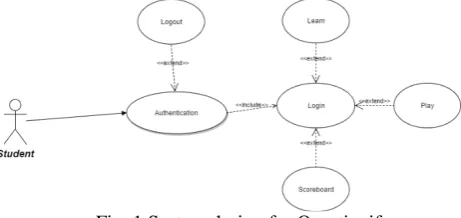
Questionify, in order to access Learn, Scoreboard and Play section, the user must be login then the three categories can be used. Fig.1 shows the system design for Questionify. Student excess login with an authentication process before they can use function Learn, Play and Scoreboard.
Fig. 1 System design for Questionify. Questionify has four different types of table to work with. LearnTopic table is for storing the normal learning title. Question table is for the challenge which will store different answer with only one correct answer. User table is storing the user information that pulls from the Google account that contains the user id, email, username and the profile pic URL. UserScore table is storing the high score of the user which has relationship with the user by linking user id. Fig. 2 shows the database design for Questionify. There are total of 4 table being used in this database which are LearnTopic, Questions, Users and UserScore. Each of the table has their primary keys and linked by secondary key show in user and UserScore. The LearnTopic and Question are independent tables with their primary keys, attributes and entities.
Fig 2: Database design for Questionify
3.2
Interface
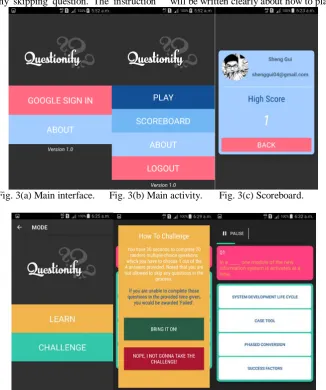
The interface of Questionify is designed to be straightforward and simple. Authentication in Questionify is directed via Google sign-in, so the students do not have to register and create a new profile for the mobile application. Once logged in, the user will be directed to the main activity page, which contain four buttons; Play, Scoreboard, About and Logout. In Play mode, the user is required to select whether to Learn or to Challenge. In Scoreboard, the user is able to keep track their high score from the last played high score. The About button describes the Questionify application along with the developer's information. Finally, the Logout button will be let the user to log out from their account. Fig. 3 shows the main interfaces for Questionify.
of time without any skipping question. The instruction will be written clearly about how to play the challenge.
Fig. 3(a) Main interface. Fig. 3(b) Main activity. Fig. 3(c) Scoreboard.
Fig. 4: Interfaces in Play going for Challenge mode.
Beside instruction, it is given two different button for the user to choose. One is accept the challenge, another is reject the challenge. Fig. 4 shows the interfaces for the Play environment in Challenge mode.In the Challenge mode as shown in Fig. 4, a time progress bar will be loaded for a continuous 30 seconds (green bar). The red color box contains random question from the database that will keep changing once the user has selected his/her answer. However, during the challenge, user can pause the challenge which will pause the timer and Questionify allows the user to resume back the challenge. If the user pressed exit, it will return to the categories/mode section. Once the challenge complete, the user high score will be shown.
4.
Evaluation
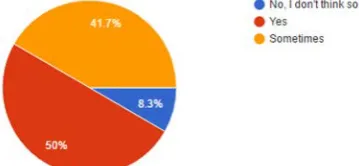
In order to evaluate the gamification concept introduced through the Questionify application, a survey was carried out and received 24 respondents among the undergraduate students at the Asia Pacific University of Technology and Innovation, Malaysia. The questionnaire survey contains 10 question that related the gamification in education. Fig. 5 shows the survey questions (1 – 10) along the findings.
Question 1: Have you ever heard of gamification?
Question 3: Do you have smartphone? If yes, what is the operating system does the device use?
Question 4: Do you think PowerPoint slides can help the student's studies?
Question 5: Do you think PowerPoint slides are packed with too much information, therefore causes sleepiness and boredom?
Question 6: Is the traditional way of learning better than e-learning?
Question 7: Have you ever struggled to catch up during class when the lecturer opens a PowerPoint slide presentation?
Question 8: Does the lecturer provides less interaction with their students all the time?
Question 9: Do you think by implementing gamification into education will improve the students' learning process?
Question 10: Which of these learning methods would you prefer for education?
Fig. 5 Questionnaire survey questions for Questionify. From the survey results in Fig. 5, although 54.2% of the respondents responded “yes” that they are aware to the term “gamification”, 66.7% of them have never used any application related to gamification. 25% from this group also do not believe that the use of PowerPoint slides would bring benefit to their studies while 50% actually believe that the PowerPoint slides are overloaded with information and most of the time uninteresting. More importantly, 70% of the respondents disagree with the use of traditional method of teaching and learning due to lack of interaction between them and the lecturers. When presented with the Questionify application, 79.2% of the respondents believe that gamification approach is highly beneficial to the students and is able to help improving the entire learning process.
5. Conclusions
achieved, which is to develop a mobile application to the students while at the same time to get more interaction, increase motivation for studying and help the software engineering students to learn and understand the subject matter easily. The module software engineering is more theory based module. Students found Questify system as a good revision tool before their exams, could be used easily by phone when they are in the bus or in public space.
By judging the outcome of the questionnaire survey, most of the respondents know what gamification is but just not sure how it will be implemented in teaching and learning. Most of the respondents believe that gamification can help in the education system which will improve the students’ performance. Respondents also believe that gamification can do better in education than the traditional method of teaching the students. In the future, this gamification approach will be tested on more technical subjects such as programming and networking subjects to help students engage learning in a different approach.
Acknowledgement
This research was supportedby Asia Pacific University. We are thankful toKoh Sheng Guiwho provided expertise that greatly assisted the research.
References
[1] Bartsch, R.A. &Cobern, K.M., 2003. Effectiveness of PowerPoint presentations in lectures. Computers and Education, 41(1): 77-86.
[2] Jones, A.M., 2003. The use and abuse of PowerPoint in Teaching and Learning in the Life
Sciences: A Personal Overview. Bioscience Education, 2(1), 1-13.
[3] Xingeng, D. and Jianxiang, L., 2012. Advantages and Disadvantages of PowerPoint in Lectures to Science Students. IT Education and Management Engineering, 9, 61-65.
[4] Paras, B. and Bizzocchi, J., 2016. Game, Motivation, and Effective Learning: An Integrated Model for Educational Game Design [Online]. [5] El-Masri, M., Tarhini, A., Hassouna, M., &Elyas,
T., 2015. A Design Science Approach ToGamify Education: From Games To Platforms. InECIS. [6] Chou, Y., 2013. Gamification in education: Top 10
gamification case studies that will change our future. Yu-Kai-Chu and Gamification.
[7] Beza, O., 2011. Gamification-How games can level up our everyday life. Universidad de Ambsterdan, Holanda, pp.1-21.
[8] Trust, T., 2017. Motivation, Empowerment, and Innovation: Teachers' Beliefs About How Participating in the Edmodo Math Subject Community Shapes Teaching and Learning. Journal of Research on Technology in Education, 49(1-2), pp.16-30.
[9] Navarro, E.O., Van Der Hoek, A., 2004. SimSE: An educational simulation game for teaching the Software engineering process. ACM SIGCSE Bull. 36(3), 233.
[10] Drappa, A., and Ludewig, J., 2000. Simulation in software engineering training. In Proceedings of the 2000 International Conference on Software Engineering, pp. 199-208. IEEE.