Ion Distribution Function Evaluation Using Escaping Neutral
Atom Kinetic Energy Samples
Pavel R. GONCHAROV, Tetsuo OZAKI, Evgeny A. VESHCHEV and Shigeru SUDO
National Institute for Fusion Science, Toki, Gifu 509-5292, Japan(Received 16 November 2007/Accepted 7 March 2008)
A reliable method to evaluate the probability density function of escaping atom kinetic energies is required for analyzing neutral particle diagnostic data used to study the fast ion distribution function in fusion plasmas. In this paper, digital processing of solid state detector signals is proposed as an improvement of the simple histogram approach. Probability density function of kinetic energies of neutral particles escaping from plasma has been derived in a general form, taking into consideration the plasma ion energy distribution, electron capture and loss rates, superposition along the diagnostic sight line, and the magnetic surface geometry. A pseudorandom number generator has been realized to simulate a sample of escaping neutral particle energies for given plasma parameters and experimental conditions. Empirical probability density estimation code has been developed and tested to reconstruct the probability density function from simulated samples assuming Maxwellian ion energy distribution shapes for different temperatures and classical slowing down distributions with different slowing down times. The application of the developed probability density estimation code to the analysis of experimental data obtained by the novel Angular-Resolved Multi-Sightline Neutral Particle Analyzer has been studied to obtain the suprathermal particle distributions. The optimum bandwidth parameter selection algorithm has also been realized.
c
2008 The Japan Society of Plasma Science and Nuclear Fusion Research
Keywords: neutral particle analysis, ion distribution, statistical data processing, empirical probability density, kernel bandwidth selection
DOI: 10.1585/pfr.3.S1083
1. Introduction
Measurements of kinetic energy distributions of neu-tral atoms escaping from magnetically confined plasma in controlled fusion experiments are performed to investigate the ion component distribution function and its evolution due to the application of various plasma heating schemes. The ion distribution function reflects the kinetic effects, the single particle confinement properties depending on the particular magnetic configuration, the finiteβeffects such as magnetohydrodynamics (MHD) induced fast ion losses, radial electric field effects, etc. The nuclear fusion reac-tion rate is determined by the ion distribureac-tion, and thus, its studies at suprathermal energies near the rate coefficient curve maximum are of primary importance. Advanced neutral particle diagnostics based on solid state detectors with high energy resolution, e.g. [1,2], are used to study the suprathermal ion distribution function. Statistical data pro-cessing is required to obtain a smooth normalized energy probability density function (PDF) using random samples of the measured values of particle energies [3].
2. Escaping Neutral Particle Energy
Distribution
Without loss of generality, we are considering mea-surements of fast neutral hydrogen fluxes. The same for-author’s e-mail: [email protected]
malism applies to neutral helium in case of energetic α -particle studies by means of charge exchange diagnostics. The probability density function f(E) for kinetic ener-gies of neutral H0particles escaping from the plasma of a magnetic confinement fusion (MCF) device and measured along a line of sight tangent to a magnetic surfaceρminis given by
f(E)=Aexp
⎧⎪⎪ ⎪⎪⎨ ⎪⎪⎪⎪⎩
1
ρmin
Q−( ˜ρ)λ−mfp1 (E, ρ˜)d ˜ρ
⎫⎪⎪ ⎪⎪⎬ ⎪⎪⎪⎪⎭
1
ρmin g(E, ρ)
× ⎡ ⎢⎢⎢⎢⎢
⎢⎢⎢⎢⎣Q+(ρ) exp
⎧⎪⎪ ⎪⎪⎨ ⎪⎪⎪⎪⎩−
ρ
ρmin
Q+( ˜ρ)λ−mfp1 (E, ρ˜)d ˜ρ
⎫⎪⎪ ⎪⎪⎬ ⎪⎪⎪⎪⎭
−Q−(ρ) exp
⎧⎪⎪ ⎪⎪⎨ ⎪⎪⎪⎪⎩−
ρ
ρmin
Q−( ˜ρ)λ−mfp1 (E, ρ˜)d ˜ρ
⎫⎪⎪ ⎪⎪⎬ ⎪⎪⎪⎪⎭ ⎤ ⎥⎥⎥⎥⎥
⎥⎥⎥⎥⎦dρ, (1)
whereAis the normalization constant calculated so that +∞
0
f(E)dE=1. (2)
The local source function for H0atoms of energyEwithin the plasma
g(E, ρ)=ni(ρ)fi(E, ρ)
l
n(l)(ρ)σv(l) (3) c
is expressed via the local plasma proton distribution ni(ρ)fi(E, ρ) and the sum of frequencies of electron capture by protons over all targets for the electron capture process H+→H0. The knowledge of radial profiles of target den-sitiesn(l)(ρ) and electron capture rate coefficientsσv(l)
is required.
The derivatives Q+(ρ) = dΛ/dρ > 0 and Q−(ρ) = dΛ/dρ < 0 of the sight line distance Λalong the two in-tervals betweenρ = 1 andρ = ρmin are obtained from the known experiment geometry and the structure of mag-netic surfacesρ = const. Integration in (1) reflects the fact that probabilities for particles that come from different locations are additive. The neutral flux attenuation in the plasma column is multiplicative and takes the form of Pois-son exponents, whereλmfp(E, ρ) is the local H0mean free path with respect to all electron loss reactions H0→H+. From the practical viewpoint, it can be calculated as
λ−1
mfp(E, ρ)=ne(ρ)σs(E) (4)
using the approximate formula
σs(E, ρ)=
exp [S1(E,ne,Te)] E
× ⎡ ⎢⎢⎢⎢⎢ ⎢⎣1+ 1
ne
j
njZj(Zj−1)×Sj(E,ne,Te)
⎤ ⎥⎥⎥⎥⎥ ⎥⎦
(5) from [4] for neutral hydrogen stopping cross section in MCF plasma. Radial profiles of electron densityne and electron temperatureTeare required. njandZjare
impu-rity densities and charges. The functionsS1(E,ne,Te) and Sj(E,ne,Te) were derived in [4] for a hydrogen plasma containing He, C, O, and Fe impurities. Alternatively,
λmfp(E, ρ) can be calculated for any given plasma com-position using the relevant cross section data.
3. Random Energy Samples
Ideally, the passive diagnostic data is an array (E1, . . . ,EN) of energies of escaped neutral particles
mea-sured along a certain observation direction, and N is the total number of particles collected during a certain time interval. This array is a sample of realizations of the ran-dom variableEdistributed according to equation (1). Such form of data is achievable with solid state detectors using pulse height analysis (PHA) techniques, while the other analyzers, e.g.,E ||B ones, intrinsically form a histogram of the incoming particle energies over a certain number of subintervals called energy channels. Histogramic data rep-resentation is often used in solid state detector digital sig-nal processing as well; however, it is possible to collect “raw” data, i.e., pulse height values, directly from a PHA mode analog to digital converter. Technical details may be found in [1, 2].
The formulation of the problem considered here is to obtain an estimatef(∗)(E) of the unknown exact probability density functionf(E) of neutral particle energies from the
experimental data. The sought function preferably should satisfy a specified precision criterion. The obtained PDF estimate is then to be used to reconstruct the ion distribu-tion for further analysis.
Two typical ion energy distribution laws have been used in the numerical simulation of escaped neutral atom energies, namely, (a) Maxwellian distribution with ion temperatureTi
fi(E)= √2
π 1 Ti E Ti
exp(−E/Ti), (6)
Fi(E)= √2
πγ 3 2, E Ti , (7)
where γ(z,x) = 0xtz−1e−tdt is the lower incomplete
gamma function; and (b) the classical slowing down dis-tribution for a delta-like fast ion source function
S(v−v0)= S0 4πv2
exp{−(v−v0)2/ 2}
√
π , (8)
fi(v)= S0 8π
τs
v3+v3
c
erf
v∗(v,t)−v 0
−erf
v−v
0
,
(9) where the slowing down time
τs=
3mpTe3/2 4√2πnee4Λm1e/2
, (10)
the critical velocity
v3 c=
3√2πTe3/2 2mpm1e/2
, (11)
Λis the Coulomb logarithm, and as shown in [5],
v∗(v,t)=v3+v3 c
e3t/τs−v3
c
1/3
. (12) The ion velocityv= 2E/mp,v0is the injection ve-locity corresponding to the injection energyE0, the values S0 and in (8) determine the source rate and peak width, respectively, andtis the time since the commencement of the fast particle source action.
4. Numerical Experiment
Assuming a predefined theoretical ion energy PDF fi(E), one can use (1)-(5) to calculate the charge exchange atom energy PDF f(E) and perform a numerical experi-ment by generating a sample of escaped atom energies for given plasma parameters and experimental conditions. We apply the inverse cumulative distribution function (CDF) approach. First, a sample of N pseudorandom numbers (u1, . . . ,uN) uniformly distributed within the (0,1) interval
is generated using an algorithm provided in [6]. Then, the energy values are calculated as solutions of the equation
where F(E)=
E
0
f( ˜E)d ˜E (14)
is the CDF. These simulation results can be supplied as in-put data for the PDF estimation procedure to test its perfor-mance, since the original exactf(E) used in the simulation is known.
Numerical experiments have been performed assum-ing Angular-Resolved Multi-Sightline (ARMS) Neutral Particle Analyzer (NPA) [2] measurement geometry for one of its lines of sight as depicted in Fig. 1. Large He-lical Device (LHD) magnetic surface structure was used, obtained by Variational Moments Equilibrium Code cal-culation of 3D MHD equilibrium assuming nested flux surfaces [7]. Figure 1 (a) shows effective radius isolines
ρ=const., i.e., the magnetic surfaces, in the vertical plane containing the diagnostic sight line. Figure 1 (b) showsρ values versus the distanceΛalong the observation direc-tion and corresponding positive and negative branches of the generalized Abel integral kernel for this sight line and for the assumed MHD equilibrium.
Fig. 1 (a) Cross section of nested LHD magnetic surfaces at
Rax =3.60 m by vertical plane containing ARMS NPA
line of sight #18; (b) positive and negative branches of general Abel integral for ARMS NPA sight line #18.
The following functions were used to describe ra-dial profiles of electron densityne(ρ), electron temperature Te(ρ), and ion temperatureTi(ρ) in case of Maxwell distri-bution
ne(ρ)=ne(0) (1−ρm)n, (15) Te(ρ)=Te(0) (1−ρp)q, (16) Ti(ρ)=Ti(0) (1−ρu)v, (17) with positive superscripts. A simple lower-bound estimate of the background neutral hydrogen density can be ob-tained from ionization balance as described in [8]
n0(ρ) ne(ρ) =
σrecv
σeiv+σiiv, (18)
with radiative recombination rateσrecvgiven in [9], and electron impact ionization rateσeivand ion impact ion-ization rateσiivfrom [10, 11]. A more sophisticated ap-proach to estimaten0(ρ) requires Monte Carlo modeling analogous to [12] including full 3D tracing of neutral par-ticle trajectories.
Proton-hydrogen charge exchange cross section was taken from [11] to calculate the local source function of H0 atoms. The attenuation of neutral hydrogen flux was calculated using (5). Figure 2 illustrates the stopping cross sectionσs(E, ρ) calculation for two cases, namely, for pure
hydrogen plasma with unit effective plasma ion charge Zeff=1.0 and forZeff =1.5, assuming the impurity density ratio to be He:C:O:Fe=5.00:1.50:0.50:0.05 as suggested in [4].
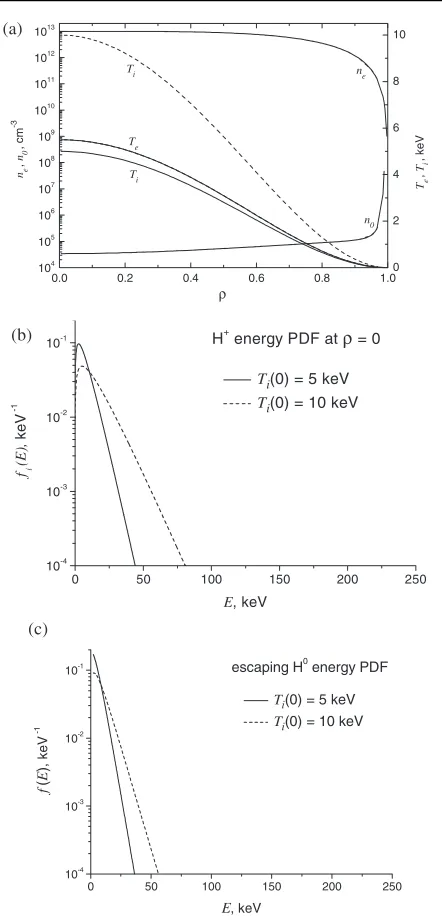
Figure 3 (a) shows radial profiles of plasma parame-ters used as input data to simulate escaping neutral particle spectra in case of Maxwellian plasma ion distribution. As-sumed Maxwellian proton energy PDF for two different Ti(0) values is shown in Fig. 3 (b). Figure 3 (c) shows the resultant PDF for kinetic energies of H0 atoms measured along the specified observation direction.
Fig. 3 (a) Input data for escaping H0energy distribution
calcu-lation in case of Maxwellian ion distribution for two dif-ferent ion temperatures; (b) Maxwellian ion energy PDF in the plasma core for two temperatures; (c) calculated escaping H0energy PDF.
Figure 4 (a) shows radial profiles of plasma parame-ters used as input data to simulate escaping neutral particle spectra in case of the classical slowing down distribution of plasma ions. Assumed proton energy PDF att=0.8 s is shown in Fig. 4 (b) for injection energyE0 =150 keV and two different pairs of the target plasmane(0) andTe(0)
val-ues, i.e., for two different slowing down time valuesτs =
1 s andτs =0.01 s. Figure 4 (c) shows the resultant PDF
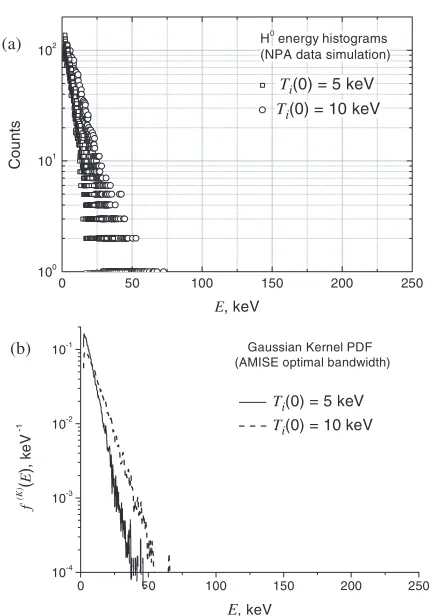
for kinetic energies of H0atoms measured along the spec-ified observation direction in these two cases. Histograms of the corresponding pseudorandom number samples governed by these neutral particle energy PDFs are shown in Fig. 5 (a) for the Maxwellian case and in Fig. 6 (a) for the case of the classical slowing down distribution.
Fig. 4 (a) Input data for escaping H0 energy distribution
calcu-lation in case of classical slowing down ion distribution for two different slowing down times; (b) ion energy PDF in the plasma core for two different slowing down times; (c) calculated escaping H0energy PDF.
5. Data Processing Method
As an improvement of the neutral particle diagnostic data analysis, we have applied the probability density es-timation using kernel smoothing techniques, e.g., [13, 14]. Given a sample ofN random energy values, first consider the empirical PDF defined in [15]
f(e)(E)= F
(e)(E+h)−F(e)(E−h)
2h , h>0, (19) which is in fact the central difference derivative of the em-pirical CDF
F(e)(E)= #{Ej:Ej≤E}
Fig. 5 (a) Histograms of pseudorandom numbers distributed as energies of escaping neutral atoms in case of Maxwellian ion distribution for two different ion temperatures; (b) Gaussian kernel PDF for H0energies calculated from the
simulated random samples.
also known as Kaplan-Meier cumulative distribution func-tion. To describe its accuracy with respect to the un-known exact CDF F(E), Kolmogorov statistic DN =
sup
E |
F(e)(E)−F(E)|and its tabulated asymptotic distribu-tion lim
N→∞P(DN √
N≤y)=K(y), y >0 are used [16]. Next, consider a generalization of formula (19) called kernel PDF estimate, written as
f(K)(E)= 1 Nh
N
j=1 K
E−Ej
h
, h>0, (21)
which is determined by the kernel functionK(z) and the kernel bandwidthh. Formula (19) is a particular case of (21), whenK(z) = I(−1,1)(z), and the rectangular function I(−1,1)(z) equals unity within (−1, 1) interval and equals zero outside. The performance criterion of the kernel PDF estimation, also referred to as Parzen window method with respect to the unknown exact PDF f(E), is the value of the mean integrated squared error
MISEf(K),f=
+∞
0
f(K)(E)−f(E)2dE
,
(22) where the averaging is performed over different samples of Nrealizations (E1, . . . ,EN), and its “asymptote” forN 1
Fig. 6 (a) Histograms of pseudorandom numbers distributed as energies of escaping neutral atoms in case of classical slowing down ion distribution for two different slowing down times; (b) Gaussian kernel PDF for H0energies
cal-culated from the simulated random samples.
(large sample approximation)
AMISEf(K),f= c1 Nh+
c2c23h 4
4 , (23)
where c1 =
K2(z)dz, c2 =
(f(z))2dz, and c3 =
z2K(z)dz. The optimum kernel derived in [17] is Epanechnikov functionK(z) = 3
4
1−z2I
(−1,1)(z). How-ever, it is emphasized [13,14] that the kernel function shape has a small influence on the method performance, while the bandwidth parameterhis more important. Therefore, Gaussian kernel
K(z)= √1 2πe
−z2/2
(24) has been used, since it has a continuous derivative.
A reliable practical method for optimumh selection was proposed in [18] and revisited recently in [19]. The bandwidth is obtained by solving the equation
h=
1 2√πNφ4(η(h))
1/5
, (25)
where the functionφris expressed via kernel derivative
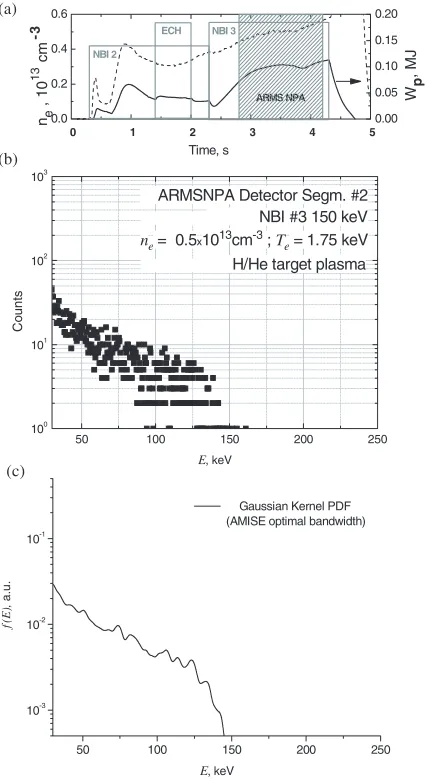
Fig. 7 (a) Background plasma parameters and ECH/ICH/NBI heating time diagram; (b) experimental histogram of es-caping H0energies measured by ARMS NPA along sight
line #2; (c) calculated H0energy PDF with Gaussian
ker-nel and AMISE-optimal smoothing parameter.
as follows
φr(h)=
1 N(N−1)h(r+1)
N
i=1
N
j=1 K(r)
Ei−Ej
h
.
(27) Her(z) designatesrth degree modified Hermite polynomial
[20]. The function
η(h)=
⎛
⎜⎜⎜⎜⎝−6√2φ4(a)
φ6(b)
⎞ ⎟⎟⎟⎟⎠1/7
h5/7 (28)
depends on the values
a=
⎛ ⎜⎜⎜⎜⎝16√2
5N
⎞ ⎟⎟⎟⎟⎠1/7
ˆ
σ and b=
⎛ ⎜⎜⎜⎜⎝480√2
105N
⎞ ⎟⎟⎟⎟⎠1/9
ˆ
σ, (29)
Fig. 8 (a) Background plasma parameters and ECH/NBI heating time diagram; (b) experimental histogram of escaping H0
energies measured by ARMS NPA along sight line #2; (c) calculated H0 energy PDF with Gaussian kernel and
AMISE-optimal smoothing parameter.
where
ˆ
σ= % & '
1 N−1
N
i=1
Ei−E¯ 2
, and E¯= 1 N
N
i=1
Ei. (30)
Direct implementation of formula (27) is slow. An approx-imate fast calculation technique to the required precision is given in [19].
These methods have been tested by constructing the kernel probability density function from the generated pseudorandom number samples assuming Maxwellian ion energy distribution shapes for different temperatures and classical slowing down distributions with different slowing down times. The test results of these numerical experi-ments are shown in Figs. 5 (b) and 6 (b).
Particle Analyzer on Large Helical Device is illustrated in Figs. 7 and 8. Figures 7 (a) and 8 (a) summarize the experi-mental conditions and heating time diagrams for H/Ar tar-get plasma heated by ICH and parallel NBI and for H/He target plasma heated by parallel NBI alone. The experi-mental setup is explained in detail in [2, 21]. Experimen-tally obtained histograms of fast neutral particles measured by ARMS NPA chord #2 during the shaded time intervals are shown in Figs. 7 (b) and 8 (b). These histograms were automatically calculated by Clear Pulse Model 1219 CA-MAC PHA module used for digital processing of detec-tor signals formed by a resistive feedback charge sensitive preamplifier and a shaping amplifier [2].
Figures 7 (c) and 8 (c) illustrate the probability density functions for energetic neutral particles from suprathermal distribution tails above 70 and 30 keV, respectively, ob-tained by Gaussian kernel smoothing (21) with AMISE op-timal bandwidth parameter calculated using (25)-(30).
It should be noted that the obtained f(K)(E) is a nor-malized, smooth continuous function, which is an approx-imation to the unknown true PDF for neutral particle en-ergies. The approximation criterion is the minimization of AMISE (23) by choosing the kernel bandwidth param-eter. This approximation is based on the experimentally obtained random sample of escaped particle energies mea-sured using a solid state detector in combination with a charge sensitive amplifier and an optional pulse shaping amplifier. Thus, the method inherits the energy resolution properties of the pulse processing electronic circuit. Dig-ital processing of charge sensitive amplifier output signal might be preferable.
6. Summary
The goal of neutral particle diagnostics is to obtain information about the ion distribution function and espe-cially its substantially non-Maxwellian high energy “tail.” This is important for ion heating and confinement stud-ies. Such measurements are not direct. The relationship between the ion distribution function and the probability density for escaping charge-exchange neutral particle ki-netic energies has been derived in a general form for chord-integral passive measurements from a magnetic confine-ment fusion plasma column. A calculation method has been realized that has a predictive force to simulate the ex-perimentally measurable random samples of escaping neu-tral atom energies for any given plasma ion distribution, electron density and temperature profiles, plasma composi-tion, and experimental geometry. This is a “direct calcula-tion” to obtain random escaping atom energy sample from the known plasma ion distribution. A method to solve the “inverse problem” has also been proposed, which is based on Gaussian kernel smoothing with automatic choice of
AMISE-optimal bandwidth parameter. Thus, neutral atom energy probability density function is obtained from the experimental random samples. This PDF for escaped neu-tral atom energies can then be used to study the ion distri-bution function within the plasma. The proposed method is applicable for diagnostics based on solid state detectors. “Raw” data obtained directly from PHA ADC is required to obtain samples of particle energies rather than the less informative, automatically built histogram PDF estimators.
Acknowledgment
This work was supported by Grant-in-Aid for JSPS Fellows No. 1806173.
[1] P.R. Goncharov, J.F. Lyon, T. Ozakiet al., J. Plasma Fusion Res. SERIES5, 159 (2002).
[2] E.A. Veshchev, T. Ozaki, P.R. Goncharovet al., Rev. Sci. Instrum.77, 10F129 (2006).
[3] P.R. Goncharov, T. Ozaki and S. Sudo, Proc. 34thEPS Conf.
Plasma Phys. P5.081 (2007).
[4] R.K. Janev, C.D. Boley and D.E. Post, Nucl. Fusion 29, 2125 (1989).
[5] J.G. Cordey and M.J. Houghton, Nucl. Fusion 13, 215 (1973).
[6] M. Matsumoto and T. Nishimura, ACM Trans. Model. Comput. Simul.8, 3 (1998).
[7] S.P. Hirshman and J.C. Whitson, Phys. Fluids26, 3553 (1983).
[8] Yu.N. Dnestrovskijet al., Nucl.Fusion19, 293 (1979). [9] Yu.S. Gordeevet al., JETP Lett.25, 204 (1977).
[10] R.K. Janev, W.D. Langer et al., Elementary Processes in Hydrogen-Helium Plasmas (Springer-Verlag, Berlin, 1987).
[11] C.F. Barnett, ed.,Atomic Data for Fusion, ORNL-6086 vol.
1(Controlled Fusion Atomic Data Center, Oak Ridge, TN, 1990).
[12] H. Hughes, D.E. Post, Journ. Comput. Phys.28, 43 (1978). [13] A.W. Bowman and A. Azzalini,Applied smoothing
tech-niques for data analysis(Clarendon, 1997).
[14] M.P. Wand and M.C. Jones,Kernel Smoothing(Chapman and Hall, London, 1995).
[15] M.S. Waterman and D.E. Whiteman, Int. J. Math. Educ. Sci. Technol.9, 127 (1978).
[16] L.N. Bolshev and N.V. Smirnov, Tables of mathematical statistics(Nauka, Moscow, 1983).
[17] V.A. Epanechnikov, Theory Probab. Appl.14, 153 (1969). [18] S.J. Sheather and M.C. Jones, J.R. Statist. Soc. B53, 683
(1991).
[19] V.C. Raykar and R. Duraiswami,Very fast optimal band-width selection for univariate kernel density estima-tion(University of Maryland, CS-TR-4774/ UMIACS-TR-2005-73, 2006).
[20] M. Abramowitz and I.A. Stegun, eds.,Handbook of math-ematical functions(Dover, New York, 1972).